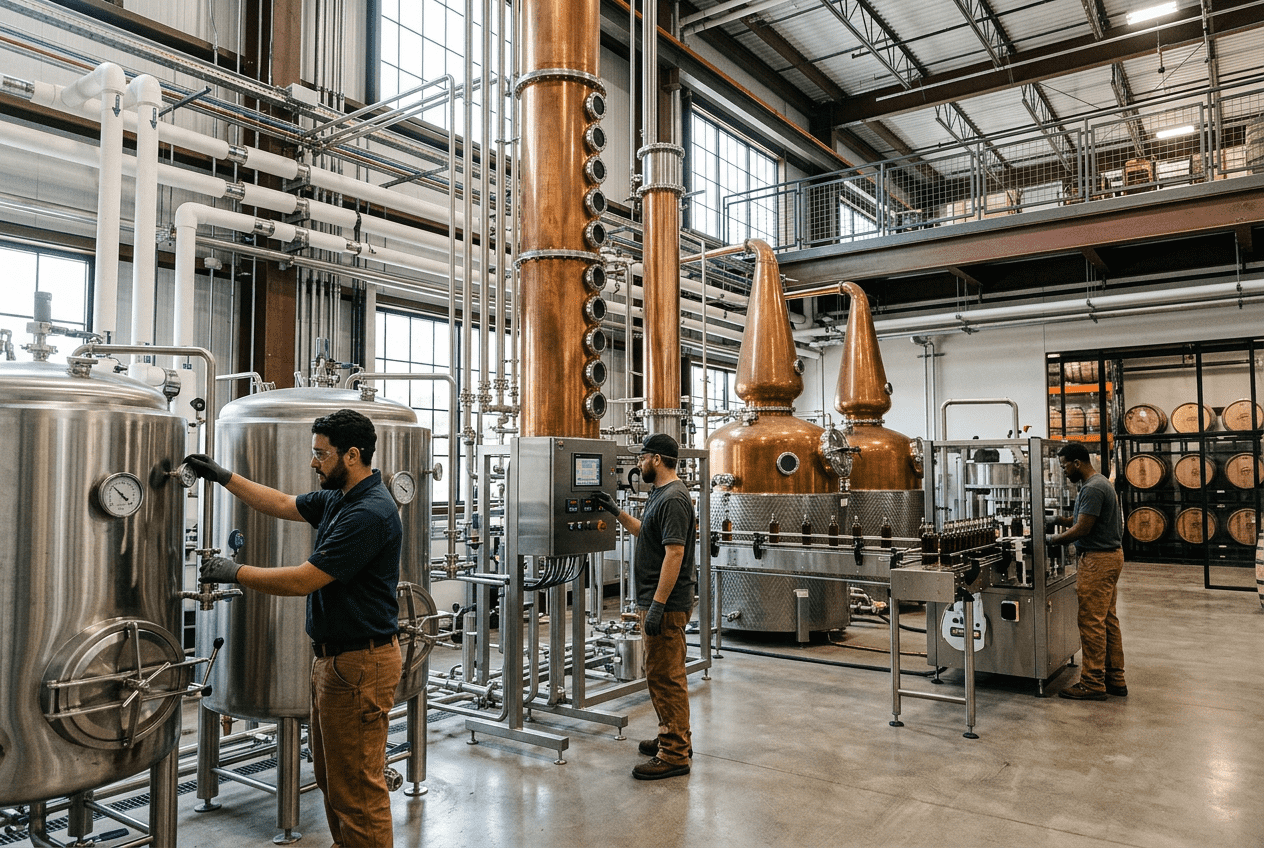
Food Processing Facility Investment Planning
[trp_language language=”en_US”]
United States Guide to Food Processing Facility Investment Planning
Food processing facility investment planning is the disciplined process of deciding what to build, where to build it, how much to spend, how to fund it, and how to make the facility profitable as fast as possible. In the United States, that means aligning market demand, regulatory compliance, utility capacity, automation, labor, logistics, and capital structure before construction begins. For food and beverage manufacturers, the difference between a successful project and a stranded asset usually comes down to planning quality, not just equipment quality.
Whether the project is a protein line in Texas, a dairy expansion in Wisconsin, a beverage co-packing plant in North Carolina, a sauce line near Chicago, or an aseptic facility serving the West Coast through the Port of Los Angeles and the Port of Oakland, capital deployment decisions must be grounded in operating reality. Smart investors and operators do not simply ask, “What will this plant cost?” They ask, “What throughput, margin, utilization, labor model, and payback can this plant support over five to ten years?”
For that reason, many manufacturers bring in engineering and execution partners early. Firms such as Disruptive Process Solutions position themselves not as conventional contractors, but as capital-minded food and beverage project partners focused on profitable manufacturing outcomes. That distinction matters when millions of dollars are at stake.
Quick Answer

Food processing facility investment planning in the United States is the end-to-end evaluation of market opportunity, product mix, site selection, plant design, equipment needs, utility infrastructure, compliance, staffing, working capital, financing, and expected return. A strong plan includes demand validation, concept engineering, cost modeling, phased capital deployment, risk controls, and a clear decision timeline from feasibility through commissioning. The best projects are designed around first-year profitability, future scalability, and realistic operating constraints such as labor availability, wastewater limits, refrigeration load, freight costs, and food safety standards.
| Question | Why It Matters | Typical U.S. Consideration | Primary Metric |
|---|---|---|---|
| What product will be made? | Defines process technology and compliance needs | USDA, FDA, aseptic, retort, dairy, protein, beverage rules | Margin per unit |
| Where should the plant be located? | Impacts inbound ingredients, outbound freight, labor, and utilities | Midwest, Southeast, California, Texas, Ontario cross-border trade | Delivered cost |
| How much capacity is needed? | Prevents overspending or undersizing | Ramp-up from year 1 to year 5 demand | Utilization rate |
| What is the full capital cost? | Supports financing and ROI modeling | Building, utilities, equipment, startup, contingency | Total installed cost |
| How will the project be funded? | Affects cash flow and ownership structure | Senior debt, mezzanine, equity, grants, tax abatements | Weighted cost of capital |
| What is the expected return? | Determines go/no-go decision | 3-7 year payback common for strategic projects | IRR, ROI, payback |
The table above shows why investment planning is broader than budgeting. It ties commercial logic to engineering decisions so the plant can operate profitably, not just start up successfully.
What Is Food Processing Facility Investment Planning?

At its core, food processing facility investment planning is a structured capital allocation exercise for manufacturing. It covers greenfield plants, brownfield retrofits, capacity additions, line relocations, co-packing facilities, utility upgrades, and product diversification projects. In the United States, it also includes a demanding compliance environment shaped by FDA, USDA, FSMA, SQF, BRC, state environmental agencies, municipal utility departments, and worker safety requirements.
A complete plan usually includes commercial due diligence, process definition, site screening, concept layouts, utility balance, automation scope, labor modeling, capex forecasting, operating expense estimates, funding analysis, and scenario-based returns. The process should also test how the facility behaves under low-volume, base-case, and aggressive growth assumptions.
For example, a beverage plant near Atlanta may look attractive because of population growth and trucking access through I-75 and I-85. Yet if carbon dioxide supply, wastewater discharge, or syrup room design is poorly planned, the facility may miss production targets. A protein facility near Kansas City may be close to livestock supply and central distribution corridors, but poor refrigeration redundancy or sanitation design can wipe out margins. Investment planning exists to surface those realities before money is committed.
Experienced engineering groups often help bridge business strategy and technical execution. Through its Design-Build-Manage approach, DPS service capabilities support feasibility studies, owner’s representation, capital planning, project and program management, general contracting coordination, installation, integration, and commissioning. For investors and operators, that kind of full-scope support reduces fragmentation between concept and execution.
Investment Planning Framework: From Concept to Capital Deployment

A practical framework for a U.S. food processing investment should move through defined stages rather than jumping from an idea directly into procurement. Each stage should answer a specific business question and establish a decision gate.
Stage 1 is opportunity definition. This is where the company clarifies what market it wants to serve, what products it will make, and whether the project is intended to lower costs, add capacity, enter a new category, or support co-manufacturing contracts.
Stage 2 is feasibility. This includes rough process flow diagrams, production assumptions, site options, staffing models, utility demand, and high-level capex and opex estimates.
Stage 3 is concept engineering. Here, the team develops block layouts, equipment lists, sanitation zoning, warehouse strategy, automation architecture, packaging assumptions, and utility systems such as steam, glycol, compressed air, water treatment, wastewater, HVAC, and CIP.
Stage 4 is financial structuring. This stage converts engineering scope into capital deployment strategy, including debt sizing, equity requirements, grant eligibility, tax considerations, and working capital needs.
Stage 5 is execution planning. This includes long-lead procurement, contractor strategy, permitting path, commissioning plan, startup labor, and contingency controls.
Stage 6 is capital deployment and construction. At this point, the focus shifts to change-order control, schedule management, procurement coordination, installation quality, FAT/SAT alignment, and startup readiness.
| Stage | Main Objective | Key Deliverables | Decision Gate |
|---|---|---|---|
| Opportunity Definition | Confirm strategic fit | Market thesis, target products, customer profile | Proceed to feasibility? |
| Feasibility Study | Test technical and economic viability | Preliminary capex, opex, site shortlist | Is the business case viable? |
| Concept Engineering | Translate goals into plant design | Layouts, utility balance, equipment scope | Freeze concept scope? |
| Financial Structuring | Align capital with return targets | Funding stack, covenants, incentives plan | Secure financing? |
| Execution Planning | Reduce schedule and procurement risk | Bid packages, permitting, project controls | Issue notice to proceed? |
| Construction and Startup | Deliver operational facility | Installation, commissioning, handover | Meet startup KPIs? |
This staged approach reduces premature spending and keeps management focused on investable facts instead of optimism. It is especially valuable for multi-phase projects where a facility may begin with one line and expand later.
The line chart illustrates a realistic growth pattern in U.S. food processing capital spending, driven by reshoring, automation, private label growth, cold-chain investment, and resilience planning through 2026 and beyond.
Market Entry Strategy: Product Selection and Target Market Analysis
The right product strategy can make a moderate facility highly profitable, while the wrong product can make a larger facility underperform. Product selection should be based on margin structure, ingredient availability, shelf life, distribution economics, regulatory burden, and customer concentration risk.
In the United States, high-interest categories for investment often include value-added proteins, sauces and dressings, ready-to-drink beverages, functional drinks, dairy-based beverages, plant-based ingredients, prepared meals, retort products, shelf-stable items, and co-packing formats with flexible packaging capabilities. However, product attractiveness varies widely by region. California may favor premium beverage and wellness categories, the Midwest may offer sourcing advantages for dairy and grain-based processing, and the Southeast may support strong growth in co-packing and distribution due to population migration and lower operating costs.
Target market analysis should cover at least six points: category growth, price realization, customer acquisition cost, retailer or foodservice requirements, logistics reach, and competitive density. Entry through co-packing can reduce market risk because signed volumes improve financing confidence. By contrast, launching a branded product and a new plant at the same time adds both commercial and operational risk.
| Product Category | Demand Outlook | Operational Complexity | Capital Intensity | Ideal Regions |
|---|---|---|---|---|
| Ready-to-drink beverages | Strong | Medium to high | High | Southeast, Texas, California |
| Value-added proteins | Strong | High | High | Midwest, Texas, Southeast |
| Sauces and dressings | Stable to strong | Medium | Medium | Illinois, Georgia, New Jersey |
| Dairy and cultured products | Stable | High | High | Wisconsin, Idaho, California |
| Retort shelf-stable meals | Growing | High | High | Mid-Atlantic, Midwest, Texas |
| Plant-based ingredients | Selective growth | Medium to high | Medium | Midwest, West Coast |
The table shows that “growth” alone does not determine investment quality. A high-growth category with expensive sterilization, complex allergen separation, or uncertain customer volume may be less attractive than a steady category with better margins and simpler operations.
The bar chart highlights relative demand growth by category. Investors should use this type of view as a starting point, then layer in margin, competition, and equipment complexity before selecting a product path.
Total Investment Cost: Facility, Equipment, and Working Capital
Total investment cost is more than the price of the building and process line. In U.S. food processing, all-in capital requirements typically include land or leasehold improvements, building shell, structural upgrades, utility generation and distribution, process equipment, packaging equipment, automation, installation, engineering, permitting, startup, training, spare parts, validation, contingency, and working capital.
Working capital is often underestimated. Raw materials, packaging inventory, receivables, labor ramp-up, sanitation chemicals, startup scrap, and initial freight costs can create significant liquidity needs. A plant can be mechanically complete and still fail financially if it does not have enough operating runway.
The cost profile also changes dramatically by process type. A simple dry blending facility may have a much lower utility burden than a beverage line requiring RO water, blending, pasteurization, carbonation, bright storage, CIP, and high-speed packaging. A protein plant may need heavy refrigeration, wastewater pretreatment, sanitation segregation, and robust floor drainage. Retort, UHT, and aseptic systems bring higher validation and controls requirements.
On the technological side, DPS supports structural, mechanical, plumbing, electrical, process, and controls engineering, including PLC programming, SCADA, batch control, and integrated utility design. Those technological capabilities are especially relevant when capital efficiency depends on the interaction between process equipment and plant infrastructure rather than on any single machine alone.
| Cost Bucket | What It Includes | Typical Share of Budget | Common Underestimate Risk |
|---|---|---|---|
| Site and Building | Land, shell, floors, drains, walls, loading, offices | 20% to 35% | Sanitary construction upgrades |
| Process Equipment | Tanks, mixers, cookers, fillers, retorts, pumps | 20% to 30% | Custom fabrication and lead times |
| Packaging Systems | Fillers, cappers, labelers, conveyors, case packers | 10% to 20% | Integration complexity |
| Utilities | Boilers, glycol, compressed air, HVAC, water, wastewater | 10% to 20% | Undersized future expansion capacity |
| Automation and Controls | PLC, HMI, SCADA, instrumentation, networking | 5% to 12% | Programming scope gaps |
| Startup and Working Capital | Labor ramp, raw materials, inventory, training, receivables | 8% to 18% | Cash runway too short |
This cost table is useful because it moves the discussion from headline project cost to complete capital readiness. Investors should model both base-case and high-case costs, especially when long-lead equipment or utility upgrades are involved.
From a manufacturing standpoint, DPS also brings capability in proprietary equipment fabrication, including storage and process tanks, CIP systems, marination tumblers, and cooking vessels, supported by broader integration of fermentation, distillation, pasteurization, aseptic, dairy, protein, and prepared-food systems. You can review more on its process equipment capabilities when evaluating make-versus-buy and integration options.
Funding Sources: Debt, Equity, Grants, and Government Incentives
Most U.S. food processing facilities use a blended capital stack. Senior debt remains the most common funding source for established operators with cash flow, while equity is often needed for greenfield facilities, rapid growth projects, and higher-risk category entries. Mezzanine financing, equipment leasing, sale-leasebacks, and strategic investors may also play a role.
Government incentives can materially improve project economics, especially in states competing for manufacturing jobs. These may include tax abatements, workforce training grants, utility incentives, infrastructure assistance, industrial revenue bonds, and local property tax relief. Rural development programs and state-level agriculture or manufacturing support can also help, depending on project location.
However, incentive value depends on early planning. Companies that wait until engineering is complete often miss negotiation leverage. Communities in North Carolina, Texas, Georgia, Indiana, Tennessee, and parts of the Midwest are especially active in courting food and beverage investment due to job creation and supply-chain benefits.
| Funding Source | Best For | Main Advantage | Main Limitation |
|---|---|---|---|
| Senior Bank Debt | Established businesses | Lower cost of capital | Covenants and collateral requirements |
| Private Equity | Growth and acquisitions | Large capital capacity | Ownership dilution |
| Strategic Equity Partner | New category entry | Commercial alignment | Shared control |
| Equipment Financing | Specific asset purchases | Preserves working capital | Limited to eligible equipment |
| State and Local Incentives | Job-creating projects | Improves project return | Compliance and timing conditions |
| Federal or Agricultural Programs | Rural or strategic sectors | Can reduce funding gap | Lengthy application process |
The table above helps management match funding structure to project risk. A brownfield expansion with contracted sales may support more debt than a speculative greenfield launch. Smart capital planning usually combines risk-adjusted funding with contingency reserves rather than maximizing leverage.
ROI and Payback Analysis for Food Processing Facility Investments
Return analysis should be built on operating reality, not on nameplate capacity alone. Investors should measure expected throughput, yield loss, labor per shift, sanitation time, planned downtime, maintenance burden, freight, energy use, and customer pricing assumptions. For many food and beverage projects, the biggest financial mistake is modeling the plant as if it will run at mature efficiency immediately after startup.
Useful metrics include simple payback, EBITDA uplift, internal rate of return, net present value, cash-on-cash return, debt service coverage, and breakeven utilization. A project may look attractive on EBITDA but still create stress if working capital or commissioning losses are ignored.
For example, a $6 million line generating $1.5 million in annual EBITDA contribution could imply a four-year simple payback before tax. But if startup losses, additional warehouse costs, higher utility rates, and slower customer onboarding reduce contribution to $1.0 million, payback extends significantly. Scenario modeling is essential.
One reason specialized project partners matter is that they can identify hidden bottlenecks before capex is locked in. In one example reflecting the operating philosophy behind DPS, a client considered spending millions for modest output growth, only to discover that controls limitations—not major equipment additions—were the true bottleneck. Solving that issue first changed the economics of the investment decision entirely. Similar lessons appear across food and beverage projects nationwide, from beverage blending systems to protein throughput constraints.
The area chart reflects a broader trend: more U.S. food processors are shifting investment toward automation-heavy capital projects as labor constraints and traceability requirements intensify through 2026.
Risk Assessment: Market, Operational, and Currency Risks
Risk assessment should be formal, documented, and tied to mitigation actions. In U.S. food processing, the most common investment risks fall into three groups: market risks, operational risks, and financial risks.
Market risks include weaker-than-expected demand, customer concentration, private label pricing pressure, retailer resets, commodity volatility, and channel shifts between grocery, convenience, club, foodservice, and e-commerce. Operational risks include process instability, sanitation design flaws, underperforming automation, labor shortages, wastewater constraints, refrigeration failure, packaging supply disruption, and delayed commissioning.
Financial risks include interest rate changes, insurance costs, foreign exchange exposure on imported equipment, tariff shifts, and contractor price escalation. Currency risk matters more than many operators expect because processing lines, fillers, pumps, controls, valves, and stainless components may come from Europe, Canada, or Asia even when final installation happens in the United States.
| Risk Type | Example | Impact | Mitigation Strategy |
|---|---|---|---|
| Market Risk | Sales volumes below forecast | Lower utilization and slower payback | Secure anchor customers and phased capacity |
| Operational Risk | Throughput below design rate | Higher unit cost | Factory acceptance testing and realistic ramp plans |
| Regulatory Risk | Permit or compliance delays | Schedule slip and added cost | Early code and agency review |
| Labor Risk | Skilled operator shortage | Inconsistent production | Automation, training, local labor analysis |
| Currency Risk | Imported equipment cost increases | Capex overrun | Hedging, early procurement, alternates |
| Utility Risk | Insufficient water, steam, or power | Production bottlenecks | Detailed utility modeling and redundancy |
This table works best when used as a live management tool during feasibility and execution. Each risk should have an owner, an early warning signal, and a documented response plan.
The comparison chart shows why many investors prefer a full-scope partner over a collection of disconnected equipment purchases. The more complex the project, the more value there is in integration, compliance fluency, utility coordination, and startup accountability.
Investment Planning Timeline and Key Decision Gates
Timeline discipline is one of the most underappreciated parts of capital planning. In the United States, a greenfield or major brownfield food processing project can easily span 12 to 24 months depending on permitting, utility upgrades, long-lead equipment, building readiness, and commissioning complexity. A smaller retrofit may move faster, but only if scope is frozen early and plant downtime windows are realistic.
Key decision gates should include market validation, concept approval, budget authorization, site confirmation, funding commitment, procurement release, construction readiness, mechanical completion, operational readiness, and post-startup performance review.
| Phase | Typical Duration | Critical Output | Go/No-Go Trigger |
|---|---|---|---|
| Market and Strategy Review | 4 to 8 weeks | Demand case and product focus | Commercial viability confirmed |
| Feasibility and Budgeting | 6 to 12 weeks | Preliminary capex and site options | Target returns achievable |
| Concept Engineering | 8 to 16 weeks | Layouts, utilities, equipment scope | Scope freeze approved |
| Financing and Incentives | 6 to 14 weeks | Capital stack and incentive package | Funding secured |
| Procurement and Construction | 5 to 12 months | Installed systems and building readiness | Mechanical completion |
| Commissioning and Ramp-Up | 1 to 4 months | Validated operations and KPI tracking | Stable commercial production |
The explanation behind this timeline is simple: decision quality early in the project saves both time and money later. Long-lead items such as tanks, retorts, fillers, boilers, switchgear, refrigeration equipment, and custom controls often determine the critical path, especially when projects compete for specialized installation labor.
Service execution becomes particularly important at this stage. DPS is built around end-to-end project support that includes capital planning, owner’s representation, project management, engineering, installation oversight, and system integration across food and beverage environments. Companies evaluating implementation partners can review selected project case examples to understand how planning translates into execution.
FAQ
How much does a food processing facility investment usually cost in the United States?
Costs vary widely by product, automation level, location, utility burden, and whether the project is greenfield or brownfield. Small retrofits may be under $1 million, while new processing plants can range from several million dollars to much larger strategic investments. The right way to estimate cost is through feasibility and concept engineering, not through generic benchmarks alone.
What products are most attractive for new facility investment?
It depends on margin, customer demand, and operating complexity. In many U.S. markets, value-added proteins, ready-to-drink beverages, sauces, aseptic products, prepared foods, and flexible co-packing lines remain active areas of investment. The best opportunity is often the one that matches existing customer access and operational competence.
What is a good payback period for a food processing plant project?
Many operators target a three- to seven-year payback depending on strategic value and risk profile. Automation upgrades that remove bottlenecks may pay back faster, while greenfield facilities with customer ramp-up periods may take longer. Payback should be evaluated alongside IRR, NPV, and working-capital impact.
How important is location selection?
It is critical. Location affects ingredient sourcing, labor access, freight cost, utility reliability, wastewater capability, tax incentives, and speed to customer. Hubs such as Chicago, Dallas-Fort Worth, Atlanta, Charlotte, Central California, and major port corridors can offer strong advantages, but only if the utility and labor profile fits the process.
Should companies buy equipment directly from vendors or use an integrated project partner?
For simple projects, direct equipment buying can work. For complex processing environments involving utilities, controls, sanitation zoning, automation, compliance, and multiple trades, an integrated partner often reduces total risk. Coordination failures usually cost more than the apparent savings from fragmented procurement.
What should companies prepare before seeking financing?
They should prepare a market case, customer assumptions, preliminary process design, capex estimate, startup plan, management narrative, and return model. Lenders and investors want to see that the facility has been planned as a business system, not just as a construction project.
What 2026 trends are shaping food processing investment planning?
Three major trends are shaping 2026 decisions in the United States. First, automation, data visibility, and SCADA-driven optimization are becoming standard because labor remains tight and traceability expectations keep rising. Second, policy and compliance pressures around food safety, emissions, wastewater, and energy use are pushing owners to invest earlier in utility efficiency and reporting systems. Third, sustainability is moving from branding language to capital design logic, with more facilities evaluating heat recovery, water reuse, high-efficiency refrigeration, electrification options, waste minimization, and packaging flexibility to protect margins and market access.
What makes an engineering partner valuable during investment planning?
The most valuable partners connect financial outcomes to process reality. That means they challenge weak assumptions, identify hidden bottlenecks, develop scalable layouts, align utilities with growth, and manage execution in a way that protects profitability. In practice, owners benefit most from partners who are willing to be candid about what not to build as well as what to build.
In summary, food processing facility investment planning is not only about spending capital; it is about converting capital into dependable manufacturing earnings. The strongest U.S. projects are based on disciplined market entry strategy, realistic cost modeling, thoughtful funding structure, risk-managed execution, and scalable technical design. When those elements come together, manufacturers can expand with confidence, meet customer demand, and build facilities that remain competitive well beyond 2026.
[/trp_language]
Complete Company Portfolio

About the Author: Disruptive Process Solutions (DPS)
The DPS team combines process engineering expertise with real-world food and beverage manufacturing experience. Our content focuses on process optimization, production efficiency, facility improvements, and practical solutions that help manufacturers operate more effectively in a rapidly evolving industry.
Share

