Beverage Manufacturing Automation
[trp_language language=”en_US”]
Advanced Beverage Automation for Plants Across the USA
Beverage manufacturing automation in the United States has moved far beyond simple conveyor control. Modern plants now connect batching, pasteurization, clean-in-place, packaging, quality data, utilities, and business systems into one coordinated production environment. For beverage producers facing labor pressure, tighter food safety demands, and margin compression, automation is no longer a luxury project. It is a practical way to improve throughput, protect consistency, reduce waste, and scale with confidence.
Across major production corridors such as Chicago, Dallas-Fort Worth, Houston, Atlanta, the Central Valley of California, New Jersey, and the Carolinas, beverage manufacturers are investing in control systems that can withstand aggressive washdown, manage recipes precisely, and provide visibility from the syrup room to finished case output. In ports and trade hubs like Los Angeles/Long Beach, Savannah, and Newark, where distribution speed matters, reliable plant automation also helps producers keep schedules tight and inventory accurate.
For companies evaluating upgrades, the smartest path is not just buying more hardware. It is choosing a system architecture that fits the beverage type, sanitation risk, utility load, expansion goals, and reporting needs of the operation. This is especially important for breweries, RTD beverage lines, dairy beverage plants, juice processors, kombucha facilities, spirits producers, and co-packers serving multiple brands.
Quick Answer

Modern beverage manufacturing automation combines PLC controls, operator interfaces, instrumentation, recipe management, SCADA visualization, utility coordination, and plantwide data integration to improve safety, consistency, labor efficiency, and profitability. In the United States, the most effective systems are designed around the plant’s actual process conditions, including washdown intensity, humidity, thermal cycles, chemical exposure, line speed, and traceability requirements.
For most beverage plants, the highest-value automation upgrades include:
- Automated batch recipe control for syrup, flavor, blending, and ingredient additions
- Integrated weighing and load cell systems to reduce giveaway and formulation drift
- Pasteurization and thermal process control with alarm management and digital records
- SCADA dashboards for operators, supervisors, quality teams, and maintenance
- Connection to MES and ERP for production visibility, inventory accuracy, and scheduling
- Washdown-ready enclosures and components matched to each plant zone
- Remote diagnostics, trend analysis, and preventive maintenance alerts
When engineered correctly, automation supports both immediate wins and long-term expansion. That may mean better OEE on an existing line in North Carolina, faster changeovers in a Midwest co-packing plant, or a scalable greenfield design for a new beverage operation near major logistics routes.
What Modern Beverage Manufacturing Automation Actually Looks Like

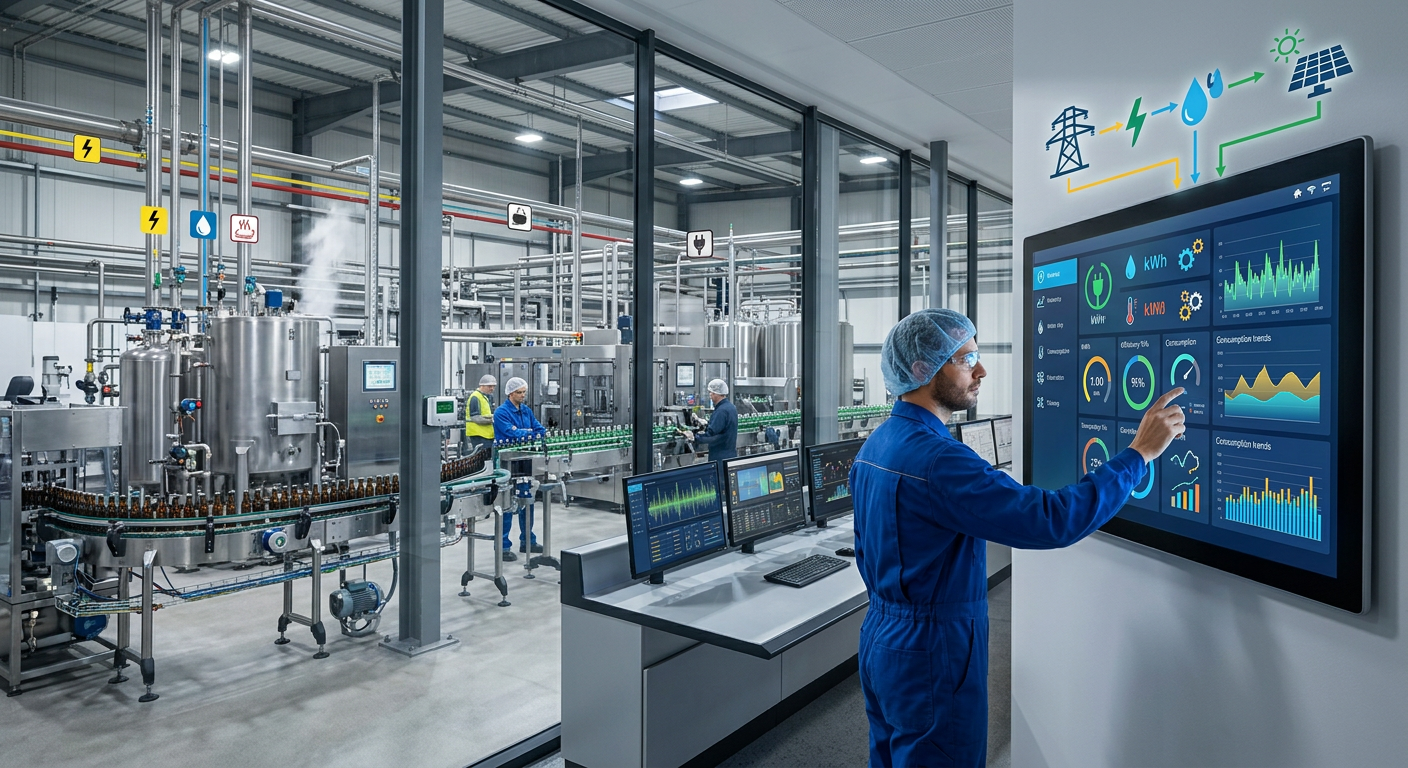
In a real beverage facility, automation is a layered system rather than a single product. At the equipment level, sensors monitor flow, temperature, pressure, Brix, conductivity, pH, tank level, and valve position. PLCs execute logic for pumps, motors, mixers, fillers, conveyors, blowers, and heat exchangers. HMIs give operators access to recipes, status screens, alarms, and production data. SCADA sits above those controls to display trends, line conditions, tank utilization, utility consumption, and exception events.
In a typical RTD or soft drink plant, an operator may start a batch from a central HMI. The PLC checks tank availability, verifies ingredient call-up, confirms CIP release, meters water and syrup, controls agitation, and records critical setpoints. Once the batch is approved, transfer logic routes product to a holding tank or filler bowl while downstream packaging equipment receives line-ready signals. Quality records are stored automatically, and production counts can feed MES or ERP systems for inventory and order tracking.
In a brewery or kombucha operation, automation may also manage fermentation conditions, cellar transfers, carbonation, bright tank levels, dissolved oxygen targets, and packaging interlocks. In dairy beverage and aseptic systems, control architecture becomes even more stringent because thermal treatment, sanitation verification, and traceability rules are more demanding.
The main benefit is not simply “fewer buttons.” It is control discipline. Operators spend less time making manual corrections. Supervisors gain live insight into bottlenecks. Maintenance teams can identify recurring faults. Management sees whether capital is producing measurable throughput, yield, and quality results.
At Disruptive Process Solutions, this plantwide view is central to project planning. Rather than treating controls as an afterthought, the company approaches beverage projects as integrated systems where process design, utilities, equipment layout, and automation all affect profitability. That perspective is particularly useful for fast-moving U.S. manufacturers trying to avoid fragmented upgrades that create new bottlenecks somewhere else.
| Automation Layer | Primary Function | Typical Beverage Use | Main Benefit | Common Risk if Missing | Best Fit |
|---|---|---|---|---|---|
| Field Instrumentation | Measures process conditions | Flow, temperature, pressure, Brix | Accurate control inputs | Unstable recipes | All beverage plants |
| PLC Control | Executes machine and process logic | Batching, routing, interlocks | Repeatable operations | Manual error and downtime | Lines with multiple unit operations |
| HMI | Operator interface | Start/stop, alarms, recipes | Faster training and response | Inconsistent operation | Single lines and tank farms |
| SCADA | Plantwide visualization and history | Utilities, batching, packaging status | Visibility and traceability | Reactive management | Multi-line sites |
| MES | Production execution and reporting | Scheduling, lot tracking, OEE | Operational discipline | Data silos | High-volume sites |
| ERP Integration | Business system connectivity | Orders, inventory, costing | Financial accuracy | Manual reconciliation | Enterprise operations |
The table above shows why automation decisions should be made as part of a process architecture, not a standalone controls purchase. Plants that invest only at one layer often leave significant value unrealized.
Unique Challenges: Washdown, Humidity, Chemical Resistance, and IP69K Requirements

Beverage plants are harder on equipment than many non-food industrial environments. Floors are wet. Cleaning chemicals are aggressive. Temperature swings are common. Packaging halls may have sugar dust, vapor, and condensed moisture. Blending rooms may expose components to acids, flavors, and sticky residues. Tunnel pasteurizers and hot-fill zones can create both heat and humidity. As a result, controls hardware that performs well in a dry warehouse may fail quickly in a beverage facility.
That is why enclosure selection, cable routing, gland design, sealing, and component specification matter so much. A line near a filler rinser or bottle washer may require a very different protection strategy than a palletizing cell or dry ingredient room. Engineers should evaluate:
- Frequency and intensity of washdown
- Chemical concentration and compatibility
- Ambient humidity and condensation risk
- Steam exposure and thermal shock
- Ingress from dust, syrup, or product splash
- Maintenance access and sanitation validation
IP69K is often discussed in food and beverage projects because it addresses high-pressure, high-temperature washdown exposure. However, not every location requires IP69K. Over-specifying everything increases cost without always improving reliability. Under-specifying critical areas, on the other hand, leads to corrosion, water ingress, nuisance faults, and downtime during production windows.
U.S. facilities near coastal regions such as Florida, Southern California, the Gulf Coast, and the Mid-Atlantic may face additional corrosion pressure from humid air and environmental exposure. Plants handling acidic beverages, kombucha, juice concentrates, or flavored syrups may also need special attention to chemical compatibility beyond basic washdown resistance.
| Plant Condition | Typical Source | Operational Risk | Automation Impact | Recommended Design Response | Priority Level |
|---|---|---|---|---|---|
| High-pressure washdown | Daily sanitation crews | Water ingress | Control cabinet failures | Use sealed enclosures and hygienic hardware | Very high |
| Persistent humidity | Pasteurizers, rinsers, steam | Condensation | Sensor drift and corrosion | Ventilation strategy and moisture-resistant components | High |
| Chemical exposure | Caustic, acid, sanitizer | Material degradation | Seal and housing breakdown | Verify chemical compatibility | High |
| Thermal cycling | Hot fill, cold rooms | Seal stress | Reduced enclosure life | Select stable gasketing and thermal-tolerant parts | Medium |
| Sticky product splash | Syrup and juice rooms | Residue buildup | Cleaning difficulty | Smooth surfaces and easy-to-clean geometry | Medium |
| Dust or powder ingress | Dry ingredient handling | Contamination and overheating | Electrical reliability issues | Appropriate sealing and filtration | Medium |
This table highlights why environmental mapping should be part of front-end design. A good automation partner will divide the facility into zones and match the hardware to each zone instead of applying one blanket standard everywhere.
Automation Applications: Batch Recipe Management, Weighing, and Pasteurization Control
The highest-value beverage automation applications usually sit at points where small process deviations create large downstream costs. Three of the most important are recipe management, weighing, and pasteurization control.
Batch recipe management
Recipe automation helps standardize ingredient addition order, mix timing, agitation speed, Brix targets, and transfer logic. This is especially important for co-packers and multi-SKU plants where flavor changes happen frequently. A good recipe system reduces operator dependence, shortens changeovers, and improves lot traceability. It also supports approval workflows so only authorized recipes can run on validated equipment.
Weighing and dosing
Load cells, mass flow meters, checkweighers, and gravimetric dosing systems reduce overfill and formulation giveaway. In high-volume operations, even small dosing errors can create major annual losses. Accurate weighing also supports claims compliance, ingredient reconciliation, and better yield reporting.
Pasteurization and thermal process control
HTST, UHT, flash pasteurization, tunnel pasteurization, and retort-like thermal operations all depend on reliable temperature, flow, pressure, and hold-time control. Automation provides interlocks, alarms, event history, and reporting needed for food safety and process confidence. For dairy beverages, juices, beer, RTD coffee, and shelf-stable products, this area often justifies automation investment by itself.
DPS has deep experience in these process areas, including fermentation systems, blending, inline Brix monitoring, carbonation, bright tank systems, water treatment, pasteurization technologies, aseptic applications, and full utility integration. That mix of technological capability matters because recipe performance depends on more than code. It depends on vessel design, piping logic, instrumentation quality, CIP strategy, and utility stability.
| Application | Typical Beverage Types | Key Signals | Main KPI Improved | Typical Payback Driver | Implementation Complexity |
|---|---|---|---|---|---|
| Recipe management | Soft drinks, RTD, juice, spirits | Brix, level, valve status, time | Consistency | Reduced batch errors | Medium |
| Automated weighing | Dairy, powders, functional drinks | Load cell, mass flow, checkweight | Yield | Less giveaway | Medium |
| Pasteurization control | Beer, juice, dairy, RTD tea | Temperature, flow, hold time | Food safety | Reduced product risk | High |
| CIP automation | All sanitary plants | Conductivity, temp, return status | Sanitation efficiency | Water and chemical savings | High |
| Carbonation control | Beer, soda, sparkling beverages | Pressure, flow, CO2 level | Quality uniformity | Reduced rejects | Medium |
| Utility coordination | Large multi-line plants | Steam, glycol, air, water | Uptime | Fewer process interruptions | High |
The practical takeaway is that the best automation investment often starts at the process step where losses are repeated daily. For one producer, that may be thermal treatment. For another, it is syrup blending accuracy or CIP cycle waste.
Stainless Steel vs. Polycarbonate: Choosing the Right Enclosures for Beverage Plants
Choosing between stainless steel and polycarbonate enclosures is a practical design decision, not a branding preference. Each material has strengths depending on zone, cleaning method, exposure level, and maintenance access.
Stainless steel enclosures are favored in harsh sanitary environments because they offer strong chemical resistance, durability, and cleanability. They are common around fillers, blending rooms, washdown-intensive packaging zones, and wet process areas. Sloped-top hygienic designs can also reduce standing water and make sanitation easier.
Polycarbonate enclosures can be effective in less severe environments where corrosion resistance, visibility, and cost efficiency matter. They are often used for remote I/O, lighter-duty control points, or utility areas that do not experience repeated high-pressure caustic washdown. In some cases, transparent covers help maintenance teams perform quick inspections without opening the enclosure.
The right choice depends on zone classification, not assumptions. A dry packaging electrical room in Phoenix may support different materials than a humid tunnel pasteurizer area in Georgia or a washdown-heavy dairy beverage line in Wisconsin.
| Selection Factor | Stainless Steel | Polycarbonate | Best Use Case | Cost Position | Notes |
|---|---|---|---|---|---|
| Washdown resistance | Excellent | Moderate to good | Wet production zones | Higher | Preferred for frequent sanitation |
| Chemical resistance | Excellent | Varies by chemistry | Caustic and acid exposure | Higher | Verify sanitizer compatibility |
| Corrosion performance | Excellent | Good | Humid plants | Higher | Grade selection matters |
| Visibility | Low | High | Quick inspection points | Lower | Clear covers can help troubleshooting |
| Mechanical durability | High | Moderate | High-traffic areas | Higher | Better against impacts |
| Weight and handling | Heavier | Lighter | Wall-mounted remote I/O | Lower | May ease installation |
The explanation here is straightforward: stainless steel is usually the safer answer in harsh sanitary zones, but polycarbonate can still be the right economic and technical choice in lower-risk areas. Matching the enclosure to the zone helps control capital cost without compromising reliability.
IP Ratings Explained: IP65, IP67, and IP69K for Different Plant Zones
IP ratings are often misunderstood. In beverage manufacturing, they should be interpreted based on actual exposure conditions and sanitation practice. The most common ratings discussed are IP65, IP67, and IP69K.
IP65 typically protects against dust and water jets. It is often acceptable in areas with occasional washdown or general moisture exposure. IP67 adds temporary immersion protection, which may be important where standing water or accidental submersion could occur. IP69K is intended for equipment exposed to high-pressure, high-temperature washdown, making it especially relevant in sanitary production zones.
Still, rating alone does not solve everything. Gasket quality, hinge design, cable entry points, mounting method, and cleaning behavior all influence real-world performance. A well-installed IP65 enclosure may outperform a poorly installed IP69K enclosure in some conditions.
| IP Rating | Protection Summary | Typical Beverage Zone | Good Fit Example | Limitations | Recommendation |
|---|---|---|---|---|---|
| IP65 | Dust-tight, protected from water jets | Dry-to-damp packaging areas | Conveyor controls away from direct washdown | Not ideal for aggressive sanitation | Use in lower-risk zones |
| IP66 | Strong water jet protection | Moderate washdown spaces | Utility skids and support equipment | Not for repeated high-temp sanitation | Good middle ground |
| IP67 | Temporary immersion protection | Low-mounted devices near wet floors | Remote I/O near drains | Not a substitute for hygienic design | Use where pooling is possible |
| IP68 | Extended immersion capability | Specialized applications | Submerged instrumentation | Application-specific | Specify carefully |
| IP69K | High-pressure, high-temp washdown | Sanitary process zones | Filler area, wash tunnel vicinity | Higher cost | Best for aggressive cleaning areas |
| Hybrid zoning | Mixed ratings by area | Most modern plants | Right-size protection by risk | Requires planning | Usually most cost-effective |
The best buying advice is to create a plant map by sanitation intensity and environmental exposure. This zoning approach is especially useful for large U.S. sites with multiple process types under one roof, such as co-packers near Indianapolis or high-throughput beverage campuses in Texas.
Integration with SCADA, MES, and ERP for Full Production Visibility
Many beverage plants already have capable equipment, but their data remains trapped in separate systems. One line has a filler OEM dashboard. Another has a standalone batch controller. Utilities are monitored elsewhere. Quality data may sit in spreadsheets. Production reporting may be recreated manually at the end of each shift. This fragmentation slows decision-making and hides losses.
SCADA, MES, and ERP integration solves different parts of that problem. SCADA provides operational visibility: live process conditions, alarms, trends, batch status, tank occupancy, and utility performance. MES manages execution: work orders, downtime tracking, OEE, lot genealogy, operator workflows, and digital production records. ERP connects plant activity to business functions such as purchasing, costing, planning, inventory, and customer order fulfillment.
In a beverage operation, the integrated stack can answer critical questions in real time:
- Which batch is feeding which line?
- Did a thermal deviation occur?
- Where did downtime start today?
- How much syrup, concentrate, or CO2 was consumed per case?
- Which lot numbers are tied to a finished shipment?
- How much rework or giveaway occurred on a SKU?
DPS brings strong technological capability in controls engineering, PLC programming, automation, SCADA, and system integration, along with broader structural, mechanical, plumbing, electrical, and process engineering. That cross-functional strength matters because software visibility is only useful when the physical system, utilities, instrumentation, and process logic all support clean data flow.
For clients needing end-to-end delivery, the company’s service model also extends from capital planning and feasibility through owner representation, project management, installation oversight, commissioning, and integration. You can review the broader engineering and project services offering to understand how automation fits into a full beverage capital program rather than acting as a detached controls package.
How to Calculate ROI: Labor Savings, Yield Improvement, and Quality Gains
Automation ROI should be calculated from multiple value streams, not just labor reduction. In beverage production, a project may pay back through fewer manual hours, reduced product loss, tighter batch accuracy, faster changeovers, lower utility consumption, improved sanitation cycles, better compliance records, and higher line uptime.
A simple ROI framework can include:
- Current-state baseline: labor hours, waste, downtime, giveaway, changeover time, utility spend, quality rejects
- Expected improvement: conservative percentage gains by area
- Annualized value: convert each improvement into dollars
- Total project cost: engineering, equipment, installation, controls, commissioning, training
- Payback and internal return: compare total value to total investment
For example, a plant running 20 million cases annually may save significant dollars from a small overfill reduction alone. A multi-SKU co-packer may gain more from changeover and scheduling efficiency. A dairy beverage site may justify investment primarily through food safety confidence and digital records. The point is that ROI must reflect the actual business model.
| ROI Category | Typical Baseline Problem | Example Improvement | Annual Value Driver | Measurement Method | ROI Strength |
|---|---|---|---|---|---|
| Labor savings | Manual batching and reporting | 2 fewer operator hours per shift | Reduced direct labor | Time study | Moderate |
| Yield improvement | Overfill and dosing giveaway | 0.5% product recovery | Lower ingredient cost | Mass balance | High |
| Quality gains | Recipe inconsistency | Fewer rejected lots | Less scrap and rework | QC records | High |
| Downtime reduction | Frequent faults and resets | 3% uptime gain | More saleable output | OEE tracking | High |
| Utility efficiency | Inefficient CIP or thermal control | 5% lower water and steam use | Reduced operating cost | Meter data | Moderate |
| Compliance efficiency | Paper records and manual audits | Digital traceability | Lower risk and admin time | Audit preparation hours | Moderate |
The explanation behind this table is important: the strongest beverage automation business cases typically combine one obvious benefit, such as yield improvement, with several secondary gains that compound over time. That is how many projects beat initial payback expectations.
DPS often approaches projects with a profitability-first lens rather than pushing capital for its own sake. That approach is especially valuable for owners comparing expansion, retrofit, relocation, or debottlenecking alternatives. In some cases, better automation logic and process redesign can unlock capacity without a major equipment purchase. Manufacturers exploring past project examples and execution style can also review the firm’s case experience.
Trends Shaping Beverage Automation: AI, Robotics, and Digital Transformation
From 2026 forward, beverage automation in the U.S. will be shaped by three converging forces: labor availability, digital decision-making, and sustainability pressure. AI, robotics, and more connected plant architectures are not replacing core engineering discipline, but they are changing what leading plants expect from automation.
AI and advanced analytics
AI is increasingly useful for pattern recognition in downtime, predictive maintenance, utility optimization, and quality drift detection. In beverage operations, the most practical AI uses are often narrow and operational: identifying filler performance trends, forecasting CIP timing, flagging abnormal pasteurization behavior, or predicting pump and valve maintenance needs before failures occur.
Robotics
Robotics adoption is growing fastest in end-of-line functions such as case packing, palletizing, depalletizing, and repetitive material movement. As beverage plants struggle with staffing variability, robotics can stabilize throughput in packaging halls and distribution zones. Integration with line controls and SCADA gives supervisors better visibility into the total packaging cell.
Digital transformation
Digital transformation in beverage manufacturing means moving from fragmented machine control to connected production intelligence. It includes electronic records, recipe governance, utility dashboards, historian trends, asset performance monitoring, and remote support. The strongest results come when digital tools are built on good process engineering rather than layered over unstable operations.
Sustainability and policy pressure
Water use, energy intensity, chemical consumption, and wastewater management are receiving more board-level attention. Automation plays a direct role in sustainability by tightening CIP cycles, reducing overprocessing, lowering giveaway, and improving utility scheduling. Policy and customer expectations in 2026 are likely to push more beverage producers toward measurable environmental KPIs tied to automation systems.
Regional supply chain and capacity strategy
As manufacturers continue balancing domestic production, reshoring, and regional distribution strategies, greenfield and brownfield beverage projects in U.S. logistics corridors will keep growing. Plants near rail, interstates, and ports can benefit especially from integrated planning because capacity, utilities, and scheduling pressures intensify quickly once output ramps.
DPS supports these trends with a blend of manufacturing and integration capability. In addition to engineering and installation, the company designs and supplies process equipment such as tanks, custom CIP systems, and other processing assets that can fit into broader automated systems. You can explore current equipment capabilities as part of a larger project strategy when evaluating suppliers.
| Trend | What Is Changing | Why It Matters in Beverage | Typical First Use Case | 2026 Outlook | Buyer Advice |
|---|---|---|---|---|---|
| AI analytics | Faster fault detection | Less unplanned downtime | Maintenance alerts | Strong growth | Start with one measurable problem |
| Robotics | More packaging automation | Labor stability | Palletizing | Very strong growth | Validate line integration early |
| Digital records | Paperless operations | Traceability and audits | Batch reporting | Mainstream adoption | Standardize data structure |
| Energy management | Real-time utility insight | Cost and sustainability gains | Boiler and glycol monitoring | Accelerating | Meter key utilities first |
| Remote support | Faster troubleshooting | Less service delay | SCADA diagnostics | Growing steadily | Address cybersecurity early |
| Flexible manufacturing | More SKU agility | Supports co-packing and premiumization | Recipe automation | Critical capability | Design for changeovers, not just volume |
This trend table shows that beverage automation is becoming more strategic. Buyers should prioritize scalable architectures, clear data ownership, and zone-specific hardware choices over isolated technology purchases.
FAQ
What is beverage manufacturing automation?
It is the use of controls, software, instrumentation, and integrated equipment to automate beverage processing, sanitation, packaging, monitoring, and reporting. It can range from a single automated batching skid to a fully connected plantwide system.
Which U.S. beverage sectors invest the most in automation?
RTD beverages, soft drinks, dairy beverages, brewing, and co-packing operations are among the most active sectors because they combine high throughput, strict consistency demands, and frequent changeovers.
Do all beverage plants need IP69K equipment?
No. IP69K is best for aggressive washdown areas. Many plants benefit from a mixed-zone strategy where some locations use IP65 or IP67 and only the harshest sanitary zones use IP69K hardware.
Is stainless steel always better than polycarbonate?
Not always. Stainless steel is usually preferred in high-sanitation wet areas, but polycarbonate can be a smart choice in less severe environments where visibility and cost matter.
How long does an automation project usually take?
It depends on scope. A focused controls retrofit may take weeks or a few months, while a full greenfield integration can take substantially longer due to engineering, procurement, installation, commissioning, and training.
What is the most common mistake in beverage automation projects?
Buying controls without aligning them to process realities. Poor zoning, weak utility coordination, incomplete instrumentation, and fragmented software architecture can limit results even when the hardware is expensive.
How should a plant calculate ROI?
Use a full model that includes labor, yield, quality, downtime, utility consumption, compliance effort, and capacity gains. The best projects usually create value in several categories at once.
Can automation help with FDA, SQF, or BRC expectations?
Yes. Digital records, alarm history, lot traceability, validated process controls, and better sanitation documentation can all support compliance readiness and audit performance.
What should companies look for in an automation partner?
Look for process understanding, sanitary design knowledge, controls capability, utility integration experience, realistic ROI analysis, and strong project execution. In beverage manufacturing, success depends on engineering the whole system, not just programming a panel.
Why do many manufacturers work with DPS?
Because the company combines process engineering, controls integration, installation oversight, equipment capability, and project management in one coordinated model focused on profitable outcomes. Its work across beverage categories and North American project delivery makes it especially relevant for producers that need both technical depth and practical execution.
For beverage companies in the United States planning a retrofit, expansion, relocation, or greenfield project, automation works best when it is tied directly to throughput, sanitation realities, utility performance, and business visibility. The strongest results come from partners who understand both the production floor and the capital strategy behind it.
[/trp_language]
Complete Company Portfolio
About the Author: Disruptive Process Solutions (DPS)
The DPS team combines process engineering expertise with real-world food and beverage manufacturing experience. Our content focuses on process optimization, production efficiency, facility improvements, and practical solutions that help manufacturers operate more effectively in a rapidly evolving industry.
Share