PLC Programming for Food Processing
[trp_language language=”en_US”]
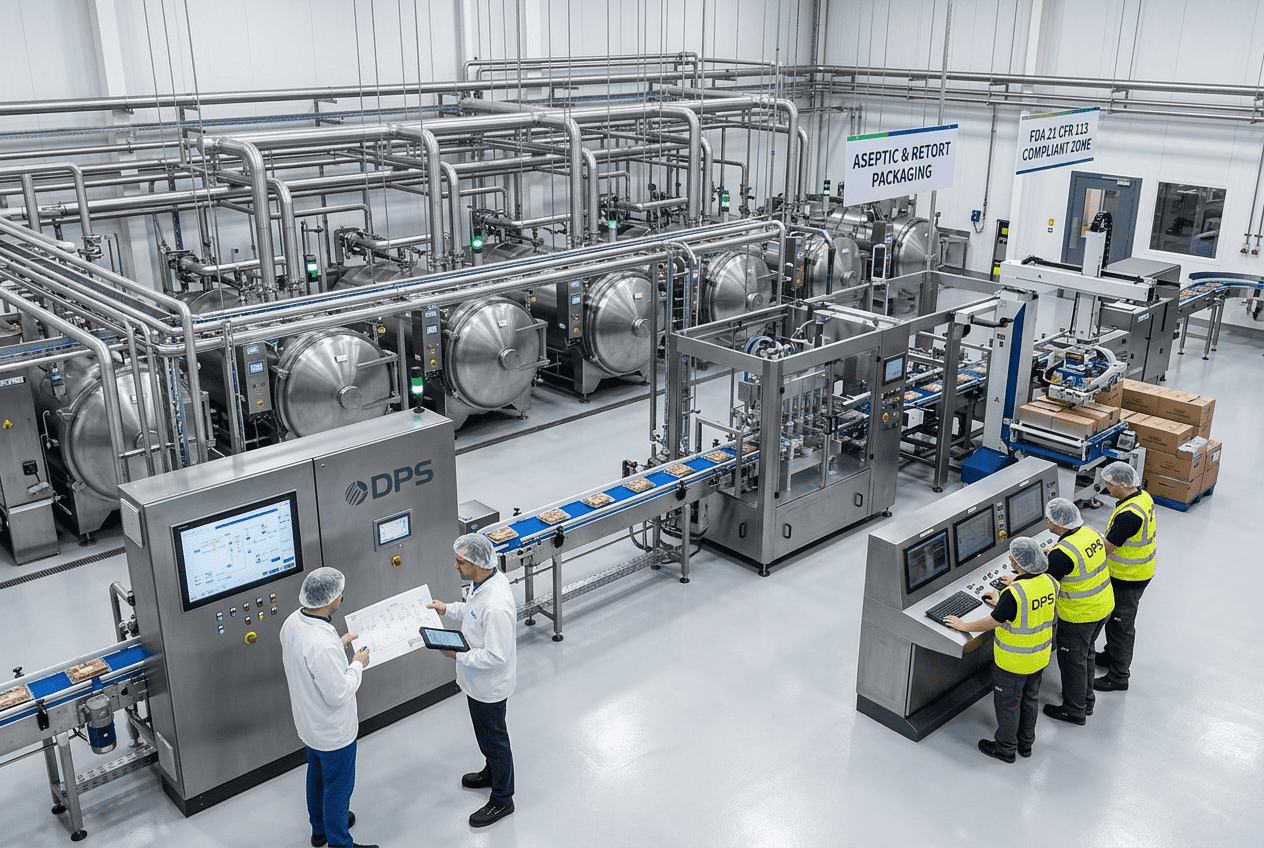
Food processing PLC programming in the United States is the discipline of designing, validating, and maintaining automation logic for sanitary production lines that must deliver safe product, repeatable quality, traceability, and regulatory compliance. In practice, that means controlling mixers, cookers, coolers, coaters, pasteurizers, clean-in-place systems, recipe management, operator access, alarms, records, and lot genealogy with a level of rigor that goes far beyond general industrial automation. For processors in major manufacturing hubs such as Chicago, Dallas, Fresno, Atlanta, Charlotte, Los Angeles, and the corridor between New Jersey and Pennsylvania, a well-programmed PLC system can improve yield, reduce giveaway, prevent food safety deviations, and support expansion without unnecessary capital spending.
Across the United States market, processors are under pressure from labor shortages, retailer quality standards, FDA expectations, USDA oversight, rising utility costs, and tighter customer audits. That is why automation projects increasingly focus on practical outcomes: stable temperature control, validated CIP sequences, secure batch records, electronic signatures, and rapid root-cause analysis. Companies that engineer these systems well tend to combine process understanding with controls execution. Disruptive Process Solutions is positioned in this category, supporting manufacturers across North America with food and beverage engineering, integration, and process-focused automation that ties programming decisions back to throughput, compliance, and profitability.
Quick Answer

If you are buying or upgrading PLC programming for a U.S. food plant, focus on five essentials first: sanitary hardware selection, process-specific control logic, validated cleaning automation, electronic records and traceability, and a scalable recipe structure. A successful project is not just about coding a machine to run. It is about building a control system that can survive washdown, maintain critical limits, document every batch, support operators on multiple shifts, and scale from pilot runs to enterprise production.
For protein, dairy, sauces, beverages, prepared foods, aseptic, and co-packing operations, the strongest automation architecture usually includes PLCs with modular I/O, managed industrial Ethernet, HMI/SCADA layers for batch and audit functions, historian integration, alarm rationalization, and clearly documented state-based sequences. The best suppliers also understand how utilities, piping, thermal systems, and production scheduling affect code performance on the floor.
In the United States, buying advice should reflect your actual product family and regulatory exposure. A yogurt line near Madison, a retort meal facility near Houston, a sauce plant in New Jersey, and a poultry processor in Arkansas all need PLC programming, but not the same validation strategy, interlocks, or lot assignment logic. Match the controls scope to the product risk profile, cleaning complexity, and production model.
| Buying Priority | Why It Matters | Typical U.S. Application | Programming Impact |
|---|---|---|---|
| Food safety critical controls | Protects product and brand | HTST dairy, sauces, RTD beverages | Interlocks, alarms, hold logic, data capture |
| Sanitary hardware | Survives washdown and chemical exposure | Protein, dairy, wet processing | Reliable I/O and fewer nuisance failures |
| Recipe structure | Improves consistency across SKUs | Batch blending and prepared foods | Parameter tables and version control |
| CIP automation | Reduces cleaning error and downtime | Dairy, beverage, aseptic systems | State machines, timing, conductivity, temp checks |
| Traceability | Supports recall readiness | Co-packers and multi-ingredient plants | Lot genealogy and batch records |
| Compliance records | Helps with audits and approvals | FDA and USDA regulated plants | Electronic signatures and audit trails |
The table above gives a practical starting point. Plants often jump directly to screens and dashboards, but the real value comes from getting the control philosophy right first. The sequence of operations, fail-safe behavior, and traceability model determine whether the system remains useful five years later.
The chart shows a realistic growth trend for food automation investment in the United States. Demand is being driven by expansion in co-packing, product diversification, modernization of legacy controls, and stronger customer expectations around digital traceability.
Core Food Processing Operations: Mixing, Cooking, Cooling, and Coating Control

Core food process programming starts with unit operations. Mixing control may seem simple, but in food plants it often includes variable speed profiles, ingredient addition timing, viscosity-dependent hold periods, vacuum integration, load cell confirmation, and operator prompts for manual additions. In high-shear systems for dressings, emulsions, plant-based slurries, or dairy bases, the PLC must coordinate motor speed, temperature rise, ingredient sequencing, and permissives tied to tank level and agitator status.
Cooking control is even more critical. Whether the line uses steam-jacketed kettles, direct steam injection, ovens, smokehouses, scraped surface heat exchangers, or continuous cookers, the program must manage product temperature ramps, dwell times, over-temperature alarms, and safe shutdown logic. In protein and prepared food plants, recipe transitions and sanitation restrictions must also be accounted for. The difference between a stable process and a yield-killing one often comes down to tuning and sequence design rather than equipment size alone.
Cooling systems need equally careful programming because cooling rates affect safety, texture, shelf life, and package integrity. U.S. processors dealing with dairy, soups, ready meals, and fillings often require automated logic that controls chilled water, glycol, valve positions, recirculation rates, and cooldown verification. If a plant ships nationally from hubs near Memphis, Kansas City, or Southern California, a stable cooling process can directly affect distribution performance and complaint rates.
Coating control matters for snacks, proteins, bakery items, and value-added products. Here the PLC may govern belt speed, drum rotation, pump flow, spray timing, recirculation, and recipe-linked coating percentages. Good programming reduces overuse of expensive ingredients and improves appearance consistency.
| Operation | Key Inputs | Key Outputs | Typical Sensors | Main Risks |
|---|---|---|---|---|
| Mixing | Speed setpoint, recipe phase, batch weight | Agitator VFD, valves, dosing pumps | Load cells, level, RPM, temp | Incorrect additions, poor blend uniformity |
| Cooking | Temperature profile, hold time | Steam valves, burners, recirculation pumps | RTDs, pressure, flow, valve feedback | Undercook, scorch, yield loss |
| Cooling | Target exit temp, rate of change | Chilled water valves, glycol pumps | RTDs, flowmeters, differential pressure | Slow cooling, microbial risk |
| Coating | Coating ratio, product speed | Spray pumps, nozzles, tumbler speed | Flow, belt encoder, tank level | Overuse, poor coverage, carryover |
| Transfer | Destination, permissives | Pumps, route valves | Valve proof, pressure, level | Cross-contamination, line blockage |
| Hold/Buffering | Residence time, availability | Tank routing, recirculation | Level, temp, conductivity | Queue disruption, product degradation |
This table illustrates why programming should follow the process. Each unit operation has a different control objective, but the PLC must integrate them into one coherent production sequence. That is where engineering depth matters.
From a technology standpoint, DPS supports exactly this type of integrated control environment through process, mechanical, electrical, and controls engineering. Its work spans PLC programming, SCADA, utility systems, batch control, thermal processes, and complete system integration, which is especially valuable when production issues are really the result of interactions between piping, heating, cooling, and automation rather than a single machine in isolation.
Pasteurization Control Programming: Cascade Control and Flow Diversion Logic

Pasteurization logic is one of the most specialized areas of food PLC programming. In U.S. dairy, beverage, liquid egg, cultured product, and some sauce applications, the control system must protect public health while maintaining production efficiency. This usually means accurate temperature control, verified hold conditions, differential pressure management where relevant, charting or electronic record retention, and flow diversion when legal process conditions are not met.
Cascade control is widely used because a single temperature loop often responds too slowly in dynamic thermal systems. A common structure is a product temperature master loop that adjusts the setpoint of a steam flow, hot water, or heating media slave loop. This arrangement improves stability during rate changes and product transitions. Programming must also account for sensor validation, instrument failure behavior, timing deadband, and startup conditions.
Flow diversion logic is just as important. If pasteurization temperature falls below the required threshold, the product must be automatically diverted based on validated logic. The code must define when diversion begins, what equipment states are required to re-enter forward flow, how alarms are latched, and how events are logged. In regulated environments, every decision path should be documented and testable.
For plants near California’s Central Valley, Wisconsin dairy corridors, or beverage production zones around Texas and the Southeast, this logic is a business issue as much as a technical one. A nuisance diversion event can waste product, but weak logic can create compliance exposure. The right programming balances both.
| Pasteurization Function | Programming Method | Control Goal | Validation Focus |
|---|---|---|---|
| Product temperature control | PID master loop | Maintain legal process temp | Sensor accuracy and tuning |
| Heating media regulation | Cascade slave loop | Fast and stable response | Valve response and loop interaction |
| Hold verification | Time and flow calculation | Ensure required residence time | Flow calibration and timing logic |
| Flow diversion | State interlock and fail-safe routing | Prevent unsafe forward flow | Proof tests and event capture |
| Pressure differential | Alarm and permissive logic | Protect product boundary where needed | Transmitter reliability |
| Record retention | SCADA/historian integration | Audit-ready documentation | Time stamps and data integrity |
The table shows that pasteurization is never just “one temperature loop.” It is a layered control strategy involving thermal performance, safety logic, and record management.
As a practical buying tip, choose a partner that understands HTST, UHT, flash, tunnel pasteurization, retort, and aseptic differences. A generic integrator may write functional code, but a process-focused team is more likely to anticipate how diversion logic, startup sequencing, CIP boundaries, and utility fluctuations affect real production uptime.
CIP Automation: State Machine Design for Validated Cleaning Sequences
Clean-in-place automation is where food plants can gain major operational value. Manual cleaning is highly dependent on shift discipline and tribal knowledge. Automated CIP replaces that variability with a state-based sequence that verifies time, temperature, conductivity, flow, route selection, and step completion. In dairy, beverage, aseptic, sauce, and liquid food systems, this is central to food safety and equipment availability.
A strong CIP state machine typically defines idle, pre-rinse, caustic wash, intermediate rinse, acid wash if required, final rinse, sanitize, recovery, drain, complete, and fault states. Each state has entry conditions, active controls, transition rules, timer behavior, alarm handling, and abort pathways. Reusable function blocks for pumps, valves, tanks, and circuits improve maintainability and validation discipline.
Conductivity feedback can confirm chemical strength, while temperature and flow verification ensure mechanical and thermal cleaning energy. The PLC should also prevent route conflicts, protect against dead legs being skipped, and block production release until cleaning is complete and accepted. In facilities with multiple skids or shared circuits, recipe-driven CIP paths can significantly reduce water, chemical, and labor costs.
This is an area where DPS’s manufacturing and integration capabilities matter. The company designs and supplies custom process equipment including CIP systems, storage and process tanks, marination tumblers, and cooking vessels, while also integrating the controls, utilities, and commissioning. That combination helps align mechanical design, sanitary routing, and automation logic from the start instead of forcing the PLC programmer to work around poor CIP architecture later.
| CIP Step | Typical Objective | Main PLC Checks | Common Failure Mode | Recommended Response |
|---|---|---|---|---|
| Pre-rinse | Remove gross soil | Flow, route, duration | Insufficient flow | Alarm and hold step |
| Caustic wash | Break down organic residues | Conductivity, temp, time | Weak chemical strength | Recirculate or abort |
| Intermediate rinse | Flush chemical | Conductivity endpoint | Residual caustic | Extend rinse automatically |
| Acid wash | Remove mineral scale | Temp, concentration, time | Skipped route | Route proof and interlock |
| Final rinse | Restore clean neutral condition | Conductivity or pH endpoint | Premature completion | Minimum time plus endpoint check |
| Sanitize | Prepare for production | Dose verification, contact time | Short contact time | Reject release to production |
The explanation behind this table is straightforward: each cleaning step should be verifiable, not assumed. Validated CIP programming reduces both sanitation risk and downtime caused by re-cleaning or QA holds.
The area chart reflects a clear industry trend: automated CIP adoption continues to grow as labor availability tightens and audit expectations rise. By 2026, many U.S. processors will view validated CIP sequencing as a standard requirement rather than an upgrade.
Batch Recipe Management: Ingredient Tables, Process Parameters, and ISA-88
Batch control becomes essential when a plant handles multiple SKUs, allergens, seasonal formulations, customer-specific specs, or frequent changeovers. In these settings, hardcoded setpoints create risk. Recipe management should separate product data from reusable equipment logic so operators can run approved formulations without editing the PLC program every time a parameter changes.
Ingredient tables usually contain material codes, target weights or percentages, tolerance bands, addition order, allergens, source location, and lot capture requirements. Process parameter tables often include agitation speed, heat ramp rates, hold times, transfer destinations, coating percentages, and CIP requirements. With ISA-88 principles, unit procedures, operations, and phases can be structured in a way that improves standardization and scalability.
For co-packers in the United States, ISA-88 style design is especially useful because it supports product diversity without creating an unmanageable codebase. A line serving national retailers through ports and logistics hubs such as Long Beach, Savannah, Newark, or Houston may need fast changeovers, secure customer recipes, and dependable records. A recipe-driven architecture supports that model far better than ad hoc edits.
| Recipe Element | Stored Data | Operational Benefit | Best Practice |
|---|---|---|---|
| Ingredient table | Code, target, tolerance, lot rules | Consistent formulation | Link to ERP or MES if available |
| Process parameter set | Times, temps, speeds, flows | Repeatable processing | Version control and approvals |
| Equipment phases | Fill, mix, heat, hold, transfer | Reusable logic | ISA-88 naming structure |
| Quality checkpoints | Brix, pH, viscosity, temp | Improved release confidence | Prompt and record operator actions |
| Allergen controls | Flags and cleaning requirements | Safer scheduling | Automatic CIP enforcement |
| Recipe audit trail | Who changed what and when | Compliance and accountability | Electronic signature workflow |
The reason this matters is simple: recipe discipline reduces variation. It also makes expansions easier when a processor adds new kettles, blending skids, fillers, or remote plants.
On the service side, DPS combines process engineering, capital planning, owner’s representation, project management, equipment supply, installation, and system integration. For recipe and batch projects, this matters because programming decisions often depend on broader plant questions such as utility capacity, batching strategy, future line additions, and plantwide scheduling.
Hardware Selection: NEMA 4X, IP69K Enclosures, and Stainless Steel Requirements
Hardware selection in food automation is not a cosmetic issue. U.S. facilities with wet washdown, chemical sanitation, salt exposure, sugar accumulation, or corrosive ingredients need enclosures, components, and mounting practices that fit the environment. Poor hardware choices lead to frequent faults, sanitation concerns, and maintenance headaches.
NEMA 4X enclosures are commonly specified where corrosion resistance and washdown protection are required. IP69K becomes important when equipment faces high-pressure, high-temperature washdown conditions. Stainless steel is often the preferred enclosure and support material in sanitary areas because it resists corrosion and is easier to clean than painted carbon steel. However, not every zone needs the same specification. Utility rooms, dry ingredient areas, and packaging halls may have different requirements.
PLC cabinet design also affects reliability. Consider heat load, component spacing, cable routing, gland selection, hygienic stand-offs, sloped tops, drain strategy, and separation of power from low-level signals. In facilities processing meat near Omaha, dairy in upstate New York, sauces in the Midwest, or RTD beverages in Southern California, environmental conditions can vary widely within the same building, so zone-based hardware selection is often the best approach.
| Hardware Option | Best Use Area | Main Advantage | Typical Limitation |
|---|---|---|---|
| NEMA 4X enclosure | Wet processing zones | Washdown and corrosion resistance | Higher cost than standard cabinets |
| IP69K enclosure | High-pressure washdown equipment | Strong ingress protection | May exceed needs in dry zones |
| Stainless steel cabinet | Sanitary production areas | Durability and cleanability | Weight and fabrication cost |
| FRP or polymer enclosure | Selective corrosive service areas | Chemical resistance | Not always preferred for sanitary aesthetics |
| Remote I/O blocks | Distributed skid controls | Reduced wiring and faster install | Requires network discipline |
| Hygienic mounting accessories | Open equipment frames | Less debris retention | Often overlooked in budget stage |
This table helps buyers avoid over- or under-specification. The right choice depends on sanitation method, exposure, maintenance access, and expected lifecycle, not just an owner preference on a datasheet.
Regulatory Compliance: 21 CFR Part 11, Electronic Records, and Electronic Signatures
Many U.S. food and beverage facilities now expect electronic records from their automation systems, especially in higher-risk processes, aseptic environments, quality-sensitive formulations, and customer-audited co-packing operations. While 21 CFR Part 11 is often associated with highly regulated environments, its concepts are increasingly relevant wherever secure electronic records, access control, and operator accountability are required.
A compliant or compliance-ready design typically includes unique user accounts, role-based access, password policies, electronic signatures for critical actions, time-stamped audit trails, protected record storage, and documented change control. The PLC may hold critical runtime logic, but HMIs, batch servers, historians, and SCADA systems often manage the records and signatures.
For example, changing a recipe parameter, acknowledging a food safety deviation, releasing a batch, or overriding a diversion condition may require a user action that is both secure and attributable. Plants supplying national retail, foodservice, or export markets often gain value from this structure even when not formally required by every customer, because it improves discipline and reduces disputes.
Future policy trends heading into 2026 point toward stronger digital record expectations, broader cybersecurity scrutiny for industrial environments, and more demand for transparent quality data across supply chains. Plants modernizing now should design with that direction in mind.
The bar chart shows realistic relative demand for electronic records projects by segment. Aseptic, dairy, and beverage applications tend to lead due to quality sensitivity, customer requirements, and regulatory complexity.
Lot Tracking Implementation: Ingredient Genealogy and Production Lot Assignment
Lot tracking is one of the most valuable outcomes of good food PLC programming, especially when integrated with HMI, SCADA, barcode systems, and ERP tools. Ingredient genealogy means the plant can identify which raw material lots entered which batch, tank, rework stream, or finished product run. Production lot assignment then ties that genealogy to packaged goods, pallet records, and shipment data.
At minimum, a robust implementation should capture raw material lot IDs, receiving date, supplier information, batch number, intermediate transfers, rework usage, finished goods lots, and operator confirmations where needed. The PLC often provides the machine-state backbone, while higher layers manage data storage and reporting. Still, the logic must be designed so the process cannot move forward with missing critical lot information.
This becomes extremely important in multi-ingredient environments such as dressings, soups, cultured dairy, beverage blending, ready meals, and protein marination. If a recall or customer complaint occurs, fast and accurate genealogy can limit the event scope, reduce financial exposure, and protect credibility.
For a processor moving goods through Atlanta distribution channels, Chicago rail corridors, or West Coast ports, the cost of weak traceability can be severe. That is why lot tracking should be treated as a process design function, not a reporting add-on.
| Traceability Layer | Data Captured | System Source | Business Value |
|---|---|---|---|
| Raw ingredient receipt | Supplier lot, item code, date | Receiving system or barcode scan | Starting point for genealogy |
| Batch charging | Actual lot used and quantity | PLC/HMI batch step | Confirms formulation history |
| Intermediate hold | Tank assignment and transfer record | PLC route logic | Tracks blending and staging |
| Rework addition | Source lot and amount | Recipe or operator prompt | Controls hidden recall exposure |
| Finished goods creation | Production lot and timestamp | Packaging line integration | Connects batch to saleable product |
| Shipment linkage | Pallet or order association | ERP/WMS interface | Speeds targeted recall response |
The explanation here is practical: better genealogy reduces uncertainty. In a crisis, uncertainty is expensive. Good control system design narrows the investigation path immediately.
Programming Languages: Ladder Logic, Function Blocks, and Structured Text
The best programming language choice depends on the process, the plant maintenance team, and the required architecture. In food processing, Ladder Logic remains common because technicians understand it and troubleshooting on the plant floor is often faster. It works well for permissives, interlocks, motor control, and straightforward sequence logic.
Function Blocks are especially effective for reusable devices and process objects such as pumps, valves, PID loops, CIP circuits, and phase modules. They support cleaner code, better consistency, and easier scaling across multiple skids or lines. For large sanitary systems, this approach is often the foundation of maintainable programming.
Structured Text is valuable for complex calculations, recipe parsing, array handling, lot management, and advanced batch functions. It can simplify logic that would be awkward or hard to maintain in Ladder. Many of the strongest food automation projects in the United States use a hybrid strategy: Ladder for visibility, Function Blocks for standardization, and Structured Text for data-heavy functions.
When comparing suppliers, ask to see naming standards, state machine methods, alarm philosophy, FAT documentation, and recovery behavior after power loss or communication failure. Those items tell you more about long-term code quality than the language alone.
This comparison chart is useful for buyers because it shows the tradeoffs clearly. No single language wins every category, which is why mixed-language architectures are so common in advanced food plants.
When evaluating local suppliers or national integrators, also consider geographic responsiveness. Plants in North Carolina, California, Texas, the Midwest, and the Northeast often need support during commissioning windows, sanitation shifts, and startup weekends. A lean but experienced partner with national coverage can outperform a larger vendor if the team understands food process realities and makes decisions quickly.
DPS operates with that kind of project model, serving all 50 states and Canada with engineering, integration, installation, and execution support. Its approach is notable for aligning programming decisions with plant economics. In one project example, a client had planned a multimillion-dollar capacity expansion, but controls analysis found the real bottleneck in PLC programming. By reworking the automation, throughput improved materially without the expected capital spend, which then opened the door to a larger strategic project. That kind of case reflects why process knowledge matters as much as coding skill.
FAQ
What industries in the United States benefit most from food PLC programming?
Dairy, meat and poultry, seafood, sauces and dressings, prepared meals, beverage blending, aseptic processing, brewing, distillation, plant-based proteins, and co-packing operations all benefit heavily. The exact controls scope depends on sanitation demands, thermal risk, SKU complexity, and traceability needs.
How long does a typical food automation upgrade take?
A focused line upgrade may take several weeks of engineering and a short shutdown. A plantwide batch, CIP, and traceability project may take months. The timeline depends on validation expectations, hardware availability, FAT requirements, and integration with existing utilities and production schedules.
Should a processor replace old PLCs or just rewrite the program?
It depends on spare parts risk, communication capability, safety requirements, and expansion plans. In some cases, a code rewrite or architecture cleanup on existing hardware is enough. In others, aging hardware creates too much operational risk to justify keeping it.
Is ISA-88 necessary for smaller food plants?
Not always in a formal enterprise sense, but the principles are useful even for mid-sized facilities. Separating recipes from equipment logic and organizing phases consistently improves maintainability and future scalability.
What should be included in a pasteurization controls scope?
At minimum: thermal control strategy, calibrated instrumentation, flow diversion logic, startup and shutdown sequences, alarm handling, event recording, user access control, and documented test procedures.
Why is CIP automation often one of the highest-return projects?
Because it directly affects downtime, labor, sanitation reliability, chemical use, water use, and audit confidence. Plants that still rely heavily on manual cleaning often see major gains from validated automated sequences.
How important is cybersecurity for food control systems by 2026?
Increasingly important. As more plants adopt remote support, electronic records, ERP integration, and historian connectivity, segmentation, account management, backups, and patch planning become central to risk control.
What sustainability trends matter most for future PLC programming?
Energy monitoring, water reduction through optimized CIP, heat recovery integration, compressed air efficiency, chemical use tracking, and utility dashboards are growing priorities. Controls systems are increasingly expected to support both production and ESG reporting.
How do I choose the right partner?
Look for a firm that understands sanitary design, process engineering, thermal systems, utilities, compliance, and controls as one system. Review code standards, commissioning approach, service coverage, and actual food-sector case experience. You can explore food and beverage engineering services, review available process equipment solutions, and examine relevant project case studies as part of your supplier comparison.
In summary, PLC programming for food processing in the United States is not just software development for machinery. It is a business-critical layer that ties product quality, safety, uptime, labor efficiency, compliance, and growth strategy together. The companies that gain the most from it are the ones that treat automation as part of a full process system, from equipment and utilities to records, recipes, and sanitation. With modernization accelerating into 2026, processors that invest in well-structured, traceable, sanitary automation will be better positioned to scale, audit cleanly, and protect margins in an increasingly competitive market.
[/trp_language]
Complete Company Portfolio

About the Author: Disruptive Process Solutions (DPS)
The DPS team combines process engineering expertise with real-world food and beverage manufacturing experience. Our content focuses on process optimization, production efficiency, facility improvements, and practical solutions that help manufacturers operate more effectively in a rapidly evolving industry.
Share

