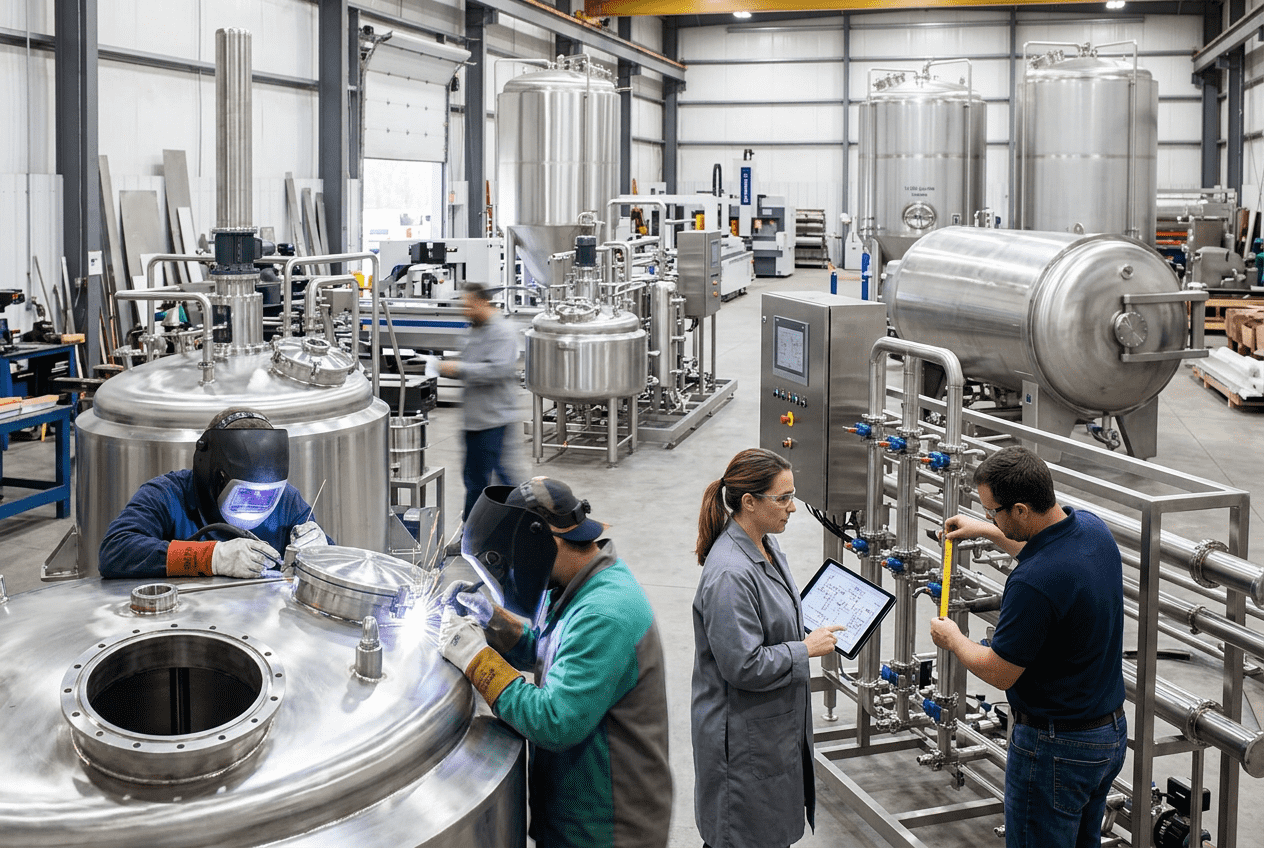
Beverage Plant HMI Design
[trp_language language=”en_US”]
Beverage plant HMI design works best when it is built around operator speed, food safety, washdown durability, and clear process visibility. In the United States, high-performing beverage HMIs give teams immediate access to carbonation, filling, CIP, pasteurization, Brix, CO2, temperature, flow, alarms, recipes, and line status without forcing operators to dig through complex screens. The most effective systems also connect PLCs, SCADA, and MES so supervisors, maintenance teams, and production leaders all see the same live data. For beverage manufacturers running carbonated soft drinks, juice, RTD, dairy beverages, kombucha, beer, wine, spirits, and aseptic lines, HMI design directly affects uptime, quality, labor efficiency, and compliance readiness.
Across the United States, especially in production hubs such as Chicago, Houston, Los Angeles, Atlanta, Charlotte, Fresno, Milwaukee, and the I-95 corridor serving East Coast distribution, beverage producers are under pressure to increase throughput while controlling labor and utility costs. Plants near major ports such as Long Beach, Savannah, New York and New Jersey, and Houston also face additional scheduling complexity tied to raw material availability, seasonal spikes, and packaging changeovers. In that environment, an HMI is not just a touchscreen. It is the day-to-day operating layer that connects the process floor to business performance.
For manufacturers seeking practical execution rather than theory, Disruptive Process Solutions approaches automation and interface design from an operations-first perspective. The company supports beverage and food manufacturers across the United States and Canada with engineering, integration, installation, and project delivery that align capital spending with measurable production gains.
Quick Answer

The best HMI design for beverage production environments in the United States uses simple navigation, role-based screen access, real-time process data, zone-specific graphics, high-contrast alarms, washdown-ready industrial hardware, and seamless integration with PLC, SCADA, and MES platforms. Operators should be able to confirm product state, line condition, critical control points, and response actions in seconds. The design should support carbonation systems, syrup rooms, blending, filling, CIP, pasteurization, utilities, and packaging with minimal training time and low error risk.
Strong beverage HMI design usually includes:
- Dedicated overview screens for each process zone and the full plant
- Live values for Brix, CO2, pressure, temperature, conductivity, flow, tank levels, and line speed
- Color standards that distinguish normal, warning, alarm, and out-of-service conditions
- Clear CIP sequence visibility, recipe confirmation, and interlock status
- Audit-friendly event logs and operator prompts
- Mobile visibility for supervisors and maintenance staff across multiple shifts
- Industrial PCs or panels selected for washdown, caustic exposure, humidity, and vibration
Plants that invest in better beverage operator interface design often reduce troubleshooting time, startup losses, flavor deviation, overfill risk, and sanitation errors. That is especially true on high-speed canning, bottling, and aseptic packaging lines where seconds matter.
HMI Design Principles for Beverage Production Environments

Beverage production environments are different from general manufacturing because process conditions change quickly and sanitation expectations are much higher. An HMI in a syrup room has different priorities than an HMI at a tunnel pasteurizer or filler discharge. Even so, several design principles should remain consistent across the plant.
First, the screen hierarchy should be intuitive. Operators should move from plant overview to area overview to equipment detail in one or two touches. If a filler trips, the operator should not need five screens to find bowl pressure, capper status, reject rates, or conveyor backup. Second, key values should be readable at a glance from typical operating distance. In U.S. beverage plants with fast changeovers and rotating crews, usability must assume the user may be tired, wearing gloves, or stepping in to help outside their usual station.
Third, alarms should inform action rather than create noise. Good alarm philosophy separates advisory conditions from line-stopping events. If every event is red and flashing, nothing is prioritized. Fourth, the interface should match how the process actually runs. Carbonation operators think in CO2 volume, pressure, and product temperature. Syrup room operators focus on batch status, ingredient sequencing, Brix verification, and transfer confirmation. CIP teams need phase, time, temperature, conductivity, chemical concentration, and destination proof. The HMI should speak the language of each role.
Fifth, sanitation and environmental exposure must influence hardware and mounting decisions. Beverage lines in North Carolina, California, Texas, Wisconsin, and Pennsylvania often experience frequent washdowns, sugar exposure, steam, and condensation. A screen that looks acceptable on a specification sheet may fail early if the enclosure, connectors, gaskets, or ventilation are not suitable for the actual area classification and washdown intensity.
The table below summarizes the most important beverage HMI design principles and why they matter on the plant floor.
| Design Principle | Plant Impact | Typical Application | Operator Benefit | Risk if Ignored | Priority Level |
|---|---|---|---|---|---|
| Simple screen hierarchy | Faster response to events | Filling and utilities | Less searching during downtime | Longer fault recovery | Very high |
| Role-based information | Better decision quality | Syrup room, blending, CIP | Only relevant values shown | Confusion and missed issues | Very high |
| High-contrast alarm design | Quicker prioritization | Pasteurization, filler, depalletizer | Immediate recognition | Alarm fatigue | Very high |
| Real-time trend visibility | Early deviation detection | Brix, CO2, temperature | Can correct before waste occurs | Delayed quality response | High |
| Washdown-ready hardware | Longer equipment life | Wet production areas | Reliable access in harsh zones | Frequent hardware failure | Very high |
| Consistent navigation standards | Lower training burden | Multi-line facilities | Faster cross-training | Operator errors during shift swaps | High |
For beverage manufacturers planning plant upgrades, this is also where front-end engineering matters. Through its controls, process, and systems integration capabilities, DPS helps align HMI design with piping, utility infrastructure, equipment layout, and process intent rather than treating the screen package as a late-stage add-on.
Multi-Zone Considerations: Carbonation, Filling, CIP, and Pasteurization Displays

A beverage facility should never rely on one generic screen strategy for all process zones. Each zone has a different operating tempo, different control variables, and different consequences when visibility is poor.
In carbonation, the operator needs a stable view of product temperature, carbonation setpoint, actual CO2, flow rate, pressure, hold consistency, and any upstream blending variation. Small drift can affect package quality, foaming, and consumer experience. A carbonation HMI should present trends in a way that shows rate of change, not only current values.
In filling, priorities include filler speed, bowl level, bowl pressure, container infeed, capper or seamer state, reject counts, low vacuum or pressure alerts, and downstream accumulation status. For high-speed lines in the United States, especially in co-packing environments, changeover guidance is also essential. Operators should see recipe confirmation, package format, sanitation release, and startup checklist status.
CIP interfaces must be extremely clear because errors can compromise product safety, create cross-contamination exposure, or waste chemicals and utilities. Display the active circuit, tank source, destination path, phase name, phase timer, conductivity, temperature, return confirmation, and valve proofing. A good CIP HMI also highlights interlocks that prevent accidental route conflicts with production.
Pasteurization screens should emphasize lethality-related values, zone temperatures, conveyor speed where applicable, product residence factors, alarms tied to safety limits, and any diversion logic for HTST or flash systems. If the plant runs tunnel pasteurization, operators need quick visibility into zone balance, package heating profile, and water recirculation conditions.
The following table shows how HMI priorities vary by zone.
| Zone | Primary Variables | Best Screen Focus | Most Common Alarm Type | Critical Operator Action | Recommended Trend View |
|---|---|---|---|---|---|
| Carbonation | CO2, pressure, product temperature, flow | Setpoint vs actual stability | Low or high carbonation drift | Correct temperature or pressure conditions | 15 to 60 minute trend |
| Filling | Line speed, bowl pressure, reject rate, accumulation | Line state and bottleneck visibility | Jam, low supply, bowl instability | Restore flow and verify package quality | Short cycle and shift trend |
| CIP | Time, temperature, conductivity, route proof | Phase progress and circuit integrity | Failed route, low temp, low concentration | Hold and verify cleaning sequence | Batch or cycle trend |
| Pasteurization | Zone temp, residence, speed, diversion logic | Safety and thermal consistency | Critical limit deviation | Adjust process or divert product | Continuous thermal trend |
| Syrup Room | Brix, batch status, ingredient dosing | Recipe execution and verification | Out-of-sequence addition | Pause batch and confirm materials | Batch trend |
| Utilities | Steam, glycol, compressed air, water | Support system availability | Pressure or temperature drop | Prevent upstream production upset | 24-hour operating trend |
Plants operating multiple beverage types, from carbonated soft drinks to kombucha or dairy-based beverages, often benefit from standardized navigation with zone-specific detail logic. That helps operators moving between lines in multi-shift operations while still preserving the needs of each process area.
Real-Time Process Visualization: Brix, CO2, Temperature, and Flow Rates
Real-time process visualization is where beverage HMI design produces some of its most measurable ROI. In syrup blending and inline dosing, Brix trends tell operators whether formulation is stable or drifting. In carbonation, CO2 and temperature trends reveal whether the process can stay within specification as speed changes. In pasteurization and hot-fill systems, temperature and flow determine both quality and regulatory confidence.
Good visualization does not mean filling every screen with gauges. It means displaying the right variables in the right context. For example, a Brix value on its own is less useful than Brix actual, Brix setpoint, recent trend, product being produced, and the active correction status. Flow is often best viewed alongside pump state, valve path, and destination confirmation. Temperature should be tied to the asset or stage where it matters most, such as blend outlet, carbonation inlet, HTST hold tube, filler bowl, or CIP return.
For many U.S. beverage facilities, line leaders and quality teams also need historical access by shift, SKU, or lot. That is why HMI screens should be designed with the broader SCADA and historian strategy in mind from the start.
The table below outlines how core beverage variables should be visualized.
| Process Variable | Where Used | Ideal Display Method | Recommended Refresh Behavior | Typical Operator Decision | Quality Impact |
|---|---|---|---|---|---|
| Brix | Blending, syrup rooms, inline formulation | Numeric plus trend with setpoint band | Near real-time | Adjust ratio or hold transfer | Flavor consistency |
| CO2 | Carbonation systems | Numeric, trend, deviation indicator | Fast update | Correct temperature or pressure | Mouthfeel and package stability |
| Temperature | Pasteurization, carbonation, CIP, hot fill | Zone map plus trend | Fast update with alarm thresholds | Prevent safety or quality loss | Safety and shelf life |
| Flow Rate | Transfer, blending, CIP, utilities | Animated line plus numeric value | Fast update | Verify routing and process balance | Batch integrity and utility use |
| Conductivity | CIP systems | Numeric with phase target range | Per phase emphasis | Confirm chemical concentration | Cleaning effectiveness |
| Tank Level | Bright tanks, syrup tanks, CIP tanks | Simple vessel graphic and percentage | Steady update | Plan transfers and avoid starvation | Line continuity |
Below is a market-oriented line chart showing estimated growth in U.S. beverage investments tied to digital visibility and operator interface modernization. It reflects realistic momentum driven by labor shortages, quality demands, and multi-line integration projects.
As more beverage producers move from isolated machine HMIs to unified visibility across blending, processing, packaging, and utilities, the value of real-time visualization continues to increase.
Mobile HMI Access for Multi-Shift Beverage Operations
Mobile HMI access has become far more relevant in U.S. beverage facilities that run two or three shifts, support multiple SKUs, and rely on maintenance and quality personnel who move constantly across the plant. Mobile access does not replace fixed HMIs at the machine. It extends visibility so supervisors, technicians, and managers can respond faster.
In practical terms, mobile access is most useful for line overview, alarm acknowledgment workflows, CIP progress review, utility checks, changeover support, and supervisory approvals. A maintenance lead should be able to see whether a filler fault is electrical, mechanical, or upstream starvation before walking across the building. A production supervisor should be able to compare line states in real time during startup. A quality manager should be able to confirm process compliance trends without waiting for reports.
However, not every control action should be mobile-enabled. For safety, security, and procedural reasons, many plants limit remote execution of critical commands such as starting pumps, forcing valves, or bypassing interlocks. Mobile design should follow role-based permissions, network segmentation, and cybersecurity best practices.
For facilities with large footprints or split operations, such as blending rooms separated from packaging halls or utility centers, mobile visibility can save significant labor time per shift. This is especially valuable in co-packing, seasonal beverage programs, and distributed campus operations near logistics hubs such as Dallas-Fort Worth, Inland Empire, and central Florida.
The bar chart below compares estimated demand for advanced HMI and mobile visibility across major beverage segments in the United States.
When mobile access is implemented correctly, it improves handoffs between day, swing, and night shifts. It can also strengthen accountability because event history, response times, and process status become easier to review.
Industrial PC Selection: Fanless, Sealed, and Washdown-Rated Options
Hardware selection is one of the most overlooked parts of beverage HMI design. A strong interface can still fail if the industrial PC or operator panel is poorly matched to washdown, temperature swing, sugar exposure, or enclosure conditions.
In beverage production, fanless designs are often preferred because they reduce contamination ingress and improve reliability. Sealed front panels help protect against moisture and routine cleaning. In wet zones, washdown-rated hardware is often necessary, particularly around fillers, rinsers, conveyors, depalletizers, and open process areas. Stainless housings or suitable enclosures may be the better choice in aggressive sanitation environments.
Screen brightness and touch performance matter too. Operators may use gloves, and ambient light can vary from dim packaging areas to bright process rooms. Mounting height, swing-arm accessibility, and cable protection also affect long-term usability. The best specification is not the most expensive one; it is the one that survives the real production environment with the least downtime.
The table below compares industrial HMI hardware considerations for beverage plants.
| Hardware Option | Best Use Area | Main Advantage | Main Limitation | Washdown Suitability | Typical Recommendation |
|---|---|---|---|---|---|
| Fanless industrial PC | General production and utilities | Higher reliability, less dust ingress | May need enclosure planning | Moderate to high with proper enclosure | Strong default choice |
| Sealed panel PC | Operator stations in wet zones | Compact and easy to mount | Service access can be tighter | High when correctly rated | Good for fillers and process skids |
| Washdown-rated stainless unit | Frequent caustic wash areas | Built for harsh sanitation | Higher capital cost | Very high | Use in exposed food contact-adjacent zones |
| Standard enclosed IPC | Dry packaging or control rooms | Lower cost | Not ideal for wet exposure | Low unless isolated | Use only in protected spaces |
| Remote thin client terminal | Plants with centralized compute architecture | Simplifies maintenance | Depends on network reliability | Varies by terminal rating | Useful in larger facilities |
| Tablet-based supervisory access | Management and maintenance review | Mobility | Not ideal as primary control point | Depends on case and environment | Use as secondary interface |
This is also where manufacturing capability matters. DPS supports processing environments with custom equipment, including tanks, CIP systems, and other integrated process assets, which allows interface hardware decisions to be coordinated with skid design, utilities, piping access, and sanitation realities rather than treated in isolation. More information on equipment integration can be found in the company’s process equipment capabilities.
Operator Interface Best Practices for High-Speed Beverage Lines
High-speed beverage lines demand interface discipline. When a line is running hundreds of containers per minute, a few seconds of hesitation can lead to product loss, package damage, or expanded downtime. The best operator interface designs support rapid comprehension under pressure.
Use muted background colors and reserve strong colors for abnormal conditions. Keep primary KPIs on one line-state screen. Show machine relationships, not only machine names. A filler fault may actually start at depalletizing, cap supply, or downstream pack-out congestion, and the screen should help the operator understand that flow logic.
Include plain-language prompts for recoverable events. “Low bowl pressure” is better than a cryptic tag, but “Check product supply valve open status and upstream balance tank level” is even better. Standardize buttons for home, alarm summary, trends, recipes, and acknowledgments across every screen. Avoid excessive animation that distracts from actual process condition.
Changeover support is especially important in beverage co-packing and SKU-dense facilities. Operators should be able to confirm package format, product selection, target speed, sanitation release, and verification checklist completion from one guided workflow. This reduces startup errors and shortens the time between batches.
The area chart below illustrates the trend shift in U.S. beverage facilities from basic local-machine interfaces toward unified, data-rich operator environments through 2026.
From a service standpoint, successful HMI execution typically requires process engineering, controls programming, field installation, commissioning, and operator training to be coordinated. That integrated delivery model is a core reason beverage manufacturers engage firms like DPS for engineering and integration services when timelines are tight and uptime expectations are high.
Integration with PLCs, SCADA, and MES for Unified Visibility
An HMI should never operate like an island. In modern beverage manufacturing, the interface must connect meaningfully with PLC logic, SCADA visualization, historian layers, and increasingly with MES or production management systems. That is how operators, supervisors, quality, maintenance, and leadership see one version of the truth.
The PLC remains the control foundation. It handles interlocks, sequences, and machine logic. The local HMI should expose what the operator needs for safe, efficient control without overcomplicating the experience. SCADA adds broader visualization, trending, alarm management, and multi-area oversight. MES or reporting layers connect production orders, downtime, genealogy, quality checks, and performance analytics.
For beverage plants with multiple processing steps, the benefit of integration is substantial. A syrup room issue should be visible to filling. A CIP lockout should be visible to production planning. Utility constraints should be visible before they stop packaging. This is especially valuable in enterprise environments operating across regions, from the Southeast and Midwest to the West Coast and cross-border Canadian operations.
The comparison chart below shows a realistic view of capability gains when beverage plants move from isolated HMI systems to integrated HMI, PLC, SCADA, and MES visibility.
Technologically, this is an area where DPS brings value beyond screen creation. Its team supports controls engineering, PLC programming, automation architecture, SCADA, process system integration, and utility coordination so clients can unify visibility from raw material handling through final packaging. That technical depth is particularly useful when retrofitting legacy beverage facilities that have grown through piecemeal expansions.
For readers evaluating implementation partners, project examples and real execution context are often more useful than generic sales claims. Relevant examples of integrated capital and process work are available in these food and beverage project case studies.
Common HMI Mistakes That Reduce Operator Effectiveness
Many beverage HMI projects fail to deliver their full value because the screens look modern but do not actually help operators perform better. The most common mistake is clutter. Too many colors, symbols, animations, and values force the user to decode the interface rather than read it. Another major problem is inconsistent design between lines or skids. If every OEM screen works differently, training becomes slow and errors increase.
Poor alarm philosophy is another frequent issue. If advisory notices, process warnings, and critical trips all appear the same way, operators lose the ability to prioritize. Hidden interlock information is also common. An operator sees that a pump will not start but cannot see the actual inhibit condition without opening multiple diagnostic screens.
Some plants also underinvest in recipe confirmation and changeover guidance. That can lead to startup waste, wrong-package events, or delayed quality release. Others fail to include maintenance-friendly diagnostics, forcing technicians to work from raw PLC tags or scattered manuals. Finally, many sites ignore the environment and install office-grade or lightly protected hardware in washdown areas, creating repeated failures that operators eventually work around.
The table below highlights common errors and practical corrections.
| Common Mistake | What Happens on the Floor | Likely Cost | Better Practice | Who Benefits Most | Implementation Difficulty |
|---|---|---|---|---|---|
| Overloaded screens | Operators miss the real issue | Longer downtime | Prioritized overview and drill-down design | Production teams | Moderate |
| Too many alarm colors | Alarm fatigue | Slow response to critical events | Standardized alarm hierarchy | Operators and supervisors | Low to moderate |
| Inconsistent navigation | Cross-trained staff struggle | Training inefficiency | Plant-wide navigation standards | All shifts | Moderate |
| Hidden interlock logic | Troubleshooting takes longer | Extended maintenance time | Visible permissive and fault detail | Maintenance | Moderate |
| No guided changeover screens | Higher startup scrap | Quality and material loss | Checklist-driven workflows | Operations and quality | Moderate |
| Wrong hardware for washdown | Frequent screen or PC failures | Unplanned replacement cost | Proper sealed or washdown-rated selection | Maintenance and finance | Low |
Buying advice for U.S. beverage manufacturers is straightforward: do not purchase an HMI solution based only on graphics demos. Evaluate it against your actual process map, sanitation routine, staffing model, reporting needs, utility dependencies, and future expansion plan. Plants expecting rapid SKU growth or line additions in 2026 and beyond should design for scalability now.
Future trends are also shaping beverage HMI strategy. By 2026, more plants are expected to use role-aware dashboards, contextual alarm guidance, energy visibility tied to utilities, stronger cybersecurity segmentation, and sustainability reporting linked to water, steam, and CIP performance. U.S. policy and customer pressure around resource use, traceability, and resilient domestic manufacturing will likely increase demand for integrated control and visibility systems. Interfaces that show water recovery, chemical use, utility intensity, and batch-level efficiency will become more common, especially in large co-packing, dairy beverage, and aseptic operations.
FAQ
What is the main goal of beverage plant HMI design?
The main goal is to help operators make fast, accurate decisions while maintaining product quality, food safety, and uptime. A good beverage HMI shows the right information at the right time and supports clear action during normal running, changeover, cleaning, and troubleshooting.
Which beverage processes need the most HMI attention?
Carbonation, blending, filling, CIP, pasteurization, and utilities usually need the most attention because small deviations in those areas can quickly affect throughput, quality, and compliance.
What data should always be visible on a beverage HMI?
That depends on the zone, but common must-have values include Brix, CO2, temperature, flow, pressure, conductivity, tank level, line speed, machine state, alarms, and recipe or SKU confirmation.
Is mobile HMI access safe for beverage plants?
Yes, if it is designed with role-based permissions, segmented networks, secure authentication, and limits on critical control actions. Mobile access is best used for visibility, acknowledgment workflows, and supervisory review rather than unrestricted machine control.
Do beverage plants need washdown-rated HMIs everywhere?
No. They need them in exposed wet or sanitation-heavy areas. Dry control rooms and protected packaging spaces may use different hardware, but wet zones around processing and filling usually require sealed or washdown-rated options.
How important is HMI integration with SCADA and MES?
It is increasingly important. Integration improves traceability, downtime analysis, production visibility, reporting, and consistency across shifts and lines. It also helps management understand how process events affect business performance.
What industries benefit from the same design logic?
Beyond carbonated soft drinks and brewing, the same HMI principles help juice, dairy beverages, spirits, wine, functional drinks, kombucha, aseptic products, prepared foods, sauces, and other sanitary process industries.
What should buyers ask a supplier before approving an HMI project?
Ask how the design handles alarm philosophy, changeovers, CIP visibility, historical trends, washdown durability, PLC and SCADA integration, mobile access, training, cybersecurity, spare parts strategy, and future expansion.
Why do some HMI projects underperform even after installation?
Usually because the system was designed around equipment tags instead of operator decisions, or because process, controls, and operations teams were not aligned during design.
Who is a strong fit for this kind of project support?
Mid-market and enterprise beverage manufacturers looking for process engineering, system integration, equipment coordination, and disciplined execution often benefit most from working with a partner that understands both operations and capital planning. Companies looking to align throughput, quality, and profitability can learn more about the team behind that approach at DPS.
In summary, beverage plant HMI design in the United States should be treated as a production performance tool, not just a controls accessory. The strongest systems combine intuitive operator screens, process-specific visibility, durable hardware, and full integration across control and reporting layers. When designed properly, they support faster startups, more stable quality, safer cleaning, and better decisions at every shift level.
[/trp_language]
Complete Company Portfolio

About the Author: Disruptive Process Solutions (DPS)
The DPS team combines process engineering expertise with real-world food and beverage manufacturing experience. Our content focuses on process optimization, production efficiency, facility improvements, and practical solutions that help manufacturers operate more effectively in a rapidly evolving industry.
Share

