CIP Systems for Food Processing
[trp_language language=”en_US”]
Food manufacturers in the United States use CIP systems, or clean-in-place systems, to wash tanks, pipes, fillers, heat exchangers, and process lines without taking equipment apart. A well-designed CIP program improves food safety, supports FDA FSMA compliance, reduces downtime, and lowers labor, water, chemical, and energy use. For dairies, beverage plants, protein processors, sauce makers, aseptic lines, and co-packers, the right CIP design depends on product soil, line complexity, production schedule, utilities, and validation requirements.
CIP Systems for Food Processing in the United States
Fast Answer

CIP systems are automated or semi-automated cleaning packages that circulate water, detergents, caustic, acid, and sanitizer through closed food processing equipment. In U.S. food plants, they are commonly used in dairy, beverage, prepared foods, sauces, proteins, and aseptic operations where repeated internal cleaning is essential. The best CIP system balances the four TACT variables: time, action, concentration, and temperature. It also matches plant production goals, utility capacity, sanitation standards, and documentation needs.
For a plant in Chicago producing dairy beverages, a brewery in North Carolina, a protein facility in Texas, or a sauce plant near California’s Central Valley, CIP design must account for line lengths, soil load, allergen changeovers, water reuse strategy, and automation level. When engineered correctly, CIP can reduce manual cleaning exposure, increase uptime, and produce repeatable sanitation records that support audits and customer requirements.
The chart above reflects a realistic growth direction for automated CIP adoption in the United States as plants upgrade aging systems, add recipe-driven cleaning, and invest in sustainability before 2026. Demand is especially strong in dairy, ready-to-drink beverages, aseptic processing, and high-care food facilities.
How Clean-in-Place Works in Food Plants

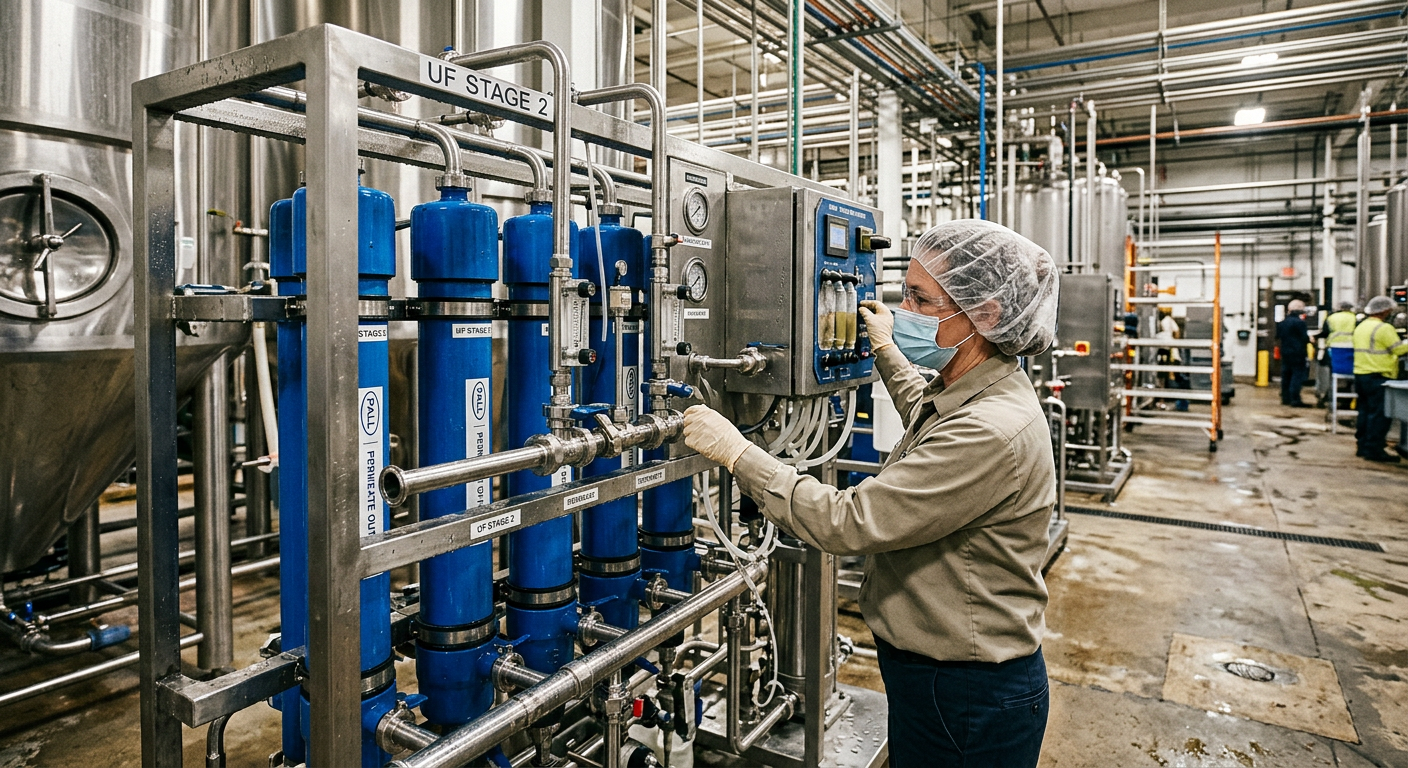
A CIP system cleans the internal surfaces of process equipment by circulating cleaning solutions at controlled flow, concentration, and temperature. Instead of dismantling equipment after each run, operators select a cleaning recipe from a local HMI or plant SCADA system. The skid then performs each step in sequence, often with automated valve routing, conductivity control, temperature verification, and return monitoring.
In a typical U.S. food plant, the CIP skid is connected to process circuits such as mix tanks, pasteurizers, pipelines, fillers, holding tubes, balance tanks, and transfer manifolds. Cleaning solutions are delivered from dedicated tanks by sanitary pumps through supply headers, valve matrices, and return lines. Sensors confirm temperature, flow, level, and chemical strength. Once a cycle is complete, reports can be stored electronically for QA review and audit support.
How CIP works in practice depends on the process. A yogurt line in Wisconsin may need strong protein and mineral removal. A sauce facility in New Jersey may need aggressive cleaning for starch, oil, and seasoning carryover. A kombucha plant in California may prioritize biofilm control and low-oxygen sanitary design. A protein marinade line in Arkansas may focus on allergen changeovers and difficult-to-remove fats. The cleaning method changes, but the objective stays the same: remove soil, reduce microorganisms, and restore a validated hygienic condition before the next production run.
Many companies also connect CIP performance to overall equipment effectiveness. If cleaning takes too long, production hours shrink. If cleaning is too weak, microbiological risk rises. If utility use is too high, the cost per case goes up. That is why more processors now treat CIP as an engineered production asset, not just a sanitation utility.
For manufacturers evaluating integrated process improvements, about our team explains how a full-scope engineering partner can align sanitation design with throughput, utility planning, and long-term profitability.
Market conditions in the United States
Across the United States, CIP investment is being driven by labor shortages, stricter customer audits, increased allergen management expectations, and utility cost pressure. Regions with dense food manufacturing clusters such as Wisconsin, the Carolinas, Texas, California, the Midwest, and the Northeast are seeing particular interest in centralized and recovery-enabled CIP systems. Plants near logistics hubs like Houston, Savannah, Newark, and the Ports of Los Angeles and Long Beach often face speed-to-market demands that make reduced downtime especially valuable.
Typical product categories using CIP
CIP is widely used for milk, yogurt, cream, cultured products, RTD coffee, carbonated drinks, juice, plant-based beverages, beer, spirits, wine, sauces, dressings, soups, liquid eggs, prepared foods, liquid sweeteners, and aseptic formulations. It is less suitable for every equipment item in heavy dry processing or open-product equipment, where COP or manual cleaning may still be required.
CIP or COP: Choosing the Right Cleaning Approach

CIP and COP solve different sanitation problems. CIP cleans enclosed equipment in place. COP, or clean-out-of-place, requires components to be removed and washed in a separate tank, cabinet, or wash area. In many plants, the best strategy is not choosing one over the other but using both in the correct locations.
CIP is ideal for pipelines, heat exchangers, storage vessels, blending systems, UHT circuits, fillers with sanitary routing, and other closed systems. COP is better for small removable parts, gaskets, screens, utensils, fillers with complex disassembly points, and equipment where internal spray coverage cannot be validated. The choice depends on product contact geometry, risk level, labor, and turnaround requirements.
| Criteria | CIP | COP | Best Fit |
|---|---|---|---|
| Equipment type | Closed tanks, pipes, heat exchangers, fillers | Removable parts, utensils, screens, valves | Use based on accessibility |
| Labor demand | Lower after automation | Higher manual handling | CIP for labor reduction |
| Validation consistency | High with sensors and recipes | Depends on operator discipline | CIP for repeatability |
| Changeover speed | Fast on frequent production runs | Slower due to teardown and reassembly | CIP for high-throughput plants |
| Capital cost | Higher initial investment | Lower equipment cost, higher labor cost | Depends on volume and schedule |
| Worker exposure | Less direct chemical contact | More chemical and ergonomic exposure | CIP improves safety |
| Complexity handling | Requires sanitary design and returnability | Good for components with dead spots | COP for hard-to-spray parts |
The table shows why beverage, dairy, and liquid food plants usually lean heavily on CIP, while mixed operations often preserve COP stations for removable components and specialty tools. If your site runs frequent SKU changes, allergen transitions, or round-the-clock production, CIP usually delivers better economics over time. If your equipment has hard-to-clean dead ends or must be dismantled for inspection anyway, COP remains essential.
Buying advice for U.S. processors
When selecting a CIP method, start with a sanitation map. Identify which circuits are true closed systems, which lines can be reliably spray-cleaned, and where manual teardown still provides the only safe verification. Then compare production losses from downtime against the capital cost of automation. In many cases, a modular CIP skid for the most critical lines pays back faster than a plantwide rebuild.
Processors should also ask whether the system can expand. A co-packer in Atlanta may begin with two cleaning circuits and later add syrup rooms, blend tanks, and fillers. A dairy in Idaho may add recovery tanks or conductivity-based chemical reclaim after year one. Building in future valve ports, extra I/O, and scalable controls can prevent expensive redesign later.
Demand is strongest where product soils are difficult, sanitation documentation is strict, and downtime is expensive. Aseptic systems and dairy lines lead the list because they require highly repeatable cleaning and validated controls.
The Four TACT Factors: Time, Mechanical Action, Chemical Strength, and Heat
Every CIP program depends on four core variables: time, action, concentration, and temperature. These variables interact. If one factor drops, another may need to increase to achieve the same cleaning result. That is why experienced sanitation engineers do not copy recipes from one plant to another without testing product soils, line geometry, and process conditions.
| TACT Factor | What It Means | If Too Low | If Too High | Typical Control Method |
|---|---|---|---|---|
| Time | How long each step runs | Incomplete soil removal | Wasted utilities and lost production time | Recipe timers and validation studies |
| Action | Flow, turbulence, impingement, and return velocity | Biofilm and residue remain | Pump wear or spray device overrun | Flow meters, pump sizing, spray device design |
| Concentration | Chemical strength of caustic, acid, or sanitizer | Poor cleaning and contamination risk | Corrosion, residue, and high cost | Conductivity, titration, dosing control |
| Temperature | Heat applied to improve chemical activity | Fat and protein soils stay on surfaces | Burn-on, vapor issues, energy loss | Heat exchangers, steam control, RTD sensors |
| Surface condition | Finish, weld quality, and hygienic design | Residues cling to rough areas | Excess polish may not solve geometry issues | 3-A style sanitary design review |
| Water quality | Hardness and mineral content affecting chemistry | Scaling, weak detergency, spotting | Unnecessary pretreatment cost | Water treatment and testing |
| Soil type | Protein, sugar, fat, mineral, starch, flavor oil | Wrong chemistry chosen | Over-cleaning with excess chemical | Product-specific sanitation development |
This table adds two practical extensions beyond classic TACT: surface condition and water quality. In real food plants, those two factors often explain why a recipe works in one facility but fails in another. For example, a plant in Denver with hard water may struggle with mineral film, while a fresh dairy beverage plant in upstate New York may see protein burn-on around heat transfer surfaces.
For 2026, the major trend is dynamic TACT control. Instead of fixed recipes only, newer CIP platforms adjust cycle length, recovery routing, and chemical replenishment based on conductivity, turbidity, temperature hold, and return clarity. That means less over-cleaning and better evidence for sustainability reporting.
Typical CIP Sequence: From Pre-Rinse Through Final Sanitation
While every process has its own recipe, most food and beverage CIP systems in the United States follow a common sequence. The exact temperatures, dwell times, and chemical concentrations depend on product type, allergen load, and hygienic risk category.
| Step | Main Purpose | Typical Medium | What Operators Watch |
|---|---|---|---|
| 1. Product push or recovery | Remove sellable product before cleaning | Air, water, pigging, or displacement | Yield recovery and line segregation |
| 2. Pre-rinse | Flush loose soils from the circuit | Ambient or warm water | Return clarity and drain load |
| 3. Caustic wash | Break down fats, proteins, and organics | Alkaline detergent | Temperature, conductivity, flow, time |
| 4. Intermediate rinse | Remove alkaline residue | Water | pH or conductivity return trend |
| 5. Acid wash | Remove mineral scale and neutralize | Acid solution as required | Concentration and compatibility |
| 6. Final rinse | Clear chemical traces | Potable or treated water | Final conductivity and quality standard |
| 7. Sanitation step | Reduce microbial load before production | Hot water, PAA, or other approved sanitizer | Contact time and no-rinse compliance |
| 8. Verification and release | Confirm line is ready | ATP, swabs, records, sensor data | QA approval and digital documentation |
The sequence above should not be treated as universal. Some beverage systems skip acid on every cycle and use it periodically. Aseptic circuits often have tighter thermal and sterility requirements. Viscous products like dressings or dairy desserts may need longer caustic exposure and stronger return velocities. Product recovery methods such as pigging can greatly reduce waste before the rinse even begins.
Plants trying to improve cycle performance should analyze the full timeline, not just chemical stages. A large portion of lost time often comes from valve delays, tank refills, routing errors, and manual verification. Better controls and line design can shorten these non-cleaning minutes significantly.
Applications by industry
Dairy plants commonly use full-step CIP with frequent acid circulation because milkstone and protein buildup are persistent. Breweries and RTD beverage plants often prioritize yeast removal, sugar control, flavor carryover prevention, and quick turnaround between batches. Sauce and prepared food plants may need longer washes for starches, gums, spices, and oil films. Aseptic processors depend on tightly validated cycles with precise thermal and chemical control because the cost of a sanitation failure is much higher.
Core Equipment: Tanks, Pumps, Heat Exchangers, and Control Panels
The quality of a CIP system depends as much on hardware design as on chemistry. Core components include solution tanks, supply and return pumps, heaters or heat exchangers, valve sets, instrumentation, control panels, and often conductivity or flow verification devices. The best design matches the plant’s production reality rather than a generic skid template.
| Component | Function | Selection Priority | Common U.S. plant concern |
|---|---|---|---|
| Rinse and chemical tanks | Store and recirculate solutions | Volume, insulation, sanitary finish | Insufficient capacity for multiple circuits |
| Supply pump | Drives cleaning solution through the loop | Flow, head, NPSH, sanitary design | Low turbulence at far line ends |
| Return pump | Moves solution back to skid or drain | Stable return and foam handling | Air entrainment and erratic conductivity |
| Heat exchanger or heater | Maintains cleaning temperature | Utility match and response speed | Steam variability or energy waste |
| Valve matrix | Routes circuits automatically | Seat lift, mix-proof logic, drainability | Cross-contamination risk |
| Instrumentation | Measures flow, conductivity, level, temp | Accuracy and sanitary mounting | Poor calibration control |
| Controls and HMI | Runs recipes and captures records | Ease of use, batch records, alarms | Limited audit trail visibility |
Processors buying a new system should examine more than tank count and pump horsepower. Ask whether the skid supports single-use or recovery mode, whether controls can integrate with existing PLC or SCADA architecture, and whether recipes can be locked by QA. Also review sanitary weld quality, dead-leg minimization, access for maintenance, and spare parts availability in the United States.
Many growing manufacturers now favor modular skids that can be expanded from one or two circuits to larger multi-line packages. That matters for co-packers around Dallas, Charlotte, and Phoenix where production can scale quickly. It also matters in port-adjacent beverage facilities near Los Angeles, Houston, or Savannah where import and export schedules drive aggressive uptime expectations.
Technological capabilities
Advanced engineering firms increasingly combine process, mechanical, electrical, and controls expertise to deliver CIP that actually works in the field. This includes PLC programming, SCADA integration, recipe control, utility balancing, heat recovery design, inline Brix interfaces, aseptic sanitation logic, and complete process line coordination. In modern projects, CIP is no longer an isolated skid; it is part of the plantwide automation and production strategy.
For companies seeking this level of integration, engineering and project services are often the deciding factor between a system that merely circulates chemicals and one that improves operating margin.
Manufacturing capabilities
Custom-built tanks, CIP skids, cooking vessels, and related sanitary equipment can improve project alignment when standard catalog systems do not fit the process. U.S. processors often benefit from suppliers that can tailor tank size, skid footprint, utility connections, and instrumentation for specific dairy, beverage, or food applications. More details on sanitary process hardware can be found in these process equipment solutions.
Meeting FDA FSMA, 3-A, SQF, and BRC Expectations
CIP systems do not create compliance on their own, but they strongly support it when properly designed, validated, and documented. In the United States, FDA FSMA pushes food plants toward preventive controls and documented sanitation practices. 3-A sanitary principles influence hygienic equipment design, especially in dairy and liquid food applications. SQF and BRC auditors typically expect evidence that sanitation procedures are controlled, repeatable, and verified.
A sound CIP program helps meet these expectations by standardizing recipes, minimizing operator variation, recording critical parameters, and demonstrating that cleaning is tied to hazard control. Auditors often review chemical use, verification records, corrective actions, allergen cleaning validation, and preventive maintenance for instruments and valves.
| Standard or Framework | What It Focuses On | Why CIP Matters | Evidence Commonly Reviewed |
|---|---|---|---|
| FDA FSMA | Preventive controls and sanitation verification | Supports hazard control and documented cleaning | SSOPs, records, corrective actions |
| 3-A sanitary expectations | Hygienic design and cleanability | Improves drainability and spray coverage | Equipment design review and inspections |
| SQF | Food safety system documentation | Requires consistent sanitation control | Validation, verification, calibration logs |
| BRCGS | Site standards and risk-based controls | Supports traceable and repeatable cleaning | Cleaning schedules, trending, deviations |
| USDA-related operations | Sanitation in regulated protein environments | Critical where residues and pathogens are high risk | Pre-op inspections and records |
| Customer audits | Brand-specific standards and KPI visibility | Proves consistency across lots and shifts | Digital reports, ATP, allergen validation |
The key message is that compliance is operational. A plant can install a premium CIP skid and still fail audits if spray devices are not maintained, recipes are not validated, or sensors drift out of calibration. Conversely, a right-sized system with disciplined records can perform extremely well in audits.
By 2026, expect stronger customer pressure for digital sanitation records, water use visibility, and sustainability-linked reporting. Food manufacturers supplying national retail chains are increasingly expected to show not only that equipment was cleaned, but also how efficiently the cleaning was performed.
Reducing Water, Chemical, and Energy Use with Automated CIP
One of the strongest business cases for automated CIP is utility savings. Water, sewer, chemical, steam, and labor costs continue to rise across the United States. Plants in California, Arizona, and parts of Texas feel water pressure acutely, while plants in the Midwest and Northeast often focus on energy cost and wastewater loading. An optimized CIP system reduces total cost by matching cleaning intensity to soil load instead of over-cleaning every line.
Common savings strategies include conductivity-based chemical reclaim, final-rinse recovery, automated concentration control, insulated tanks, heat recovery, variable frequency drives, product recovery before rinse, and recipe segmentation by product family. A low-acid RTD line does not need the same cycle every time as a heavy cream line or a sticky syrup circuit.
The area chart illustrates a realistic trend shift toward sustainability-focused CIP design. More U.S. plants are moving beyond simple automation and into recovery-enabled, data-driven sanitation platforms because utility costs and ESG expectations are no longer secondary issues.
Plants should measure utilities per clean, per batch, and per case. That turns CIP from a fixed overhead into a controllable KPI. In many projects, the easiest savings are not from cutting chemical strength, but from reducing unnecessary rinse time and recovering hot solutions correctly.
Service capabilities
Food and beverage manufacturers often need more than equipment supply. They need front-end feasibility, capital planning, installation management, controls integration, startup support, and commissioning. A design-build-manage approach is useful because CIP touches process piping, utilities, automation, wastewater, scheduling, and food safety documentation at the same time. That is especially true for expansions, line relocations, and greenfield co-packing facilities where sanitation must be coordinated with overall plant profitability.
A practical example of execution-focused support is shown in these project case examples, where engineering decisions are tied directly to throughput, capital efficiency, and operational outcomes rather than just equipment delivery.
Local supplier considerations
When evaluating suppliers in the United States, prioritize field service access, spare parts support, controls expertise, and sanitary fabrication quality. A lower-priced skid loses value quickly if your plant in Tennessee or Oregon waits days for startup help or struggles to integrate with existing PLC standards. Look for partners who understand both food safety and production economics.
This comparison reflects a common pattern: higher automation often creates more lifecycle value when plants have enough throughput, sanitation complexity, and audit pressure to justify it. The best option is not always the most advanced one, but the one correctly sized for your operation.
Frequent CIP Problems in Food Facilities and How to Avoid Them
Most CIP failures are not caused by one dramatic defect. They come from small mismatches between recipe, equipment design, instrumentation, and production behavior. Many food plants discover problems only after microbial counts rise, allergen swabs fail, or audits expose record gaps.
| Failure | Likely Cause | Operational Impact | Prevention |
|---|---|---|---|
| Poor soil removal | Low flow, weak chemistry, short cycle time | Residue, microbial risk, repeat cleaning | Validate TACT, verify flow and concentration |
| Chemical carryover | Inadequate rinse or valve routing error | Product contamination and waste | Use conductivity endpoints and valve proofs |
| Cross-contamination | Mix-proof failure, poor segregation, bad logic | Allergen or product safety incident | Review piping design and interlocks |
| Inconsistent records | Manual entry or missing sensor data | Audit exposure and weak investigations | Automate data capture and alarm history |
| Excessive utility use | Overlong rinses and no recovery strategy | High cost per case and wastewater load | Optimize recipes and add recovery logic |
| Sensor drift | Poor calibration program | Wrong concentration or temperature control | Routine calibration and verification |
| Spray coverage gaps | Improper tank geometry or device selection | Persistent residue and failed verification | Coverage testing and hygienic redesign |
The table above highlights the most frequent failure points seen in U.S. food plants. Preventing them requires cross-functional ownership. Sanitation alone cannot solve a valve matrix issue. Maintenance alone cannot validate allergen removal. Engineering alone cannot compensate for poor operating discipline. Successful CIP programs connect QA, operations, maintenance, utilities, and controls teams.
Case study patterns seen in the market
In many expansions, processors first believe they need larger tanks or more production lines when the true bottleneck is cleaning time or poor controls logic. A better CIP sequence, improved valve automation, or corrected return flow can unlock more capacity without major process equipment replacement. This is especially common in beverage and dairy facilities where sanitation windows quietly consume usable production hours.
Another frequent scenario involves line additions that outgrow the original skid. Plants in fast-growth areas such as central Texas, the Carolinas, and Southern California often install basic systems early, then face high water use, routing conflicts, and scheduling strain as new products are added. A phased design with expansion capability is usually the better long-term choice.
2026 outlook
Looking ahead, the CIP systems that gain traction in 2026 will be those that combine sanitation assurance with measurable resource efficiency. Expect wider use of predictive maintenance for pumps and valves, digital twin modeling for cleaning circuits, remote support for controls troubleshooting, and stronger integration between CIP data and plant MES or ERP systems. Policy pressure around water and wastewater, especially in drought-sensitive regions, will keep accelerating recovery and reuse features.
Frequently Asked Questions
What does CIP mean in food processing?
CIP means clean-in-place. It refers to cleaning the inside of process equipment without disassembling the system. Solutions are circulated through closed equipment under controlled conditions.
What industries use CIP systems most in the United States?
Dairy, beverage, brewing, plant-based beverage, sauces, prepared foods, aseptic processing, and some liquid protein operations are the heaviest users. These sectors need frequent, repeatable internal cleaning with documented control.
Is CIP always better than COP?
No. CIP is better for enclosed sanitary systems, while COP remains important for removable parts and equipment that cannot be fully validated in place. Most plants use both methods.
How long does a typical CIP cycle take?
It varies by product and system design. A simple circuit may clean in under an hour, while complex, high-risk, or heavily soiled systems can take much longer. Optimization should be based on validated results, not guesswork.
What chemicals are commonly used in CIP?
Common options include caustic detergents, acid cleaners, and sanitizers such as peracetic acid, depending on the product soil, material compatibility, and plant sanitation program.
How can a plant reduce CIP water use?
Use product recovery before rinsing, optimize cycle timing, reclaim final rinse water where appropriate, automate chemical concentration control, and add heat or solution recovery strategies.
What records should be kept for CIP compliance?
Plants should keep cycle parameters, temperature data, conductivity or concentration records, verification results, corrective actions, calibration logs, and maintenance history for critical sanitation equipment.
What should buyers ask a CIP supplier?
Ask about sanitary design, circuit capacity, controls integration, data capture, utility demand, recovery options, validation support, startup service, future expansion, and U.S. parts availability.
Can CIP improve profitability, not just food safety?
Yes. Better CIP design can increase uptime, reduce labor, lower utility costs, improve product recovery, shorten changeovers, and support more stable production schedules.
How should a processor start a CIP upgrade project?
Start with a line audit: map soils, utilities, cleaning times, downtime cost, compliance gaps, and growth plans. Then compare a targeted upgrade against a full-system replacement based on payback and operational risk.
For food and beverage manufacturers in the United States, CIP is no longer just a sanitation necessity. It is a production, compliance, and cost-control system that directly affects plant performance. Whether the need is a new skid for a dairy plant, a scalable system for a co-packer, or a full process integration strategy for a beverage or prepared food facility, the right design should fit the plant’s products, people, utilities, and long-term business plan.
[/trp_language]
Complete Company Portfolio
About the Author: Disruptive Process Solutions (DPS)
The DPS team combines process engineering expertise with real-world food and beverage manufacturing experience. Our content focuses on process optimization, production efficiency, facility improvements, and practical solutions that help manufacturers operate more effectively in a rapidly evolving industry.
Share