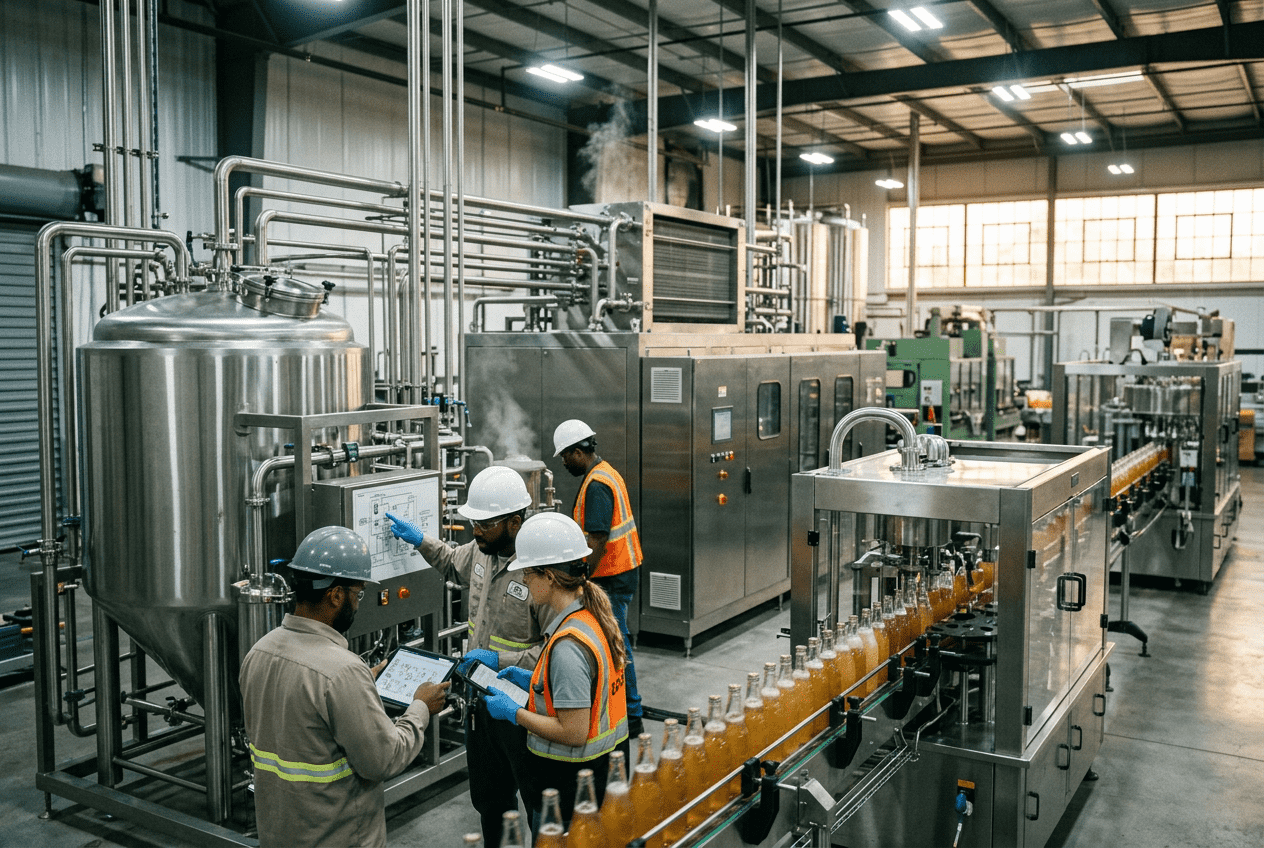
CIP Controls Automation Services
[trp_language language=”en_US”]
Clean-in-place automation is no longer a nice-to-have for U.S. food, beverage, dairy, protein, and aseptic manufacturers. It is a core production asset that directly affects sanitation repeatability, utility use, labor efficiency, product safety, and audit readiness. Well-designed CIP controls automation services combine PLC sequence programming, operator-friendly HMI screens, sensor validation, automated chemical dosing, data logging, alarm management, and plant-level integration so every wash cycle runs the same way every time. For manufacturers in markets such as Chicago, Dallas, Charlotte, Los Angeles, Atlanta, Houston, Fresno, Milwaukee, and the Mid-Atlantic corridor, the right control strategy can reduce downtime, improve first-pass sanitation compliance, and support expansion without rebuilding the entire process platform.
In the United States, CIP controls are especially valuable in facilities handling allergen changeovers, high-acid and low-acid beverages, cultured dairy, sauces, marinades, meat and poultry lines, aseptic systems, and co-packing operations where frequent product transitions demand documented cleaning performance. The most successful automation projects are built around plant realities: existing tanks and skids, operator skill levels, chemical supplier requirements, USDA or FDA expectations, utility constraints, and business goals. That means the best partner is not simply a programmer, but an engineering and integration team that understands process design, field installation, production economics, and regulatory expectations.
Quick Answer

CIP controls automation services in the United States typically include sequence development for pre-rinse, caustic, intermediate rinse, acid, sanitizer, recovery, and final rinse steps; PLC programming to enforce interlocks, recipe control, timing, and permissives; HMI development for cycle selection and operator guidance; integration of temperature, conductivity, flow, and level instruments; automatic concentration control and chemical dosing; data logging and electronic batch records; SCADA connectivity for remote monitoring and alarms; and interfaces to MES or ERP systems for production traceability. For regulated and audit-sensitive environments, a complete scope also includes commissioning support and validation documentation for IQ, OQ, and PQ.
For many U.S. manufacturers, the biggest return does not come from simply automating valves and pumps. It comes from standardizing cleaning performance across shifts, reducing water and chemical losses, minimizing manual overrides, shortening changeovers, and creating trustworthy records for quality, food safety, and customer audits. Plants near major logistics and production hubs such as California’s Central Valley, North Carolina’s research and manufacturing corridor, the Texas triangle, and the Great Lakes dairy region often prioritize these improvements because volume, labor pressure, and customer scrutiny are high.
| Business Need | Typical CIP Control Function | Operational Benefit | Who Cares Most |
|---|---|---|---|
| Reduce sanitation variation | Recipe-based PLC sequences | Repeatable cleaning across shifts | Quality and operations teams |
| Lower chemical waste | Conductivity-guided dosing and recovery | Less overuse of caustic and acid | Plant managers and EHS |
| Shorten changeovers | Automated routing and valve confirmation | More available production time | Production scheduling |
| Improve audit readiness | Electronic records and event logs | Faster review during inspections | QA and compliance |
| Reduce operator error | Guided HMI prompts and alarms | Fewer missed steps and safer execution | Sanitation supervisors |
| Support expansion | SCADA and MES-ready architecture | Easier scale-up for new lines | Leadership and engineering |
The table above shows why CIP automation is both a sanitation and a business decision. Plants that treat it only as a controls retrofit usually miss larger gains in uptime, utility reduction, and reporting discipline.
PLC Programming for CIP Sequences: Best Practices & Standards

Strong PLC programming is the foundation of an automated CIP system. In practice, CIP sequence logic must do more than turn pumps on and off. It must manage tank selection, return path verification, valve proofing, step timing, temperature hold conditions, flow minimums, conductivity thresholds, chemical reclaim rules, drain or recovery decisions, and safe shutdown logic during a fault. U.S. facilities commonly require multiple recipes for product family, line length, allergen risk, soil load, and sanitation standard. A brewery in Milwaukee, a dairy processor in Wisconsin, and a sauce facility near Memphis may all use CIP, but their sequence philosophies can differ dramatically.
Best practice is to use modular code blocks for devices and reusable step templates for rinse, wash, recovery, and sanitize phases. That shortens validation time and makes future expansion easier. Interlocks should be explicit: no caustic circulation without verified tank level, no heat enable without flow, no route open without destination confirmation, and no chemical transfer without permissive status from the receiving vessel. Another standard is robust fault handling. Operators should know whether the cycle is paused, aborted, awaiting acknowledgment, or safe to resume.
Many American plants also benefit from ISA-aligned naming conventions, consistent alarm classes, and recipe management structures that can be understood by maintenance teams after project handover. Standardized code matters even more when a manufacturer has multiple facilities across states such as North Carolina, California, Texas, and Ohio. Replicability reduces support cost.
| CIP Sequence Element | Programming Best Practice | Reason | Common Risk If Ignored |
|---|---|---|---|
| Recipe management | Parameterized cycle templates | Fast deployment across lines | Hard-coded logic and poor scalability |
| Valve routing | Proof-of-position interlocks | Prevents cross-contamination | Misrouted chemical or rinse water |
| Temperature control | Hold timers only after setpoint achievement | Ensures true exposure time | False completion of wash step |
| Flow assurance | Minimum flow permissives and alarms | Confirms cleaning velocity | Shadowing and ineffective cleaning |
| Conductivity logic | Upper and lower thresholds with hysteresis | Stable chemical decision making | Oscillation or wrong recovery decision |
| Abort recovery | Defined fail-safe state | Protects equipment and personnel | Unsafe restart or incomplete cleaning |
| Batch records | Time-stamped state changes | Supports QA review | Missing audit trail |
As buying advice, manufacturers should ask prospective automation partners how they structure CIP phases, manage reusable code libraries, test abnormal conditions, and document sequence narratives. A qualified integrator should explain how commissioning, FAT, SAT, and operator training are handled, not just the programming hours.
The line chart illustrates a realistic growth trend in CIP automation demand as U.S. plants modernize for labor efficiency, traceability, and sustainability.
HMI Design: Operator Interface for CIP Cycle Control & Monitoring

An HMI for CIP should make correct operation easy and incorrect operation difficult. That means the interface should not overload the operator with every tag in the system. Instead, it should present the current route, selected recipe, active step, elapsed time, target values, actual values, permissive status, and alarm priority clearly. Color use should be consistent. Navigation should be shallow. Manual mode should be protected. Cleaning history should be easy to find. On large campus facilities or multi-line plants, a role-based design often works best, with summary views for supervisors and detailed diagnostics for maintenance.
In the United States, operator populations can vary widely by site and shift. HMI design should account for training turnover, sanitation crews working under time pressure, and quality personnel who need review screens during audits. On protein, dairy, and beverage lines, a good interface reduces costly mistakes such as launching the wrong recipe, returning weak chemical to a concentration tank, or bypassing a temperature hold.
Useful HMI screens often include a cycle overview, route matrix, trend display, alarm summary, chemical tank status, utility dashboard, and record review page. For facilities connected to broader digital systems, the HMI should also expose lot or batch identifiers tied to the wash cycle. This is especially useful in co-pack and contract manufacturing settings where proof of sanitation between products can affect customer acceptance.
| HMI Screen Type | Primary User | What It Shows | Why It Matters |
|---|---|---|---|
| Cycle overview | Operators | Current step, recipe, status, timers | Fast situational awareness |
| Route visualization | Operators and maintenance | Open valves, active tanks, return path | Confirms process path |
| Instrument dashboard | Maintenance and QA | Temperature, conductivity, flow, level | Verifies cleaning conditions |
| Alarm summary | All users | Priority, cause, acknowledgment state | Improves response time |
| Manual control page | Authorized maintenance only | Device jog and service actions | Protects system integrity |
| Batch record review | QA and supervisors | Completed cycles and exceptions | Supports audits and release decisions |
For plants evaluating vendors, ask to see sample HMI standards and alarm philosophy documents. If a provider cannot explain how operators will actually use the screens on second shift at 2 a.m., the design may be too engineering-centric.
Sensor Integration: Temperature, Conductivity, Flow & Level
CIP performance depends on measurement quality. Temperature confirms thermal cleaning conditions. Conductivity supports concentration verification, phase detection, and reclaim decisions. Flow helps ensure the proper turbulence and line coverage needed for cleaning. Level protects pumps, validates chemical inventory, and coordinates transfer steps. In sophisticated systems, pressure, pH, turbidity, and valve feedback add even more confidence, but the four core measurements remain the backbone of most U.S. food and beverage CIP skids.
Sensor integration should be treated as a process engineering task, not just an I/O list. Placement matters. Calibration strategy matters. Instrument range, hygienic connection type, cable routing, washdown ratings, and response speed all matter. A conductivity meter mounted in the wrong location may create false chemical transitions. A temperature RTD installed too close to the heater may overstate actual circuit temperature. A magnetic flowmeter on an incompletely filled line may mislead the control logic.
For local supplier planning, many U.S. facilities source instrumentation through regional networks in hubs like Houston, Minneapolis, Chicago, and California, but selection should be based on sanitary suitability, service support, and controls compatibility rather than brand habit alone. Plants with aggressive expansion plans should also choose instruments that fit into a broader digital maintenance strategy.
| Sensor Type | Main CIP Use | Typical Placement Concern | Control Action Supported |
|---|---|---|---|
| Temperature RTD | Wash and sanitize verification | Avoid localized hot spots | Hold timer enable |
| Conductivity sensor | Chemical strength and phase split | Stable flow profile required | Dose, recover, or drain decision |
| Flowmeter | Cleaning velocity confirmation | Full pipe and straight runs | Pump permissive and alarm |
| Level transmitter | Tank inventory and pump protection | Foam and geometry effects | Transfer and low-level shutdown |
| Pressure transmitter | Route verification and pump performance | Pulsation filtering | Abnormal restriction detection |
| pH sensor | Neutralization and specialty wash control | Frequent calibration needs | Wastewater and process transition logic |
The explanation behind this table is simple: better instruments create better CIP decisions. In many retrofits, sequence logic is blamed for poor wash performance when the root cause is weak signal quality or bad instrument placement.
Automated Chemical Dosing & Concentration Control
Automated dosing protects cleaning consistency and operating cost. In manual systems, concentration drift is common because operators rely on estimated additions, strip tests, or inconsistent setpoints. Automated control uses conductivity, level, flow, and recipe logic to meter caustic, acid, sanitizer, or additives into the correct tank at the correct time. This is especially valuable in high-throughput U.S. plants where several CIP turns may be completed in a single day and where chemistry cost, wastewater load, and safety exposure are under constant scrutiny.
Concentration control should be designed around the chemistry provider’s recommended operating window, the soil profile, and recovery philosophy. Some facilities prefer tight automated trim additions. Others use larger batch corrections. Recovery loops may send strong return to reclaim, weak return to drain, and intermediate return to a recovery tank depending on conductivity thresholds. Good controls also account for dilution from make-up water, heat exchange, and carryover.
Plants producing dairy beverages, sauces, fermented products, protein slurries, and aseptic liquids often see measurable ROI from automated dosing because these applications are sensitive to under-cleaning, allergen risk, and downtime. From a sustainability standpoint, concentration control also supports 2026 goals around lower chemical use and more intelligent wastewater loading.
The bar chart compares realistic industry demand patterns for advanced CIP dosing controls across key U.S. manufacturing segments.
Data Logging, Batch Records & Electronic Audit Trails
Sanitation records are becoming more digital, more detailed, and more important. A modern CIP control system should capture recipe name, line or circuit ID, start and end times, actual step durations, achieved temperatures, conductivity values, flow confirmation, alarms, manual interventions, and operator acknowledgments. In regulated and customer-audited environments, that information can support release decisions, root-cause investigations, and verification that cleaning happened under validated conditions.
Electronic batch records are especially useful for co-packers, dairy processors, ready-to-drink producers, and facilities managing allergen transitions. If a customer asks whether the line was properly cleaned before their run, the answer should be more than a paper checklist. It should be a reviewable electronic record with event history.
For many U.S. sites, the challenge is not whether to log data, but how much to log and where to store it. The best approach balances compliance, usefulness, and maintainability. Excessive raw data with poor naming and no review workflow can become a burden instead of an asset. Good system design defines the critical process parameters, event classes, retention period, user access, and report outputs from the start.
| Record Type | Typical Data Captured | Main User | Value to the Plant |
|---|---|---|---|
| Cycle summary record | Recipe, line, start/end, pass/fail | Supervisors | Quick operational review |
| Step detail log | Actual times and measured values | QA | Verification against cleaning standard |
| Alarm history | Alarm cause and acknowledgment | Maintenance | Faster troubleshooting |
| User action audit trail | Manual mode, overrides, edits | Compliance teams | Improves accountability |
| Trend archive | Temperature, conductivity, flow curves | Engineering | Supports optimization |
| Exception report | Aborted cycles and deviations | Management and QA | Supports CAPA and review |
The practical takeaway from the table is that not all records serve the same audience. A well-structured CIP platform gives operations, quality, and maintenance each the data they need without clutter.
SCADA Connectivity: Remote Monitoring & Alarm Management
SCADA connects CIP from an isolated skid into a plant-wide operational system. With SCADA, supervisors can monitor active cycles from a control room, receive priority alarms, review trends, compare line performance, and coordinate sanitation with production scheduling. On multi-building campuses or distributed utilities, this visibility is critical. A site in the Midwest with central CIP feeding several process areas, for example, may need route-level awareness to prevent conflicts and maximize utilization.
Remote monitoring is useful, but alarm management is where value often becomes obvious. CIP alarms should be rationalized by severity and consequence. A low-priority notification about a nearing tank refill is different from a high-priority alarm indicating a route mismatch or missed temperature hold. Good SCADA design also includes escalation logic, event filtering, and alarm shelving rules where appropriate.
Facilities near major trade and production hubs such as the Port of Los Angeles, Houston’s manufacturing corridor, Savannah-linked food logistics networks, and New Jersey’s dense processing zones often run complex schedules. SCADA-backed CIP visibility helps those sites protect throughput while maintaining sanitation rigor.
This area chart shows the realistic trend shift toward broader SCADA-connected CIP architectures as manufacturers seek centralized visibility, analytics, and faster alarm response.
Integration with Plant MES & ERP Systems
CIP data becomes more powerful when it connects upstream and downstream. At the MES level, cleaning records can be tied to production orders, line status, product family, quality holds, and changeover approval workflows. At the ERP level, plants may use sanitation-related data for maintenance planning, cost analysis, utility tracking, chemical purchasing, and customer traceability support. The depth of integration varies by facility maturity, but the direction is clear: CIP should not remain a black box.
For buying decisions, U.S. manufacturers should decide early whether they need basic status exchange, batch association, full recipe orchestration, or enterprise analytics. That choice affects tag structures, historian design, user roles, cybersecurity, and validation scope. It also affects how future-ready the project will be for 2026 trends such as stronger sustainability reporting, more automated proof of compliance, and broader digital plant performance management.
Plants with multiple SKUs, customer-specific sanitation requirements, or regional manufacturing footprints gain the most from MES and ERP integration. A national co-packer, for example, may need to prove line cleaning before a specific customer batch starts. A dairy plant may want CIP utility use allocated by campaign. An aseptic beverage producer may need electronic release logic before filling can resume.
| Integration Level | Typical Connection | Data Exchanged | Business Outcome |
|---|---|---|---|
| Basic | SCADA to MES status | Cycle running, complete, failed | Better scheduling visibility |
| Intermediate | Batch linkage | Line ID, recipe, lot association | Improved traceability |
| Advanced | Electronic workflow handoff | Release and readiness signals | Fewer manual approvals |
| Cost management | ERP reporting feed | Water, steam, chemical usage | Stronger financial control |
| Maintenance support | CMMS or ERP maintenance module | Alarm counts and device events | Smarter preventive maintenance |
| Enterprise analytics | Historian or data lake layer | Trend and KPI archives | Continuous improvement at scale |
The explanation here is that integration should fit the business case. Not every plant needs the deepest stack on day one, but every plant benefits from a roadmap that avoids dead-end architecture.
Validation Support for Automated CIP Controls (IQ/OQ/PQ)
Validation support is essential where sanitary performance must be demonstrated, documented, and repeatable. IQ verifies that the installed system matches approved specifications. OQ verifies that the controls, devices, alarms, sequences, and functions operate as intended. PQ confirms that the system performs effectively in actual production conditions. For automated CIP, validation support often includes instrument calibration review, I/O checks, sequence testing, interlock verification, alarm challenge tests, recipe review, data integrity checks, and approved execution documents.
This is where multidisciplinary capability matters. A team that understands process design, control narratives, field installation, commissioning, and quality review can shorten the path to acceptance. In many facilities, validation challenges arise not from software quality alone but from mismatches between P&IDs, installed hardware, utility performance, and sanitation procedures.
For manufacturers in the United States working under FDA expectations, customer audit pressure, or internal corporate validation standards, a practical validation package can reduce launch delays and change-control friction. It also helps during expansions, especially when adding circuits or standardizing CIP across multiple lines or facilities.
Future 2026 trends point toward more digital validation evidence, stronger cybersecurity expectations around user access and audit trails, and wider use of sustainability metrics in project acceptance criteria. Plants investing now should make sure their automation architecture can support those expectations.
The comparison chart highlights why integrated engineering-and-controls support often outperforms a narrow programming-only approach when sanitation, production, and compliance all matter.
FAQ
What industries benefit most from automated CIP controls?
Dairy, brewing, spirits, wine, ready-to-drink beverages, soft drinks, juice, plant-based beverages, protein processing, sauces, dressings, prepared foods, aseptic processing, and co-packing operations all benefit. Any plant with frequent changeovers, customer audit pressure, or strict sanitation windows is a strong candidate.
What product types are commonly cleaned with automated CIP systems?
Typical applications include storage tanks, blend tanks, bright tanks, fermenters, pasteurizers, fillers, process piping, heat exchangers, dosing manifolds, syrup rooms, dairy circuits, sauce kettles, and transfer loops. Plants may automate a single skid or a central multi-circuit CIP system.
How do I know if my current CIP process needs controls upgrades?
Common signs include inconsistent cleaning results, excessive water or chemical use, frequent manual intervention, poor records, long changeovers, difficult troubleshooting, repeated audit findings, and operator dependence on tribal knowledge.
Should I upgrade controls only, or redesign the whole CIP system?
That depends on the root cause. Some plants only need software, instrumentation, or HMI improvements. Others need piping changes, better chemical recovery logic, tank resizing, or utility upgrades. An upfront process and controls assessment is the best buying approach.
Can CIP controls tie into an existing SCADA or plant historian?
Yes. Most modern projects can integrate with existing SCADA, historians, MES platforms, and reporting systems if the architecture is planned correctly. Early definition of tags, alarms, records, and cybersecurity roles is important.
What should a U.S. manufacturer look for in a CIP automation partner?
Look for process understanding, not only PLC coding. The ideal partner can review sanitation objectives, design or verify the skid and routing, program the controls, manage field installation, support startup, and assist with validation and training.
Are there local supplier and service considerations in the United States?
Yes. Plants should consider regional parts availability, field service reach, electrical code familiarity, sanitary component sourcing, and support access across production hubs such as the Carolinas, Texas, California, the Midwest, and the Northeast.
How can a project support sustainability goals by 2026?
Through conductivity-based recovery, tighter temperature control, reduced rinse overrun, utility metering, better chemical concentration management, exception reporting, and integration of water and energy KPIs into plant reporting. Sustainability is increasingly linked to cost control and customer expectations.
What kind of partner is Disruptive Process Solutions?
Disruptive Process Solutions serves manufacturers across the United States and Canada with an engineering-led model built for food and beverage capital projects. On the technology side, the company supports controls engineering, PLC programming, automation architecture, SCADA, and process integration. On the manufacturing side, it designs and supplies process equipment including custom tanks and CIP systems. On the service side, it delivers engineering, installation coordination, project management, commissioning, and owner-focused execution for clients that need practical results rather than generic contracting. Companies looking to understand the team can visit about Disruptive Process Solutions, review its broader engineering and project services, explore available process equipment solutions, or see selected project case examples.
What makes an integrated approach better than hiring separate vendors?
When process design, controls, installation, and execution are coordinated, there are fewer handoff gaps. That is especially important for CIP because sequence performance depends on piping realities, utility performance, sanitary design, operator workflow, and validation needs all at once.
For U.S. manufacturers evaluating the market, the strongest approach is to begin with a practical assessment of current CIP performance, future capacity plans, compliance needs, and available utility infrastructure. From there, the project scope can be sized appropriately: controls modernization only, skid optimization, central CIP expansion, or full process integration. Plants in fast-growth regions and tight labor markets often find that investing in a scalable, well-documented CIP controls platform pays back far beyond sanitation. It supports throughput, quality confidence, cost management, and expansion readiness.
That is why CIP controls automation services are increasingly treated as a strategic investment rather than a maintenance project. With the right PLC programming standards, HMI design, sensor integration, dosing control, digital records, SCADA visibility, MES and ERP connectivity, and validation support, manufacturers across the United States can turn cleaning from a variable cost center into a repeatable performance system.
[/trp_language]
Complete Company Portfolio

About the Author: Disruptive Process Solutions (DPS)
The DPS team combines process engineering expertise with real-world food and beverage manufacturing experience. Our content focuses on process optimization, production efficiency, facility improvements, and practical solutions that help manufacturers operate more effectively in a rapidly evolving industry.
Share

