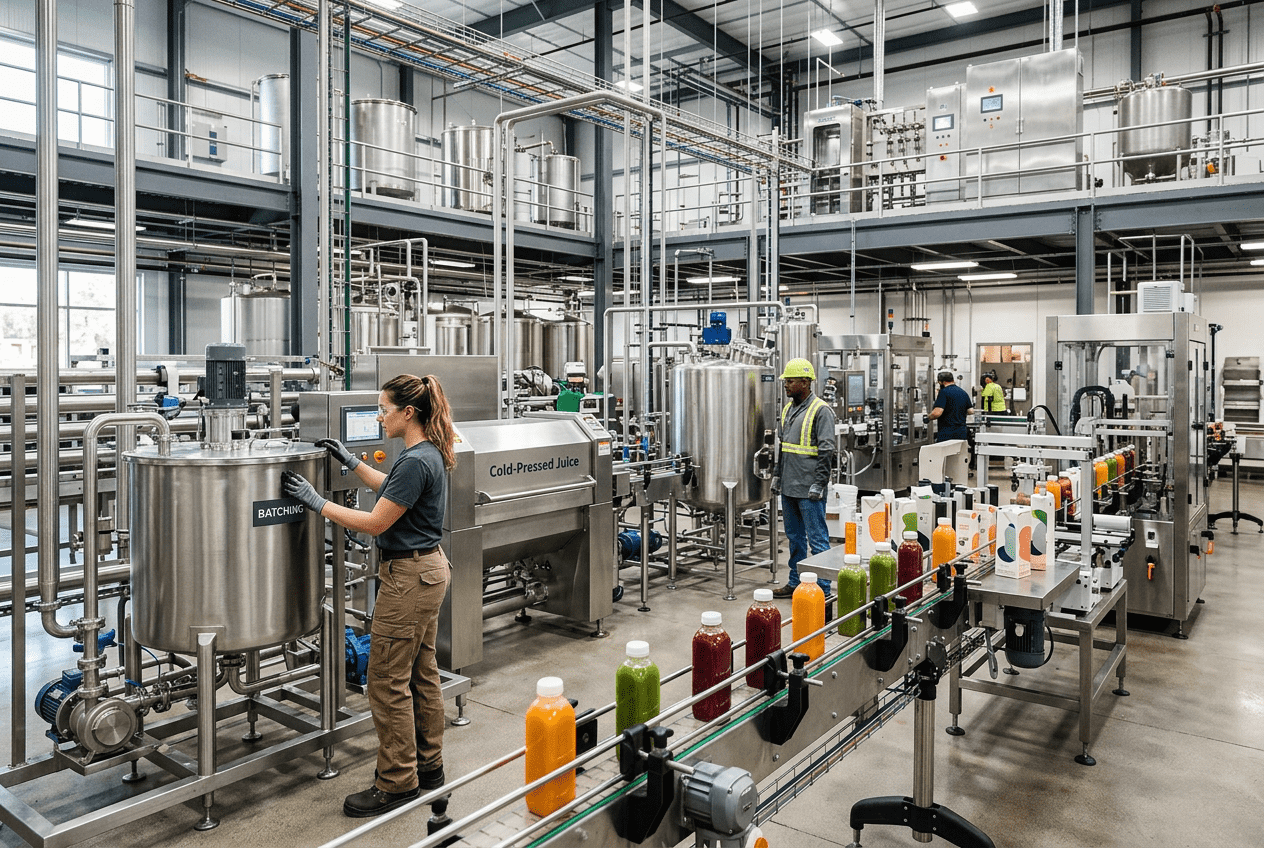
Food Processing Equipment Manufacturer
[trp_language language=”en_US”]
Choosing the Right Food Processing Equipment Manufacturer in the United States
Food and beverage manufacturers in the United States rarely need only a machine. In most cases, they need a partner that can design around throughput, sanitation, labor, utilities, automation, compliance, and future expansion. That is why selecting a food processing equipment manufacturer should start with a broader question: can the supplier support your process from concept to commissioning, or are they only shipping hardware?
Across major production corridors such as Chicago, Dallas-Fort Worth, Los Angeles, Fresno, Atlanta, Charlotte, Milwaukee, and the Northeast I-95 corridor, processors are under pressure to add capacity while controlling capital spend. The same is true near logistics hubs like the Port of Los Angeles, Port of Long Beach, Port of Savannah, Port of Houston, and Port Newark, where imported ingredients, packaging, and finished-goods distribution create tight schedules and little tolerance for equipment delays. In this market, the strongest manufacturers combine fabrication knowledge with engineering, project execution, installation, and long-term support.
Quick Answer

A full-service food processing equipment manufacturer in the United States should do more than fabricate tanks or skids. The best partners help define process requirements, select sanitary materials, verify regulatory and hygienic standards, integrate controls, manage installation, and support startup. Buyers should compare stainless steel options such as 304 and 316L, confirm certifications like 3-A or ASME where relevant, and evaluate total cost of ownership rather than quote price alone.
For companies expanding in protein, dairy, prepared foods, sauces, beverages, aseptic systems, or co-packing, the most reliable model is often an engineering-led supplier with manufacturing and field integration capability. That is especially important when projects involve utilities, clean-in-place systems, batch control, piping, structural modifications, or multi-line growth planning.
| Buying Priority | Why It Matters | Typical Risk if Ignored | Who Should Focus on It |
|---|---|---|---|
| Sanitary design | Protects product quality and food safety | Harborage points, contamination, difficult cleaning | Dairy, protein, beverage, prepared foods |
| Material selection | Impacts corrosion resistance and service life | Premature wear, off-spec surfaces, high maintenance | Acidic, salty, aseptic, CIP-intensive lines |
| Process integration | Improves throughput and reduces bottlenecks | Idle equipment, poor OEE, mismatched utilities | Growing plants and greenfield sites |
| Compliance alignment | Supports FDA, USDA, SQF, and BRC readiness | Audit findings, rework, delayed startup | Regulated and export-oriented facilities |
| Lead time visibility | Protects launch schedules and capital plans | Late production, missed customer commitments | Fast-growth brands and co-packers |
| Lifecycle support | Reduces downtime after startup | Long outages and expensive emergency fixes | Multi-shift operations |
The table above summarizes the core screening factors. Price still matters, but in most processing environments, cleaning performance, integration quality, and schedule reliability have a larger impact on profitability than a lower initial quote.
What Makes a Full-Service Food Processing Equipment Manufacturer?

A full-service manufacturer typically covers five connected areas: process design, equipment fabrication, project delivery, installation/integration, and startup support. Instead of treating equipment as a standalone purchase, this approach treats it as part of a production system. For example, a mixing skid is only as effective as the upstream ingredient handling, downstream fill rate, CIP strategy, automation logic, and utility capacity supporting it.
In the United States market, many vendors are excellent fabricators but do not manage field execution. Others sell packaged systems but rely heavily on third parties for design and commissioning. Manufacturers should understand which model they are buying. A true end-to-end partner helps during feasibility, develops layout and process concepts, coordinates utilities, aligns with sanitary requirements, and remains accountable during installation and performance ramp-up.
Disruptive Process Solutions (DPS) reflects this broader model. Rather than serving only as a component seller, the company supports complete food and beverage capital projects across North America. Its approach combines engineering, equipment supply, field execution, and project management under a design-build-manage structure intended to keep projects aligned with profitability goals. Manufacturers can review the company background on the About Us page and see how that operating model differs from a conventional single-scope vendor.
That difference matters when a project includes process equipment plus boilers, glycol, compressed air, controls, piping, and building modifications. A standalone fabricator may ship quality hardware, but an engineering-led partner is better positioned to identify hidden bottlenecks before they become change orders.
| Capability | Basic Equipment Vendor | Full-Service Manufacturer | Benefit to Buyer |
|---|---|---|---|
| Concept development | Limited | Yes | Better capacity planning |
| Process engineering | Often outsourced | In-house or led directly | Improved system fit |
| Custom fabrication | Usually yes | Yes | Application-specific design |
| Controls integration | Variable | Common | Fewer startup delays |
| Installation support | Minimal or advisory | Managed execution | Less coordination burden |
| Commissioning | Sometimes | Typically included | Faster path to production |
This comparison shows why many U.S. processors now prefer suppliers that can own outcomes, not just equipment shipments. It reduces handoff risk and creates clearer accountability across the project lifecycle.
The line chart illustrates a realistic growth pattern in U.S. equipment demand driven by reshoring, automation investment, labor constraints, and growth in value-added food production. The upward trend helps explain why experienced manufacturers with predictable delivery systems are in strong demand.
304 vs 316L Stainless Steel: Material Selection for Food Equipment

Material selection is one of the most misunderstood buying decisions in food equipment procurement. Both 304 and 316L stainless steel are widely used in sanitary applications, but they are not interchangeable in every process. Choosing correctly affects corrosion resistance, cleanability, longevity, and total maintenance cost.
304 stainless steel is often appropriate for standard food contact applications involving less aggressive products and routine washdown. It is common in dry ingredient systems, many mixing vessels, access platforms, non-chloride-heavy environments, and general food handling equipment. It usually offers a strong balance of cost and performance.
316L stainless steel contains molybdenum, which improves resistance to chlorides and more corrosive process conditions. It is frequently selected for saline, acidic, or highly cleaned systems, including some dairy, beverage, brine, sauce, aseptic, and pharmaceutical-adjacent applications. The lower carbon content in 316L also supports better corrosion behavior after welding when properly finished.
Plants in coastal environments such as Southern California, the Gulf Coast, or the Southeast may also find 316L attractive where ambient conditions, aggressive cleaning chemicals, or product chemistry justify the higher cost. However, upgrading everything to 316L is not always economically rational. The right choice depends on product, CIP chemistry, temperature, dwell time, and expected service life.
| Criterion | 304 Stainless Steel | 316L Stainless Steel | Best Use Case |
|---|---|---|---|
| Cost | Lower | Higher | Budget-sensitive projects vs corrosive service |
| Corrosion resistance | Good | Superior | Standard food duty vs chloride-heavy cleaning |
| Welded sanitary service | Good with proper finish | Excellent with proper finish | High-cleanability systems |
| Acidic products | Moderate suitability | Better suitability | Sauces, beverages, cultured products |
| Salt or brine exposure | Less ideal | Preferred | Protein and marination systems |
| Lifecycle value | Strong in general use | Strong in harsh service | Depends on process conditions |
The table makes clear that material choice should match the process, not a generic standard. A knowledgeable manufacturer will ask about product chemistry, operating temperature, sanitation regime, and expected production intensity before recommending a grade.
Surface finish also matters. A well-designed vessel in 304 with proper weld finishing, drainability, and sanitary connections can outperform a poorly fabricated 316L vessel. Buyers should ask about interior finish, passivation, weld maps when needed, and documentation for critical sanitary zones.
Key Certifications to Verify: 3-A, EHEDG, ASME & USDA Standards
Certifications and standards do not all serve the same purpose, so they should be reviewed in the context of your product and process. In the United States, many food and beverage projects require a mix of sanitary design expectations, pressure vessel code compliance, and regulatory alignment with inspection or audit frameworks.
3-A sanitary standards are especially relevant in dairy and certain hygienic processing applications. They focus on cleanability and hygienic equipment design. EHEDG is more commonly associated with European hygienic design frameworks, but U.S. processors exporting globally or adopting best-in-class hygienic practices may still look for alignment with EHEDG principles. ASME standards apply when pressure vessels or coded systems are involved. USDA requirements matter heavily in meat, poultry, and some inspected protein operations, where equipment layout, cleanability, and operational practices are scrutinized closely.
It is also important to distinguish between a component that is “built to sanitary principles” and one that is formally certified to a specific standard. Ask for documentation. If a supplier claims code compliance, request the stamp, supporting paperwork, and scope details.
| Standard or Framework | Main Focus | Common Applications | Buyer Verification Step |
|---|---|---|---|
| 3-A | Sanitary design and cleanability | Dairy, liquid foods, hygienic processing | Review applicable equipment certification |
| EHEDG | Hygienic engineering guidance | Global food and beverage systems | Confirm design basis and component suitability |
| ASME | Pressure vessel/code construction | Jacketed tanks, thermal systems, pressure equipment | Check code stamp and calculations |
| USDA alignment | Inspectability and sanitation in regulated plants | Protein and meat processing | Validate cleanable design and plant fit |
| FDA alignment | Food contact and process expectations | Most food and beverage plants | Review materials and sanitary documentation |
| SQF/BRC compatibility | Audit readiness and food safety systems | Branded food, co-packing, exports | Assess documentation and maintenance approach |
The practical takeaway is simple: verify what is mandatory, what is customer-driven, and what supports long-term hygienic performance. Overbuying on certifications can raise project cost unnecessarily, but under-specifying them can create serious startup and audit risk.
Equipment Categories: Mixing, Cooking, Storage & Material Handling
The food processing equipment landscape is broad, but most capital projects fall into several core categories: mixing and blending, thermal processing and cooking, storage, and material handling. Each category has its own sanitary design concerns and process-integration requirements.
Mixing systems may range from simple batch tanks to high-shear emulsification systems with load cells, inline dosing, recipe control, and Brix monitoring. Cooking equipment can include kettles, scraped surface heat exchangers, cook tanks, retorts, smokehouses, ovens, and thermal treatment skids. Storage can involve ingredient silos, sanitary tanks, buffer vessels, bright tanks, day tanks, and finished product holding. Material handling includes conveyors, pumps, augers, tote handling, ingredient batching, and transfer systems.
When buyers review suppliers, they should ask whether the manufacturer can connect equipment categories into one functioning line. A mixer is not enough if transfer pumps are undersized. A retort system is not enough if staging and cooling are poorly planned. A storage tank is not enough if CIP routing creates dead legs or excess downtime.
DPS supports a wide range of equipment and integrated process systems for food and beverage manufacturers, including vessels, custom CIP systems, marination tumblers, cooking equipment, fermentation systems, pasteurization technologies, aseptic systems, and complete utility infrastructure. Manufacturers can browse representative categories on the equipment solutions page to understand the breadth required in multi-scope projects.
| Equipment Category | Typical Equipment | Main Design Concern | Industries Served |
|---|---|---|---|
| Mixing and blending | Agitated tanks, high-shear mixers, batching skids | Homogeneity and CIP access | Sauces, beverages, dairy, ingredients |
| Cooking and thermal | Kettles, cookers, retorts, heat exchangers | Temperature control and product protection | Prepared foods, dairy, shelf-stable products |
| Storage | Sanitary tanks, silos, holding vessels | Drainability and residence time | Food, beverage, liquid ingredients |
| Material handling | Pumps, conveyors, augers, tote systems | Flow reliability and hygiene | Protein, bakery, ingredients, beverages |
| Utility systems | CIP, boilers, glycol, compressed air | Support capacity and redundancy | All processing sectors |
| Automation | PLC, SCADA, batch control | Repeatability and visibility | High-volume and multi-SKU operations |
This overview matters because many U.S. facilities do not fail for lack of a single machine; they fail when the surrounding infrastructure is undersized or disconnected from process reality.
The bar chart highlights where equipment demand is strongest in the current U.S. market. Beverages and protein continue to drive significant spending, but prepared foods, dairy modernization, and plant-based capacity also remain important categories.
Custom Fabrication vs. Standard Equipment: Which Fits Your Line?
Standard equipment can be the right answer when the application is well understood, the process is stable, and the footprint fits common production layouts. It usually offers faster delivery, lower engineering hours, and a simpler procurement path. Examples include common sanitary tanks, off-the-shelf pumps, basic conveyors, and standardized heat transfer skids.
Custom fabrication becomes more valuable when the process is unusual, the footprint is constrained, the utility tie-ins are complex, or the plant is scaling around specific throughput economics. It is often the better fit in retrofit projects, USDA-inspected facilities, aseptic environments, high-viscosity processes, or multi-product lines that need flexible automation and CIP sequencing.
The key is not choosing custom because it sounds advanced. It is choosing the level of customization that protects production efficiency. Too much customization can complicate maintenance and spare parts. Too little can force operators to work around equipment limitations for years.
An engineering-led supplier can help strike that balance. DPS, for example, combines proprietary equipment manufacturing with broader system design and integration, allowing clients to use custom elements only where they improve process outcomes. That is often more effective than forcing a full custom build when a hybrid solution would reduce cost and lead time.
| Selection Factor | Standard Equipment | Custom Fabrication | Best Decision Trigger |
|---|---|---|---|
| Lead time | Usually shorter | Usually longer | Use standard when schedule is dominant |
| Capital cost | Lower upfront | Higher upfront | Use custom when ROI justifies it |
| Process fit | Moderate | High | Custom for unique products or layouts |
| Installation simplicity | Often easier | Can be more involved | Depends on retrofit constraints |
| Future flexibility | Limited to standard design | Can be built for expansion | Custom for phased capacity growth |
| Maintenance support | Simpler parts sourcing | Requires documentation discipline | Plan spare strategy early for custom builds |
The explanation here is straightforward: choose standard where standards work, and choose custom where process economics, hygiene, or footprint demand it. The best suppliers do not push one answer for every project.
Lead Times, Capacity Planning & Supply Chain Reliability
Lead times are now a strategic issue, not a purchasing detail. Long-cycle items such as tanks, pressure vessels, controls hardware, pumps, valves, instrumentation, and utility equipment can define the entire project schedule. A manufacturer that cannot provide real visibility into sub-suppliers, fabrication slots, and approval timelines creates risk long before installation starts.
In the United States, capacity planning is especially important for manufacturers building around seasonal demand, contract packaging commitments, or retailer launch windows. Plants in logistics-heavy regions like Southern California, Texas, the Carolinas, or the Midwest often coordinate equipment delivery with building contractors, utility upgrades, and line commissioning teams. One late component can delay all of them.
Ask suppliers how they handle procurement sequencing, expediting, approved drawing cycles, and change management. Also ask whether they fabricate in-house, rely on strategic partner shops, or broker equipment from multiple OEMs. None of these models are inherently wrong, but they require different schedule controls.
DPS operates with a lean project-focused structure and a vetted network that supports execution across all 50 states and Canada. For buyers, that matters because an agile delivery model can accelerate decision making, reduce communication lag, and improve coordination across engineering, field trades, and startup activities. More detail on the service structure is available on the services page.
The area chart shows a realistic market shift toward integrated systems rather than isolated machine purchases. As labor pressure, data visibility, and utility efficiency become more important, more processors are buying complete line solutions instead of piecing systems together.
Looking toward 2026, lead-time strategy will also be shaped by domestic manufacturing policy, electrification and energy efficiency incentives, continued automation adoption, and resilience planning for imported components. Buyers should expect top suppliers to discuss alternate sourcing, controls architecture flexibility, and phased startup strategies as part of the quote process.
How to Evaluate Manufacturer Experience: Installations & References
Experience should be verified in practical terms. It is not enough to hear that a manufacturer has “years in the industry.” Ask what they have installed, in which sectors, at what capacities, and with what level of responsibility. A supplier that has built ten excellent sanitary tanks may still be the wrong choice for a turnkey sauce line, protein marination system, or high-speed beverage utility backbone.
Good reference questions include:
- What product categories has the supplier supported?
- How many comparable installations are operating today?
- Did the supplier manage only equipment delivery or full integration?
- How did they handle startup issues or scope changes?
- Were schedule and budget expectations realistic from the start?
- Would the client use them again?
Case history also matters. Processors should look for examples tied to business outcomes, not only fabrication photos. A strong case study explains what bottleneck existed, how the solution was designed, and what changed in throughput, labor, uptime, quality, or capital efficiency.
DPS is notable here because it positions itself not merely as a contractor, but as a profit-oriented project partner. Its portfolio spans food, beverage, utilities, controls, and complete processing systems, including high-growth beverage facilities and complex food manufacturing applications. Manufacturers can review selected project outcomes through the case studies section to see how installation experience translates into measurable results.
The company’s technological capabilities are especially relevant for buyers evaluating system-level expertise. Those capabilities include process, mechanical, structural, plumbing, electrical, and controls engineering, with PLC programming, automation, SCADA, recipe control, and utility integration all playing a role in complete line performance. That is important because many production gains come from system logic and utility balancing, not from replacing a vessel alone.
Manufacturing capabilities also deserve close review. DPS produces selected branded process equipment such as storage and processing tanks up to 12,000 gallons, custom CIP systems, marination tumblers, and cooking vessels. For buyers, this means the company can support both project integration and application-specific fabrication where standard solutions do not fit. The value is not just in owning fabrication scope, but in aligning that fabrication with the total process objective.
Finally, service capabilities can determine whether a project succeeds on schedule. DPS provides capital planning, feasibility analysis, owner’s representative support, project and program management, installation oversight, and turnkey integration. In practical terms, that service depth can help clients avoid spending heavily on the wrong bottleneck, a risk that often appears in fast-growth operations.
The comparison chart illustrates why references should focus on full project capability. A supplier that scores well in fabrication but weakly in engineering or integration may still create execution risk on a complex U.S. processing project.
Total Cost of Ownership: Beyond the Initial Equipment Quote
The lowest quote is rarely the lowest cost. Total cost of ownership includes installation labor, controls integration, utility demand, water use, CIP chemistry, preventive maintenance, downtime risk, operator training, spare parts, and service responsiveness. It also includes the financial cost of a poor process fit, such as excess giveaway, product loss, slow changeovers, or labor-heavy cleaning.
For example, a low-cost vessel with weak sanitary detailing may require longer cleaning cycles. Over a year, those extra minutes can reduce available production hours and increase labor, water, and chemical costs. A cheaper pump package may create product shear or poor net positive suction conditions. An underspecified automation package may force manual intervention and inconsistent batches.
That is why buyers should request cost discussions beyond capex. Ask suppliers to quantify design assumptions related to capacity, utility load, labor impact, changeover time, and expected service intervals. Ask about spare parts availability in the United States. Ask how easy the equipment is to inspect, clean, and maintain on a third shift.
| TCO Element | Typical Hidden Cost | How to Evaluate It | Potential Savings Lever |
|---|---|---|---|
| Cleaning time | Lost production hours | Review CIP logic and drainability | Sanitary design optimization |
| Utility usage | High steam, water, glycol, or air demand | Request operating assumptions | Right-sized heat transfer and controls |
| Maintenance | Frequent seal, valve, or motor issues | Examine wear parts and access | Standardized components |
| Downtime risk | Delayed repairs and parts shortages | Confirm U.S. service and stock strategy | Spare parts planning |
| Labor burden | Extra operator intervention | Assess automation and ergonomics | Recipe control and better HMI design |
| Expansion limits | Future retrofit expense | Check scalability assumptions | Modular utility and controls planning |
This table shows why a procurement decision should include operations, maintenance, engineering, and finance, not only purchasing. A strong manufacturer supports that cross-functional review instead of resisting it.
In 2026 and beyond, total cost of ownership will be shaped even more by sustainability and policy factors. Processors are increasingly evaluating wastewater load, heat recovery, water reuse, electrification pathways, energy management systems, digital maintenance tools, and traceability in controls architecture. Equipment suppliers that can align capital projects with ESG goals and utility efficiency targets will have a growing advantage in the U.S. market.
FAQ
What is the difference between an equipment manufacturer and a system integrator?
An equipment manufacturer fabricates or supplies machines and vessels. A system integrator connects equipment, controls, utilities, and field execution so the production line works as one system. Some companies do both, which often reduces risk on larger projects.
Is 316L always better than 304 for food processing equipment?
No. 316L offers better corrosion resistance in harsher conditions, but 304 is often fully appropriate for many food applications. The right choice depends on product chemistry, cleaning chemicals, temperature, and expected operating intensity.
Which certifications should I verify first?
Start with the standards relevant to your process. For example, review 3-A for certain hygienic applications, ASME for pressure equipment, and USDA alignment for protein operations. Also confirm FDA-compatible materials and audit-ready documentation where needed.
When should I choose custom fabrication?
Choose custom when your layout, product behavior, sanitation requirements, utility constraints, or throughput goals cannot be met efficiently with standard equipment. Retrofits and complex multi-product lines often benefit most from custom design.
How long do food processing equipment projects usually take?
Simple equipment purchases may move in weeks, while integrated projects can take several months or longer depending on engineering, approvals, controls scope, fabrication, and utility work. Long-lead components should be identified early.
What should I ask for in a supplier reference check?
Ask about schedule accuracy, startup support, change management, sanitation performance, documentation quality, and whether the customer would hire the supplier again for a similar project.
Why does total cost of ownership matter so much?
Because cleaning time, downtime, maintenance, labor, utility consumption, and poor integration often cost more over the life of the system than the initial difference between two quotes.
What types of industries need full-service equipment partners most?
Protein, dairy, beverage, aseptic, sauces, prepared foods, and co-packing operations often benefit the most because their projects usually involve multiple disciplines, compliance pressure, and demanding startup schedules.
Can one company support both food and beverage projects?
Yes, but verify actual experience in your category. The best cross-sector firms understand differences in hygienic design, thermal treatment, utility systems, automation, and regulatory expectations across both food and beverage operations.
How can U.S. manufacturers reduce project risk before ordering equipment?
Invest in front-end planning. Confirm throughput assumptions, utility capacity, sanitation requirements, controls philosophy, product characteristics, and expansion pathways before release. Early engineering typically saves money later.
For U.S. manufacturers evaluating a food processing equipment manufacturer, the smartest path is to choose a partner that understands the entire process, not just the machine. When engineering depth, fabrication quality, integration capability, and business-minded project execution come together, capital projects are far more likely to produce durable returns.
[/trp_language]
Complete Company Portfolio
About the Author: Disruptive Process Solutions (DPS)
The DPS team combines process engineering expertise with real-world food and beverage manufacturing experience. Our content focuses on process optimization, production efficiency, facility improvements, and practical solutions that help manufacturers operate more effectively in a rapidly evolving industry.
Share