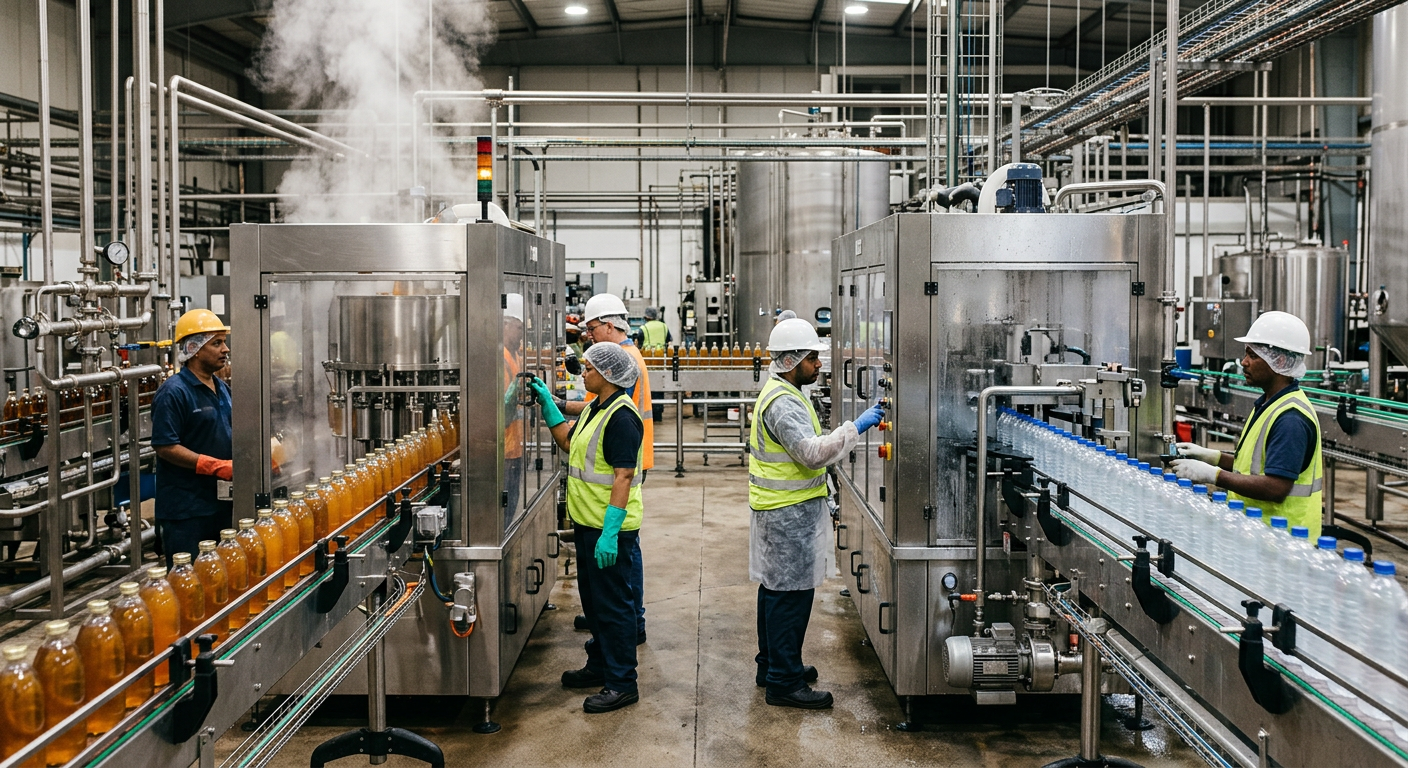
Sanitary Tank Manufacturer
[trp_language language=”en_US”]
Sanitary Tank Design for Food, Beverage, and Dairy Processing in the United States
Choosing the right sanitary tank is not just about vessel size or price. In the United States, food, beverage, dairy, and clean-process manufacturers need tanks that protect product quality, simplify cleaning, support compliance, and reduce lifecycle costs. A properly specified sanitary tank should be fully drainable, free of dead legs and crevices, compatible with CIP, built with suitable stainless steel, finished to the right surface roughness, and fitted with hygienic seals and connections. For processors from California and Texas to Wisconsin, North Carolina, and New Jersey, these details directly affect uptime, audit readiness, and total operating margin.
Disruptive Process Solutions (DPS) supports processors across all 50 states and Canada with sanitary process system design, equipment integration, installation, and project execution. As a food and beverage engineering partner with equipment capabilities that include tanks up to 12,000 gallons, DPS approaches sanitary tank projects as part of a larger profitability strategy rather than a stand-alone purchase. That is especially important in high-volume corridors such as Chicago, Los Angeles, Houston, Atlanta, Charlotte, Minneapolis, and the port-driven manufacturing zones around Savannah, Newark, and Long Beach.
Quick Answer

A sanitary tank for U.S. food and beverage processing should typically be designed around five core principles: complete drainability, hygienic geometry, validated cleanability, corrosion resistance, and standards alignment. In practice, that usually means a 316L stainless steel product-contact shell, continuous sanitary welds, an internal finish commonly specified at or below 32 microinch Ra depending on the application, sloped floors or cone bottoms that self-drain, CIP spray device coverage that can be verified, and sanitary fittings such as Tri-Clamp connections with FDA-appropriate gasket materials.
For dairy, beverage, liquid foods, sauces, RTD products, cultured products, and aseptic support systems, buyers in the United States should also check whether the vessel design aligns with 3-A expectations where applicable, whether documentation includes material traceability and finish records, and whether the tank can be integrated cleanly with plant utilities, controls, batching systems, heat exchangers, and CIP skids. A low-cost tank that traps product, requires manual cleaning, or causes repeated gasket failures usually becomes expensive very quickly.
In the current U.S. market, the best sanitary tank decisions are made at the system level. That means evaluating not only the vessel, but also upstream and downstream process impacts: pump sizing, valve manifolds, automation, chemical concentration, drain routing, insulation, agitation, temperature control, and maintenance access.
| Selection Factor | Why It Matters | Typical U.S. Expectation | Risk if Ignored |
|---|---|---|---|
| Drainability | Prevents standing product and rinse water | Self-draining bottom with proper outlet orientation | Residue, contamination, long changeovers |
| Material Grade | Supports corrosion resistance and product safety | 316L for many sanitary product-contact areas | Pitting, staining, reduced service life |
| Surface Finish | Affects cleanability and biofilm risk | Often 32 µin Ra or better, sometimes finer | Hard-to-clean surfaces and failed inspections |
| Fittings and Seals | Controls leak points and sanitary integrity | Tri-Clamp and food-grade gasket selection | Leaks, flavor carryover, microbial harborage |
| CIP Compatibility | Reduces labor and standardizes cleaning | Verified spray coverage and chemical access | Manual rework and inconsistent cleaning |
| Documentation | Supports audits and maintenance | MTRs, weld maps, finish data, FAT/SAT records | Compliance gaps and procurement disputes |
The table above summarizes the essentials. For many U.S. processors, especially those selling through retail, co-packing, or multi-site networks, sanitary tank performance is evaluated not only by how it operates on day one, but by whether it can maintain cleanability and throughput over years of repeated production cycles.
Sanitary Tank Design Principles: Fully Drainable, Crevice-Free & CIP-Ready

The most important sanitary tank design principle is simple: product and cleaning solution must not be allowed to stagnate. In real facilities, poor geometry creates hidden costs. A tank that appears acceptable on a drawing can still trap syrup under a nozzle reinforcement, leave cream in a flat outlet zone, or collect sauce solids along a poorly blended weld. These are common failure points in beverage plants, dairy lines, prepared food operations, and protein ingredient systems across the United States.
Fully drainable design normally requires proper bottom slope, outlet placement at the low point, and support geometry that does not distort the vessel base. Crevice-free construction requires smooth transitions, hygienic fittings, flush-mounted instruments where needed, and weld finishing that avoids pits or undercut. CIP-ready design means the vessel can be cleaned repeatedly using validated time, temperature, chemical concentration, and mechanical action without depending on operator improvisation.
In many projects, DPS evaluates sanitary tanks as part of an integrated line, not as isolated hardware. Through its process engineering and project delivery services, the company helps processors assess how tank design interacts with circulation rates, utility capacity, valve sequencing, automation logic, and production scheduling. That system-level approach is especially valuable when scaling facilities in major U.S. manufacturing zones such as the Midwest dairy belt, the Southeast beverage corridor, or West Coast value-added food operations.
Sanitary tanks are used in multiple roles, and the role affects the design:
| Tank Type | Common Use | Key Hygienic Need | Typical U.S. Sectors |
|---|---|---|---|
| Storage Tank | Holding raw or finished liquid | Drainability and vent protection | Dairy, juice, brewing |
| Mixing Tank | Blending ingredients | Agitator seal hygiene and CIP reach | Sauces, dressings, RTD |
| Jacketed Process Tank | Heating or cooling product | Temperature control and smooth internals | Dairy, soups, aseptic prep |
| Fermentation Vessel | Controlled biological conversion | Pressure integrity and sanitary sampling | Beer, kombucha, cultured dairy |
| Bright Tank | Carbonated beverage finishing | Pressure rating and polish quality | Breweries, sparkling beverages |
| CIP Supply/Return Tank | Cleaning media circulation | Chemical compatibility and instrumentation | All hygienic processing plants |
The table shows that “sanitary tank” is a broad category. A dairy balance tank near Madison or Twin Falls is not specified exactly like a carbonated beverage bright tank in Dallas or a sauce mix tank near Fresno. Buyers should align geometry, finish, fittings, and controls with the true process duty.
The line chart reflects a realistic growth pattern driven by reshoring, food safety investment, beverage diversification, dairy modernization, and expansion in co-packing. Demand is particularly strong in facilities adding flexible batching, allergen control, and higher-throughput CIP infrastructure.
3-A Sanitary Standards Compliance for Dairy, Beverage & Food Tanks

In the United States, 3-A sanitary design expectations are especially relevant for dairy and many hygienic applications where cleanability and construction details matter. While not every food tank must be certified in the same way, 3-A-aligned thinking is often used by owners, QA teams, and engineering groups to reduce sanitary risk. Buyers should understand whether they need formal compliance, equivalent hygienic design, or customer-specific documentation standards.
For dairy processors, cultured product facilities, beverage plants with high-cleanliness requirements, and co-manufacturers serving demanding retail brands, a tank that reflects recognized sanitary design criteria can reduce audit pressure and support more consistent sanitation outcomes. This is particularly valuable in states with large regulated processing footprints, including Wisconsin, California, Texas, Pennsylvania, Idaho, and North Carolina.
Key points to review include weld quality, surface finish records, drainability, cleaning device location, instrument design, dead-leg avoidance, elastomer suitability, and documentation package completeness. Procurement teams should also ask whether the supplier understands how the tank fits into FDA, USDA, SQF, and BRC expectations at the plant level.
| Compliance Topic | What Buyers Should Ask | Operational Benefit | Common Audit Concern |
|---|---|---|---|
| Hygienic Geometry | Are internals free of dead zones? | Better cleanability | Product residue retention |
| Weld Finish | Are product-contact welds continuous and finished? | Lower harborage risk | Pits, undercut, rough welds |
| Documentation | Are MTRs and finish reports included? | Faster validation | Missing traceability |
| CIP Design | Is spray coverage verified? | Repeatable sanitation | Shadowed surfaces |
| Seal Materials | Are gaskets appropriate for chemistry and temperature? | Longer seal life | Swelling or cracking |
| Inspection Access | Can QA and maintenance inspect key points? | Quicker troubleshooting | Hidden failure locations |
The right tank supplier should be able to explain not only what standards apply, but why the design choices support real plant conditions. That matters in facilities shipping nationwide through ports and distribution hubs such as Houston, Savannah, Los Angeles, and Newark, where customer scrutiny and multi-state retail requirements can be high.
This chart shows where demand is strongest today. Dairy and RTD beverages remain major drivers because they require hygienic equipment, frequent cleaning, and rapid product turnover. Sauce, dressing, and plant-based applications are also rising as processors seek flexible lines with clean-label and allergen-management capability.
316L Stainless Steel: The Industry Standard for Sanitary Tank Construction
For many U.S. sanitary tank applications, 316L stainless steel remains the preferred product-contact material because it offers strong corrosion resistance, broad chemical compatibility, and a low-carbon composition that supports weld quality. That does not mean every non-contact component must be 316L, but in product zones exposed to acids, chlorides, aggressive cleaning regimens, or repeated washdown, 316L is often the safest long-term choice.
304 stainless steel can still be suitable in some less aggressive environments, but cost savings on initial purchase can be erased by corrosion, discoloration, product contamination risk, or shorter service life. Beverage systems with acidic formulations, dairy systems with chlorinated cleaning history, and food plants running hot caustic and acid cycles often benefit from selecting 316L from the start.
DPS brings practical material selection into larger plant decisions through its engineering and integration capabilities. Its teams support processors with process, mechanical, structural, electrical, and controls coordination so that vessel material selection matches utility chemistry, throughput, cleanability targets, and expected production growth. More on the company’s background can be found on the DPS company overview page.
| Material Option | Typical Use | Advantage | Limitation |
|---|---|---|---|
| 304 Stainless Steel | Lower-aggression sanitary duties | Lower upfront cost | Less resistant in harsh CIP environments |
| 316L Stainless Steel | Most premium sanitary product-contact uses | Strong corrosion resistance | Higher purchase price |
| Carbon Steel Exterior Supports | Non-product structural frames | Cost effective structure | Requires coating and environment control |
| Duplex Stainless | Specialized corrosive environments | High strength and resistance | Less common for standard food tank builds |
| Alloy Internals | Niche chemical compatibility cases | Custom resistance profile | Higher complexity and cost |
| Polymer Components | Non-structural seals or sight parts | Targeted functionality | Limited by temperature and chemistry |
The comparison above shows why 316L is often the industry benchmark. In the United States, where processors may run frequent sanitation cycles and face strict customer expectations, corrosion resistance is not a luxury feature. It is a productivity feature. Fewer repairs, fewer leaks, and fewer surface defects usually mean more consistent output.
Surface Roughness (Ra) Requirements for Product-Contact Surfaces
Surface roughness is one of the most misunderstood parts of sanitary tank buying. A vessel may look shiny, yet still have an Ra value that is not suitable for the intended product or cleaning regime. Rougher surfaces provide more opportunity for product adhesion and microbial retention. Smoother surfaces generally improve cleanability, though the “right” finish depends on product, cleaning chemistry, and the plant’s validation requirements.
In many U.S. food and beverage applications, 32 microinch Ra is a common baseline for product-contact surfaces, with finer finishes specified for more demanding applications. Buyers should ask whether the finish is mechanically polished, electropolished, where measurements are taken, and how the finish is verified and documented. They should also be clear about which areas are included: shell, heads, nozzles, fittings, agitator zones, and weld blends.
For manufacturing capability, DPS not only supports engineered sanitary process systems but also produces its own branded equipment line, including sanitary tanks up to 12,000 gallons, CIP systems, and custom process vessels. That manufacturing perspective helps align vessel finish requirements with practical fabrication, installation, and startup considerations. Processors exploring sanitary vessel options can review available equipment capabilities as part of early project planning.
| Ra Level | General Interpretation | Typical Use Case | Buyer Note |
|---|---|---|---|
| 63 µin Ra | Moderately smooth | Some non-critical zones | Often too rough for premium product-contact use |
| 45 µin Ra | Improved finish | Selected utility or less critical sanitary uses | Confirm suitability case by case |
| 32 µin Ra | Common sanitary benchmark | Many food and beverage tanks | Widely specified in the U.S. |
| 25 µin Ra | Finer sanitary finish | Higher-cleanability requirements | Useful for sticky or sensitive products |
| 20 µin Ra | Premium smoothness | Dairy, biotech-adjacent, high-cleanliness lines | May increase cost but support hygiene goals |
| <20 µin Ra | Very high finish level | Specialized hygienic processes | Specify only when justified by process need |
This table should not replace plant-specific standards, but it helps frame the discussion. The real question is not “What finish is cheapest?” but “What finish supports repeatable cleaning, quality, and lifecycle value in this exact process?” That answer may differ between a cultured dairy tank in Idaho, an acidified beverage tank in Florida, and an aseptic ingredient vessel in New Jersey.
Sloped Bottoms, Dome Tops & Self-Draining Configurations Explained
Tank geometry affects everything from product recovery to CIP cycle time. Sloped bottoms and properly oriented outlets support complete drainability. Dome tops can improve structural performance and support certain process requirements, but top design must still account for manways, spray devices, venting, sensors, and access. In sanitary processing, “self-draining” is not a marketing phrase; it is a measurable design outcome that should be demonstrated in drawings and confirmed during commissioning.
Buyers should ask where the lowest point is, how outlet ferrules are blended, whether internal attachments create ledges, and how the tank behaves when installed on the actual plant floor. Small field changes in support height, pad orientation, or piping slope can compromise an otherwise good design. This is why installation quality matters as much as fabrication quality.
Applications vary by industry and location. Breweries in Denver or Portland may prioritize conical geometry and pressure performance. Dairy processors in the Upper Midwest may prioritize rapid drainability and complete CIP turnover. Sauce and dressing plants near Chicago or central California often care deeply about sweep, agitation, and heel reduction for viscous products. A good sanitary tank design adapts to those realities.
The area chart illustrates a clear trend: new projects increasingly favor vessel geometries that reduce manual intervention and sanitation variability. This trend is likely to accelerate into 2026 as labor constraints, water use scrutiny, and stricter customer quality expectations continue shaping capital investment.
Gasket Materials, Tri-Clamp Connections & Sanitary Fitting Standards
Even a well-built tank can fail hygienically if the wrong gasket or fitting is used. Gaskets must handle process temperature, cleaning chemistry, pressure, and product compatibility. Tri-Clamp connections remain common in U.S. sanitary processing because they are serviceable, widely available, and suitable for many hygienic duties when properly specified and maintained. However, they are not automatically correct for every high-pressure or specialized application.
Buyers should review elastomer type, compression set behavior, cleanability, replacement frequency, and whether the gasket profile matches the ferrule and clamp design. EPDM, silicone, FKM, PTFE envelope, and other materials each have strengths and limitations. Standardization across a plant can reduce spare-parts complexity, but over-standardization can create performance problems if one gasket material is forced into incompatible duties.
| Gasket/Fitting Option | Best For | Main Strength | Main Caution |
|---|---|---|---|
| EPDM Gasket | Many CIP and hot water applications | Good general sanitary performance | Check compatibility with oils and specific chemicals |
| Silicone Gasket | Temperature-sensitive and flexible sealing needs | Good flexibility | May wear faster in some aggressive duties |
| FKM Gasket | Chemically demanding applications | Strong chemical resistance | Higher cost |
| PTFE-Based Seal | Challenging chemical exposure | Broad resistance profile | Can be less forgiving mechanically |
| Tri-Clamp Connection | General sanitary piping and tank nozzles | Easy maintenance and widespread use | Requires proper assembly discipline |
| Welded Sanitary Joint | Permanent product-contact piping | Minimizes disassembly points | Less flexible for frequent changes |
The explanation is straightforward: seal and fitting decisions should match actual use conditions, not catalog habits. Plants running citrus beverages near Tampa, high-fat dairy in Wisconsin, or hot-fill sauces in Texas may each require different gasket strategies even when the tanks look similar on paper.
Local supply support also matters. In U.S. manufacturing hubs near Philadelphia, St. Louis, Salt Lake City, and Sacramento, processors often value tank builders and integrators that can source sanitary components quickly and coordinate field service when shutdown windows are short.
Passivation & Electropolishing: Ensuring Long-Term Corrosion Resistance
Passivation helps restore and strengthen the protective chromium oxide layer on stainless steel after fabrication, welding, and finishing. Electropolishing can further improve surface smoothness and corrosion performance by removing a thin layer of metal and reducing microscopic peaks and valleys. These are not decorative extras. In the right sanitary applications, they materially affect hygiene, cleanability, and long-term tank condition.
Passivation is particularly important after welding and mechanical polishing. If fabrication residue, heat tint, or iron contamination remains, stainless surfaces become more vulnerable to corrosion. Electropolishing may be justified where very high cleanability, appearance retention, or corrosion resistance is needed, especially in aggressive sanitation environments.
For buyers, the key is documentation and scope. Ask which surfaces are passivated, what chemistry and procedure are used, whether rinse quality is controlled, and how completion is verified. If electropolishing is specified, confirm target areas and expected finish outcome. These steps can have a major impact on lifecycle cost in high-throughput plants.
Case experience matters here. DPS has supported complex food and beverage capital projects where process reliability, hygienic execution, and utility integration all determine project profitability. Examples of project outcomes and execution approach can be explored through selected case studies and project examples, which are useful for buyers evaluating a partner’s ability to connect equipment decisions to plant-wide performance.
The comparison chart highlights a frequent U.S. buying mistake: selecting a vessel-only quote without evaluating integration and lifecycle support. A sanitary tank is rarely successful by fabrication alone. It succeeds when design, installation, utilities, controls, and startup all work together.
How to Validate Sanitary Tank Performance in Your Facility
Validation should happen in stages: design review, fabrication review, factory acceptance when appropriate, installation verification, startup, CIP confirmation, and operational monitoring. Too many facilities wait until after product trials to discover that spray devices miss surfaces, outlet lines hold residual product, or instrument penetrations create cleanability issues.
In the United States, smart buyers use a practical validation checklist before final sign-off. This is especially important in co-packing, dairy, RTD beverage, aseptic support, and high-care food environments where production interruptions can be expensive. A robust validation process typically includes visual inspection, slope verification, finish documentation review, gasket confirmation, pressure and leak testing where applicable, CIP riboflavin or coverage evaluation when needed, control sequence testing, and maintenance training.
| Validation Step | What to Confirm | When to Check | Why It Matters |
|---|---|---|---|
| Drawing Review | No dead legs, correct outlet location, proper nozzle layout | Before fabrication | Fixing design errors early is cheapest |
| Material Verification | 316L and other specified grades match documents | During fabrication | Prevents hidden substitution risk |
| Finish Inspection | Ra meets spec in contact areas | Before shipment | Supports cleanability and audits |
| Installation Check | Tank sits correctly and drains as intended | After setting and piping | Field conditions can alter geometry |
| CIP Performance Test | Spray coverage and return flow are acceptable | Commissioning | Confirms cleanability in real conditions |
| Operational Monitoring | No recurring residue, leaks, or corrosion signs | First production months | Verifies long-term sanitary performance |
The table above is best used as a living commissioning tool. If a tank serves multiple products, include worst-case trials for viscosity, fat, sugar, pulp, particulate load, or allergen changeover. Plants shipping nationally from manufacturing centers such as Indianapolis, Kansas City, or the Inland Empire should also consider spare parts strategy and remote support responsiveness.
When evaluating suppliers in the United States, local presence alone is not enough. The best partner is one that can engineer the process, coordinate trades, manage startup, and understand regulatory and operational consequences. DPS’s service capability is built around that full-project model: feasibility support, owner’s representation, engineering, general contracting where licensed, installation management, integration, and commissioning. That integrated structure is useful when sanitary tank performance must fit into broader utility, automation, and expansion plans.
Looking ahead to 2026, three trends will shape sanitary tank buying in the United States. First, automation and data visibility will expand, with more tanks tied into SCADA, recipe management, and CIP verification. Second, policy and customer pressure around water, energy, and chemical use will push designs that shorten cleaning cycles and improve product recovery. Third, sustainability goals will drive more interest in optimized spray devices, heat recovery, lower-loss tank geometry, and right-sized vessel selection rather than overbuilding capacity. Buyers who plan for these trends now will likely see better ROI over the next capital cycle.
FAQ
What industries most commonly use sanitary tanks in the United States?
Dairy, brewing, spirits, wine, kombucha, soft drinks, juices, RTD beverages, sauces, dressings, prepared foods, plant-based products, aseptic foods, and selected pharmaceutical-adjacent applications all rely on sanitary tanks.
Is 316L always required?
Not always, but it is often preferred for product-contact surfaces because of its corrosion resistance. The correct choice depends on product chemistry, cleaning chemicals, temperature, and expected service life.
What does self-draining really mean?
It means the tank drains completely under intended installation conditions without leaving standing product or rinse solution in product-contact areas. This must be evaluated by actual geometry, not just sales language.
Why is Ra finish important?
Surface roughness affects how easily product residue can be removed and how likely microorganisms are to remain attached. Smoother finishes generally improve cleanability.
Are Tri-Clamp fittings enough for every sanitary application?
No. They are widely used and very effective in many hygienic services, but some applications need other connection styles based on pressure, chemistry, frequency of disassembly, or owner standard.
Should I request passivation on every stainless sanitary tank?
In most cases, yes. Passivation is a sound practice after fabrication and welding because it improves corrosion resistance and supports long-term sanitary performance.
How do I compare suppliers fairly?
Compare more than vessel price. Review design support, drainability, finish control, documentation, CIP understanding, field installation capability, startup support, spare parts planning, and post-installation service response.
What tank sizes are common for food and beverage projects?
Common sizes range from small batching and balance tanks to several thousand gallons for storage, mixing, fermentation, and CIP service. Custom sizing should match actual throughput, not just future wish lists.
Can one sanitary tank design serve multiple products?
Sometimes, but only if the geometry, agitation, seals, cleaning method, and controls are designed around the most demanding product and changeover scenario.
What makes DPS relevant for sanitary tank projects?
DPS combines engineering, project management, installation oversight, and equipment capability in one model. For U.S. processors, that means sanitary tanks can be specified as part of an integrated process solution that supports profitability, compliance, and scalable growth.
For food, beverage, and dairy manufacturers in the United States, sanitary tank selection is a strategic decision. The right vessel reduces risk, shortens cleaning time, improves product recovery, and fits smoothly into the larger production system. The wrong vessel can slow changeovers, create sanitation failures, and drain margins. Whether the project is a single process tank or a full expansion tied to utilities, controls, and CIP infrastructure, the best results come from disciplined design, practical validation, and a partner that understands the full manufacturing picture.
[/trp_language]
Complete Company Portfolio
About the Author: Disruptive Process Solutions (DPS)
The DPS team combines process engineering expertise with real-world food and beverage manufacturing experience. Our content focuses on process optimization, production efficiency, facility improvements, and practical solutions that help manufacturers operate more effectively in a rapidly evolving industry.
Share