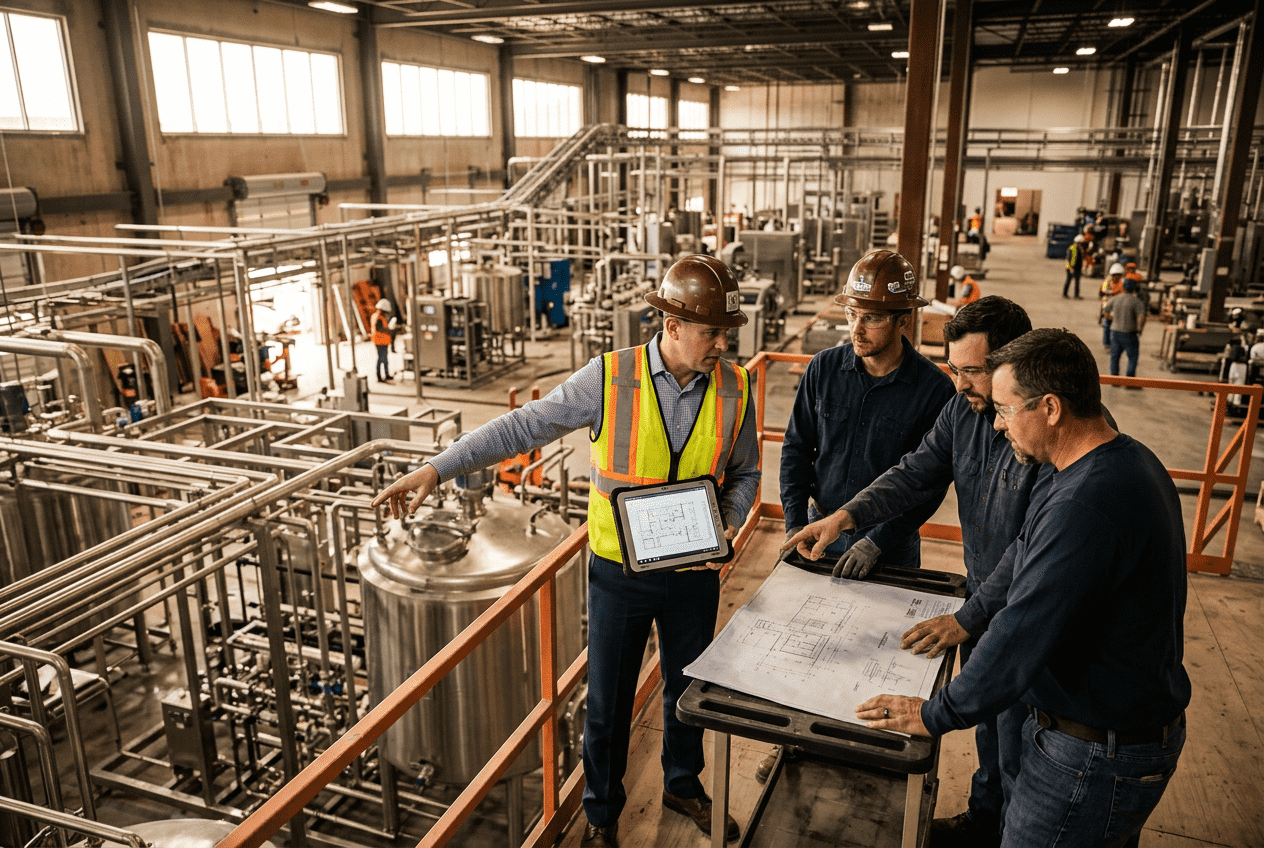
Food Cooking Kettle Manufacturer
[trp_language language=”en_US”]
Choosing the Right Food Cooking Kettle Manufacturer in the United States
For food processors in the United States, selecting a food cooking kettle manufacturer is not just an equipment decision; it is a plant performance, food safety, labor efficiency, and long-term capital planning decision. Whether you are producing soup in Chicago, sauce in New Jersey, chili in Texas, dairy blends in Wisconsin, or ready meals in California, the right kettle supplier should be able to do more than quote a vessel. A qualified partner should understand recipe behavior, heat transfer, sanitary design, utility integration, automation, compliance, installation, and throughput economics.
In the U.S. market, buyers increasingly expect kettles that support better yield, shorter cook times, easier cleaning, lower operator risk, and traceable compliance. That means the discussion should include stainless grade, finish quality, heating medium, agitation style, controls, CIP strategy, and whether the manufacturer can support customization at the plant level. For processors expanding near logistics hubs like Houston, Los Angeles, Savannah, Newark, or the Midwest manufacturing corridor, lead time, field support, and integration capability also matter.
Quick Answer

A strong food cooking kettle manufacturer in the United States should offer sanitary stainless construction, multiple heat source options, batch sizes aligned with your production goals, certified fabrication where required, and the ability to tailor agitation, controls, discharge, and vessel geometry to your recipe. The best suppliers also provide engineering support, utility coordination, installation planning, and startup assistance instead of selling a standard tank with minimal process input.
If your products include sauces, soups, gravies, fillings, jams, confectionery bases, dairy blends, meat emulsions, prepared foods, or plant-based formulations, choose a manufacturer that can prove experience with viscous, particulate, shear-sensitive, or burn-prone recipes. In practice, that means they should discuss whether you need 304 or 316L stainless, a hemispherical or cylindrical bottom, a tilting or fixed body, and an agitation package such as paddle, scraper, planetary, or high-shear mixing.
For many U.S. processors, the lowest purchase price does not deliver the lowest total cost. A kettle with the wrong agitation system may create scorch points. A vessel with the wrong finish may prolong cleaning. An undersized heating jacket may slow output. A supplier that cannot coordinate controls, utilities, or field installation may shift hidden cost back onto the owner. That is why many buyers now prefer engineering-led partners that can connect equipment selection to overall line performance.
| Selection Factor | Why It Matters | Typical U.S. Buyer Question | Risk if Ignored |
|---|---|---|---|
| Material grade | Determines corrosion resistance and cleanability | Is 304 enough or is 316L required? | Premature corrosion or contamination issues |
| Heating method | Affects speed, utility cost, and control | Should we use steam, gas, electric, or thermal oil? | Slow cook cycles and higher operating cost |
| Agitation design | Prevents burn-on and improves uniformity | Do we need scraper, paddle, or high-shear mixing? | Product damage, uneven heating, poor texture |
| Capacity | Sets labor and throughput efficiency | Is 300L enough or should we scale to 1,000L? | Bottlenecks or overinvestment |
| Compliance | Supports inspections and customer approvals | Do we need FDA, 3-A, USDA, or ASME? | Delayed project approval or audit findings |
| Customization | Aligns the kettle to your exact recipe | Can nozzles, controls, and discharge be modified? | Workarounds, rework, operator frustration |
The table above summarizes the six issues that should drive any kettle purchase. In real projects, these factors overlap. For example, a tomato-based sauce may push you toward 316L, scraper agitation, and a precise steam control package at the same time.
What to Look for in a Food Cooking Kettle Manufacturer

A credible manufacturer should be able to demonstrate process knowledge, not just metalworking capability. Ask how they size jackets, how they model heat-up times, what finish levels they provide, how they prevent dead legs, and what standard instrumentation is included. Good answers indicate the supplier has worked with real food plants rather than only generic stainless fabrication.
You should also evaluate whether the supplier can support your full project scope. Some companies can build a vessel but cannot help with steam headers, condensate return, electrical load review, controls integration, or floor layout. Others can coordinate the complete system. For growth-oriented manufacturers in the United States, this distinction matters because batch cooking often touches multiple disciplines at once: process, mechanical, structural, plumbing, electrical, controls, food safety, and commissioning.
A practical benchmark is to ask for examples by application. If you produce fruit fillings, ask how they avoid fruit damage and sugar scorching. If you make cheese sauce, ask how they manage sticky protein and fat systems. If you run protein marinades or prepared meals, ask about particulate handling and discharge strategy. The best manufacturers can explain what worked, what did not, and what they changed.
Another important factor is lifecycle support. U.S. processors value suppliers that can provide startup help, operator training, spare parts guidance, and modifications later as recipes change. This is especially important for co-packers and multi-SKU plants where equipment flexibility creates financial value over time.
For companies that want broader project support, integrated processing services can be useful because they connect vessel selection with the practical realities of installation, utilities, and production ramp-up. This can reduce scope gaps between engineering, procurement, and plant execution.
The line chart reflects a realistic trend in the United States: demand for sanitary cooking equipment is rising as prepared foods, premium sauces, plant-based products, and contract manufacturing continue expanding. Growth is also linked to reshoring, automation investments, and food safety modernization.
Material Specifications: 304 and 316L for Different Food Applications

For most food cooking kettles, the material conversation starts with 304 stainless steel and 316L stainless steel. Both are common, but they serve different application needs. In many dry or mildly acidic products, 304 is fully suitable and cost effective. In harsher environments involving salt, chloride exposure, acidic recipes, aggressive washdowns, or highly sanitary requirements, 316L often becomes the better choice.
304 stainless is frequently used for soups, neutral sauces, starch systems, bakery fillings, and many general-purpose batch processes. It offers good corrosion resistance, solid durability, and lower upfront cost. It is often the right answer where chemistry is not especially aggressive and where the plant already maintains strong sanitation discipline.
316L stainless adds molybdenum, which improves corrosion resistance, especially in chloride-rich or acidic service. It is commonly recommended for tomato sauces, saline brines, some dairy applications, seafood, certain dressings, and recipes with repeated exposure to aggressive clean-in-place chemicals. The low-carbon “L” grade also supports better weld corrosion resistance when properly fabricated and passivated.
Beyond alloy selection, buyers should ask about internal finish, weld polish quality, passivation, and gasket compatibility. The metal grade alone does not guarantee sanitary performance if the fabrication details are weak.
| Material | Best Fit Applications | Corrosion Resistance | Relative Cost |
|---|---|---|---|
| 304 Stainless | Soups, neutral sauces, starch systems | Good | Lower |
| 316L Stainless | Tomato, saline, seafood, acidic products | Very high | Higher |
| 304 with polished finish | General sanitary food batches | Good | Moderate |
| 316L with polished finish | High-purity or aggressive recipes | Excellent | High |
| Dual-material approach | Product contact 316L, frame 304 | Targeted | Balanced |
| Custom alloy review | Special chemical or pharma-adjacent needs | Application-specific | Varies |
This table shows that the right material choice is usually economic as well as technical. Many U.S. plants use 304 very successfully, but where corrosion risk is known, the extra cost of 316L can protect uptime and sanitation confidence.
At the engineering level, manufacturers should also discuss jacket material compatibility, valve metallurgy, sensor fittings, and whether the vessel will be exposed to chlorinated environments near coastal regions such as Florida, the Gulf Coast, or the Port of Long Beach where ambient conditions can influence long-term wear.
Cooking Kettle Configurations: Tilting, Fixed, Cylindrical & Hemisphere Bottoms
Food cooking kettles are not one-shape-fits-all. Vessel geometry influences heat transfer, drainability, product movement, cleanability, and ergonomic handling. The most common choices are tilting kettles, fixed kettles, cylindrical-bottom vessels, and hemisphere-bottom vessels. The right choice depends on viscosity, batch size, particulate content, and downstream handling.
Tilting kettles are popular in smaller to mid-size batch applications because they make discharge simple and intuitive. Operators can pour product directly into hoppers, depositors, or transfer carts. These are common in pilot plants, specialty foods, bakery fillings, and moderate-volume prepared foods.
Fixed kettles are often preferred in larger production environments. They usually discharge through a bottom valve or pump connection, which supports piping integration, repeatability, and automation. If your plant is moving product to fillers, hold tanks, or scraped-surface exchangers, a fixed kettle may be more efficient.
Hemispherical bottoms generally improve heat distribution and product sweep, especially for viscous products or scraper agitators. Cylindrical-bottom vessels may work well in simpler applications or where geometry is driven by layout and manufacturing preference. In many food plants, the hemisphere-bottom design is favored because it reduces stagnation and supports more even cooking.
| Configuration | Main Advantage | Common Use | Limitation |
|---|---|---|---|
| Tilting kettle | Easy manual discharge | Sauces, fillings, small prepared foods | Less ideal for full automation |
| Fixed kettle | Best for piped discharge | Large-batch soup or sauce lines | Needs discharge system design |
| Cylindrical bottom | Simpler fabrication | Lower-viscosity applications | Less efficient sweep in some products |
| Hemisphere bottom | Excellent heat transfer and drainability | Viscous and sensitive products | Can cost more |
| Open kettle | Operator visibility and access | Manual addition processes | More exposure to environment |
| Covered kettle | Better control and sanitation | Automated and sanitary production | May need added access ports |
The explanation behind this table is simple: geometry changes process behavior. If your recipe is thick, sticky, or particulate-heavy, bottom contour and discharge arrangement can be as important as heat source selection.
Manufacturers serving the U.S. prepared foods market often need to balance sanitation with floor practicality. A plant in Atlanta may prioritize labor efficiency and automated discharge, while a specialty producer in Portland may prefer a flexible tilting design for frequent recipe changes. The best kettle suppliers tailor the configuration to the operation rather than forcing a standard package.
Agitation Systems: Paddle, Scraper, Planetary & High-Shear Options
Agitation is often the difference between a productive kettle and a frustrating one. The right mixer prevents scorching, improves temperature uniformity, protects particulates, and supports consistent texture. The wrong mixer can create dead zones, excessive shear, broken ingredients, and cleaning headaches.
Paddle agitators are widely used for general blending and moderate-viscosity products. They are cost-effective and versatile, especially where product is not highly adhesive. Scraper agitation is more specialized and is often critical when the product tends to stick to heated surfaces. By continuously sweeping the vessel wall, scraper systems reduce burn-on and improve thermal efficiency.
Planetary agitation is useful for heavier products that need broad coverage and strong movement through the batch. This can work well in confectionery, pastes, and dense fillings. High-shear mixers are used where emulsification, particle reduction, or rapid dispersion is required, such as dressings, cheese sauces, nutritional slurries, or plant-based emulsions.
Many manufacturers now combine agitation styles. For example, a kettle may use an anchor-scraper for thermal sweep and a high-shear head for ingredient incorporation. This hybrid approach is increasingly common in premium sauces and functional food products across the United States.
| Agitation Type | Best For | Shear Level | Key Benefit |
|---|---|---|---|
| Paddle | General blending | Low to moderate | Simple, versatile mixing |
| Scraper | Sticky or scorch-prone foods | Low to moderate | Better wall sweep and heat use |
| Planetary | Dense fillings and pastes | Moderate | Excellent batch coverage |
| High-shear | Emulsions and rapid dispersion | High | Fine texture and quick incorporation |
| Anchor | Viscous batches | Low | Strong bulk movement |
| Hybrid system | Complex multi-stage recipes | Variable | Flexibility across SKUs |
This table highlights how mixing style should follow product behavior. A processor making chunky marinara near Philadelphia needs a different agitation strategy than a dairy beverage plant in Minnesota making smooth protein slurry.
The bar chart illustrates where kettle demand is strongest in the U.S. market. Prepared meals and sauce applications remain especially active due to retail convenience trends, labor shortages that favor batch automation, and continuing growth among co-manufacturers.
Heat Source Selection: Steam, Gas, Electric & Thermal Oil Systems Compared
Heat source selection shapes cook time, operating cost, maintenance, controls complexity, and utility planning. In U.S. food plants, steam remains the most common option for industrial batch kettles because it offers responsive heat transfer and is often already available in facilities with broader thermal processes. However, gas, electric, and thermal oil each have strong use cases.
Steam-jacketed kettles are ideal where a boiler system already exists or where process heating is central to the plant. They are widely used in soup, sauce, and dairy plants from Wisconsin to the Carolinas. Proper pressure control and condensate management are essential to maximize efficiency.
Gas-fired kettles can be attractive where direct utility economics are favorable and where infrastructure simplicity matters. Electric kettles are often used in smaller operations, pilot facilities, or locations where emissions, permitting, or utility profile favor electric heating. Thermal oil systems are useful when high and stable temperatures are needed without the pressure characteristics of steam, though they are less universal in standard food kettle applications.
| Heat Source | Strengths | Best Fit | Watchouts |
|---|---|---|---|
| Steam | Fast, even heating; proven industrial option | Large food plants with boiler access | Needs boiler and condensate design |
| Gas | Can offer attractive utility cost | Facilities with gas infrastructure | Combustion and ventilation needs |
| Electric | Clean control, simpler on small scale | Pilot plants and smaller batches | Power load may be significant |
| Thermal oil | Stable high-temperature operation | Specialty thermal processes | More complex thermal loop |
| Hybrid utility planning | Allows future expansion flexibility | New facilities and phased growth | Higher initial planning effort |
| Custom utility integration | Matches actual site conditions | Retrofits and brownfield plants | Requires engineering review |
The value of this comparison is that utility choice should be based on site context, not industry habit. A greenfield plant near Dallas may justify full steam infrastructure, while a small specialty producer in Denver may find electric more practical at current scale.
For projects involving broader utility design, engineering-led firms can connect kettle selection to boilers, condensate return, glycol, controls, and energy management. A company such as Disruptive Process Solutions stands out in this area because it approaches capital projects through integrated design, build, and management rather than isolated equipment procurement.
Capacity Ranges From 100L to 10,000L for Batch Cooking Operations
Capacity planning should reflect actual production economics. Small kettles under 300L work well for R&D, pilot production, premium small-batch foods, and startup operations. Mid-range units from 500L to 2,000L are common for regional processors and flexible co-packers. Larger systems from 3,000L to 10,000L fit high-volume industrial cooking where line integration, utility load, and floor traffic become more complex.
The key mistake is sizing from a single shift target without considering SKU count, changeovers, ingredient staging, and downstream packaging pace. In some plants, two medium kettles generate better throughput than one large kettle because they allow overlapping prep, cleaning, and cooking cycles. In others, a large automated vessel lowers labor cost and improves consistency.
When reviewing capacity, ask the manufacturer for expected heat-up time, working volume versus nominal volume, agitation horsepower, discharge time, and clean cycle duration. These are the numbers that affect OEE and cost per pound.
| Nominal Capacity | Typical Use | Ideal Buyer Profile | Operational Note |
|---|---|---|---|
| 100L–300L | R&D, pilot, chef-driven production | Startups, innovation centers | High flexibility, low throughput |
| 300L–500L | Small commercial batches | Regional specialty brands | Good for premium SKU variety |
| 500L–1,000L | Growing commercial production | Mid-size processors | Balanced capacity and flexibility |
| 1,000L–3,000L | Industrial core production | Established food manufacturers | Needs stronger utility planning |
| 3,000L–5,000L | High-volume batch cooking | Large prepared food plants | Automation becomes more valuable |
| 5,000L–10,000L | Enterprise-scale operations | National brands and major co-packers | Layout, safety, and CIP are critical |
This table helps buyers link batch size to business stage. Many U.S. food plants expand capacity in phases, especially when located near growing distribution corridors like the Inland Empire, Nashville, or central Pennsylvania.
The area chart shows a realistic trend shift in the U.S. market: processors increasingly favor automated kettles with better agitation and thermal control, especially as labor cost and product consistency pressure intensify.
Compliance Standards: FDA, 3-A, USDA & ASME Certification Requirements
Compliance requirements vary by product, customer base, and inspection environment. In the United States, FDA-aligned sanitary design expectations apply broadly across many food categories. USDA-related requirements are especially important in meat and poultry environments. 3-A standards may become relevant in dairy and other highly sanitary applications. ASME considerations often apply when pressure vessels or code-stamped jackets are involved.
Not every kettle needs every certification, but every buyer should define the compliance target early. Waiting until procurement is underway can create redesigns, delays, or approval issues. If your plant serves national retailers, export markets, or contract manufacturing customers, documentation quality matters almost as much as fabrication quality.
Ask your manufacturer about weld records, material traceability, surface finish verification, pressure testing, nameplate data, and document turnover. The strongest suppliers know how to package compliance documentation in a way that supports plant acceptance and future audits.
For processors running regulated sanitary environments, it is useful to work with teams experienced in FDA, USDA, SQF, and BRC contexts. That broader project fluency helps ensure the kettle fits the room, the utility approach, and the quality system—not just the recipe.
Custom Fabrication: Modifying Standard Designs for Your Specific Recipe Needs
Standard kettles can be a good starting point, but many successful food operations require customization. Product viscosity, particulate size, ingredient addition sequence, floor space, operator access, and downstream packaging can all justify modifying a base design. In the United States, custom requests commonly include special agitators, load cells, sight glasses, venting, vacuum capability, spray devices, pump-out systems, manifold changes, PLC integration, recipe control, and access platforms.
Customization is especially valuable when your recipe behaves differently from generic products. A salsa with delicate vegetable particulates needs different flow and shear behavior than a cheese sauce. A confectionery base may require stronger wall sweep and more robust thermal control. A plant-based slurry may need both hydration performance and final emulsification. These are process questions, not just vessel questions.
This is where manufacturer capability becomes important in three distinct areas. First, technological capability: advanced suppliers should understand process engineering, controls, automation, PLC programming, SCADA visibility, and utility interaction. Second, manufacturing capability: they should be able to fabricate sanitary vessels, integrate custom nozzles and frames, and support branded equipment lines beyond off-the-shelf designs. Third, service capability: they should help with capital planning, field installation, startup, commissioning, and project coordination so the kettle works in the plant as intended.
Disruptive Process Solutions is a good example of this more complete model in North America. The company supports food and beverage processors through engineering, integration, installation, and project execution, while also manufacturing selected process equipment such as tanks, CIP systems, marination tumblers, and cooking vessels. That combination can be useful when a customer needs more than a fabricator and wants a partner that understands utilities, controls, sanitary processing, and site execution. Buyers can review processing equipment capabilities and explore how custom fabrication can align with broader plant needs.
| Customization Item | Why Buyers Request It | Common Applications | Benefit |
|---|---|---|---|
| Custom agitator geometry | Match product viscosity and particulates | Sauces, soups, fillings | Better texture and heat distribution |
| Scraper blade package | Reduce sticking and burn-on | Dairy, confectionery, cheese sauces | Lower fouling and easier cleaning |
| Bottom pump-out design | Automate transfer to fillers or tanks | Prepared foods, co-packing | Less labor and better repeatability |
| Integrated load cells | Improve batching accuracy | Multi-ingredient recipes | Reduced giveaway and better control |
| PLC and HMI package | Manage recipes and alarms | High-volume plants | Repeatable operation and traceability |
| CIP spray coverage design | Support faster sanitation validation | Sanitary multi-SKU plants | Shorter downtime and better hygiene |
The explanation here is that customization should solve a measurable plant problem. It should shorten cycles, improve quality, reduce labor, or make sanitation more repeatable—not simply add complexity.
For buyers seeking practical examples, reviewing project case studies can help show whether a supplier understands production reality, schedule pressure, and return-on-capital thinking.
FAQ
What industries use food cooking kettles most often in the United States?
Sauces, soups, dairy, prepared meals, confectionery, meat processing, seafood, bakery fillings, pet food, and plant-based foods are among the most common sectors. Demand is especially strong in co-packing and value-added prepared foods.
How do I choose between 304 and 316L stainless?
Choose based on product chemistry, sanitation chemicals, corrosion risk, and customer requirements. 304 works for many applications, while 316L is often preferred for acidic, salty, or more aggressive service.
Is steam always the best heating choice?
Not always. Steam is often best for industrial plants, but electric can be ideal for smaller systems, gas can be cost-effective in some regions, and thermal oil may suit special temperature needs. Utility availability and operating profile matter.
When is scraper agitation necessary?
It is usually recommended when the product sticks to heated surfaces, scorches easily, or becomes very viscous. Cheese sauces, sugary fillings, dairy blends, and heavy pastes often benefit from scraper systems.
Should I buy one large kettle or multiple smaller kettles?
That depends on SKU count, sanitation schedule, staffing, and packaging speed. Multiple kettles can improve flexibility, while one larger vessel can reduce labor per pound in stable high-volume production.
Do all kettles need ASME certification?
No, but many jacketed or pressurized systems require code compliance. Your manufacturer should confirm what applies to the vessel, jacket, and local jurisdiction before fabrication begins.
Can a manufacturer modify standard designs for my exact recipe?
Yes, and many should. Typical modifications include agitators, ports, discharge methods, controls, load cells, covers, CIP features, and integrated high-shear tools.
What should I ask about cleaning?
Ask about interior finish, weld polish, spray coverage, gasket selection, drainability, and whether the vessel is intended for manual cleaning, COP, or full CIP validation.
How important is automation in 2026 and beyond?
It is becoming increasingly important. U.S. processors are moving toward recipe control, energy monitoring, batch traceability, remote diagnostics, and tighter integration with plant SCADA and MES systems.
What future trends should buyers watch?
Three major 2026 trends stand out. First, smarter controls: more kettles will include recipe-driven automation, temperature trending, and predictive maintenance features. Second, policy and compliance pressure: food safety documentation, sanitary design expectations, and energy oversight will continue tightening. Third, sustainability: processors are looking for better jacket efficiency, lower water use in cleaning, heat recovery opportunities, and more electric-ready designs where utility strategy supports decarbonization goals.
The comparison chart reinforces a final buying lesson: in the U.S. market, the strongest cooking kettle suppliers are not just vessel builders. They understand engineering, integration, automation, and long-term plant economics.
As you compare manufacturers in the United States, focus on who can align vessel design with recipe performance, compliance needs, utility reality, labor goals, and future expansion. That is the approach most likely to create a profitable, durable batch cooking solution.
[/trp_language]
Complete Company Portfolio

About the Author: Disruptive Process Solutions (DPS)
The DPS team combines process engineering expertise with real-world food and beverage manufacturing experience. Our content focuses on process optimization, production efficiency, facility improvements, and practical solutions that help manufacturers operate more effectively in a rapidly evolving industry.
Share

