Custom Process Equipment for Food & Beverage
[trp_language language=”en_US”]
Food and beverage manufacturers in the United States often reach a point where standard equipment no longer fits their throughput, sanitation, footprint, product quality, or automation goals. In those cases, custom process equipment becomes the practical path forward. A well-engineered custom system can improve yield, reduce labor, support FDA and 3-A sanitary objectives, integrate with existing utilities and controls, and align capital spending with long-term profitability rather than short-term convenience.
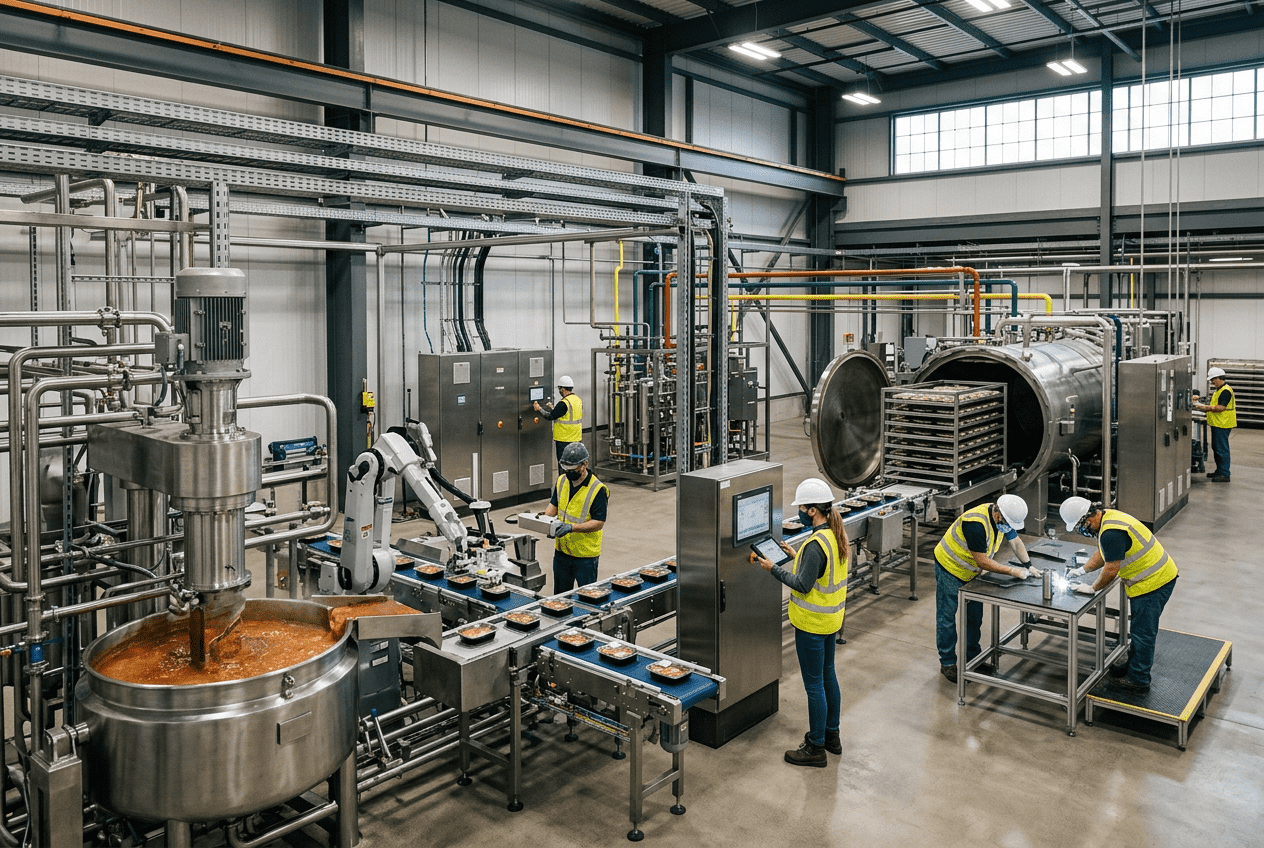
For companies expanding in markets such as Texas protein processing, California beverages, Midwest dairy, or East Coast co-packing, the decision is rarely about buying a tank alone. It is about how vessels, CIP, pumps, heat exchangers, automation, utilities, structural supports, and installation work together inside one production strategy. That is where a design-build-manage partner can make the difference between a line that merely runs and a line that produces margin.
Quick Answer

Custom process equipment makes the most sense when off-the-shelf systems cannot meet a plant’s required capacity, product characteristics, sanitation standards, space limitations, utility conditions, or automation architecture. In the United States, food and beverage manufacturers typically choose custom equipment for high-value applications such as blending, thermal processing, aseptic service, CIP, fermentation, distillation, marination, dairy, proteins, sauces, and specialty ingredient handling.
A successful custom project usually includes front-end engineering, 3D layout review, material selection, code and sanitary compliance review, fabrication, factory testing, shipment planning, field installation, controls integration, startup, and operator handoff. Companies that treat custom equipment as part of a broader production and profitability model tend to see the strongest results.
| Decision Factor | Off-the-Shelf | Custom Equipment | Best Fit |
|---|---|---|---|
| Lead time | Usually shorter | Moderate to long | Urgent replacements |
| Footprint match | Limited | Exact layout fit | Tight existing plants |
| Sanitary design | Standard options | Tailored hygienic details | High-care processing |
| Automation integration | Basic or separate | Designed to plant controls | Advanced recipe systems |
| Process performance | Generic | Product-specific | Viscous or sensitive products |
| Lifecycle value | Varies | Often higher long term | Growth-oriented facilities |
The table above shows the central buying truth: standard equipment can be appropriate for simple needs, but custom process equipment usually wins when the operating environment is complex, regulated, or margin-sensitive.
When Custom Equipment Makes Sense vs. Off-the-Shelf Solutions

Custom equipment is not automatically the better option. It is the better option when the economics of operation, compliance, uptime, or expansion justify the added engineering. For example, a co-packer in Chicago may need a syrup room skid sized for future line additions, while a poultry processor in Arkansas may need washdown-ready product handling equipment designed around USDA expectations, labor flow, and existing utility corridors.
Off-the-shelf systems work well for standardized processes with predictable duty conditions. A stock transfer tank, utility cart, or basic pump set may be enough when product variability is low and layout flexibility is high. But once the project involves difficult heat transfer, corrosive ingredients, high viscosity, foam control, allergen segregation, hygienic weld details, or SCADA-driven batch management, the limitations of catalog equipment appear quickly.
Manufacturers often move toward custom process equipment in five situations:
- They need to increase throughput without expanding the building.
- They need better product consistency or reduced giveaway.
- They must meet specific sanitary, FDA, 3-A, or ASME expectations.
- They are integrating acquired lines, relocated assets, or mixed OEM equipment.
- They want capital projects tied to measurable business outcomes.
This is especially common in logistics corridors such as Houston, Charlotte, Atlanta, Los Angeles, and Milwaukee, where plants frequently combine legacy infrastructure with new capacity targets. In those environments, the right solution is rarely a simple equipment purchase. It is a systems integration exercise.
| Scenario | Typical Issue | Why Standard Falls Short | Custom Advantage |
|---|---|---|---|
| RTD beverage expansion | Need future capacity | Fixed skid architecture | Modular growth planning |
| Dairy processing upgrade | Sanitary risk points | Generic fittings and drainability | Hygienic detailing |
| Protein marination line | Product variability | Inconsistent handling | Process-specific geometry |
| Sauce batching | High viscosity | Poor mixing and transfer | Agitator and pump sizing |
| Aseptic project | Sterility and controls | Limited validation support | Integrated process design |
| Facility relocation | Mixed legacy assets | No unified interface | Adapted integration package |
As a buying rule, if poor fit will cost more than custom engineering over three to seven years, custom usually makes sense.
The chart indicates a realistic upward trend in U.S. demand as manufacturers modernize plants, reshore production, and push for more flexible line design heading into 2026.
The Custom Design Process: From Concept to Fabricated Equipment

The best custom equipment projects start before drawings. They start with process goals, product characteristics, operational constraints, and expected business outcomes. That means understanding not only what the equipment should do, but why the plant needs it and how it affects yield, labor, utility demand, sanitation time, and packaging throughput.
A disciplined process typically follows these stages:
- Discovery and site review
- Capacity, product, and utility definition
- Concept design and equipment sizing
- 3D layout and interference checks
- Controls and instrumentation planning
- Code, sanitary, and safety review
- Fabrication package release
- Shop build, testing, and quality verification
- Shipment, field installation, and startup
In practice, this work is often coordinated by an engineering partner that can connect process, mechanical, electrical, controls, structural, and installation scopes. That matters because many projects fail not on vessel design, but on poor coordination between trades. A well-run project prevents conflicts around access, cleanability, drainage, pipe routing, steam service, glycol distribution, electrical loads, and control panel placement.
Disruptive Process Solutions approaches these projects with a design-build-manage model that aligns engineering decisions with installation execution and business performance. Instead of isolating design from field realities, the model helps owners connect concept development, procurement strategy, general contracting, integration, and commissioning into one capital plan. More about the company’s operating approach can be found on its about page.
| Project Stage | Main Activities | Primary Deliverables | Owner Benefit |
|---|---|---|---|
| Discovery | Site walk, interviews, production review | Requirements summary | Clear scope definition |
| Concept | Preliminary process and layout | Budget concept drawings | Early decision support |
| Engineering | Mechanical, process, controls details | Fabrication package | Reduced rework |
| Compliance review | Code and sanitary checks | Compliance matrix | Lower regulatory risk |
| Fabrication | Cutting, forming, welding, assembly | Completed equipment | Quality-controlled build |
| Startup | Installation, testing, training | Operational handoff | Faster ramp-up |
The table shows why the design phase is not just paperwork. It is where cost control, startup speed, and sanitation performance are largely determined.
Material Selection Flexibility: 304, 316L, AL-6XN & Specialty Alloys
Material selection directly affects corrosion resistance, cleanability, fabrication cost, weld behavior, and total lifecycle value. In U.S. food and beverage processing, 304 stainless steel remains common for general applications, but 316L is often preferred when chloride exposure, aggressive clean-in-place chemistry, acidic products, or longer service life are important. For especially demanding environments, AL-6XN and other specialty alloys may be justified.
Choosing the right metal is not about selecting the most expensive alloy. It is about aligning chemistry, temperature, pressure, cleaning regime, and expected duty cycle with the real operating environment. For example, a brewery in Portland may use 304 for some non-critical support applications but specify 316L for product-contact surfaces exposed to harsher chemicals. A sauce or brine application near the Gulf Coast may justify more robust alloy decisions because of corrosive conditions and washdown demands.
| Material | Typical Use | Strengths | Limitations |
|---|---|---|---|
| 304 Stainless | General food contact, tanks, frames | Economical, widely available | Less resistant to chlorides |
| 316L Stainless | CIP, dairy, acidic products | Better corrosion resistance | Higher cost than 304 |
| AL-6XN | High chloride and aggressive chemistry | Excellent pitting resistance | Premium price, specialized fabrication |
| Duplex Stainless | Selected utility or severe service | Good strength and corrosion profile | Application-specific design needed |
| Hastelloy | Highly corrosive specialty service | Exceptional chemical resistance | Very high cost |
| Carbon Steel with coating | Non-product utility service | Lower initial cost | Not suitable for many sanitary uses |
This comparison helps buyers avoid overspecifying every surface while still protecting critical product-contact zones. Good engineering often uses different materials intentionally within one project.
Special finishes, weld passivation, electropolishing, and surface roughness targets may also matter, especially in dairy, aseptic, or high-care systems. Material selection should be tied to cleaning validation, not just corrosion charts.
Integrating Custom Equipment Into Existing Production Lines
Integration is where many projects either create long-term value or create years of frustration. Installing a custom tank, skid, tumbler, kettle, or thermal system into an active plant means dealing with real-world constraints: low ceilings, existing trench drains, overloaded utility headers, old PLC architecture, sanitation pathways, forklift traffic, allergen zones, and line balancing.
Successful integration begins with accurate site data and realistic shutdown planning. For brownfield facilities in places like New Jersey, Ohio, and North Carolina, even a well-built piece of equipment can become a costly problem if tie-in points, access clearances, and operator movement were not evaluated early.
Key integration questions include:
- Will the new equipment match existing line speed and product flow?
- Can current utilities support steam, chilled water, glycol, compressed air, and electrical demand?
- Will control logic communicate with existing PLC, HMI, SCADA, and recipe systems?
- Does the line maintain hygienic zoning and maintenance access?
- Can the installation be staged to reduce downtime?
DPS is particularly strong in this area because its technical capabilities extend beyond process design into structural, mechanical, plumbing, electrical, and controls engineering, including PLC programming, automation, and SCADA. That cross-discipline capability matters when integrating a new processing asset into a live facility. Owners can review broader engineering and integration services when evaluating project support.
The bar chart highlights where custom food process equipment is in strongest demand. Beverage, protein, and dairy continue to lead due to sanitation complexity, recipe variation, and utility intensity.
ASME, 3-A & FDA Compliance for One-of-a-Kind Process Equipment
Custom equipment does not mean informal equipment. In regulated food and beverage operations, one-of-a-kind systems still need disciplined design documentation, material traceability where required, sanitary detailing, and code alignment. Depending on application, equipment may need to satisfy ASME pressure design requirements, 3-A sanitary principles, and FDA-focused hygienic considerations for product-contact surfaces.
For some plants, compliance also intersects with USDA, SQF, BRC, customer audit expectations, and internal corporate engineering standards. That is why compliance should be built into the project from the start rather than checked near shipment.
Important compliance elements often include:
- Proper material and weld selection
- Drainability and cleanability
- Surface finish suitability
- Elimination of dead legs where applicable
- Pressure boundary calculations where required
- Documentation, testing, and inspection records
For processors serving retail, foodservice, export, or pharmaceutical-adjacent applications, compliance also affects customer confidence and insurance posture. A tank or skid that looks sanitary is not enough. It must be engineered and documented in a way that supports validation, operations, and audit readiness.
| Compliance Area | What It Covers | Why It Matters | Typical Project Impact |
|---|---|---|---|
| ASME | Pressure vessel design and code rules | Safety and legal conformity | Design calculations and stamping |
| 3-A | Sanitary equipment principles | Cleanability and hygiene | Geometry and finish decisions |
| FDA | Food-contact suitability | Product safety | Materials and hygienic design |
| USDA | Meat and poultry processing expectations | Inspection readiness | Washdown and access design |
| SQF/BRC | Food safety system verification | Customer and audit demands | Documentation discipline |
| Corporate standards | Owner-specific requirements | Portfolio consistency | Preferred components and controls |
The value of this matrix is simple: compliance is not one item; it is a stack of overlapping requirements that can influence fabrication, installation, startup, and future audits.
Project Management: Timeline Milestones From Design to Startup
Custom equipment schedules are shaped by engineering depth, material lead times, shop capacity, controls complexity, shipping method, and plant shutdown windows. For U.S. projects, realistic timeline planning also needs to account for local permits, freight constraints, contractor availability, and seasonal production peaks. A beverage plant in California may need installation before summer volume ramps, while a protein plant in Kansas may require holiday blackout planning.
A disciplined project schedule should include formal milestones rather than broad promises. Owners need visibility into design approval, long-lead procurement, shop completion, FAT readiness, field installation, utility tie-ins, dry commissioning, wet commissioning, and performance confirmation.
| Milestone | Typical Duration | Main Risk | Risk Control |
|---|---|---|---|
| Requirements definition | 1-3 weeks | Scope ambiguity | Stakeholder alignment |
| Concept and budget design | 2-4 weeks | Missed assumptions | Early site verification |
| Detailed engineering | 4-8 weeks | Late changes | Design freeze discipline |
| Fabrication | 6-16 weeks | Material or labor delays | Procurement tracking |
| Installation | 1-6 weeks | Shutdown overrun | Preplanned tie-ins |
| Startup and training | 3-10 days | Controls or operator issues | Commissioning plan |
The explanation is important here: delays usually do not come from fabrication alone. They often come from late owner decisions, weak site information, poor coordination between trades, or underestimating controls integration.
DPS serves manufacturers across all 50 U.S. states and Canada, which is useful for multi-site operators that need repeatable project management rather than one-off local coordination. The company’s service capabilities include capital planning, owner’s representation, project and program management, general contracting where licensed, and turnkey installation and integration.
Fabrication Capabilities: Prototyping, Pilot-Scale & Full Production Units
Not every project begins with a full-size system. In many product development or process improvement cases, manufacturers first need pilot-scale equipment to validate heat transfer, residence time, ingredient incorporation, sanitation behavior, or operator workflow. That is especially true in functional beverages, plant-based proteins, fermented products, specialty sauces, and aseptic concepts.
Fabrication flexibility matters because the right approach may be a prototype vessel today, a pilot skid next quarter, and a full production train next year. A capable equipment partner should be able to support that progression without forcing owners to start over each time.
DPS has been growing its proprietary equipment manufacturing around practical food and beverage applications, including storage and processing tanks up to 12,000 gallons, custom CIP systems, marination tumblers, and cooking vessels. That manufacturing capability becomes more valuable when combined with engineering and field integration support, because the equipment is designed with the site and project outcome in mind rather than treated as an isolated product. You can review the company’s process equipment offerings for examples of manufactured systems.
| Fabrication Scale | Typical Objective | Example Application | Owner Advantage |
|---|---|---|---|
| Prototype | Test core concept | New mixing geometry | Lower early risk |
| Bench/Pilot | Validate product behavior | Thermal or blending trial | Supports commercialization |
| Demo skid | Operator and process proof | CIP or batching skid | Faster plant acceptance |
| Semi-production | Limited launch volume | Regional beverage line | Controlled market entry |
| Full production | Commercial throughput | Large tank or cooker system | Maximized capacity |
| Modular expansion | Future line additions | Utility-ready equipment train | Better long-term scalability |
For many U.S. manufacturers, modular fabrication is becoming the preferred strategy because it reduces field labor, shortens installation windows, and simplifies future capacity additions.
The area trend reflects how buyers are moving toward flexible, modular, and automation-ready equipment strategies, especially as labor pressures and SKU complexity continue into 2026.
Total Cost Analysis: Engineering, Fabrication, Installation & Lifecycle Value
Many buyers make the mistake of comparing only purchase price. The better comparison is total delivered value over the asset’s operating life. That includes engineering, fabrication, freight, structural support, installation, controls, startup, operator training, maintenance burden, sanitation time, utility usage, spare parts, uptime, and future expansion potential.
Custom equipment can carry a higher initial price than catalog equipment, but the lifecycle economics are often stronger when the system reduces downtime, prevents product loss, shortens cleaning, or eliminates labor-intensive workarounds. In high-volume facilities, even a small gain in OEE or yield can outweigh the initial engineering premium quickly.
Consider a simple example: if a custom batching system reduces ingredient giveaway by 1.5%, cuts sanitation time by 30 minutes per shift, and improves line utilization by 4%, the annual financial impact can be substantial. This is why sophisticated operators increasingly evaluate capital through throughput, margin, and payback, not unit price alone.
This comparison chart shows a common commercial reality: standard equipment may appear attractive on initial price, but custom equipment often performs better across operational value drivers.
When evaluating suppliers, buyers should ask for a cost model that includes:
- Engineering and project management scope
- Shop fabrication and QA activities
- Shipping, rigging, and installation assumptions
- Utility modifications and controls integration
- Documentation and compliance support
- Expected maintenance and upgrade path
For plants making large capital decisions, case-based review is often useful. DPS shares project examples and outcomes through its project case studies, which can help owners compare approaches across beverage, food, and utility-intensive applications.
FAQ
What types of custom process equipment are most common in the United States food and beverage market?
Common examples include process tanks, blending systems, CIP skids, cooking vessels, marination systems, fermentation equipment, distillation systems, thermal processing skids, utility modules, and integrated packaging support systems.
How do I know whether 304 or 316L is the better choice?
304 is often suitable for general service, while 316L is typically preferred where higher corrosion resistance, aggressive cleaning chemistry, or more demanding sanitary conditions are expected. The final decision should be based on product chemistry, cleaning protocol, and lifecycle goals.
Can custom equipment be installed into an older facility?
Yes, but the project needs careful field verification, utility review, layout modeling, and controls planning. Brownfield integration usually requires more engineering attention than greenfield installation.
Does custom equipment always cost more?
It usually costs more upfront, but not always more over the equipment’s life. If custom design improves uptime, yield, sanitation time, labor efficiency, or future expansion options, the total value can be better than a cheaper standard unit.
What compliance standards matter most?
That depends on application, but ASME, 3-A, FDA-related hygienic design principles, USDA expectations for certain food sectors, and private audit frameworks such as SQF or BRC are common factors in U.S. projects.
How long does a custom project take?
Simple projects may move in a few months, while larger integrated systems can take much longer. Timeline depends on design complexity, material lead times, controls integration, and the owner’s shutdown window.
What industries benefit most from custom process equipment?
Beverage, dairy, protein, prepared foods, sauces, ingredient processing, distilling, aseptic operations, and co-packing are among the strongest candidates because they often combine sanitation demands with changing throughput and product requirements.
What trends are shaping 2026 buying decisions?
The biggest 2026 trends include energy-aware system design, water and chemical reduction in CIP, increased automation and SCADA visibility, modular skid construction, stronger traceability expectations, and more capital planning tied to sustainability and labor resilience. U.S. manufacturers are also watching policy developments around domestic production, infrastructure reliability, food safety modernization, and environmental efficiency.
Why do some owners choose a partner like DPS instead of separate designers, fabricators, and installers?
Because combining engineering, manufacturing understanding, project management, and field execution can reduce coordination gaps. For many projects, especially complex food and beverage expansions, that integrated approach lowers schedule risk and aligns the equipment decision with broader plant profitability.
In summary, custom process equipment is most valuable when it is treated as part of a complete operating system. For U.S. food and beverage manufacturers, the smartest projects are the ones that connect process performance, sanitary design, utility realities, compliance, integration, and long-term business value. Whether the need is a pilot-scale skid, a 12,000-gallon process vessel, a custom CIP system, or a fully integrated production upgrade, the right solution starts with honest engineering and ends with reliable startup.
[/trp_language]
Complete Company Portfolio
About the Author: Disruptive Process Solutions (DPS)
The DPS team combines process engineering expertise with real-world food and beverage manufacturing experience. Our content focuses on process optimization, production efficiency, facility improvements, and practical solutions that help manufacturers operate more effectively in a rapidly evolving industry.
Share