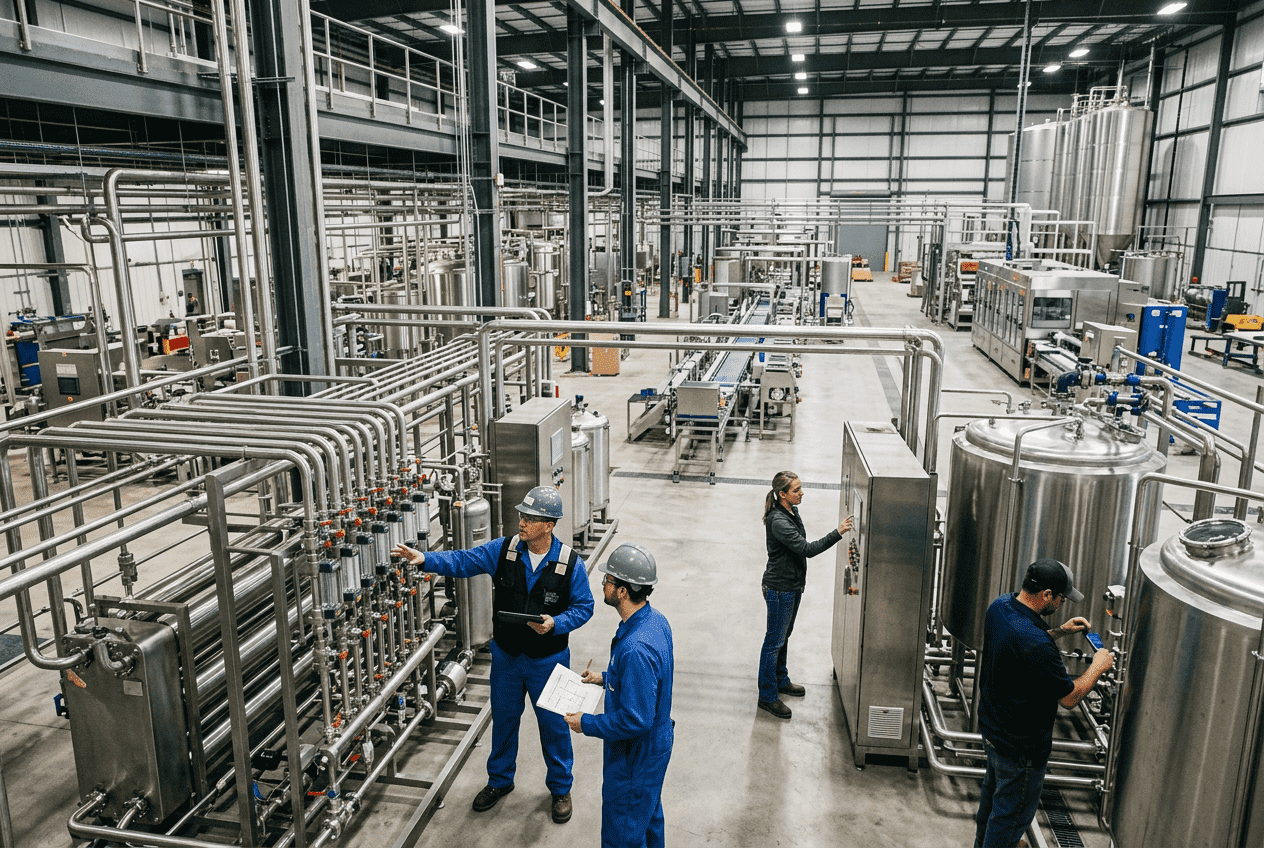
Kombucha Production Equipment
[trp_language language=”en_US”]
Kombucha Equipment Systems for Commercial Production
Commercial kombucha production equipment in the United States typically includes a tea brew kettle, sugar dissolution and ingredient handling systems, hot or cold liquor tanks, first-stage fermentation tanks, second-stage blending or conditioning tanks, brite tanks, refrigeration or glycol temperature control, sanitary transfer pumps, CIP systems, pH and quality monitoring tools, and a filling line suited to either still or carbonated live kombucha. The right layout depends on whether the brand will sell raw kombucha, pasteurized kombucha, or a hybrid product with flavoring, forced carbonation, and broader shelf distribution through grocery, foodservice, or co-packing channels.
For manufacturers in markets such as Los Angeles, Austin, Chicago, Portland, Denver, Atlanta, and the Research Triangle, equipment decisions should be based not only on tank size but also on fermentation method, acidity management, packaging style, sanitation design, labor model, utility demand, and future expansion. Producers shipping through major logistics corridors near the Port of Long Beach, Port of Savannah, Port of Houston, or distribution hubs in New Jersey and the Midwest also need to think carefully about shelf stability, cold-chain reliability, and line uptime.
Disruptive Process Solutions (DPS) supports beverage manufacturers across the United States and Canada with integrated process engineering, equipment supply, installation, automation, and capital project execution. For kombucha brands, that matters because the production system is never just a set of tanks; it is a complete operating platform that must support profitability, regulatory compliance, and scalable throughput.
Quick Answer

If you are selecting commercial kombucha brewing equipment, start with the production target and package format, then build backward. A small regional brand may begin with a 5 to 15 barrel tea brew and fermentation system, while a fast-growing brand serving multiple states may need 30 to 100 barrel fermentation capacity, dedicated blending tanks, brite tanks, a hygienic CIP skid, in-line instrumentation, and either a canning or bottling line with low-oxygen, counter-pressure capability.
The core process usually follows this sequence:
- Water treatment and tea brewing
- Sugar dissolution and sweet tea transfer
- Cooling to fermentation setpoint
- Inoculation with kombucha culture and starter liquid
- Primary fermentation in sanitary vessels
- Optional flavor dosing and secondary fermentation or conditioning
- Carbonation management in tank or package
- Filling, coding, packing, and cold storage
Most U.S. commercial producers also need documented sanitation procedures, pH logging, batch records, and thoughtful utility planning. CIP, glycol, compressed air, process drains, and floor layout are often more important than a shiny tank spec sheet. That is why many growing beverage companies use an integrated design-build approach rather than buying equipment piece by piece.
| Equipment Category | Primary Function | Typical Material | Common Size Range | Key Selection Factor | Who Usually Needs It |
|---|---|---|---|---|---|
| Tea brew kettle | Brews sweet tea base | 304 or 316 stainless steel | 100 to 5,000 gallons | Heating method and agitation | All commercial producers |
| Primary fermentation tank | Acidification and culture activity | 316 stainless preferred | 200 to 12,000 gallons | Headspace and sanitation design | Raw and pasteurized brands |
| Propagation vessel | SCOBY and starter management | 316 stainless or food-grade polymer | 50 to 2,000 gallons | Culture separation and traceability | Multi-batch operations |
| Blending tank | Flavoring and standardization | 304 or 316 stainless steel | 100 to 4,000 gallons | Mixing shear and cleanability | Flavored kombucha producers |
| Brite tank | Carbonation and fill buffer | Pressure-rated stainless steel | 100 to 4,000 gallons | Pressure rating and cooling | Carbonated SKUs |
| Filling line | Packaging into cans or bottles | Stainless, sanitary contact parts | 20 to 400+ containers/min | Oxygen pickup and pressure handling | Scaling brands and co-packers |
The table above summarizes the minimum equipment categories found in most commercial kombucha plants. It also shows why equipment should be selected as a system: each item affects microbiology, quality consistency, and total production cost.
Commercial Kombucha Brewing Equipment: From Tea Brew Kettle to Brite Tank

A commercial kombucha line begins with the sweet tea base. The brew side normally includes water treatment, ingredient receiving, tea extraction, sugar addition, heat transfer, and transfer piping. In many U.S. facilities, producers adapt brewery-style hardware, but kombucha requires specific attention to acid exposure, sanitation, and culture management.
The tea brew kettle should support repeatable extraction and complete sugar dissolution. Steam-jacketed kettles are common in larger plants because they deliver efficient heating and faster recovery between batches. Electric systems can work for smaller producers, especially in leased spaces where boiler installation is difficult. After brewing, the tea must be cooled quickly and transferred hygienically to fermentation or a holding tank. Plate heat exchangers are often used when the process design includes chilled water or glycol.
On the downstream side, the brite tank becomes important when the product is force-carbonated, standardized, or held as a buffer before filling. Unlike primary fermentation vessels, brite tanks are pressure-rated and usually jacketed for precise temperature control. If the brand is producing a sparkling kombucha for retail chains in California, Texas, Florida, or the Northeast, a brite tank can help reduce package variability and improve filling line efficiency.
Other important brewing-side components include:
- Ingredient hoppers or sugar handling systems
- Transfer pumps sized for low-shear sanitary movement
- Inline filters or strainers where needed
- CIP return and supply loops
- Sanitary valves, sample ports, and instrumentation
- Floor drains and sloped washdown-compatible surfaces
| Process Step | Typical Equipment | Operational Goal | Main Risk | Best Practice | Expansion Note |
|---|---|---|---|---|---|
| Water preparation | RO, carbon filtration, UV | Consistent source water | Flavor variation | Test hardness and chlorine | Size for future throughput |
| Tea brewing | Jacketed kettle | Extract tea and dissolve sugar | Scorching or weak extraction | Controlled heating profile | Add automation for repeatability |
| Cooling | Heat exchanger | Reach inoculation temperature | Slow cooldown contamination risk | Validated cooling curve | Plan glycol load early |
| Primary fermentation | Atmospheric or vented tank | Culture-driven acidification | Inconsistent batch performance | Dedicated culture handling SOPs | Use parallel tanks for flexibility |
| Blending | Mix tank | Flavor addition and adjustment | Overmixing or oxygen pickup | Gentle agitation and dosing controls | Include load cells if possible |
| Packaging buffer | Brite tank | Stable fill conditions | CO2 loss or pressure drift | Pressure-rated, chilled vessel | Essential for high-speed lines |
This table shows the equipment path from utility preparation to final packaging. For many brands, the biggest gains come from linking these stages through clean piping, automation, and smart tank scheduling rather than simply buying larger tanks.
The line chart illustrates a realistic upward demand trend in commercial kombucha equipment across the United States, driven by premium functional beverages, multi-state distribution, and co-packing growth.
SCOBY Management: Propagation Vessels and Fermentation Tank Design

SCOBY management is one of the clearest differences between kombucha and other beverage categories. A commercial producer cannot treat the culture like a casual ingredient. It is a biological production asset that needs traceability, protection, and predictable propagation. As operations scale, ad hoc culture handling becomes a major source of variation.
Propagation vessels are used to maintain healthy starter liquid and, where relevant, pellicle formation. Many modern producers focus more on liquid inoculum control than on handling thick mats, but both require dedicated space and process discipline. Tanks should be easy to sanitize, easy to sample, and separated from non-culture activities. Exposure to aggressive cleaners, dead legs in piping, and poor temperature stability can all weaken performance.
Fermentation tank design depends on process philosophy. Some brands use open or loosely covered vessels for traditional fermentation behavior; others prefer enclosed sanitary tanks with venting control and insect exclusion. In either case, material finish, port placement, sample valves, and cleanability matter. If the brand intends to maintain multiple flavor lines or regional SKUs, separate propagation and quarantine capacity is often wise.
Important SCOBY management questions include:
- How is mother culture stored, rotated, and documented?
- How much starter liquid is required per batch?
- Can weak batches be isolated without risking the main culture bank?
- Are tanks dedicated by stage, flavor family, or culture generation?
- How are pH, temperature, and sensory outcomes linked to inoculum history?
| SCOBY Management Element | Preferred Equipment Feature | Why It Matters | Operational Risk if Missing | Recommended U.S. Practice | Scale Trigger |
|---|---|---|---|---|---|
| Culture storage | Dedicated propagation vessel | Preserves batch consistency | Culture drift | Separate mother culture from production | More than 2 batches per week |
| Sampling | Sanitary sample valve | Fast pH and sensory checks | Contamination during testing | Use aseptic sampling SOPs | Any commercial operation |
| Vent management | Filtered vent or protected headspace | Reduces contamination exposure | Wild microbes or insects | Install protected breathing path | Warm-climate facilities |
| Tank finish | Smooth sanitary internal surface | Improves cleaning | Residue retention | Specify sanitary weld quality | Always |
| Batch traceability | Tagging and digital records | Supports food safety and consistency | Unclear root cause analysis | Link culture lot to fill lot | Retail distribution |
| Quarantine capacity | Spare vessel or hold tank | Protects main production | Cross-batch loss | Maintain isolation option | Regional and national brands |
The table highlights how culture management moves from craft habit to engineered system as a kombucha producer grows. This is especially relevant for brands supplying chains that expect lot-to-lot uniformity.
First and Second Stage Fermentation Equipment Selection
First-stage fermentation is where sweet tea becomes kombucha. The equipment choice here affects acid development, sugar depletion, microbial balance, and flavor complexity. Many U.S. producers prefer atmospheric or lightly vented vessels for primary fermentation. Tank geometry should allow manageable cleaning, low-stress transfers, and headspace appropriate to fermentation activity.
Second-stage processing varies widely. Some brands conduct true secondary fermentation with flavor ingredients and natural carbonation; others use a controlled blending and conditioning step followed by force carbonation. The latter often provides better consistency for large retail programs, especially when products move through ambient staging before cold placement.
Choose first- and second-stage equipment based on:
- Batch residence time
- Desired residual sugar level
- Need for fruit puree, juice, or botanical additions
- Packaging pressure requirements
- Tolerance for natural batch variation
- Cold-chain strategy
A producer in Seattle serving specialty retailers may accept slower batch turnover for artisanal flavor complexity. A co-packer in the Midwest serving club-store programs will usually prioritize repeatability, CIP speed, and packaging compatibility.
| Fermentation Stage | Typical Vessel Type | Pressure Rating | Main Objective | Best Fit | Limitation |
|---|---|---|---|---|---|
| Primary fermentation | Atmospheric stainless tank | Low or none | Acid and flavor development | Traditional raw kombucha | Less carbonation control |
| Primary fermentation | Enclosed vented tank | Minimal | Sanitary protection | Urban production sites | Needs careful vent design |
| Secondary flavoring | Agitated blend tank | Low | Flavor dosing and mixing | Fruit or botanical SKUs | Possible oxygen pickup |
| Conditioning | Jacketed holding tank | Moderate | Temperature stabilization | Multi-SKU scheduling | Extra tank cost |
| Carbonation | Pressure-rated brite tank | High | CO2 absorption | Sparkling kombucha lines | Requires tight controls |
| Package fermentation | Direct fill with refermentation | Package-dependent | Natural sparkle | Niche artisanal formats | Harder shelf consistency |
This comparison helps identify whether the plant should prioritize traditional fermentation character or packaging consistency. Many growing U.S. brands eventually adopt a hybrid approach: authentic primary fermentation followed by more controlled downstream handling.
Temperature Control Systems for Consistent Kombucha Fermentation
Temperature control is one of the most overlooked profit levers in kombucha production. Fermentation is biologically active, and seasonal changes in facilities from North Carolina to Arizona can create meaningful shifts in acidity, sugar use, and flavor development. Even a few degrees of drift can change batch timing and yield.
Common temperature control methods include ambient-conditioned fermentation rooms, jacketed tanks with glycol loops, insulated vessels, and automated temperature feedback controls. For small operations, room conditioning may seem attractive, but it can become inefficient as tank count grows. Jacketed tanks offer better precision and make it easier to stagger batches.
When evaluating temperature systems, consider:
- Total heat load from brew, fermentation, and packaging areas
- Climate conditions and seasonal humidity
- Target fermentation setpoint and allowable drift
- Utility redundancy
- Cleaning compatibility
- Control system integration with alarms and data logging
DPS regularly supports food and beverage clients with utility planning that includes glycol, boilers, compressed air, cooling towers, refrigeration, and controls. In kombucha projects, that broader utility expertise is critical because temperature performance depends on the entire plant infrastructure, not just the tank jacket.
The bar chart shows where controlled fermentation infrastructure is most in demand: co-packers and national brands generally invest sooner because consistency and throughput are directly tied to margin and customer retention.
pH Monitoring and Acidity Control in Kombucha Production
pH monitoring is not optional in commercial kombucha. It is a core quality and food safety control point. Producers need reliable bench meters, calibrated probes, sampling procedures, and batch records that document acidification progress. In larger plants, pH data may be linked to SCADA or digital batch systems so supervisors can track trends across tanks and production weeks.
Acidity control depends on more than measurement. It also requires control of inoculation rate, sweet tea composition, fermentation temperature, residence time, and transfer timing. If fruit additions are made after fermentation, their sugar and acid load must be accounted for. Brands seeking lower residual sugar or tighter sensory targets often benefit from formalized decision thresholds such as pH windows for transfer, flavor addition, or cold crash.
Best practices in U.S. kombucha plants include:
- Daily calibration of pH meters during active production
- Redundant handheld and bench-top measurement capability
- Defined batch release specifications
- Documented corrective actions for slow or fast fermentations
- Trend review by lot, ingredient source, and culture age
For companies scaling into retail chains across the United States, digital traceability becomes increasingly valuable. DPS brings automation, PLC programming, SCADA, and process integration expertise that can connect instrumentation, tank controls, utility systems, and reporting into a more manageable operating environment.
| Control Point | Tool or Equipment | Typical Frequency | Purpose | Common Deviation | Corrective Action |
|---|---|---|---|---|---|
| Incoming water | Water test kit or lab analysis | Weekly or per source change | Protect flavor baseline | Mineral drift | Adjust treatment settings |
| Sweet tea batch | Brix meter and temperature check | Every batch | Consistent fermentable input | Weak or strong extract | Rebalance formulation |
| Inoculation | Volume and pH verification | Every batch | Proper starter ratio | Under-inoculation | Supplement starter liquid |
| Active fermentation | Calibrated pH meter | Daily or twice daily | Track acidification rate | Slow pH drop | Investigate temperature and culture health |
| Pre-flavoring | pH and sensory review | Every transfer | Confirm target maturity | Over-acidification | Blend strategy or product repositioning |
| Finished product | Final pH and packaged retention | Each lot | Release verification | Drift during hold | Review stabilization method |
The table above shows how pH control spans the whole process, not just the fermentation vessel. It is a plant-wide quality discipline.
Carbonation Management: Counter-Pressure Filling for Live Kombucha
Carbonation is where many kombucha brands struggle as they scale. Live kombucha can continue changing in package, and the product’s acidity, solids, and biological activity can complicate fill performance. For sparkling products, the equipment must preserve carbonation while minimizing oxygen pickup and foam losses.
Counter-pressure filling is often the preferred approach for live kombucha in cans or glass bottles when the product is carbonated in a brite tank before packaging. This method equalizes package pressure before fill, reducing breakout and improving consistency. For producers supplying natural grocery chains or refrigerated convenience channels, it can substantially improve finished quality and package appearance.
Key carbonation equipment elements include:
- Pressure-rated chilled brite tank
- Accurate CO2 stone or in-line carbonation setup
- Counter-pressure filler with hygienic change parts
- Dissolved oxygen management
- Foam control strategy
- Cold holding space after fill
If the product contains pulp, puree, or botanical solids, filler selection becomes more specialized. Some brands also need package warmers or post-fill stabilization steps depending on the retail route. Canning lines in high-volume regions such as Southern California and the Northeast often justify more automation because labor cost and throughput expectations are higher.
The area chart reflects the U.S. trend toward controlled carbonation systems rather than relying on unpredictable in-package refermentation. This shift is especially strong among brands pursuing wider distribution.
Pasteurization vs Raw Kombucha: Equipment Implications for Shelf Stability
One of the most important strategic decisions in kombucha production is whether the finished product will remain raw or receive a pasteurization step. The answer changes the equipment list, utility demand, quality program, and distribution strategy.
Raw kombucha usually requires stricter cold-chain control and more careful package stability planning. It may preserve a brand identity built around live culture, but it also creates more sensitivity around residual fermentation, carbonation drift, and shelf variability. Equipment emphasis tends to be on culture integrity, refrigeration, sanitary handling, and rapid inventory movement.
Pasteurized kombucha generally requires thermal processing equipment such as flash pasteurization, tunnel pasteurization, or another validated stabilization method. That can widen distribution and simplify some retail logistics, but it introduces additional capital cost and may alter sensory positioning.
DPS has broad process experience with HTST, UHT, tunnel pasteurization, flash pasteurization, retort, aseptic systems, and integrated beverage processing. That wider thermal processing capability is valuable when a kombucha producer is evaluating not just equipment cost, but business model fit.
| Production Model | Typical Equipment Priority | Shelf Stability Approach | Distribution Fit | Capital Impact | Main Trade-Off |
|---|---|---|---|---|---|
| Raw refrigerated kombucha | Fermentation, cold storage, sanitary filling | Cold-chain dependence | Natural retail and local distribution | Moderate | More biological variability |
| Raw carbonated kombucha | Brite tank and counter-pressure filler | Cold with CO2 control | Regional retail | Moderate to high | Packaging sensitivity |
| Flash-pasteurized kombucha | HTST or flash unit | Improved microbial stability | Broader retail routes | Higher | Potential flavor change |
| Tunnel-pasteurized package | Filled-pack thermal system | Packaged product stabilization | Larger packaged beverage programs | High | Energy and package compatibility |
| Hybrid limited-raw line | Flexible tanks and optional stabilization | SKU-specific control | Mixed channel strategy | Higher design complexity | Operational complexity |
| Aseptic-adjacent functional beverage extension | Advanced sterile handling | Very high stability | National expansion | Very high | Different product identity |
The table makes it clear that shelf stability is not simply a quality question; it is a business and infrastructure decision. Brands planning to move beyond local cold distribution should evaluate this early.
Scaling Kombucha Production: From Small Batch to Commercial Brewery
Scaling kombucha production is rarely a straight line. The move from pilot batches to regional commercial output usually exposes bottlenecks in utilities, labor flow, culture management, and packaging uptime before it exposes a lack of tank volume. Many producers discover that they do not need a larger system first; they need a smarter one.
In the United States, successful scaling often follows these stages:
- Pilot validation with flexible small vessels
- Regional launch with semi-manual brewing and fermentation
- Dedicated sanitary process line with CIP and chilled capacity
- Automated batching, integrated controls, and faster packaging
- Multi-SKU or multi-site operation with stronger data systems
Local conditions matter. A facility near Charlotte or Raleigh may have different utility economics than one in Oakland or Brooklyn. Access to ingredients, labor, cold storage, and freight lanes can change the best equipment configuration. Brands shipping nationwide also need to think about where co-packing, line balancing, or satellite production might lower delivered cost.
DPS is especially relevant in this stage because its service model combines engineering, capital planning, installation, equipment integration, and project management. Through its Design Build Manage approach, the company works not just as an equipment seller but as a project partner focused on long-term profitability. Its technological capabilities include process, mechanical, structural, plumbing, electrical, and controls engineering, along with PLC programming and SCADA integration. Its manufacturing capabilities include proprietary process equipment such as tanks and CIP systems that can be integrated into broader plant solutions. Its service capabilities span feasibility, owner’s representation, turnkey installation, commissioning, and multi-trade coordination across North America.
For kombucha producers, that kind of full-scope support can reduce risk during expansion, especially when adding new packaging, utilities, or facility infrastructure. You can learn more about the company’s background on the About Us page, explore broader beverage and food project support through its engineering and execution services, review available process equipment solutions, or see practical outcomes in selected project case studies.
| Growth Stage | Typical Annual Output | Best Equipment Strategy | Most Common Bottleneck | Recommended Investment Priority | Operational Focus |
|---|---|---|---|---|---|
| Pilot | Under 50,000 gallons | Flexible modular vessels | Process learning | Data collection and SOPs | Recipe validation |
| Local commercial | 50,000 to 250,000 gallons | Dedicated brew and ferment setup | Labor intensity | CIP and cold storage | Consistency |
| Regional expansion | 250,000 to 1 million gallons | Jacketed tanks and better filling | Packaging speed | Brite tank and controls | Retail service levels |
| Multi-state brand | 1 to 5 million gallons | Integrated utilities and automation | Plant scheduling | SCADA and line balancing | Margin management |
| National program | 5 to 20 million gallons | High-throughput process architecture | Shelf stability complexity | Thermal strategy and redundancy | Network optimization |
| Enterprise co-packing | 20 million+ gallons equivalent | Turnkey plant design | Multi-SKU changeovers | Automation and utility resilience | Portfolio profitability |
This table shows why each growth stage calls for a different investment mindset. Buying the largest possible fermenter is rarely the answer if filling, utilities, or culture control are the true constraints.
The comparison chart shows why integrated project partners often outperform isolated equipment vendors for larger kombucha investments. Process, utilities, packaging, controls, and facility layout need to work together.
FAQ
What equipment is absolutely necessary to start commercial kombucha production?
At minimum, you need a brew kettle, sanitary fermentation vessels, transfer pumps, pH monitoring tools, refrigerated storage, cleaning equipment, and a packaging setup. Once volume increases, a dedicated CIP system, glycol control, and better filling technology usually become necessary.
Do kombucha producers need 316 stainless steel?
Not every component must be 316 stainless, but acidic products benefit from corrosion-resistant sanitary materials. Many plants use a mix of 304 and 316 depending on exposure, cleaning chemistry, and budget.
Can brewery equipment be repurposed for kombucha?
Sometimes, yes. However, brewery tanks and piping should be reviewed for acid compatibility, venting, cleaning design, and process fit. A direct retrofit without engineering review can create sanitation and quality issues.
Is a brite tank necessary for kombucha?
If you sell carbonated kombucha and want consistent package pressure, a brite tank is highly recommended. For still kombucha or very small artisanal production, it may not be necessary.
What is the best filling method for live sparkling kombucha?
Counter-pressure filling is typically the best commercial option because it helps maintain carbonation and reduce oxygen pickup. The exact filler depends on package type, solids load, and line speed.
Should a kombucha brand choose raw or pasteurized production?
That depends on brand positioning, shelf-life goals, and distribution model. Raw products often support a live-culture identity but require stronger cold-chain control. Pasteurized products can simplify broader distribution but require added equipment and process validation.
How important is automation in kombucha plants?
Automation becomes increasingly valuable as batch count, SKU count, and retail commitments grow. PLC and SCADA tools help track temperatures, utilities, recipe steps, alarms, and production records more reliably.
What should companies consider in 2026 and beyond?
Three major trends stand out for 2026: first, more automation and digital batch traceability; second, stronger policy and retailer expectations around food safety documentation, sustainability, and utility efficiency; third, increased interest in flexible systems that can produce kombucha alongside adjacent functional beverages. Energy-efficient glycol systems, water reuse planning, low-loss filling, recyclable packaging compatibility, and future-ready controls will matter more every year.
How can U.S. producers lower expansion risk?
They should validate throughput assumptions, model utility demand, design for cleanability, and align equipment with actual distribution strategy. Working with a partner that understands engineering, installation, controls, and long-term operational economics can prevent expensive oversizing or the wrong process path.
In summary, the best commercial kombucha production equipment is not defined by one tank or one machine. It is defined by how well the system supports safe fermentation, stable flavor, efficient cleaning, scalable packaging, and profitable growth in the United States market. From tea brew kettle to brite tank, and from culture propagation to plant-wide controls, the strongest projects are engineered around the full process and the business model behind it.
[/trp_language]
Complete Company Portfolio

About the Author: Disruptive Process Solutions (DPS)
The DPS team combines process engineering expertise with real-world food and beverage manufacturing experience. Our content focuses on process optimization, production efficiency, facility improvements, and practical solutions that help manufacturers operate more effectively in a rapidly evolving industry.
Share

