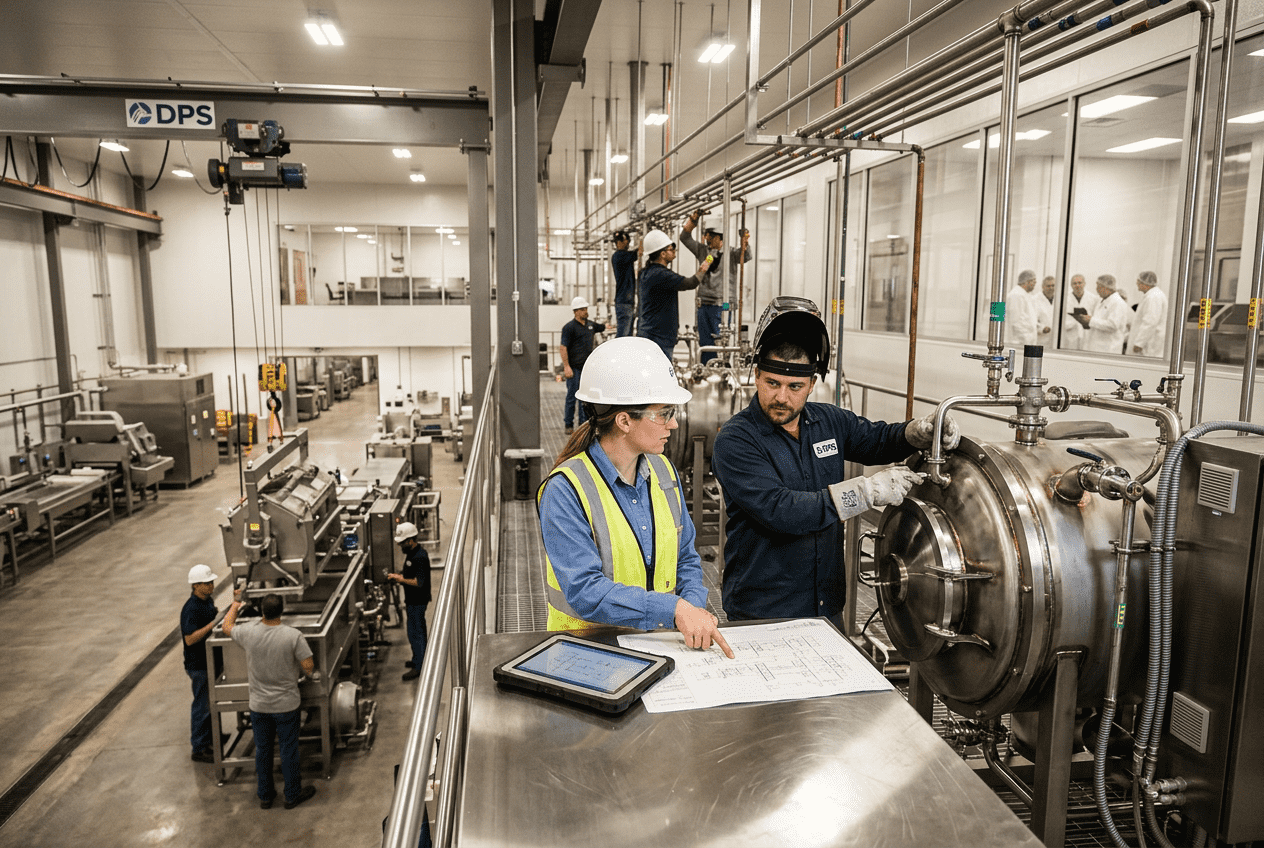
Prepared Foods Processing Solutions
[trp_language language=”en_US”]
Prepared Food Processing Systems in the United States
Prepared foods processing in the United States covers a wide range of products, including soups, sauces, ready meals, protein bowls, frozen entrées, dips, fillings, meal kits, and refrigerated side dishes. The right system depends on SKU mix, throughput, food safety requirements, viscosity, particulate size, shelf-life targets, and labor strategy. For manufacturers scaling production or upgrading older lines, the best approach usually combines recipe automation, fit-for-purpose cooking technology, integrated chilling or freezing, strong allergen controls, and facility planning that supports long-term profitability rather than short-term equipment purchases.
Quick Answer

Prepared food manufacturing is one of the most dynamic processing categories in the U.S. because it serves retail, foodservice, club store, private label, e-commerce, and co-packing demand all at once. The category includes ready-to-eat and ready-to-cook items that may be refrigerated, frozen, hot-filled, retorted, or assembled under chilled conditions. A successful prepared foods processing solution must do more than cook product. It must manage formulation accuracy, ingredient staging, thermal consistency, texture protection, sanitation, allergen segregation, and packaging line synchronization.
For most processors, the core decision is not simply which vessel or mixer to buy. The more important question is how the full line will perform as an integrated system. That means evaluating upstream ingredient receiving, dry and liquid metering, in-process heating, hold times, particulate handling, transfer pumps, buffering, final temperature pull-down, clean-in-place design, and operator interaction. Plants serving urban consumption centers such as Chicago, Los Angeles, Dallas, Atlanta, New Jersey, and the greater New York corridor also need to factor in freight velocity, labor competition, utility cost, and cold-chain access.
Companies looking for long-term value often engage a partner that can connect engineering, installation, and execution. That is where a full-scope firm such as Disruptive Process Solutions becomes relevant. Rather than treating a project as a stand-alone equipment purchase, DPS evaluates how capital choices affect throughput, margin, sanitation risk, and future expansion. Its work across North America supports manufacturers that need practical solutions for growth, relocation, modernization, and high-stakes schedule execution.
| Product Category | Typical State | Primary Process Need | Key Risk | Packaging Format | Typical Market Channel |
|---|---|---|---|---|---|
| Soups and stews | Hot-fill, chilled, or frozen | Uniform heat transfer | Particulate damage | Cups, pouches, tubs | Retail and foodservice |
| Sauces and gravies | Hot or ambient after retort | Viscosity control | Scorching or phase separation | Jars, pouches, bulk totes | Retail, QSR, industrial |
| Frozen entrées | Cooked then frozen | Line balancing | Freezer bottlenecks | Trays, bowls, cartons | Retail and club |
| Meal kit components | Chilled | Rapid temperature pull-down | Shelf-life loss | Lidded trays, bags | E-commerce and retail |
| Dips and spreads | Chilled | Shear management | Texture breakdown | Tubs, cups | Retail deli and grocery |
| Protein bowls | Chilled or frozen | Multi-component assembly | Allergen crossover | Bowls, trays | Retail and convenience |
The table shows why no single platform fits every prepared food. Soups demand gentle particulate movement, sauces depend on precise viscosity control, while frozen entrées live or die by downstream chilling and freezer capacity. Matching process design to product reality is essential.
Prepared Foods Processing: Defining the Category and Market Opportunity

In the United States, prepared foods sit at the intersection of convenience, premiumization, labor scarcity, and cold-chain sophistication. Consumers want restaurant-style flavor with reduced prep time, and operators want products that lower kitchen labor and improve consistency. That demand supports growth across refrigerated side dishes, premium frozen meals, deli salads, ethnic sauces, plant-forward bowls, breakfast assemblies, and protein-based convenience foods.
Major logistics corridors shape the market opportunity. Midwest plants near Chicago, Kansas City, and Indianapolis can reach broad population density quickly. West Coast operations in Southern California gain access to Port of Los Angeles and Port of Long Beach import flows, while East Coast and Southeast processors benefit from New Jersey, Savannah, Jacksonville, and Atlanta distribution access. Texas plants often serve both national and regional strategies due to strong highway reach, lower operating cost in some submarkets, and large population centers such as Dallas-Fort Worth and Houston.
Prepared foods also span many industries and applications:
- Retail private label
- National branded refrigerated and frozen foods
- QSR and chain restaurant back-of-house simplification
- Institutional feeding for schools, healthcare, and corrections
- Club store multipacks
- Meal assembly and co-manufacturing
- Special diet, high-protein, keto, gluten-free, and plant-based products
The opportunity is strong, but margin can erode fast when systems are poorly designed. Overheating can ruin yield. Excessive manual staging can slow releases. Under-sized glycol or ammonia systems can choke capacity. Weak recipe governance can create giveaway, inconsistency, or rework. For that reason, leading processors increasingly view prepared foods as a systems-engineering challenge rather than a collection of isolated machines.
The line chart illustrates a realistic market growth pattern for prepared foods in the U.S. through 2026. Growth is supported by demand for convenience, regional menu innovation, and expanded cold-chain distribution.
| Driver | Why It Matters | Most Affected Products | Operational Impact | Investment Priority | 2026 Outlook |
|---|---|---|---|---|---|
| Convenience demand | Consumers want fast meal solutions | Frozen meals, chilled bowls | More SKU proliferation | Flexible lines | Strong |
| Labor shortages | Plants need automation | All segments | Reduced manual dosing | Controls and handling | Strong |
| Foodservice outsourcing | Chains shift prep off-site | Sauces, proteins, sides | Higher volume runs | Continuous processing | Growing |
| Premiumization | Higher quality expectations | Chef-style entrées | Gentler thermal design | Texture-preserving systems | Growing |
| Private label expansion | Retailers need agile suppliers | Meal kits, soups, dips | Frequent changeovers | Recipe management | Strong |
| Sustainability pressure | Energy and waste reduction matter | All segments | Utility optimization | Heat recovery and water reuse | Accelerating |
This market table highlights that growth alone is not the story. The winning processors are those that convert demand into efficient, scalable operations without losing quality or safety.
Batch vs Continuous Processing: Selecting the Right Mode for Your Operation

Choosing batch or continuous processing depends on SKU complexity, run length, viscosity range, allergen exposure, required traceability, and labor model. Batch systems are common when processors need flexibility for many recipes, low-to-medium volumes, or frequent product launches. Continuous systems are attractive when demand is predictable, volumes are high, and the thermal and rheological properties of the product can be held within a narrower operating band.
Batch processing offers advantages for premium sauces, seasonal soups, custom foodservice formulations, and co-pack environments where production schedules change daily. Operators can adjust ingredients, cooking profiles, dwell times, and order sequence with less disruption. However, batch can create more downtime between runs and higher labor per pound.
Continuous processing delivers strong economics for stable demand products such as institutional soups, base sauces, fillings, and some ready meal components. It improves throughput consistency and can reduce energy use per unit. The tradeoff is that system design becomes less forgiving. Feed variability, particulate control, and sanitation transitions require more disciplined engineering.
A practical decision framework should consider not only today’s production, but where the plant needs to be in three to five years. That is why many manufacturers use integrated engineering support from firms offering food and beverage engineering services to build a phased roadmap instead of overinvesting too early or undersizing a line that will be capacity-constrained in 18 months.
| Factor | Batch Processing | Continuous Processing | Best Fit Example | Main Benefit | Main Limitation |
|---|---|---|---|---|---|
| SKU count | High flexibility | Best with fewer SKUs | Private label sauces | Fast product changes | Lower hourly output |
| Volume | Low to medium | Medium to high | Institutional soup base | Economies of scale | Less adaptable |
| Allergen separation | Easier scheduling control | Harder if line is shared | Dairy vs non-dairy dips | Risk reduction | More downtime |
| Recipe changes | Frequent | Limited | Co-manufacturing plants | Commercial agility | Labor intensity |
| Traceability | Strong by lot | Strong with advanced controls | High-value premium meal components | Quality accountability | Control complexity |
| Capital efficiency at scale | Moderate | High | Long-run gravy lines | Lower unit cost | Higher upfront design demand |
The matrix shows that there is no universal winner. Batch wins on flexibility, while continuous wins on stable-volume economics. Many U.S. processors end up with hybrid facilities: batch make-up and blending feeding semi-continuous thermal and packaging systems.
Recipe Management Systems for Multi-SKU Prepared Food Production
As product portfolios expand, recipe management becomes a profit center. In multi-SKU prepared food plants, recipe control systems reduce giveaway, improve repeatability, and protect brand consistency across shifts and facilities. A strong system typically includes ingredient verification, operator prompts, lot tracking, weigh-and-dispense integration, dosing logic, thermal profile capture, and digital batch records.
For processors operating across multiple states or serving both branded and private-label customers, recipe governance is especially important. It limits unauthorized adjustments, standardizes allergen declarations, and helps resolve customer complaints faster. Plants near major trade hubs such as Atlanta, Minneapolis, Philadelphia, and the Inland Empire often serve diverse customer mixes, making digital recipe discipline even more valuable.
From a technological capabilities standpoint, DPS supports process, controls, automation, PLC programming, and SCADA integration that can tie recipe execution to actual plant operation. That matters because recipe software without disciplined hardware integration often fails at the floor level. Pumps, valves, meters, vessel sequencing, Brix or solids measurements where applicable, and operator interfaces all need to work together.
For buyers, the best advice is to view recipe management as part of the process architecture, not an afterthought. A good implementation addresses:
- Master formula control
- Scaling logic for different batch sizes
- Ingredient substitutions and approval workflow
- Real-time alarms for out-of-spec additions
- Digital lot genealogy
- ERP and inventory connectivity
The demand chart compares major prepared food categories by a realistic relative demand index. Frozen entrées and sauces continue to attract strong volume because they serve both retail and foodservice applications.
| Feature | Purpose | Operational Value | Quality Benefit | Compliance Benefit | Best For |
|---|---|---|---|---|---|
| Digital batch records | Capture each run | Faster review | Less undocumented variation | Improved audit readiness | Multi-shift plants |
| Ingredient verification | Confirm correct lot and material | Lower error rate | Formula consistency | Traceability | High-SKU operations |
| Automated dosing logic | Control additions | Lower labor dependence | Repeatable flavor | Documented control | Liquids and minor ingredients |
| Approval workflow | Restrict changes | Better governance | Less formulation drift | Label accuracy support | Branded products |
| Lot genealogy | Track sources to finished goods | Faster recalls | Root-cause clarity | Regulatory support | National distribution |
| ERP connectivity | Link production and inventory | Better planning | Reduced stockouts | Record alignment | Growing enterprises |
This feature set shows why recipe systems matter in prepared foods. They improve cost control, support audits, and reduce dependence on tribal knowledge.
Cooking Technologies: Steam Injection, Jacketed Kettles, and Indirect Heat Exchange
The choice of cooking technology shapes flavor, yield, viscosity, cleanability, and capacity. In prepared foods plants, three common approaches are steam injection, jacketed kettles, and indirect heat exchange. Each has strengths depending on the product and production objective.
Steam injection offers rapid heating and strong thermal responsiveness. It works well for some liquid-heavy products where fast temperature rise is essential. But direct steam affects moisture balance and can change finished solids, so formula compensation may be needed. Water quality and culinary steam quality must also be carefully managed.
Jacketed kettles remain a workhorse for many processors. They are flexible, operator-friendly, and suitable for batch cooking of sauces, soups, fillings, and starch-based systems. With proper agitation and surface design, they support decent particulate integrity and manageable sanitation. Their limitation is that throughput may not keep pace with aggressive growth unless multiple vessels or parallel systems are installed.
Indirect heat exchangers, including scraped surface systems where appropriate, are valuable for products requiring controlled thermal profiles, tight consistency, or higher throughput. These systems can reduce scorching risk and improve repeatability, especially in products with sensitive proteins, dairy components, or viscous matrices.
From a manufacturing capabilities perspective, DPS supports processing system design and integration across jacketed vessels, scraped surface heat exchange, mixing, emulsification, retort, aseptic, and broader utility infrastructure. The company also manufactures selected branded process equipment, including tanks, custom CIP systems, marination tumblers, and cooking vessels, helping clients align equipment selection with full project execution rather than piecemeal purchasing.
| Technology | Heating Method | Best Product Types | Major Advantage | Main Watchout | Typical Use Case |
|---|---|---|---|---|---|
| Steam injection | Direct steam contact | Liquid soups, pumpable sauces | Fast heat-up | Water addition changes solids | High-speed thermal rise |
| Jacketed kettle | Indirect jacket heat | Soups, gravies, fillings | Versatility | Lower scale efficiency | Multi-SKU batch processing |
| Scraped surface exchanger | Indirect with rotating scraper | Viscous or heat-sensitive products | Reduced fouling | More complex maintenance | Dairy or starch-heavy systems |
| Tubular exchanger | Indirect tube-based heating | Smooth sauces, bases | Efficient transfer | Particulate limits | Continuous sauce production |
| Plate heat exchanger | Indirect plate-based heating | Lower viscosity liquids | Compact footprint | Limited for large particulates | Pumpable pre-mixes |
| Retort-ready cook systems | Integrated pre-pack thermal step | Shelf-stable prepared meals | Packaging flexibility | Validation burden | Ambient meal solutions |
The comparison shows that cooking technology should be chosen around product behavior, not marketing labels. A well-designed system can protect both quality and economics.
Ingredient Handling: Dry Blending, Liquid Dosing, and Particulate Integration
Ingredient handling is often where prepared foods projects succeed or fail. The process may look simple on paper, yet accuracy, ergonomics, dust control, and staging logic determine whether the line actually performs. Dry spices, starches, proteins, gums, salts, and functional ingredients must be introduced in ways that minimize clumping, dust loss, and operator variability. Liquids such as oils, vinegars, dairy bases, syrups, broths, and liquid seasonings need reliable metering and hygienic transfer. Particulates like diced chicken, vegetables, beans, pasta, rice, or seafood must be integrated without excessive breakage.
Plants with high-SKU environments should define ingredient handling by risk class. Minor ingredients may need centralized weigh-up rooms. Major dry components may be best served through super sacks or automated feed systems. Liquids can be managed through metering skids, load cells, flow measurement, and recirculation designs. Particulate addition points should align with thermal and shear requirements, because timing can significantly affect final product appearance and texture.
For buyers in the United States, this is also a labor strategy issue. Facilities in high-cost labor regions such as coastal California or the Northeast may benefit more from automation and ergonomic ingredient delivery than plants in lower-cost interior markets. At the same time, processors receiving imported spices or ingredients through ports like Long Beach, Newark, or Savannah should account for variability in inbound scheduling and staging capacity.
When manufacturers review process equipment options, they should assess not only the vessel or mixer, but also how ingredient receiving, transfer, and discharge interact with the rest of the line. Good engineering reduces rework, dust, lifting, and waiting.
Texture and Viscosity Control in Prepared Food Manufacturing
Texture is one of the clearest quality signals in prepared foods. Consumers immediately notice if a queso is too thin, a soup feels floury, a pasta filling becomes gummy, or a premium sauce breaks after reheating. Viscosity and texture control depend on formula chemistry, temperature profile, hydration sequence, shear exposure, hold time, and cooling rate.
Starches, proteins, hydrocolloids, fats, and particulates all interact differently under heat and shear. That means processors must decide when to introduce functional ingredients, how aggressively to mix, and how to monitor consistency. In some operations, inline viscosity measurement or density proxies may be appropriate. In others, disciplined batch timing and thermal repeatability are more practical than adding expensive instrumentation.
Applications vary by sector. Dairy-based prepared foods need emulsion stability and careful protein handling. Meat-forward gravies need suspended particulates without settling. Plant-based meals may demand hydration control and masking ingredients. Institutional products may prioritize freeze-thaw resilience and hold stability. All of these affect equipment selection.
A useful buying principle is to test texture failure modes before approving a scale-up. Many products look acceptable at the kettle but fail after pumping, filling, freezing, reheating, or distribution vibration. Engineering teams should validate the entire path, not just the cook step.
The area chart reflects the steady shift toward cleaner labels and texture-sensitive formulations. As processors reduce stabilizers or artificial aids, process precision becomes more important.
Freezing and Chilling Integration for Ready-to-Cook and Ready-to-Eat Products
In many prepared foods plants, the real bottleneck is not cooking but temperature pull-down. Ready-to-cook and ready-to-eat products need integrated chilling or freezing designed around food safety, packaging protection, throughput, and utility load. A line that makes excellent product can still fail commercially if blast chilling, spiral freezing, or refrigerated buffering cannot keep up.
Chilled products require fast movement through the danger zone while protecting texture and limiting purge. Frozen products need stable ice crystal development, manageable residence time, and packaging compatibility. For multi-component meals, line balancing becomes more complex because proteins, starches, sauces, and vegetables may cool at different rates and arrive at assembly with different constraints.
Manufacturing capabilities here extend beyond the food-contact equipment itself. DPS regularly works across refrigeration coordination, utilities, process integration, and facility-scale infrastructure, which is critical because freezing and chilling performance relies on compressors, glycol, controls, air movement, drainage, and layout. A processor adding a new prepared meal line in Phoenix, Charlotte, or the Chicago suburbs cannot treat refrigeration as an isolated package if it wants reliable year-round throughput.
Case experience across North American projects shows a common pattern: companies often plan around target hourly output but underestimate buffer management, sanitation windows, and packaging synchronization. That is why smart expansion projects start with a realistic model of cook rate, dwell, cooling, assembly, fill speed, and freezer capacity before construction begins. Manufacturers considering broader project strategy can review examples of integrated execution in the project case study section.
Allergen Management and Changeover Protocols in Prepared Foods Plants
Allergen management is a defining issue in prepared foods because the category commonly includes dairy, soy, wheat, egg, sesame, tree nuts, and increasingly specialized ingredients with cross-contact risk. Plants making multiple sauces, dips, bowls, or assembled meals may run both allergen-containing and allergen-free products on shared assets, so scheduling and sanitation protocols need to be engineered in from the start.
Strong allergen control combines facility zoning, dedicated storage, validated cleaning, label governance, line clearance, color-coded tools, recipe controls, and operator training. The right answer depends on product mix. Some operations can manage with campaign scheduling. Others need dedicated vessels, transfer paths, or packaging lanes. The more sticky, oily, or proteinaceous the product, the harder validation becomes.
From a service capabilities perspective, DPS brings value by combining capital planning, owner’s representation, project management, general contracting where licensed, equipment integration, and execution oversight. That matters in allergen-heavy plants because risk is not just procedural; it is also architectural. Pipe routing, floor slope, CIP coverage, access for inspection, and material flow all influence whether a changeover protocol works in practice.
Local supplier selection also matters. U.S. processors should evaluate not just machine vendors, but also controls integrators, sanitary piping contractors, refrigeration specialists, and packaging partners with strong audit histories. In food hubs like Wisconsin, North Carolina, Arkansas, California, and Pennsylvania, the best partners are those who understand how USDA, FDA, SQF, and BRC expectations translate into day-to-day plant reality.
| Control Area | Key Practice | Why It Matters | Verification Method | Operational Cost | Risk Reduction Level |
|---|---|---|---|---|---|
| Production scheduling | Run non-allergen before allergen | Limits contamination risk | Schedule review | Low | High |
| Dedicated utensils | Color-coded tools | Prevents accidental reuse | Visual inspection | Low | Medium |
| CIP validation | Validated cleaning cycles | Ensures residue removal | Swabs and records | Medium | High |
| Label controls | Recipe-linked packaging release | Reduces mislabeling | System lockout | Medium | High |
| Material segregation | Separated storage and staging | Reduces crossover | Warehouse audit | Medium | High |
| Line clearance | Formal pre-start checks | Catches human error | Supervisor signoff | Low | High |
The table confirms that allergen control is not one action. It is a layered system combining scheduling, hardware, verification, and people practices.
This comparison chart reflects what buyers increasingly prioritize when selecting prepared food processing partners: integration depth, execution control, and the ability to align process systems with utilities and commercial goals.
| Evaluation Criterion | Why Buyers Care | Low-Maturity Supplier Risk | High-Maturity Supplier Strength | Best Question to Ask | Decision Impact |
|---|---|---|---|---|---|
| Process engineering depth | Drives fit-for-purpose design | Generic layouts | Product-specific systems | How do you design around viscosity and particulates? | Very high |
| Installation capability | Affects schedule and quality | Fragmented subcontracting | Managed field execution | Who controls field coordination? | High |
| Controls integration | Enables recipe and batch discipline | Manual workarounds | Unified automation strategy | Can you connect PLC, SCADA, and recipe control? | High |
| Utility understanding | Prevents hidden bottlenecks | Under-sized support systems | Whole-plant coordination | How do you validate steam, glycol, and CIP demand? | Very high |
| Food safety fluency | Reduces compliance risk | Poor hygienic details | Audit-ready design approach | What experience do you have with FDA, USDA, SQF, and BRC? | Very high |
| Scalability mindset | Supports future growth | Short-term sizing only | Phased expansion planning | How do you plan for year-three capacity? | High |
This final table helps procurement and operations teams compare suppliers more effectively. The best partner is rarely the lowest bid. It is the one that prevents expensive redesign, downtime, and throughput disappointment later.
FAQ
What products fall under prepared foods processing?
Prepared foods processing includes soups, sauces, frozen entrées, refrigerated meals, deli sides, dips, fillings, meal kit components, protein bowls, ready-to-cook items, and ready-to-eat assembled products.
Is batch or continuous processing better for prepared foods?
Neither is universally better. Batch is usually stronger for high-SKU flexibility and frequent changeovers, while continuous is stronger for stable, high-volume products with consistent formulations.
What is the biggest mistake in prepared foods line design?
A common mistake is focusing only on the cooker or mixer while underestimating ingredient handling, chilling, utility loads, sanitation access, and packaging synchronization.
Why is recipe automation important?
Recipe automation improves consistency, reduces giveaway, supports traceability, and lowers the risk of incorrect ingredient additions or labeling errors in multi-SKU operations.
How do manufacturers protect texture in sauces and entrées?
They manage shear, thermal exposure, ingredient sequence, residence time, pump selection, cooling rate, and particulate handling. Product behavior after filling, freezing, and reheating should also be validated.
What chilling or freezing approach is best?
The best approach depends on product format, throughput, packaging, and shelf-life target. The key is integrating cooling capacity with upstream cooking rate and downstream packaging demand.
How should plants handle allergens in prepared foods?
Use a layered system: segregated storage, recipe-linked controls, campaign scheduling, validated cleaning, line clearance, dedicated tools, operator training, and packaging verification.
What should U.S. buyers look for in a processing partner?
Look for deep process engineering, field execution capability, automation fluency, utility coordination, regulatory awareness, and the ability to align capital spending with long-term plant profitability.
How is the market expected to evolve by 2026?
Expect more automation, cleaner labels, stronger traceability expectations, energy-efficiency investments, flexible packaging growth, and more projects designed around sustainability, labor efficiency, and policy-driven food safety accountability.
By 2026, prepared foods processing in the United States will continue shifting toward smarter control systems, more sustainable thermal design, tighter water and energy use, and better operational visibility. Policy and customer pressure will keep raising expectations around allergen management, digital records, and environmental performance. Processors that modernize now with scalable, integrated solutions will be in the best position to serve retail, foodservice, and co-manufacturing demand across the country.
[/trp_language]
Complete Company Portfolio
About the Author: Disruptive Process Solutions (DPS)
The DPS team combines process engineering expertise with real-world food and beverage manufacturing experience. Our content focuses on process optimization, production efficiency, facility improvements, and practical solutions that help manufacturers operate more effectively in a rapidly evolving industry.
Share