Soup Processing Systems
[trp_language language=”en_US”]
Soup Processing Systems for Manufacturers in the United States
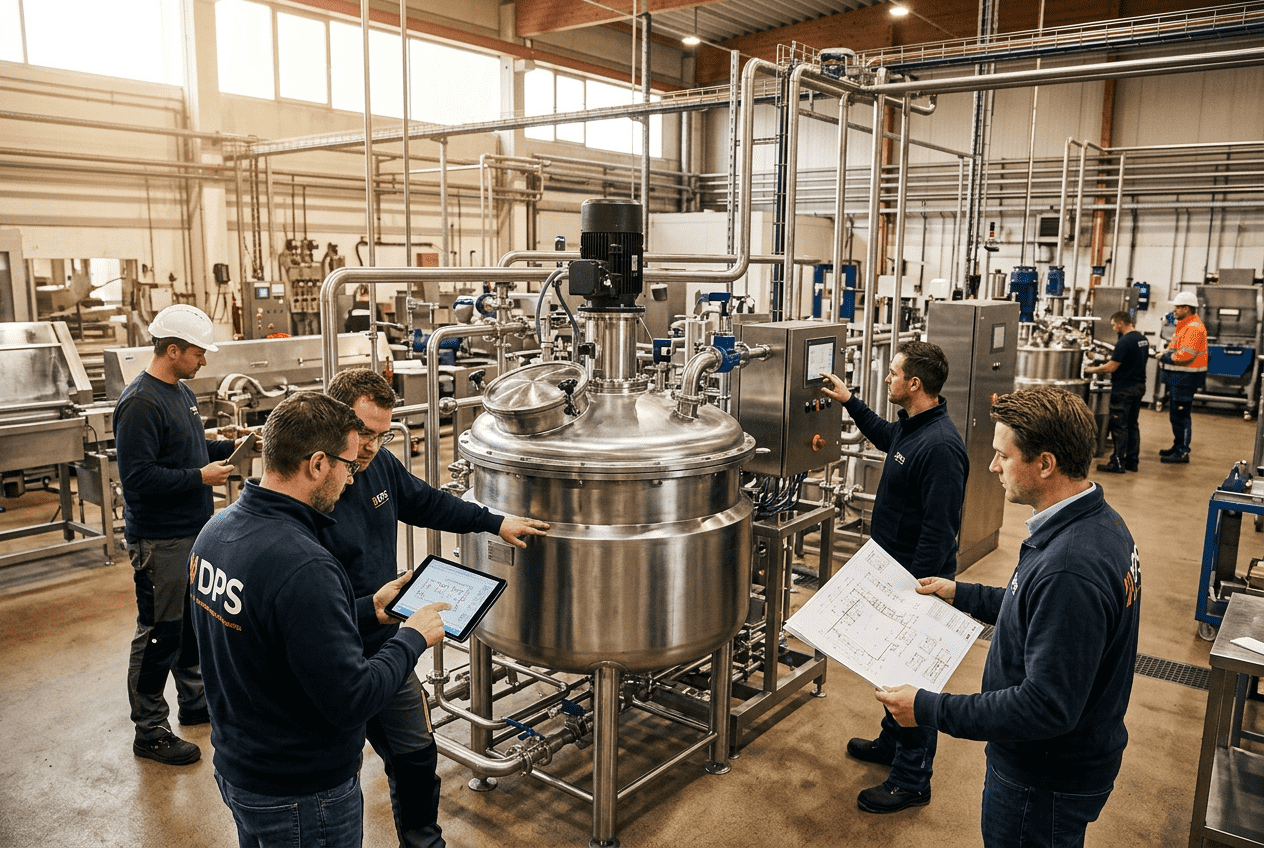
Soup processing systems must do more than heat ingredients in a tank. In the United States market, processors need lines that can handle clear broths, dairy or plant-based cream soups, and particulate-heavy products while meeting food safety, throughput, labor, and energy targets. The right system design balances recipe flexibility, thermal performance, particle integrity, cleanability, automation, and plant utilities. For manufacturers supplying retail, foodservice, institutional, and private-label channels, the best soup lines are usually built around a clear product family strategy rather than a one-size-fits-all skid.
Quick Answer

A well-designed soup processing system for the United States market typically includes raw ingredient receiving, dry and liquid dosing, hydration and mixing, cooking, particulate handling, texture control, cooling, holding, CIP, automation, and integration with filling or packaging. Clear broths generally benefit from gentle heating and effective clarification or straining. Cream-based soups often need higher shear mixing, precise viscosity control, and in some cases homogenization. Chunky soups require pumps, valves, and heat transfer equipment sized for large particulates so vegetables, pasta, beans, meat, or seafood are not damaged during transfer.
When buyers compare system concepts, the main design decision is not only “what cooker should we buy?” but “what product mix are we trying to run for the next five to ten years?” A facility making premium lobster bisque near Boston, a tortilla soup line in Texas, and a chicken noodle producer serving Midwest retail distribution through Chicago will each need different flow paths, heating profiles, and sanitation strategies.
For many processors, the most effective path is to work with an engineering and integration partner that understands processing, utilities, controls, and construction together. Disruptive Process Solutions approaches projects this way, aligning capital planning with operational profitability rather than treating equipment selection as a stand-alone purchase.
In practical terms, a soup line should answer these questions early:
- What is the required hourly and annual throughput?
- How many recipes share the line?
- What is the largest particle size that must survive pumping?
- What final viscosity range is acceptable?
- Will the product be hot filled, refrigerated, aseptic, or retorted?
- How much floor space and utility capacity are available?
- What sanitation regime is required by product risk and changeover frequency?
The U.S. soup market remains active across grocery, club store, co-manufacturing, kettle-cooked premium brands, school nutrition, hospital foodservice, and shelf-stable export channels. This keeps demand strong for modular systems that can support multiple formulations without excessive downtime.
| Soup Category | Typical Solids Level | Viscosity Tendency | Particle Sensitivity | Common Heating Need | Best-Fit Design Priority |
|---|---|---|---|---|---|
| Clear broth | Low | Low | Low to moderate | Gentle, uniform heating | Clarity and flavor retention |
| Cream soup | Medium | Medium to high | Low | Controlled heating with shear | Texture and emulsion stability |
| Chunky vegetable soup | Medium to high | Medium | High | Even heating without damage | Particle integrity |
| Noodle soup | Medium | Low to medium | High | Short residence time | Prevent overcooking |
| Bean or lentil soup | High | High | Moderate | Extended hydration and cook | Consistency control |
| Protein-rich chowder | High | Medium to high | Very high | Careful thermal lethality design | Food safety and chunk survival |
The table above shows why soup processing cannot be reduced to one equipment type. Product rheology, heat sensitivity, and particle size strongly influence system selection.
Designing Soup Processing Lines for Broths, Cream Bases, and Chunky Recipes

System design begins with recipe families. Broths, cream bases, and chunky formulations behave differently during mixing, heating, transfer, and cooling, so the layout should reflect the dominant products rather than the marketing category on the label.
For broths, processors usually prioritize fast dissolution of seasonings, extraction of flavor, minimal burn-on, and clean appearance. This often means high-quality filtration or straining, controlled agitation, and lower-viscosity pumps that avoid unnecessary turbulence. If the product is positioned as premium bone broth or slow-simmered stock, residence time and aroma retention also become important.
Cream soup lines introduce additional complexity because starches, dairy solids, fats, proteins, and hydrocolloids interact during heating. If powders are not hydrated correctly, the plant may see fish-eyes, sediment, or inconsistent body from batch to batch. If the heating rate is too aggressive, scorching and protein instability can occur. Many U.S. processors now run both dairy and plant-based cream soups on adjacent schedules, which makes allergen segregation and CIP validation even more important.
Chunky soups create the broadest mechanical design challenge. Diced vegetables, shredded chicken, pasta, rice, beans, potatoes, sausage, or seafood all move differently through pipes and valves. A line that looks efficient on a P&ID can become a yield problem if elbows, valve restrictions, or high pump speeds shear ingredients. In plants around Fresno, Houston, and New Jersey where co-packers handle wide product variation, oversized transfer paths and gentle particulate pumps often pay back quickly through lower giveaway and fewer product defects.
Good design also considers packaging downstream. A refrigerated soup cup line may need rapid cool-down and short hold times, while a retort pouch or can operation can tolerate different pre-fill conditions. Aseptic soup systems demand tighter control over sterilization, surge balance, and hygienic zoning.
| Design Area | Broths | Cream Bases | Chunky Soups | Main Risk | Recommended Solution |
|---|---|---|---|---|---|
| Ingredient addition | Fast liquid blending | Powder hydration critical | Staged particulate loading | Lumps or uneven mix | Automated dosing and recipe sequencing |
| Agitation | Moderate | Higher shear possible | Gentle sweep | Foam or particle breakage | Variable-speed agitators |
| Pumping | Centrifugal often suitable | Positive displacement common | Low-shear particulate pump | Viscosity mismatch | Pump selection by rheology and solids |
| Heating | Rapid and uniform | Controlled to avoid scorch | Even particle heating | Undercook or burn-on | Validated thermal design |
| Cooling | Simple exchanger possible | May need higher pressure control | Particle-friendly method | Texture damage | Match cooler to product family |
| CIP | Standard circuits | Heavy soil possible | Dead-leg risk higher | Residue retention | Cleanability built into routing |
This comparison highlights why line architecture must be tailored to recipe behavior, not just production volume.
From a technology standpoint, DPS supports these requirements through integrated process engineering, controls, utilities, and sanitary equipment design. Its experience across food, beverage, aseptic, dairy, prepared foods, and protein applications is especially useful when soup processors need multi-product flexibility under one roof. Details on broader system integration and engineering services can be explored through the company’s processing and project capabilities.
The market trend above reflects rising investment in flexible lines, automation upgrades, and sanitary retrofits as processors respond to labor pressure, premiumization, and refrigerated meal growth across the United States.
Jet Cooking vs. Steam-Jacketed Kettles: Which Cooks Better?

Jet cook technology and steam-jacketed kettles both have a place in soup production, but they solve different problems. Jet cooking injects steam directly into the product stream or vessel, providing rapid heat transfer and fast temperature ramp-up. Steam-jacketed kettles apply heat indirectly through a jacketed surface, usually with slower but highly controllable heating.
Jet cooking is often preferred when processors need fast heating, high throughput, short cycle times, and strong dispersion of starches or powders. It can be particularly effective for liquid bases, gravies, and some cream soup systems where rapid thermal input helps processing efficiency. However, direct steam injection changes the water balance and requires careful formulation control. It can also be less ideal for delicate particulates if the process path creates shear or if residence time after injection is not well managed.
Steam-jacketed kettles remain popular because they are versatile, intuitive for operators, and well suited to batch processing. They allow visual monitoring, staged ingredient addition, and recipe flexibility, which is useful for specialty soups and smaller production runs. The tradeoff is slower heat-up and cool-down, lower throughput per square foot, and potentially higher labor demand.
In many U.S. projects, the best answer is a hybrid approach: use kettles for development, pilot-scale runs, or premium batch products, and use continuous jet cook or tubular systems for higher-volume base preparation. Plants serving foodservice out of Atlanta or club-store channels through the Midwest often split production this way to balance SKU complexity with capacity.
| Criterion | Jet Cooking | Steam-Jacketed Kettle | Operational Impact | Best Use Case | Buyer Note |
|---|---|---|---|---|---|
| Heat-up speed | Very fast | Moderate | Shorter cycle time | High-volume bases | Check steam quality |
| Recipe flexibility | Moderate | High | More manual staging possible | Frequent SKU changes | Good for R&D to production |
| Particle handling | Depends on design | Generally gentle in vessel | Chunk survival varies | Delicate inclusions | Validate transfer path |
| Labor intensity | Lower | Higher | Automation advantage | Labor-constrained plants | Factor in controls cost |
| Utility efficiency | High thermal transfer | Good but slower | Energy profile differs | Continuous production | Review condensate recovery |
| Cleanability | Depends on circuit design | Good access for inspection | CIP complexity differs | Mixed product portfolios | Assess soil load and downtime |
The table shows that “better” depends on whether the plant values throughput, flexibility, or gentle handling more highly.
Buying advice for U.S. manufacturers: do not compare only the equipment price. Compare the full installed system cost, changeover time, operator dependency, steam infrastructure, recipe loss, and planned future capacity. A lower-cost kettle project can become expensive if the plant later needs more throughput, while an advanced continuous system can be oversized for a regional premium brand with many short runs.
Managing Large Particles and Chunks in Soup Production
Large-particle handling is one of the most common failure points in soup line design. Pumps, valves, pipe routing, and heat exchangers that work well for sauces or dairy bases may not work for diced potato chowder, chicken tortilla soup, or gumbo. In these products, particulates are part of the brand promise. Broken vegetables, smeared proteins, or settled solids lead directly to consumer complaints and filler inconsistency.
Key design choices include pipe diameter, bend radius, pump type, line velocity, and valve geometry. Positive displacement pumps with low-shear action are often selected for chunk-heavy products. Full-port valves reduce restriction points. Short, direct routing helps avoid repeated impact on ingredients. Agitators should suspend solids without creating excessive vortex or collision damage.
Another critical question is when to add chunks. Some processors add all particulates before final cooking. Others pre-cook or blanch solids separately and add them after the base reaches a target temperature. The right answer depends on lethality requirements, target texture, and how long the particles can tolerate thermal exposure. For example, pasta and rice are especially sensitive to hold time, while root vegetables can often withstand longer processing.
Chunk management also affects filling. If solids distribution in the surge or balance tank is poor, each package will vary. In cities like Los Angeles, where premium refrigerated soups compete on visible ingredient quality, solids-to-broth ratio is a retail differentiator. The filler, transfer loop, and tank agitation pattern all influence this outcome.
This demand profile helps explain why many new projects emphasize particulate protection and recipe flexibility rather than only maximum flow rate.
| Component | Preferred Feature for Chunks | Why It Matters | Typical Risk if Undersized | Example Ingredient | Design Tip |
|---|---|---|---|---|---|
| Pump | Low-shear positive displacement | Protects particle shape | Shearing and mash | Potato cubes | Validate maximum particle size |
| Valve | Full-port sanitary valve | Reduces restriction | Bridging and damage | Beans | Avoid tight internal geometry |
| Pipework | Larger diameter and smooth bends | Lowers impact points | Plugging | Chicken pieces | Minimize unnecessary elbows |
| Agitator | Gentle sweep or anchor | Keeps solids suspended | Settling or breakage | Noodles | Use variable speed |
| Heat exchanger | Particle-tolerant design | Preserves inclusions | Fouling or blockage | Vegetable medley | Match gap size to recipe |
| Filler feed tank | Uniform suspension control | Improves package consistency | Solids stratification | Seafood chowder | Test tank geometry with product |
This table explains why particulate handling must be engineered from the cook step through packaging, not treated as a single pump-selection issue.
Controlling Viscosity and Texture Batch After Batch
Consistency is one of the biggest quality metrics in soup processing. U.S. buyers and consumers expect the same pour, spoon feel, solids ratio, and mouthfeel every time. Variability often comes from ingredient hydration, cook profile, solids content, water absorption, starch activation, shear history, and cooling rate.
Batch-to-batch viscosity control begins with recipe management. Accurate dry dosing, Brix or solids measurement where relevant, and in-line temperature tracking reduce variability before the product even reaches the cook stage. For cream soups, ingredient order matters. Starches, gums, proteins, fats, and salts do not behave independently. A process sequence that works at pilot scale may perform differently in a 2,000-gallon production vessel.
Automation is increasingly important here. Recipe-driven controls can standardize water addition, powder induction, mixing time, steam modulation, and hold temperatures. SCADA visibility also helps supervisors compare actual process conditions to validated standards. This is especially valuable for multi-shift operations around Dallas, Charlotte, and Minneapolis where operator skill may vary.
Viscosity management should also account for downstream effects. Some soups thicken during cooling, while others loosen with shear during transfer. If the target is set only at the cook vessel, final packaged texture may drift outside specification. Leading processors therefore measure texture at multiple points: post-cook, post-cool, and at fill.
The trend is clear: by 2026, more U.S. soup plants are expected to adopt automated process monitoring for texture, weight control, and recipe execution as labor costs and quality expectations continue to rise.
| Source of Variation | Common Symptom | Operational Cause | Measurement Method | Corrective Action | Long-Term Fix |
|---|---|---|---|---|---|
| Powder hydration | Lumps or thin body | Poor induction sequence | Visual check and viscosity test | Adjust addition order | Install better powder handling |
| Cook temperature drift | Texture swings | Unstable steam control | Temperature trend review | Tune valves and controls | Upgrade automation loop |
| Water balance error | Thin soup | Metering inaccuracy | Mass balance | Recalibrate meters | Automated batching |
| Excess shear | Broken body | High pump speed | Line pressure and texture test | Reduce RPM | Resize pump and piping |
| Extended hold time | Overthickening | Scheduling delays | Time-temperature log | Shorten hold | Rebalance line capacity |
| Cooling profile | Unexpected final texture | Slow or uneven cool-down | Post-cool viscosity | Change cooling setpoint | Upgrade cooler design |
The explanation here is straightforward: texture consistency is an end-to-end process outcome, not a single quality test at the end of the line.
Homogenizing and Straining Smooth Soup Varieties
Smooth soups such as tomato bisque, butternut squash soup, cream of mushroom, and blended vegetable formulations often require a finishing step beyond cooking. Depending on the product target, this may include straining, colloid milling, high-shear mixing, or homogenization.
Straining is typically used to remove oversized fibrous material, seed fragments, skins, or agglomerates. The challenge is selecting a screen or filtration approach that improves mouthfeel without sacrificing too much yield. Excessively fine straining can remove desirable body and increase waste. Homogenization, by contrast, breaks down fat globules and suspended particles to create a more uniform texture and stable appearance. It is especially useful in cream-style products where separation or graininess would otherwise be visible.
Not every smooth soup needs full homogenization. Some premium products intentionally retain a rustic texture. Others rely on high-shear mixing or a scraped surface finishing step rather than classic homogenizer pressure. The correct approach depends on label claims, ingredient sensitivity, and package format.
This is also an area where manufacturing capability matters. DPS not only supports engineering and integration but also has proprietary equipment manufacturing for tanks, custom CIP systems, and process vessels. That capability can help soup processors standardize vessel design, improve sanitary access, and coordinate equipment with line controls and installation under one project umbrella. More information on available process hardware can be found in the company’s equipment offerings.
Cooling Soup with Plate Exchangers, Vacuum, and Water Systems
Cooling is often underestimated during project planning, yet it strongly affects food safety, texture, package quality, and plant throughput. The right cooling method depends on soup viscosity, particle size, final package, utility availability, and required temperature drop.
Plate heat exchangers work well for many low-to-medium viscosity soups with limited particulate size. They offer efficient heat transfer, compact footprint, and good opportunities for heat recovery. However, they may not be the best choice for delicate chunks or products prone to fouling. Wider-gap configurations can expand applicability, but there are still product limits.
Vacuum cooling can be valuable when rapid flashing of moisture and temperature reduction support the process, especially in certain cooked bases or where aroma management and thermal exposure are concerns. It is not universal for all soup styles, but in the right application it can shorten cooling time and support product quality.
Cold water or glycol-assisted systems, often paired with tubular or scraped surface exchangers, are common when processors need more gentle handling or better control over viscous products. The utility side matters here: cooling towers, chilled water loops, refrigeration loads, and heat rejection all influence lifecycle cost.
In U.S. facilities near Phoenix, Sacramento, and the Gulf Coast, ambient conditions and utility rates can materially affect the best cooling strategy. Plants with strong refrigeration infrastructure may favor one path, while retrofit sites with limited utility headroom may need staged cooling or heat recovery integration.
| Cooling Method | Best For | Main Advantage | Main Limitation | Utility Need | Typical Use Note |
|---|---|---|---|---|---|
| Plate heat exchanger | Broths, light cream soups | High efficiency | Particle limitations | Chilled water or glycol | Strong choice for low-viscosity products |
| Wide-gap plate | Moderate solids soups | More solids tolerance | Still limited for large chunks | Chilled utility loop | Useful bridge option |
| Tubular exchanger | Viscous or particulate products | Gentler product path | Larger footprint | Cooling water or glycol | Good for chunky lines |
| Scraped surface cooler | High-viscosity soups | Controls fouling | Higher capital cost | Refrigeration support | Ideal for heavy cream bases |
| Vacuum cooling | Select cooked bases | Fast temperature drop | Application-specific | Vacuum and condensate handling | Validate moisture balance |
| Cold water vessel cooling | Smaller batch plants | Simple concept | Slower process | Cooling water supply | Often used in legacy operations |
The explanation from this table is that cooling technology must be chosen as part of the entire line design, especially when soup style and utility infrastructure vary.
CIP Design for Sanitary Soup Processing Equipment
Clean-in-place design is essential in soup operations because soups can leave stubborn soils: starch films, protein deposits, fat residues, spice carryover, and burnt-on material at heat transfer surfaces. A CIP system for soup production must be designed around the product family, not copied from a beverage line.
Key variables include circuit velocity, detergent concentration, temperature, return conductivity, tank sizing, and whether the plant needs dedicated allergen circuits. Cream soups, dairy-containing chowders, and protein-rich formulations generally create heavier soils than clear broths. If a site runs tomato soup in the morning and a dairy-based bisque in the afternoon, cleaning validation and allergen changeover procedures become central to scheduling.
Soup plants also need to think about hard-to-clean zones: dead legs, under-agitated vessel areas, pump seals, valve clusters, filler manifolds, and heat exchanger surfaces. A line that is difficult to clean will eventually become expensive through longer downtime, higher chemical use, and microbiological risk.
DPS supports this through service capability as well as design. The company’s Design Build Manage model combines engineering, installation oversight, project execution, utilities coordination, and sanitation-minded equipment integration so that CIP is planned as part of the plant system rather than bolted on afterward. Manufacturers evaluating complex retrofits or multi-line expansion can review relevant project experience through selected case studies and project examples.
For U.S. compliance, CIP design should support FDA expectations, documented sanitation procedures, and where applicable USDA inspection requirements. Facilities certified to SQF or BRC will also expect verifiable hygienic design and repeatable cleaning records.
Reducing Energy Use with Heat Recovery and Smarter Cook Cycles
Energy savings in soup processing usually come from better thermal integration rather than a single “green” machine. Steam, hot water, refrigeration, compressed air, and pumping loads all influence operating cost. With utility prices and sustainability expectations rising, especially for national brands selling into major retailers, energy efficiency is now a board-level discussion instead of a maintenance topic.
Heat recovery is often the first major opportunity. If a plant cools hot soup through a heat exchanger, part of that heat can often be recovered to preheat incoming water or product streams. Condensate recovery from steam systems also improves boiler efficiency. Smart cook cycles further reduce waste by tightening heat-up profiles, minimizing overcooking, and shortening idle holds.
Automation again plays a major role. When the control system tracks actual thermal demand, production scheduling, and utility consumption, managers can compare recipes by energy intensity and identify underperforming shifts. This is especially useful in larger networks with plants near Seattle, Kansas City, or Philadelphia where utility tariffs and seasonal loads differ.
By 2026, three trends are likely to shape the United States soup processing sector:
- More electrification and hybrid utility strategies where practical, especially in new facilities looking to reduce carbon intensity.
- Greater use of water and heat recovery to support ESG goals and retailer sustainability scorecards.
- Stronger automation, digital batch records, and recipe analytics to meet labor, traceability, and compliance expectations.
This comparison reflects a common buying reality: processors are increasingly selecting partners based on total integration capability, not just catalog equipment price.
FAQ
What is the best soup processing system for a new plant?
The best system depends on whether the plant will focus on broths, cream soups, chunky products, or a mixed portfolio. New facilities should start with product family mapping, expected throughput, package format, and utility planning before choosing cookers and coolers.
Are jet cook systems always more efficient than kettles?
Not always. Jet cooking is often more efficient for high-throughput liquid bases, but kettles can be better for flexible batch operations, frequent recipe changes, and premium short-run production.
How do manufacturers protect vegetables, noodles, or meat chunks?
They use low-shear pumps, full-port valves, larger line diameters, gentle agitation, shorter routing, and product-specific thermal profiles. Sometimes particulates are pre-cooked and added later in the process.
When is homogenization necessary?
It is useful when a smooth, stable, uniform soup texture is required, especially in cream-style products. It is less important for rustic soups where some natural texture is desired.
Which cooling system is best for soup?
Plate exchangers are efficient for lighter soups, while tubular or scraped surface systems are often better for viscous or particulate-heavy formulations. Vacuum cooling is more specialized and should be validated by application.
How important is CIP in soup processing?
It is critical. Soup soils can be heavy and variable, especially with dairy, starch, fat, and protein. A poor CIP design creates sanitation risk, longer downtime, and inconsistent changeovers.
What industries commonly use soup processing systems?
Prepared foods manufacturers, private-label packers, institutional food producers, co-manufacturers, dairy-based food processors, shelf-stable canners, refrigerated meal producers, and aseptic processors all use soup systems.
What should U.S. buyers ask suppliers before purchase?
Ask about throughput at your actual viscosity, maximum particle size, utility demand, allergen changeover strategy, installed references, automation scope, CIP validation, spare parts, commissioning support, and lifecycle energy cost.
Why work with an engineering-led integration company instead of buying equipment directly?
Because soup systems succeed or fail at the interfaces between process equipment, utilities, controls, piping, sanitation, and plant operations. An engineering-led integrator can align those elements and reduce costly redesign later.
How can a processor prepare for 2026 market conditions?
Plan for higher automation, stronger traceability, better energy performance, more recipe flexibility, and sanitation designs that support retailer, regulatory, and sustainability expectations across the United States.
For manufacturers evaluating a new line, expansion, retrofit, or utility upgrade, the strongest approach is to build the project around product behavior, not equipment marketing claims. Broths, cream soups, and chunky recipes each place different demands on cooking, cooling, transfer, CIP, and controls. When those details are engineered correctly, the result is better yield, safer processing, lower energy use, and a more profitable operation over the long term.
[/trp_language]
Complete Company Portfolio
About the Author: Disruptive Process Solutions (DPS)
The DPS team combines process engineering expertise with real-world food and beverage manufacturing experience. Our content focuses on process optimization, production efficiency, facility improvements, and practical solutions that help manufacturers operate more effectively in a rapidly evolving industry.
Share