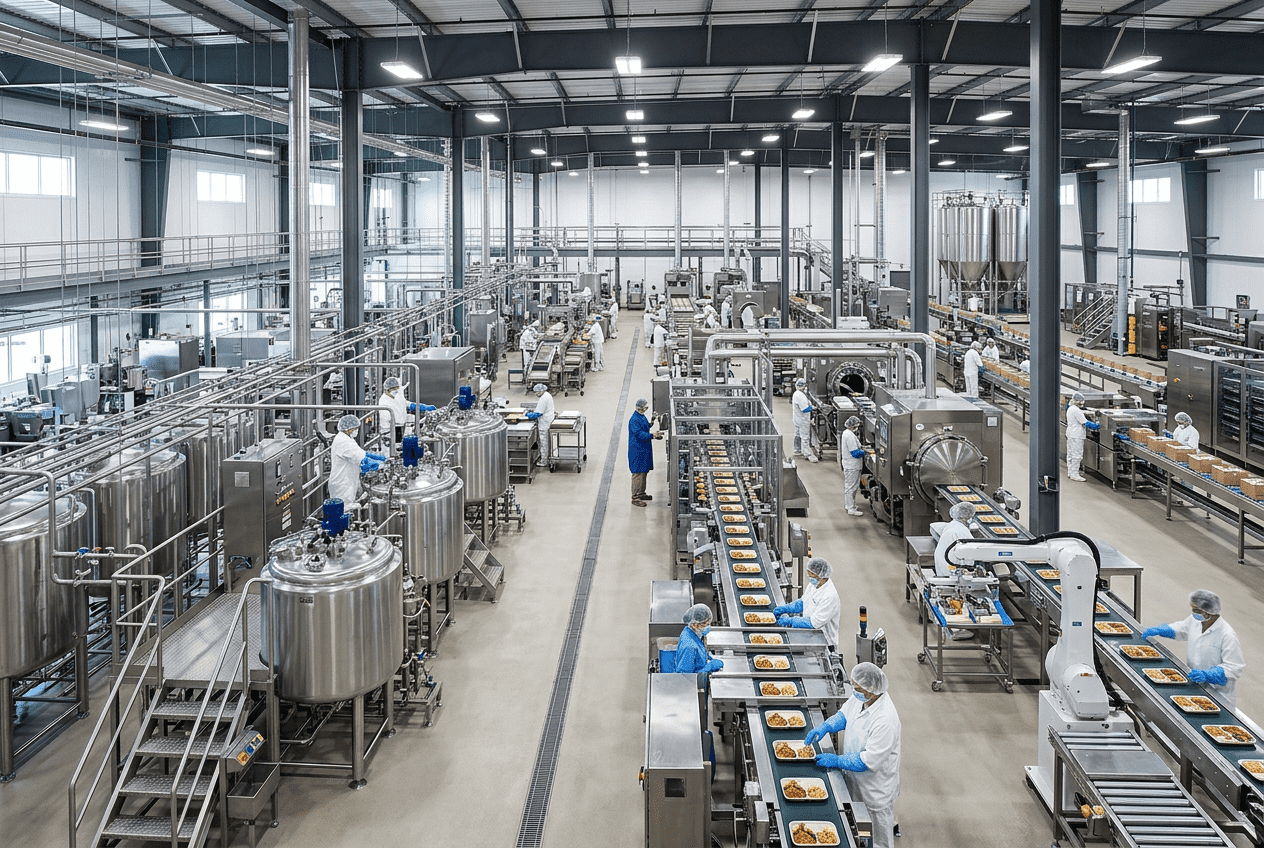
Yogurt Processing Line Design
[trp_language language=”en_US”]
Yogurt Processing Line Design Guide for the United States
Designing a yogurt processing line in the United States requires more than selecting tanks and fillers. A profitable project must align product style, milk solids targets, food safety, packaging format, utility loads, labor strategy, distribution distance, and long-term expansion plans. Whether the goal is set cup yogurt for retail, stirred yogurt for club packs, drinking yogurt for convenience channels, or Greek yogurt for high-protein demand, the line must be configured around the intended finished product rather than around isolated pieces of equipment.
Across the U.S., yogurt manufacturers face a unique mix of conditions: strong dairy supply in Wisconsin, Idaho, New York, and California; major refrigerated distribution corridors through Chicago, Dallas, Atlanta, and New Jersey; and continued pressure from retailers for lower cost, better shelf life, cleaner labels, and stronger sustainability performance. Plants shipping through the ports of Los Angeles/Long Beach, Savannah, or Houston also need resilient packaging and ingredient supply strategies. For this reason, a modern yogurt processing line design should combine process engineering, hygienic layout, utilities planning, automation, and commercial decision-making from the start.
For companies evaluating a new facility or expansion, this guide explains the main technical choices, the business tradeoffs behind them, and the most common mistakes that raise capital cost or reduce operating margin. It also reflects the type of profit-focused thinking used by Disruptive Process Solutions, a U.S.-based food and beverage engineering partner serving manufacturers across North America.
Quick Answer

A yogurt processing line in the United States typically includes raw milk receiving, standardization, preheating, homogenization, high-heat pasteurization, cooling to inoculation temperature, fermentation, post-fermentation handling, fruit or flavor blending where applicable, filling, case packing, and cold storage. The exact sequence changes by product type. Set yogurt is fermented in the final cup, stirred yogurt is fermented in a tank and then cooled before filling, drinking yogurt requires lower viscosity and more aggressive blending, and Greek yogurt adds a whey-removal step such as ultrafiltration or centrifugal separation.
The best design starts by answering five practical questions:
- What yogurt type will drive most of the volume?
- What annual throughput is required at year one and year five?
- Will fruit be bottom, side, or fully blended?
- Is the plant regional or national in refrigerated distribution scope?
- How much automation is justified by labor, SKU count, and sanitation frequency?
In the U.S. market, many plants also need to plan for retailer-driven SKU growth, high protein positioning, and stricter utility efficiency expectations by 2026. Therefore, a strong yogurt line is not just sanitary and code compliant; it is flexible, scalable, and commercially disciplined.
| Line Decision Area | Basic Requirement | Why It Matters | Typical U.S. Concern | Design Priority | Risk If Ignored |
|---|---|---|---|---|---|
| Product style | Set, stirred, drinking, Greek | Defines process flow and equipment | Retail and foodservice SKU mix | Very high | Wrong tank and filler selection |
| Capacity target | Year 1 and future expansion | Sets tank sizing and utilities | Seasonal demand spikes | Very high | Early bottlenecks |
| Milk solids strategy | Protein and total solids control | Impacts texture and yield | Cost volatility in dairy ingredients | High | Inconsistent body and margin erosion |
| Packaging format | Cups, bottles, pouches | Changes filling and secondary packaging | Retail shelf requirements | High | Limited channel access |
| Cold chain reach | Local, regional, national | Affects shelf-life design | Long distribution lanes | High | Spoilage and returns |
| Sanitation philosophy | CIP frequency and separation | Controls food safety and uptime | Labor constraints | High | Downtime and contamination events |
The table above shows why yogurt processing line design should be treated as a systems project. Process steps, packaging, and logistics are interdependent, especially in the United States where distribution distances are often much longer than in compact markets.
Yogurt Processing Line Configuration: Set, Stirred, Drinking, and Greek Varieties

The first major design decision is product configuration. Although all yogurt starts with a cultured dairy base, each style behaves differently in process and packaging. This affects line layout, shear exposure, hold times, instrumentation, and capex.
Set yogurt is usually filled into cups before incubation. The cups then move through an incubation tunnel or controlled warm room until the target pH is reached, after which they are chilled. This approach gives a firm gel structure and traditional spoonable texture, but it requires precise temperature control after filling and careful handling to avoid disturbing the curd.
Stirred yogurt is fermented in a tank, then broken gently and cooled before filling. It offers more flexibility for fruit blending and larger cup formats. Drinking yogurt uses similar fermentation logic but with lower viscosity targets and often includes additional stabilizer management, high-shear blending, or smoothing steps. Greek yogurt adds concentration after fermentation or, in some process designs, protein concentration before culturing depending on label, economics, and sensory goals.
For U.S. manufacturers supplying supermarkets, club stores, and foodservice chains, a hybrid line is often attractive. For example, a plant in Texas may run stirred yogurt in family tubs during the day and switch to drinking yogurt in PET bottles at night, while a Midwest plant may dedicate one fermentation train to Greek yogurt and another to standard cultured products.
| Yogurt Type | Main Process Route | Texture Target | Common Packaging | Key Equipment Need | Main Design Challenge |
|---|---|---|---|---|---|
| Set yogurt | Fill before incubation | Firm gel | Single-serve cups | Incubation room or tunnel | Protecting curd integrity |
| Stirred yogurt | Tank fermentation then cooling | Smooth spoonable | Cups and tubs | Agitated fermenters and coolers | Managing shear after gel set |
| Drinking yogurt | Tank fermentation plus blending | Low to medium viscosity | Bottles and pouches | Inline mixer and bottle filler | Consistent mouthfeel |
| Greek yogurt | Fermentation plus concentration | Dense high-protein body | Cups and tubs | UF or separator system | Yield and whey handling |
| Probiotic yogurt | Controlled culture management | Varies by product | Cups and bottles | Gentle thermal profile | Culture viability |
| Children’s yogurt blends | Stirred or drinking route | Very smooth | Pouches | Pouch filler and deaeration | Seal quality and low particulates |
This comparison is useful because each configuration creates a different bottleneck. Set yogurt is filler and incubation limited. Stirred yogurt is fermentation and cooling limited. Greek yogurt is concentration and whey handling limited. Drinking yogurt is often packaging and viscosity-control limited. The right layout depends on which constraint will matter most at the plant’s target volume.
Demand patterns in the United States also vary by channel. Club stores favor larger tubs, convenience channels prefer drinkable formats, school and institutional users may need pouches, and premium grocery chains often prefer high-protein or fruit-on-the-bottom products. That is why line design should connect directly to market strategy, not just to current recipes.
Milk Standardization, Homogenization, and Pasteurization for Yogurt Base

Once the product family is defined, the base treatment section becomes the heart of process control. Milk standardization determines fat and solids balance. Homogenization affects body, whey separation resistance, and visual consistency. Pasteurization not only ensures food safety but also develops yogurt texture by denaturing whey proteins and improving water binding.
In many U.S. plants, standardization combines raw milk, cream, skim milk, milk protein concentrate, nonfat dry milk, or other approved dairy ingredients to hit target solids. A high-protein formulation in Idaho may use a different cost model than one in California because local milk pricing, hauling, and ingredient availability differ. If the line is designed without flexibility in solids handling, formulation cost can become a major margin problem.
Homogenization usually occurs before pasteurization or in an integrated thermal process sequence. For yogurt, pressure selection should match product type. Over-homogenization may create an overly thin or pasty result depending on recipe and downstream shear. Under-homogenization can contribute to creaming and weak texture. Pasteurization for yogurt is generally more intensive than standard fluid milk treatment because functional protein change is part of the quality objective.
| Process Step | Primary Goal | Typical Design Focus | Critical Instrument | Operational Benefit | Common Mistake |
|---|---|---|---|---|---|
| Raw milk receiving | Accept safe milk at stable quality | Insulated storage and testing point | Temperature and flow meter | Protects upstream quality | Undersized silo turnover planning |
| Cream separation | Adjust fat level | Reliable separator sizing | Density or fat testing control | Accurate standardization | Ignoring variation in inbound milk |
| Solids addition | Raise protein and body | Powder handling and mixing | Load cells and inline concentration checks | Consistent viscosity | Poor powder wet-out |
| Homogenization | Stabilize fat and improve texture | Pressure and stage control | Pressure transmitter | Smoother finished product | Using one setting for all SKUs |
| High-heat pasteurization | Safety and protein denaturation | Hold time and heat recovery | Temperature recorder and divert valve | Texture and shelf-life support | Designing for milk, not yogurt needs |
| Cooling to inoculation | Prepare for fermentation | Fast controlled cooling | Outlet temperature sensor | Culture performance stability | Slow pull-down due to weak utilities |
The explanation behind these steps is simple: every inconsistency upstream becomes magnified in fermentation. A plant that struggles with fat variation, heat balance, or solids dispersion will rarely achieve consistent pH endpoint, viscosity, and filling performance downstream.
This is where technology selection matters. DPS supports dairy projects with process engineering, automation, and utility integration that connect thermal systems, homogenizers, controls, and CIP logic into one coordinated operating platform. That technological capability is especially important for multi-SKU U.S. plants that need recipe control, data visibility, and fast changeovers rather than isolated equipment islands. More detail on this integrated approach can be found through its engineering and project services.
Fermentation Tank Design: Temperature Control, Agitation, and pH Monitoring
Fermentation is the most sensitive stage in a yogurt line. Tank design determines not only microbial performance but also final texture, flavor, and line stability. The fermenter should be viewed as a controlled bioprocess vessel, not a generic stainless tank.
For stirred yogurt and drinkable yogurt, jacket design and temperature uniformity are critical. Hot spots or cold zones can push culture activity out of range, especially in larger vessels. Agitation must be designed for the exact phase of use. During incubation, excessive movement can damage gel development. After fermentation, controlled agitation may be needed to smooth the product before cooling or blending. Tank geometry, impeller selection, and wall heat transfer all matter.
Online pH monitoring is another major design advantage. In older facilities, operators may rely too heavily on manual grab checks. That increases variability and can create over-acidification, particularly during shift changes or high-volume campaigns. A plant running around the clock in Chicago or Atlanta distribution corridors benefits from automated pH endpoint detection linked to cooling sequence control.
| Tank Design Element | Recommended Purpose | Impact on Product | Automation Need | Maintenance Concern | Best Practice |
|---|---|---|---|---|---|
| Insulated jacket | Accurate heating and cooling | Stable fermentation rate | High | Valve performance | Zone-controlled jacket circuits |
| Tank geometry | Support cleanability and mixing | Uniform temperature profile | Medium | Spray coverage validation | Sanitary cone and head design |
| Gentle agitator | Post-set smoothing only | Controls viscosity loss | High | Seal hygiene | Variable-speed drives |
| Inline pH probe | Real-time endpoint control | Reduces batch variation | High | Probe calibration | Dual-probe verification |
| Load cells | Batch inventory accuracy | Improves formulation repeatability | Medium | Signal drift | Integrate with recipe system |
| CIP coverage | Reliable sanitation | Protects culture purity | High | Spray device wear | Riboflavin test during commissioning |
The table shows that fermentation vessel design is inseparable from controls, sanitation, and recipe management. For this reason, DPS frequently approaches fermentation systems as part of a broader automation strategy including PLC programming, SCADA visibility, batch logic, and utility synchronization. That is one of the company’s strongest technological capabilities and a major advantage when clients need a scalable system rather than a manual operation that becomes unstable at higher volume.
U.S. labor markets also influence tank design. In regions where skilled operators are difficult to recruit, such as fast-growing manufacturing zones in the Southeast and parts of Texas, higher automation in fermentation often pays back quickly through reduced batch loss and more repeatable quality.
Greek Yogurt Production: Ultrafiltration and Centrifugal Whey Separation
Greek yogurt deserves separate treatment because its economics differ from standard yogurt. The defining technical issue is concentration. Manufacturers must decide whether to remove whey after fermentation, concentrate milk upstream, or use a hybrid approach. Each route changes yield, flavor, texture, byproduct handling, water use, and labeling strategy.
Ultrafiltration is increasingly attractive for U.S. processors seeking better protein efficiency and lower wastewater burden. It can reduce whey volume and improve solids control, but it adds membrane management complexity and requires thoughtful CIP design. Centrifugal whey separation remains common for high-throughput Greek yogurt plants and can fit well when the operation already has strong separator expertise. However, it may create different texture outcomes and byproduct logistics.
The commercial side matters just as much. A Greek yogurt line in Wisconsin with nearby animal feed outlets may manage whey differently from a California plant facing tighter discharge and hauling costs. A processor serving premium retailers may prioritize clean texture and lower batch-to-batch variability, while a co-packer may emphasize throughput and changeover speed across customer formulas.
| Greek Yogurt Method | Main Advantage | Main Limitation | Best Use Case | Utility Consideration | Byproduct Impact |
|---|---|---|---|---|---|
| Ultrafiltration | Strong protein standardization | Membrane fouling management | High-protein premium lines | Water and CIP load | Reduced whey volume |
| Centrifugal separation | High throughput | Texture tuning required | Large-volume production | Power and maintenance | Higher whey stream |
| Bag straining | Simple pilot approach | Not scalable | R&D and artisan output | Low utility demand | High labor intensity |
| Pre-concentrated milk | Less post-fermentation waste | Recipe cost sensitivity | Targeted premium products | Depends on upstream system | Lower whey handling onsite |
| Hybrid UF plus separator | Balanced flexibility | Higher capex | Multi-SKU regional plants | Complex controls | Optimized yield options |
| Outsourced concentration model | Lower onsite investment | Less process control | Emerging brands | Reduced plant footprint | Supplier dependency |
This table highlights a core design truth: Greek yogurt production is as much a utility and byproduct project as it is a cultured dairy project. Plants need to plan whey storage, loadout, wastewater, membrane cleaning, separator maintenance access, and product consistency all at once.
DPS also brings manufacturing capability to this discussion through its branded process equipment line, including tanks and custom process systems that can be integrated into larger yogurt projects. That manufacturing capability helps clients avoid piecemeal sourcing and creates better alignment between vessel fabrication, process intent, and field installation. Companies evaluating this path can review available process equipment capabilities as part of early capital planning.
Fruit and Flavor Addition: Inline Blending and Aseptic Ingredient Dosing
Fruit preparation and flavor dosing are often underestimated in yogurt line design. Yet many quality complaints originate here: poor fruit distribution, damaged particulates, phase separation, inconsistent sweetness, or microbial risk from post-pasteurization handling. The fruit system should therefore be designed as a controlled hygienic module rather than a simple add-on skid.
Inline blending is ideal for many stirred and drinking yogurt lines because it improves recipe accuracy and reduces hold times of finished flavored product. It also allows cleaner changeovers when a plant is running multiple flavors daily. However, the system must be matched to ingredient behavior. Strawberry prep with seeds and particulates requires a different pump and valve strategy than smooth vanilla or coffee flavor bases.
Aseptic ingredient dosing becomes especially valuable when sensitive inclusions or long refrigerated shelf life are important. For U.S. manufacturers selling through national grocery networks, lowering post-fermentation contamination risk can materially improve returns performance. Plants located far from end markets, such as West Coast production shipping into the Mountain states or East Coast distribution lanes, benefit from this added risk control.
Common design considerations include low-shear positive displacement pumping, insulated or chilled fruit tanks, sanitary pigging where justified, accurate mass flow or metering systems, and recipe software tied to batch records. When fruit-on-the-bottom formats are required, depositor timing and cup handling accuracy become central to filler performance.
The area trend above reflects why flexible flavor and ingredient systems matter. Functional ingredients, cleaner labels, and SKU proliferation are increasing. By 2026, many U.S. yogurt plants will need more agile dosing, stronger traceability, and better allergen control than older single-recipe facilities were designed to support.
Filling Equipment: Cup Filling, Bottle Lines, and Pouch Systems
Filling is where product characteristics meet retail reality. A yogurt processing line can be perfectly designed upstream and still underperform if the filler is mismatched to viscosity, particulates, package format, or sanitation requirements. Filling equipment should always be selected after product rheology, package architecture, and expected OEE are understood.
Cup filling dominates spoonable yogurt. It supports single-serve retail, multipacks, and large tubs. Bottle lines are the standard for drinkable yogurt and cultured dairy beverages, often using PET or HDPE with induction seal or foil plus cap. Pouch systems are growing in family and children’s segments because they reduce material weight and support portable consumption. Each format requires different product handling, hygienic zoning, and secondary packaging strategy.
| Filling System | Best Product Fit | Strength | Weakness | Typical U.S. Channel | Design Note |
|---|---|---|---|---|---|
| Rotary cup filler | Set and stirred yogurt | High speed for retail cups | Format change parts can be costly | Supermarkets and club packs | Excellent for foil seal control |
| Inline cup filler | Medium-volume yogurt SKUs | Flexible changeover | Lower top speed | Regional brands | Good for SKU variety |
| Bottle filler | Drinkable yogurt | Strong convenience fit | Needs viscosity consistency | C-stores and wellness brands | Cap torque and neck handling matter |
| Pouch filler | Kids and portable formats | Lightweight packaging | Seal integrity is critical | School and family segments | Control particulate size carefully |
| Bucket or large tub line | Foodservice yogurt | Efficient bulk packing | Less retail flexibility | Institutional and commissary | Focus on weight accuracy |
| Aseptic-adjacent hygienic filler | Extended chilled products | Improved contamination control | Higher capital cost | Long-haul distribution | Integrate room classification carefully |
This comparison shows why packaging line selection must consider more than speed. If the plant serves both Costco-style tubs and premium single-serve cups, changeover time may be more important than peak output. If the line is in the Southeast and shipping into Florida, Georgia, and the Carolinas, distribution lane economics may favor one package over another due to pallet density and shelf presentation.
Buying advice for U.S. processors is straightforward: define your top three package formats, realistic hourly targets, labor model, and sanitation windows before speaking with filler vendors. Then evaluate not just the filler but the entire packaging cell including denesting, lidding, coding, checkweighing, case packing, and pallet flow. This is where an owner’s representative or integrated design-build partner can protect the capital plan from hidden downstream costs.
Cold Chain Requirements: Chilling, Cold Storage, and Refrigerated Distribution
Cold chain design is often treated as a warehouse issue, but for yogurt it is a core process issue. The speed and uniformity of chilling after fermentation affect acidity progression, texture stability, and shelf life. Once filled, the product moves into a logistics environment where dock design, pallet residence time, and refrigerated transport can either preserve or damage product quality.
In the United States, cold chain planning must account for long transport routes, seasonal temperature swings, and mixed regional demand. A plant in North Carolina shipping to the Mid-Atlantic has different residence time assumptions than a California plant shipping inland during summer. Therefore, chilling tunnel capacity, finished goods cooler sizing, and dock scheduling all need to be built into the original line model.
Good practice includes rapid post-fill cooling where required, validated cooler air distribution, lot traceability, backup refrigeration capacity, and clear separation between warm process zones and finished refrigerated zones. Plants serving national accounts may also benefit from stronger data logging and alarm systems to support customer audits and quality claims management.
| Cold Chain Stage | Primary Goal | Critical Control | U.S. Distribution Issue | Recommended Design Feature | Failure Result |
|---|---|---|---|---|---|
| Post-fermentation cooling | Stop acid development | Fast thermal pull-down | High ambient summer conditions | Robust glycol or chilled water capacity | Over-acidified product |
| Filled product stabilization | Protect texture before warehousing | Residence time control | Peak production surges | Buffer staging with monitored temperature | Texture breakdown |
| Cold room storage | Maintain shelf life | Uniform air flow | High pallet density | Validated rack and air layout | Warm spots and spoilage |
| Dock loading | Prevent temperature abuse | Door discipline | Frequent truck cycles | Refrigerated dock seals | Condensation and warming |
| Regional trucking | Hold product within spec | Trailer setpoint verification | Long lanes to Midwest or Northeast | Carrier SOP and data loggers | Claims and returns |
| Retail delivery window | Preserve sellable shelf life | FEFO inventory control | DC dwell time | Integrated lot coding and visibility | Reduced remaining shelf life |
The explanation here is practical: a yogurt line is only as good as its cold chain. Plants that invest heavily in process equipment but underinvest in chilling and refrigerated logistics usually experience quality drift, shelf-life compression, or retailer complaints.
Common Design Mistakes and How to Avoid Them
The most expensive yogurt processing line problems usually come from early design assumptions, not from equipment failure. Many projects overspend on capacity in one area and underspend in another, creating a line that looks impressive on paper but underdelivers in operation.
| Common Mistake | What Happens | Typical Root Cause | Business Impact | How to Avoid It | Who Should Own It |
|---|---|---|---|---|---|
| Designing around current SKU only | Line becomes inflexible quickly | No five-year planning model | New capex sooner than expected | Model future package and flavor mix | Operations and finance |
| Undersized utilities | Slow heating, cooling, or CIP | Equipment bought before utility study | Lower throughput | Complete integrated load analysis | Engineering team |
| Weak whey handling plan | Greek line bottlenecks | Process focus without byproduct strategy | Lost yield and downtime | Design whey storage and outlet path early | Process and environmental teams |
| Too much shear after fermentation | Thin yogurt and texture defects | Generic pump and mixer selection | Customer complaints | Validate product rheology in FAT and SAT | Quality and engineering |
| Fruit system contamination risk | Shortened shelf life | Poor post-pasteurization hygiene zoning | Returns and brand damage | Use hygienic ingredient dosing design | Food safety team |
| Ignoring operator workflow | Excess labor and cleaning issues | Layout made from equipment footprints only | Higher opex | Design for people, access, and maintenance | Plant leadership |
These mistakes are avoidable when the project is managed as a complete manufacturing system. DPS is especially relevant here because its service capability goes beyond engineering drawings. Through its Design Build Manage approach, the company supports capital planning, owner representation, project execution, field integration, and commissioning across the United States and Canada. That combination is useful for manufacturers that want one partner accountable for technical alignment, trade coordination, schedule control, and startup results rather than a fragmented handoff between consultants and contractors.
Case-based experience also matters. On complex food and beverage projects, DPS is known for identifying the true operating bottleneck before clients spend unnecessary capital. That business-first mindset is consistent with yogurt plant design, where the right automation update, utility modification, or process reconfiguration can sometimes unlock more capacity than buying another major vessel. Manufacturers interested in similar project outcomes can review selected project case studies to understand how integrated execution reduces risk.
Local supplier strategy is another area where U.S. buyers should be disciplined. Source critical components with attention to regional service coverage, spare parts availability, and technician access in markets such as the Upper Midwest, California’s Central Valley, the Northeast dairy corridor, and major logistics hubs like Dallas and Chicago. Lowest purchase price rarely equals lowest lifecycle cost.
Looking ahead to 2026, the strongest yogurt line designs will emphasize water reuse discipline, energy recovery, digital batch traceability, labor-saving automation, and sustainability reporting readiness. Policy pressure, retailer scorecards, and investor expectations are all pushing U.S. dairy processors toward more measurable environmental performance. Membrane systems, heat recovery, smarter CIP sequencing, and plant-wide data collection will become even more important.
FAQ
What is the best yogurt processing line configuration for a new U.S. plant?
The best configuration depends on product mix. A startup focused on spoonable retail yogurt often begins with a stirred yogurt tank-fermentation line and cup filling. A business centered on high-protein products may justify a Greek yogurt system with ultrafiltration. If the product portfolio is still evolving, flexibility should outweigh maximum theoretical speed.
How much automation should a yogurt line include?
Enough to control recipe accuracy, thermal treatment, fermentation endpoint, CIP, traceability, and major utility interlocks. Plants with high SKU counts or labor constraints benefit from stronger PLC and SCADA integration. Smaller regional plants may begin with moderate automation but should still leave room for expansion.
Is ultrafiltration always better for Greek yogurt?
No. Ultrafiltration can improve protein control and reduce whey load, but centrifugal whey separation may be more practical for some high-throughput operations. The decision should consider product target, wastewater costs, utility infrastructure, maintenance resources, and local whey outlet options.
What package format is growing fastest in the United States?
Growth is strongest where convenience, high protein claims, and portability intersect. Drinkable yogurt, premium single-serve cups, and children’s pouches all have strong use cases. However, club-store tubs and foodservice packs remain important volume drivers in many regions.
How should a yogurt facility plan for cold chain performance?
Start with shelf-life target and actual shipping radius. Then size chilling, finished goods storage, dock refrigeration, and carrier management to support that requirement. Plants shipping across multiple states need stronger temperature verification and inventory control than local direct-store delivery models.
What are the most important utility systems in yogurt processing?
Hot water or steam for thermal treatment, chilled water or glycol for rapid cooling, compressed air, reliable CIP supply, refrigeration, and electrical infrastructure for packaging and controls. Utility bottlenecks are one of the most common reasons lines fail to hit nameplate capacity.
Can one line make set, stirred, and drinking yogurt?
Sometimes, but not always efficiently. Stirred and drinking yogurt can often share much of the same upstream process, with different downstream blending and filling. Set yogurt requires a different filling-incubation approach, so combining all three on one system may introduce compromises.
How early should engineering be involved?
As early as possible, ideally before equipment is purchased. Early engineering clarifies throughput assumptions, utility loads, sanitary zoning, structural needs, and future expansion logic. It also prevents overspending on equipment that does not solve the real constraint.
What should buyers look for in a yogurt line partner?
Look for process knowledge, sanitary design experience, automation depth, field execution capability, and commercial honesty. The best partner will challenge weak assumptions, not simply sell hardware. In the United States, buyers often gain the most value from teams that understand both dairy processing and full plant integration.
A well-designed yogurt processing line is ultimately a profitability system. It should produce consistent texture, hit food safety standards, support the chosen package mix, protect refrigerated shelf life, and scale with market demand across the United States. When all those pieces are engineered together, the line does more than make yogurt; it builds a stronger manufacturing business.
[/trp_language]
Complete Company Portfolio
About the Author: Disruptive Process Solutions (DPS)
The DPS team combines process engineering expertise with real-world food and beverage manufacturing experience. Our content focuses on process optimization, production efficiency, facility improvements, and practical solutions that help manufacturers operate more effectively in a rapidly evolving industry.
Share