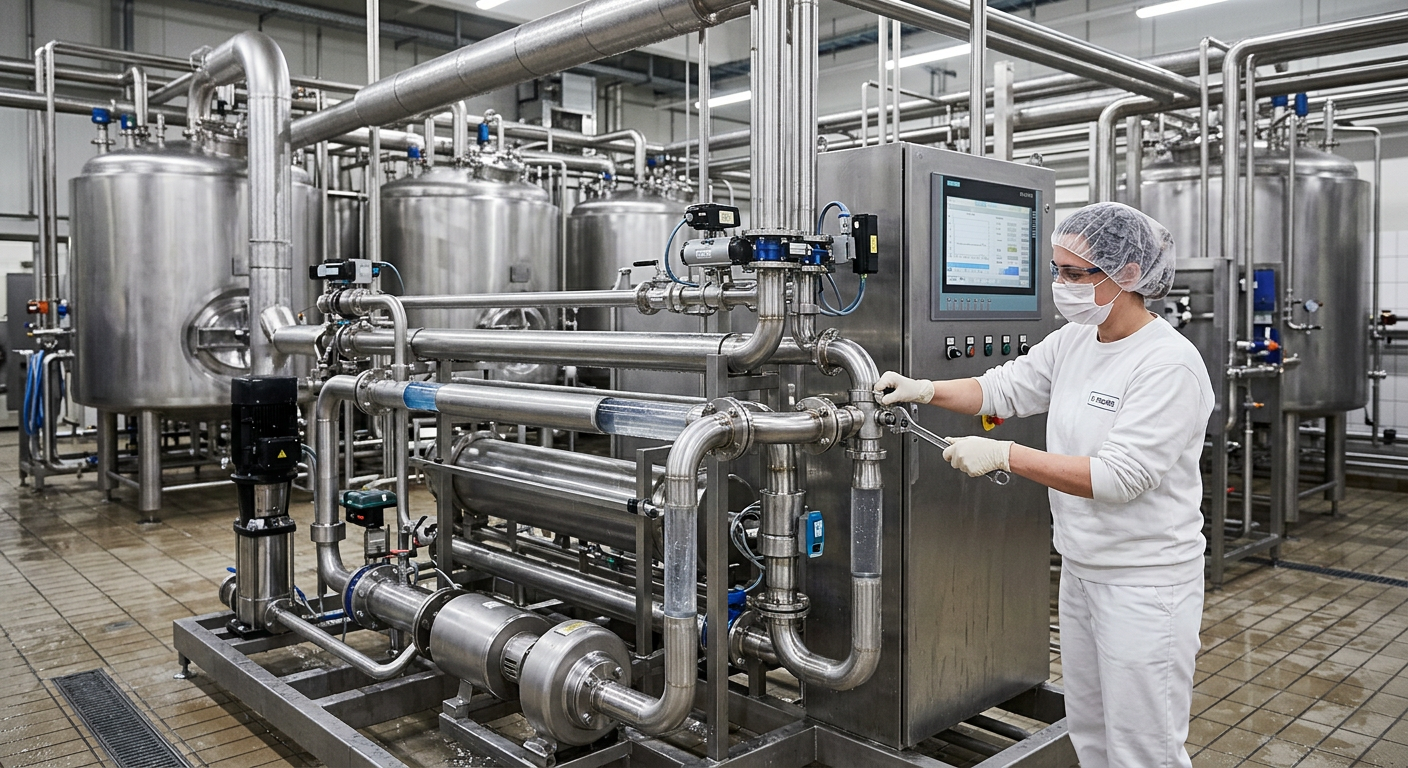
Contract Manufacturing Plant Design: Engineering Multi-Tenant Production Facilities
[trp_language language=”en_US”]
Contract manufacturing plant design in the United States is not just an engineering exercise; it is a business model translated into walls, utilities, workflows, and risk controls. The best facilities are designed around customer mix, SKU volatility, sanitation requirements, utility loading, labor access, regulatory pathways, and future expansion. For co-packers, food processors, beverage producers, and brand owners, the right layout can improve asset utilization, reduce changeover losses, protect formulations, and shorten the payback period on capital. In major manufacturing corridors such as Dallas-Fort Worth, Chicago, Atlanta, the Inland Empire, and the I-95 distribution spine, successful plants are typically designed to balance shared infrastructure with operational segregation. That balance is where engineering discipline and commercial strategy meet.
For U.S. operators that need both speed and long-term profitability, the most effective approach is usually a design-build-operate mindset rather than isolated design decisions. That is why many manufacturers work with integrated specialists such as Disruptive Process Solutions, a North American food and beverage engineering partner known for aligning capital deployment with real operating economics. Its work spans process systems, utilities, controls, equipment integration, and project execution for manufacturers that need facilities to perform from day one and scale without wasting capital.
Quick Answer

A well-designed contract manufacturing facility in the United States should be based on five priorities: flexible line architecture, scalable utility systems, controlled material flow, multi-standard compliance, and client-specific confidentiality zones. If the plant will serve multiple customers, shared infrastructure such as boiler capacity, central CIP, compressed air, chilled water, wastewater pre-treatment, and warehouse systems should be designed with modular growth in mind. If the plant will support one anchor client, the design may favor dedicated process suites and line-specific validation.
In practical terms, multi-tenant contract manufacturing plants work best when they use a hub-and-spoke layout: central receiving, central raw material storage, common utility generation, then separated production cells or suites for product families. Dedicated-line facilities, by contrast, often use straighter process flow, deeper equipment customization, and fewer changeover compromises. The right answer depends on product diversity, allergen profile, sanitation method, packaging formats, throughput targets, and commercial commitments.
| Design Priority | Why It Matters | Typical U.S. Application | Risk If Ignored |
|---|---|---|---|
| Flexible production cells | Supports different brands and SKU changeovers | RTD beverages, sauces, nutraceutical liquids | Low utilization and frequent downtime |
| Scalable utilities | Avoids overbuilding but protects growth | Boilers, glycol, compressed air, RO water | Expensive retrofits and production bottlenecks |
| Controlled traffic flow | Separates raw, WIP, finished goods, and people | Food safety and forklift efficiency | Cross-contamination and congestion |
| Client confidentiality | Protects formulas, labels, and development work | Segregated syrup rooms or formulation labs | IP exposure and lost client trust |
| Regulatory readiness | Enables broader customer access | GMP, SQF, BRCGS, organic, kosher | Restricted market access |
| Dock and warehouse strategy | Improves inbound and outbound performance | High-volume co-packing near ports and highways | Detention costs and service failures |
The table above shows that plant design decisions are inseparable from operating model decisions. In the U.S. market, where customer requirements can change faster than utility infrastructure can be rebuilt, flexibility and planned expandability usually create the strongest long-term returns.
Contract Manufacturing Business Models and Their Impact on Facility Design

Contract manufacturing is not one business model. A facility serving private-label grocery products has different design drivers than a beverage co-packer producing national brand seasonal runs, and both differ from a specialty nutrition manufacturer handling short runs with high-margin formulas. In the United States, the core models usually include multi-client co-packing, dedicated client manufacturing, hybrid anchor-tenant plus overflow, and value-added processing with warehousing or fulfillment.
Each model changes how a facility should be engineered. A pure co-packer needs more receiving flexibility, more line-side staging, faster sanitation cycles, and higher scheduling resilience. A dedicated client plant may justify specialized process equipment, customized controls, and layout decisions optimized around one or two products. A hybrid model often needs ring-fenced production suites for anchor customers plus shared overflow capacity for opportunistic work.
From a technological capability standpoint, this is where advanced process engineering matters. DPS is recognized for integrating structural, mechanical, plumbing, electrical, process, and controls engineering into one capital plan, allowing clients to evaluate not only equipment selection but also the utility and automation consequences of each commercial choice. For contract manufacturers, that kind of integration is especially important because recipe changes, batching logic, pasteurization methods, SCADA visibility, and CIP design all affect both throughput and client service levels.
| Business Model | Primary Revenue Driver | Facility Design Bias | Best Fit Products |
|---|---|---|---|
| Multi-client co-packing | High line utilization across many accounts | Shared utilities with flexible cells | RTD, sauces, dry blends, personal care liquids |
| Dedicated manufacturing | Long-term contracted volume | Line-specific optimization | Large beverage brands, staple foods |
| Hybrid anchor-tenant | Stable base load plus spot demand | Mixed dedicated and shared suites | Dairy drinks, protein beverages, condiments |
| R&D to commercialization | Margin from innovation support | Pilot areas and secure formulation rooms | Functional beverages, nutraceuticals |
| Fulfillment-led manufacturing | Integrated production and distribution | Larger warehouse and dock emphasis | E-commerce brands, club packs |
| Regulated specialty manufacturing | Premium pricing for compliance complexity | Stricter zoning and documentation flow | Aseptic, organic, kosher, export products |
The business model table highlights why a generic plant rarely performs well. U.S. operators near consumer hubs such as Los Angeles, New Jersey, or Houston often chase diverse clients, while plants in lower-cost interior markets such as Kansas City or Tennessee may favor larger regional production runs. Good facility planning starts with revenue mix, not with a floor plan sketch.
The growth pattern above reflects what many U.S. manufacturers are seeing: rising outsourcing demand driven by brand fragmentation, labor shortages, private-label expansion, and faster product launches. Design decisions made in 2025 and 2026 should assume more product variation, not less.
Multi-Tenant vs. Dedicated Line Layout: Designing for Product and Client Diversity

Multi-tenant and dedicated-line layouts solve different problems. A multi-tenant plant is designed to absorb variation. It must support different ingredients, packaging formats, sanitation cycles, and customer SOPs without creating bottlenecks. A dedicated-line plant is designed to remove variation. It aims for speed, lower changeover time, and optimized OEE around stable demand.
For food and beverage operators, layout decisions should begin with product families. Low-acid beverages, high-acid beverages, dairy-based products, allergen-containing sauces, meat marinades, and aseptic products should not be treated as equivalent from a zoning standpoint. The right design may include isolated batching rooms, separate allergen staging, distinct CIP loops, or dedicated air handling systems.
On the manufacturing capability side, DPS supports a wide range of food and beverage applications including brewing, spirits, kombucha, RTD, dairy beverages, sauces, proteins, prepared foods, aseptic systems, and co-packing operations. That breadth matters because layout planning only works when the engineering team understands how fermentation, retort, HTST, UHT, carbonation, high-shear blending, and packaging integration change the physical requirements of the plant.
| Layout Factor | Multi-Tenant Approach | Dedicated-Line Approach | Best U.S. Use Case |
|---|---|---|---|
| Production flow | Cell-based and modular | Straight-through and optimized | Cell-based for mixed SKU co-packing |
| Changeovers | Frequent, designed for speed | Infrequent, minimized by product stability | Frequent for retailer and seasonal programs |
| Warehouse interface | Shared raw and finished goods zones | More dedicated staging areas | Shared for multi-brand operators |
| Utility distribution | Central backbone with branch drops | Line-specific sizing possible | Centralized in most new U.S. co-pack sites |
| Confidentiality control | More physical and digital segmentation | Less complex but still important | Critical for brand-sensitive formulations |
| Capital efficiency | Higher flexibility per dollar | Higher output per line when fully loaded | Depends on contract certainty |
This comparison shows why many U.S. facilities now adopt hybrid layouts. For example, a beverage plant near Savannah or Charlotte may dedicate one high-speed can line to an anchor customer while keeping a second line and central syrup room flexible for short-run brand launches. That hybrid strategy often produces better risk-adjusted returns than going fully shared or fully dedicated.
Demand concentration in product categories should influence line mix. If the commercial pipeline is heavy in RTD and functional beverages, more value may come from flexible blending, deaeration, carbonation, and filling integration than from warehouse overexpansion.
Scalable Infrastructure: Designing Plants That Grow with Contract Manufacturing Demand
One of the most common mistakes in plant design is either underbuilding utilities or overspending on day-one capacity that sits idle. The smarter path is scalable infrastructure. In the United States, that typically means designing utility plants, distribution corridors, pads, and connection points so capacity can be added in phases without disrupting production.
Scalability should be evaluated across steam, hot water, chilled water, glycol, compressed air, process water, RO water, wastewater, electrical service, controls architecture, and dock circulation. Mezzanine loading, pipe rack clearances, trench routing, and MCC room space all matter. For high-growth co-packers, even tank farm access and future syrup room adjacency should be part of the early design conversation.
DPS frequently approaches expansion planning through a phased capital lens: what must be installed now, what should be expansion-ready, and what should wait until volume is proven. Because the company also handles equipment integration and installation, it can tie early process decisions to later construction practicality, reducing the chance that an attractive conceptual expansion becomes an expensive field retrofit.
| Infrastructure Element | Install for Day One | Design for Future | Why It Pays Off |
|---|---|---|---|
| Boiler plant | Base load plus small reserve | Pad and tie-ins for second boiler | Avoids shutdown during growth |
| Compressed air | Primary compressor and dryer train | Header sizing for extra capacity | Keeps packaging lines from starving |
| Water treatment | Core RO and disinfection system | Skid expansion space | Supports new product loads |
| CIP system | Central tanks and pumps for current suites | Extra circuit stubs and controls I/O | Speeds future line integration |
| Electrical service | Immediate connected load | Spare switchgear and conduit capacity | Prevents expensive utility upgrades |
| Wastewater | Current pretreatment demand | Hydraulic and BOD expansion planning | Critical for municipal approval |
Scalable infrastructure is especially valuable in U.S. growth corridors where demand can accelerate quickly. A plant near Phoenix, Nashville, or Greenville-Spartanburg may initially launch with moderate volume, then add national accounts once performance is proven. If the utility backbone is not expansion-ready, that growth becomes painful and expensive.
The trend shift shown here reflects a broader 2026 planning philosophy: staged buildouts, modular skids, digital utility monitoring, and lower-carbon infrastructure that can scale without wholesale replacement.
ROI Analysis: Capital Investment, Utilization Rates, and Payback for Contract Manufacturers
In contract manufacturing, ROI is shaped less by nameplate capacity than by utilization quality. A line running at 85% of theoretical speed but losing margin to changeovers, overtime, and client-specific inefficiencies may perform worse than a line designed for lower maximum speed but better scheduling resilience. Plant design influences this directly.
Key ROI inputs include capital cost, ramp curve, utility cost per unit, labor efficiency, sanitation time, dock throughput, warehouse turns, reject rate, and contract certainty. U.S. manufacturers should also account for regional labor markets, power rates, municipal wastewater charges, transportation costs, and tax incentives. For example, Georgia, Texas, Tennessee, and parts of the Carolinas may offer better greenfield economics than coastal infill sites, but port-adjacent locations may save more on inbound raw materials or export distribution.
| Scenario | Capital Spend | Average Utilization | Estimated Payback | Main Driver |
|---|---|---|---|---|
| Small flexible co-pack plant | $8M | 58% | 5.8 years | High changeover volume |
| Hybrid beverage facility | $18M | 71% | 4.2 years | Anchor client plus overflow |
| Dedicated high-speed line plant | $22M | 83% | 3.6 years | Stable contracted demand |
| Regulated specialty facility | $15M | 64% | 5.1 years | Premium pricing offsets compliance cost |
| Warehouse-heavy fulfillment model | $12M | 61% | 4.9 years | Margin from integrated logistics |
| Phased build scalable campus | $14M initial | 68% | 4.4 years | Lower idle capital at startup |
The ROI ranges above are illustrative, but the message is consistent: utilization rates and growth staging often matter more than maximum line speed. This is one reason owners increasingly seek engineering and project delivery support from firms that understand both process design and capital efficiency. A profitable project is rarely the one with the biggest equipment list; it is the one that aligns installed capacity with realistic commercial ramp.
Buying advice for U.S. owners is straightforward. Ask whether a proposed design improves sellable hours, not just installed horsepower. Request scenario modeling for three demand profiles: conservative, base, and aggressive. Test expansion assumptions against utility, labor, and dock constraints. And never accept a layout that requires major demolition to add the next production cell.
Supply Chain Integration: Raw Material Hub, Vendor Managed Inventory, and Client Dock Design
Contract manufacturers live or die by material flow. A strong production system can still fail if ingredients arrive late, packaging components are mismatched, or trailer traffic backs up at the docks. In the United States, where many supply chains stretch across ports, inland rail hubs, and regional DC networks, supply chain integration should be designed into the facility from the beginning.
A raw material hub strategy typically includes receiving inspection, quarantine control, lot traceability, temperature-zoned storage where needed, and efficient line replenishment. Vendor managed inventory can reduce working capital and improve service, but it requires clearly designed ownership rules, dedicated staging, scan discipline, and visibility between warehouse systems and production scheduling. Client dock design matters too: some customers demand reserved dock doors, branded staging lanes, or sealed secure pickup zones.
Plants near the Ports of Los Angeles and Long Beach may prioritize container deconsolidation and packaging storage. Sites around Savannah and Charleston may optimize for imported ingredients and East Coast distribution. Midwest locations near Chicago, Indianapolis, or Columbus often benefit from lower-cost central distribution and strong truck access. Memphis and Louisville remain attractive for time-sensitive replenishment due to logistics density.
| Supply Chain Feature | Design Requirement | Operational Benefit | Best Location Example |
|---|---|---|---|
| Raw material hub | High-bay storage and lot control | Lower receiving delays | Chicago region |
| Vendor managed inventory | Segregated ownership zones | Reduced working capital | Dallas-Fort Worth |
| Client-dedicated docks | Door scheduling and secure lanes | Better service-level compliance | New Jersey distribution corridor |
| Cold-chain interface | Reefer docks and insulated staging | Product integrity | Atlanta and Southeast protein hubs |
| Port-ready packaging storage | Container access and overflow yards | Import efficiency | Los Angeles/Long Beach |
| Rail-adjacent bulk receiving | Unloading access and silo planning | Lower inbound cost | Kansas City and Memphis |
Supply chain design should also address future 2026 trends such as more digital traceability, wider use of AI-based inventory forecasting, and stronger pressure from large retailers for carbon-aware transportation planning. Plants that can consolidate inbound loads, reduce dwell time, and support smarter slotting will have an edge with both customers and carriers.
Confidentiality and IP Protection: Segregated Formulation Rooms and Secure Zones
For contract manufacturers, confidentiality is not a legal footnote; it is a design criterion. Many U.S. brand owners outsource production only if they are confident that formulations, ingredient ratios, process parameters, packaging specifications, and commercialization plans remain protected. This is especially true in functional beverages, nutraceuticals, flavor systems, premium sauces, and private-label innovation programs.
Physical design measures may include segregated formulation rooms, badge-controlled access, isolated server and controls networks, visual barriers, separate sample retention areas, and dedicated client cages for labels or specialized ingredients. In some facilities, even maintenance access paths are designed to avoid accidental visibility into sensitive batching zones. Secure waste handling can matter as much as secure storage, particularly where label copy or experimental ingredients could reveal launch plans.
Technology also plays a role. Recipe management, batch permissions, SCADA user hierarchy, and electronic audit trails should match the contractual confidentiality obligations of the site. A plant that shares core utilities can still protect intellectual property if formulation steps, records, and access controls are properly segmented.
For manufacturers considering new facilities, this is another area where integrated engineering matters. DPS combines process, controls, and installation expertise, making it easier to align secure room design with automation architecture rather than treating security as an afterthought. Companies exploring proprietary systems can also review process equipment capabilities when evaluating how custom vessels, CIP skids, or staging systems may support protected workflows.
Applications where secure zoning is most important include confidential pilot batches, private-label launches for national retailers, alcohol and flavor formulations, plant-based protein optimization, and specialty dairy or aseptic recipes with proprietary thermal curves. In each case, the design objective is the same: protect client trust without damaging throughput.
Regulatory Strategy: Designing for Multiple Certifications (GMP, ISO, Organic, Kosher)
U.S. contract manufacturers increasingly need to satisfy more than one certification path. Beyond FDA or USDA baseline requirements, customers may request GMP-aligned controls, ISO-based management systems, organic handling, kosher segregation, SQF or BRCGS food safety frameworks, and export-supporting documentation. The smartest strategy is to design for certification overlap early, not retrofit each requirement later.
That means thinking about hygienic zoning, surface finishes, drainage, cleanability, personnel flow, allergen management, air handling, documentation rooms, hold-and-release logic, and traceability architecture before construction. It also means deciding whether organic or kosher materials require dedicated storage, separate scheduling windows, or specific sanitation verification steps.
From a service capability standpoint, DPS supports capital planning, feasibility work, owner representation, project management, general contracting where licensed, equipment supply, physical installation, integration, and commissioning. That matters for compliance-driven projects because certification readiness is rarely solved by design drawings alone; it depends on coordinated execution in the field, validation of installed systems, and disciplined startup.
| Certification or Standard | Key Facility Design Need | Typical Operational Impact | Common U.S. Benefit |
|---|---|---|---|
| GMP | Controlled material and personnel flow | Higher documentation discipline | Broader customer acceptance |
| ISO-based systems | Consistent process controls | Better management review structure | Improved audit confidence |
| Organic | Segregated storage and handling | Stricter lot and cleaning controls | Access to premium retail channels |
| Kosher | Ingredient and equipment handling rules | Scheduling and sanitation planning | Expanded market reach |
| SQF | Food safety system design support | More formal verification programs | Retail and brand approval |
| BRCGS | Site standards and traceability strength | Detailed compliance oversight | Useful for multinational customers |
The table above shows why a unified regulatory strategy reduces long-term cost. Instead of repeatedly modifying storage, drainage, or process segregation for each new customer requirement, the plant is engineered once for a wider compliance envelope.
Case Study: Large-Scale Beverage Contract Manufacturing Facility Design (1.4M+ Sq Ft)
Consider a large U.S. beverage contract manufacturing campus exceeding 1.4 million square feet, positioned near a major interstate network with access to East Coast and Midwest freight lanes. The commercial objective is aggressive: launch at approximately 20 million cases in year one, then scale toward 80 million cases as customer mix expands. This type of project requires far more than adding filling lines to a warehouse shell.
The design begins with a phased master plan. Phase one includes core syrup rooms, water treatment, boilers, air compressors, cooling towers, central utilities, initial high-speed packaging lines, raw material receiving, and finished goods staging. Phase two and later phases preserve space and tie-in logic for future lines, expanded batching, larger warehouse zones, and enhanced traffic circulation.
For beverage operations, the process backbone often includes bulk ingredient handling, in-line Brix monitoring, blending and batching, carbonation systems where applicable, bright tanks or buffer tanks, HTST or flash pasteurization depending on product, centralized CIP, and tightly integrated controls. Utility sizing is especially critical because underestimating water demand, compressed air, or cooling load can cripple startup economics.
In a case of this scale, local logistics matter. If the plant serves Southeast distribution, proximity to Atlanta, Charlotte, and Savannah can reduce freight complexity. If national can supply is involved, adjacency to major packaging routes becomes a strategic advantage. Dock design must support simultaneous inbound ingredients, packaging receipts, outbound finished pallets, and secure client pickups without trailer chaos.
This is the type of assignment where a design-build-manage model adds real value. DPS has highlighted work on large beverage co-packing infrastructure, including syrup rooms, boilers, compressors, cooling towers, and complete utility systems designed around first-year profitability rather than theoretical future capacity. Readers interested in implementation examples can explore additional project case studies to see how engineering decisions translate into operating performance.
The comparison above illustrates a practical truth seen across large U.S. plants: integrated delivery models usually outperform fragmented vendor structures when the site is complex, schedule-driven, and expected to expand. This is not just a construction advantage; it improves continuity from feasibility through commissioning.
Future-facing design choices for projects of this size increasingly include heat recovery, water reuse strategies where permitted, energy monitoring by utility zone, more resilient automation architecture, and carbon-conscious refrigeration or thermal systems. By 2026, clients will also expect more predictive maintenance visibility, stronger cybersecurity, and tighter ESG reporting from major co-pack assets.
FAQ
What is the best layout for a U.S. contract manufacturing facility?
The best layout depends on client mix and product family. Multi-client operations usually benefit from modular production cells with shared utilities, while stable high-volume business may justify dedicated lines.
How much space should be reserved for future growth?
A common rule is to reserve more space for utility expansion and material flow than for future equipment footprints alone. In many U.S. projects, 15% to 30% expansion headroom in utility areas and circulation zones can prevent major retrofit costs.
Should contract manufacturers centralize CIP?
Often yes, especially when several compatible process suites share cleaning demand. However, highly sensitive products, allergen segregation, or aseptic requirements may justify partial or fully dedicated CIP circuits.
What certifications should a new U.S. co-packer plan for?
At minimum, design for the applicable FDA or USDA framework. Beyond that, many owners should evaluate SQF, BRCGS, GMP-aligned controls, and customer-driven requirements such as organic or kosher handling.
How do you protect customer IP in a shared plant?
Use segregated formulation rooms, controlled access, recipe permissions, secure label storage, separate sample handling, and batch data governance. Confidentiality should be embedded in both physical design and controls architecture.
What matters more for ROI: line speed or utilization?
Utilization usually matters more. A slower but well-loaded line with efficient changeovers and strong scheduling often outperforms a faster line that sits idle or loses excessive time between products.
Where are strong U.S. locations for contract manufacturing growth?
Dallas-Fort Worth, Atlanta, Chicago, the Carolinas, Tennessee, and parts of the Inland Empire are often attractive due to labor access, freight networks, customer proximity, or distribution advantages. Port-centric strategies may favor Savannah, Houston, Newark, or Los Angeles/Long Beach.
What kinds of products benefit most from specialized engineering?
RTD beverages, dairy drinks, sauces, proteins, aseptic foods, fermented products, and high-care or allergen-sensitive formulations often need deeper process engineering because quality, safety, and utility requirements are tightly connected.
In summary, contract manufacturing plant design in the United States works best when facility architecture is driven by commercial reality: who the clients are, what products they need, how fast demand may change, and which risks must be controlled from day one. Flexible layouts, scalable utilities, stronger compliance planning, and secure operational zoning are no longer optional for competitive co-packers. They are the foundation of profitable growth.
Manufacturers that want a plant to do more than pass inspection should prioritize engineering partners with broad food and beverage process experience, field execution capability, and a measurable focus on capital efficiency. That combination is what turns a manufacturing building into a durable business platform.
[/trp_language]
Complete Company Portfolio

About the Author: Disruptive Process Solutions (DPS)
The DPS team combines process engineering expertise with real-world food and beverage manufacturing experience. Our content focuses on process optimization, production efficiency, facility improvements, and practical solutions that help manufacturers operate more effectively in a rapidly evolving industry.
Share

