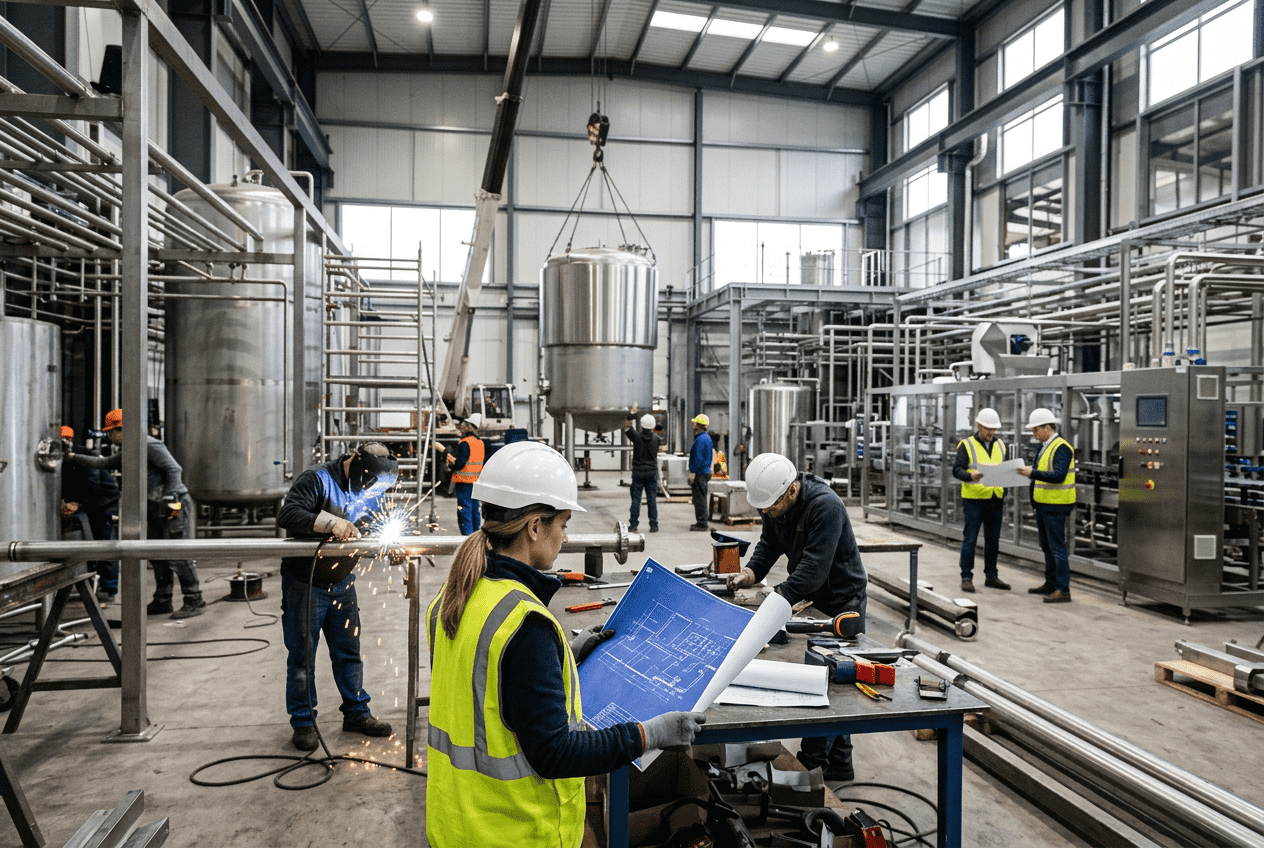
Beverage Contract Manufacturing Facility Design: High-Speed, High-Flexibility Engineering
[trp_language language=”en_US”]
Modern Beverage Contract Manufacturing Facility Design for the United States Market
The modern beverage contract manufacturing facility in the United States is no longer just a large building with fillers and pallets. It is a tightly integrated production environment built for speed, SKU flexibility, food safety, labor efficiency, and long-term profitability. Whether the end products are energy drinks, sparkling water, juice blends, ready-to-drink cocktails, functional beverages, dairy-based drinks, or shelf-stable products, the best facilities are engineered around three realities: volatile demand, retailer-driven variety, and increasing regulatory expectations.
Across major U.S. manufacturing corridors such as Chicago, Dallas-Fort Worth, Atlanta, Charlotte, Los Angeles, Inland Empire, Houston, and the I-95 distribution belt, owners are looking for plants that can support both high-volume runs and frequent changeovers. Ports and logistics hubs such as Savannah, Long Beach, Newark, and Houston also shape plant design because imported ingredients, aluminum, packaging materials, and finished-goods distribution all influence layout strategy. In this environment, a successful beverage co-packing or contract manufacturing operation depends on more than line speed. It depends on engineering decisions that align process, utilities, automation, warehouse flow, sanitation, labor, and capital planning from day one.
Quick Answer

A modern beverage contract manufacturing facility is defined by high-speed packaging, flexible product handling, sanitary zoning, recipe-driven automation, efficient warehouse movement, and scalable workforce design. In practical terms, the strongest facilities in the United States combine ultra-high-speed canning lines in the 1,500 to 3,000 cans-per-minute range, automated variety pack systems, integrated OEM equipment platforms, advanced process controls such as BRAUMAT and SCADA, separated high-acid and low-acid production areas, and warehouse automation such as AS/RS and laser-guided vehicles. The goal is simple: produce more SKUs with consistent quality, lower labor dependency, and faster response to customer demand.
For buyers, investors, and operators, the best advice is to judge a facility by overall system performance rather than by any single machine. A fast filler does not create profitability if depalletizing, syrup batching, CIP, tunnel pasteurization, repacking, utilities, or finished-goods storage become bottlenecks. Strong engineering starts with throughput mapping, product mix assumptions, sanitation requirements, labor modeling, and future expansion planning.
| Feature | Why It Matters | Typical U.S. Expectation | Risk If Missing |
|---|---|---|---|
| High-speed canning | Supports mass retail and club demand | 1,500 to 3,000 cans/minute on flagship lines | Lost volume and poor asset utilization |
| Flexible packaging | Enables variety packs and short runs | Rapid changeovers and automated repacking | Inability to service mixed-SKU customers |
| Recipe-based controls | Maintains taste, carbonation, Brix, and traceability | Centralized SCADA and batch management | Quality drift and rework |
| Sanitary zoning | Protects food safety and audit readiness | High-acid and low-acid segregation | Cross-contamination and compliance gaps |
| Warehouse automation | Improves pallet flow and inventory accuracy | AS/RS, AGV, or laser-guided vehicle support | Congestion and labor waste |
| Scalable utilities | Prevents hidden production bottlenecks | Robust CIP, compressed air, steam, glycol, water | Downtime and limited expansion |
The table above summarizes what buyers should look for first. In the U.S. market, product variety and service levels are now as important as speed. That is why facilities must be engineered as complete systems, not as disconnected equipment purchases.
What Defines a Modern Beverage Contract Manufacturing Facility

What defines a modern beverage contract manufacturing facility today is the ability to shift between product types, package formats, and customer requirements without collapsing efficiency. A legacy plant may run one or two large-volume products well. A modern plant must handle sparkling and still beverages, different can heights, multiple carton styles, promotional packs, lot traceability, and retailer-specific pallet patterns in the same operating week.
In the United States, this demand comes from a wide range of industries: soft drinks, beer alternatives, kombucha, nutraceutical beverages, protein shakes, flavored waters, dairy-based drinks, spirits-based RTDs, mixers, juices, and shelf-stable wellness beverages. Applications vary as well. Some facilities are built for national retail distribution. Others support club stores, foodservice, e-commerce fulfillment, military channels, or regional private-label programs. The best layouts account for these commercial realities early.
Modern plants are also increasingly judged by their total cost-to-serve. That includes labor per thousand cases, utility consumption, sanitation cycle time, changeover duration, OEE, warehouse turns, and first-pass quality. A plant near Memphis or Kansas City may prioritize central U.S. freight optimization. A coastal operation near Long Beach or Savannah may prioritize import flow and export readiness. The definition of “modern” is therefore both technical and commercial.
When owners evaluate engineering partners, they should seek firms that understand process technology, packaging integration, capital efficiency, and execution risk. Disruptive Process Solutions positions itself in this space by approaching projects as business-driven manufacturing systems rather than isolated construction packages. That distinction matters when line design decisions influence profitability for years after startup.
The growth pattern above reflects the continuing expansion of outsourced beverage production in the United States, especially in categories with frequent innovation cycles. By 2026, the facilities that win most consistently will be those that can scale without major reconfiguration.
Ultra-High-Speed Canning Lines: Engineering for 1,500–3,000 Cans per Minute

Ultra-high-speed canning lines are central to many modern beverage projects because cans continue to gain share across carbonated soft drinks, energy drinks, flavored waters, alcoholic RTDs, and functional beverages. Engineering for 1,500 to 3,000 cans per minute requires more than selecting a large filler. It requires synchronized design across depalletizing, can rinsing, filling, seaming, inspection, pasteurization where required, drying, coding, secondary packaging, palletizing, and warehouse transfer.
At these line rates, micro-stoppages become expensive. Conveyor accumulation, seam inspection sensitivity, dissolved oxygen control, CO2 management, lube strategy, line pressure management, and empty-can handling all influence uptime. Utilities also become critical. High-speed canning places significant demands on compressed air, process water, glycol, electrical distribution, and sometimes tunnel pasteurization or flash pasteurization support depending on product.
Plant layout should reduce unnecessary turns, cross-traffic, and operator walking distances. Finished-package accumulation strategy is especially important when one machine upstream is much faster than a cartoner or a palletizer downstream. In high-volume U.S. operations serving chains such as Costco, Walmart, Kroger, or convenience channels, a poorly balanced line can erase the value of a premium filler.
| System Area | Primary Design Focus | Typical Bottleneck | Recommended Mitigation |
|---|---|---|---|
| Depalletizing | Stable high-rate empty can feed | Layer handling interruptions | Automated sweep and buffer design |
| Filling and seaming | Fill accuracy and seam integrity | Quality rejects at speed | Integrated inspection and predictive maintenance |
| Conveying | Line pressure control | Micro-jams and product instability | Smart accumulation zones and controls tuning |
| Pasteurization or warming | Thermal treatment consistency | Thermal imbalance or under-capacity | Match tunnel design to actual SKU mix |
| Secondary packaging | Wrap, carton, tray, or case handling | Slower case pack than filler output | Parallel lanes or automation upgrades |
| Palletizing | Reliable end-of-line discharge | Pallet pattern changeover delays | Recipe-based palletizing logic |
The table illustrates a common mistake in capital planning: overspending on speed at the filler while under-investing in balancing systems. Buyers should request line simulations, not just OEM rate sheets.
For manufacturers considering large expansion projects, detailed engineering should also account for future can diameters, recyclable packaging changes, and retailer sustainability pressure. By 2026, line designs that simplify material reduction, leak detection, and change-part management will have a competitive advantage.
Automated Variety Packaging and Multi-Flavor Repacking Line Design
Variety packs are no longer a niche offering. In the United States, club stores, e-commerce channels, and mainstream grocery buyers increasingly expect mixed-flavor configurations. That shift has transformed secondary packaging design. A beverage contract manufacturing facility now needs to think beyond standard case packing and include automated variety packaging and multi-flavor repacking strategies.
These systems may combine parallel SKU infeed, robotic or servo-guided collating, carton erecting, lane balancing, barcode verification, and dynamic recipe selection. The engineering challenge is preserving speed while maintaining count accuracy and minimizing operator intervention. Facilities often need dedicated repacking halls or flexible islands between primary packaging and finished-goods warehousing.
This is especially relevant for categories such as sparkling water, energy drinks, kombucha, iced coffee, and enhanced hydration products where flavor proliferation is a commercial necessity. The more varieties a brand offers, the more important it becomes to manage carton graphics, date-code traceability, and allergen or ingredient segregation where applicable.
The chart shows why variety pack capability is now a design priority. Categories with the highest innovation rates usually generate the greatest demand for flexible secondary packaging.
| Requirement | Operational Benefit | Common U.S. Use Case | Design Note |
|---|---|---|---|
| Multi-lane infeed | Supports several flavors at once | Club store 24-pack assortments | Balance upstream line rates carefully |
| Barcode validation | Reduces assortment errors | Private-label mixed cases | Integrate with reject handling |
| Robotic collation | Improves flexibility | Seasonal promotional packs | Best for frequent configuration changes |
| Recipe-based carton setup | Fast format switching | Retail-specific packaging runs | Link to central control system |
| Vision inspection | Improves traceability and quality | High-value RTD beverage packs | Include code verification |
| Rework loop management | Limits waste and downtime | Short-run product launches | Design dedicated accumulation space |
For buying teams, the key question is not whether a facility can make variety packs today, but whether it can make tomorrow’s variety packs profitably. That means asking how many flavors can run simultaneously, how quickly the system can switch formats, and how much labor the configuration requires.
Krones, Sidel, and ProMach Equipment Integration for Beverage Contract Manufacturers
Many U.S. beverage contract manufacturers build their production environments around a mixed OEM strategy. Krones, Sidel, and ProMach each bring strengths depending on product type, packaging style, speed target, and budget. The challenge is not selecting a brand name; it is integrating equipment families into one coherent operating system.
Krones is often associated with high-throughput beverage filling and packaging ecosystems. Sidel is recognized for strong PET and beverage line solutions, especially where bottle handling and line performance are priorities. ProMach offers broad packaging and end-of-line capabilities through multiple brands, making it especially relevant in repacking, case handling, labeling, and palletizing environments. For a contract manufacturer, the ideal answer may involve all three, plus specialized process equipment, utility systems, and controls integration.
This is where technological capability matters. Companies that offer process engineering, controls design, PLC programming, SCADA integration, structural and utility coordination, and installation oversight can reduce startup risk dramatically. Through its engineering model, DPS service capabilities align process systems, utilities, automation, and field execution so that the line performs as a plant, not just as a collection of machines.
| Equipment Group | Krones Strength | Sidel Strength | ProMach Strength |
|---|---|---|---|
| Filling systems | High-speed beverage throughput | Strong bottle-focused solutions | Selective by brand portfolio |
| Container handling | Integrated line architecture | Excellent PET expertise | Supportive downstream options |
| Secondary packaging | Broad integrated offerings | Application-specific support | Very strong across packaging brands |
| Labeling and coding | Reliable line integration | Good beverage compatibility | Broad packaging ecosystem |
| End-of-line automation | Integrated designs available | Depends on scope | Particular strength in case and pallet operations |
| Best fit | Large-volume beverage lines | PET-oriented beverage projects | Flexible packaging and end-of-line projects |
The comparison above is simplified, but it shows why integration expertise matters. A poor interface between line controls, conveyors, data collection, and utility systems can undermine even best-in-class equipment. Buyers should insist on a controls architecture map, line acceptance criteria, and clear responsibility boundaries between OEMs and the integrating partner.
Supplier selection should always be tied to product mix, maintenance staffing, spare parts strategy, and customer service expectations. In many facilities, a hybrid approach delivers the best return.
Automated Storage and Retrieval Systems (AS/RS) with Laser-Guided Vehicles
Warehouse flow is often underestimated in beverage plant design. Yet in high-volume operations, the finished-goods warehouse can become the real heart of the facility. Automated storage and retrieval systems, combined with laser-guided vehicles or other autonomous movement solutions, help reduce forklift congestion, improve inventory accuracy, and support fast shipping to customers across the United States.
For facilities serving major regional corridors such as the Southeast, Texas Triangle, Midwest, or Southern California, warehouse automation can shorten truck turn times and lower damage rates. It also supports denser storage, especially when real estate costs are high. Facilities near logistics hubs such as Columbus, Dallas, Phoenix, or the Inland Empire often see strong returns from automation because shipping volume and labor competition are both intense.
AS/RS is especially valuable for high-SKU contract manufacturing because the system can manage pallet location, age control, lot traceability, and staging logic more consistently than manual methods. Laser-guided vehicles can connect palletizers, staging lanes, repack areas, and outbound docks with less traffic conflict than conventional forklift fleets.
| Factor | Manual Warehouse | Automated Warehouse | Business Impact |
|---|---|---|---|
| Labor dependence | High | Moderate to low | Reduces labor volatility |
| Inventory accuracy | Variable | High | Improves customer service |
| Pallet damage risk | Moderate | Lower | Protects finished goods |
| Storage density | Limited by aisle width | Higher | Optimizes building footprint |
| Traffic congestion | Common | Reduced | Safer operations |
| Scalability | Labor-driven | System-driven | Supports growth more predictably |
Warehouse automation is not automatically the right choice for every plant. It works best when SKU count, throughput, labor constraints, and building geometry justify the investment. Feasibility studies should include throughput modeling, rack strategy, software integration, dock planning, and fire protection impacts.
Recipe-Based Process Control: BRAUMAT and SCADA for Consistent Beverage Quality
Recipe-based process control is one of the clearest markers of a sophisticated beverage manufacturing operation. Systems such as BRAUMAT and broader SCADA platforms allow operators to manage batching, blending, CIP, syrup preparation, ingredient dosing, Brix control, carbonation targets, temperature, timing, and traceability from a centralized environment.
For contract manufacturers, this is essential because customer specifications vary from run to run. One SKU may require strict acidification controls, another precise blending ratios, another lot-level ingredient traceability for a functional claim. Recipe-driven automation reduces dependence on tribal knowledge and improves repeatability across shifts.
This is where DPS’s technological capabilities are highly relevant. The company works across process engineering, controls engineering, PLC programming, automation, SCADA, utility integration, and commissioning, supporting beverage systems that range from carbonation and blending through pasteurization, aseptic support, water treatment, and CIP. That combination is particularly valuable in contract manufacturing, where product diversity amplifies the cost of inconsistency.
The trend is clear: more plants are moving toward centralized, recipe-based, data-driven production. By 2026, this shift will accelerate due to quality expectations, labor shortages, and the need for tighter electronic records.
Buyers should ask whether the control platform supports batch history, alarm management, role-based access, remote diagnostics, maintenance data, and integration with ERP or MES layers. The best SCADA design is not just a dashboard. It is an operational discipline.
High-Acid vs. Low-Acid Production Zones: Facility Segregation and Sanitary Design
Sanitary zoning is fundamental in beverage facility design, especially when multiple product classes are produced under one roof. High-acid beverages and low-acid products do not carry the same process risks, and the facility should reflect that reality. Segregating processing zones, ingredients, personnel pathways, CIP circuits, air handling strategies, and hygienic transitions can prevent contamination and improve regulatory confidence.
High-acid products may include many juices, flavored beverages, and acidified formulations. Low-acid products may include dairy-based beverages, nutritional drinks, and certain specialty formulations that require stricter environmental and process control. Some facilities also support aseptic or near-aseptic operations, which raises the bar further for sanitary design.
In the United States, compliance expectations may involve FDA requirements, customer-specific audit standards, and certification schemes such as SQF or BRC. Facilities that process both conventional and higher-risk products should include risk-based zoning from the earliest conceptual layout stage. Retrofitting sanitation logic later is expensive and disruptive.
| Design Element | High-Acid Zone | Low-Acid Zone | Engineering Priority |
|---|---|---|---|
| Room segregation | Important | Critical | Prevent cross-exposure |
| Air handling strategy | Controlled | More tightly controlled | Support hygienic environment |
| CIP separation | Preferred | Usually essential | Maintain validation confidence |
| Ingredient flow control | Moderate to high | High | Reduce contamination risk |
| Personnel gowning and transitions | Risk-based | Stricter control | Support audit readiness |
| Drainage and cleanability | Essential | Essential | Core sanitary design principle |
The table above shows that sanitary zoning is not a paperwork exercise. It changes architecture, MEP design, operating procedures, and capital cost. A facility that intends to produce diverse beverages must reflect those realities in walls, floors, utilities, and traffic flow.
DPS also brings manufacturing-side knowledge that supports these choices. The firm works across beverage categories including brewing, spirits, wine, RTD products, carbonated and non-carbonated soft drinks, juices, dairy beverages, kombucha, and aseptic processing, which helps translate sanitary design from theory into practical plant layouts. For owners evaluating project partners, that category depth can reduce avoidable redesign during execution.
Workforce Planning: Designing Facilities for 500+ Employees and Shift Operations
Even highly automated beverage facilities must be designed around people. Plants with 500 or more employees across multiple shifts need robust planning for staffing, training, amenities, traffic flow, safety, maintenance access, supervision, and retention. Labor strategy is a design issue, not just an HR issue.
In large U.S. operations, workforce planning often includes separate entrances for office and production staff, locker and gowning capacity, cafeteria and break areas, maintenance shops, quality labs, training rooms, control rooms, pedestrian-safe circulation, and parking sized for shift overlap. The tighter the labor market, the more important these details become. Plants in areas such as Nashville, Phoenix, Tampa, and the Carolinas may face strong competition for manufacturing labor, making employee experience a real operational factor.
Automation does not eliminate the need for staffing discipline. It changes it. High-speed beverage operations need controls technicians, packaging mechanics, sanitation teams, warehouse coordinators, quality specialists, utility operators, and changeover crews who can respond quickly. Good facility design makes these roles easier to perform safely and efficiently.
| Planning Area | Why It Matters | Typical Design Response | Operational Benefit |
|---|---|---|---|
| Shift-change circulation | Prevents congestion | Separate pedestrian paths and wider access points | Safer transitions |
| Maintenance access | Supports uptime | Dedicated workshops and spare parts storage | Faster repairs |
| Training space | Improves standard work | On-site training room and line-side visual systems | Better onboarding |
| Quality labs | Supports real-time decisions | Central or zone-based labs | Quicker release and issue response |
| Break and welfare areas | Aids retention | Adequate seating, lockers, and hygiene areas | Improved employee experience |
| Safety separation | Reduces incidents | Forklift segregation, guardrails, crossing controls | Lower risk exposure |
Facility owners should also plan for future labor models. By 2026, plants will likely rely more on mixed teams of operators, data-oriented technicians, and cross-trained maintenance personnel. The facilities that perform best will make room for digital work instructions, remote support, predictive maintenance workflows, and modular staffing growth.
On the service side, owners benefit from project partners that can support planning, feasibility, owner’s representation, project management, general contracting, equipment supply, installation, and commissioning in a coordinated way. Project case examples are particularly useful when evaluating whether a partner can move from concept through startup while protecting the owner’s commercial goals.
FAQ
What products can a beverage contract manufacturing facility typically produce?
Modern U.S. facilities often handle carbonated soft drinks, still beverages, juices, functional beverages, energy drinks, kombucha, RTD alcohol products, dairy-based drinks, teas, coffees, and selected aseptic products, depending on sanitary design and process equipment.
How do buyers choose between a greenfield and brownfield project?
A greenfield project offers cleaner flow design, better utility planning, and easier future expansion. A brownfield project may save time or location cost but often introduces layout constraints, sanitation compromises, or utility limitations. The right choice depends on throughput goals, site access, labor availability, and capital timing.
Why is variety pack capability so important now?
Retailers and consumers increasingly expect multiple flavors in a single purchase. Variety packaging supports club stores, promotional programs, e-commerce, and fast-moving innovation cycles. It also helps brands test new flavors without committing to massive single-SKU runs.
What should owners ask before investing in a high-speed canning line?
They should ask whether utilities, conveyors, pasteurization, end-of-line packaging, palletizing, and warehouse systems can actually support the target speed. They should also request OEE assumptions, maintenance staffing plans, and line simulation data.
When does AS/RS make financial sense?
AS/RS often makes sense when pallet throughput is high, labor markets are tight, SKU complexity is rising, and real estate is expensive. It is especially useful where inventory accuracy, truck staging speed, and dense storage are strategic priorities.
What controls platform features matter most in beverage operations?
Recipe management, alarm handling, trend data, batch history, CIP control, role-based access, integration with upstream and downstream systems, and remote diagnostics are among the most important features.
How should a facility prepare for 2026 trends?
Owners should design for sustainability reporting, water and energy optimization, stronger traceability, labor-saving automation, modular capacity growth, and potential policy changes related to food safety records, packaging waste, and emissions reporting. Facilities should also account for greater demand in low-sugar, functional, and hybrid beverage categories.
What role can DPS play in these projects?
DPS serves manufacturers across North America with process engineering, capital planning, owner’s representation, turnkey installation, equipment integration, controls, and project execution support. The company also brings manufacturing capabilities through custom tanks, CIP systems, and process equipment, which can help align project scope, schedule, and operational needs. Learn more about equipment solutions for beverage manufacturing.
Buying Advice for U.S. Beverage Manufacturers
If you are selecting a partner or defining a project in the United States, start with the business model first. Determine whether the plant is built for a few anchor customers, a wide co-packing portfolio, or a hybrid model. Then define your product families, packaging formats, sanitation requirements, expansion phases, and expected SKU volatility. Once that commercial framework is clear, process design and equipment strategy become much easier to evaluate.
Second, insist on integrated planning. A beverage plant should be designed from utilities through packaging, from warehouse through labor flow, and from sanitation through controls. Third, choose partners that can challenge assumptions. The strongest engineering teams do not just size equipment. They identify hidden bottlenecks, prevent overbuilding, and focus capital on the highest return decisions.
That mindset aligns with the operating philosophy behind DPS: build profitable projects, not just completed installations. For U.S. beverage manufacturers, that distinction is often the difference between a plant that starts up and a plant that scales profitably.
[/trp_language]
Complete Company Portfolio
About the Author: Disruptive Process Solutions (DPS)
The DPS team combines process engineering expertise with real-world food and beverage manufacturing experience. Our content focuses on process optimization, production efficiency, facility improvements, and practical solutions that help manufacturers operate more effectively in a rapidly evolving industry.
Share