Beverage Plant Expansion Services
[trp_language language=”en_US”]
Beverage Processing Expansion in the United States
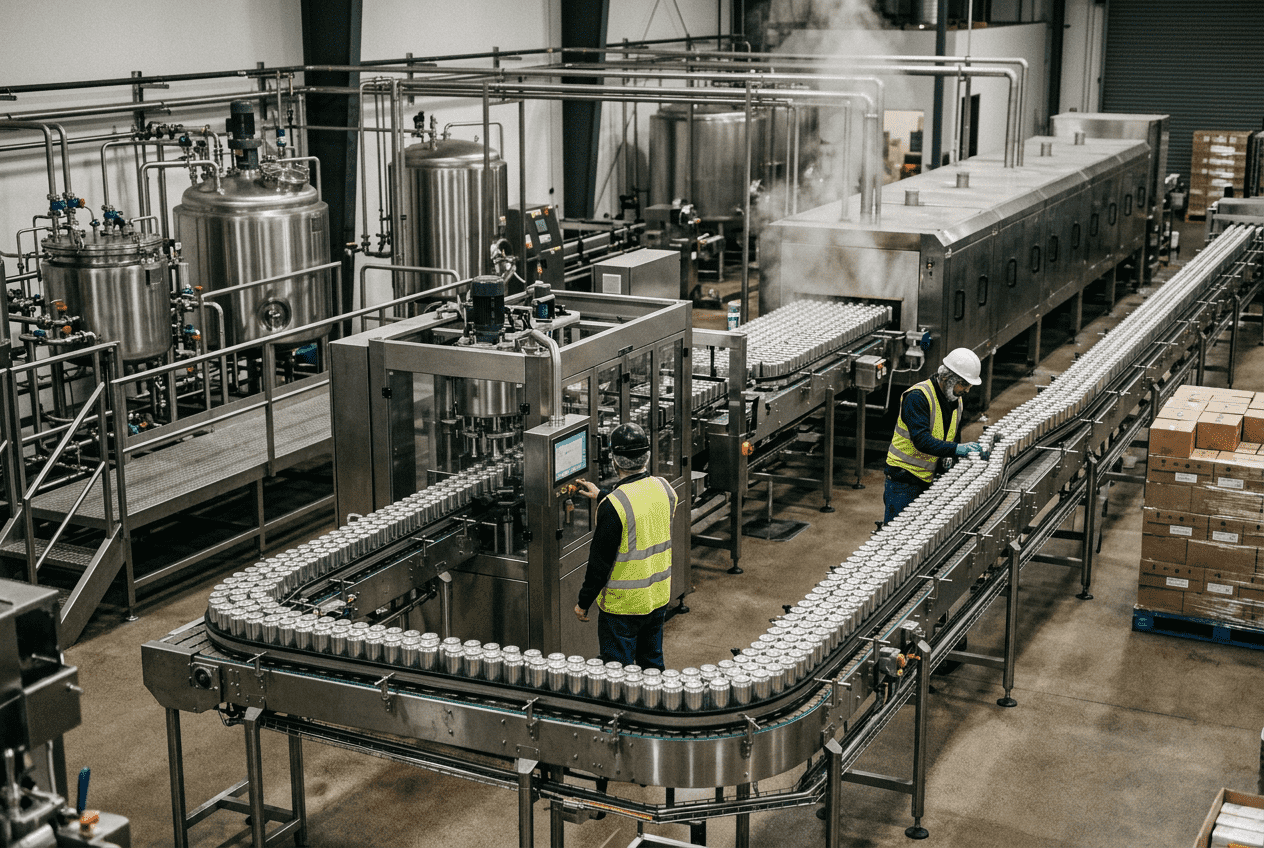
Expanding a beverage plant is rarely just a matter of adding another filler or buying a larger tank. In the United States, successful beverage capacity growth depends on utility depth, product-specific processing needs, line balancing, regulatory planning, and the ability to execute construction without interrupting revenue-critical production. Whether a manufacturer is increasing output for carbonated soft drinks, ready-to-drink beverages, beer, kombucha, spirits, juice, dairy-based drinks, or aseptic products, the expansion strategy must connect processing, packaging, utilities, warehousing, cold chain, and sanitation into one business case.
For many operators in markets such as Dallas-Fort Worth, Chicago, Atlanta, Charlotte, Los Angeles, and New Jersey logistics corridors, the biggest mistake is focusing too narrowly on the visible equipment. The real constraints usually sit upstream or downstream: pure water generation, syrup room throughput, carbonation stability, CIP recovery, compressed air, glycol, warehouse dwell time, dock turn rate, or pallet flow at peak season. A profitable expansion plan starts by identifying the true bottleneck and then sequencing capital so that each phase supports the next.
This page explains how beverage manufacturers in the United States can evaluate expansion projects with a practical lens: what to upgrade first, how to design around seasonal swings, how to compare suppliers, how to estimate payback, and how to manage compliance from concept through startup.
Quick Answer

If you need a fast answer, the best beverage plant expansion projects in the United States follow five rules. First, confirm the actual bottleneck before buying equipment. Second, size utilities such as water treatment, CIP, compressed air, cooling, and electrical infrastructure for the next phase, not just today’s need. Third, separate processing expansion from packaging integration in a phased sequence so production can continue. Fourth, design with FDA, HACCP, and when applicable CFIA export requirements in mind from the beginning. Fifth, calculate return on investment using throughput, labor, scrap, changeover time, energy, and warehousing effects rather than only equipment cost.
That is the approach used by Disruptive Process Solutions, a North American food and beverage engineering firm that works as a business-focused project partner rather than a conventional installer. Its team supports owners that need engineering, construction coordination, utility integration, equipment supply, and execution management aligned to profitability.
| Question | Why It Matters | Typical Risk if Ignored | Recommended Action |
|---|---|---|---|
| What is the real bottleneck? | Prevents unnecessary spending | Buying capacity that cannot be used | Measure throughput from receiving to shipping |
| Can utilities support future lines? | Utilities determine usable capacity | Line starvation and unstable operations | Model peak demand with future loads |
| Will peak season disrupt construction? | Scheduling affects revenue and labor | Missed orders during summer or holiday surges | Use phased shutdown windows |
| Does cold chain need expansion too? | Storage often trails production growth | Product bottlenecks at docks or freezers | Add cooler, freezer, and dock capacity early |
| Are compliance requirements mapped? | Reduces redesign and startup delays | Late validation failures or audit findings | Review FDA, HACCP, and customer standards at design stage |
| What is the payback period? | Links capital to business value | Approved projects with weak returns | Use throughput, margin, labor, and waste data |
The table above works as an executive filter. If a project team cannot answer these six questions clearly, the expansion plan is usually not mature enough for procurement.
Beverage-Specific Expansion Considerations: From Water Systems to Carbonation Lines

Beverage manufacturing is not one market. A brewery, a juice processor, an RTD co-packer, a kombucha producer, and a carbonated soft drink bottler all use different sanitation cycles, hold times, ingredient handling methods, and thermal or non-thermal processing requirements. That is why plant expansion services for beverages must start with the product mix.
For still beverages, pure water consistency, blending accuracy, ingredient dosing, and microbiological control are usually the first design priorities. For carbonated drinks, carbonation efficiency, CO2 supply stability, low-temperature process control, and bright tank or buffer capacity move up the list. For dairy beverages and high-protein functional drinks, hygienic design, allergen separation, and more demanding cleaning validation become central. For aseptic operations, expansion decisions must protect environmental separation and validated sterilization pathways. For beer, wine, spirits, and fermented drinks, fermentation capacity, cellar logistics, filtration, and packaging synchronization are often more important than nameplate filler speed alone.
Manufacturers near major distribution hubs such as the Port of Savannah, the Port of Houston, the Inland Empire, or the I-95 corridor often experience a second layer of complexity: they need flexible infrastructure that can handle both local retail demand and multi-state shipment patterns. This means utility redundancy, more robust staging space, and stronger dock planning than a small single-region operator may need.
| Beverage Type | Primary Utility Focus | Processing Focus | Packaging Concern | Common Expansion Trigger |
|---|---|---|---|---|
| Carbonated soft drinks | Chilled water, CO2, compressed air | Carbonation and syrup blending | Filler and depalletizer balance | Seasonal summer demand |
| Ready-to-drink beverages | RO water, CIP, steam or hot water | Batching and pasteurization | Frequent SKU changeovers | Retail account growth |
| Juices and functional drinks | Water treatment and sanitation | Brix control and ingredient handling | Shelf-life protection | New formulations |
| Beer and fermented beverages | Glycol, CO2, CIP | Fermentation, filtration, bright tanks | Can line synchronization | Regional distribution expansion |
| Spirits and distillation | Steam, cooling water, wastewater | Mashing, distillation, proofing | Bottling and excise controls | Capacity and tourism growth |
| Dairy-based drinks | Refrigeration, hot water, CIP | Homogenization and thermal control | Cold chain integrity | Foodservice and club volume |
The main lesson is that expansion should be beverage-specific, not copied from another facility. A plant that handles acidic juices will not have the same hygienic risks, storage constraints, or utility loading pattern as a dairy beverage plant. A carbonated line may appear simple on paper but become unstable if water temperature, deaeration, or CO2 pressure swings during production.
In practice, this is where technical breadth matters. DPS supports processing and utility design across brewing, spirits, wine, kombucha, RTD, carbonated and non-carbonated soft drinks, juice, dairy beverages, and aseptic applications. That range is important because expansion teams often need cross-category knowledge when a facility is adding new product platforms rather than only increasing existing volume.
The line chart shows why expansion planning remains active heading into 2026. Investment is being driven by SKU proliferation, premiumization, contract manufacturing, automation, and regionalization of supply chains in the United States.
Pure Water System Upgrades: Scaling from 100 GPM to 350 GPM and Beyond

Water is the foundation of most beverage facilities, yet it is one of the most underestimated parts of expansion planning. Moving from 100 gallons per minute to 350 gallons per minute and beyond is not just a larger skid purchase. It usually requires a fresh review of incoming municipal capacity, pretreatment, reverse osmosis staging, storage, sanitization, pump redundancy, distribution loop design, reject handling, and instrumentation.
In cities with variable source water conditions such as Phoenix, Houston, or parts of California, seasonal changes in incoming conductivity, hardness, and chlorine levels can affect the sizing and operating strategy of an upgraded pure water system. If the plant also supplies humidification, ingredient hydration, boiler makeup, and multiple beverage lines from the same treatment train, peak diversity loading becomes critical.
A typical jump from 100 GPM to 350 GPM often requires:
- New pretreatment for sediment, carbon, softening, or antiscalant control
- Higher-capacity RO skids or parallel trains for redundancy
- Larger pure water storage with turnover monitoring
- Sanitary loop redesign to protect velocity and dead-leg control
- New VFD-driven pumps and pressure control logic
- Instrumentation for conductivity, flow, pressure, and sanitization verification
- Updated CIP integration and chemical usage planning
| System Element | At 100 GPM | At 350 GPM+ | Main Design Question | Typical Failure Mode |
|---|---|---|---|---|
| Incoming water service | Often adequate with minor buffer | May require utility confirmation or new service | Can the municipality support peak draw? | Pressure drop during production |
| Pretreatment | Single train may work | Parallel or staged treatment often needed | How variable is source water quality? | Membrane fouling |
| RO capacity | Standalone skid | Multi-skid redundancy preferred | What is the recovery and turndown need? | Insufficient flow at peak demand |
| Storage tank sizing | Short buffer | Longer buffer for line changes and sanitation | How much surge protection is required? | Starvation during CIP overlap |
| Distribution loop | Simple routing | Hydraulic balancing becomes important | Will loop velocity remain sanitary? | Stagnation zones |
| Controls and alarms | Basic monitoring | Integrated SCADA and trending recommended | How quickly can issues be detected? | Quality drift before operator response |
The table makes one point very clear: water system scaling is a plant infrastructure project, not simply an equipment purchase. It affects beverage quality, sanitation, energy, wastewater, and uptime. Companies that treat water expansion as a strategic utility upgrade usually avoid expensive rework later.
DPS brings process, mechanical, electrical, plumbing, and controls engineering together for this type of project. That integrated capability matters because water systems connect directly to RO skids, disinfection, storage tanks, CIP, automation, and packaging demand. Beverage clients can review engineering and project delivery services when evaluating how to coordinate utility growth with processing and filling.
Managing Expansion Around Seasonal Demand Peaks in Beverage Production
Many beverage plants do not have the luxury of shutting down for three months to build. Carbonated soft drinks can surge ahead of summer. RTD beverages and flavored waters may peak with promotional calendars. Beer can see major spring and summer lift. Dairy beverages and specialty holiday drinks have different cycles. Expansion planning must fit around these revenue windows.
In the United States, a practical schedule often revolves around shoulder seasons, regional weather patterns, and customer buying calendars. Facilities serving the Southeast may experience earlier warm-weather spikes than plants supplying the Upper Midwest. West Coast operations tied to grocery and convenience channels may have different promotional timing than co-packers serving club stores nationwide.
| Season/Window | Typical Production Pressure | Best Construction Activity | Shutdown Tolerance | Planning Advice |
|---|---|---|---|---|
| January-February | Moderate after holiday normalization | Utility tie-ins and controls upgrades | Medium | Use for hidden infrastructure work |
| March-April | Rising for spring resets | Off-line equipment staging | Low to medium | Protect startup from seasonal demand ramp |
| May-August | High for cold beverage categories | Minimal intrusive work | Low | Avoid core production disruptions |
| September | Moderate with SKU transitions | Packaging integration prep | Medium | Prepare for year-end installation windows |
| October-November | Variable by product mix | Structural and warehousing upgrades | Medium | Good for dock and cooler work |
| December | Mixed, often holiday constrained | Short shutdown cutovers | Medium | Use only with detailed commissioning plan |
This table helps operations teams align capital work with sales realities. The exact windows change by category, but the discipline remains the same: build the schedule around the market, not around the contractor’s convenience.
A common tactic is to complete civil, structural, utility, and off-line fabrication first; then perform short-duration cutovers in carefully planned shutdowns. Another is to install new process capacity in parallel while the existing packaging line runs, then connect packaging later. Plants with critical summer volume in Texas, Florida, Georgia, and Southern California often benefit from especially conservative summer cutover plans.
The bar chart reflects where expansion demand is trending in the United States. Functional beverages, RTD products, and established carbonated categories are sustaining strong capital planning, especially where co-packing networks are expanding.
Cold Chain Infrastructure Expansion: Coolers, Freezers, and Climate-Controlled Docks
Cold chain is often the last budget line to be fully appreciated and the first place where plants feel pain after a successful line expansion. If production increases but coolers, freezers, or docks do not, throughput simply moves from the filler to the warehouse bottleneck.
For dairy beverages, cultured drinks, chilled juices, and some high-value functional products, cold chain determines both shelf life and customer service reliability. Even for products that are shelf stable, climate-controlled staging can be important in humid or high-heat regions where packaging materials, ingredients, and finished goods are sensitive. Manufacturers operating in Gulf Coast climates or in dense Northeast logistics zones may need better dock seals, traffic flow, and temperature management to prevent quality drift and labor inefficiency.
Expansion can include larger coolers, blast chilling, freezer room additions, insulated panels, low-temperature air distribution, underfloor heating in freezer applications, dock shelters, traffic management systems, and separate inbound/outbound temperature zones. The decision should be based on dwell time, pallet velocity, SKU count, and truck turn performance, not only on square footage.
| Area | Key Metric | Typical Trigger | Operational Risk | Recommended Upgrade |
|---|---|---|---|---|
| Cooler storage | Pallet positions vs. daily output | Production outgrows rack space | Product congestion | Rack expansion or new cooler room |
| Freezer storage | Residence time | Seasonal stock building | Overflow to off-site storage | Freezer addition with improved airflow |
| Climate-controlled docks | Truck turn time | Higher shipping frequency | Temperature excursions | Sealed, conditioned loading areas |
| Material staging | Forklift travel distance | More SKUs and packaging formats | Labor inefficiency | Dedicated inbound and outbound lanes |
| Refrigeration plant | Peak tonnage demand | Added rooms or warmer climate load | Short cycling or insufficient pull-down | New compressors and controls |
| Dock scheduling | Appointments per day | Growth in retail and distributor orders | Demurrage and late shipments | Digital dock management and yard planning |
The explanation is straightforward: warehouse and dock capacity must expand in step with processing and packaging, or the project will not deliver its intended throughput. This is especially true for beverage operators near major freight gateways such as Long Beach, Savannah, Newark, and Memphis distribution channels.
Phased Sequencing for Beverage Lines: Processing Before Packaging Integration
One of the safest ways to expand a beverage plant is to separate the project into logical phases. In many cases, processing should be upgraded before final packaging integration. That allows owners to build utility depth, create ingredient and batching capacity, validate sanitation, and install controls while the current packaging line continues to run.
A phased approach might look like this:
- Validate constraints and future-state throughput model
- Expand utilities: water, steam, chilled water, glycol, compressed air, wastewater, and electrical
- Install new batching, storage, syrup room, bright tank, or thermal process capacity
- Upgrade CIP and automation layers
- Introduce buffer tanks or transfer routing
- Integrate filler, pasteurizer, depalletizer, labeler, or pack-out equipment
- Complete final controls commissioning and operator training
This sequence lowers risk because it addresses the hidden capacity drivers first. It also improves startup quality. Beverage lines that try to tie in utilities, processing, and packaging at the same time often encounter compounded delays. When everything is critical path, nothing is predictable.
From a technology standpoint, DPS supports this model through process design, structural and utility engineering, controls integration, PLC programming, SCADA, and on-site execution management. That matters when a plant needs clean handoff between legacy systems and new equipment. It also helps when a manufacturer is adding proprietary or custom-built assets. Companies exploring integrated skids, tanks, or custom process equipment can review process equipment capabilities as part of expansion planning.
The area chart reflects a clear 2026 trend: more beverage expansion budgets are shifting toward automation, controls visibility, resource efficiency, and utility resilience, rather than only toward visible packaging speed.
Regulatory Compliance for Beverage Plant Expansion: FDA, HACCP, and CFIA Requirements
Compliance should not be treated as a final checklist item. In beverage projects, it should influence layout, materials, drainage, zoning, cleanability, allergen handling, water system validation, and documentation strategy from the very beginning. In the United States, FDA expectations apply broadly, while HACCP-based preventive thinking underpins hazard control. If the plant ships into Canada, CFIA requirements and customer documentation standards can add another layer.
For many beverage manufacturers, the expansion review should include hygienic design, environmental controls, traffic segregation, ingredient traceability, validated cleaning procedures, calibration programs, and records integration. Plants serving large retailers or national restaurant chains may also need to satisfy customer audit frameworks such as SQF or BRC-aligned expectations even if the base legal requirement is different.
| Compliance Area | What Reviewers Expect | Design Impact | Typical Documentation | Expansion Risk if Missed |
|---|---|---|---|---|
| Facility zoning | Separation of raw and finished risk areas | Walls, traffic flow, room pressure | Layouts and traffic maps | Cross-contamination risk |
| Hygienic equipment design | Cleanable, inspectable surfaces | Material and weld standards | Equipment specs and FAT records | Persistent sanitation failures |
| Water quality management | Controlled source and treated water quality | RO, disinfection, sampling points | Water testing and validation logs | Product quality deviations |
| CIP validation | Documented cleaning effectiveness | Return routing, conductivity monitoring | Cycle records and verification data | Audit findings or contamination events |
| Traceability and lot control | Fast ingredient-to-product linkage | Automation and coding integration | Batch records and recall procedures | Slow or incomplete recall response |
| Export and customer standards | Additional labeling or process records | Documentation workflow design | Certificates, SOPs, supplier files | Delayed market access |
The explanation behind this table is simple: the physical expansion and the compliance system must be built together. If they are handled separately, plants often end up paying twice through redesign, extra validation, or delayed startup.
DPS has experience supporting regulated food and beverage environments across FDA, USDA, SQF, and BRC-aligned projects, with service reach across the United States and Canada. For owners comparing execution partners, that combination of engineering and compliance fluency can reduce handoff friction between design, construction, and commissioning.
ROI Analysis: Calculating Payback Period for Beverage Capacity Increases
A beverage expansion should be approved as a profit project, not as an equipment project. The strongest return models capture more than simple additional volume. They include contribution margin per case, labor reduction, scrap reduction, lower changeover losses, reduced outsourced storage, lower freight touches, energy savings, and avoided downtime.
A practical payback formula is:
Payback Period = Total Installed Cost / Annual Net Benefit
Annual net benefit can include:
- Incremental gross profit from added sellable volume
- Reduced co-packing or outsourced production fees
- Lower labor cost per case through automation
- Reduced product loss, syrup loss, or packaging waste
- Lower utility cost from efficient systems
- Reduced off-site warehousing and shuttle expenses
| Benefit Driver | Example Annual Value | How It Is Measured | Common Oversight | Financial Effect |
|---|---|---|---|---|
| Extra sellable volume | $2,400,000 | Cases added x contribution margin | Using nameplate instead of real throughput | Largest revenue impact |
| Labor productivity | $320,000 | Fewer overtime hours and manual tasks | Ignoring peak-season premium labor | Improves margin stability |
| Waste reduction | $180,000 | Lower scrap, overfill, and syrup loss | Not tracking startup losses | Raises effective yield |
| Energy efficiency | $110,000 | Utility cost before and after upgrade | Excluding demand charge savings | Supports ESG targets |
| Storage and logistics savings | $260,000 | Reduced outside warehousing and shuttles | Missing dock detention costs | Lowers indirect operating cost |
| Downtime avoidance | $450,000 | Recovered production hours x margin | Not valuing reliability gains | Improves service level performance |
Suppose total installed cost is $4.8 million and annual net benefit is $3.72 million. The payback period is about 1.29 years. That is the kind of model that gets executive attention because it ties capacity expansion to cash generation.
One reason DPS has gained traction with larger beverage and food manufacturers is its focus on identifying the real economic bottleneck. In some cases, a controls or PLC issue can unlock more capacity than major steel in the floor. In others, a well-planned utility expansion creates the foundation for multiple future phases. For examples of how projects are approached in the field, manufacturers can review project case studies.
Working with Mechanical Contractors and Equipment Suppliers on Tight Timelines
Tight schedules are normal in beverage manufacturing. Lead times on tanks, chillers, RO skids, fillers, labelers, compressors, electrical gear, and refrigeration components can vary widely. Mechanical contractors may have labor constraints in fast-growth markets such as Texas, the Carolinas, Tennessee, Arizona, and parts of California. Successful owners manage this by aligning engineering release, procurement, fabrication, permitting, and site readiness in one integrated schedule.
Supplier management should include not just price and delivery, but also utility loads, service access, startup support, spare parts, controls compatibility, factory acceptance testing, and documentation quality. A cheaper machine that cannot integrate cleanly with the plant SCADA or CIP architecture can become far more expensive in the field.
| Factor | Why It Matters | Preferred Condition | Risk Signal | Owner Action |
|---|---|---|---|---|
| Lead time reliability | Controls schedule confidence | Documented milestones and updates | Vague delivery promises | Request detailed fabrication schedule |
| Integration support | Reduces startup delays | Clear controls and utility interfaces | Supplier limits responsibility narrowly | Define scope matrix early |
| Field labor availability | Determines install pace | Confirmed crews and supervisors | Uncommitted manpower | Lock manpower plan before PO release |
| Documentation quality | Supports validation and maintenance | Full manuals, P&IDs, I/O lists | Late or incomplete document turnover | Make deliverables contractual |
| Commissioning ownership | Prevents blame shifting | Named startup responsibilities | Multiple parties with unclear handoff | Use integrated commissioning plan |
| Spare parts and service | Protects post-startup uptime | Critical spare list at handover | Long service response windows | Buy startup spares in original order |
The table shows how owners can compare bidders on more than headline cost. The best expansion projects are won in planning meetings, not during emergency troubleshooting on startup weekend.
The comparison chart highlights a common reality in the United States market: packaging lines and refrigeration systems often carry the longest lead times, so they should be planned early even when installation occurs in a later phase.
From a manufacturing capability standpoint, DPS can also supply selected proprietary process equipment such as tanks and CIP systems, which can simplify coordination when owners need custom dimensions, faster alignment with process requirements, or fewer vendor handoffs. From a service capability standpoint, the company’s Design Build Manage approach gives owners a single partner for design, field coordination, local trade management, and execution oversight, especially useful when timelines are compressed.
FAQ
What is the first step in a beverage plant expansion?
The first step is a bottleneck and feasibility assessment. Measure where the plant actually loses capacity: water, batching, carbonation, pasteurization, filler speed, packaging labor, cooler space, or docks. Do not buy equipment before validating the true constraint.
How long does a beverage expansion project usually take?
Small utility or process modifications may take a few months. Major line additions or warehouse and refrigeration expansions can take nine to eighteen months depending on permitting, procurement, and shutdown windows. Long-lead equipment often determines the schedule.
Should processing or packaging be expanded first?
In many beverage facilities, processing and utilities should be expanded first. That creates stable upstream capacity and reduces risk before the packaging integration phase. The exact answer depends on where the current bottleneck sits.
How important is water treatment in beverage growth projects?
It is critical. Water treatment affects taste, microbiological control, equipment life, sanitation, and uptime. A line cannot reliably produce at higher rates if the water system cannot support volume and quality targets.
What compliance issues cause the most delays?
Late review of hygienic zoning, CIP validation, drainage, traffic flow, traceability integration, and customer audit requirements causes many delays. These should be reviewed during design, not after installation.
How do I estimate ROI accurately?
Use real throughput data and include gross margin, labor savings, waste reduction, utility changes, outside storage, freight touches, and downtime avoidance. Avoid relying only on the supplier’s nameplate capacity.
Can a project be executed without stopping production?
Often yes, but only with phased sequencing. Off-line fabrication, utility prework, weekend tie-ins, and shoulder-season cutovers are common methods. Total avoidance of downtime is rare, but disruption can be minimized sharply.
What kinds of beverage plants benefit most from expansion services?
Co-packers, regional bottlers, breweries, RTD brands, juice and functional beverage processors, dairy beverage plants, and aseptic facilities all benefit when volume growth, SKU complexity, or service expectations begin to outpace the plant’s infrastructure.
How does DPS fit into a beverage expansion project?
DPS supports clients across engineering, capital planning, owner representation, project management, equipment supply, utility integration, installation, and startup. Its team works across all 50 U.S. states and Canada, with beverage-specific expertise spanning water systems, fermentation, carbonation, pasteurization, aseptic systems, utilities, and automation.
What trends should beverage manufacturers watch in 2026?
Key 2026 trends include stronger investment in automation and SCADA visibility, water reuse and sustainability planning, energy optimization, flexible multi-SKU lines, regionalized supply chains, tighter documentation expectations, and more resilient cold chain and dock operations.
For beverage manufacturers in the United States, expansion is no longer just a construction event. It is a capital strategy that must connect product mix, utilities, compliance, labor, distribution, and profit. Plants that plan in phases, size infrastructure correctly, and work with partners who understand both engineering and operations are the ones most likely to grow without sacrificing service or margin.
[/trp_language]
Complete Company Portfolio
About the Author: Disruptive Process Solutions (DPS)
The DPS team combines process engineering expertise with real-world food and beverage manufacturing experience. Our content focuses on process optimization, production efficiency, facility improvements, and practical solutions that help manufacturers operate more effectively in a rapidly evolving industry.
Share