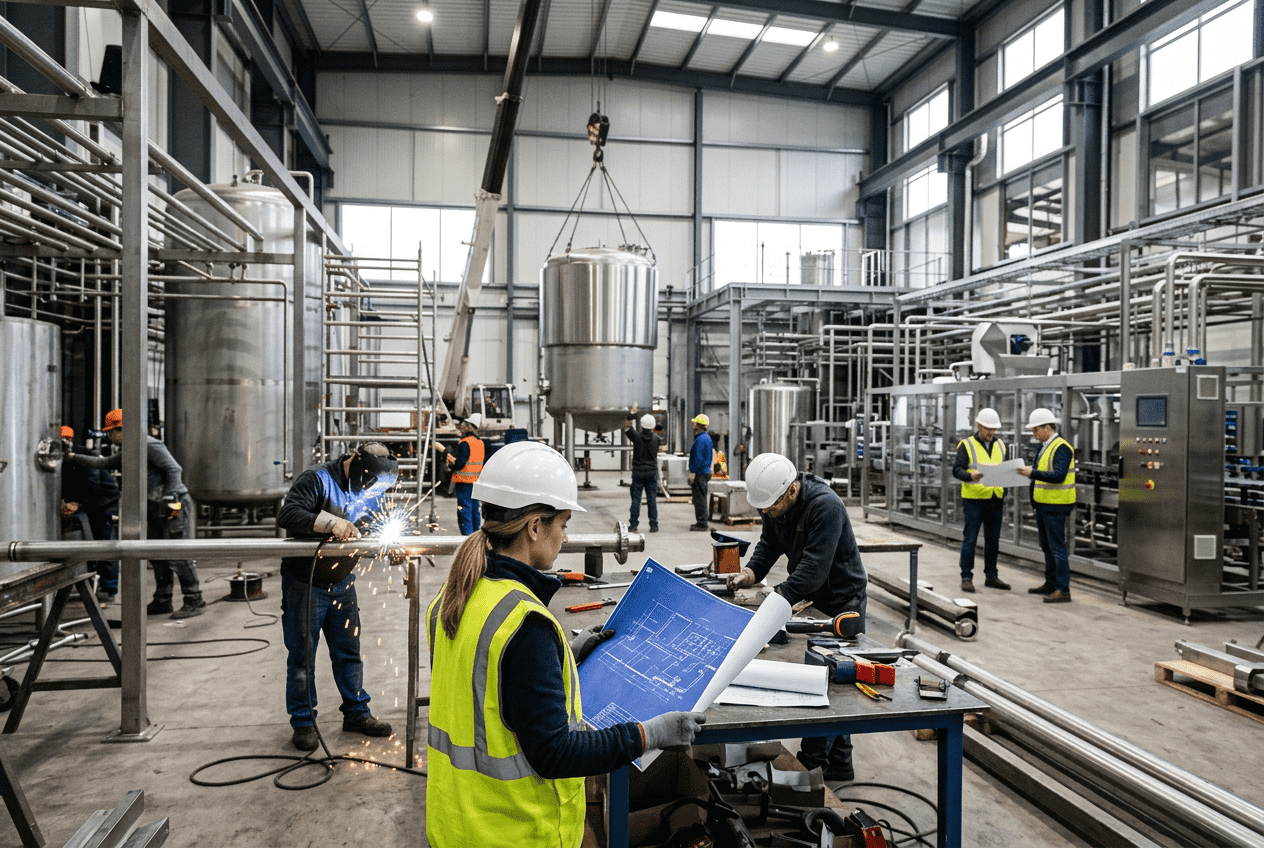
Beverage Factory Expansion Planning
[trp_language language=”en_US”]
Beverage Plant Expansion Strategy in the United States
Expanding a beverage facility in the United States is not simply a matter of adding square footage or buying a faster filler. The best projects connect commercial demand, process design, utility capacity, packaging flexibility, quality control, labor planning, and logistics economics into one capital roadmap. Whether a producer is scaling kombucha in Portland, RTD cocktails in Texas, juice in California, dairy-based drinks in Wisconsin, or carbonated soft drinks near Atlanta, the most profitable expansion plans begin with a clear answer: what exact production bottleneck is limiting output today, and what future state is the plant supposed to support three to seven years from now?
For many beverage manufacturers, that answer lives somewhere between product development and full industrialization. A bench-top formula may work in a lab, and a pilot run may succeed at a co-packer, but commercial profitability depends on repeatable throughput, sanitation design, utility resilience, changeover speed, and packaging line efficiency. That is why plant expansion often requires an integrated engineering partner rather than isolated equipment purchases. Companies such as Disruptive Process Solutions are increasingly selected by U.S. beverage producers because they tie capital planning to plant performance, not just installation scope.
This guide explains how to plan beverage factory expansion for the U.S. market, including capacity modeling, the pilot-to-commercial gap, line selection, utility sizing, phased scheduling, quality lab integration, supply chain savings, timeline control, budget discipline, and 2026 trends in automation, sustainability, and compliance.
Quick Answer

The fastest way to plan beverage factory expansion in the United States is to work backward from sellable cases, SKU mix, package formats, sanitation windows, and peak-season demand. From there, determine required process throughput, tank capacity, filler speed, warehouse space, labor, and utility loads. A strong expansion plan should answer ten questions before equipment is ordered:
| Planning Question | Why It Matters | Typical U.S. Impact |
|---|---|---|
| How many annual cases are required? | Sets total design basis | Defines line speed, shifts, and storage needs |
| What is the peak monthly demand? | Seasonality often drives underbuilt systems | Summer beverage peaks can exceed average demand by 25% to 60% |
| How many SKUs and package formats exist? | Complexity reduces effective line uptime | Short runs create more changeover losses |
| What is the real bottleneck? | Prevents overspending in the wrong area | Controls, CIP, or utilities may limit output more than fillers |
| Are utilities sized for future phases? | Avoids reopening walls and pads later | Electrical service and compressed air often become hidden constraints |
| What food safety standard applies? | Impacts layout and construction | FDA, SQF, BRC, alcohol, or aseptic rules shape design decisions |
| How will production continue during construction? | Revenue protection is critical | Phased installation can preserve service to retailers and distributors |
The direct answer for most U.S. operators is this: expand only after validating the business case, mapping the bottleneck, and designing a phased utility and equipment plan that can scale without disrupting current production.
In the current U.S. market, expansion is being driven by premiumization, regionalization, shorter logistics radius expectations, the rise of functional beverages, and the need for more resilient domestic manufacturing. Producers shipping long distances from a single plant often discover that a second line, a utility expansion, or a new regional facility can reduce freight cost enough to improve margins even before higher output is sold.
The chart above reflects a realistic directional trend: U.S. beverage producers continue to invest in line flexibility, regional capacity, and automation as labor costs, freight volatility, and retailer service expectations reshape plant economics.
Capacity Planning: From Bench-Top to Commercial Production Scale-Up

Capacity planning starts with a simple but often misunderstood principle: formula success is not manufacturing success. A drink that tastes right in a bench-top batch can fail commercially because of carbonation drift, ingredient hydration time, emulsification limits, heat sensitivity, flavor separation, or filling temperature variation. Commercial scale-up requires both process science and production math.
In practical terms, U.S. beverage producers should convert sales forecasts into a design basis using annual cases, peak-week demand, target OEE, package count per case, operating days, and sanitation downtime. For example, a company projecting 8 million cases per year with heavy summer demand may need equipment sized closer to 10 million-case capability once downtime, SKU changes, and peak periods are accounted for.
Below is a useful planning framework.
| Scale Stage | Typical Batch Size | Primary Goal | Main Risk |
|---|---|---|---|
| Bench-top | 1 to 20 liters | Formula development | Results do not predict full-scale heat and shear behavior |
| Pilot | 50 to 500 liters | Process proof and shelf-life testing | Insufficient data on line efficiency and sanitation timing |
| Demo or mini-commercial | 500 to 3,000 liters | Packaging validation | False confidence from short-duration runs |
| Early commercial | 3,000 to 10,000 liters | Stable launch volume | Utilities and warehouse flow become constraints |
| Regional commercial | 10,000 to 40,000 liters+ | Profitable multi-state supply | Poor line integration and labor inefficiency |
| National scale | 40,000 liters+ continuous or multi-shift | Cost leadership and resiliency | Capex misalignment across process, packaging, and logistics |
A strong engineering team will model more than filler speed. It will also study syrup room design, mixing accuracy, CIP turnaround, bright tank residence time, flash or tunnel pasteurization requirements, can warmer needs, palletizing rates, and warehouse staging. This is especially important for producers in major U.S. corridors such as Chicago, Dallas-Fort Worth, Los Angeles, New Jersey, and Charlotte, where distribution velocity and customer fill rates directly impact retailer relationships.
On the technology side, DPS supports projects requiring process, mechanical, plumbing, electrical, structural, controls, and automation engineering. That matters in scale-up because the difference between a theoretical capacity increase and a real one often comes down to PLC logic, SCADA visibility, recipe control, inline Brix verification, or integrated CIP sequencing rather than simply vessel size.
The 0-to-100 Case Gap: How Pilot Plant Expansion Bridges the Scale Challenge

One of the most expensive mistakes in beverage manufacturing is underestimating the gap between making zero commercial cases and making one hundred repeatable, shippable cases every hour, every shift, every week. This “0-to-100 case gap” is where pilot plant expansion plays a strategic role.
Pilot-scale assets help manufacturers test process assumptions before major capital is committed. That may include small blending systems, modular pasteurization, mini-CIP skids, trial fillers, temporary carbonation equipment, or flexible tank farms. For functional beverages, RTD coffee, dairy-based drinks, kombucha, and aseptic products, pilot expansion can identify failure points in ingredient handling, microbiological controls, or package performance early enough to avoid major field rework.
U.S. manufacturers often use pilot expansion in three ways:
- To validate process performance before a greenfield plant is built.
- To de-risk a fast-growing brand’s move from co-packing into self-manufacturing.
- To bridge capacity while waiting for full commercial equipment lead times.
This is also where the manufacturing capabilities of a partner matter. DPS designs and integrates beverage systems covering fermentation, distillation, blending, carbonation, pasteurization, filtration, water treatment, aseptic processing, hot fill, cold fill, and full utility infrastructure. For clients moving from proof-of-concept to expansion, that breadth helps prevent the common U.S. problem of buying isolated pilot equipment that cannot connect cleanly to future production assets.
A good pilot-to-commercial bridge should prove six things: process consistency, sanitation strategy, operator workflow, utility demand, package integrity, and realistic throughput. If those items are not documented, the pilot phase has not actually reduced project risk.
The area chart highlights a broader trend: capital is shifting away from rigid single-purpose assets toward flexible systems that can support phased expansion, SKU growth, and future automation.
Equipment Selection for Expanded Capacity: Canning, Bottling, and Processing Lines
Equipment selection should always start with the product and packaging mix. A juice producer serving club stores may prioritize high-speed PET, while a craft beer or sparkling water producer may focus on canning flexibility. An RTD cocktail producer may need alcohol-compliant processing, explosion-proof zones, and tight dissolved oxygen control. A dairy beverage plant may require homogenization, refrigeration redundancy, and stringent hygienic zoning.
When evaluating expanded capacity, compare not just nameplate speed but effective speed under real U.S. operating conditions. A 400-cans-per-minute line with long changeovers and poor depalletizer reliability may underperform a 250-cans-per-minute line designed for the actual SKU profile.
| Line Type | Best Fit Products | Expansion Advantage | Common Watch-Out |
|---|---|---|---|
| Canning line | Beer, seltzer, energy, RTD cocktails, sparkling water | Strong freight efficiency and retailer acceptance | Seam quality and dissolved oxygen control |
| PET bottling line | Water, juice, sports drinks, teas | High speed and light weight | Hot-fill or panel stability considerations |
| Glass bottling line | Premium beverages, spirits mixers, sauces, specialty drinks | Brand positioning and oxygen barrier | Breakage, line wear, and freight cost |
| Aseptic filling line | Shelf-stable dairy, plant-based, nutraceutical drinks | Ambient distribution capability | Validation complexity and high capex |
| Bag-in-box or syrup system | Foodservice concentrates and fountain | Lower logistics cost per serving | Ingredient segregation and cleaning complexity |
| Keg or bulk line | Brewery, taproom, B2B transfers | Useful for regional and pilot growth | Wash cycle time and keg fleet management |
For packaging line procurement, producers should review fillers, seamers or cappers, depalletizers, rinsers, pasteurizers, labelers, coders, conveyors, packers, palletizers, and warehouse interface. In many U.S. expansions, the best result comes not from replacing everything, but from integrating selected new modules into an existing line architecture.
To compare equipment approaches, the following chart shows a realistic scoring model used in capital planning.
The lesson is not that one approach always wins. It is that modular expansion often outperforms full replacement when the facility needs phased growth, budget control, and continued production during construction.
Buying Advice for U.S. Beverage Producers
Before placing equipment orders, ask for documented run rates at similar plants in the United States, FAT scope details, spare parts strategy, sanitation access, local service support, controls compatibility, and long-lead component lead times. Equipment should match the business model, not just the desired brochure speed.
Infrastructure Sizing: Electrical, Compressed Air, and Process Water Requirements
Utilities are where many expansion projects quietly fail. A new line may fit physically into the building, but if the plant lacks transformer capacity, compressor redundancy, process water flow, wastewater handling, or glycol tonnage, the line will never deliver planned output.
Infrastructure sizing must account for current load, future phase load, start-up surge, sanitation demand, and utility redundancy. In U.S. markets with aging industrial parks, such as parts of the Northeast or older Midwest manufacturing corridors, power upgrades may require long utility coordination windows. In fast-growth regions like Phoenix, Nashville, or Central Florida, water and wastewater permitting may become the pacing item.
| Utility System | Key Expansion Metric | Frequent U.S. Constraint | Recommended Planning Margin |
|---|---|---|---|
| Electrical service | Total connected load and demand profile | Transformer and switchgear lead time | 15% to 25% |
| Compressed air | CFM at pressure plus dew point quality | Undersized compressors and poor redundancy | N+1 critical design |
| Process water | GPM and water quality treatment needs | Municipal flow limits or pretreatment needs | 10% to 20% |
| Boiler or steam | Peak thermal load | Insufficient blowdown or condensate return planning | 15% |
| Glycol or chilled water | Tons and temperature stability | Expansion without hydraulic balancing | 20% |
| Wastewater | BOD, pH, temperature, and flow | Sewer surcharge and pretreatment compliance | Case-specific |
| HVAC and hygienic air | Pressure zoning and humidity control | Ignored during line-only projects | Design to product risk |
In this part of the project, the technological capability of the project partner matters substantially. DPS combines process and utility engineering with controls and integration, allowing infrastructure to be designed alongside production logic instead of as an afterthought. That is particularly valuable for U.S. beverage facilities adding SCADA, recipe management, energy monitoring, and automated CIP verification.
For plants considering 2026 expansion, sustainability targets are now influencing utility design. More projects are incorporating water recovery strategies, heat reclamation, VFD-driven pump systems, compressed air leak analytics, and energy dashboards that help justify capex through lower operating expense. As state and local pressure grows around water use and carbon reporting, these features are becoming commercial tools, not just environmental talking points.
Phased Construction Scheduling Around Beverage Production Cycles
Most beverage manufacturers cannot shut down for six months while expansion takes place. They must keep serving distributors, retailers, and foodservice customers during construction. That makes phased scheduling one of the highest-value disciplines in the entire project.
A practical U.S. expansion schedule begins with the production calendar. Beer, energy drinks, teas, sports drinks, and sparkling beverages often surge ahead of spring and summer. Cider, specialty holiday SKUs, and certain alcohol-adjacent products may peak later in the year. Construction should be sequenced around these commercial realities.
Typical phases include enabling work, utility reroutes, pad and steel installation, off-line equipment assembly, tie-ins during shutdown windows, dry commissioning, wet commissioning, and ramp-up support. In active beverage plants, night work, weekend shutdowns, holiday tie-ins, and temporary bypass systems are often essential.
| Project Phase | Typical Duration | Main Goal | Production Protection Tactic |
|---|---|---|---|
| Feasibility and concept | 4 to 8 weeks | Scope, business case, bottleneck analysis | Minimal plant disruption |
| Detailed engineering | 6 to 14 weeks | Layouts, utility loads, permitting package | Survey during low-impact windows |
| Procurement | 8 to 30+ weeks | Order long-lead assets | Preserve flexibility with hold points |
| Site prep and civil | 2 to 8 weeks | Pads, trenches, access paths | Separate contractor circulation from operations |
| Mechanical and electrical install | 4 to 16 weeks | Set equipment and connect utilities | Use staged tie-ins and temporary services |
| Commissioning | 2 to 6 weeks | Prove controls, flow, and sanitation | Trial runs outside peak shipping days |
| Ramp-up and optimization | 4 to 12 weeks | Reach target OEE | Hybrid operation with legacy assets as backup |
The service model matters here. DPS is known for a design-build-manage approach that combines engineering, construction coordination, and execution oversight into one framework. For U.S. plants trying to avoid finger-pointing between designers, equipment vendors, and trades, that integrated structure can reduce schedule drift and change-order confusion.
For many producers, a smart move is to schedule noisy or high-risk work after peak shipping periods and perform final tie-ins during planned sanitation shutdowns or holiday closures. Plants near major distribution hubs such as Memphis, Columbus, Kansas City, and Savannah often benefit from synchronizing construction with freight seasonality to reduce warehouse pressure during transition.
Quality Lab and R&D Integration in Expanded Beverage Facilities
Expansion should not be limited to tanks and packaging lines. Quality labs and R&D spaces become more important as product portfolios expand. More SKUs, more ingredients, and more package formats create more opportunities for variance, contamination risk, shelf-life failure, and label claim inconsistency.
A modern beverage expansion in the United States should consider dedicated zones for incoming ingredient verification, microbiology support, analytical testing, bench formulation, pilot trials, retain sample management, and data review. For carbonated drinks, oxygen and CO2 checks matter. For juices and functional products, Brix, pH, viscosity, and thermal validation may be central. For dairy or aseptic products, environmental and microbiological controls become even more critical.
Lab integration also improves commercial agility. When R&D sits too far from production, scale-up delays increase. When the lab is designed into the facility with proper sample pull points and pilot utilities, commercial launches move faster and with fewer surprises.
The chart below reflects demand by beverage segment for upgraded quality and process infrastructure.
Manufacturing capabilities and quality systems should be aligned. DPS supports beverage processing systems from fermentation to pasteurization to water treatment, which is valuable when a plant needs to connect R&D results directly to operating conditions on the floor rather than treating the lab as a separate function.
Supply Chain Optimization: How Expansion Reduces Logistics Radius and Cost
Expansion is often justified by production demand, but the supply chain impact can be equally powerful. In the United States, freight costs, retailer service expectations, and risk of disruption have made regional manufacturing networks more attractive. A producer shipping from one facility in the Southeast to customers on the West Coast may find that adding regional capacity cuts delivered cost, improves freshness, and reduces service failures.
Ports, rail corridors, and interstate access also matter. Beverage plants near Los Angeles/Long Beach, Savannah, Houston, Newark, Chicago, and Inland Empire logistics clusters often gain advantages in ingredient receiving or finished goods distribution. However, a lower-cost rural site can still win if outbound lanes, labor availability, and utility access align with the commercial map.
| Supply Chain Lever | Expansion Benefit | U.S. Example |
|---|---|---|
| Shorter delivery radius | Lowers freight and lead time | Midwest plant serving Chicago, St. Louis, and Minneapolis |
| Regional production redundancy | Reduces risk from weather or outages | Dual-plant strategy across Texas and the Carolinas |
| Closer ingredient sourcing | Improves inbound reliability | Juice concentration near California supply base |
| Improved retailer service levels | Supports fill-rate performance | Faster replenishment into Northeast distribution centers |
| Lower safety stock needs | Frees working capital | Regional canning near demand clusters |
| Reduced carbon footprint | Supports ESG and brand messaging | Lower truck miles for high-volume water or soft drinks |
| Better co-packer negotiation position | More network flexibility | Hybrid owned plant plus overflow co-pack model |
For some brands, expansion can reduce logistics radius enough to offset a meaningful share of project cost over time. This is especially true for low-margin, high-weight products such as water, juice, and mainstream soft drinks, where freight can erode profitability quickly.
When evaluating local suppliers and regional vendors, manufacturers should look beyond initial machine price. Assess installation support, domestic spare parts, controls compatibility, field service response time, and experience with FDA, SQF, or BRC expectations. In many cases, the best supplier network includes both national OEMs and specialized regional fabricators, especially in manufacturing centers across North Carolina, Wisconsin, Ohio, California, and Texas.
Timeline and Budget Best Practices for Beverage Factory Expansion Projects
Timeline and budget discipline depend on clarity of scope. The most common causes of cost overrun in U.S. beverage expansion are incomplete utility assumptions, underdefined controls integration, late layout changes, poor coordination between process and building trades, and unrealistic commissioning expectations.
Best practice is to build the project around stage gates: concept validation, budget approval, detailed design freeze, procurement release, installation readiness, startup readiness, and performance acceptance. Each gate should include both technical and commercial review.
| Budget Category | Typical Share of Project Cost | Why It Is Missed | Control Method |
|---|---|---|---|
| Process equipment | 25% to 45% | Focus stays only on main tanks or fillers | Detailed equipment list with allowances |
| Packaging line equipment | 20% to 40% | Ancillary conveyors and automation omitted | Line integration scope map |
| Utilities and infrastructure | 10% to 25% | Existing system capacity assumed without verification | Load study and field survey |
| Building modifications | 5% to 20% | Drainage, slab work, and structural steel overlooked | Early civil and architectural review |
| Controls and software | 5% to 12% | Programming effort underestimated | Detailed I/O and logic scope |
| Commissioning and training | 2% to 8% | Budget ends at install completion | Formal startup plan and KPI acceptance |
| Contingency | 5% to 15% | Often removed to make numbers fit | Risk-based contingency by phase |
A useful rule is to separate “required to operate” scope from “nice to have later” scope. Producers should also avoid locking into equipment before the utility basis of design is complete. A filler may look like the critical purchase, but a delayed transformer or boiler package can determine the actual go-live date.
Another best practice is selecting a partner that can challenge assumptions. DPS has built its reputation in part by identifying when clients are about to spend heavily in the wrong place. In one example, a planned multi-million-dollar capacity investment was avoided when the true bottleneck proved to be PLC programming rather than mechanical equipment. That kind of honesty is financially valuable because it protects capital efficiency, not just construction activity.
Case Study Themes Seen in U.S. Expansion Projects
Across beverage projects, common winning patterns include regional co-packing transitions into owned production, brownfield line additions with phased utility upgrades, fast-track compressor and boiler expansions supporting canning growth, and integrated syrup room plus packaging expansions for high-volume soft drink operations. DPS has also supported large beverage infrastructure programs where the plant is designed to scale dramatically over time, including utility-intensive systems such as compressors, boilers, cooling towers, and full process support for multi-million-case operations. More project examples can be explored through the company’s project case studies.
Our Company
Disruptive Process Solutions serves manufacturers across all 50 U.S. states and Canada, with a strong focus on profitable capital execution in food and beverage environments. Rather than acting as a narrow equipment reseller, the company supports clients through engineering, capital planning, owner’s representation, project management, general contracting coordination, equipment supply, installation, and system integration. Its technical and project delivery services are summarized on the services page, while custom process assets including tanks and CIP systems are featured in its equipment portfolio. For beverage producers seeking a partner that can connect process design, manufacturing practicality, and schedule accountability, that integrated model is especially relevant.
From a manufacturing capability perspective, DPS works across brewing, spirits, wine, kombucha, RTD, carbonated soft drinks, juices, dairy beverages, aseptic systems, and broader food processing categories. From a technology perspective, the team supports process design, controls, SCADA, utilities, thermal systems, refrigeration, water treatment, automation, and compliance-driven hygienic design. From a service perspective, the firm operates as a project-based execution partner built around planning, building, and managing capital projects with speed and transparency.
FAQ
What is the first step in beverage factory expansion planning?
The first step is identifying the real constraint: demand, process throughput, packaging speed, utilities, labor, warehouse space, or controls. Expansion should be based on verified bottleneck analysis, not assumptions.
How much future capacity should a U.S. beverage plant design for?
Most plants should design utilities and layout for at least one future phase beyond current need. Even if only one new line is installed now, room for added tanks, compressors, electrical distribution, and warehouse flow should be planned in advance.
Is it better to add a second line or upgrade the existing line?
It depends on SKU mix, available floor space, utility capacity, and required uptime. If changeovers are the main issue, a second dedicated line may outperform a speed upgrade. If controls or ancillary equipment are limiting performance, optimizing the existing line may be the better investment.
How important is pilot-scale validation before commercial expansion?
It is critical for products with sensitive ingredients, carbonation, thermal treatment, fermentation, or aseptic demands. Pilot validation reduces risk in process behavior, sanitation, and package performance before full-scale capital is committed.
What utility is most often underestimated?
Compressed air and electrical service are commonly underestimated, followed closely by wastewater and chilled utilities. Sanitation loads and peak simultaneous demand are often missed in early estimates.
How can expansion be completed without stopping production?
Use phased construction, temporary utility bypasses, preassembled skids, planned shutdown windows, and commissioning outside peak production periods. Strong field coordination is essential.
Which beverage categories are driving U.S. expansion right now?
Functional beverages, RTD cocktails, sparkling and flavored waters, premium soft drinks, energy products, dairy alternatives, and high-value niche fermented beverages continue to drive investment.
What should companies watch for in 2026?
Expect stronger emphasis on automation, energy monitoring, water reuse, traceability, labor-saving packaging systems, domestic supply resilience, and compliance-ready digital records. Sustainability and operating cost reduction will increasingly be evaluated together.
How do regional logistics influence plant expansion?
If outbound freight is high or service levels are inconsistent, a regional plant expansion can improve margins by shortening delivery radius, lowering safety stock, and improving replenishment speed to retailers and distributors.
When should a company bring in an engineering and integration partner?
Ideally before equipment is selected. Early involvement helps align the business case, utility basis, layout, compliance strategy, schedule, and procurement plan so expensive redesigns are avoided later.
In the United States, beverage factory expansion works best when engineering, operations, finance, and supply chain are treated as one decision. The winning plants of 2026 will not simply be larger. They will be more flexible, more automated, more utility-efficient, and better aligned with regional demand. A carefully planned expansion can improve capacity, lower delivered cost, reduce risk, and create a platform for profitable long-term growth.
[/trp_language]
Complete Company Portfolio

About the Author: Disruptive Process Solutions (DPS)
The DPS team combines process engineering expertise with real-world food and beverage manufacturing experience. Our content focuses on process optimization, production efficiency, facility improvements, and practical solutions that help manufacturers operate more effectively in a rapidly evolving industry.
Share

