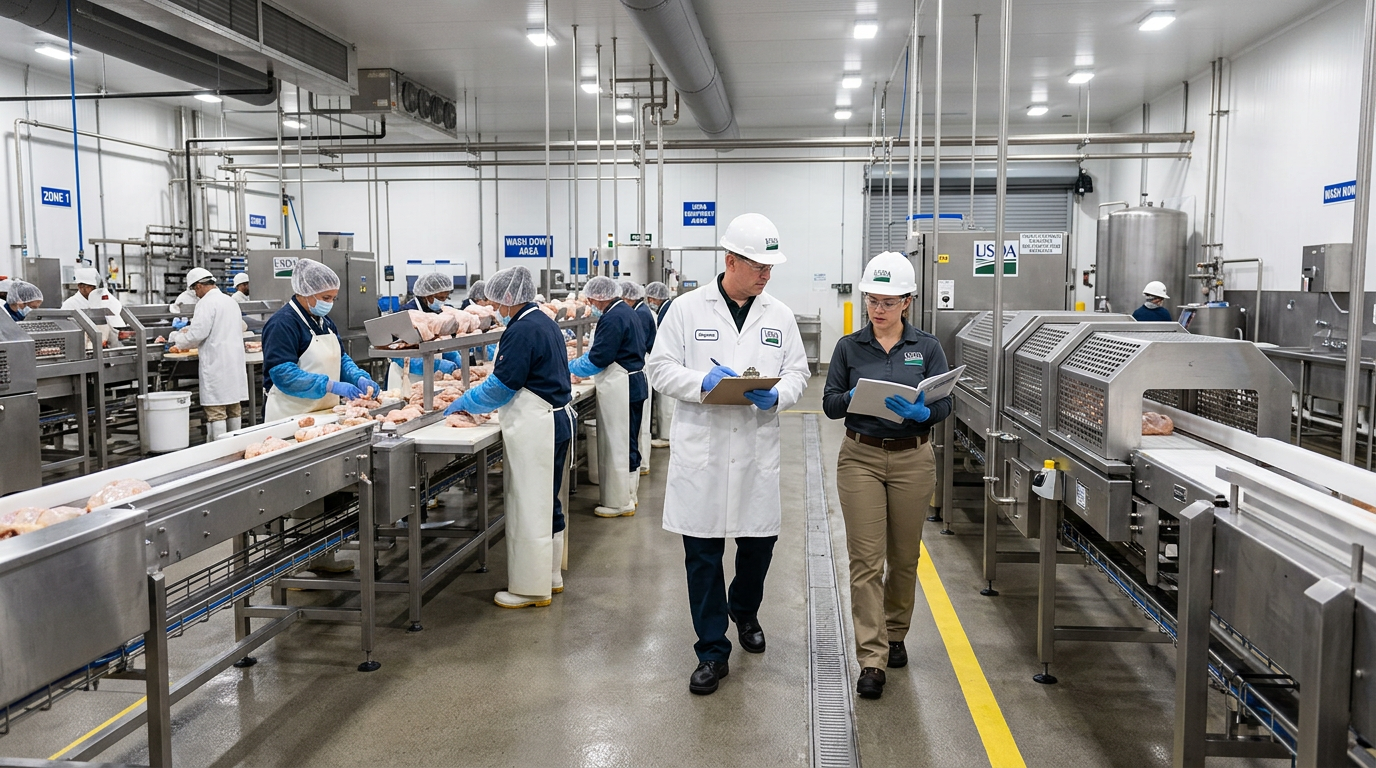
Food Plant Capital Allocation Strategy: Maximizing Returns Across Priorities
[trp_language language=”en_US”]
Capital Allocation for Food Plants in the United States
Food manufacturers in the United States rarely struggle because they lack ideas. More often, they struggle because too many worthwhile projects compete for the same pool of capital. A protein processor in Kansas City may need wastewater upgrades, a dairy plant in Wisconsin may need a new HTST skid, a co-packer near Dallas-Fort Worth may want faster changeovers, and a beverage producer shipping through the Port of Long Beach may need utility redundancy to protect service levels. Capital allocation is the discipline that decides what gets funded, when, why, and at what expected return.
For U.S. food and beverage operators, the issue is especially important in a market shaped by labor pressure, retailer service expectations, FSMA compliance, energy costs, freight volatility, and the need to scale without destroying margins. The strongest plant investment strategies do not simply approve the biggest projects. They rank opportunities by value creation, operational risk reduction, customer impact, and strategic fit. That is how manufacturers turn plant spending into a competitive advantage rather than a recurring budget fight.
Quick Answer

Capital allocation in food manufacturing is the process of deciding how a company should deploy limited investment dollars across maintenance, capacity expansion, automation, utilities, compliance, quality, and working capital improvements. The goal is not to spend less. The goal is to spend better.
In practice, the best food plant capital allocation strategy in the United States does five things well:
- Protects the base business with safety, compliance, and reliability investments.
- Separates maintenance spend from true growth spend so returns are not distorted.
- Uses a portfolio view instead of evaluating each project in isolation.
- Applies financial tools such as ROIC and economic value added alongside plant realities.
- Stages risk through phased investment, governance, and clear decision rights.
A poultry processor in Arkansas, a yogurt producer in Idaho, and a beverage co-packer in North Carolina may all use different equipment, but the decision framework is similar. First protect continuity. Then fund the highest-value bottleneck removals. Then scale infrastructure only when commercial demand, operational readiness, and margin support are visible.
This is also why experienced project partners matter. Companies that can combine engineering, field execution, and business-minded capital planning tend to produce stronger outcomes than firms that only quote equipment. When project economics, utility design, automation strategy, and installation sequencing are coordinated early, capital decisions become far more accurate.
What Is Capital Allocation in Food Manufacturing

Capital allocation in a food plant is the structured method used to decide where long-term investment should go. That includes production lines, process systems, packaging systems, automation, utilities, buildings, quality systems, sanitation infrastructure, environmental systems, digital tools, and strategic relocations. In food manufacturing, the challenge is that many projects are interdependent. A filler upgrade may require more compressed air. A new retort line may require steam, floor drains, water treatment, and finished goods storage. A higher-speed deboning line may expose limits in packaging or refrigeration.
Unlike office-based sectors, food manufacturing capital decisions must account for sanitation, downtime windows, shelf life, seasonal demand, traceability, and regulatory risk. A project that looks attractive on paper can fail in execution if it disrupts peak season production or creates cleaning complexity.
That is why capital allocation should be viewed as both a financial and operating discipline. Finance asks whether a project clears return thresholds. Operations asks whether the project solves the right problem. Engineering asks whether the full system has been scoped correctly. Commercial leadership asks whether customer demand is durable enough to justify the spend.
In the United States, this matters across diverse product categories:
- Protein processing for beef, pork, poultry, seafood, and alternative proteins.
- Dairy including milk, yogurt, cultured products, cream, and cheese.
- Beverages such as soft drinks, RTD coffee, kombucha, beer, wine, spirits, and aseptic drinks.
- Sauces, dressings, ingredients, prepared foods, and shelf-stable meals.
- Co-manufacturing and co-packing operations where flexibility drives value.
Plants located near major freight and sourcing corridors often face especially complex choices. Facilities in California’s Central Valley may need water reuse and energy optimization. Plants serving the Midwest from Chicago, Indianapolis, or St. Louis may prioritize throughput and labor efficiency. Gulf Coast operators near Houston may focus on utility resilience and export support. East Coast sites tied to the Port of Savannah or New Jersey logistics networks may emphasize service reliability and packaging agility.
| Capital Category | Primary Objective | Typical Example | Main Benefit | Common Risk | Best Evaluation Lens |
|---|---|---|---|---|---|
| Maintenance | Protect uptime | Replace failing pumps or motors | Reduces unplanned downtime | Under-scoping root cause | Reliability and cost avoidance |
| Compliance | Meet regulatory requirements | USDA room upgrades, traceability systems | Protects license to operate | No direct revenue gain | Risk reduction |
| Capacity Expansion | Increase output | New filler, retort, cook line | Supports revenue growth | Demand overestimation | Incremental margin and payback |
| Automation | Improve productivity | PLC, SCADA, robotic handling | Labor and yield gains | Integration complexity | ROIC and labor savings |
| Utilities | Enable process performance | Boilers, glycol, compressed air | Supports full plant operations | Hidden dependencies | System-wide economics |
| Strategic Transformation | Reposition the business | Plant relocation or multi-line redesign | Long-term margin expansion | Execution and timing risk | Scenario planning and EVA |
The table above shows why all capital should not be judged by one metric alone. A compliance project may be mandatory. A maintenance project may not add revenue, but it may protect millions in annual contribution margin. A strategic project may take longer to pay back but unlock a completely different cost position.
The line chart reflects a realistic directional trend: plant capital spending in the United States has steadily risen as manufacturers respond to automation demand, utility upgrades, sustainability pressure, and network redesign.
Growth Investments vs Maintenance Spend

One of the most common mistakes in capital planning is treating all spend as if it contributes equally to growth. In reality, maintenance spend keeps the asset base from deteriorating, while growth spend should create incremental earnings. If the two are blended together, project returns become misleading and management can overestimate the plant’s true investment performance.
Maintenance spend includes asset replacement, sanitation restoration, piping renewal, controls modernization required to keep lines running, and utility reliability projects that preserve current throughput. Growth spend includes new lines, debottlenecking that expands sellable capacity, automation that materially cuts labor cost per unit, and infrastructure investments tied to new customers, new SKUs, or new channels.
The distinction matters for budgeting, forecasting, and executive decision making. A cheese plant in Wisconsin replacing worn pumps is not pursuing a growth project, even if the replacement improves uptime. A beverage site in Phoenix adding a new bright tank, blending system, and CIP expansion to support a new customer program is making a growth investment.
Best-in-class operators usually create at least three buckets:
- Non-discretionary spend: safety, compliance, critical repairs.
- Productivity and margin spend: labor reduction, yield, energy, downtime.
- Growth spend: new volume, customer wins, category expansion, network shifts.
That structure creates cleaner internal discussions. Instead of forcing all projects into one ranking list, the company can protect the base business while still competing for growth.
| Project Example | Type | Plant Situation | Expected Benefit | Typical Approval Basis | Common Mistake |
|---|---|---|---|---|---|
| Boiler replacement | Maintenance | Aging steam system | Avoids outages and quality failures | Reliability and risk | Calling it growth because efficiency improves |
| New canning line | Growth | New customer demand | Higher revenue and contribution | Demand-backed ROI | Ignoring warehouse and utility needs |
| SCADA upgrade | Maintenance/Productivity | Legacy controls unstable | Less downtime, better visibility | Cost savings and resilience | Underestimating integration time |
| Wastewater pretreatment expansion | Compliance/Capacity | Higher production loads | Protects permit and future growth | Risk plus capacity logic | Approving too late |
| Robotic case packing | Productivity | Labor-constrained end of line | Lower labor cost, better ergonomics | Labor ROI | Skipping changeover analysis |
| Secondary fermentation cellar | Growth | Expanding beverage throughput | Supports output and SKU flexibility | Volume and margin upside | Missing cooling and CIP implications |
This comparison is useful when building annual budgets. If a plant says 80 percent of its capital is “strategic,” there is usually a classification problem. Clear labels help leadership understand whether the business is funding survival, improvement, or expansion.
Portfolio Approach to Capital Allocation
Looking at projects one by one is not enough. Food manufacturers should manage capital the same way they manage a product mix: as a portfolio. Some projects offer fast payback. Some reduce downside risk. Some create strategic options. Some support a future market entry that cannot be justified by current-year earnings alone. The portfolio approach balances those roles.
A strong portfolio often includes:
- Base protection projects that prevent catastrophic downtime.
- Quick-win productivity projects with 12-24 month payback.
- Capacity unlocks tied to contracted or highly probable demand.
- Longer-horizon strategic projects such as site redesigns or relocations.
- Sustainability projects that lower future utility and compliance exposure.
For example, a national manufacturer with plants in Fresno, Chicago, and Atlanta may decide not to put all capital into one large expansion. Instead, it may fund a mix of small automation wins, one utility backbone upgrade, one regional capacity expansion, and several compliance projects. That creates better resilience and smoother earnings impact.
A portfolio view is also helpful when comparing product types. Shelf-stable foods, chilled dairy, protein processing, and RTD beverages all carry different margin structures, sanitation burdens, and capacity economics. A retort upgrade may have longer implementation time but strong shelf-life value. A high-speed packaging automation project may deliver quicker labor savings. The right answer depends on business mix, customer contracts, and network constraints.
| Portfolio Bucket | Typical Share of Budget | Time Horizon | Risk Level | Example Use Case | Decision Priority |
|---|---|---|---|---|---|
| Base Reliability | 20% to 30% | 0 to 2 years | Low | Critical utility replacements | Very high |
| Compliance and Food Safety | 10% to 20% | Immediate to 3 years | Low | Drainage, hygienic zoning, traceability | Very high |
| Productivity | 20% to 25% | 1 to 3 years | Moderate | Automation, yield improvement | High |
| Capacity Expansion | 20% to 30% | 2 to 5 years | Moderate to high | New process lines | Demand dependent |
| Strategic Transformation | 5% to 15% | 3 to 7 years | High | Network redesign, relocation | Selective |
| Sustainability and Utilities Optimization | 5% to 10% | 2 to 6 years | Moderate | Heat recovery, water reuse | Rising priority |
The percentages above are not rules, but they are a practical starting point. They help operators avoid overfunding exciting growth projects while neglecting reliability or compliance. A plant that fails an ammonia system, boiler, or CIP backbone does not care that its pipeline project had a great spreadsheet.
This bar chart illustrates where capital demand is likely to concentrate by 2026. RTD beverages, co-packing, and protein remain especially active due to capacity needs, packaging complexity, utility intensity, and customer service expectations.
ROIC and Economic Value Added Frameworks
Financial discipline matters, but food manufacturing capital should be evaluated with tools that reflect plant realities. Two of the most useful frameworks are ROIC, or return on invested capital, and economic value added, often called EVA. ROIC measures how efficiently capital produces after-tax operating profit. EVA goes further by asking whether the project earns more than the company’s cost of capital.
In simple terms, a food plant project should not be called successful just because it “pays back.” It should create value beyond the cost of tying up capital and management attention. That is particularly important in multi-plant organizations where dozens of projects compete for funds.
Still, plant leaders should not use finance metrics mechanically. For example:
- A food safety project may have weak ROIC but must be done.
- A utility redundancy project may not increase sales but can protect service commitments to major retail accounts.
- A labor automation project may have excellent ROIC in a tight labor market even if volume is flat.
- A new line may look attractive, but if the plant lacks supporting utilities, the actual return will be lower than forecast.
The most useful approach is a blended scorecard combining finance and operations. That scorecard may include capital intensity, contribution margin, labor impact, OEE gain, sanitation complexity, implementation downtime, customer concentration, and supply chain resilience.
| Metric | What It Measures | Why It Matters | Best For | Limitation | Practical Plant Note |
|---|---|---|---|---|---|
| ROIC | Profit generated from invested capital | Shows capital efficiency | Comparing growth projects | Can miss risk differences | Use normalized volume assumptions |
| EVA | Profit above cost of capital | Shows true value creation | Portfolio ranking | Needs solid cost of capital inputs | Helpful for large network decisions |
| Payback Period | Time to recover investment | Simple and fast | Quick productivity projects | Ignores long-term upside | Do not use alone |
| NPV | Present value of future cash flows | Captures time value of money | Complex multi-year projects | Sensitive to assumptions | Build best/base/worst cases |
| IRR | Discount rate implied by cash flows | Useful ranking signal | Alternative project sets | Can mislead with uneven flows | Check against scale of investment |
| Cost Avoidance | Losses prevented rather than profits added | Critical for maintenance and compliance | Base protection projects | Harder to prove historically | Use downtime and scrap history |
The explanation above shows why multiple financial lenses are needed. A small controls upgrade may win on payback, while a network redesign may win on NPV and EVA. Leadership should understand both.
Buying advice for capital projects in the United States: do not approve equipment based only on vendor brochure output. Ask for installed performance assumptions, utility load impacts, sanitation labor implications, startup loss expectations, and spare parts strategy. That turns a quote into an investment case.
Phased Investment and Risk Mitigation
Many food manufacturers lose money not because the idea was wrong, but because they committed too much too early. Phased investment solves that problem. Instead of funding an entire expansion at once, the business breaks the project into decision gates. Each gate is approved only after the prior phase proves technical, commercial, and operational assumptions.
Typical phases include feasibility, concept design, pilot validation, long-lead procurement, detailed engineering, construction, commissioning, and ramp-up. This is especially useful for new product categories, new geographies, and unfamiliar process technologies.
Consider a U.S. beverage co-packer evaluating a new aseptic line. The company might first confirm customer pipeline, package format, utility loads, warehouse implications, and quality systems. Then it may approve core infrastructure with space for future expansion rather than install every downstream element at day one. That approach preserves capital and reduces ramp risk.
Risk mitigation also includes timing strategy. Some projects should be executed during seasonal troughs. Others may require temporary bypass systems or pre-built skids to reduce shutdown time. Strong project sequencing can dramatically improve realized return.
By 2026, phased investment will become even more important due to higher equipment lead times, policy uncertainty, sustainability requirements, and the increasing use of digital monitoring systems. Plants are investing more in energy management, water reuse, traceability, and automation, but they want proof points before full deployment.
| Phase | Main Decision | Key Output | Risk Reduced | Typical Stakeholders | Go/No-Go Trigger |
|---|---|---|---|---|---|
| Feasibility | Should we pursue it? | Business case and rough order cost | Strategic misfit | Finance, operations, commercial | Demand and margin support |
| Concept Design | What is the right solution? | Layout, utility concept, process flow | Scope gaps | Engineering, QA, maintenance | Technical viability |
| Pilot or Trial | Will the process work? | Performance data | Product and process failure | R&D, operations, customers | Quality and throughput success |
| Detailed Engineering | How exactly will it be built? | Final specifications and schedule | Change order exposure | Engineering, procurement | Budget confidence |
| Construction and Installation | Can we execute safely? | Installed system | Schedule overrun | GC, trades, plant leadership | Field readiness |
| Commissioning and Ramp | Is value being captured? | Startup metrics and handoff | Underperformance after launch | Operations, controls, maintenance | Stable output and OEE |
This phased view is useful for both large enterprises and mid-market manufacturers. It improves visibility, sharpens accountability, and allows commercial demand to catch up before every capital dollar is committed.
The area chart highlights a major trend shift in the United States: a rising share of capital is moving toward automation, controls, utility efficiency, and sustainability rather than purely adding square footage.
Capital Allocation Governance and Decision Rights
Even great analysis fails if governance is weak. Capital allocation needs clear decision rights so projects do not drift, expand in scope, or bypass challenge. In food manufacturing, the most effective governance models define who owns the business case, who validates technical assumptions, who signs off on food safety impacts, who controls contingencies, and who accepts startup performance.
A practical governance structure usually includes:
- Plant leadership to define the operational problem.
- Finance to validate assumptions and compare alternatives.
- Engineering to confirm scope, utility needs, and integration risk.
- Quality and regulatory leaders to address FDA, USDA, SQF, or BRC impacts.
- Procurement to align contracts and supplier terms.
- Executive sponsors to make tradeoff decisions across the network.
Decision rights matter especially in companies with several U.S. sites. Without clear governance, local plants may overstate urgency, understate complexity, or buy around standards. A disciplined review process prevents fragmented spending and improves enterprise purchasing leverage.
It also helps to separate sponsor roles from gatekeeper roles. The project champion should not be the only one deciding whether assumptions are credible. Independent review improves project quality and reduces optimism bias.
For complex work, many manufacturers benefit from outside owners representation or integrated project leadership. That is particularly true when the work touches process engineering, field construction, controls integration, startup, and compliance all at once. Companies looking for that type of support often review providers based on food and beverage engineering services that combine planning with execution rather than offering isolated design packages.
Case Studies in Effective Capital Allocation
The best way to understand capital allocation is to see how it works in real operating situations. The examples below reflect common U.S. food and beverage scenarios.
Case 1: Controls Before Capacity
A manufacturer planned to spend roughly $3 million to expand capacity at a processing site. The expected gain was modest, around 20 percent. After deeper review, the real bottleneck turned out to be PLC programming and line logic, not hardware capacity. By correcting the controls strategy first, the operation unlocked about 30 percent more output without the full expansion cost. That is an example of disciplined capital allocation: fix the true constraint before buying more steel.
Case 2: Utility Backbone Before New Line
A Midwestern prepared foods plant wanted a new production line to support a private label win. Early analysis showed the real risk was not the line itself but undersized steam, chilled water, and CIP support. Management funded utility upgrades first, then staged line installation. That prevented startup underperformance and avoided expensive post-install retrofits.
Case 3: Regional Network Rebalance
A beverage operator supplying the Southwest compared expansion in Southern California against a more central model near Phoenix and Las Vegas freight lanes. The decision was based not only on equipment cost, but on labor availability, water strategy, outbound freight, and customer service windows. The result was a better network return than simply expanding the oldest site.
Case 4: Facility Designed for Scale
One current model seen in the U.S. market is a new beverage co-packing facility designed to be profitable early while scaling significantly over time. Instead of overbuilding every system at startup, the project is structured to support first-year economics and later expansion through modular utilities, staged process areas, and operational visibility. That is what good capital allocation looks like when demand is growing but certainty is still developing.
Manufacturers researching similar outcomes often look at project case examples to understand how sequencing, scope control, and system integration affect actual returns.
This comparison chart illustrates why supplier structure affects outcomes. The most efficient models tend to be those that connect planning, engineering, procurement, installation, and startup accountability rather than splitting responsibility across many disconnected parties.
Our Company
Disruptive Process Solutions supports food and beverage manufacturers across the United States and Canada with a business-first approach to capital projects. The company is built around the idea that smart capital should lead smart manufacturing decisions, not the other way around. Rather than chasing project volume for its own sake, the focus is on profitable projects, disciplined planning, and transparent guidance when a client is about to overspend or solve the wrong problem.
From a service standpoint, DPS works across capital planning, feasibility, owners representation, project management, program leadership, equipment supply, general contracting where licensed, and GC-equivalent coordination elsewhere. That matters because many food plant investments fail at the handoff points between concept, design, field execution, and startup. An integrated approach reduces those gaps. Companies interested in the background and philosophy behind that model can review the company overview.
From a technological capability standpoint, DPS brings engineering depth across process, mechanical, plumbing, structural, electrical, controls, PLC programming, SCADA, batch systems, and utility integration. That supports everything from fermentation systems and distillation to HTST, UHT, retort, HPP support environments, carbonation, blending, filtration, water treatment, aseptic processing, refrigeration, compressed air, and energy management. These capabilities are important because capital allocation decisions are only as good as the technical assumptions behind them.
From a manufacturing capability standpoint, DPS works across both food and beverage applications. Beverage experience includes brewing, spirits, wine, kombucha, RTD products, dairy beverages, juices, soft drinks, and aseptic systems. Food experience includes protein processing, prepared foods, sauces, dairy processing, shelf-stable systems, plant-based lines, and co-manufacturing operations. The firm also manufactures selected process equipment such as tanks, CIP systems, marination tumblers, and cooking vessels, which can be explored through its process equipment portfolio. This matters for clients who want capital discipline tied closely to how systems will actually be built and operated.
For U.S. manufacturers, the value proposition is straightforward: align project scope with business reality, challenge weak assumptions, engineer for profitability, and execute with accountability. In a market where one wrong capital call can lock in years of inefficiency, that mindset is often more valuable than a lower initial quote.
FAQ
What is the biggest capital allocation mistake in food manufacturing?
The most common mistake is approving projects based on symptoms instead of root causes. Plants often assume they need more capacity when the true issue is controls logic, sanitation cycle time, labor flow, or utility imbalance.
How should a U.S. plant balance growth and maintenance spending?
Set separate budget buckets. Protect safety, compliance, and reliability first. Then rank productivity projects and demand-backed growth projects. Do not force all spending into one ROI table.
Which industries typically require the most complex capital planning?
Protein, dairy, aseptic beverages, co-packing, and shelf-stable prepared foods tend to be complex because they combine sanitation requirements, utility intensity, packaging diversity, and throughput sensitivity.
What applications usually create the fastest returns?
Debottlenecking, controls optimization, changeover reduction, robotic end-of-line automation, yield improvement, and energy optimization often produce faster returns than greenfield line additions.
How important are local suppliers and contractors?
Very important, but only when they fit a larger integration plan. Local trades in hubs such as Chicago, Raleigh, Houston, Fresno, and Atlanta can improve response time and field coordination, yet the overall project still needs unified engineering and startup accountability.
Should projects be approved based only on payback period?
No. Use payback as one lens, but also review ROIC, NPV, EVA, downtime risk, food safety implications, customer commitments, and implementation complexity.
How does sustainability affect capital allocation in 2026?
It is moving from optional to strategic. Water reuse, heat recovery, efficient boilers, refrigeration optimization, and digital energy monitoring are becoming more important as utility costs, emissions expectations, and customer reporting requirements increase.
What buying advice applies when comparing equipment vendors?
Ask for total installed cost, utility needs, integration requirements, startup assumptions, sanitation labor impact, spare parts strategy, and realistic OEE expectations. A low equipment price can still produce a poor investment.
When should a manufacturer use phased investment?
Use it when entering a new category, deploying unfamiliar technology, scaling with uncertain demand, or building infrastructure that may be expanded later. Phased investment protects flexibility.
How can leadership improve decision quality across multiple plants?
Standardize business cases, define decision rights, use common return thresholds, require engineering validation, and review projects as a portfolio instead of allowing each site to advocate in isolation.
In the United States, capital allocation in food manufacturing is no longer just an annual budgeting exercise. It is a competitive system for deciding which plants grow, which products scale, which technologies get adopted, and which companies preserve margin through volatility. The winners are not always the ones spending the most. They are the ones making the clearest decisions, at the right time, with the right level of technical and financial discipline.
[/trp_language]
Complete Company Portfolio

About the Author: Disruptive Process Solutions (DPS)
The DPS team combines process engineering expertise with real-world food and beverage manufacturing experience. Our content focuses on process optimization, production efficiency, facility improvements, and practical solutions that help manufacturers operate more effectively in a rapidly evolving industry.
Share

