Food Manufacturing Investment Risk Assessment: Identifying and Mitigating Threats
[trp_language language=”en_US”]
U.S. Food Manufacturing Risk Review for Investors
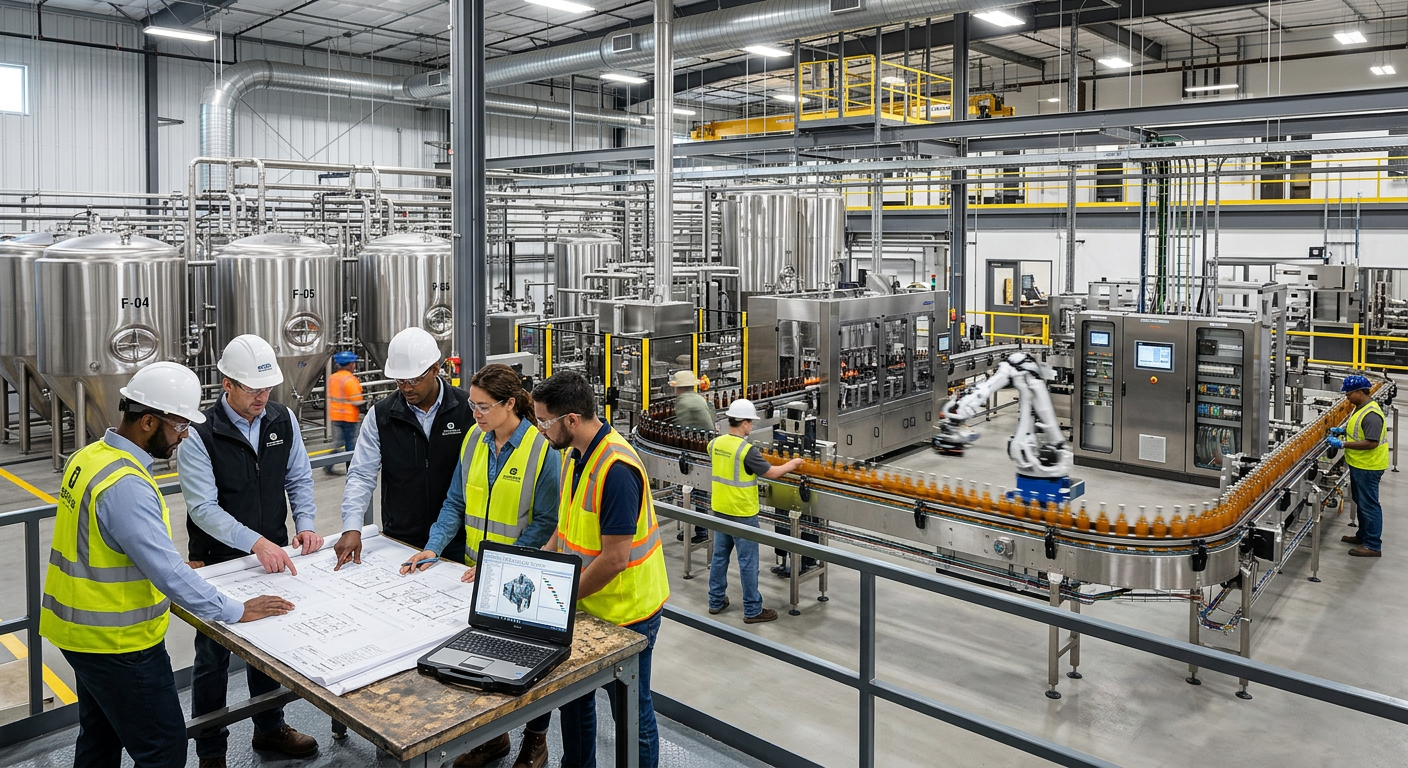
Investing in food manufacturing in the United States can produce strong long-term returns, but only when risk is measured with discipline. A modern plant may look attractive on paper because of growing demand, automation, and regional distribution advantages, yet the real investment outcome depends on whether the project team has tested market demand, operating constraints, compliance exposure, working capital pressure, utility resilience, and execution readiness. In practical terms, food manufacturing investment risk assessment is the process of identifying threats that can reduce profitability, delay payback, or damage enterprise value, and then building a plan to reduce those threats before capital is committed.
For U.S. manufacturers, these risks are shaped by local realities: labor availability in the Midwest and Southeast, port congestion around Los Angeles and Long Beach, packaging supply concentration in Texas and Illinois, cold-chain limitations in some inland markets, and changing FDA, USDA, SQF, and BRC expectations. Investors, owners, and operators need a framework that goes beyond spreadsheets. They need to understand how product type, plant design, utility infrastructure, automation maturity, supplier depth, and management capability influence commercial success.
This guide explains how to assess food manufacturing investment risk in the United States, with a focus on market and demand risk factors, operational execution, regulation, finance, technology, contingency planning, and supplier selection. It also includes practical tables and charts to help evaluate projects ranging from beverage filling lines and aseptic facilities to protein processing, dairy, sauces, co-packing, and shelf-stable foods.
Quick Answer

Food manufacturing investment risk assessment is a structured review of the factors that could reduce returns on a processing plant, expansion, retrofit, or equipment purchase. In the United States, the highest-impact risks usually fall into six groups: demand uncertainty, operational execution, regulatory compliance, financial exposure, technology reliability, and supply chain resilience. A strong assessment asks four direct questions: Is there durable demand for the product? Can the facility run efficiently at planned throughput? Can the business stay compliant and audit-ready? Can the project still work if costs, timing, or customer assumptions shift?
The quickest way to evaluate an opportunity is to review the product category, customer concentration, throughput assumptions, labor model, utility design, sanitation requirements, regulatory pathway, and capital efficiency together rather than in isolation. For example, a ready-to-drink beverage line in North Carolina or Texas may benefit from population growth and logistics access, but its returns can still be undermined by syrup room design flaws, underbuilt compressed air systems, or weak controls integration. Similarly, a protein processing plant near Kansas City or Omaha may have favorable regional sourcing, yet still face margin pressure from wastewater handling costs, skilled labor shortages, or export market volatility.
| Risk Area | Key Question | What Good Looks Like | Warning Sign | Impact Level | Initial Action |
|---|---|---|---|---|---|
| Demand | Is volume backed by contracts or stable customers? | Diversified accounts and realistic forecasts | One large buyer dominates revenue | High | Stress-test sales assumptions |
| Operations | Can the line hit planned throughput? | Validated capacity model and utility sizing | Nameplate capacity used as actual output | High | Run process simulation |
| Compliance | Does the plant meet FDA or USDA standards? | Documented sanitary design and audit readiness | Retrofit needed after installation | High | Perform compliance gap review |
| Financial | Is the project resilient to cost overruns? | Contingency built into capex and ramp-up | No reserve for delays or inflation | High | Model downside scenarios |
| Technology | Are controls and data systems secure and scalable? | Integrated automation and cybersecurity plan | Legacy PLCs with poor visibility | Medium to High | Audit OT and IT architecture |
| Supply Chain | Are critical materials locally available? | Multiple qualified suppliers | Single-source ingredients or packaging | Medium to High | Build dual-source strategy |
The table above is useful as a first-pass investment screen. If two or more categories show clear warning signs, a deeper feasibility and engineering review should occur before capital approval.
What Is Investment Risk Assessment in Food Manufacturing

Investment risk assessment in food manufacturing is the due diligence process used to determine whether a new facility, plant expansion, line upgrade, equipment package, or co-manufacturing platform can deliver acceptable returns within a defined risk tolerance. It combines commercial analysis with engineering, operations, quality, and finance. In U.S. food and beverage projects, this work should happen early, before equipment is ordered or construction begins, because many of the most expensive mistakes are locked in during planning.
A proper assessment looks at both project-level and business-level risk. Project-level risk includes schedule slippage, contractor coordination, utility design errors, commissioning delays, and startup inefficiencies. Business-level risk includes category growth, private label competition, customer churn, freight costs, compliance changes, energy pricing, and long-term margin compression. This is especially important in sectors such as dairy, aseptic beverages, protein processing, sauces, frozen foods, fermented products, and shelf-stable packaged goods, where the line between process design and business performance is very thin.
Investors often underestimate how product type changes the risk profile. A hot-fill beverage line has different thermal, packaging, sanitation, and shelf-life exposures than a fresh meat operation. A yogurt system faces different refrigeration and clean-in-place demands than a retort meal project. A distillation or fermentation plant must manage batch variability, utility stability, and process control differently from a high-speed carbonated drink facility. That is why good investment review is never generic; it is tied to specific applications, throughput targets, and local operating conditions.
In the United States, location also matters. A plant near Chicago may benefit from central freight access but face older utility infrastructure and labor competition. Facilities around Atlanta, Raleigh, Dallas-Fort Worth, or Phoenix may gain from population growth and newer industrial development, yet still need to model water costs, permitting timelines, and heat-related energy demand. Coastal operations near New Jersey, Savannah, Houston, or Southern California must pay attention to import dependencies, port disruptions, and drayage volatility.
The line chart shows a realistic growth trend in capital intensity across U.S. food manufacturing. Growth can create opportunity, but it also raises the cost of mistakes. The more capital flows into automation, utility systems, and integrated processing, the more valuable early-stage risk assessment becomes.
| Product Type | Main Commercial Risk | Main Process Risk | Main Compliance Risk | Typical Capex Sensitivity | Investor Focus |
|---|---|---|---|---|---|
| Ready-to-drink beverages | Retail demand swings | Filler uptime and syrup accuracy | Labeling and food safety | High | Volume utilization and changeover speed |
| Dairy processing | Margin compression | Cold-chain and CIP performance | Pasteurization control | High | Yield, utilities, and shelf life |
| Protein processing | Commodity volatility | Labor and sanitation | USDA oversight | Medium to High | Wastewater, labor, and throughput |
| Sauces and dressings | Private label pressure | Mixing consistency | Allergen segregation | Medium | Recipe flexibility and batch control |
| Aseptic products | High entry cost | Sterility assurance | Validation standards | Very High | Validation, uptime, and experienced staff |
| Frozen prepared foods | Freight and energy costs | Thermal balance and packaging | Traceability | High | Energy efficiency and logistics model |
This table shows why buyers should match investment criteria to product reality. A project can be attractive in one category and weak in another even at the same budget level.
Market and Demand Risk Factors

Market and demand risk is usually the first item investors analyze, but it is often reviewed too narrowly. A forecast showing category growth is not enough. The better question is whether the specific product, channel, geography, and capacity plan can support profitable utilization over time. U.S. food manufacturing returns are highly sensitive to underused assets. If a facility is built for 80 million cases but only sells 35 million consistently, the fixed-cost burden can overwhelm EBITDA even in a growing category.
Demand risk should be reviewed at several levels: consumer demand, retailer or foodservice demand, customer concentration, pricing power, promotional dependence, and substitution risk. For example, growth in protein snacks may support new processing investments, but the margin profile can still deteriorate if raw input costs rise faster than brand pricing. Likewise, a co-packing model in the Southeast may appear diversified, but if most revenue comes from a small number of startup beverage brands, the facility may face churn and volatile scheduling.
Regional market logic matters as well. Plants serving the Northeast may benefit from dense population and shorter delivery windows into New York, Philadelphia, and Boston, but face higher labor and real estate costs. Operations in Texas can access large domestic markets and strong transport corridors through Houston, Dallas, and San Antonio, but should still test heat-related utility loads, water resilience, and supplier concentration. Midwest facilities near Indianapolis, St. Louis, or Minneapolis often gain freight efficiency, yet they must evaluate labor competition and cold-weather maintenance impacts.
Buying advice for investors and owners is straightforward: do not finance capacity just because equipment can run at that speed. Finance the volume you can support with realistic sales channels, proven formulations, packaging availability, and a clear route to market. In many cases, phased expansion lowers risk more effectively than building maximum scale on day one.
The bar chart compares demand expansion potential by industry segment. It should not be read as a guarantee of growth. Instead, it helps investors compare relative demand momentum when screening opportunities.
| Indicator | Low-Risk Signal | Moderate-Risk Signal | High-Risk Signal | Why It Matters | Recommended Review |
|---|---|---|---|---|---|
| Customer concentration | No single customer over 25% | One customer at 25% to 40% | One customer above 40% | Revenue volatility | Contract and churn analysis |
| Channel diversity | Retail, foodservice, and club mix | Two-channel exposure | Single-channel exposure | Buffers demand shocks | Scenario planning |
| Volume forecast quality | Backed by history and contracts | Mixed evidence | Based mainly on optimistic projections | Protects capex planning | Independent forecast validation |
| Geographic demand | Strong regional pull | Emerging demand pocket | Weak local support | Affects freight and service | Map route-to-market |
| Packaging supply | Multiple nearby suppliers | Some concentration | Single source or imports | Output depends on packaging | Supplier risk audit |
| Price elasticity | Strong brand or spec position | Some discount pressure | Highly price-sensitive category | Impacts margin durability | Gross margin stress test |
This market table helps distinguish growth from investable demand. A fast-growing segment can still be high risk if its revenue is concentrated, packaging is constrained, or customers can switch easily.
Operational and Execution Risks
Operational and execution risk is where many otherwise promising food manufacturing investments fail. The issue is not always bad equipment. More often, the problem is poor integration between process design, utilities, controls, installation sequencing, sanitation, staffing, and startup planning. A new line may be technically capable, but if glycol, steam, compressed air, wastewater, or CIP systems were undersized or badly staged, true throughput will miss the business case.
Investors should examine whether the project team has modeled actual run conditions rather than ideal conditions. Nameplate speed is not the same as sustainable production. Changeovers, allergen washdowns, batch hold times, retort cycles, ingredient staging, operator training, and maintenance windows all reduce effective capacity. The best feasibility work reflects OEE realities and includes commissioning strategy, spare parts planning, and line balancing.
Execution risk is especially high when multiple contractors are involved and no one owns the full result. That is one reason many manufacturers prefer integrated partners that can design, build, and manage delivery under one coordinated model. For owners evaluating support options, it is worth reviewing an engineering and integration partner’s food and beverage project services to see whether feasibility, owner representation, process design, installation, controls, and commissioning are managed as one commercial outcome rather than as disconnected scopes.
Operational risk also varies by application. Fermentation systems, distillation, carbonated soft drink lines, blending and batching, retort systems, dairy homogenization, slicing and portioning, marination, and aseptic filling all have different failure points. Local suppliers matter too. In regions like Wisconsin, California’s Central Valley, eastern Pennsylvania, and the Carolinas, investor confidence can improve when nearby fabrication, utility, and maintenance support are available.
The area chart highlights the growing operational shift toward automation and digitally managed production. This trend reduces some labor risks but increases controls, integration, and cybersecurity exposure.
| Operational Factor | Low-Risk Condition | High-Risk Condition | Common Cost Impact | Common Time Impact | Mitigation Step |
|---|---|---|---|---|---|
| Utility sizing | Modeled to peak and future load | Based only on current minimum need | Rework and added equipment | 4 to 12 weeks | Validate steam, glycol, air, and water loads |
| Controls integration | Single architecture and testing plan | Mixed legacy and new systems | Startup inefficiency | 2 to 8 weeks | Conduct FAT/SAT planning early |
| Sanitary design | Hygienic layout and cleanability built in | Hard-to-clean dead legs or poor drainage | Audit exposure and downtime | Variable | Review with food safety team |
| Line balancing | Process and packaging rates aligned | One asset bottlenecks the whole line | Lost output | Persistent | Run throughput simulation |
| Contractor coordination | Single accountable manager | Fragmented trade control | Claims and change orders | 3 to 10 weeks | Centralize project governance |
| Workforce readiness | Operators trained before startup | Training delayed until live production | Scrap and downtime | 1 to 6 weeks | Use startup training plan |
This table shows how execution errors convert directly into cost and time losses. For investors, these risks influence not just budget but also revenue timing, customer service, and working capital burn during ramp-up.
Regulatory and Compliance Risk Exposure
Regulatory and compliance risk is central in U.S. food manufacturing because a plant can be technically impressive and commercially promising yet still lose value quickly if it fails food safety, sanitary, traceability, environmental, or worker safety expectations. Depending on the product and process, oversight may involve FDA, USDA, state agriculture departments, local building authorities, environmental regulators, and customer audit frameworks such as SQF or BRC.
Compliance exposure begins in design. Drainage, zoning, hygienic material selection, room separation, air handling, allergen control, traffic flow, wastewater management, clean utility design, and validated process controls all affect audit readiness. If these factors are treated as late-stage corrections, remediation can be expensive and disruptive. This is especially true in USDA-inspected protein environments, aseptic systems, dairy processing, and facilities with retort or kill-step validation requirements.
Investors should also examine permit timing and jurisdictional complexity. A project in California may face different environmental and wastewater review expectations than one in North Carolina or Tennessee. Urban retrofits in New Jersey, Chicago, or Los Angeles can involve fire code, occupancy, utility tie-in, and sanitation constraints that do not appear in greenfield sites in more industrial parks. In acquisitions, a compliance history review should include audit findings, recall events, corrective action quality, and document discipline.
When selecting project partners, a good sign is practical fluency across food safety and regulated environments rather than general industrial experience alone. Reviewing a firm’s background in food and beverage case studies can help determine whether it has delivered in facilities governed by FDA, USDA, SQF, and BRC expectations.
| Compliance Area | Primary Trigger | Typical Exposure | Who Reviews It | Business Impact | Preventive Action |
|---|---|---|---|---|---|
| Food safety plan | Insufficient hazard analysis | Audit findings or enforcement | FDA or customer auditor | Shipment delays | Update HACCP/PCQI framework |
| USDA inspection readiness | Poor sanitary flow | Operational interruption | USDA FSIS | Lost production | Design around inspection needs |
| Allergen control | Weak segregation or labeling | Recall risk | FDA and customers | Brand damage | Validate changeover and label control |
| Environmental permits | Wastewater or emissions limits | Fines and project delay | State and local agencies | Capex increase | Permitting review early in planning |
| Worker safety | Unsafe layout or machine guarding | Injury and OSHA issues | OSHA and insurers | Claims and downtime | Safety by design |
| Traceability | Weak lot control systems | Slow recall response | Customers and regulators | High recall cost | Digitize lot and batch records |
This matrix helps investors rank compliance topics by consequence. In food manufacturing, compliance is not just a legal requirement; it is part of operational value creation.
Financial and Currency Risk Considerations
Financial risk in food manufacturing includes more than project budget overruns. It also includes margin compression, working capital strain, financing cost changes, utility price movements, ingredient volatility, packaging inflation, and foreign exchange exposure when imported equipment or inputs are involved. U.S. projects often buy specialty process equipment, valves, automation components, stainless fabrication, or packaging systems from Canada, Europe, or Asia, so currency swings can materially change installed cost.
Investors should build at least three financial scenarios: base, downside, and stressed downside. These models should test volume ramp delay, slower customer onboarding, lower line efficiency, utility cost increases, labor inflation, and higher maintenance during the first year. If the project only works under ideal conditions, it is not a strong investment. This is especially relevant for new co-packing platforms, aseptic builds, and highly automated lines with large fixed-cost structures.
Buying advice here is simple: favor projects with clear milestone controls, firm scope definitions, contingency reserves, and visibility into long-lead items. Also review payment timing against revenue ramp. Some plants absorb months of cash burn between mechanical completion and stable production. If this gap is ignored, debt pressure can rise before the asset is truly productive.
For imported systems or Canadian cross-border sourcing, FX hedging or fixed-price commercial structures may reduce uncertainty. Plants near Detroit, Buffalo, and the Pacific Northwest sometimes benefit from efficient U.S.-Canada equipment movement, but the compliance and cost structure must still be modeled carefully.
Technology and Cybersecurity Risks
Technology risk is rising quickly in U.S. food manufacturing because more plants rely on PLC programming, SCADA visibility, recipe management, batch control, remote support, cloud reporting, and integrated plant networks. These tools improve efficiency and traceability, but they also introduce system dependency. If a controls architecture is poorly designed, unsupported, or vulnerable to cyber intrusion, the investment case weakens.
Cybersecurity in food plants is no longer a side topic. Ransomware, unsecured remote access, weak password policies, unsupported operating systems, and poor network segmentation can stop production, disrupt batch records, or compromise food safety data. For high-throughput beverage, dairy, or protein operations, even a short outage can create large revenue losses and spoilage costs.
Technology diligence should cover OT and IT together. Investors should ask whether the line can be maintained locally, whether the PLC environment is standardized, whether SCADA data is actionable, whether remote access is controlled, and whether backup and recovery procedures are tested. In 2026, stronger demand is expected for predictive maintenance, energy management dashboards, AI-supported quality monitoring, and tighter cybersecurity governance as insurers and major customers raise expectations.
Technological capability also affects long-term competitiveness. Facilities that invest in recipe control, energy monitoring, integrated CIP validation, automated batching, and data-backed OEE improvement tend to scale more effectively than plants still operating with disconnected systems. Buyers comparing providers can review specialized process equipment and integration capabilities to understand whether an engineering partner can support both production performance and digital control maturity.
The comparison chart illustrates a common market reality: integrated delivery models often reduce risk where multi-vendor coordination is weak. The exact score will differ by supplier, but the framework is useful when comparing support options.
Developing a Risk Mitigation and Contingency Plan
A strong risk mitigation plan turns analysis into action. It should be written before final capital approval and updated through design, procurement, installation, commissioning, and the first year of operation. The plan should identify the top risks, define early warning indicators, assign accountability, set budget contingencies, and document operational responses if a problem occurs.
For food manufacturing projects in the United States, the best contingency plans usually include: phased construction or phased capacity startup, dual-source ingredients or packaging, utility redundancy for critical systems, documented startup protocols, spare parts strategy, temporary labor backup, validated sanitation plans, insurance review, cybersecurity incident response, and working capital reserves. If the business depends on imported components, the plan should also address customs delays, freight disruption, and FX volatility.
Risk mitigation works best when tied to practical operating decisions. If a plant in Houston depends on one can supplier near the Gulf Coast, a weather disruption plan matters. If an aseptic line in California depends on highly trained technicians, retention and cross-training should be part of investment planning. If a Midwest protein facility has wastewater exposure, pretreatment contingency and local permit alignment should be in the base case, not treated as optional.
Case study thinking is valuable here. In one common U.S. scenario, a manufacturer plans a large expansion expecting modest throughput gains, but deeper analysis shows that automation bottlenecks, not physical space, are limiting output. In such cases, controls optimization can unlock capacity at a fraction of the cost of full expansion. That is exactly why investors should challenge assumptions before approving major construction.
| Risk | Early Warning Sign | Owner | Primary Mitigation | Contingency Response | Review Frequency |
|---|---|---|---|---|---|
| Demand shortfall | Orders trail launch forecast | Commercial lead | Phased capacity and flexible scheduling | Shift to co-pack or alternate channels | Monthly |
| Construction overrun | Change orders accelerate | Project manager | Clear scope and cost controls | Use contingency reserve | Weekly |
| Utility failure | Peak loads exceed model | Engineering lead | Load validation and redundancy | Temporary utility support | Weekly during startup |
| Compliance setback | Audit observations increase | Quality leader | Pre-audit reviews and training | Corrective action task force | Monthly |
| Cyber incident | Unauthorized access alerts | IT/OT security owner | Segmentation, MFA, backups | Isolate network and restore systems | Continuous |
| Labor instability | High overtime or turnover | Operations leader | Cross-training and retention plan | Temporary staffing and revised schedule | Biweekly |
This framework is actionable because it links each risk to a trigger, an owner, and a response. Investors should ask for this level of discipline before funds are released.
Our Company
Disruptive Process Solutions helps food and beverage manufacturers reduce investment risk by connecting engineering decisions to business outcomes. Rather than approaching projects as isolated construction scopes, the company focuses on profitable capital deployment and practical execution across North America. Manufacturers evaluating plant upgrades, relocations, greenfield builds, or process integration can learn more about the DPS team and approach.
From a technological capabilities standpoint, DPS supports structural, mechanical, plumbing, electrical, process, and controls engineering, including PLC programming, automation, and SCADA integration. That matters for investors because production reliability often depends on how well utilities, process controls, and plant data systems are aligned. In beverage and food applications alike, stronger digital control can unlock capacity, improve recipe consistency, support traceability, and reduce startup risk. This is particularly relevant for fermentation, distillation, carbonation, blending, pasteurization, retort, dairy systems, and advanced batching environments.
From a manufacturing capabilities standpoint, DPS works across a wide range of food and beverage applications in the United States and Canada. The company supports beverage categories such as brewing, spirits, wine, kombucha, ready-to-drink products, soft drinks, juices, dairy beverages, and aseptic processing, as well as food categories including proteins, prepared foods, sauces, dairy, retort systems, and plant-based processing. It also designs and supplies proprietary equipment such as tanks, CIP systems, tumblers, and cooking vessels. For investors, this breadth is useful because category-specific process risk can be addressed by a team that understands how product type changes sanitary design, thermal control, utility demand, and production flow.
From a service capabilities standpoint, DPS offers process engineering and design, capital planning and feasibility studies, owner’s representative support, project and program management, general contracting where licensed, equipment supply, installation, and full system integration. Its design-build-manage model is intended to create clearer accountability from planning through commissioning. In practical risk terms, that helps reduce the disconnects that often appear when engineering, trades, equipment, and startup support are split among too many vendors. For manufacturers with project budgets from several hundred thousand dollars to multi-million-dollar programs, that integrated structure can improve schedule discipline, budget visibility, and operational readiness.
What makes this relevant to food manufacturing investment risk assessment is not just technical reach, but decision quality. A disciplined partner should be willing to challenge weak assumptions, identify the real production bottleneck, and protect the client’s long-term profitability rather than simply increasing project scope. In the U.S. market, where capital costs, compliance expectations, and speed-to-market pressure continue to rise into 2026, that mindset can materially reduce downside exposure.
FAQ
What is the biggest investment risk in food manufacturing?
The biggest risk is usually the combination of overestimated demand and underestimated execution complexity. A plant that misses volume targets while struggling through startup delays can lose cash quickly.
How do I assess whether a food plant expansion is worth the capital?
Review demand quality, actual throughput constraints, utility capacity, sanitary design, staffing, compliance exposure, and payback under downside scenarios. Do not rely on best-case production assumptions.
Why is location so important in the United States?
Location affects labor access, freight costs, ingredient supply, utility reliability, permitting speed, and proximity to customers. A strong process design in the wrong region can still underperform financially.
Which industries need the deepest risk review?
Aseptic, dairy, protein, beverage co-packing, and highly automated prepared food operations usually need the deepest review because they carry higher validation, utility, and startup complexity.
How many suppliers should a project rely on?
For critical ingredients, packaging, controls support, and utilities-related components, at least two qualified supply paths are preferable where possible. Single-source dependency raises both cost and continuity risk.
What are the main 2026 trends affecting investment decisions?
In 2026, the strongest trends include automation adoption, OT cybersecurity hardening, energy efficiency projects, water and wastewater scrutiny, more auditable traceability, and sustainability-driven design choices. Policy pressure and customer expectations are also pushing better documentation, lower emissions intensity, and smarter utility management.
How can investors reduce operational risk before construction starts?
Use feasibility studies, process modeling, line balancing reviews, controls architecture planning, sanitary design checks, and startup readiness planning before procurement and installation begin.
Do small and mid-sized manufacturers need formal risk assessment too?
Yes. Smaller companies are often more exposed because they have less margin for startup delays, customer churn, or compliance problems. Formal review improves capital discipline at every scale.
What should be included in a supplier comparison?
Compare sanitary design expertise, controls depth, local service reach, project management accountability, compliance experience, and ability to support commissioning and post-startup optimization.
When should a company bring in an engineering partner?
Ideally before final scope and budget are locked. Early involvement helps align business assumptions with process reality, which is where much of the investment value is either protected or lost.
[/trp_language]
Complete Company Portfolio
About the Author: Disruptive Process Solutions (DPS)
The DPS team combines process engineering expertise with real-world food and beverage manufacturing experience. Our content focuses on process optimization, production efficiency, facility improvements, and practical solutions that help manufacturers operate more effectively in a rapidly evolving industry.
Share