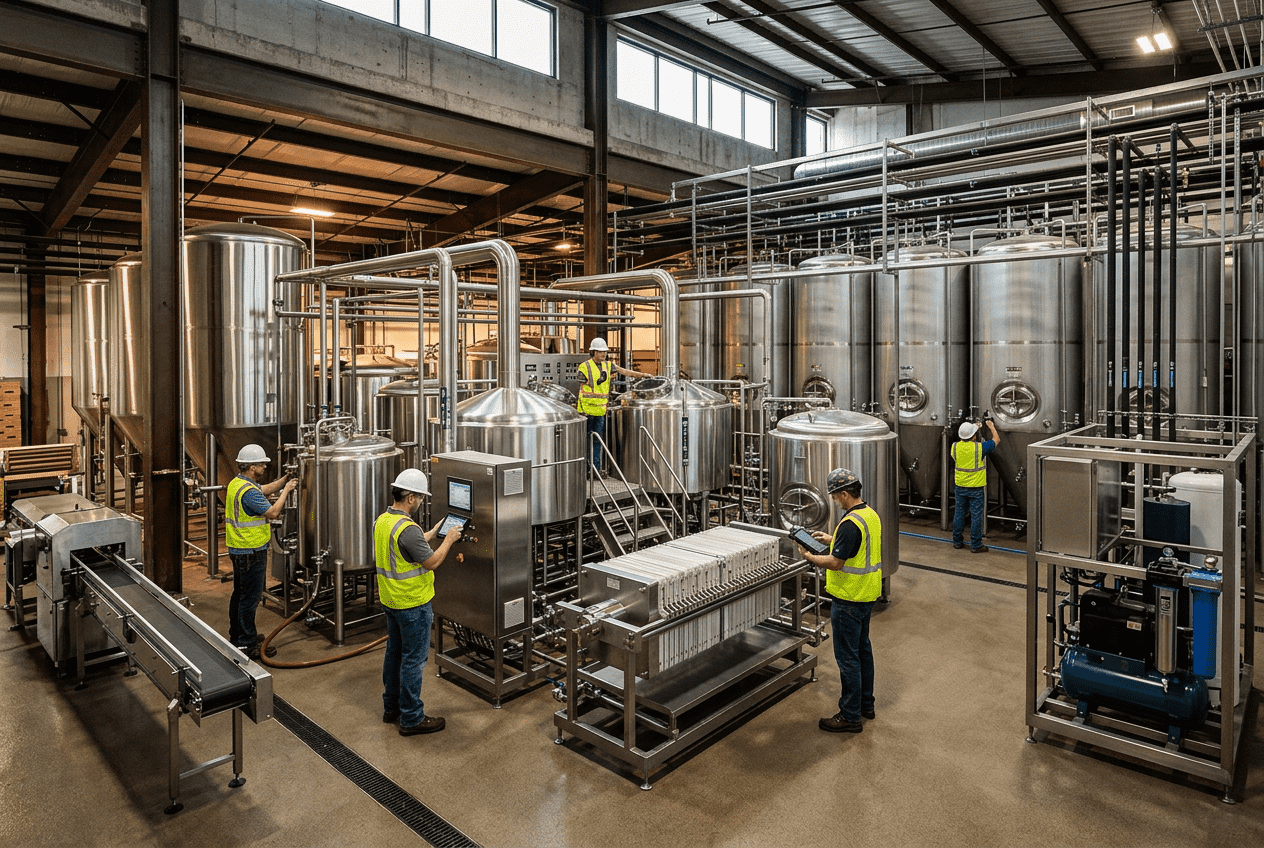
2026 Food Facility Startup Support Services: From Commissioning to Production
[trp_language language=”en_US”]
2026 Food Facility Startup Support in the United States
Launching a new food or beverage facility is rarely won or lost during equipment delivery alone. In the United States, the difference between a profitable first year and an expensive delay usually comes down to startup execution: how quickly utilities are proven, operators are trained, systems are stabilized, food safety controls are verified, and production ramps to commercial speed without sacrificing quality. For manufacturers opening new plants, expanding co-packing lines, relocating process systems, or commissioning new utility infrastructure, startup support services bridge the gap between construction completion and dependable output.
In 2026, this gap matters even more. U.S. manufacturers face tighter labor markets, stricter customer quality expectations, more automation, higher utility costs, and increasing pressure from FDA, USDA, SQF, and BRC programs. Whether a project is in North Carolina, Texas, California, Illinois, Georgia, Pennsylvania, or near major trade corridors such as the Port of Los Angeles, Port Houston, Savannah, or Chicago’s inland logistics hub, startup planning must align engineering, operations, maintenance, sanitation, and compliance from day one.
Immediate Answer

Food facility startup support services help U.S. manufacturers move from commissioning to steady production by organizing production ramp-up planning, operator training, performance verification, system stabilization, troubleshooting, regulatory readiness, and post-startup optimization. The goal is not only to turn equipment on, but to achieve repeatable throughput, safe product quality, labor efficiency, and audit-ready documentation as fast as possible.
For most plants, the best startup partner is one that can work across process engineering, utilities, controls, installation, and compliance instead of treating each discipline separately. That is especially important for beverage plants with syrup rooms, carbonation, pasteurization, and filling lines, and for food plants with cooking, blending, cooling, packaging, CIP, refrigeration, or aseptic processes. A strong startup plan should answer five questions clearly:
- What must be tested before the first saleable batch runs?
- Who owns each startup task by shift, line, and utility?
- How will operator competency be measured?
- What are the acceptance criteria for throughput, yield, quality, and sanitation?
- What escalation path exists if the line underperforms?
U.S. buyers should also evaluate startup support based on local labor availability, seasonal utility constraints, state inspection timelines, and supply chain realities. A dairy line in Wisconsin, a protein facility in Arkansas, and a beverage co-packer in Southern California each face different startup risks even if the mechanical scope looks similar on paper.
| Startup Phase | Main Objective | Primary Team | Typical U.S. Risk | Success Metric | Why It Matters |
|---|---|---|---|---|---|
| Pre-start planning | Define startup sequence | Project, operations, engineering | Schedule overlap with construction | Approved readiness checklist | Prevents rushed handoff |
| Dry commissioning | Verify equipment movement and controls | Controls, maintenance, OEMs | Incomplete IO checks | All critical alarms and interlocks proven | Protects assets and people |
| Wet commissioning | Test with water or safe media | Process, utilities, sanitation | Leaks, drain capacity, CIP faults | Stable flow, pressure, temperature | Finds issues before product loss |
| Product trials | Run saleable or validation batches | Production, QA, process | Waste and quality drift | Yield and spec compliance | Proves commercial readiness |
| Ramp-up | Increase output safely | Operations leadership | Labor inconsistency by shift | Target OEE trend | Builds profitability |
| Stabilization | Reduce variation and downtime | Operations, maintenance, QA | Recurring nuisance stops | Consistent weekly performance | Locks in sustainable production |
The table above shows why startup support is broader than commissioning alone. Commissioning confirms systems can operate. Startup support confirms the business can produce at commercial conditions with repeatable results.
Production Ramp-Up Strategy

Production ramp-up planning should begin well before the first batch. In the U.S. market, many delays happen because owners wait until installation is nearly complete to define throughput goals, labor assumptions, SKU sequencing, and utility loading. A better approach is to build a phased ramp-up model that connects commercial demand with equipment capability, staffing reality, sanitation windows, and supplier lead times.
For example, a beverage facility serving East Coast distribution through Charlotte, Atlanta, and Savannah may need to ramp by package format and carbonation complexity. A protein processor in Kansas or Nebraska may need to ramp by raw material variability, temperature control, and downstream packaging speeds. An aseptic operation shipping nationally through Dallas-Fort Worth or the Inland Empire has to prioritize validation and hold-time control before chasing nameplate speed.
Effective ramp-up plans usually include:
- Daily and weekly output targets for the first 12 weeks
- SKU prioritization based on process difficulty and margin
- Utility load assumptions for steam, glycol, compressed air, and water
- Shift-by-shift labor plans with backup coverage
- Material staging and warehouse flow rules
- Downtime categories and escalation thresholds
- Finished goods release criteria tied to quality and compliance
In 2026, many U.S. plants are also adding digital visibility during ramp-up. Even simple dashboards tied to PLC and SCADA data can help teams track line speed, temperature stability, CIP cycle completion, hold times, changeover losses, and operator intervention frequency. This shortens the learning curve and gives plant leaders objective evidence when corrective actions are needed.
The chart illustrates the growing U.S. need for structured startup support as manufacturers invest in capacity, automation, and modernization. Growth has been especially strong in co-packing, prepared foods, dairy, functional beverages, and value-added protein.
| Week | Planned Throughput | Recommended Focus | Typical Constraint | Mitigation Action | Output Review |
|---|---|---|---|---|---|
| Week 1 | 20% of design rate | Safe startup and basic process stability | Operator unfamiliarity | Extra floor support on every shift | Daily |
| Week 2 | 35% of design rate | Repeatable startups and shutdowns | Utility fluctuation | Trend steam, air, water demand | Daily |
| Week 3 | 50% of design rate | Waste reduction | Recipe and timing variation | Lock critical setpoints | Daily |
| Week 4 | 60% of design rate | Changeover discipline | Long sanitation windows | Refine CIP and line clearance steps | Twice weekly |
| Week 5-8 | 70% to 85% | Shift consistency | Maintenance response time | Spare parts and escalation matrix | Weekly |
| Week 9-12 | 85% to 95% | OEE improvement and labor efficiency | Recurring nuisance faults | Root cause elimination plan | Weekly |
The table provides a realistic staging model. It is often smarter to reach stable 85% performance quickly than to force 100% too early and create quality losses, overtime, and morale problems.
Manufacturers comparing providers should ask whether startup support also connects to broader project execution. Teams that understand process design, installation, and controls can often spot ramp-up issues faster because they know how the line was intended to operate. Buyers can review integrated execution experience through project case studies and see whether a partner has worked across both utilities and processing systems rather than only one layer of the plant.
Operator Training and Qualification

Operator training programs are one of the most undervalued startup investments in the U.S. food sector. Plants spend heavily on stainless systems, automation, packaging lines, and utilities, then lose weeks because operators are trained informally or too late. Good training is not a one-time classroom event. It is a structured qualification system that covers safety, standard work, process understanding, troubleshooting, sanitation, documentation, and escalation.
A practical startup training model should address different roles separately:
- Line operators need startup, shutdown, alarm response, and changeover instruction.
- Maintenance teams need preventive care, lockout, fault tracing, and spare parts knowledge.
- Quality teams need CCP monitoring, record review, and deviation handling.
- Sanitation crews need chemical concentration, verification, and line reassembly standards.
- Supervisors need decision rules, escalation timing, and shift communication routines.
U.S. facilities with high turnover or multi-language workforces should also build training materials in formats that are usable on the floor: laminated one-point lessons, photo-based work instructions, short videos, HMI screenshots, and skills verification checklists. In regions with heavy competition for labor, such as Southern California, Central Texas, and parts of the Southeast, practical cross-training can be as important as the line design itself.
| Training Module | Audience | Format | When Delivered | Competency Check | Business Benefit |
|---|---|---|---|---|---|
| Equipment basics | Operators | Classroom plus floor walk | Pre-start | Verbal and visual check | Reduces misuse |
| Control system navigation | Operators and supervisors | HMI practice | Pre-start and first week | Task completion test | Faster response to alarms |
| Sanitation and CIP | Sanitation, QA, operations | Live demonstration | Before wet runs | Chemical and cycle verification | Supports food safety |
| Maintenance care points | Maintenance | OEM plus internal session | Pre-start | PM execution review | Improves uptime |
| Deviation handling | QA and supervisors | Scenario workshop | During trials | Mock incident review | Limits compliance risk |
| Shift handoff discipline | All shifts | Standard work session | Ramp-up | Checklist audit | Reduces repeat mistakes |
The training matrix above works best when tied to documented sign-off. If a plant cannot show who has been trained, on what topic, and to what standard, startup problems tend to recur across shifts.
By 2026, leading manufacturers are also introducing simulation-based training and digital work instructions integrated into SCADA or MES layers. Even plants without full MES can gain value from alarm libraries, downtime coding prompts, and guided startup sequences. These tools help new operators learn faster and preserve tribal knowledge when veteran staff retire.
Performance Verification and Acceptance Testing
Performance verification testing determines whether the plant can actually make product to specification under realistic conditions. This stage should validate more than mechanical operation. It should confirm process capability, utility stability, packaging performance, sanitation effectiveness, and documentation discipline.
In U.S. food and beverage projects, performance testing commonly covers:
- Flow rates, pressures, temperatures, and hold times
- Fill accuracy, package integrity, and coding performance
- Yield, giveaway, and waste percentages
- CIP parameters and sanitation verification
- Alarm functionality and interlock response
- Changeover duration and line clearance accuracy
- Downtime frequency by cause category
Testing criteria should be agreed before startup. Otherwise, owners and suppliers may disagree about whether a line has passed. For example, a filler may hit nameplate speed for ten minutes, but if upstream blending drifts or downstream accumulation collapses, the system is not ready for routine production. Acceptance must reflect whole-line performance, not isolated equipment demonstrations.
The bar chart shows where demand is especially strong in 2026. Co-packing and beverage projects are leading due to private label growth, brand outsourcing, and continuing investment in flexible packaging and functional drinks.
| Test Category | What Is Measured | Common Instruments | Pass Standard Example | Typical Failure Mode | Recommended Action |
|---|---|---|---|---|---|
| Thermal process | Time and temperature profile | Data logger, transmitters | Within validated range | Sensor lag or control tuning | Retune loop and retest |
| Filling accuracy | Net content variation | Scale, checkweigher | Within legal and internal spec | Nozzle inconsistency | Adjust valves and timing |
| CIP performance | Flow, temp, concentration, return clarity | Conductivity, temp probes | Cycle meets recipe limits | Dead leg or low velocity | Modify routing or pump speed |
| Packaging integrity | Seal, torque, seam, leak | Seal tester, torque meter | No critical defects | Misalignment or wear | Reset tooling and inspect parts |
| Yield verification | Input versus saleable output | Mass balance, ERP data | Target yield achieved | Overfill, startup waste | Reduce giveaway and startup scrap |
| Whole-line uptime | Run duration without major stop | SCADA, OEE dashboard | Agreed sustained run time | Bottleneck migration | Rebalance line controls |
The testing table highlights why startup support must involve process, controls, utilities, and quality. A passing startup is one where data supports operational confidence, not one where assumptions fill documentation gaps.
System Stabilization and Early-Run Monitoring
After initial production begins, stabilization monitoring becomes critical. This is the period when hidden reliability issues surface: motors trip under sustained load, pumps cavitate during certain recipes, air demand spikes during package transitions, temperature loops overshoot at shift changes, or cleaning windows extend longer than designed. Without active monitoring, these issues turn into routine waste.
Strong stabilization programs track both technical and operational indicators. Typical early-run metrics include:
- Overall equipment effectiveness by line and shift
- First-pass quality yield
- Water, steam, glycol, and compressed air consumption
- Downtime minutes by root cause family
- CIP completion rate and deviations
- Operator intervention count per hour
- Maintenance work orders opened in the first 30 days
Plants near expensive utility markets, such as California or the Northeast, often discover that startup inefficiencies quickly become cost issues. Facilities in hot climates like Texas, Arizona, and Florida may also see cooling and refrigeration constraints during summer ramp-up. Monitoring helps plant leaders separate one-time startup noise from genuine design or operational problems.
The area chart reflects an important trend: startup support is moving from mostly manual observation toward integrated digital monitoring. In 2026, more U.S. plants want live visibility into process drift, utility use, downtime, and operator behavior during early production.
| Monitoring Metric | Day 1-7 Target | Day 8-30 Target | Alert Threshold | Owner | Why It Matters |
|---|---|---|---|---|---|
| OEE | 40% to 55% | 60% to 75% | No improvement over 5 days | Operations | Shows real startup progress |
| First-pass quality | 90%+ | 95%+ | Two consecutive shifts below target | QA | Protects customer service |
| CIP completion | 95% recipe compliance | 98% recipe compliance | Any skipped critical step | Sanitation | Supports food safety |
| Utility stability | Within design band | Within design band | Repeated excursions | Engineering | Prevents line instability |
| Unplanned downtime | <20% of scheduled time | <12% of scheduled time | One major repeat fault | Maintenance | Reveals chronic issues |
| Labor productivity | Baseline capture | Improving trend | No gain by week 4 | Operations leadership | Drives margin improvement |
These indicators create an objective stabilization framework. They also help justify when OEM support, controls revisions, or staffing changes are needed rather than relying on subjective opinions.
Troubleshooting and Escalation Protocols
Every startup encounters problems. The difference between a controlled issue and a costly crisis is whether the plant has a troubleshooting protocol. In many U.S. projects, repeated delays happen not because the problem is unsolvable, but because no one is clear on who owns diagnosis, who approves changes, and when to stop production to prevent bigger losses.
A robust troubleshooting system should define:
- Immediate response steps for safety, quality, and equipment protection
- Shift-level problem logging with time stamps and symptoms
- Decision rules for when operations can adjust settings
- Triggers for maintenance, controls engineers, OEMs, or management escalation
- Root cause methodology, such as 5 Whys or fault tree review
- Documentation standards for permanent corrective action
This is particularly important in automated plants where multiple systems interact. A packaging stop may actually come from upstream viscosity variation, compressed air instability, or poor change-part setup. Troubleshooting protocols should encourage system thinking, not blame shifting.
Local supplier response also matters. A startup in Chicago, Houston, or Los Angeles may have relatively strong OEM and contractor coverage. A rural project in the Mountain West or Upper Midwest may need more spare parts, remote support, and preplanned escalation because technician travel can delay recovery.
The comparison chart shows why many U.S. manufacturers prefer integrated startup partners. When one team can coordinate process, utilities, controls, and contractor communication, issue resolution usually becomes faster and less political.
| Problem Type | Likely Symptom | First Response | Escalation Level | Long-Term Fix | Prevention Method |
|---|---|---|---|---|---|
| Control loop instability | Temperature or pressure swings | Review tuning and sensors | Controls engineer | Retune and validate sequence | Pre-start simulation |
| Packaging jams | Frequent downstream stops | Inspect alignment and speed match | OEM technician | Mechanical reset and recipe update | Format change standards |
| Low CIP effectiveness | Failed verification or long cycles | Check concentration and flow | Process and sanitation lead | Piping or recipe correction | Hydraulic review |
| Pump cavitation | Noise, vibration, poor flow | Check suction conditions | Process engineer | NPSH and routing correction | Design review |
| Compressed air shortfall | Actuator failure during peaks | Measure header pressure | Utility specialist | Add storage or sequencing control | Load study |
| Excess startup waste | Product giveaway or purge loss | Review sequencing and timing | Operations manager | Recipe and automation refinement | Trial optimization |
For buyers, one useful question is whether the partner offers only reactive support or a formal escalation framework with logs, action owners, and closure verification. That distinction often determines whether startup problems are solved once or repeated for months.
Regulatory Readiness and Audit Preparation
Regulatory readiness is a core startup requirement in the United States. Even technically strong lines can fail commercially if documentation, sanitation controls, labeling practices, preventive maintenance records, or CCP verification are not ready for review. Depending on the product and process, facilities may need to satisfy FDA, USDA, state departments of agriculture, customer audits, SQF, or BRC expectations.
Readiness should be assessed before commercial launch, not after the first production complaint. Key questions include:
- Are SOPs, SSOPs, and work instructions current and accessible?
- Have preventive controls, CCPs, or critical quality checks been validated?
- Are calibration and verification records complete?
- Is allergen control built into scheduling and sanitation?
- Are traceability and lot coding procedures tested?
- Can the plant document startup deviations and corrective actions?
For aseptic, dairy, thermal processing, and protein operations, documentation discipline is especially important. Customers and regulators will expect proof that the process performs as designed, not just verbal assurance. Plants serving major retail, foodservice, or export channels through ports such as New York/New Jersey, Long Beach, Oakland, or Savannah may also face stricter customer documentation demands during startup.
Manufacturers selecting a startup partner should look beyond mechanical expertise. A strong provider should understand compliance expectations and how startup activities affect audit readiness. Capabilities in FDA, USDA, SQF, and BRC-sensitive environments are particularly valuable when production must scale quickly without rework.
This is where service depth matters. Through its broader food and beverage engineering services, DPS supports clients with process planning, project execution, installation coordination, and system integration that can help align startup activity with operational and compliance goals rather than treating validation as an afterthought.
Post-Startup Optimization and Capacity Growth
Once the plant is stable, attention shifts to optimization. Post-startup work turns a functioning line into a profitable one. In many facilities, the biggest gains after launch come from small adjustments: control tuning, sequencing changes, changeover simplification, utility balancing, operator standardization, line balancing, and waste reduction.
Optimization usually focuses on four commercial outcomes:
- Higher throughput without sacrificing quality
- Lower labor per unit
- Reduced water, energy, and chemical consumption
- More predictable scheduling and customer service
For 2026, three trends are shaping post-startup optimization in the United States:
- Automation and data use are expanding beyond large enterprises. Mid-market processors increasingly want OEE tracking, recipe control, remote diagnostics, and alarm analytics.
- Sustainability is becoming more operational. Water reuse, heat recovery, compressed air efficiency, wastewater load reduction, and CIP optimization are now tied directly to cost control and customer expectations.
- Policy and customer scrutiny are increasing. More buyers expect documented preventive controls, traceability maturity, and evidence of disciplined process management from day one.
Facilities planning expansion should also design optimization into future phases. A startup partner that understands long-term capital planning can help owners avoid dead-end choices. For example, a plant that starts with 20 million cases may need utilities, controls architecture, and floor layout that can support 80 million later. The same principle applies in protein, dairy, sauces, and prepared foods where future SKUs, packaging formats, or sanitation zoning may change line requirements.
Equipment selection is part of that strategy as well. Reviewing a partner’s process equipment capabilities can help buyers understand whether custom tanks, CIP systems, vessels, or related hardware will integrate cleanly with the startup plan and future growth targets.
About Our Company
Disruptive Process Solutions supports U.S. and Canadian manufacturers that need more than a conventional contractor at startup. The company works across food and beverage projects with a business-first mindset focused on long-term plant profitability, practical execution, and transparent decision-making. For clients exploring a new facility launch, line expansion, relocation, or utility-intensive scale-up, the firm’s approach is built around engineering the solution, building it through coordinated field execution, and managing the result through startup and operating readiness.
From a technological capability standpoint, DPS works across process engineering, mechanical systems, plumbing, electrical integration, and controls. That includes automation support such as PLC programming, SCADA, recipe and batch control, and the process understanding needed for fermentation, distillation, carbonation, blending, pasteurization, sterilization, retort, aseptic systems, water treatment, refrigeration, and CIP. This breadth is important during startup because the most expensive problems often occur between disciplines rather than within a single machine.
From a manufacturing capability standpoint, DPS supports both beverage and food environments. Beverage projects can include craft brewing, spirits, wine, RTD products, juices, dairy beverages, and aseptic lines. Food projects can include protein processing, prepared foods, sauces, ingredients, dairy, shelf-stable systems, and plant-based operations. The company also manufactures selected process equipment such as tanks, CIP systems, marination tumblers, and cooking vessels, giving clients another option when integration and project control are critical.
From a service capability standpoint, DPS provides capital planning, feasibility work, owner’s representation, project and program management, general contracting functions where applicable, equipment supply, installation, integration, commissioning, and startup coordination. Because the team serves projects across all 50 U.S. states and Canada, it is accustomed to adapting execution to local code requirements, utility conditions, labor realities, and compliance needs. Manufacturers can learn more about the company and how it approaches profit-driven project delivery.
For buyers in the United States, the practical value of this model is straightforward: one coordinated partner can help connect project intent to operating reality. Instead of handing a plant over and leaving operations to figure out the rest, integrated startup support helps shorten the path from installed system to stable production.
Frequently Asked Questions
What is the difference between commissioning and startup support?
Commissioning proves systems can operate according to design intent. Startup support goes further by helping the plant run saleable product consistently, training teams, resolving early issues, and reaching stable commercial output.
How long does startup support usually last in the United States?
It depends on plant complexity. Simple line additions may need a few weeks. New food or beverage facilities often need 30 to 90 days of structured support, with optimization continuing longer.
Which U.S. industries need startup support most often?
High-demand sectors include beverage co-packing, dairy, value-added protein, prepared foods, sauces, aseptic systems, and facilities adding automation or new utility infrastructure.
Should startup support include operator training?
Yes. Without role-based training and qualification, plants often suffer repeated faults, safety issues, sanitation deviations, and slower ramp-up across shifts.
What data should be tracked during ramp-up?
At minimum, track throughput, OEE, first-pass quality, waste, downtime causes, utility consumption, CIP compliance, and maintenance events. The data should be reviewed by shift and by week.
How do I choose a startup partner in the U.S. market?
Look for experience in your process category, proven ability to coordinate controls and utilities, documented acceptance testing methods, compliance awareness, and enough service depth to solve cross-functional issues quickly.
Do local conditions really affect startup planning?
Absolutely. Climate, utility costs, labor availability, state inspections, and proximity to OEM support all affect startup risk. A line in California, Texas, Wisconsin, or Georgia may need different preparations.
What are common warning signs of a weak startup plan?
No clear acceptance criteria, late operator training, missing spare parts, undefined escalation paths, incomplete SOPs, weak data collection, and unrealistic expectations about reaching nameplate speed immediately.
Can startup support improve audit readiness?
Yes. Good startup programs align training, records, sanitation, testing, and deviation handling so the facility is better prepared for FDA, USDA, SQF, BRC, and customer reviews.
What should companies expect in 2026?
Expect more demand for integrated startup partners, stronger use of automation and data, greater pressure to control energy and water use, and more emphasis on documented readiness from customers and regulators.
For U.S. manufacturers, startup is no longer just the last project milestone. It is the first operating test of whether smart capital was converted into smart manufacturing. Plants that treat startup support as a strategic discipline are far more likely to reach stable production quickly, satisfy customers, reduce waste, and create the foundation for profitable expansion.
[/trp_language]
Complete Company Portfolio

About the Author: Disruptive Process Solutions (DPS)
The DPS team combines process engineering expertise with real-world food and beverage manufacturing experience. Our content focuses on process optimization, production efficiency, facility improvements, and practical solutions that help manufacturers operate more effectively in a rapidly evolving industry.
Share

