Food Plant Renewable Energy Integration: Options and ROI
[trp_language language=”en_US”]
Renewable Energy Integration for Food Plants in the United States
Food manufacturers in the United States are under pressure to lower utility costs, improve resilience, meet retailer and investor sustainability requirements, and protect margins against volatile power and fuel prices. For processors running refrigeration, boilers, compressed air, wastewater treatment, clean-in-place systems, retorts, aseptic filling, or high-volume packaging lines, renewable energy is no longer a branding exercise. It is a capital planning decision tied directly to operating cost, uptime, and long-term competitiveness.
Across major production corridors such as California’s Central Valley, the Midwest dairy and protein belt, the Carolinas, Texas, the Pacific Northwest, and logistics hubs connected to the ports of Los Angeles, Long Beach, Houston, Savannah, and Newark, plants are evaluating combinations of rooftop or ground-mount solar, anaerobic digestion, battery storage, grid participation, and third-party energy contracts. The right answer depends on load profile, thermal demand, wastewater strength, roof condition, interconnection rules, tax appetite, and how aggressively the plant wants to pursue decarbonization by 2026 and beyond.
Quick Answer

The fastest path to renewable energy integration for most U.S. food plants is a phased approach: first reduce demand through utility optimization, then add solar PV for predictable daytime electric savings, evaluate anaerobic digestion where wastewater or organic residuals are strong enough to support gas production, and use battery storage selectively where demand charges, outage risk, or time-of-use rates justify it. Plants with large balance sheets often prefer direct ownership to capture tax benefits and depreciation, while plants preserving capital may choose a power purchase agreement or energy-as-a-service structure.
For many facilities, the highest-return sequence looks like this:
| Priority | Action | Typical Fit | Main Benefit | Common Risk | ROI Outlook |
|---|---|---|---|---|---|
| 1 | Energy audit and load study | All food plants | Finds waste before adding assets | Incomplete interval data | Very high |
| 2 | Utility and controls optimization | Plants with motors, refrigeration, boilers | Immediate kWh and gas reduction | Operational resistance | High |
| 3 | Solar PV | Daytime electric users with roof or land | Predictable savings | Interconnection delay | Moderate to high |
| 4 | Battery storage | High demand charge or outage-sensitive sites | Peak shaving and resilience | Oversizing | Site-specific |
| 5 | Anaerobic digestion | High-BOD wastewater or organic residual plants | On-site gas and waste reduction | Feedstock variability | High when well matched |
| 6 | PPA or financed build | Capital-constrained organizations | Lower upfront spend | Contract complexity | Moderate but flexible |
This table shows why renewable energy for food plants should be treated as a plant-wide business case rather than a single equipment purchase. A facility processing poultry in Arkansas, yogurt in Wisconsin, sauces in New Jersey, or RTD beverages near Dallas-Fort Worth may all use renewables, but the winning mix will differ because their thermal loads, wastewater characteristics, and utility tariffs are different.
The line chart reflects a realistic market direction: adoption is rising as corporate sustainability targets, state incentives, grid volatility, and decarbonization expectations converge. By 2026, adoption should broaden beyond marquee projects into mid-market food and beverage plants seeking margin protection.
Renewable Energy Options for Food Plants

Food plants generally have five practical renewable or low-carbon energy pathways: solar PV, anaerobic digestion, renewable natural gas procurement, battery-backed grid optimization, and off-site contracted renewable supply. The selection should begin with process mapping. Refrigerated plants often have large electrical loads and gain the most from solar paired with controls and storage. Plants generating strong organic wastewater or byproducts may unlock biogas economics that purely dry facilities cannot match.
The most common U.S. applications include meat and poultry operations in the Midwest and Southeast, dairy processing plants in Wisconsin, Idaho, and upstate New York, fruit and vegetable processors in California and the Pacific Northwest, beverage bottlers in the Carolinas and Texas, and aseptic or shelf-stable food manufacturers running high thermal loads near population centers like Chicago, Atlanta, and Phoenix.
| Option | Best For | Energy Form | Typical Scale | Main Advantages | Main Constraints |
|---|---|---|---|---|---|
| Rooftop solar PV | Large flat roofs, daytime load | Electricity | 250 kW to 5 MW | Low maintenance, predictable output | Roof condition and structural limits |
| Ground-mount solar PV | Sites with available land | Electricity | 500 kW to 20 MW | Higher scale and easier access | Land use and permitting |
| Carport solar | Sites with parking demand | Electricity | 100 kW to 3 MW | Dual land use and shade value | Higher installed cost |
| Anaerobic digestion | High-organic wastewater or residuals | Biogas/heat/power | Plant-specific | Waste reduction and fuel creation | Feedstock consistency required |
| Battery energy storage | Demand-charge exposure | Stored electricity | 250 kW to 10 MW | Peak shaving and resilience | Economics vary by tariff |
| Off-site renewable PPA | Multi-site companies | Contracted electricity | Portfolio scale | No on-site space needed | Less operational control |
This comparison table highlights why there is no universal “best” renewable solution. A frozen food plant near Kansas City may gain more from battery-backed peak management than from biogas, while a cheese or protein processor with high-strength wastewater may find digestion far more attractive than pure solar.
Buying advice for U.S. operators is straightforward: start with interval utility data, demand charges, steam demand, wastewater sampling, available roof or land area, and planned production growth. If the plant expects line additions, new refrigeration capacity, or utility corridor rework within two to three years, renewable energy design should be integrated with capital planning rather than bolted on later.
That integration point matters. Companies that approach renewables as a standalone vendor purchase often miss opportunities to right-size switchgear, coordinate heat recovery, optimize CIP schedules, or align digesters with wastewater pretreatment and utility redundancy. That is especially true in complex facilities processing dairy, proteins, sauces, prepared meals, or fermentation-based beverages.
The bar chart reflects where project activity is strongest today. Dairy and protein facilities often lead because they combine large utility consumption with wastewater, refrigeration, and thermal energy opportunities.
Solar PV System Design Considerations

Solar is usually the first renewable technology considered because it is well understood, modular, and relatively low maintenance. But for food plants, solar design is not just about panel count. It must account for washdown environments, sanitation routes, roof warranty conditions, electrical redundancy, utility curtailment rules, and production uptime.
Key design considerations include roof age, structural load, shading from penthouses or HVAC units, inverter placement, electrical room capacity, and the relationship between daytime solar output and the plant’s actual load shape. A facility with steady daytime refrigeration and packaging demand tends to use solar power more efficiently than one whose biggest loads occur overnight.
| Design Factor | Why It Matters | Food Plant Example | Risk if Ignored | Preferred Practice | Impact on ROI |
|---|---|---|---|---|---|
| Roof structure | Supports dead load and wind load | Large bottling roof in Texas | Retrofit costs | Structural review before layout | High |
| Load profile | Aligns generation with use | Dairy plant with daytime chillers | Excess export or low self-use | Use interval meter analysis | High |
| Interconnection | Defines export and timeline | PJM or CAISO territory site | Project delay | Early utility application | High |
| Electrical capacity | Determines tie-in method | Older meat plant switchgear | Unexpected upgrades | Single-line study and field audit | Moderate |
| Cleaning and access | Supports maintenance and safety | Powder plant with roof traffic | Service difficulty | Dedicated access paths | Moderate |
| Expansion planning | Avoids redesign later | Fast-growing co-packer | Stranded capacity | Phase electrical infrastructure | High |
This table matters because solar underperforms financially when it is designed around available roof area instead of operational reality. In the United States, utility structures vary widely. A plant in California may focus on time-of-use value and resilience; a plant in ERCOT may focus on market exposure and backup strategy; a plant in the Midwest may prioritize self-consumption and distribution constraints.
Solar product choices also matter. Rooftop systems may be ideal for high-value urban or infill sites such as facilities near Newark or Los Angeles where land is scarce. Ground-mount systems may work better in rural processing zones around Fresno, Modesto, Amarillo, or parts of Wisconsin where adjacent land is easier to secure. Carport systems can make sense for corporate campuses or high-traffic production sites where employee parking and EV charging are part of the long-term plan.
By 2026, expect more food plants to pair PV with advanced controls, microgrid-ready switchgear, and production-aware energy management. Plants that already run SCADA, recipe systems, batch control, and automated utilities have an advantage because solar and storage data can be layered into operational decision-making instead of staying isolated in a vendor dashboard.
Biogas From Anaerobic Digestion
Anaerobic digestion can be one of the strongest renewable energy options for food plants when the feedstock supports it. The process uses microorganisms to break down organic material in low-oxygen conditions, producing biogas that can be burned for heat, used in combined heat and power, or upgraded for renewable natural gas pathways where scale and local conditions support it.
Biogas is especially relevant for facilities producing high-BOD or high-COD wastewater, fats, sugars, starches, proteins, or residual organics. Typical candidates include dairy processors, meat plants, breweries, distilleries, juice plants, sauce and prepared food operations, and some plant-based protein manufacturers.
| Feedstock Source | Typical U.S. Plant Type | Biogas Potential | Operational Benefit | Primary Challenge | Best Use Case |
|---|---|---|---|---|---|
| Dairy wastewater | Cheese, yogurt, milk plants | High | Fuel plus treatment support | Flow variability | Boiler or CHP support |
| Brewery residuals | Craft and regional brewing | Moderate to high | Offset thermal use | Seasonal production swings | Hot water and steam support |
| Protein processing waste | Beef, pork, poultry plants | High | Waste reduction and gas yield | Grease and solids handling | Integrated wastewater strategy |
| Fruit and vegetable waste | Canners, frozen produce plants | Moderate | Diverts organics from disposal | Seasonality | Hybrid digestion approach |
| Sugary beverage waste | Juice and soft drink plants | High | Strong digestibility | Cleaning chemistry balance | Steady byproduct streams |
| Prepared food residuals | Sauces, meals, soups | Moderate to high | Combined waste handling value | Mixed feedstock control | Sites with strong pretreatment |
The explanation behind the table is simple: digestion economics depend less on the label of the plant and more on consistency, concentration, contamination control, and the ability to use the gas product. A digestion project without a stable feedstock plan often disappoints, while one integrated with wastewater treatment, solids handling, boiler demand, and utility controls can materially reduce both disposal cost and fossil fuel use.
Food manufacturers should also evaluate whether the best project is full digestion, co-digestion, a phased pretreatment-to-digestion path, or no digestion at all. Not every site needs it. In some plants, the smarter move is to improve wastewater equalization, capture heat, and pursue solar first. In others, especially around major protein and dairy clusters, digestion can outperform every other on-site renewable option.
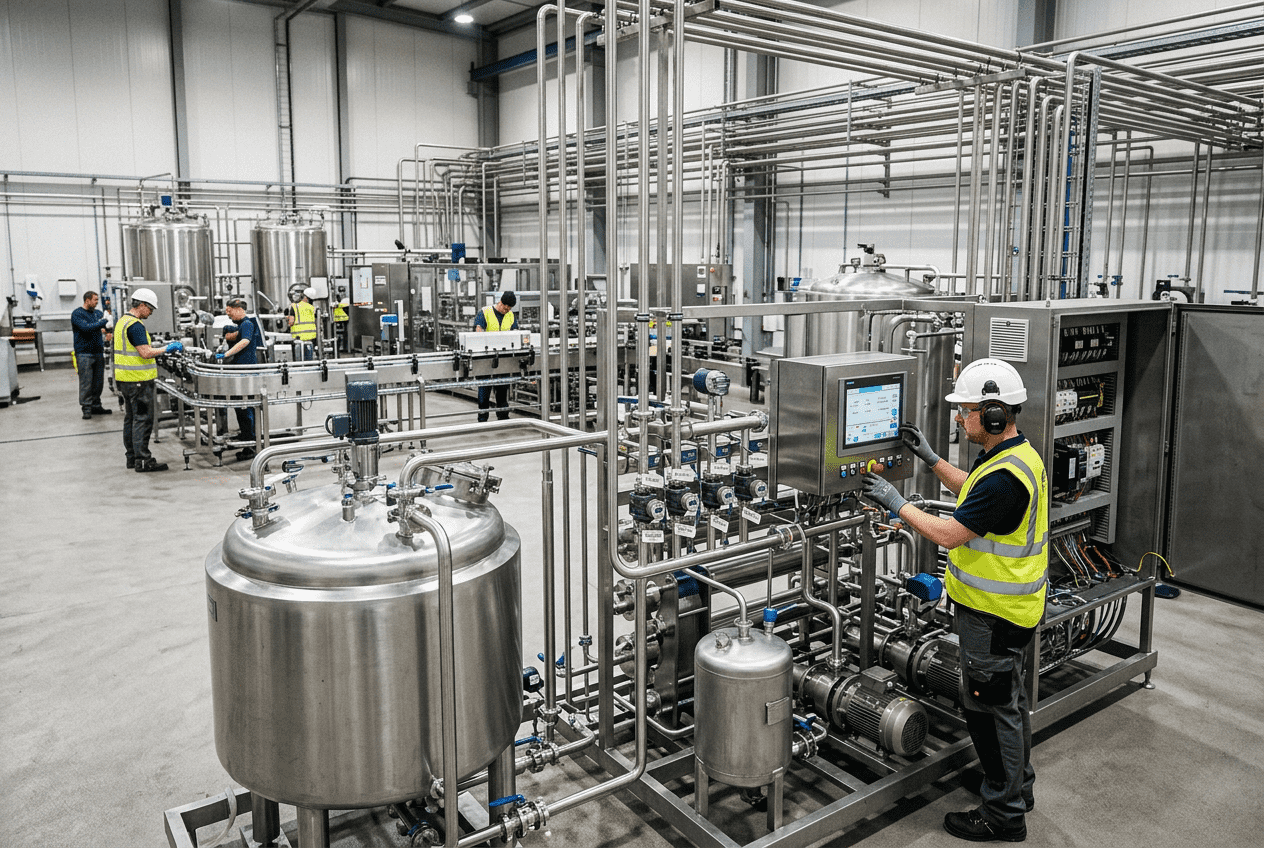
From a manufacturing perspective, process integration matters. Renewable systems touch tanks, pumps, piping, valves, controls, utility skids, and cleanability standards. A partner with experience in custom vessels, sanitary utility design, process integration, and field installation can reduce handoff risk between civil, mechanical, electrical, and process scopes. That is particularly important when energy systems share interfaces with wastewater, CIP, heat exchangers, or production-side collection systems.
Battery Storage and Grid Integration
Battery storage is not automatically a savings machine, but in the right tariff and reliability environment it can be highly effective. U.S. food plants often consider batteries for four reasons: shaving demand peaks, reducing exposure to time-of-use pricing, supporting backup power or ride-through for critical loads, and improving the value of on-site solar by storing midday excess for later use.
Grid integration is where many projects become complex. The local utility, regional market rules, feeder capacity, protection settings, and export limitations all shape project economics. A plant in CAISO territory may see different opportunities from a plant in MISO, PJM, ERCOT, NYISO, or ISO-NE. Facilities near major logistics corridors like Inland Empire distribution hubs, Atlanta cold chain zones, or Chicago intermodal networks may also place higher value on resilience because downtime can ripple through retailer commitments.
| Battery Use Case | Best Facility Type | Primary Value Driver | Control Need | Typical Duration | Decision Note |
|---|---|---|---|---|---|
| Peak shaving | High-demand-charge plants | Monthly peak reduction | High | 1 to 2 hours | Best with stable peak pattern |
| Solar shifting | Plants with export limits | Higher self-consumption | Moderate | 2 to 4 hours | Useful in TOU markets |
| Critical load backup | Aseptic or sensitive process plants | Downtime avoidance | High | Varies | Often paired with generators |
| Power quality support | Automation-heavy plants | Protects controls and drives | High | Short duration | Supports uptime more than energy |
| Microgrid readiness | Remote or risk-sensitive sites | Operational continuity | Very high | 2 to 8 hours | Requires careful islanding design |
| Market participation | Larger multi-site portfolios | Ancillary or tariff value | High | Varies | Complex and region-specific |
This table shows why battery systems should not be sold as a generic add-on. The financial case depends on rate design and operations, while the strategic case depends on product risk. A ready-to-drink beverage plant with continuous packaging may value outage avoidance differently from a dry ingredient plant that can tolerate short interruptions.
The area chart shows a realistic trend shift: stand-alone solar remains important, but combined solar-plus-storage systems are gaining share as resilience and tariff optimization become more valuable in food manufacturing.
Technological capability is critical here. Plants integrating storage need more than equipment supply. They need electrical engineering, controls architecture, PLC and SCADA integration, load sequencing, and utility coordination. Facilities with refrigeration, compressed air, steam, process water, and sanitation utilities can benefit when energy assets are tied into a broader operational control strategy rather than managed independently.
Power Purchase Agreements Explained
A power purchase agreement, or PPA, allows a third party to finance, build, own, and operate an energy system while the food plant buys the output under a contract. For many U.S. manufacturers, PPAs are attractive because they reduce upfront capital needs and shift some performance and maintenance responsibility to the provider.
There are several structures. An on-site PPA supports a system installed at the facility. A virtual or off-site PPA contracts for energy from a remote project and is more common for larger companies managing multi-state portfolios. The right structure depends on credit profile, tax appetite, roof or land availability, and internal capital priorities.
PPAs can work well for food plants that want savings without owning energy assets, but the details matter. Contract length, escalators, buyout rights, production guarantees, curtailment terms, roof access, casualty language, and assignment provisions all affect value. This is especially relevant for leased facilities, private-equity-backed operators, and companies considering relocation or expansion.
| Contract Model | Ownership | Upfront Capital | Main Benefit | Main Limitation | Best Fit |
|---|---|---|---|---|---|
| Direct purchase | Plant owner | High | Full savings and tax alignment | Uses internal capital | Strong balance sheet operators |
| Loan-financed ownership | Plant owner | Moderate | Retains ownership | Debt capacity required | Growth-oriented manufacturers |
| On-site PPA | Third party | Low | Minimal upfront spend | Shared savings model | Capital-constrained sites |
| Operating lease | Third party or hybrid | Low to moderate | Flexible accounting treatment | Varies by structure | Sites needing flexibility |
| Energy-as-a-service | Third party | Low | Broad bundled solution | Complex agreements | Multi-asset projects |
| Virtual PPA | Off-site developer | Low | Portfolio-scale sustainability | No direct on-site resilience | Large enterprise buyers |
The value of this table is that it separates financing choice from technology choice. A plant may prefer solar and storage technically, but decide to implement through a PPA because capital is being allocated to a new line, warehouse automation, or expansion near ports like Savannah or Houston.
Financing and Incentive Programs
Financing and incentives often determine whether a project moves this year or sits in a pipeline. In the United States, renewable energy for food plants can benefit from federal tax incentives, accelerated depreciation, selected state rebates, utility incentives, demand response programs, and in some cases grants or rural development support depending on the site and ownership structure.
Plants should evaluate incentives early because they influence system size, ownership model, schedule, and procurement strategy. A project may qualify differently if it is owned directly by the operating company, by a real estate entity, or by a third-party developer under a PPA.
Common U.S. funding levers include investment tax treatment for eligible solar and storage structures, depreciation benefits, state clean energy incentives, utility make-ready programs, and targeted support for resilience or grid modernization. Anaerobic digestion economics may also be improved by avoided disposal costs, wastewater savings, thermal fuel displacement, and renewable fuel attributes where available.
Smart buyers should also account for non-cash returns: reduced outage exposure, improved customer scorecards, better ESG reporting, and support for retailer or foodservice procurement requirements. These benefits are often decisive for co-manufacturers and brand owners seeking preferred vendor status.
Implementation Timeline and Performance
Project timing varies sharply by technology. A relatively straightforward rooftop solar system may move from feasibility to operation in less than a year if roof condition, utility approval, and procurement are clean. A digester project can take longer because it involves process engineering, civil works, permitting, feedstock testing, gas handling, and integration with utilities or boilers.
Performance should be measured with plant-specific KPIs, not generic sustainability claims. The best scorecards combine energy savings, demand reduction, gas displacement, wastewater improvements, uptime, maintenance burden, and ROI against the plant’s real production profile.
| Project Type | Feasibility Phase | Design and Permitting | Construction | Commissioning | Primary KPI |
|---|---|---|---|---|---|
| Rooftop solar PV | 1 to 2 months | 2 to 4 months | 2 to 5 months | 2 to 4 weeks | kWh offset |
| Ground-mount solar PV | 1 to 3 months | 3 to 6 months | 3 to 7 months | 2 to 4 weeks | kWh offset |
| Battery storage | 1 to 2 months | 2 to 5 months | 2 to 5 months | 2 to 6 weeks | Demand reduction |
| Solar plus storage | 2 to 3 months | 3 to 6 months | 3 to 7 months | 3 to 6 weeks | Blended utility savings |
| Anaerobic digestion | 2 to 4 months | 4 to 8 months | 6 to 12 months | 1 to 3 months | Gas yield and treatment savings |
| Portfolio PPA rollout | 2 to 4 months | 3 to 9 months | Varies by site | Varies | Contracted savings and emissions |
The implementation table helps set expectations. Many project delays are not technology failures; they come from interconnection, procurement lead times, utility study queues, landlord approvals, environmental review, or incomplete front-end engineering.
For performance, experienced food manufacturers should watch these indicators after startup: utility cost per unit produced, peak kW demand, boiler fuel displacement, energy intensity by line, digester uptime, wastewater surcharge reduction, avoided spoilage risk, and maintenance hours per month. In 2026, more owners will also track carbon intensity per pound, gallon, or case shipped as customer reporting expectations grow.
The comparison chart illustrates a common U.S. buying reality: the more complex the process environment, the greater the value of a partner that understands both energy assets and plant operations. Food facilities are not generic warehouses; utility systems interact with sanitation, product quality, throughput, and compliance.
That is why many manufacturers prefer an implementation partner that can move from feasibility to detailed engineering, construction management, and commissioning while coordinating process, utilities, controls, and local trades. This becomes even more important when renewable energy is packaged into a broader expansion, relocation, or capacity project.
Our Company
Disruptive Process Solutions supports food and beverage manufacturers across the United States and Canada with a practical, profitability-first approach to capital projects. Rather than treating energy, utilities, process equipment, and construction as separate silos, DPS works through an integrated design-build-manage model that helps clients make better investment decisions from concept through startup.
From a service capability standpoint, DPS supports capital planning, feasibility evaluation, owner’s representation, project and program management, general contracting where licensed, equipment supply, installation, and full system integration. That makes the company especially valuable for processors that want one team coordinating schedule, budget, local trades, and operational startup instead of handing work across multiple disconnected vendors. You can learn more about the company’s approach on the about us page and review its broader engineering and project services.
On the technology side, DPS brings cross-functional capability in structural, mechanical, plumbing, electrical, process, and controls engineering, including PLC programming, automation, SCADA, utility systems, and commissioning. For renewable projects in food plants, that technical depth matters because solar, biogas, storage, boilers, compressed air, refrigeration, water treatment, and process controls often affect one another. A renewable initiative performs better when it is designed around the whole plant.
From a manufacturing capability perspective, DPS also designs and supplies branded process equipment such as tanks, CIP systems, tumblers, and cooking vessels, while integrating third-party systems across food and beverage applications. That manufacturing and integration experience is useful when renewable projects require utility skids, tanks, process tie-ins, cleanable piping, or coordinated equipment modifications. More detail is available through the company’s equipment capabilities and selected project case studies.
DPS serves diverse sectors including brewing, spirits, wine, RTD, dairy, protein, sauces, aseptic processing, prepared foods, plant-based products, and co-manufacturing. For clients evaluating renewable energy options for food plants, the company’s value is not limited to equipment procurement. It lies in helping owners avoid poor capital allocation, align utility investments with production realities, and execute projects that strengthen long-term profitability.
FAQ
What is the best renewable energy option for most U.S. food plants?
For many facilities, solar PV is the first step because it is modular, proven, and relatively easy to maintain. However, plants with strong organic wastewater or byproducts may gain more from anaerobic digestion, and plants with heavy demand charges may justify battery storage.
How long does a renewable energy project usually take?
Simple solar projects may move from study to commissioning in roughly 6 to 12 months. Storage may be similar. Digestion projects often take longer, commonly 12 to 24 months, due to process, permitting, and integration complexity.
Do food plants need battery storage with solar?
No. Storage is valuable when the plant has high demand charges, outage sensitivity, export limits, or time-of-use pricing. If the facility already uses most solar output during the day and resilience is not a major concern, solar alone may be sufficient.
Can anaerobic digestion replace natural gas entirely?
Usually not for most sites, but it can offset a meaningful share of boiler or thermal demand when feedstock volume and quality are strong. The outcome depends on wastewater strength, residual handling, digester uptime, and gas utilization strategy.
Are PPAs better than owning the system?
Not always. Ownership often provides the highest total economic upside when the company can use tax benefits and fund the project. PPAs are attractive when preserving capital or outsourcing asset operation is more important than capturing every dollar of upside.
What should a plant evaluate before requesting proposals?
Collect 12 to 24 months of electric and gas bills, interval meter data, production trends, demand charges, roof drawings, site plans, wastewater data, and future expansion plans. Strong front-end information improves proposal quality and reduces pricing surprises.
Which food sectors are most active in renewable energy adoption?
Dairy, protein, beverage, prepared foods, and large co-manufacturing operations are among the most active. These sectors often have the scale, utility intensity, or wastewater profile that supports strong project economics.
What 2026 trends should food manufacturers watch?
Expect continued growth in solar-plus-storage, smarter utility controls, tighter customer carbon reporting expectations, more policy support for resiliency and decarbonization, and greater use of integrated project delivery where energy systems are designed together with production expansion and utility modernization.
In the United States, renewable energy integration is becoming less about checking a sustainability box and more about building stronger, more resilient food plants. The companies that win will be the ones that connect energy choices to throughput, uptime, utility strategy, and capital efficiency.
[/trp_language]
Complete Company Portfolio

About the Author: Disruptive Process Solutions (DPS)
The DPS team combines process engineering expertise with real-world food and beverage manufacturing experience. Our content focuses on process optimization, production efficiency, facility improvements, and practical solutions that help manufacturers operate more effectively in a rapidly evolving industry.
Share

