Remote Monitoring Systems for Food Facilities: IIoT & Cloud Dashboards
[trp_language language=”en_US”]
Remote Monitoring Systems for Food Facilities in the United States
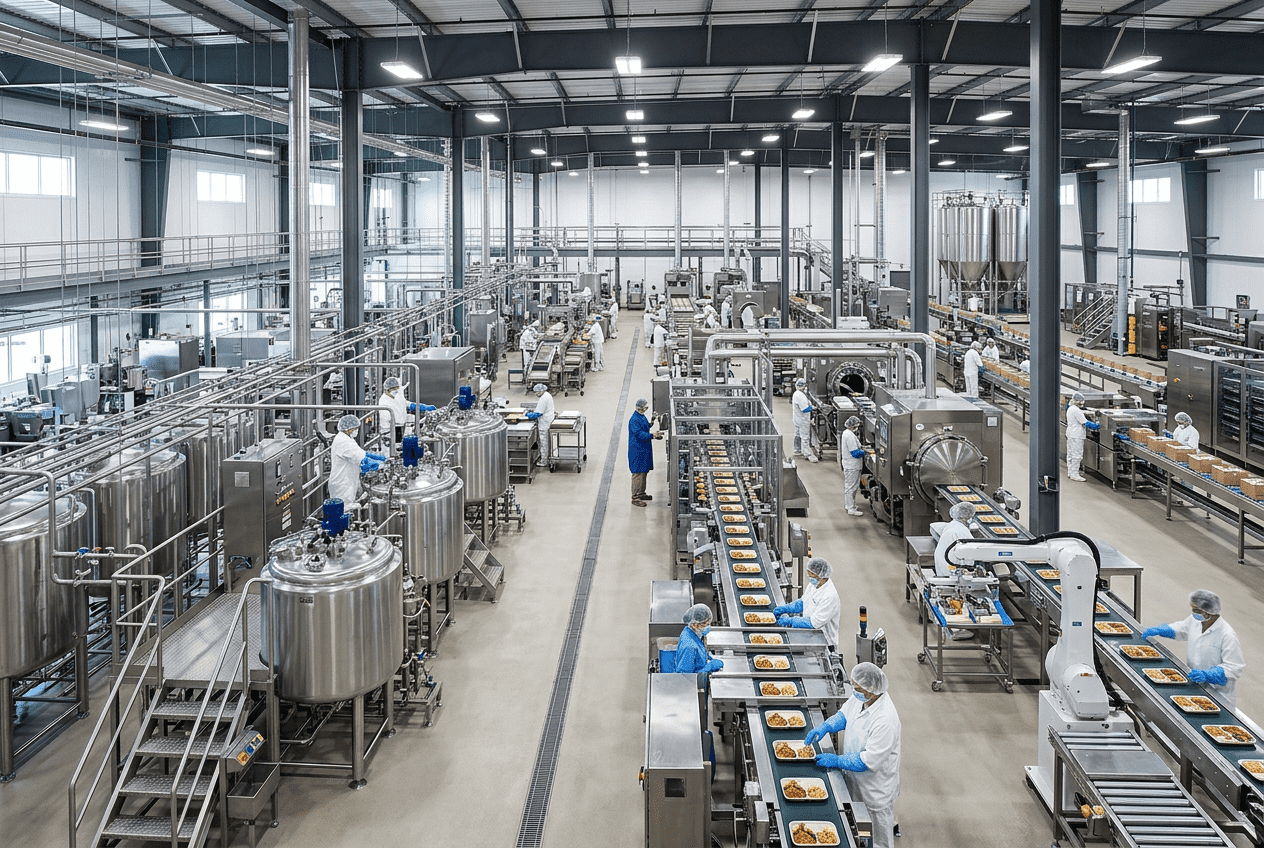
Food and beverage manufacturers across the United States are under pressure to reduce downtime, protect product quality, document compliance, and make faster operational decisions across one plant or many. Remote monitoring systems built on industrial IoT sensors, edge devices, cloud platforms, and role-based dashboards help plants track temperature, pressure, flow, tank levels, vibration, utility consumption, and sanitation-critical conditions without relying only on manual rounds. In practice, these systems are especially valuable in high-consequence environments such as protein processing in the Midwest, dairy plants in Wisconsin, beverage packaging lines in Texas, ready-to-drink facilities in the Southeast, and washdown-heavy operations near major logistics hubs like Chicago, Dallas-Fort Worth, Savannah, and Los Angeles.
For U.S. processors, the best remote monitoring strategy is not just about adding sensors. It is about choosing the right connectivity path, selecting hardware that survives washdown, building dashboards that different teams can actually use, and creating escalation rules that turn data into action. It also means working with engineering partners who understand process systems, utilities, controls, plant operations, and compliance realities. That is where an end-to-end firm can provide an advantage, especially when remote monitoring is part of a larger capital project, line expansion, utility upgrade, CIP redesign, or plant modernization effort.
Quick Answer

Yes, remote monitoring systems are highly effective for food facilities in the United States when they are designed for sanitary environments, operational continuity, and practical user adoption. A modern system typically combines wireless or wired industrial sensors, secure gateways, edge processing, cellular or segmented network connectivity, cloud dashboards, alarms, historian functions, and mobile alerts. The most successful deployments focus on a limited set of critical variables first, such as refrigeration temperature, cook and hold temperatures, CIP parameters, compressed air pressure, tank levels, pump health, and utility performance.
For many U.S. food plants, a cellular-first IIoT architecture is often the fastest route to value because it can bypass internal OT and IT bottlenecks while still keeping monitoring segregated from production control. In facilities with strict cybersecurity rules or multi-site visibility needs, cloud dashboards make it easier for plant managers, maintenance teams, quality leaders, and corporate operations to see exceptions in real time. When washdown is intense, IP69K-rated wireless sensors and enclosures matter. When uptime matters, the real return comes from automatic thresholds, escalation workflows, and dashboards tailored by role rather than generic charts that no one checks.
The table below summarizes where remote monitoring usually delivers the fastest return in U.S. food and beverage plants.
| Application Area | Typical Data Points | Main Risk Reduced | Likely User | Typical ROI Driver | Priority Level |
|---|---|---|---|---|---|
| Cold storage and refrigeration | Room temperature, suction pressure, compressor status | Product spoilage | Maintenance and QA | Loss prevention | Very High |
| Cook, chill, and hold steps | Time, temperature, batch status | Food safety deviation | Production and QA | Compliance and yield | Very High |
| CIP monitoring | Conductivity, temperature, flow, concentration | Inadequate cleaning | Sanitation and engineering | Chemical and water savings | High |
| Utilities | Steam pressure, compressed air, glycol, water use | Downtime and energy waste | Maintenance and plant manager | OPEX reduction | High |
| Packaging lines | Line speed, reject rate, downtime events | Throughput loss | Operators and operations | OEE improvement | High |
| Tank farms and batching | Level, temperature, Brix, transfer status | Scheduling errors | Operations and quality | Inventory visibility | Medium to High |
For buyers, the key lesson is simple: start with assets that cause the biggest financial or compliance pain when they drift out of spec, then scale the architecture plant-wide.
Cellular vs Plant Network: Bypassing OT Security Barriers

One of the first decisions in any remote monitoring project is how data will leave the plant. In the United States, many food manufacturers operate in environments where IT teams are understandably cautious about allowing new devices onto the corporate network, and OT teams are even more cautious about anything near PLCs, SCADA, or validated process systems. That is why cellular-connected gateways and sensor hubs have become so attractive. They create a separate path for monitoring data without opening broad access into the plant control environment.
Cellular is especially useful in brownfield plants where the network is fragmented, poorly documented, or difficult to extend into utility rooms, roof spaces, freezers, remote tank farms, and washdown zones. It is also valuable during pilot programs because plants can begin collecting data in days rather than waiting months for internal network approvals. In major food corridors such as California’s Central Valley, the Carolinas, Wisconsin dairy regions, and Texas beverage clusters, this approach lets corporate teams compare site performance without requiring every facility to adopt the same OT infrastructure first.
Plant network connectivity still has an important place, especially when data volume is high, latency matters, or the monitoring system needs close integration with historians, MES, CMMS, or SCADA. A segmented plant network with firewalls, VLANs, and DMZ architecture can support more comprehensive industrial visibility. However, that path usually requires stronger governance, cybersecurity review, and a more formal change-control process.
| Criteria | Cellular IIoT Approach | Plant Network Approach | Best Fit Scenario | Main Limitation | Typical Deployment Speed |
|---|---|---|---|---|---|
| Cybersecurity separation | High separation from OT network | Depends on segmentation design | Rapid pilot and brownfield sites | Carrier dependency | Fast |
| IT approval burden | Lower | Higher | Plants with strict IT governance | May need new data governance rules | Fast to Medium |
| Integration depth | Moderate | High | Enterprise analytics and MES linkage | Longer engineering cycle | Medium to Slow |
| Installation complexity | Lower in retrofit cases | Higher in older facilities | Remote assets and utility areas | Signal mapping required | Fast |
| Scalability across sites | High | Variable by site | Multi-plant operators | Monthly connectivity fees | Fast to Medium |
| Control system interaction | Usually limited to monitoring | Can be broader | Read-only visibility | Less control integration | Fast |
In most U.S. food applications, the best answer is not either-or. It is phased architecture. Start with cellular for isolated monitoring and fast wins, then bridge selected data into the broader enterprise environment later. This protects OT boundaries while still giving decision-makers immediate visibility.
The chart above reflects a realistic market direction: adoption is accelerating because labor remains tight, corporate quality teams expect better data, and 2026 planning cycles increasingly include energy monitoring, sustainability reporting, and digital audit readiness.
IP69K-Rated Wireless Sensors for Washdown Environments

Food plants do not have the same environmental demands as dry industrial sites. Protein facilities, dairy rooms, sauce plants, seafood operations, and beverage filler areas often experience aggressive washdown, foam cleaning, caustic exposure, hot water, and pressure spray. That is why remote monitoring hardware must be selected for hygienic durability, not just measurement accuracy. IP69K-rated wireless sensors and enclosures are particularly relevant in washdown-heavy zones because they are built to withstand high-pressure, high-temperature cleaning.
In practical terms, U.S. processors should evaluate not only ingress protection rating but also material compatibility, mounting style, battery strategy, antenna placement, calibration process, and wireless reliability around stainless equipment and insulated panels. A sensor that survives in a dry packaging mezzanine may fail quickly in a poultry deboning room or near a tunnel pasteurizer. Likewise, battery-powered wireless devices are attractive for retrofit speed, but they need a maintenance strategy if they are spread across dozens of points in freezers or wet rooms.
Typical applications for washdown-rated wireless sensing include ambient and surface temperature, humidity, differential pressure in hygienic spaces, vibration on pumps and motors, tank level monitoring, conductivity during CIP, and door-open conditions in cold rooms. When chosen well, these devices reduce wiring cost and expand monitoring coverage into areas that would otherwise be skipped.
| Sensor Type | Typical Food Application | Why IP69K Matters | Common Mounting Area | Wireless Benefit | Engineering Note |
|---|---|---|---|---|---|
| Temperature sensor | Coolers, freezers, process rooms | Survives direct washdown | Walls, panels, vessels | Fast retrofit | Confirm probe placement avoids false readings |
| Pressure sensor | Water, air, glycol, CIP circuits | Protects seals and housing | Utility skids, piping drops | Reduced conduit work | Check sanitary connection requirements |
| Vibration sensor | Pumps, motors, gearboxes | Handles wet sanitation zones | Motor housings | Predictive maintenance | Need baseline trend after install |
| Level sensor | Ingredient tanks and day tanks | Better life in splash zones | Tank side or top | Inventory visibility | Match with foam and product properties |
| Humidity sensor | Dry rooms, packaging, storage | Resists cleaning intrusion | Room envelope | Quality trend tracking | Avoid direct steam blast paths |
| Door/position sensor | Cold rooms and sanitation barriers | Improves reliability after cleaning | Doors, access points | Loss prevention | Pair with time-based alarm logic |
The buying takeaway is clear: do not purchase based on sensor data sheet claims alone. Match the sensor package to the exact hygiene zone, cleaning chemistry, and process context.
Real-Time Dashboards by Role: Operator, Maintenance & Plant Manager
One of the most common mistakes in remote monitoring projects is presenting the same dashboard to everyone. Operators, maintenance technicians, supervisors, plant managers, and corporate quality leaders do not need the same view. The dashboard should reflect the decisions each person is responsible for making.
An operator needs a simple current-state display: what is in alarm, what is approaching alarm, what line or room needs attention now, and what action should be taken. A maintenance technician needs equipment health trends, utility stability, battery status, signal quality, and indications of developing mechanical issues. A plant manager needs a higher-level summary: compliance exposure, downtime risk, site performance, utilities, and whether the plant is running within target. Corporate leaders may need cross-site comparison, exception reports, and audit-ready summaries rather than minute-by-minute noise.
Role-based dashboards increase adoption because they reduce clutter and improve response speed. In a large operation near Atlanta or Houston, that can mean the difference between correcting a cold-room issue in minutes and discovering it after product quality is already at risk. In a multi-line beverage facility near Charlotte or Fresno, it can help teams pinpoint line imbalance and utility instability before packaging throughput drops.
| User Role | Primary Dashboard Focus | Best Metrics | Update Frequency | Preferred Alert Format | Decision Outcome |
|---|---|---|---|---|---|
| Operator | Immediate process status | Current temp, pressure, line state | Real time | Visual and mobile prompt | Fast intervention |
| Maintenance technician | Asset condition and reliability | Vibration, runtime, utility health | Real time to hourly | Text and work order trigger | Prevent failure |
| Sanitation lead | CIP and cleaning verification | Flow, temp, concentration, cycle status | Per cycle | Completion and exception alerts | Improve cleaning confidence |
| Quality manager | Critical control visibility | Temperature history, deviations, audit trail | Near real time | Email summary and exception alert | Reduce compliance risk |
| Plant manager | Operational overview | Downtime risk, alarms, utility KPI | Hourly to shift-based | Escalation dashboard | Resource allocation |
| Corporate operations | Site comparison | Alarm rates, energy per unit, uptime | Daily to weekly | Executive summary | Portfolio prioritization |
Well-designed dashboards also support training and handoffs. Teams can review shift events, see whether alarms were acknowledged, and understand what happened before a problem escalated. That is especially valuable in 24/7 plants or in organizations facing labor turnover.
Automated Alert Thresholds & Escalation Rules
Data alone does not protect product or uptime. Threshold design does. Food facilities need alarm logic that reflects process reality instead of arbitrary setpoints. For example, a freezer door left open for thirty seconds may not matter, but five minutes might. A compressor suction pressure drift may need a warning threshold and a critical threshold. A cook room deviation may require immediate escalation to production and quality at once. A CIP cycle temperature gap may need a hold on release until the exception is reviewed.
The best alerting frameworks use tiered thresholds, time delays, deadbands, and escalation rules based on severity. They also distinguish between advisory alerts and critical alarms. Too many alerts create fatigue. Too few create blind spots. In U.S. food plants, the right balance usually includes role-based notifications, after-hours rules, and integration with email, text, mobile apps, and sometimes CMMS ticketing.
Escalation design should answer five questions: what variable matters, when should someone care, who should be notified first, when should the issue be escalated, and how should the event be documented. This is often where operational expertise matters more than software features.
The trend is moving toward exception-driven management. By 2026, many food manufacturers will expect alert systems to support not only downtime prevention but also digital documentation for food safety, environmental monitoring, and utility sustainability targets.
Multi-Site Visibility for Central Quality & Operations Teams
Many U.S. manufacturers now operate multiple sites with different vintages, brands, process types, and local practices. A corporate team may oversee a dairy plant in Wisconsin, a beverage site in North Carolina, a prepared foods facility in Ohio, and a protein site in Arkansas. Without a unified remote monitoring layer, comparisons are slow, inconsistent, and often based on spreadsheets after the fact.
Multi-site visibility lets central quality and operations teams compare alarm frequency, refrigeration stability, utility efficiency, CIP adherence, and response times across plants. It also helps identify where capital should go first. A site with repeated deviations in refrigeration or chronic compressed air instability may need maintenance intervention, controls tuning, or a larger utility project rather than more operators.
This is also where remote monitoring connects to broader engineering strategy. Companies planning expansions near major trade routes such as the Port of Savannah, the Port of Los Angeles, the Inland Empire, or Midwest distribution corridors need consistent operating data to support capital planning and network design. Standardized dashboards help management understand whether process issues are local, systemic, or tied to specific equipment families.
The demand profile above reflects current U.S. priorities. Protein, beverage, and dairy continue to lead because temperature control, sanitation intensity, throughput, and spoilage risk create strong business cases for real-time visibility.
Technical Specifications and Engineering Requirements
A remote monitoring system should be treated as an engineered operational layer, not a generic add-on. The technical specification needs to define environmental conditions, data accuracy, sampling rates, power source, enclosure rating, communication protocol, cybersecurity architecture, historian retention, calibration requirements, dashboard roles, and integration expectations. If the site may later connect to SCADA, ERP, CMMS, or energy reporting tools, that should be considered at the front end.
In food and beverage environments, engineering requirements often include stainless-friendly mounting, hygienic hardware choices, chemical compatibility, freezer and hot-zone operating limits, battery replacement strategy, and reliable wireless propagation in dense metal environments. Signal surveys matter. So does naming convention design. If sites use different labels for the same asset type, enterprise reporting becomes messy fast.
Below is a practical specification framework used by many U.S. processors when evaluating systems.
| Specification Category | Recommended Requirement | Why It Matters | Typical U.S. Food Example | Risk if Ignored | Owner |
|---|---|---|---|---|---|
| Environmental rating | IP67 to IP69K as needed | Protects hardware in washdown | Poultry cut floor | Premature failure | Engineering |
| Connectivity | Cellular, Wi-Fi, or industrial protocol plan | Supports data continuity | Remote compressor yard | Blind spots | Controls and IT |
| Power strategy | Battery life or hardwired design defined | Ensures maintainability | Freezer temp nodes | Unexpected dropouts | Maintenance |
| Data retention | Minimum 12 to 24 months online | Supports audits and trends | QA review and CAPA | Missing records | Quality and IT |
| Alarm architecture | Tiered thresholds with escalation | Improves response | Refrigeration alerting | Alarm fatigue | Operations |
| Calibration and validation | Defined intervals and documented method | Protects data credibility | Cook temp verification | Questionable records | QA and engineering |
Another key requirement is integration discipline. If a facility already has PLC and SCADA assets, remote monitoring should complement them rather than duplicate confusion. The monitoring layer should answer operational questions more simply, especially for mobile use and multi-site reporting.
That comparison illustrates a common selection tradeoff in the United States market: cellular-first architectures win on speed and separation, while plant-integrated architectures win on deep system interoperability.
Implementation Roadmap and Project Best Practices
The most reliable path is a phased roadmap. First, define the business case. Second, choose critical assets and critical variables. Third, validate the connectivity model. Fourth, install a pilot in one area. Fifth, tune thresholds and dashboards with real users. Sixth, standardize naming, alarm logic, and reporting before scaling to other departments or sites.
Food manufacturers often struggle when they start with too many points at once. A better approach is to launch with one to three high-value use cases: refrigeration reliability, CIP verification, utility monitoring, or environmental monitoring in quality-sensitive spaces. Once the team trusts the system and sees value, expansion becomes easier.
Best practices also include operator training, response ownership, calibration planning, battery replacement scheduling, and documented alarm governance. A dashboard that looks impressive but has no accountable process behind it will not create measurable value.
| Project Phase | Main Objective | Key Deliverable | Typical Stakeholders | Common Mistake | Best Practice |
|---|---|---|---|---|---|
| Discovery | Define business pain points | Use-case priority list | Operations, QA, maintenance | Starting with technology, not need | Quantify risk and ROI |
| Site assessment | Map assets and conditions | Point list and environment review | Engineering and plant team | Ignoring washdown realities | Perform physical walkthroughs |
| Pilot design | Test architecture | Pilot scope and KPI baseline | Controls, IT, maintenance | Oversized pilot | Keep scope narrow and critical |
| Deployment | Install and configure | Live sensors and dashboards | Integrator and plant users | Poor naming and documentation | Use standard templates |
| Optimization | Tune alarms and roles | Threshold matrix | Users and management | Too many alerts | Set tiered escalation rules |
| Scale-up | Expand by plant or area | Corporate rollout plan | Leadership and site champions | Different standards by site | Govern centrally, deploy locally |
By 2026, implementation roadmaps should also include sustainability and policy considerations. More U.S. manufacturers are linking utility monitoring to energy intensity targets, water reduction programs, and carbon reporting. Food safety expectations are also moving toward stronger digital traceability and documented environmental controls. A future-ready monitoring system should support those needs without forcing a complete redesign later.
When remote monitoring is part of a larger expansion, modernization, or utility upgrade, companies often benefit from working with an engineering partner that can align instrumentation, utilities, controls, installation, and project execution under a single plan. That reduces friction between what the data platform promises and what the plant can actually support.
Our Company
Disruptive Process Solutions supports food and beverage manufacturers across the United States and Canada with a business-first engineering approach that connects smart capital planning to practical plant execution. Rather than treating remote monitoring as a standalone gadget purchase, the company approaches it as part of a larger operating system for profitable manufacturing performance.
From a technological capabilities perspective, DPS brings process, controls, and integration expertise that helps clients connect monitoring systems to real plant needs. That includes work across automation, PLC programming, SCADA-related environments, utility systems, batching, pasteurization, aseptic processes, fermentation, water systems, and broader plant infrastructure. For food and beverage operators evaluating digital visibility, this matters because the value of monitoring depends on understanding what process variable should be measured, where the sensor belongs, how the data should be interpreted, and which operational response is correct. Companies exploring broader modernization work can review DPS service capabilities here: food and beverage engineering services.
From a manufacturing capabilities standpoint, DPS also designs and manufactures select process equipment, including tanks, custom CIP systems, marination tumblers, and cooking vessels. That practical fabrication and equipment knowledge is useful in remote monitoring projects because it improves the fit between sensor design, skid layout, tank geometry, hygienic access, and field installation constraints. It also helps when a monitoring initiative grows into equipment replacement, line modifications, or utility package improvements. More about this equipment side can be seen here: process equipment solutions.
From a service capabilities perspective, DPS operates through an integrated design-build-manage model that supports capital planning, process engineering, owner representation, project and program management, installation oversight, system integration, and execution across local trades and specialty partners. For U.S. food facilities, that means remote monitoring can be planned alongside expansion, relocation, utility optimization, sanitary design upgrades, or compliance-driven projects instead of being handled in isolation. Companies wanting background on the team and operating philosophy can visit the company overview, while those looking for project examples can explore recent case studies and project work.
This integrated model is particularly relevant for manufacturers that need more than a dashboard. Many plants need a partner who can connect data visibility to production economics, utility reliability, hygiene design, controls logic, and site execution. In those cases, monitoring becomes part of a measurable operations improvement plan rather than just another software subscription.
FAQ
What is the biggest advantage of remote monitoring in a U.S. food plant?
The biggest advantage is faster intervention before quality, food safety, or equipment reliability issues become expensive. Real-time alerts reduce the delay between a deviation and a response.
Is cellular connectivity secure enough for food facility monitoring?
For many monitoring-only applications, yes. Cellular architectures can provide strong separation from the plant OT network when designed correctly. They are especially useful for brownfield sites and fast pilots.
Do all sensors need to be IP69K rated?
No. Only sensors installed in high-pressure washdown or similarly harsh environments need that level of protection. Dry packaging and office-adjacent spaces may require less robust enclosures.
Which plants benefit most?
Dairy, protein, beverage, prepared foods, aseptic processing, and cold storage all benefit strongly because process stability, sanitation, and temperature control directly affect quality and profitability.
How long does a pilot project usually take?
A focused pilot can often be scoped, installed, and reviewed within several weeks, depending on hardware availability, connectivity conditions, and internal approval speed.
What data points should we monitor first?
Start with the variables that cause the highest financial or compliance risk: refrigeration temperatures, cook and hold temperatures, CIP parameters, utility pressures, tank levels, and critical motor or pump health.
Can remote monitoring replace SCADA?
Usually no. It should complement SCADA, not replace it. SCADA remains essential for control, while remote monitoring adds easier enterprise visibility, mobile access, and exception management.
How does this help central quality teams?
It gives them standardized visibility across multiple plants, making it easier to review deviations, compare performance, support audits, and identify recurring risk patterns.
What should buyers ask suppliers before purchasing?
Ask about environmental rating, battery life, calibration method, data retention, alarm logic, cyber architecture, integration options, washdown survivability, implementation support, and total cost over three to five years.
What are the most important 2026 trends?
Expect stronger use of predictive maintenance, AI-assisted anomaly detection, broader energy and water monitoring, tighter digital documentation for compliance, and greater alignment between monitoring platforms and sustainability reporting.
For food facilities in the United States, remote monitoring is no longer a niche technology. It is becoming a core operational layer for uptime, quality assurance, utility management, and enterprise decision-making. The plants that gain the most are the ones that deploy it with engineering rigor, clear ownership, and a roadmap tied to real business outcomes.
[/trp_language]
Complete Company Portfolio
About the Author: Disruptive Process Solutions (DPS)
The DPS team combines process engineering expertise with real-world food and beverage manufacturing experience. Our content focuses on process optimization, production efficiency, facility improvements, and practical solutions that help manufacturers operate more effectively in a rapidly evolving industry.
Share