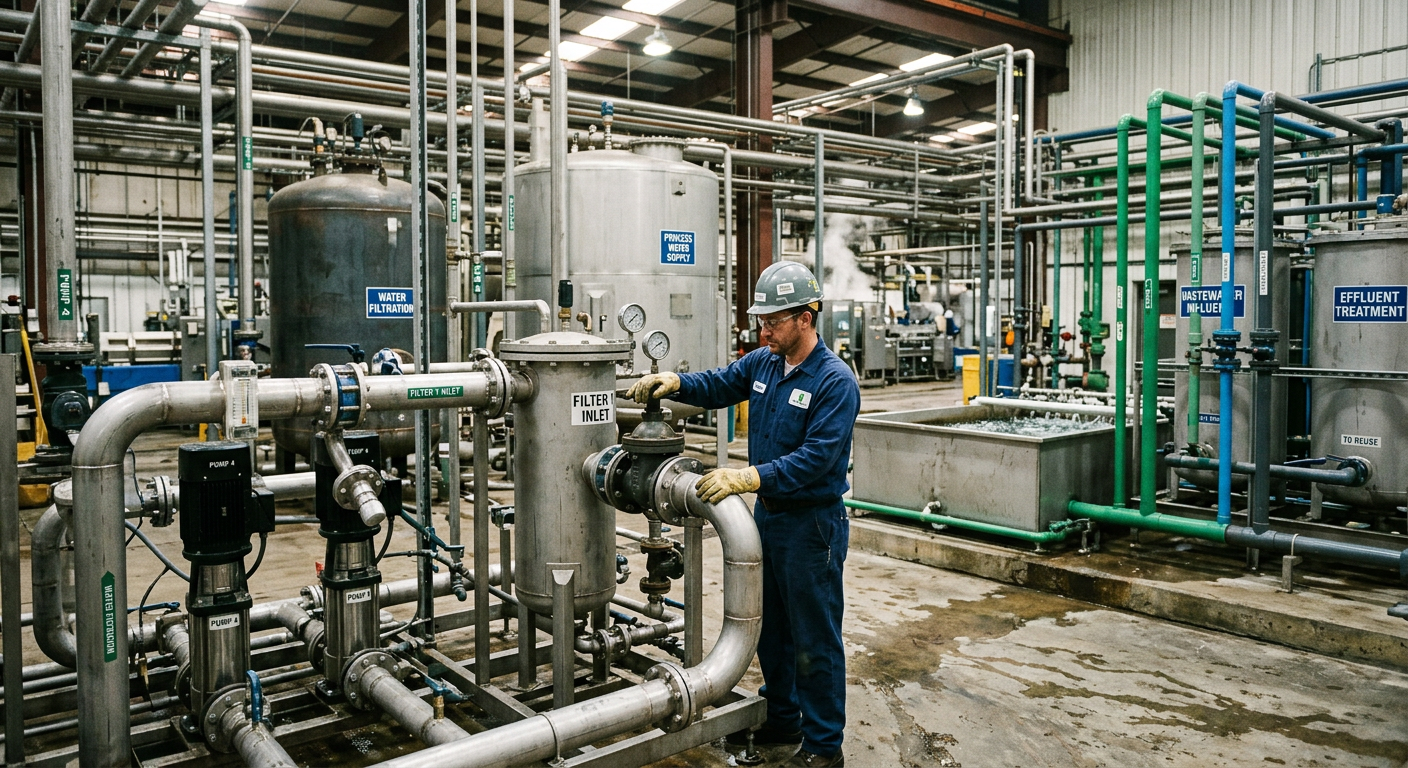
Food Plant Wastewater Management: DAF and Biological Treatment System Design
[trp_language language=”en_US”]
Food Plant Wastewater Systems Design in the United States
Food and beverage manufacturers across the United States face growing pressure to control fats, oils, grease, suspended solids, biochemical oxygen demand, chemical oxygen demand, odors, sludge volume, and sewer surcharge exposure. Whether a facility handles dairy in Wisconsin, poultry in Arkansas, beverages in California, seafood near Seattle, or sauces around Chicago, the right wastewater strategy usually starts with accurate flow characterization, then moves through screening, equalization, dissolved air flotation, biological treatment, sludge management, and final compliance monitoring. A well-designed system does more than meet discharge limits. It protects production uptime, supports expansion, improves water stewardship, and lowers the total cost of ownership.
In practice, most food plants do not need a one-size-fits-all wastewater package. They need a process-specific design based on production peaks, cleaning cycles, ingredient losses, future capacity, utility constraints, and local discharge permits. In many U.S. markets, especially around Los Angeles, Houston, Atlanta, Minneapolis, Fresno, Kansas City, and the I-95 manufacturing corridor, treatment decisions are driven as much by municipal pretreatment rules and hauling costs as by pure engineering. That is why system selection should connect process engineering, capital planning, construction execution, and operational support from the start.
Immediate Takeaway

For most food plants in the United States, the most effective wastewater management approach is a staged system: screening and equalization first, a DAF unit for fats, oils, grease, and suspended solids removal next, and then biological treatment to reduce dissolved BOD and COD before discharge or reuse. This sequence is especially effective for processors handling dairy, meat, sauces, fried foods, ready-to-drink beverages, and high-CIP operations.
If a plant has high FOG, floatable solids, proteins, starches, sugars, or intermittent discharge spikes, a DAF system is often the best primary workhorse. If the plant also has high soluble organics, an aerobic, anaerobic, or hybrid biological system is usually needed to reach final limits. The correct design depends on five core inputs: average flow, peak hourly flow, pollutant loading, pH variation, and sludge handling strategy.
From a buying standpoint, U.S. food processors should avoid selecting wastewater equipment by brochure alone. They should ask for mass balance calculations, design basis assumptions, projected chemical use, sludge yield estimates, energy demand, operator attention requirements, and expansion flexibility. Plants shipping through major trade hubs such as the Port of Los Angeles, Port of Long Beach, Port of Houston, Savannah, Newark, and Tacoma often operate under tighter scheduling and production volatility, which makes robust equalization and control automation even more valuable.
The chart above reflects a realistic upward trend in wastewater upgrade activity across the U.S. food sector. Growth is being driven by capacity expansion, ESG reporting, higher sewer surcharges, nutrient controls, water scarcity in Western states, and 2026 planning for tighter sustainability targets.
Wastewater Characterization and Flow Patterns

Good treatment design begins with wastewater characterization. In food processing, wastewater quality changes by product mix, shift schedule, sanitation method, batch frequency, and seasonal throughput. A frozen food plant in the Midwest may see large starch and suspended solids loads; a dairy processor may see proteins, lactose, and fat; a brewery may see strong soluble COD and yeast solids; a poultry plant may produce blood, fat, and cleaning chemistry variability.
Design teams should establish both hydraulic and organic loading profiles. Average daily flow alone is not enough. U.S. municipal authorities frequently evaluate peak discharge conditions, and treatment units can fail if the system is sized only for average values. A plant that averages 150,000 gallons per day may still discharge 300 gallons per minute during shift change cleanup or tank dump events.
| Parameter | Typical Range | Why It Matters | Common Source | Design Impact | Monitoring Method |
|---|---|---|---|---|---|
| Flow rate | 20,000-1,500,000 gpd | Determines tank and equipment size | Production and CIP | Equalization volume, pump sizing | Flow meter |
| BOD | 800-6,000 mg/L | Measures biodegradable organics | Sugars, proteins, starches | Biological reactor sizing | Lab analysis |
| COD | 1,500-10,000 mg/L | Captures total oxidizable load | Ingredient loss, cleaners | DAF and bio selection | Lab analysis |
| TSS | 200-4,000 mg/L | Drives solids separation needs | Fibers, curd, crumbs, meat fines | Screening and DAF loading | Gravimetric test |
| FOG | 100-2,500 mg/L | Causes sewer and treatment problems | Fryers, dairy fat, meat processing | DAF, heating, skimming needs | Hexane extract |
| pH | 4.5-11.5 | Affects coagulation and biology | Acid/caustic CIP | Neutralization system | Online probe |
This table shows why characterization must be multidisciplinary. A plant can have moderate flow but severe loading, or high flow with relatively low strength. Both situations require different process decisions. Many U.S. plants benefit from a two- to four-week sampling campaign that captures production peaks, allergen changeovers, weekend sanitation, and abnormal dumps.
It is also important to separate streams where practical. Boiler blowdown, cooling tower bleed, RO reject, sanitary sewage, and high-strength process drains should not automatically be blended without analysis. Segregation can reduce treatment costs dramatically. For example, a sauce plant near Dallas may isolate concentrated kettle washout for recovery or controlled dosing rather than sending it directly to a DAF. A beverage site in New Jersey may recover first-rinse sugar loads before they shock the biological system.
| Food Segment | Average Flow Pattern | Peak Risk | Common Pollutant Profile | Preferred Front-End Control | Typical Next Step |
|---|---|---|---|---|---|
| Dairy | Steady with cleanup spikes | Fat slugs and pH swings | FOG, protein, lactose | Equalization + screening | DAF + aerobic treatment |
| Meat and poultry | Shift-based | Blood and fat peaks | TSS, FOG, ammonia | Rotary screen | DAF + bio or anaerobic |
| Beverage | Batch and CIP driven | Sugar dumps | High soluble COD | Equalization | Aerobic or anaerobic |
| Sauces and dressings | Recipe-dependent | Oil emulsion loads | FOG, TSS, COD | Fine screening | DAF + aerobic polishing |
| Seafood | Seasonal | Protein solids surges | TSS, FOG, odor | Drum screen | DAF + odor control |
| Prepared foods | Mixed and variable | Sanitation variability | TSS, starch, grease | Equalization + screen | DAF + MBR or SBR |
The table above helps buyers compare product categories. It also shows why local market knowledge matters. Processors in California, Washington, and parts of the Northeast often face stricter discharge and water reuse expectations than plants with more permissive inland discharge conditions.
Screening and Primary Solids Removal

Primary treatment protects the rest of the system. The first line of defense normally includes trench baskets, static screens, rotary drum screens, screw presses, or internally fed screens. These units remove rags, labels, vegetable pieces, meat fines, bones, curd particles, and packaging debris before they enter tanks and pumps.
Screening is often undervalued because it appears simple, yet poor screening can create chronic maintenance costs downstream. If large solids enter equalization or DAF tanks, they increase cleanout frequency, wear pumps, and raise sludge disposal volume. In U.S. retrofit projects, a properly selected wedge-wire or rotary drum screen can pay back quickly by reducing DAF polymer demand and sludge hauling.
Equalization should follow or accompany screening in most food plants. It smooths hydraulic surges, blends acidic and caustic washes, reduces shock loading to DAF and biological systems, and allows better chemical control. A plant near Atlanta or Charlotte operating with multiple SKU changes per day may need several hours of equalization capacity even at modest average flow because its peak-to-average ratio is high.
Primary treatment design commonly includes:
- Coarse screening for packaging debris and gross solids
- Fine screening for recoverable food particles
- Equalization tanks with mixing and odor control
- pH adjustment for acid and caustic wash streams
- Feed pumps with variable frequency control
- Sampling points for operator verification
For plants considering local suppliers, the decision should not rest only on equipment footprint. Buyers should ask whether screens can handle fibrous loads, whether bypass structures are included, how often spray bars need maintenance, and whether local field service is available in places such as North Carolina, Texas, Illinois, California, or Ontario if cross-border support is needed.
DAF System Engineering for FOG Removal
Dissolved air flotation is often the core primary treatment step for food plant wastewater management. A DAF system removes fats, oils, grease, suspended solids, and a portion of BOD and COD by attaching microbubbles to flocculated particles, which then float to the surface for skimming. For facilities processing dairy, proteins, fried foods, dressings, and oily prepared meals, DAF is usually essential.
DAF performance depends on chemistry and hydraulics, not just vessel size. Coagulants such as ferric chloride, alum, or specialized blends destabilize emulsions. Polymers build larger flocs. pH adjustment may be necessary for optimal separation. Air saturation pressure, recycle ratio, surface loading rate, hydraulic retention time, and scraper design all affect outcome.
| DAF Design Factor | Typical Design Consideration | Operational Effect | If Undersized | If Oversized | Buyer Question |
|---|---|---|---|---|---|
| Surface loading rate | Based on peak flow and solids | Controls separation performance | Carryover solids | Higher capital cost | What peak flow was used? |
| Recycle ratio | 15%-50% | Creates microbubble density | Poor float formation | Higher energy cost | How is recycle controlled? |
| Chemical program | Jar-tested by waste type | Affects FOG and TSS removal | Weak floc | Excess chemical cost | Was jar testing completed? |
| Air saturation | Pressure and contact time | Bubble quality | Low separation | Mechanical complexity | What is saturation efficiency? |
| Skimmer design | Chain, flight, or beach | Sludge capture consistency | Residual float in effluent | More maintenance | How is skimmings dryness improved? |
| Feed equalization | Buffer before DAF | Stable treatment | Shock loads reduce removal | Larger footprint | What surge factor is assumed? |
This table shows that DAF buying advice should focus on design basis, not just vendor claims. In many projects, a DAF can remove 60% to 95% of FOG and TSS and a meaningful share of BOD/COD tied to floatable or particulate matter. However, it will not remove most dissolved organic load by itself.
For U.S. food manufacturers, DAF is especially valuable when municipal sewer districts impose grease caps or surcharge formulas. Plants near municipal systems in Southern California, the Chicago metro, or the Mid-Atlantic often find that DAF investment is justified by avoided surcharges and reduced risk of permit violations.
The chart indicates where DAF demand is strongest by industry. Beverage plants often rely more heavily on biological systems when dissolved sugars dominate, while meat, dairy, and oily prepared foods generally need robust flotation up front.
Choosing the Right Biological Treatment System
After primary solids and grease removal, biological treatment handles the dissolved organic fraction. The correct biological process depends on effluent goals, footprint, operator skill, nutrient balance, climate, odor tolerance, and whether the plant wants low energy use, biogas recovery, or water reuse potential.
The main options in the U.S. food sector include conventional activated sludge, sequencing batch reactors, membrane bioreactors, moving bed biofilm reactors, anaerobic reactors such as UASB or EGSB, and hybrid treatment trains. Each has strengths and tradeoffs.
| Biological System | Best Use Case | Main Advantage | Main Limitation | Typical Footprint | Recommended For |
|---|---|---|---|---|---|
| Activated sludge | Stable flows, moderate loading | Proven and flexible | More operator attention | Medium to large | General food processing |
| SBR | Variable flow and batch plants | Equalization and treatment combined | Cycle control complexity | Medium | Prepared foods, mixed plants |
| MBR | Tight effluent or reuse goals | High effluent quality | Higher capital and membrane care | Small | Urban sites, water reuse projects |
| MBBR | Retrofits and stable polishing | Compact and robust | Needs good solids control | Small to medium | DAF effluent polishing |
| Anaerobic reactor | High-strength soluble COD | Low sludge, biogas recovery | Needs warm, consistent feed | Compact | Beverage, dairy, starch streams |
| Hybrid anaerobic + aerobic | High load with strict discharge | Energy and compliance balance | Most complex integration | Medium | Large multi-line plants |
This comparison is especially useful during project development. A beverage co-packer in Arizona with high soluble sugar losses may justify anaerobic pretreatment. A tight urban dairy site in New York or Boston may favor MBR because footprint and effluent quality matter more than energy optimization. A poultry processor in the Southeast may prefer DAF plus aerobic treatment with ammonia management.
By 2026, more U.S. plants are expected to consider hybrid systems that combine DAF, anaerobic treatment, aerobic polishing, and advanced controls. The drivers are energy cost volatility, carbon reduction targets, water reuse pressure, and local pretreatment enforcement. Facilities seeking future resilience should ask whether the biological system can be expanded modularly and whether automation can support remote diagnostics.
This area chart illustrates a realistic trend: U.S. food manufacturers are moving away from purely single-stage wastewater solutions and toward integrated systems that can adapt to stricter policy and sustainability expectations.
BOD and COD Reduction Strategies
Reducing BOD and COD should begin inside the plant, not only in the treatment yard. The most cost-effective strategy is source reduction. Every pound of product kept out of the drain is cheaper than removing it later with chemicals, aeration, sludge hauling, or permit risk.
Common BOD and COD reduction strategies include:
- Dry cleanup before washdown to reduce solids loading
- Ingredient recovery from tanks, lines, and fillers
- Segregation of first-rinse or dump streams
- Optimized CIP recipes and conductivity-based transitions
- Balanced production scheduling to reduce wash frequency
- DAF chemistry optimization through periodic jar testing
- Biological nutrient balancing for stable microbial performance
- Automation and alarms for accidental product loss events
For high-strength facilities, the design team should evaluate whether soluble and insoluble COD are being treated in the right stages. Suspended or emulsified load belongs in front-end solids removal. Dissolved sugars, organic acids, and soluble proteins are typically better handled biologically. If these fractions are confused, the plant may overspend on chemicals or oversize its aeration system.
Plants planning capital investment should compare several pathways: source reduction only, DAF upgrade, DAF plus aerobic, DAF plus anaerobic plus aerobic, or hauling concentrated side streams while treating the base load onsite. Buyers should review life-cycle cost, not simply installed cost.
Sludge Dewatering and Disposal
Sludge handling is one of the most underestimated cost centers in food plant wastewater management. DAF float, primary screenings, biological waste sludge, and equalization cleanout solids all need an end-of-line strategy. If sludge is not addressed early, a treatment system that appears economical on paper can become expensive to operate.
DAF sludge often contains fat, protein, fibers, chemical precipitates, and water. Biological sludge contains microbial solids and trapped organics. The choice of dewatering equipment depends on solids type, desired cake dryness, polymer demand, labor availability, and disposal outlet.
| Dewatering Method | Typical Solids Type | Dryness Potential | Operational Complexity | Best Fit | Disposal Note |
|---|---|---|---|---|---|
| Filter press | DAF chemical sludge | High | Moderate to high | Plants seeking lower haul volume | Good for landfill cost control |
| Screw press | Mixed biological sludge | Moderate | Low to moderate | Continuous operation sites | Simple operator routine |
| Centrifuge | Wide solids range | Moderate to high | High | Larger regional plants | Higher power demand |
| Belt press | Biological sludge | Moderate | Moderate | Plants with space available | Wash water demand matters |
| Geobag/geotextile | Intermittent sludge volumes | Low to moderate | Low | Seasonal or remote sites | Slow dewatering cycle |
| Direct haul liquid sludge | Low-volume facilities | None | Low onsite effort | Very small operations | Often highest long-term cost |
This table highlights the buying tradeoff between capital cost and hauling cost. A processor near Minneapolis or St. Louis with year-round production may justify a mechanical dewatering unit. A seasonal seafood processor near the Gulf Coast or Pacific Northwest may use lower-capital methods if annual volume is limited.
Disposal routes in the United States can include landfill, compost blending, land application where permitted, rendering-adjacent options for certain organic residuals, or offsite digestion. Regulations and economics vary by state and municipality, so local outlet confirmation is essential before final design. A good project team will verify haul distance, tipping fees, solids acceptance criteria, and contingency outlets.
Effluent Compliance and Ongoing Monitoring
Compliance is not a one-time design exercise. It is an operating discipline. Food plants must understand whether they discharge to a municipal POTW, to surface water under a direct permit, or to a reuse system. Each path has different limits, sampling expectations, and reporting obligations.
Typical monitored parameters include flow, pH, temperature, BOD, COD, TSS, FOG, ammonia, total nitrogen, total phosphorus, and sometimes dissolved oxygen or chlorine residual depending on the process. Plants should also monitor upstream process indicators that predict wastewater upsets, such as product loss events, CIP conductivity, and tank dump frequency.
Facilities in fast-growing industrial regions such as Central Texas, the Inland Empire, the Carolinas, and the Nashville corridor are increasingly seeing tighter pretreatment oversight as municipalities manage infrastructure strain. By 2026, food manufacturers should expect more digital reporting, stronger sustainability documentation, and closer scrutiny of slug discharges and nutrient loads.
Best practices for compliance include:
- Online pH and flow monitoring with alarms
- Routine composite sampling during representative production
- Preventive maintenance for chemical dosing and aeration systems
- Documented SOPs for spills, dumps, and sanitation transitions
- Quarterly performance review against permit and surcharge metrics
- Operator training tied to actual process variability
The comparison chart reflects a common market reality: a standalone wastewater vendor may supply good hardware, but food plants often need broader integration across utilities, controls, production constraints, and expansion planning. That is particularly true when schedules are aggressive or the site is active during construction.
About Our Company
Disruptive Process Solutions supports food and beverage manufacturers throughout the United States and Canada with practical, profit-focused capital project execution. Rather than treating wastewater as a disconnected utility, the company approaches it as part of the full production ecosystem, linking process design, expansion planning, utilities, controls, installation, and startup.
From a technological capabilities perspective, DPS brings cross-disciplinary engineering in process, mechanical, plumbing, electrical, structural, and controls. That matters in wastewater work because DAF and biological systems interact with CIP, heat loads, pumping, automation, compressed air, tanks, and plant utilities. The team also understands automation, PLC programming, and SCADA, which are critical for alarm management, equalization control, chemical dosing, trending, and operator visibility. More about this approach can be found on the engineering and project services page.
From a manufacturing capabilities perspective, DPS designs and supplies process equipment that fits broader facility needs, including tanks, CIP systems, and custom processing support equipment. That equipment background is useful when wastewater performance depends on what happens upstream in blending, batching, holding, or sanitation. Manufacturers evaluating source reduction, drain loss control, or tank farm optimization can benefit from a partner that understands both the process floor and the treatment yard. Additional details are available through the equipment capabilities section.
From a service capabilities perspective, DPS works through a full design-build-manage model that helps clients move from concept and feasibility to construction and execution with a single accountable team. For wastewater projects, that means support with assessment, scope development, budgeting, installation coordination, trade management, startup planning, and owner-side decision support. Companies considering multi-site planning, fast-track retrofits, or operationally sensitive brownfield projects can learn more on the company overview page.
This integrated model is especially valuable when a food plant needs more than equipment procurement. Many U.S. projects require utility tie-ins, phased shutdown planning, odor controls, permit coordination, and future capacity mapping. DPS has built its reputation by focusing on long-term client profitability rather than selling oversized scope. For examples of how strategic engineering decisions translate into business outcomes, visit the project case studies page.
Frequently Asked Questions
1. Does every food plant need a DAF system?
No. A DAF system is most valuable when wastewater contains significant FOG, emulsified oils, or suspended solids. Some beverage or low-solids plants may rely more on equalization and biological treatment.
2. What is the biggest mistake in food wastewater design?
Sizing based on average flow without accounting for peak hydraulic and organic loads is one of the most common and most expensive errors.
3. How much BOD and COD can a DAF remove?
It depends on waste composition and chemistry, but DAF typically removes the particulate and floatable fraction well. It does not replace biological treatment for high dissolved COD streams.
4. Which industries benefit most from DAF plus biological treatment?
Dairy, meat, poultry, seafood, sauces, dressings, fried foods, prepared meals, and mixed co-packing operations are frequent candidates.
5. What should buyers ask local suppliers?
Ask about design basis, installed references in similar food sectors, local service coverage, startup support, chemical assumptions, sludge yield, spare parts, and integration with controls and utilities.
6. How important is equalization?
Very important. Equalization protects both DAF and biological treatment from flow and load surges, especially in batch plants and high-CIP facilities.
7. Should a plant choose aerobic or anaerobic treatment?
Choose based on soluble loading, footprint, energy strategy, temperature, effluent goals, and operator capability. High-strength soluble wastewater often justifies anaerobic pretreatment, while final polishing often remains aerobic.
8. How should a plant plan for 2026 and beyond?
Design for expansion, digital monitoring, water reuse potential, stronger sustainability metrics, and likely tighter nutrient and surcharge oversight in major U.S. industrial regions.
9. What are the most relevant applications for these systems?
Applications include pretreatment before municipal discharge, internal load reduction, compliance upgrades, utility expansion, water reuse preparation, odor reduction, and production capacity support.
10. Are there good case study indicators to request from vendors?
Yes. Ask for before-and-after pollutant data, sludge generation rates, operator labor expectations, chemical usage, uptime performance, and how the system handled seasonal or product mix variability.
In summary, successful food plant wastewater management in the United States depends on matching treatment stages to real process conditions. Screening protects equipment. Equalization stabilizes the system. DAF removes floatable and suspended loads. Biological treatment reduces dissolved organics. Sludge handling controls operating cost. Monitoring protects compliance. When those elements are engineered together with plant operations in mind, wastewater becomes a managed business function rather than a recurring emergency.
[/trp_language]
Complete Company Portfolio

About the Author: Disruptive Process Solutions (DPS)
The DPS team combines process engineering expertise with real-world food and beverage manufacturing experience. Our content focuses on process optimization, production efficiency, facility improvements, and practical solutions that help manufacturers operate more effectively in a rapidly evolving industry.
Share

