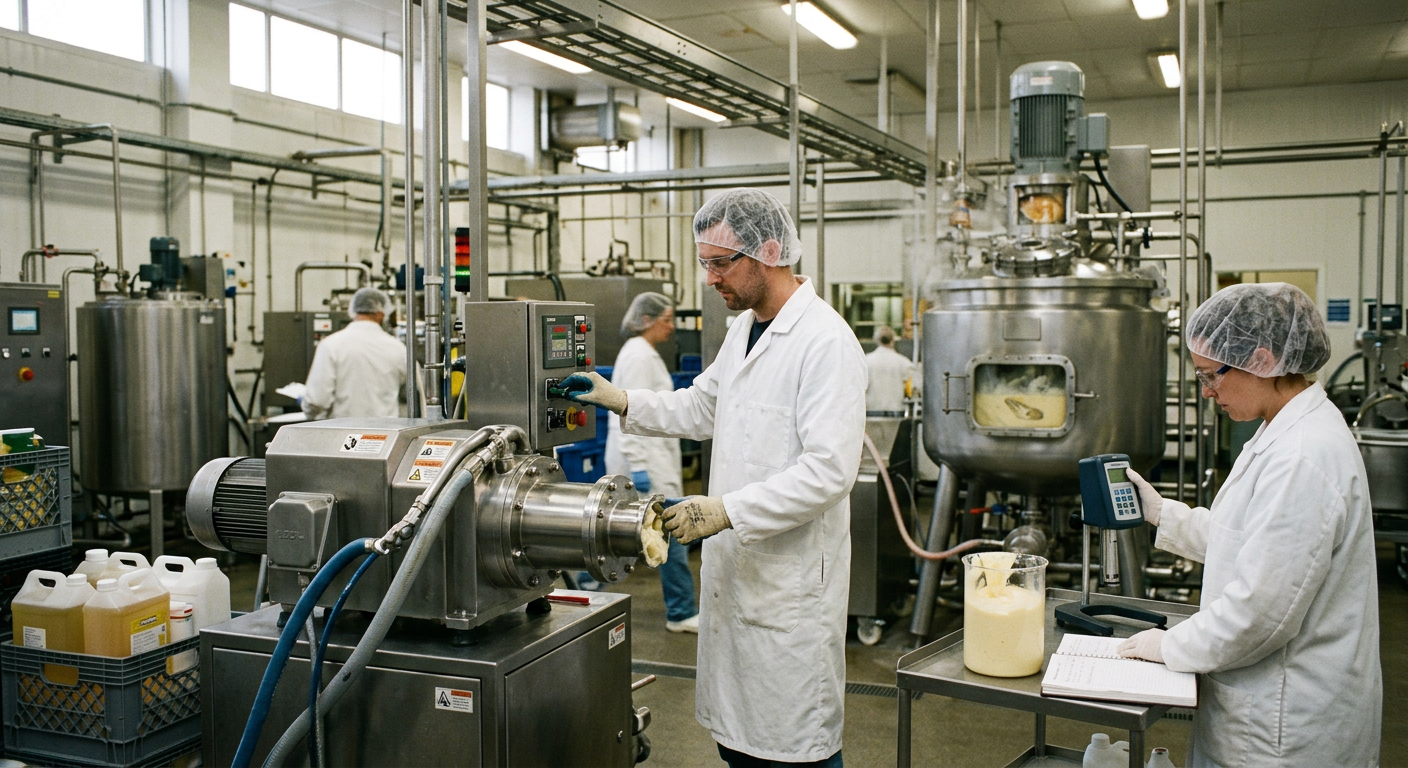
8 Elements of an Effective Food Facility Internal Audit Program
[trp_language language=”en_US”]
How to Build a Strong Internal Audit Program for U.S. Food Facilities
Food manufacturers in the United States operate under constant pressure from FDA expectations, customer standards, GFSI-benchmarked schemes, retail audits, insurance reviews, and internal performance goals. A well-run internal audit program helps a facility detect risk early, verify whether procedures work on the floor, and confirm that corrective actions actually close gaps instead of simply documenting them. For processors handling proteins, dairy, beverages, sauces, prepared foods, aseptic products, or co-packing operations, the internal audit function is one of the clearest ways to protect food safety, brand reputation, labor efficiency, and capital investment.
Effective internal audits are not paperwork drills. They are structured management tools that connect sanitation, preventive controls, GMPs, maintenance, utilities, environmental monitoring, traceability, training, supplier controls, and production realities. This is especially important in U.S. trade and manufacturing hubs such as Chicago, Fresno, Dallas-Fort Worth, Milwaukee, Atlanta, Savannah, Los Angeles, and the Research Triangle, where facilities must balance regulatory compliance with throughput, labor turnover, and high customer expectations.
Quick Answer

An effective food facility internal audit program in the United States includes eight core elements: a risk-based annual schedule, qualified and independent auditors, practical checklists by program area, on-floor GMP verification, disciplined documentation review, clear non-conformance grading, timely CAPA follow-up, and management oversight that turns findings into measurable improvement. The best programs combine compliance verification with operational insight. They do not just ask whether a procedure exists; they confirm whether people, equipment, records, utilities, and workflows support safe, repeatable production.
For most U.S. plants, the strongest internal audit systems follow a simple rule: audit more often where consumer risk, regulatory exposure, and business disruption are highest. A ready-to-drink beverage line with aseptic filling, a USDA protein plant with complex sanitation, and a dairy processor managing allergen controls should not all be audited with the same depth or frequency. Risk, complexity, volume, and history should shape the program.
| Program Element | Primary Purpose | Typical Frequency | Key Owner | Main Output | Business Value |
|---|---|---|---|---|---|
| Annual audit plan | Prioritize risk and coverage | Yearly with quarterly updates | Quality leader | Audit calendar | Improves resource allocation |
| Auditor qualification | Ensure competence and objectivity | Annual review | QA manager or site director | Training matrix | Raises audit credibility |
| Checklist development | Standardize evaluation | Per audit cycle | Program owner | Area-specific checklist | Reduces missed issues |
| Floor inspections | Verify actual practice | Monthly to weekly | Cross-functional team | Observation log | Finds real operational gaps |
| Record review | Confirm execution and evidence | Every audit | Auditor | Verification notes | Supports compliance defense |
| CAPA closure | Prevent repeat findings | 30, 60, or 90 days | Department manager | Closure verification | Drives continuous improvement |
The table above shows why internal audits matter beyond compliance. They help leadership see where process control, staffing, equipment condition, and facility design influence food safety. In many plants, repeated audit findings are not caused by poor intent; they are caused by layout constraints, rushed expansion, utility bottlenecks, or legacy systems that no longer fit production needs.
Annual Audit Planning and Scheduling

Annual audit planning and scheduling should begin with risk ranking, not with a blank calendar. In the United States, facilities often align internal audits to FDA preventive controls requirements, USDA expectations where applicable, customer audit cycles, and certification dates such as SQF or BRCGS. The best plans consider product risk, process complexity, allergen profile, kill step validation needs, environmental monitoring exposure, volume, complaint history, and recent changes such as line additions or packaging conversions.
A practical U.S. schedule often combines full-system audits with shorter targeted audits. For example, a beverage operation in California shipping through the Port of Los Angeles may run a quarterly packaging and traceability audit due to export and retailer requirements, while a protein facility near Kansas City may audit sanitation execution weekly because of direct microbial risk. A plant in North Carolina producing dairy-based beverages may focus more heavily on preventive maintenance, CIP verification, and utility reliability because downtime affects both food safety and yield.
Facilities should also schedule around seasonality. Frozen foods, co-packing, RTD beverages, and holiday-driven prepared foods often have demand surges that reduce available staffing for deep audits. If the schedule ignores production peaks, audits are rushed, findings are weak, and CAPAs stall. Strong planning includes blackout periods, escalation rules, and backup auditors.
| Audit Area | Risk Level | Suggested U.S. Frequency | Typical Trigger for Extra Audit | Records to Review | Notes |
|---|---|---|---|---|---|
| GMP and hygiene | High | Monthly | Complaint spike or turnover | Training and inspection logs | Core baseline program |
| Sanitation and SSOPs | High | Monthly or biweekly | Environmental positives | Pre-op and ATP records | Critical for wet plants |
| Allergen control | High | Quarterly | Label change or new SKU | Changeover and label checks | Very high recall exposure |
| Preventive maintenance | Medium to high | Quarterly | Downtime trend or failures | PM logs and work orders | Strong link to sanitation |
| Traceability and recall | High | Semiannual | New ERP or warehouse change | Lot code and mock recall files | Tests response readiness |
| Supplier approval | Medium | Semiannual or annual | New ingredient source | COAs and vendor files | Important for imported inputs |
| Food defense and security | Medium | Annual | Facility expansion | Access logs and maps | Rising priority for 2026 |
This schedule table works as a planning model, not a fixed rule. A seafood processor near Seattle, a distillery in Kentucky, and a shelf-stable sauce plant in New Jersey have very different operational risk profiles. What matters is documented rationale. If management can explain why audit frequency matches risk, the program is easier to defend during external review.
The line chart illustrates a realistic market trend: more U.S. food plants are broadening internal audit scope as regulatory complexity, retailer demands, labor variability, and automation increase. By 2026, digital records review, environmental data trending, utility reliability checks, and cybersecurity-adjacent controls are expected to become more common within audit plans.
Auditor Qualifications and Independence

Auditor qualifications and independence are essential because weak auditors create false confidence. In food manufacturing, an internal auditor should understand the process being reviewed, know the applicable standard, recognize practical production realities, and remain independent enough to challenge what is normal but no longer acceptable. Independence does not always require an outside consultant, but it does require that an auditor not routinely grade their own direct work.
In U.S. plants, good internal auditors often come from quality, sanitation, operations, maintenance, engineering, warehousing, or supply chain backgrounds. Cross-functional audits are particularly valuable. For example, a maintenance leader may notice hygienic design weaknesses that a documentation-focused auditor misses. Likewise, a quality specialist may catch label reconciliation gaps that operations staff view as routine.
Training should include food safety fundamentals, regulatory context, root cause analysis, interview technique, observation skills, evidence gathering, and non-conformance writing. A trained auditor knows how to separate a symptom from a system failure. If a pre-op form is missing a signature, the real issue may be rushed startup, poor supervisor review, a software workflow problem, or unclear accountability.
Independence can be supported by rotating auditors across departments, using sister-plant reviewers, or combining internal staff with specialized outside support during high-risk audits. Manufacturers expanding or remodeling lines often benefit from engineering-informed auditors because layout, utility routing, traffic flow, drainage, and CIP design can directly affect compliance outcomes.
This is where a partner with deep process and facility knowledge can be valuable. Food and beverage project services from DPS support manufacturers that need practical alignment between compliance goals and plant execution. When audit findings point to drainage defects, CIP dead legs, traffic crossover, poor utility access, or underperforming controls, the issue may be broader than a QA problem.
| Qualification Area | Why It Matters | Minimum Expectation | Preferred Capability | Common Gap | Improvement Action |
|---|---|---|---|---|---|
| Food safety knowledge | Supports standard interpretation | PCQI or equivalent awareness | Multi-standard familiarity | Overreliance on forms | Annual refresher |
| Process understanding | Connects risk to operation | Area orientation | Hands-on line exposure | Missed process interactions | Floor shadowing |
| Audit technique | Improves evidence quality | Basic internal auditor training | Root cause interviewing | Checklist-only auditing | Mentored audits |
| Independence | Reduces bias | No self-audit | Cross-site review | Friendly scoring | Rotation plan |
| Writing skill | Clarifies findings and actions | Clear factual notes | Risk-based grading | Vague findings | Report templates |
| Technical literacy | Handles digital systems | Basic data review | Trend analysis capability | Poor record verification | System training |
The table above shows that competence goes well beyond a one-time course. As U.S. plants adopt more automation, historian data, SCADA systems, electronic batch records, and sensor-based verification, auditor capability must expand too. By 2026, auditors who cannot evaluate digital evidence will struggle to verify whether controls are truly functioning.
Checklist Development by Program Area
Checklist development by program area should be structured, simple, and risk-based. Overloaded checklists often lead to shallow audits, while overly general lists miss critical details. The most useful approach is to build a core audit framework and then create area-specific modules for sanitation, allergen control, process controls, maintenance, receiving, storage, packaging, utilities, traceability, and food defense.
Each checklist should include three layers of verification: documented requirements, observed practice, and objective evidence. For example, an allergen audit should not stop at reviewing a procedure. It should verify label control at the line, material segregation in storage, changeover execution, reconciliation records, and employee understanding. A maintenance checklist should not just ask whether PMs exist. It should confirm whether critical assets are maintained in ways that protect hygienic design and line reliability.
For facilities with multiple process types, such as breweries adding RTD products or co-packers running both acidified and dairy items, checklists should be separated by process risk rather than managed as one generic plant list. Plants near logistics centers such as Memphis, Indianapolis, or the Port of Savannah may also need stronger warehouse and shipping verification because product movement is fast and lot control complexity is high.
| Program Area | Checklist Focus | Evidence Examples | Common U.S. Issue | Operational Impact | Audit Tip |
|---|---|---|---|---|---|
| Receiving | Inspection and lot control | COAs, temperature logs | Unverified supplier paperwork | Ingredient risk | Trace one lot end-to-end |
| Storage | Segregation and rotation | Inventory records, labels | Allergen crossover | Recall exposure | Check overflow zones |
| Processing | Critical limits and setup | Batch sheets, alarms | Parameter drift | Safety and yield loss | Observe startup |
| Packaging | Label and code accuracy | Reconciliation logs | Wrong film or labels | Misbranding risk | Inspect line clearance |
| Utilities | Water, air, steam, glycol | Test records, PM logs | Weak support-system control | Plantwide disruption | Audit non-production areas too |
| Sanitation | Execution and verification | SSOPs, pre-op records | Inconsistent wash practices | Micro risk | Compare crew to written SSOP |
| Training | Competency and refreshers | Sign-offs, assessments | Language gaps | Repeat findings | Interview operators directly |
This checklist table is useful because it links audit questions to actual evidence and business consequences. A strong internal audit program should make it easier for management to see which issues are procedural, which are training-related, and which are physical plant constraints.
Facilities expanding capacity or reconfiguring process flow often discover that audit findings are symptoms of design problems. In those cases, engineering support matters. Process equipment and system capabilities are relevant when recurring issues involve CIP effectiveness, vessel access, transfer piping, utility support, or production line integration. A better checklist can identify the problem, but long-term closure may require equipment or facility modification.
GMP Verification and Floor-Level Inspections
GMP verification and floor-level inspections are where internal auditing becomes real. Policies and records can appear compliant while actual practice drifts. On-floor inspections should focus on behaviors, conditions, traffic patterns, housekeeping, equipment condition, material handling, handwashing, tool control, temporary fixes, and startup discipline. In U.S. food plants, many of the findings that later become customer complaints or regulatory concerns begin as visible floor-level issues.
Effective GMP auditing means watching the process in motion. Inspect gowning at shift change. Observe forklift routes around exposed packaging. Verify whether utensils are stored as written. Check whether rework containers are labeled and controlled. Look at drains, condensate, overspray, worn seals, cracked hoses, unlabeled spray bottles, and maintenance work taking place during production. In protein, dairy, and wet beverage environments, floor conditions and drainage patterns often reveal risks faster than paperwork does.
High-performing facilities also use floor inspections to verify whether infrastructure supports GMP compliance. Congested traffic, poor zoning, inadequate handwash placement, weak air balance, limited storage, and hard-to-clean equipment surfaces create predictable failures. Plants in older industrial corridors such as the Midwest frequently deal with legacy layouts that no longer match modern food safety expectations. In these cases, internal audit findings should be escalated beyond housekeeping and into capital planning.
The bar chart reflects how different sectors rely on floor-level GMP verification. Protein, dairy, and co-packing operations often demand the most frequent observation because of sanitation complexity, allergen exposure, high SKU counts, and rapid line changeovers.
When floor findings repeatedly connect to poor equipment access, utility congestion, or layout problems, a broader operational view is required. DPS brings strong technological capabilities in process, mechanical, plumbing, electrical, structural, and controls engineering, including PLC programming, automation, and SCADA. That matters because many food safety issues are rooted in how systems are designed and integrated, not just how operators behave. A plant that cannot clean a line properly because of dead legs or poor valve placement will keep failing audits until the design problem is solved.
Documentation Review and Record Verification
Documentation review and record verification confirm whether the plant can prove control. Internal audits should examine not only whether records exist, but whether they are complete, timely, accurate, legible, trendable, and linked to the right corrective actions. In the United States, this matters for FDA inspections, customer inquiries, certification audits, and legal defensibility after complaints or incidents.
Good record review includes preventive controls monitoring, verification logs, calibration, maintenance, sanitation, training, environmental monitoring, pest control, supplier approval, receiving, traceability, and change management. Record verification should also test whether forms reflect reality. If a line changeover supposedly takes 12 minutes, but floor observation shows 35 minutes, then the record system may be encouraging rushed sign-offs instead of accurate control.
Digital systems can improve this, but only if configured well. Electronic records should support time stamps, exception flags, review workflows, and retrieval speed. Plants in highly automated sectors, such as aseptic beverage, high-speed dairy, or integrated protein operations, increasingly rely on control systems, historian data, batch software, and connected instruments. Auditors should know how to verify alarm history, parameter trends, and user permissions, not just paper binders.
| Record Type | What the Auditor Verifies | Typical Defect | Risk Level | Best Evidence Check | Recommended Action |
|---|---|---|---|---|---|
| CCP or preventive control logs | Limit met and reviewed | Missing initials or times | High | Cross-check with production run | Retrain and revise review timing |
| Sanitation records | Execution matches SSOP | Generic comments only | High | Compare to pre-op findings | Use more specific defect coding |
| Calibration records | Devices are within tolerance | Overdue instruments | Medium to high | Spot-check serial numbers | Escalate asset control |
| Training files | Competency documented | Sign-in without assessment | Medium | Interview trained employees | Add practical verification |
| Maintenance work orders | Critical repairs closed properly | Temporary fixes left open | Medium to high | Inspect repaired asset physically | Track repeat failures |
| Traceability records | Lot linkage is intact | Manual entry mismatch | High | Run mock recall exercise | Improve label and ERP controls |
| Supplier documents | Approval status current | Expired certificates | Medium | Match to recent receipts | Automate renewal alerts |
This table matters because record verification is one of the quickest ways to distinguish a mature system from a superficial one. Strong records show control, but they also help reveal where staffing, automation, or workflow needs improvement.
Manufacturers dealing with major expansions, utility upgrades, or new process integration often need records that align with how the plant actually operates. DPS supports this through service capabilities that span feasibility, capital planning, owner’s representation, project and program management, general contracting support where licensed, installation, and system integration. More detail on the firm’s background is available on the about page. For many plants, document problems improve only after process flow, controls, and accountability are redesigned together.
Non-Conformance Identification and Grading
Non-conformance identification and grading should be consistent, risk-based, and easy for leadership to interpret. If one auditor calls an issue minor while another calls the same issue major, the program loses credibility. The goal is not to generate more findings. The goal is to express the seriousness of the issue based on food safety risk, regulatory exposure, customer impact, recurrence, and system weakness.
A useful grading model separates observations, minor non-conformances, major non-conformances, and critical non-conformances. An observation may be a low-risk issue with no direct failure of control, such as inconsistent wording on a supporting checklist. A minor non-conformance indicates a lapse that does not currently compromise product safety but shows weakness. A major non-conformance signals that a required system is ineffective or not followed in a way that could affect safety, legality, or customer commitments. A critical issue indicates an immediate and significant threat requiring urgent containment and leadership escalation.
U.S. plants should also trend repeat findings. A minor issue repeated across three audit cycles is no longer minor from a management perspective. Repeat failures often indicate broken ownership, poor resource planning, weak training retention, or unresolved facility limitations. Sites near large distribution routes, such as I-80 and I-95 corridors, may face especially high pressure to keep product moving; audit grading helps prevent speed from overriding control.
| Grade | Definition | Typical Example | Immediate Response | Closure Expectation | Escalation Level |
|---|---|---|---|---|---|
| Observation | Improvement opportunity, low risk | Checklist wording inconsistent | Document for review | Next cycle or planned update | Program owner |
| Minor | Isolated lapse without direct hazard | One incomplete training record | Correct and monitor | 30 days typical | Department manager |
| Moderate | Multiple related lapses or trend | Repeated gowning issues | Corrective action plan | 30 to 45 days | Site QA lead |
| Major | System ineffective or not followed | Allergen label checks not executed | Containment and root cause | 15 to 30 days with verification | Plant leadership |
| Critical | Immediate food safety or legal risk | Uncontrolled CCP failure | Stop, hold, investigate | Immediate plus formal verification | Executive escalation |
| Repeat major | Major issue not sustainably fixed | Same sanitation failure across audits | Broader management review | Leadership-led closure | Senior management |
The grading model above helps sites prioritize action and funding. It also improves communication between QA, operations, maintenance, engineering, and finance. When leadership sees which findings are systemic, it becomes easier to justify projects involving drainage, airflow, line segregation, automation changes, or replacement equipment.
The area chart shows a realistic trend shift: more facilities are moving from static findings lists to digital grading, recurrence tracking, and trend dashboards. This shift is expected to accelerate through 2026 as sustainability, labor efficiency, and enterprise risk reporting gain importance.
CAPA Follow-Up and Closure Verification
CAPA follow-up and closure verification are where many internal audit programs fail. Plants often document corrective actions quickly but do not verify effectiveness. Replacing a damaged squeegee, retraining an operator, or editing a form may close the symptom while leaving the root cause in place. Effective CAPA requires containment, root cause analysis, action ownership, due dates, implementation evidence, and independent verification that the issue is unlikely to recur.
Closure verification should ask five questions. Was the immediate risk contained? Was root cause identified at the system level? Was the action appropriate to the risk? Was the action completed as claimed? And has effectiveness been demonstrated over time? For higher-risk findings, closure may require a follow-up floor inspection, additional record review, trend evaluation, or even engineering change verification.
This is especially important for findings tied to infrastructure and process design. If repeated issues involve inadequate CIP coverage, difficult-to-clean equipment geometry, compressed air quality, steam reliability, glycol capacity, or poor line controls, the CAPA should not stop at retraining. It may require redesigned systems, upgraded equipment, or a broader capital project.
DPS brings manufacturing capabilities that are relevant when CAPAs point toward physical solutions rather than procedural fixes. The company supports food and beverage manufacturers across North America with engineered process equipment, system integration, proprietary tanks and CIP systems, installation, and commissioning support. That combination is useful when an audit program identifies recurring issues tied to process vessels, utility systems, transfer lines, automation, or expansion constraints. Examples of project work can be seen in selected industry case studies.
| CAPA Stage | Main Question | Responsible Party | Evidence Needed | Timing | Failure Risk if Skipped |
|---|---|---|---|---|---|
| Containment | Is product or process risk controlled now? | Area manager | Hold, segregation, temporary control | Immediate | Continued exposure |
| Root cause | Why did the failure happen? | Cross-functional team | Analysis record | 1 to 5 days | Symptom-only fix |
| Action plan | What will prevent recurrence? | Department owner | CAPA plan with deadlines | Within 1 week typical | Weak accountability |
| Implementation | Was the action completed correctly? | Assigned owner | Photos, records, revised SOPs | Varies by risk | Paper closure only |
| Verification | Did the action work in practice? | Independent verifier | Follow-up audit evidence | 15 to 90 days | Repeat findings |
| Management review | Should this issue affect priorities or budget? | Leadership team | Trend report | Monthly or quarterly | Systemic risk remains hidden |
The CAPA table above makes a crucial point: closure is a process, not a signature. Mature U.S. plants treat CAPA data as strategic information. If one site repeatedly struggles with drainage, label reconciliation, environmental positives, or utility instability, leadership should use that information to guide staffing, training, maintenance planning, and capital deployment.
The comparison chart highlights an important buying consideration. Facility-linked audit findings often close more successfully when food safety, operations, equipment, utilities, and capital execution are treated together instead of separately. That is why many manufacturers seek partners who understand both compliance and plant performance.
Our Company
Disruptive Process Solutions supports U.S. and Canadian food and beverage manufacturers that need more than standard contractor execution. The company works as an engineering and project delivery partner for processors that want profitable, practical, and scalable outcomes. Rather than approaching every problem as a standalone equipment or construction task, DPS aligns process design, utility infrastructure, installation, integration, and execution management to the client’s long-term manufacturing goals.
From a technological capability standpoint, DPS works across structural, mechanical, plumbing, electrical, process, and controls engineering. Its team supports automation, PLC programming, SCADA, utility coordination, and process integration across beverage, dairy, protein, prepared foods, aseptic, and specialty applications. This is relevant to internal audit improvement because many repeat findings arise from how systems are configured, controlled, or maintained rather than from policy language alone.
From a manufacturing capability standpoint, DPS supports a broad mix of food and beverage systems, including fermentation, distillation, pasteurization, sterilization, blending, batching, filtration, CIP, water treatment, tanks, cook systems, marination, forming, retort, and clean-process environments. The company also offers its own process equipment line, which can be useful when CAPAs require replacement or expansion of tanks, CIP skids, or other integrated assets.
From a service capability standpoint, DPS provides capital planning, feasibility, owner’s representation, process design, project management, general contracting functions where applicable, equipment supply, installation, and integration. For manufacturers facing internal audit findings tied to growth, aging assets, line conversion, or utility constraints, that end-to-end model helps move from problem identification to implementation.
The company serves clients throughout all 50 U.S. states, with headquarters in Cary, North Carolina, and a West Coast office in Lake Forest, California. That footprint supports work across major food and beverage corridors, from the Southeast and Texas to the Midwest, California, and broader North America. Facilities looking for a strategic partner can review service capabilities, explore equipment offerings, or learn more about the team and approach.
For U.S. buyers, the practical advice is simple: choose audit support and project partners who can connect compliance findings to real plant conditions. If a recurring issue could involve layout, automation, utility capacity, product flow, or cleanability, the most cost-effective answer may not be another round of training. It may be smarter design, smarter capital, and smarter execution.
FAQ
What is the ideal frequency for internal audits in a U.S. food facility?
Most plants should use a mix of monthly GMP or sanitation audits, quarterly program audits, and annual full-system reviews. High-risk areas such as allergen control, environmental monitoring, aseptic processing, or USDA-regulated operations may require more frequent checks.
Should internal auditors come from quality only?
No. Quality should usually coordinate the program, but the strongest audit teams are cross-functional. Operations, maintenance, warehousing, engineering, sanitation, and supply chain leaders often identify different risk signals.
How long should an internal audit take?
A focused area audit may take one to three hours, while a full-system audit may take one to several days depending on plant size, complexity, and product mix. What matters most is evidence quality, not duration.
What is the most common weakness in food facility internal audits?
Many programs are weak in CAPA verification. They document findings and assign actions, but they do not confirm whether the root cause was addressed or whether the same issue returns later.
How should a plant handle repeat audit findings?
Repeat findings should be escalated in severity or management attention. They usually indicate that the issue is systemic, under-resourced, or linked to design and workflow limitations rather than isolated employee error.
Can internal audits support capital planning?
Yes. In fact, they should. Trends involving drainage, CIP effectiveness, traffic crossover, equipment access, utility instability, or control limitations often justify capital improvement more effectively than anecdotal complaints.
How do 2026 trends affect audit planning?
By 2026, U.S. plants are expected to place more focus on digital verification, energy and water efficiency, data-integrated CAPA tracking, food defense, workforce retention, and sustainability-linked operational risk. Policies may increasingly reward documented environmental performance, utility efficiency, and resilient infrastructure.
Are local market conditions relevant to audit design?
Yes. Plants near ports such as Los Angeles/Long Beach, Savannah, or Newark may face more imported material complexity. Sites in major manufacturing regions like Wisconsin dairy, California beverage, Texas protein, or North Carolina processing clusters often face region-specific labor, utility, and supply chain realities that should influence audit focus.
What should a company look for in an outside partner?
Look for industry-specific expertise, regulatory fluency, ability to understand process and utility systems, strong project execution, and willingness to challenge assumptions. The right partner should help turn findings into sustainable plant performance, not just produce reports.
What is the business benefit of a mature internal audit program?
A mature program reduces recalls, complaints, downtime, rework, and certification risk. It also improves labor efficiency, management visibility, and capital planning by revealing where systems are failing before outside parties do.
In the United States, the most effective internal audit programs are practical, risk-based, cross-functional, and tied to action. They do not live in binders. They live on the floor, in records, in management review, and in the plant systems that support safe production every day.
[/trp_language]
Complete Company Portfolio
About the Author: Disruptive Process Solutions (DPS)
The DPS team combines process engineering expertise with real-world food and beverage manufacturing experience. Our content focuses on process optimization, production efficiency, facility improvements, and practical solutions that help manufacturers operate more effectively in a rapidly evolving industry.
Share