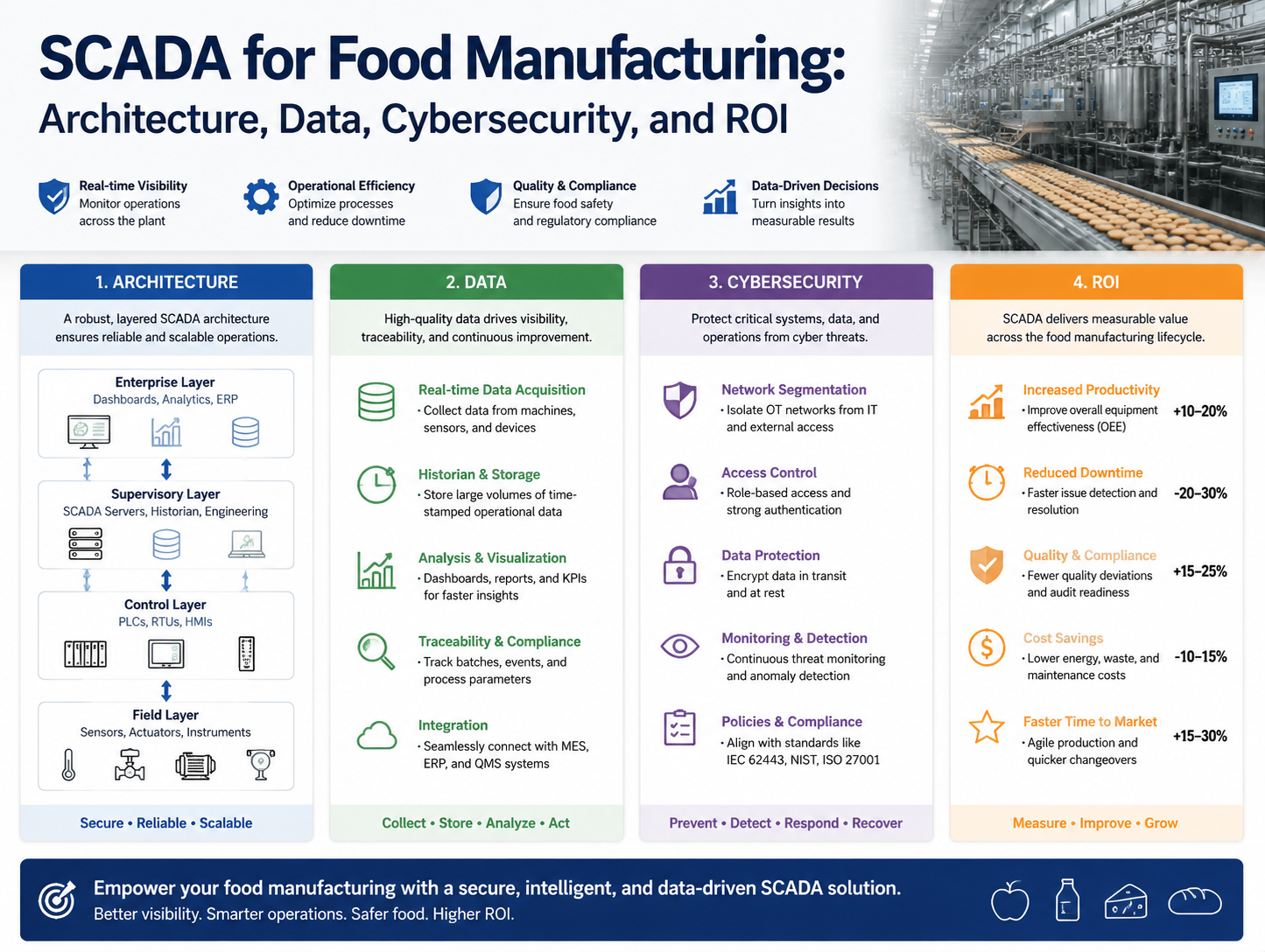
SCADA for Food Manufacturing: Architecture, Data, Cybersecurity, and ROI
[trp_language language=”en_US”]
Food Manufacturing SCADA Systems in the United States
Food manufacturers need automation systems that do more than display process values. A well-designed SCADA platform connects equipment, operators, recipes, quality records, utilities, maintenance information, and business decisions into one dependable operating environment. For facilities in the United States, a food manufacturing SCADA system can support safer production, stronger traceability, lower operating risk, and more profitable capital investments.
Quick Answer

A SCADA system for food manufacturing is a supervisory platform that collects data from PLCs, sensors, drives, process skids, packaging lines, utilities, and plant networks. It gives operators and managers a real-time view of production while recording the information needed for recipes, batches, alarms, sanitation, quality verification, maintenance, and product traceability.
In a modern U.S. food or beverage plant, SCADA typically sits above PLC and HMI controls. PLCs execute machine logic, HMIs provide local operator interaction, and SCADA coordinates plant-wide visibility, historian data, reporting, alarming, user access, and integration with systems such as ERP, MES, laboratory information systems, and maintenance platforms.
The right architecture depends on the process. A ready-to-eat protein facility may prioritize cooker verification, sanitation interlocks, allergen control, and USDA-ready records. A dairy processor may require continuous temperature, flow, pasteurization, CIP, and separator data. A sauce, dressing, or beverage producer may focus on recipe management, Brix control, batching accuracy, changeovers, and tank inventory. In every case, the system should be designed around operational and financial outcomes rather than software features alone.
For manufacturers expanding in regions such as the Midwest protein corridor, California’s Central Valley, North Carolina’s food and beverage market, Texas processing hubs, or port-connected production centers near Savannah, Houston, Newark, and Los Angeles, SCADA can provide a scalable automation foundation without forcing a complete replacement of existing equipment.
What Is a SCADA System for Food Manufacturing?

SCADA stands for Supervisory Control and Data Acquisition. In food manufacturing, it is the software and network layer that supervises production assets, gathers data from the floor, provides visual process screens, records critical events, and helps personnel make faster, more consistent decisions.
A food manufacturing SCADA system is not one single device. It is a coordinated environment that may include industrial servers, virtual machines, operator workstations, engineering workstations, industrial Ethernet switches, firewalls, PLCs, remote I/O, barcode scanners, SQL databases, historians, reporting tools, and remote-support procedures. The system may cover one packaging line or an entire multi-building campus with processing, refrigeration, wastewater, boiler, CIP, and warehouse operations.
SCADA is particularly valuable where production depends on repeatable processing conditions. Examples include HTST pasteurization, UHT processing, retort cooking, fermentation, marination, blending, high-shear mixing, dehydration, smoking, carbonation, filling, and clean-in-place operations. It can capture the conditions that matter: time, temperature, pressure, flow, conductivity, pH, Brix, speed, weight, valve position, sanitation sequence, alarms, operator actions, and lot identifiers.
The market is moving toward connected manufacturing, but the most useful systems remain practical. Operators need clear graphics, controls personnel need maintainable logic, quality teams need usable records, and leadership needs trustworthy production and downtime information. A SCADA project succeeds when the plant can make better decisions at 2:00 a.m. on a production shift, not merely when a dashboard looks impressive in a conference room.
The chart provides an illustrative planning view of continued U.S. investment in connected food automation. Drivers include labor constraints, retailer documentation requirements, product complexity, energy costs, food-safety expectations, and the need to increase throughput without proportionally increasing headcount.
Operational Problems This System Should Solve

Before selecting a SCADA platform, define the operational problems that have measurable cost or risk. Installing new screens without resolving those issues creates another layer of complexity. The best projects begin with a current-state assessment of production losses, manual records, quality risks, and maintenance limitations.
| Operational problem | Typical root cause | SCADA response | Business impact |
|---|---|---|---|
| Inconsistent batches | Manual ingredient additions and undocumented changes | Electronic recipes, permissives, guided steps, and batch records | Less rework and improved product consistency |
| Unexplained downtime | Alarm floods and poor event history | Time-stamped alarms, downtime codes, and trend review | Faster troubleshooting and improved OEE |
| Weak traceability | Paper logs, disconnected lot records, and manual entry | Lot capture, material genealogy, and electronic production records | Faster investigations and recall readiness |
| CIP uncertainty | Incomplete cycle documentation or poorly sequenced valves | Recipe-controlled CIP sequences and verification records | Reduced sanitation risk and water use |
| Utility waste | Limited visibility into steam, chilled water, compressed air, and power | Metering, demand trends, and utility alarms | Lower energy and maintenance costs |
| Operator dependency | Tribal knowledge and inconsistent operating practices | Standardized screens, procedures, and role-based guidance | More reliable shift-to-shift performance |
| Slow quality investigations | Data spread across binders, spreadsheets, and local machines | Central historian, batch reports, and secure audit trails | Quicker release decisions and root-cause analysis |
This table shows why a SCADA scope should be tied to plant performance. A manufacturer does not need every capability on day one. However, the architecture should allow the system to grow from one high-value process area to additional lines, utilities, warehouses, and sites without requiring a redesign.
Common high-priority use cases include identifying recurring filler faults, reducing mixer wait time, verifying cook and cool windows, controlling allergen changeovers, monitoring refrigeration temperatures, proving CIP completion, calculating material yields, and locating the source of frequent conveyor stops. These are operational problems that can be measured in labor hours, scrap, lost capacity, customer risk, or utility expense.
Demand is especially high in sectors where process variability, compliance records, multiple SKUs, sanitation complexity, and line speed make manual management difficult. Beverage co-packers, dairy operations, protein processors, and high-volume prepared-food facilities often benefit from connected control environments because their production constraints span more than one piece of equipment.
PLC, HMI, SCADA, Network, and Data Architecture
A reliable control architecture separates responsibilities. The PLC is responsible for deterministic machine and process control. The HMI gives operators local access to equipment status, commands, setpoints, and guided procedures. SCADA provides supervisory control, system-wide visualization, data collection, alarms, reporting, and integration. Network and data layers provide secure communication, resilience, and usable long-term records.
In a well-designed facility, critical safety functions remain in properly designed safety circuits and safety-rated control systems. SCADA should not replace safety engineering. Instead, it should make safety status clear, record relevant events, and ensure that process permissives are visible and controlled according to approved operational requirements.
| Architecture layer | Primary function | Food manufacturing examples | Design consideration |
|---|---|---|---|
| Field devices | Measure and actuate the process | Temperature probes, flowmeters, valves, VFDs, load cells | Use hygienic, calibrated, maintainable instruments |
| PLC and remote I/O | Execute sequence and interlock logic | CIP sequencing, cooker controls, conveyor logic | Provide capacity for future I/O and documented code |
| Local HMI | Support equipment-level operation | Skid touchscreen, filler panel, boiler interface | Design screens for real operator workflows |
| SCADA servers | Supervise plant processes and collect data | Central control room, alarm server, visualization server | Use redundancy where downtime risk justifies it |
| Historian and database | Store time-series and production records | Batch reports, temperature trends, utility consumption | Define retention, backup, and retrieval requirements |
| Industrial network | Connect control assets reliably | Managed switches, fiber backbone, VLANs | Segment OT traffic from IT and guest networks |
| Business integration layer | Exchange approved data with enterprise systems | ERP orders, MES schedules, CMMS work orders | Use controlled interfaces and least-privilege access |
The table highlights an important buying principle: software cannot compensate for weak field instrumentation, unreliable wiring, undocumented PLC logic, or an unmanaged network. A successful food manufacturing SCADA project evaluates the full control stack, from sensor accuracy through reporting requirements.
For brownfield facilities, the first task is often to map existing PLC families, proprietary OEM controls, communication protocols, remote-access paths, and unmanaged switches. Older lines may communicate through serial connections, Modbus, EtherNet/IP, PROFINET, OPC UA, or vendor-specific interfaces. Integration is usually possible, but the scope should distinguish between monitored data, controlled data, and systems that must remain isolated due to safety, warranty, or operational constraints.
Disruptive Process Solutions supports the technological side of these projects through control-system engineering, PLC programming, automation design, SCADA development, panel and field integration, and commissioning. Its automation and controls engineering services are intended to connect process intent to dependable plant-floor execution, rather than treating SCADA as a standalone IT project.
Recipe, Batch, Alarm, and Traceability Requirements
Recipes and batch management are central to food manufacturing automation because they convert product specifications into repeatable operating instructions. A recipe may define ingredient targets, temperatures, mixer speeds, hold times, valve routes, Brix limits, cook profiles, sanitation rules, and packaging settings. A batch record captures what actually occurred during production.
The appropriate level of batch functionality depends on the process. A high-volume beverage syrup room may need precise automated batching and tank allocation. A protein marination line may need formula control, lot tracking, tumbler cycle verification, and allergen changeover controls. A prepared-food facility may need ingredient scale interfaces, cook-step confirmations, and electronic review of critical control data.
| Requirement | Recommended SCADA capability | Data to retain | Typical user |
|---|---|---|---|
| Formula control | Versioned recipes with approval workflow | Recipe ID, version, approver, effective date | R&D, quality, production |
| Ingredient verification | Barcode, RFID, or manual confirmation prompts | Supplier lot, ingredient lot, quantity, operator ID | Warehouse, batching operators |
| Batch execution | Step-by-step sequencing and permissives | Start/end time, actual values, exceptions | Production operators |
| Critical limits | Configured limits, alarms, and holds | Time-temperature data, deviations, corrective actions | Quality and food-safety teams |
| Alarm management | Prioritized alarms with acknowledgment records | Alarm source, duration, response, recurrence | Operations and maintenance |
| Genealogy | Lot-to-batch-to-finished-good linkage | Raw material, WIP, packaging, finished lot | Quality, supply chain, recall team |
| Electronic reporting | Shift, batch, CIP, exception, and yield reports | Signed or approved production records | Plant leadership and auditors |
Alarm design deserves special attention. An alarm should communicate a condition that requires timely awareness or action. If operators see hundreds of repetitive messages during a routine upset, they may miss the event that actually threatens safety, production, or equipment. Alarm rationalization identifies meaningful alarm priorities, expected operator response, deadbands, delays, shelving rules, and escalation procedures.
Traceability should be designed from the material flow, not from the database outward. Start with how ingredients enter the site, where they are sampled, which tanks or rooms receive them, how they are transformed, when packaging is applied, and how finished goods leave the facility. This approach is important for plants receiving materials through major logistics hubs such as the Port of Houston, Port of Savannah, Port of Los Angeles, Chicago rail terminals, or regional cold-chain centers in Dallas, Atlanta, and Indianapolis.
For sanitation-intensive processing, automated CIP records can be equally important. A properly designed system can document circuit selection, chemical concentration, return conductivity, flow, temperature, phase time, valve confirmation, deviations, and final rinse conditions. DPS also designs and integrates custom CIP systems for food and beverage plants, allowing CIP hardware and automation requirements to be developed together.
Integration with Existing Equipment and Utilities
Most SCADA investments in the United States are brownfield projects. The facility already has production equipment, OEM panels, operators who understand local workarounds, and utility systems that cannot be taken offline casually. The goal is to improve coordination without creating new production risks.
Integration planning should begin with a site survey and an equipment inventory. This includes asset names, controller models, firmware versions, network addresses, panel condition, available drawings, electrical capacity, instrument condition, protocol support, and operational ownership. The survey should also document who owns each equipment package: the manufacturer, the system integrator, plant maintenance, corporate automation, or a third-party service provider.
| Asset category | Common integration opportunity | Important risk | Recommended approach |
|---|---|---|---|
| Mixers and blenders | Recipe parameters, speed, run time, load monitoring | OEM logic changes affecting warranty | Use approved interface points and test under load |
| Cookers, smokers, and ovens | Profile recording, alarms, dwell-time confirmation | Loss of process validation data | Validate data paths and retain independent safeguards |
| Fillers and packaging lines | Downtime reasons, throughput, reject counts | High-speed communication overload | Capture relevant counters and event summaries |
| CIP skids | Cycle status, conductivity, routing, reports | Cross-connection or incomplete cleaning | Use verified valve matrices and sequence testing |
| Boilers and steam systems | Pressure, condensate, fuel, and demand trends | Safety and code restrictions | Monitor through approved controls and isolation boundaries |
| Refrigeration systems | Temperatures, compressor status, defrost trends | Cold-room product exposure | Set escalation and after-hours notification plans |
| Wastewater treatment | pH, flow, chemical feed, tank levels | Discharge violations and odor events | Trend critical values and automate documented responses |
The table illustrates why a food SCADA implementation often extends beyond the production line. Utilities affect product quality, uptime, sanitation, energy cost, and regulatory risk. Steam pressure instability can slow cooking. Inadequate chilled water can limit filling or cooling. Compressed-air losses can affect actuators and packaging reliability. Wastewater process issues can create operational and environmental exposure.
DPS brings manufacturing capability to this integration work because the team understands both process equipment and plant infrastructure. Its projects can include tanks, process skids, cooking vessels, utility systems, blending and batching equipment, pasteurization, water treatment, refrigeration interfaces, and sanitary installation. This helps ensure the automation design reflects how materials and utilities actually move through the facility.
For facilities considering expansion, a broader food and beverage process engineering design review can identify whether automation is the true constraint. In some cases, a control rewrite, additional instrumentation, or better sequence logic delivers more capacity than a major equipment purchase. In other cases, SCADA reveals a physical bottleneck that should be addressed before software is added.
This area chart shows the operational shift from disconnected logs toward electronic, contextualized records. The objective is not to eliminate operator judgment. It is to give skilled teams better information, consistent instructions, and faster access to the facts needed to run the plant safely and profitably.
Cybersecurity, Validation, and Compliance Considerations
Food manufacturing controls are operational technology, or OT. These systems must remain available, predictable, and secure. Cybersecurity for SCADA is therefore not limited to antivirus software. It requires asset visibility, network segmentation, access control, backups, patch procedures, vendor remote-access rules, incident response, and clear ownership between IT, OT, engineering, and operations.
A practical approach separates the business network from the control network and limits communication paths to only those required for operations. Remote access should be authenticated, approved, logged, time-limited, and disabled when not needed. Unmanaged remote connections, shared passwords, exposed PLCs, and undocumented vendor modems create unnecessary risk.
| Control area | Minimum practice | Food manufacturing benefit | Evidence to maintain |
|---|---|---|---|
| User access | Unique accounts and role-based permissions | Limits unauthorized recipe and setpoint changes | User matrix and access review records |
| Network segmentation | Separate OT zones, VLANs, and controlled firewall rules | Reduces spread of IT incidents into production | Network diagram and firewall rule set |
| Remote support | MFA, approval workflow, session logging | Allows faster support with less exposure | Remote-access logs and vendor procedures |
| System backups | Tested backups of PLCs, HMIs, servers, and databases | Accelerates recovery after failure or cyber event | Backup schedule and restoration test results |
| Patch management | Risk-based testing before deployment | Protects uptime while addressing vulnerabilities | Patch register and approval documentation |
| Change control | Reviewed, documented, and tested modifications | Protects validated recipes and operating sequences | Change request, test record, rollback plan |
| Incident response | Defined communications and recovery roles | Reduces confusion during downtime events | Response plan and periodic exercise results |
Validation should be proportional to risk. A process controlling pasteurization, allergen handling, metal detection interfaces, retort processing, or regulated quality records needs more formal testing and documentation than a noncritical production display. Food manufacturers may need to align system design with FDA requirements, USDA expectations, preventive controls, customer specifications, SQF or BRCGS programs, and internal quality standards.
Validation typically includes functional requirements, design specifications, input/output checks, factory acceptance testing when applicable, site acceptance testing, alarm verification, recipe testing, user acceptance testing, backup verification, training records, and final turnover documents. Where electronic records or signatures carry regulatory significance, the project team should define requirements early rather than trying to retrofit audit trails and approvals after commissioning.
By 2026, more U.S. manufacturers are expected to prioritize cyber-resilient architecture, secure remote support, edge data collection, and AI-assisted anomaly detection. Policy pressure around cybersecurity, supply-chain resilience, water use, energy performance, and food-safety documentation will continue to influence capital decisions. Sustainable automation will increasingly mean measuring and reducing wasted water, steam, refrigeration load, chemicals, product, and idle machine time.
Budget, Downtime, and Automation ROI
SCADA budgets vary widely because the platform is only one part of the project. Cost drivers include the number of assets, protocol conversions, PLC upgrades, network remediation, I/O additions, instrumentation, server requirements, cybersecurity, recipe complexity, reporting, validation, site conditions, and commissioning windows.
For many projects, the largest financial mistake is evaluating only the upfront software price. A lower-cost application may become expensive if it requires excessive custom work, lacks maintainable documentation, cannot integrate with existing equipment, or forces a shutdown later for network and PLC remediation. Conversely, a high-end architecture can be excessive for a small line with limited data needs. The right scope matches the operational risk and growth plan.
| ROI category | How SCADA creates value | Example measurement | Decision owner |
|---|---|---|---|
| Throughput | Removes sequence delays and identifies bottlenecks | Cases, pounds, or batches per shift | Operations leadership |
| Labor efficiency | Reduces manual logging and repetitive intervention | Labor hours per production unit | Plant management |
| Yield | Improves dosing, routing, and loss visibility | Material loss percentage | Production and finance |
| Downtime | Provides fault history and response priorities | Minutes lost by cause code | Maintenance leadership |
| Quality | Controls recipes and captures critical data | Rework, holds, complaints, deviations | Quality assurance |
| Utilities | Monitors demand and abnormal consumption | Steam, water, air, and energy per unit | Engineering and sustainability teams |
| Risk reduction | Improves traceability and controlled change management | Investigation duration and recall readiness | Executive and compliance teams |
ROI should be calculated from baseline data whenever possible. If a plant does not know its current downtime, changeover time, scrap rate, utility intensity, or labor spent on manual records, the first phase may need to establish that baseline. A short discovery effort can prevent a capital project from being justified with assumptions that operations cannot verify.
Downtime planning is equally important. Food plants often have narrow shutdown windows between production campaigns, seasonal demand peaks, and customer commitments. A staged implementation can reduce risk: first install network infrastructure and servers, then add passive data collection, then migrate selected controls, then commission recipe or batch functions during planned outages. Temporary parallel operation may be appropriate when replacing a critical legacy system.
This comparison chart is a buying framework rather than a ranking of specific companies. Food manufacturers should evaluate suppliers according to the project’s actual needs. A simple historian project may only require a focused automation integrator. A greenfield production expansion may benefit from a partner that can coordinate process design, equipment, utilities, controls, construction, and startup under a single accountable plan.
How DPS Delivers Food Manufacturing SCADA Systems
Disruptive Process Solutions delivers SCADA and automation projects as part of a broader Design Build Manage approach. The company works with food and beverage manufacturers across the United States and Canada, helping clients plan capital projects around operational performance, financial returns, and long-term scalability.
Its service capabilities include feasibility planning, process engineering, owner’s representation, project management, general contracting coordination, equipment supply, installation management, controls integration, commissioning, and startup support. This approach is useful when a SCADA project affects more than one discipline, such as a new processing line that requires sanitary piping, power distribution, utility upgrades, panels, instrumentation, process skids, network architecture, and operator training.
DPS is especially suited to manufacturers that need a business-minded partner rather than a vendor focused only on installing software. The team evaluates whether automation is the right capital solution, where the real bottleneck exists, and how the project should be phased to protect production. In one capacity analysis, a client’s planned major expansion was reconsidered after controls limitations were identified as a key constraint. Improving PLC programming increased capacity more effectively than the initially assumed equipment investment.
For food and beverage operations, DPS can support SCADA applications across protein processing, prepared foods, sauces and dressings, dairy, co-packing, aseptic processing, brewing, distillation, juice, functional beverages, carbonated products, and fermentation. Typical applications include recipe and batch control, tank farm management, CIP monitoring, pasteurization data capture, cooker and smoker integration, retort records, blending controls, utility dashboards, energy monitoring, and alarm management.
The company’s operating model is designed for rapid decisions and coordinated execution. With headquarters in Cary, North Carolina, a West Coast office in Lake Forest, California, and a vetted national partner network, DPS can support projects from the Southeast and Mid-Atlantic through the Midwest, Texas, the Mountain West, and California. This geographic reach is valuable for multi-site food manufacturers that need consistent standards while respecting local construction, utility, and regulatory conditions.
A typical DPS engagement begins with a discovery process that identifies current constraints, available data, required outcomes, and project risks. The team then develops a practical roadmap covering controls architecture, process requirements, equipment interfaces, network needs, compliance expectations, installation sequencing, commissioning, and ROI measures. The outcome is intended to be a production-ready system that operators can run, maintenance teams can support, and leadership teams can use to make capital decisions with confidence.
FAQ
What is the difference between PLC, HMI, and SCADA in a food plant?
A PLC controls equipment and executes programmed logic. An HMI is usually a local operator screen connected to a machine or skid. SCADA supervises multiple PLCs and HMIs, provides plant-wide visibility, stores historical data, manages alarms, supports reports, and can integrate with enterprise systems.
Can SCADA be added to a legacy food manufacturing line?
Yes. Many projects connect to existing PLCs, drives, instruments, and OEM panels. The scope should begin with an assessment of controller condition, communication capability, cybersecurity, available documentation, and the operational risk of making changes to the legacy line.
How does SCADA improve food traceability?
SCADA can capture ingredient lot numbers, batch IDs, processing conditions, packaging information, operator actions, and finished-good lot records. When integrated correctly, it creates a faster path for investigating quality events and tracing material movement through the process.
Is SCADA required for FDA, USDA, SQF, or BRCGS compliance?
SCADA itself is not universally required. However, it can support compliance programs by providing controlled recipes, electronic records, alarm histories, CIP documentation, critical process trends, user access controls, and more consistent documentation.
How much downtime is needed to implement SCADA?
Downtime depends on the scope. Passive data collection and network upgrades may be completed with little production impact, while PLC replacements, panel modifications, and recipe cutovers may require planned shutdown windows. A phased plan reduces risk for high-output facilities.
What food processes benefit most from recipe and batch control?
Recipe and batch control are highly valuable for sauces, dressings, beverages, dairy products, marinades, prepared foods, bakery fillings, fermentation, aseptic products, and any process where ingredient order, quantity, time, temperature, speed, or hold conditions affect quality and safety.
How should a manufacturer choose a SCADA integrator?
Choose a partner that understands your process, existing equipment, production schedule, food-safety requirements, utility systems, cybersecurity responsibilities, and financial goals. Request clear scope definitions, testing plans, documentation standards, change-control practices, training requirements, and post-startup support expectations.
What trends will shape food manufacturing SCADA systems after 2026?
Key trends include secure remote operations, edge computing, AI-assisted maintenance insights, stronger cyber segmentation, electronic batch records, connected quality systems, energy and water monitoring, digital work instructions, and more integrated reporting across production, maintenance, quality, and supply-chain functions.
[/trp_language]
Complete Company Portfolio
About the Author: Disruptive Process Solutions (DPS)
The DPS team combines process engineering expertise with real-world food and beverage manufacturing experience. Our content focuses on process optimization, production efficiency, facility improvements, and practical solutions that help manufacturers operate more effectively in a rapidly evolving industry.
Share