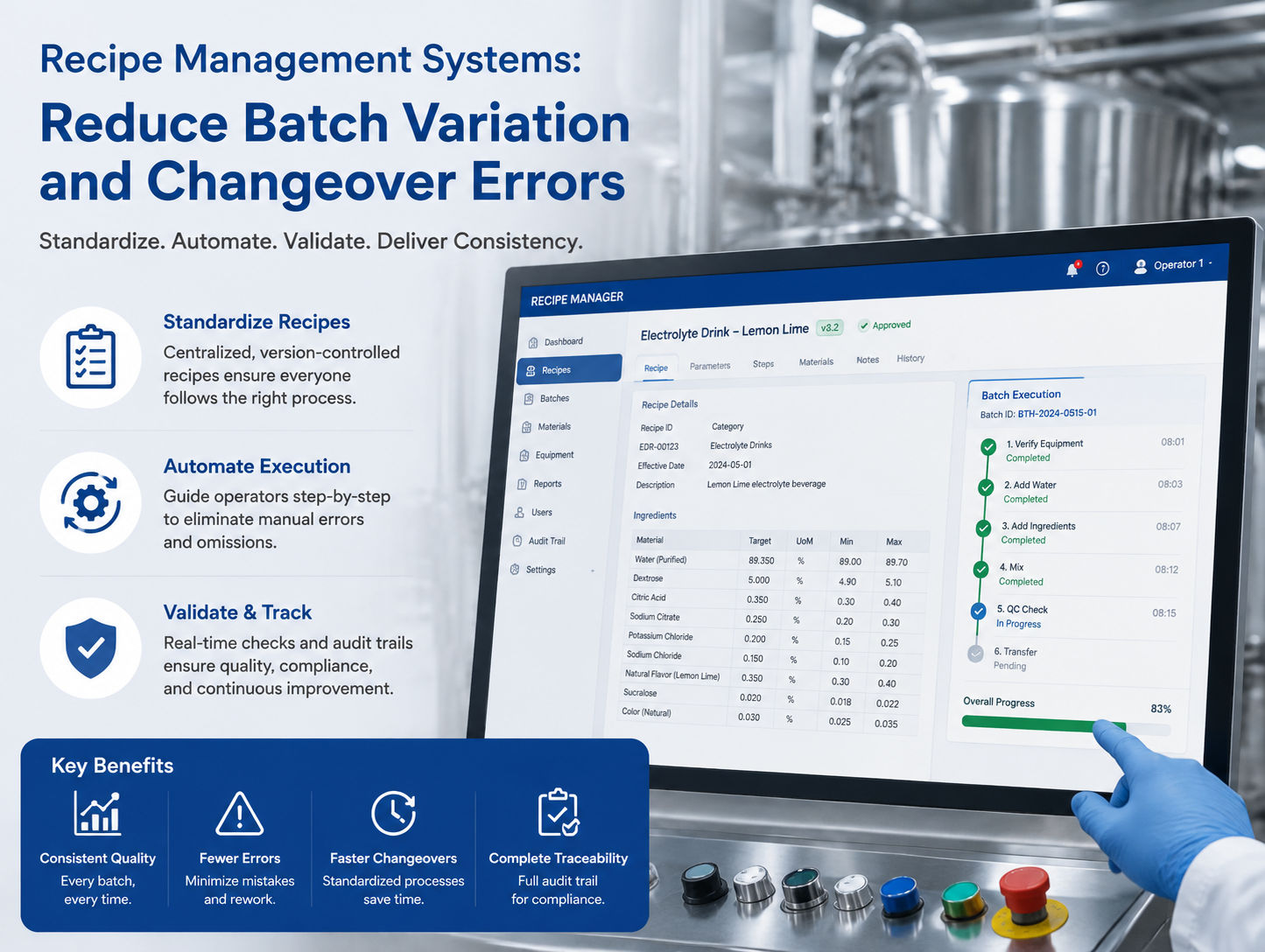
Recipe Management Systems: Reduce Batch Variation and Changeover Errors
[trp_language language=”en_US”]
Recipe Management Systems for U.S. Food and Beverage Manufacturing
Quick Answer

A recipe management system is an automation framework that controls, records, and verifies the steps required to make a product consistently. In U.S. food and beverage plants, it typically connects PLCs, HMIs, SCADA platforms, production equipment, quality checks, ingredient systems, CIP systems, and business data.
Instead of relying on handwritten instructions, spreadsheets, tribal knowledge, or operators manually entering setpoints, the system delivers approved production parameters to the equipment. It can control ingredient additions, mixing times, temperatures, flow rates, fill volumes, hold times, agitation speeds, CIP sequences, alarm responses, and packaging changeover settings.
For a manufacturer producing sauces in Chicago, dairy beverages in Wisconsin, ready-to-drink products in New Jersey, protein products in Georgia, or co-packed beverages near the Ports of Los Angeles and Long Beach, recipe management can reduce avoidable variation between shifts, plants, and product runs. It also creates a stronger audit trail for FDA, USDA, SQF, BRCGS, customer, and internal quality requirements.
The right solution is not always the most complex platform. A practical recipe management system should match the plant’s product portfolio, existing automation maturity, downtime windows, cybersecurity posture, operator needs, compliance risk, and capital plan. Disruptive Process Solutions (DPS) designs solutions that connect profitable manufacturing outcomes to realistic engineering execution.
What Is a Recipe Management System?

A recipe management system is a structured way to define, approve, execute, secure, and report the manufacturing instructions for a product. In a food or beverage environment, a recipe may include material quantities, ingredient tolerances, production sequence logic, equipment settings, quality targets, sanitation requirements, process limits, packaging formats, and operator prompts.
Recipes are commonly organized at several levels. A master recipe identifies the approved process definition. A site recipe adapts that definition to local equipment. A control recipe is the specific production instruction used for an individual batch, lot, line, or order. This hierarchy allows a company to protect product standards while accounting for differences between a blending room in Cary, North Carolina, and a co-packing line in California, Texas, or Ontario.
Recipe management is especially useful where a plant makes frequent product changes, runs multiple pack sizes, handles allergens, manages variable raw materials, or uses complex thermal, blending, fermentation, batching, marination, cooking, filling, or CIP processes. It can be applied to a small craft producer with a few vessels or to a national manufacturer operating multiple plants and dozens of SKUs.
| Recipe Level | Primary Purpose | Typical Owner | Example in Food or Beverage Manufacturing |
|---|---|---|---|
| Product specification | Defines commercial and quality intent | R&D and quality | Target Brix, flavor profile, allergens, nutrition requirements |
| Master recipe | Defines approved manufacturing logic | Process engineering | Order of syrup, water, acid, and flavor additions |
| Site recipe | Adapts logic to installed assets | Plant engineering | Specific tank, pump, mixer, and valve assignments |
| Control recipe | Executes a production order | Production supervisor | Batch size, lot number, assigned line, destination tank |
| Equipment phase | Performs a reusable equipment action | Controls engineering | Fill, heat, mix, transfer, hold, discharge, or rinse |
| Electronic batch record | Captures what actually happened | Quality and operations | Actual weights, temperatures, alarms, operator actions, timestamps |
This recipe hierarchy helps prevent operators from changing critical parameters without authorization. It also allows plants to compare target values against actual process performance and identify whether variation started with ingredients, equipment, utilities, programming, or operator workflow.
Operational Problems This System Should Solve

Most recipe management projects begin with a production problem, not a software problem. A plant may be experiencing inconsistent batches, excessive startup scrap, unplanned changeover delays, missed additions, difficult investigations, lost institutional knowledge, or inconsistent cleaning execution. The automation system should address the highest-value operational risks first.
For example, a beverage producer may find that different shifts use slightly different blend sequencing or water volumes. A sauce manufacturer may have multiple operators selecting manual mix times. A protein processor may need better control of marinade application and tumbler settings. A dairy plant may need verified pasteurization, hold, and diversion records. In each case, a recipe system can create repeatable execution rules while preserving appropriate operator flexibility.
| Operational Problem | Common Root Cause | Recipe Management Response | Business Impact |
|---|---|---|---|
| Batch-to-batch variation | Manual setpoint entry and inconsistent sequence | Locked approved parameters and guided execution | Improved yield and product consistency |
| Changeover errors | Wrong package, formula, or line settings | SKU-specific setup confirmation and interlocks | Less scrap and fewer customer complaints |
| Missing ingredients | Paper instructions or verbal handoffs | Step confirmation, weighing integration, and prompts | Fewer rework events |
| Slow investigations | Incomplete production records | Electronic batch and alarm history | Faster root-cause analysis |
| Allergen exposure risk | Unverified sequencing and sanitation status | Allergen-specific recipes and CIP verification | Reduced recall exposure |
| Inconsistent utility conditions | Steam, glycol, air, or water fluctuations | Utility monitoring and process-limit alarms | More stable production performance |
The following chart shows a planning-level illustration of how adoption of structured recipe and batch control may grow across U.S. food and beverage operations. Actual adoption varies by product complexity, capital availability, labor availability, customer requirements, and installed control platforms.
PLC, HMI, SCADA, Network, and Data Architecture
A reliable recipe management system is an architecture, not simply an HMI screen. The PLC must execute deterministic control logic. The HMI must give operators clear instructions and useful status. The SCADA layer typically coordinates batch execution, alarm management, reporting, historian connectivity, user access, and supervisory visualization. Network and data architecture must support availability, security, maintenance, and future expansion.
In many U.S. plants, the installed environment is mixed. A facility may use Rockwell Automation PLCs on packaging lines, Siemens controls in a process area, legacy Wonderware or AVEVA SCADA screens, standalone OEM skid controls, and separate laboratory or ERP systems. DPS evaluates what can be retained, what should be upgraded, and what must be isolated or integrated.
At the equipment level, reusable phases such as “charge water,” “dose ingredient,” “heat to setpoint,” “agitate,” “hold,” “transfer,” and “CIP rinse” should be designed with clear permissives, status signals, exception handling, and manual recovery procedures. At the supervisory level, the system should manage production order data, version-controlled recipes, electronic records, and performance reporting.
| Architecture Layer | Typical Components | Recipe Function | Design Consideration |
|---|---|---|---|
| Field layer | Transmitters, load cells, valves, VFDs, flowmeters | Measures and executes physical process actions | Calibration, signal reliability, hygienic installation |
| PLC layer | Controllers, remote I/O, safety hardware | Runs sequence logic and equipment phases | Deterministic response and recoverable faults |
| HMI layer | Local touchscreens and operator stations | Displays steps, prompts, setpoints, and status | Simple operator workflow and role-based access |
| SCADA layer | Servers, clients, alarm systems, historians | Coordinates recipes, batches, trends, and reports | Redundancy, audit records, and alarm rationalization |
| Operations network | Managed switches, firewalls, VLANs | Connects automation assets securely | Segmentation and maintainable documentation |
| Business integration layer | ERP, MES, LIMS, warehouse systems | Shares order, material, and quality data | Defined ownership, data mapping, and exception rules |
DPS brings controls engineering experience across PLC programming, SCADA development, network planning, commissioning, and process system integration. Through its automation and controls engineering services, DPS helps manufacturers define a platform that serves current operations without creating an unnecessarily rigid or costly environment.
Recipe, Batch, Alarm, and Traceability Requirements
Recipe control should be designed around the product and the risk. A low-risk dry blend may need controlled ingredient verification and lot capture. A high-acid beverage may need Brix, pH, temperature, and fill control. A retort operation may require detailed thermal process records. A dairy or aseptic line may need extensive sanitation, diversion, time-temperature, and equipment-status verification.
A batch record should show more than a final “pass” or “fail.” It should document the selected recipe version, batch identifier, production order, material lots, actual quantities, target values, operator actions, equipment used, start and completion times, alarms, deviations, holds, rework decisions, and quality release status. This record supports process improvement as well as traceability.
Alarm design is equally important. Plants often have too many unprioritized alarms, which can cause operators to ignore meaningful events. Recipe management should distinguish critical process deviations from maintenance notices, advisory messages, and expected sequence transitions. Alarm priorities, deadbands, delays, shelving rules, and response instructions should be rationalized during the project.
| Requirement | Recommended Capability | Example | Why It Matters |
|---|---|---|---|
| Recipe version control | Approval workflow and revision history | Version 4.2 replaces 4.1 after pilot validation | Prevents unauthorized process changes |
| Ingredient verification | Barcode, scale, or manual double-check | Confirm correct acidulant lot before dosing | Reduces formula and allergen mistakes |
| Parameter enforcement | Min/max limits and role permissions | Mix speed limited to approved range | Protects quality and equipment |
| Batch genealogy | Lot-to-batch and batch-to-finished-goods links | Trace syrup lot into finished canned beverage | Supports targeted investigations |
| Exception management | Deviation reason and supervisor review | Authorized extra hold time due to temperature recovery | Creates accountable decision records |
| Electronic signatures | Unique user authentication and audit trail | Quality approval before release to packaging | Strengthens compliance documentation |
For facilities using clean-in-place systems, sanitation recipes should be managed with the same discipline as production recipes. CIP circuits may require controlled water recovery, chemical concentration, temperature, conductivity, flow, time, return conditions, and final rinse verification. DPS can integrate recipe and traceability logic with custom or existing CIP systems for food and beverage plants so operators can confirm that the correct circuit and cleaning sequence were executed before production begins.
Integration with Existing Equipment and Utilities
Few plants begin with a blank slate. A recipe management project may need to connect legacy vessels, skid-mounted pasteurizers, OEM fillers, tank farms, ingredient rooms, boilers, refrigeration systems, compressors, water treatment assets, and warehouse systems. Integration planning starts with a field audit of equipment capability, available signals, communication protocols, sanitation boundaries, and mechanical constraints.
Utilities deserve special attention because process consistency depends on them. Inconsistent steam pressure can affect cook profiles. Variable glycol temperature can disrupt fermentation or cooling. Unstable compressed air can cause actuator problems. Poor process-water control can influence Brix, flavor concentration, and batch volume. Recipe systems can capture utility conditions as contextual data and block a critical step when a required utility is unavailable or outside defined limits.
DPS integrates process equipment, utilities, controls, and commissioning as one coordinated scope. Its manufacturing and integration capabilities include custom tanks, CIP skids, cooking vessels, marination equipment, process piping, electrical systems, automation panels, and plant-wide utility connections. That integrated approach reduces the risk of a controls design that does not match actual field conditions.
| Existing Asset | Typical Integration Method | Recipe Data Available | Potential Upgrade Need |
|---|---|---|---|
| Legacy blend tank | Remote I/O and VFD interface | Level, speed, temperature, batch time | Add load cells or automated valves |
| OEM pasteurizer skid | Protocol gateway or hardwired signals | Flow, temperature, diversion, hold status | Document interface and alarm mapping |
| Ingredient scale station | Serial, Ethernet, or barcode integration | Actual weight, material code, lot number | Add scanner and label workflow |
| Filler or packaging line | Line PLC interface | SKU, package format, speed, rejects | Recipe handshake and change-part confirmation |
| Boiler and glycol systems | Utility PLC or SCADA connection | Pressure, temperature, availability, energy | Add metering and process alarms |
| CIP skid | Shared sequence and permissive logic | Circuit, concentration, time, temperature, flow | Expand valve matrix or return verification |
A detailed process engineering and design assessment should precede major controls changes. It allows the project team to identify hidden bottlenecks, validate process flow, confirm utility capacity, and determine whether automation alone will solve the issue or whether mechanical modifications are also necessary.
Cybersecurity, Validation, and Compliance Considerations
Recipe management increases connectivity and data availability, so it must also increase discipline around cybersecurity. Food and beverage manufacturers should segment operational technology from business networks, use managed switches and firewalls, apply role-based access, manage passwords and accounts, control remote access, maintain backups, and document recovery procedures.
Cybersecurity does not need to stop plant operations. It should be designed around production realities. An operator needs fast access to execute a batch. A maintenance technician needs controlled diagnostic access. A process engineer needs a secure way to propose recipe changes. A trusted service provider may require time-limited remote access through approved pathways. The system should provide each role the minimum access required to perform its job.
Validation requirements vary by application. FDA-regulated food production, USDA-inspected operations, SQF-certified facilities, BRCGS-certified plants, aseptic systems, pharmaceutical-adjacent operations, and customer-specific programs may require different levels of documentation, testing, review, and record retention. A practical validation package typically includes user requirements, functional specifications, design documentation, test protocols, alarm testing, backup verification, operator training, and final acceptance records.
By 2026, manufacturers are increasingly expected to demonstrate stronger cyber resilience, faster traceability, more transparent supplier controls, and measurable sustainability performance. Recipe management can support these trends by recording energy-intensive steps, water use, CIP cycles, material losses, rework causes, and out-of-spec events. The objective is not simply more data; it is usable data that helps a plant reduce waste and make defensible operating decisions.
Budget, Downtime, and Automation ROI
Budget planning should separate software, controls hardware, electrical installation, mechanical modifications, engineering, commissioning, operator training, validation, and contingency. The least expensive proposal may not be the lowest-cost project if it excludes field verification, documentation, commissioning support, or post-startup troubleshooting.
For many plants, a phased implementation is the best financial and operational approach. Phase one may standardize batch screens and capture critical data. Phase two may integrate ingredient verification and CIP records. Phase three may connect to ERP, warehouse, laboratory, maintenance, or enterprise reporting systems. This reduces downtime risk and allows the organization to prove value before expanding scope.
| ROI Driver | Typical Measurement | Recipe Management Contribution | Evaluation Frequency |
|---|---|---|---|
| Yield improvement | Good product output per input volume | Reduces incorrect additions and process drift | Per batch and monthly |
| Changeover performance | Minutes from last good unit to first good unit | Guides setup and confirms correct SKU settings | Per changeover |
| Labor utilization | Operator time spent on manual documentation | Automates data capture and prompts | Weekly and monthly |
| Scrap and rework | Value of nonconforming product | Prevents wrong recipe and sequence execution | Per product family |
| Quality investigations | Hours required to reconstruct an event | Provides batch, alarm, and trend history | Per incident |
| Utility consumption | Water, steam, compressed air, and energy per unit | Identifies process and CIP optimization opportunities | Monthly and seasonal |
The bar chart below provides an illustrative view of where recipe management demand is often strongest in U.S. manufacturing. Scores represent relative planning demand, not market share.
Downtime planning should include site surveys, panel fabrication, software development, factory acceptance testing when appropriate, pre-staging, installation sequencing, dry testing, water runs, product trials, and hypercare support. Plants near high-volume distribution hubs such as Dallas-Fort Worth, Atlanta, Columbus, Memphis, Inland Empire California, and the New York-New Jersey corridor often schedule automation work around narrow customer delivery windows. A detailed shutdown plan is essential.
How DPS Delivers Recipe Management Systems
DPS delivers recipe management projects through a Design Build Manage approach that connects process, controls, utilities, construction, equipment, and business objectives. Rather than treating recipe software as an isolated controls scope, DPS evaluates how the proposed system will affect throughput, quality, labor, sanitation, utility demand, maintenance, and future capacity.
Technologically, DPS supports PLC programming, HMI development, SCADA configuration, batch control, alarm management, data collection, network design, and controls commissioning. The team can define functional requirements, map equipment phases, establish recipe structures, configure user roles, develop reports, and support startup. The goal is a clear operating environment that production teams can use under real shift conditions.
From a manufacturing perspective, DPS engineers and integrates processing systems for beverage, food, dairy, protein, aseptic, fermentation, distillation, cooking, blending, retort, water treatment, and CIP applications. This matters because recipe logic must reflect physical process realities: tank geometry, pump performance, valve response, heat-transfer limits, utility capacity, ingredient handling, hygienic design, and line constraints.
From a service perspective, DPS provides feasibility planning, process design, owner’s representation, project management, general contracting where licensed, equipment supply, installation coordination, controls integration, commissioning, and startup support. Founded in Cary, North Carolina, with a West Coast presence in Lake Forest, California, DPS serves food and beverage manufacturers throughout the United States and Canada through an agile network of qualified engineering and installation partners.
A typical DPS project begins with discovery. The team documents current state, production goals, control assets, pain points, compliance needs, and commercial priorities. DPS then develops a practical roadmap that may include immediate programming improvements, targeted instrumentation upgrades, recipe platform development, utility improvements, equipment modifications, and future expansion phases.
| DPS Delivery Stage | Key Activities | Primary Deliverable | Client Benefit |
|---|---|---|---|
| Discovery | Interviews, site walk, controls and process review | Current-state assessment | Clear definition of actual production constraints |
| Concept development | Recipe hierarchy, architecture, scope options | Automation roadmap | Investment aligned with operational priorities |
| Detailed engineering | I/O design, network plan, control narratives, layouts | Issued-for-construction package | Reduced field ambiguity |
| Build and integration | Panel work, programming, equipment interfaces | Configured system | Coordinated process and controls execution |
| Commissioning | Testing, loop checks, sequence verification, startup | Accepted operating system | Lower startup risk |
| Optimization | Trend review, training, recipe tuning, support | Performance improvement plan | Continuous operational value |
The area chart illustrates a common operational trend: as a manufacturer shifts from manual records toward connected recipe execution, the share of information captured automatically can increase while reliance on paper and memory declines.
When comparing potential suppliers, manufacturers should consider more than software brand familiarity. The strongest partner understands processing, mechanical integration, utilities, sanitation, construction logistics, controls engineering, and production economics. This is particularly important for capital projects involving expansion, relocation, co-packing startups, or modernization of an operating plant.
FAQ
What types of manufacturers benefit most from recipe management?
Recipe management is valuable for beverage bottlers, breweries, distilleries, dairy plants, sauce and dressing producers, prepared-food manufacturers, protein processors, co-packers, aseptic processors, ingredient manufacturers, and facilities with frequent SKU changes or strict traceability needs.
Can recipe management work with existing PLCs?
Yes. Many projects retain existing PLC hardware and add structured programming, HMI improvements, SCADA connectivity, historian functions, network upgrades, and batch reporting. The feasibility depends on controller capacity, communication capability, condition, supportability, and safety requirements.
Does every plant need a full batch management platform?
No. Some plants need a full supervisory batch platform, while others benefit from a simpler recipe structure implemented directly in PLC and HMI systems. The appropriate solution depends on batch complexity, product risk, number of SKUs, reporting requirements, and growth plans.
How does recipe management improve traceability?
It can link raw-material lots, actual ingredient weights, process parameters, equipment assignments, operator actions, alarms, quality checks, and finished-goods batches. This makes investigations faster and supports focused corrective action when a quality or customer issue occurs.
What is the role of CIP in a recipe management project?
CIP execution should be connected to production scheduling, allergen controls, sanitation verification, and equipment availability. Managing CIP recipes helps confirm that the correct circuit, chemical sequence, temperatures, flow conditions, and rinse requirements were completed before product is introduced.
How should a U.S. manufacturer prepare for implementation?
Start by documenting product families, current recipes, pain points, existing automation assets, utility constraints, downtime windows, quality requirements, and desired reports. Then prioritize the highest-value production area for an initial phase. A structured assessment can reveal whether the constraint is software, instrumentation, equipment capacity, process design, or operator workflow.
For manufacturers seeking better repeatability, faster changeovers, stronger traceability, and more profitable capital decisions, DPS can develop a recipe management approach that fits the plant’s process, automation maturity, and long-term growth plan.
[/trp_language]
Complete Company Portfolio
About the Author: Disruptive Process Solutions (DPS)
The DPS team combines process engineering expertise with real-world food and beverage manufacturing experience. Our content focuses on process optimization, production efficiency, facility improvements, and practical solutions that help manufacturers operate more effectively in a rapidly evolving industry.
Share