ISA-88 Batch Control for Food and Beverage Manufacturers
[trp_language language=”en_US”]
ISA-88 Batch Automation for United States Food and Beverage Plants
Rapid Guidance

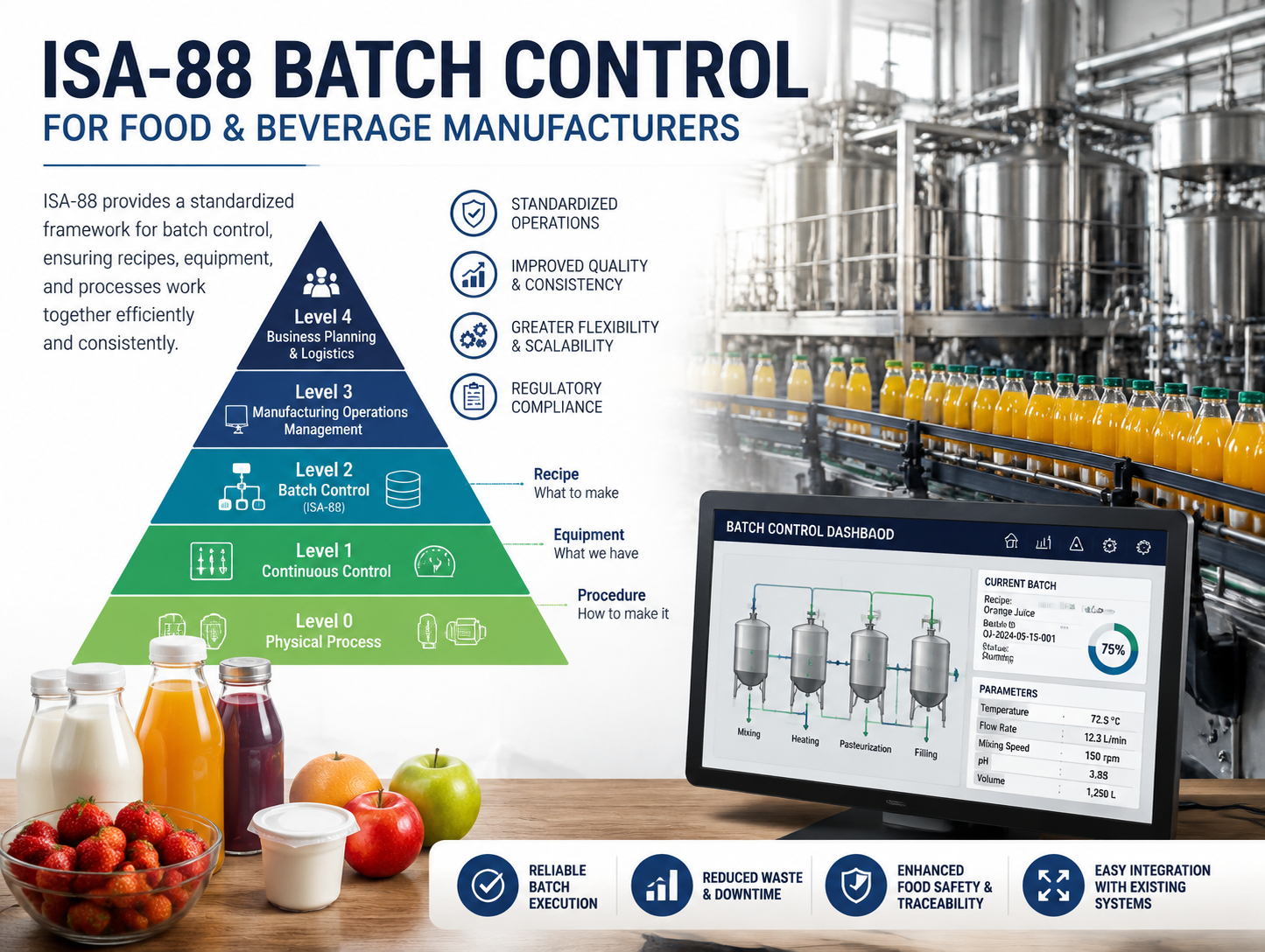
ISA-88 batch control is a structured automation approach for running repeatable, traceable production processes in food and beverage manufacturing. It separates the recipe from the equipment logic, allowing manufacturers to make multiple products, sizes, flavors, or formulations on shared assets without rebuilding PLC code for every change.
For United States manufacturers, an ISA-88 batch control system can improve recipe consistency, reduce operator-dependent variation, shorten changeovers, document production history, support CIP coordination, and create a scalable foundation for plant growth. It is especially valuable for beverage blending, brewing, dairy processing, sauces, marinades, prepared foods, fermentation, aseptic processing, protein processing, and co-packing operations.
A well-designed ISA-88 solution typically combines PLC control, HMI screens, SCADA visibility, recipe management, batch reporting, alarms, historian data, user access control, and integration with business or quality systems. The goal is not simply to automate valves and pumps. The goal is to make production safer, more repeatable, more measurable, and more profitable.
Disruptive Process Solutions (DPS) designs and delivers practical batch automation projects for food and beverage manufacturers throughout the United States and Canada. From Cary, North Carolina, and Lake Forest, California, DPS supports facilities from the Southeast and Midwest manufacturing corridors to West Coast beverage hubs, Gulf Coast ports, and large co-packing operations near Chicago, Dallas, Atlanta, Los Angeles, and the Port of Savannah.
Understanding ISA-88 Batch Automation

ISA-88, commonly called S88, is a batch control standard that provides a common structure for defining products, equipment, procedures, and production records. It is useful when a facility must make multiple SKUs using shared tanks, mixers, pasteurizers, fermenters, fillers, cooking vessels, or utility systems.
Rather than embedding every product-specific instruction directly in a PLC program, ISA-88 organizes production into reusable models. A master recipe describes how a product should be made. A control recipe applies that master recipe to a specific production order. The system then executes procedural steps through physical equipment modules such as pumps, valves, tanks, heat exchangers, CIP circuits, and dosing skids.
This approach is important in food and beverage plants because production requirements change frequently. A beverage plant may alternate between carbonated drinks, functional beverages, juices, syrups, and seasonal flavors. A sauce manufacturer may produce allergen-containing and non-allergen formulations on the same blending line. A dairy plant may schedule different fat contents, cultures, temperatures, and filling formats. Without a consistent batch framework, every variation can create engineering effort, operator workarounds, and traceability risk.
| ISA-88 Layer | Purpose in a Food or Beverage Plant | Example |
|---|---|---|
| Process Cell | Groups resources used for a production area | Syrup room, fermentation cellar, sauce kitchen |
| Unit | Major equipment that performs a processing function | Blend tank, cooker, fermenter, HTST skid |
| Equipment Module | Combines devices into a controllable equipment function | Tank agitation module, transfer module, CIP supply loop |
| Control Module | Controls an individual device or tightly related devices | Valve cluster, pump VFD, flow meter, temperature loop |
| Phase | Defines a reusable action performed by equipment | Charge, mix, heat, hold, transfer, rinse, sanitize |
| Recipe Procedure | Sequences phases to manufacture a product | Add water, dose ingredients, blend, pasteurize, transfer |
The table above shows why ISA-88 is more than a software purchase. It is an operational model. When phases such as “charge ingredient,” “mix to time,” “heat to setpoint,” and “transfer to filler” are standardized, the same building blocks can be used across recipes and future capacity additions.
In the United States market, ISA-88 batch control is increasingly relevant for plants managing retailer requirements, co-manufacturing contracts, private-label production, allergen segregation, lot genealogy, sanitation verification, and high SKU growth. It can also help create common automation standards across multiple facilities after acquisition or expansion.
This market-growth illustration reflects the direction many manufacturers are taking: replacing isolated machine automation with connected, recipe-driven process control. Growth is being driven by labor constraints, product proliferation, food safety documentation, rising utility costs, and the need to expand capacity without proportionally expanding headcount.
Operational Challenges an ISA-88 System Must Address

A batch control project should begin with plant problems, not screen preferences. The right system must solve the production, quality, maintenance, and business issues that limit throughput or create risk. In many legacy plants, the core issue is not that equipment is old; it is that the control philosophy is fragmented, undocumented, or dependent on experienced operators.
| Operational Problem | Typical Root Cause | ISA-88 Response | Business Effect |
|---|---|---|---|
| Inconsistent product quality | Manual additions and informal operating methods | Guided sequences, interlocks, setpoints, and electronic records | Less variation and fewer quality holds |
| Slow flavor or SKU changeovers | Recipes embedded in PLC logic or paper instructions | Centralized formula and procedural recipe management | More flexible production scheduling |
| Unplanned batch delays | Unclear equipment status and utility conflicts | Unit status, resource arbitration, and exception handling | Higher equipment availability |
| Weak lot traceability | Manual records and disconnected systems | Batch IDs, ingredient records, timestamps, and event history | Faster investigation and recall readiness |
| Sanitation uncertainty | Separate CIP controls and incomplete verification | Integrated CIP sequences and cleaning confirmation | Reduced cross-contamination risk |
| Excessive operator dependence | Tribal knowledge and inconsistent work practices | Role-based guidance, prompts, alarms, and digital procedures | Faster training and stronger repeatability |
| Limited production insight | No historian, poor reporting, or siloed data | Batch reports, downtime events, and trend analysis | Better decisions on yield and capacity |
The table demonstrates that batch automation should be evaluated as a business system. A plant may believe it needs a larger tank farm or another blending line, yet the true bottleneck may be sequence timing, manual verification, CIP availability, transfer routing, or poor alarm management. DPS routinely evaluates the process and controls constraints before recommending major capital spending.
For example, a co-packer near Dallas may lose production time because operators wait for manual approval before transferring product between blend tanks and pasteurization. A brewery in North Carolina may struggle with fermenter scheduling because CIP status is not visible across the cellar. A sauce plant in the Midwest may experience frequent recipe deviations because ingredient additions are manually tracked. Each problem requires a different batch-control design, but all benefit from a disciplined ISA-88 structure.
PLC, HMI, SCADA, Network, and Data Architecture
Reliable batch control begins with a clear automation architecture. The PLC should provide deterministic equipment control and safety-related interlocks. The HMI should support local operation, maintenance, and troubleshooting. SCADA should provide supervisory recipe execution, plant-wide visualization, alarm management, batch reports, historian access, and user management when appropriate.
The architecture must fit the plant’s scale. A small sauce kitchen with two blend tanks may need a compact PLC and HMI system with electronic batch reports. A regional beverage co-packer may need redundant SCADA servers, segmented industrial networks, multiple production cells, historian storage, ERP connectivity, and remote support controls. A multi-site manufacturer may require a common template that can be deployed across plants in California, Texas, Wisconsin, Pennsylvania, and Georgia.
DPS brings technological capabilities across PLC programming, SCADA development, controls engineering, electrical integration, recipe management, batch reporting, energy monitoring, and process-system automation. Its team can align control platforms with the practical requirements of tanks, CIP systems, pasteurizers, utilities, fermentation equipment, cookers, fillers, refrigeration systems, and process water infrastructure. Learn more about DPS automation and controls engineering services for food and beverage facilities.
| Architecture Layer | Primary Function | Recommended Design Consideration |
|---|---|---|
| Field Devices | Measure and actuate the process | Use hygienic instruments, clear tags, calibration records, and maintainable wiring |
| PLC and Remote I/O | Execute equipment logic and interlocks | Standardize code modules, fault handling, and control narratives |
| Local HMI | Support operator interaction at the machine or process area | Use consistent navigation, permissions, and clear status indicators |
| SCADA and Batch Server | Coordinate recipes, visibility, alarms, and batch execution | Provide user roles, audit trails, reporting, and scalable tag structures |
| Historian and Reporting | Store process values and production events | Retain critical quality, utility, downtime, and traceability data | Industrial Network | Connect equipment and supervisory systems | Segment IT and OT traffic; document switches, VLANs, and device ownership | Business-System Interface | Exchange orders, materials, lots, and performance data | Define ownership, validation rules, retry logic, and cybersecurity boundaries |
The architecture table is intended as a planning framework. Every layer should have an owner, a documented purpose, and a support strategy. Projects often fail when a new SCADA layer is added without addressing instrument reliability, valve feedback, network capacity, or the maintenance team’s ability to troubleshoot the finished system.
Network design should also consider facility geography. Plants near port and distribution centers such as Long Beach, Houston, Newark, Savannah, and Seattle may operate extended hours to accommodate supply schedules. Those facilities need resilient network infrastructure, backup procedures, and clearly defined degraded-mode operation when a server, remote connection, or enterprise interface is unavailable.
Recipe, Batch, Alarm, and Traceability Requirements
Recipe management should allow authorized users to create, approve, version, release, and retire formulas without undermining production control. A recipe is not simply a list of ingredients. It includes targets, tolerances, process conditions, phase logic, timing, hold conditions, sequencing rules, quality checks, and instructions for operator intervention.
For food and beverage applications, batch records should capture what was made, where it was made, which ingredients were used, who initiated or adjusted the batch, when key events occurred, what exceptions were accepted, and whether the required processing parameters were achieved. This information supports internal quality systems, customer requirements, investigations, and recall response.
| Requirement Category | Recommended Capability | Example for a Production Batch |
|---|---|---|
| Recipe Versioning | Controlled revision number, approval workflow, effective date | Version 4.2 becomes active only after quality approval |
| Material Verification | Lot entry, barcode scan, weigh scale confirmation, tolerance checks | Validate the correct citrus concentrate lot before charging |
| Procedural Execution | Reusable phases and defined step transitions | Fill, dose, mix, heat, hold, cool, and transfer |
| Critical Parameters | Capture temperatures, times, pressures, flow, pH, Brix, and conductivity | Record pasteurization hold temperature and duration |
| Exception Management | Reason codes, electronic acknowledgment, escalation, review | Document an approved mix-time extension |
| Alarm Management | Priority, response guidance, shelving rules, and audit history | High-temperature alarm directs operator to verified response steps | Genealogy and Reporting | Link ingredients, intermediate product, finished lot, and destination | Trace one syrup lot into affected packaged product lots |
This table highlights the difference between data collection and usable traceability. Recording thousands of tags is not enough if the plant cannot quickly identify the ingredients, process deviations, and downstream finished lots connected to a specific batch. The best batch records are searchable, understandable, and reviewed as part of routine operations.
Alarm design deserves equal attention. Food and beverage plants often suffer from alarm flooding, nuisance alarms, and unclear priorities. A critical high-temperature deviation, loss of flow during pasteurization, or open-path sanitation conflict should never be buried among low-value communications alarms. Alarm rationalization should define priority, consequence, operator action, escalation, and maintenance responsibility.
The industry-demand comparison is directional rather than a forecast. Co-packers and beverage manufacturers frequently rank highly because they manage high SKU counts, frequent changeovers, customer-specific formulations, and compressed production schedules. Dairy, sauce, brewery, and prepared-food operations also benefit strongly when shared equipment must execute tightly controlled recipes.
Connecting Legacy Equipment and Plant Utilities
Most ISA-88 projects are not greenfield projects. They are modernization programs that must connect new controls to existing tanks, pumps, valve manifolds, scales, cookers, fermenters, fillers, boilers, chillers, compressors, refrigeration systems, and CIP equipment. Integration starts with field verification, not assumptions based on outdated drawings.
Legacy equipment can often remain useful when its mechanical condition is sound and the control interface can be safely upgraded. A 20-year-old blend tank may receive new instrumentation, automated valves, a VFD-controlled agitator, load cells, and a standardized PLC module. A manual CIP skid may be modernized with conductivity measurement, return-temperature verification, automated chemical dosing, and validated route control.
DPS has manufacturing capabilities that extend beyond control programming. The company designs and integrates tanks up to 12,000 gallons, custom CIP systems, marination tumblers, cooking vessels, utility systems, and process equipment packages. This enables DPS to coordinate mechanical design, piping, electrical work, controls, commissioning, and operations requirements as one project team. Manufacturers considering sanitation upgrades can review DPS custom CIP system solutions as part of a broader batch-control strategy.
| Existing Asset | Typical Integration Scope | Batch-Control Benefit |
|---|---|---|
| Blend or mix tank | Load cells, level, agitation, valves, temperature control | Repeatable charging, mixing, and yield measurement |
| Pasteurizer or HTST skid | Flow, temperature, divert status, historian connection | Critical-process documentation and controlled release |
| Fermenter or unitank | Temperature zones, pressure, CO2, transfer valves, CIP status | Consistent fermentation and cellar scheduling |
| Cooking vessel | Steam control, scrape agitation, temperature profile, discharge routing | Controlled cook curves and batch repeatability |
| Manual valve manifold | Valve feedback, route matrices, automated valves where justified | Reduced routing errors and improved sanitation control |
| Legacy CIP skid | Conductivity, temperature, chemical control, route confirmation | Documented cleaning cycles and less utility waste |
| Boiler, chiller, or compressor | Demand monitoring, alarms, utility availability signals | Fewer batch interruptions caused by utility constraints |
The integration table illustrates a key design principle: batch control should understand utility availability and sanitation status, not just product processing steps. A recipe should not begin a heating phase if steam capacity is unavailable, initiate a transfer if the destination tank is not ready, or schedule allergen-sensitive production if the required CIP cycle has not been completed.
For a major expansion, the process design should account for future units, spare I/O, network capacity, panel space, sanitary routing, and recipe scaling rules. DPS supports this work through process engineering and design services, connecting process requirements with controls logic before construction begins.
Cybersecurity, Validation, and Compliance Planning
Food and beverage batch systems increasingly sit at the intersection of operational technology, quality systems, and enterprise data. This makes cybersecurity an operational requirement. A ransomware event, unauthorized recipe change, compromised remote connection, or failed network switch can disrupt production, jeopardize product records, and create significant recovery costs.
Cybersecurity should be designed into the project scope. Practical controls include network segmentation, managed remote access, multi-factor authentication where feasible, unique user accounts, least-privilege roles, secure backups, patch-management procedures, approved vendor access, asset inventories, and incident-response planning. A plant does not need unnecessary complexity, but it does need defined ownership and tested recovery procedures.
Validation and compliance needs vary by product and market. Food and beverage facilities may operate under FDA, USDA, SQF, BRCGS, customer quality programs, sanitation requirements, allergen-control programs, and internal corporate standards. Pharmaceutical or aseptic applications can demand more formal electronic records, audit trails, change control, and computerized system validation.
The trend-shift chart reflects the ongoing movement away from paper-based and isolated operation toward connected batch execution. By 2026 and beyond, manufacturers will increasingly expect systems to support secure data exchange, real-time production visibility, digital quality records, energy analysis, remote expert support, and better scheduling across shared equipment.
Sustainability will also influence batch control design. Automated sequencing can reduce water, chemical, steam, compressed air, and product losses by controlling CIP cycles, preventing overfills, optimizing transfer paths, and reducing rework. For plants facing wastewater constraints or high utility costs in water-stressed regions of California, Texas, Arizona, and parts of the Southeast, these improvements can be commercially meaningful.
Budget, Downtime, and Automation Return on Investment
ISA-88 batch automation budgets vary widely because the project scope can range from a small control upgrade to a multi-line plant modernization. The largest cost drivers are often not the SCADA license or PLC hardware. They include field instrumentation, valve automation, electrical upgrades, panel fabrication, network infrastructure, mechanical modifications, process shutdown windows, commissioning, and training.
Manufacturers should avoid asking only, “What does the software cost?” A better question is, “What level of operational control, traceability, capacity, and risk reduction will the finished system deliver?” A low-cost system that preserves manual workarounds and lacks maintainable documentation can become expensive over time.
| Investment Area | Typical Scope | Primary ROI Lever | Planning Consideration |
|---|---|---|---|
| Controls assessment | Site walk, I/O review, process mapping, gap analysis | Avoids incorrect capital decisions | Use before committing to major equipment purchases |
| PLC and HMI modernization | New processors, panels, remote I/O, standard code | Reliability and maintainability | Plan migration and fallback methods carefully |
| SCADA and recipe platform | Supervision, recipes, alarms, reporting, historian | Consistency, visibility, and faster changeovers | Define user roles and long-term ownership |
| Field automation | Instruments, valves, drives, scales, feedback devices | Reduced manual labor and fewer errors | Verify sanitary design and calibration requirements | CIP and utility integration | Route control, conductivity, flow, demand monitoring | Water, chemical, steam, and downtime reduction | Coordinate with sanitation and maintenance teams | Data and traceability | Batch reports, material lots, interfaces, dashboards | Faster investigations and improved accountability | Determine data retention and review requirements | Commissioning and training | Testing, startup, SOP support, operator coaching | Faster adoption and lower startup risk | Protect time for real production trials |
The investment table should be used to build a complete business case. Quantify expected improvements in throughput, yield, labor, rework, giveaway, sanitation time, utility consumption, unplanned downtime, quality holds, and product-loss events. A plant that gains even a few production hours per week during a high-demand season may justify automation more quickly than one focused only on labor savings.
Downtime planning is equally important. DPS typically recommends phased implementation where possible: verify and document the existing system, build and test controls offline, install during scheduled maintenance windows, commission individual units, complete water runs and CIP testing, then execute controlled production trials. This approach reduces the risk of a large cutover disrupting a facility’s most profitable operating period.
This supplier-comparison chart is a planning illustration, not a universal vendor ranking. It shows why manufacturers should compare project partners by scope coverage, not only by programming rate. A controls-only firm may be an excellent fit for a defined PLC upgrade, while a larger process expansion may benefit from an integrated partner that can coordinate equipment, utilities, piping, electrical work, control narratives, installation, and startup.
How DPS Implements ISA-88 Batch Control
DPS delivers ISA-88 batch control as part of a broader design-build-manage approach. The process begins by understanding commercial objectives: required capacity, expected SKU growth, operational constraints, customer commitments, product characteristics, facility limitations, and desired return on capital. The controls strategy is then developed around the actual manufacturing process rather than around a generic software template.
DPS service capabilities include capital planning, feasibility studies, owner’s representation, process engineering, controls engineering, equipment supply, general contracting where licensed, project management, installation coordination, commissioning, and system integration. This structure helps reduce the handoff problems that often occur when a manufacturer separately manages process designers, equipment vendors, mechanical contractors, electricians, controls programmers, and startup teams.
A typical DPS batch-control project follows a disciplined path:
- Assess current production, constraints, equipment condition, documentation, and operator workflows.
- Define the process model, unit boundaries, equipment modules, phases, recipes, alarms, traceability requirements, and utility dependencies.
- Develop process descriptions, control narratives, functional requirements, I/O lists, network architecture, and implementation sequencing.
- Coordinate mechanical, electrical, process, and controls scopes with equipment suppliers and local installation trades.
- Build, test, simulate, install, commission, and document the system using defined acceptance criteria.
- Train operators, maintenance technicians, sanitation teams, supervisors, and quality personnel on the finished operating model.
- Support post-startup optimization using actual batch data, downtime events, yield results, and operator feedback.
DPS is particularly effective for manufacturers that need an honest operating partner rather than a vendor that simply agrees with the first proposed solution. In one client situation, DPS identified PLC limitations as the true capacity bottleneck instead of recommending a planned major expansion. Reprogramming the control system improved output substantially and helped the client redirect capital toward higher-value investments.
For a new beverage co-packing facility, a batch-control approach can connect syrup rooms, blending, boilers, compressors, cooling towers, process water, CIP, filling support, and production reporting into one scalable operating model. For a prepared-food plant, the same approach can coordinate ingredient staging, batching, cooking, cooling, allergen segregation, sanitation, and lot traceability. For a brewery or distillery, it can standardize fermentation, transfer, CIP, and utility use while preserving process flexibility.
The best result is not a complex dashboard. It is a plant where people understand what the system is doing, why it is doing it, how to respond when something changes, and how production data supports better decisions. That is where smart capital meets smart manufacturing.
Frequently Asked Questions
Is ISA-88 batch control only for large manufacturers?
No. Large multi-site manufacturers gain significant value from standardization, but smaller plants can also benefit when they run multiple recipes, have recurring quality variation, need better traceability, or rely heavily on operator knowledge. The system should be sized to the process and business case.
Can ISA-88 work with existing PLCs and older equipment?
Often, yes. Existing PLCs, tanks, pumps, valves, and skids can be retained if they are reliable, supportable, and suitable for the required control strategy. A site assessment should confirm electrical condition, available I/O, network compatibility, instrumentation quality, and mechanical limitations before finalizing the scope.
What products benefit most from recipe-driven control?
Common applications include soft drinks, juices, functional beverages, beer, spirits, kombucha, dairy products, sauces, dressings, marinades, soups, prepared foods, protein products, plant-based foods, aseptic products, and co-packed consumer packaged goods.
How does ISA-88 improve food traceability?
It can connect ingredient lots, formula versions, equipment use, critical process parameters, operator actions, alarms, exceptions, intermediate product, finished goods, and production timestamps within a searchable batch record. The exact level of traceability depends on the plant’s equipment and integration scope.
Will batch automation reduce the need for skilled operators?
It does not eliminate the need for skilled people. Instead, it captures proven operating practices, provides guided workflows, reduces repetitive manual work, and makes it easier to train new team members. Experienced operators remain essential for judgment, quality decisions, troubleshooting, and continuous improvement.
How long does an ISA-88 implementation take?
Timing depends on equipment condition, production complexity, shutdown availability, software scope, instrumentation upgrades, and integration requirements. A focused modernization can be completed in phases, while a new facility or multi-line conversion requires a longer design, installation, testing, and startup plan.
What should a manufacturer prepare before selecting a batch-control partner?
Gather current process flow diagrams, P&IDs, equipment lists, electrical drawings, PLC backups, recipe documents, sanitation procedures, production schedules, quality records, downtime data, and known operational pain points. If documents are incomplete, a structured discovery phase should be part of the project scope.
What are the most important 2026 batch-control trends?
Key trends include secure remote support, better OT cybersecurity, digital batch records, integration with MES and ERP systems, energy and water monitoring, AI-assisted production analysis, stronger audit trails, sustainability reporting, and modular automation templates that support fast expansion across multiple facilities.
[/trp_language]
Complete Company Portfolio
About the Author: Disruptive Process Solutions (DPS)
The DPS team combines process engineering expertise with real-world food and beverage manufacturing experience. Our content focuses on process optimization, production efficiency, facility improvements, and practical solutions that help manufacturers operate more effectively in a rapidly evolving industry.
Share