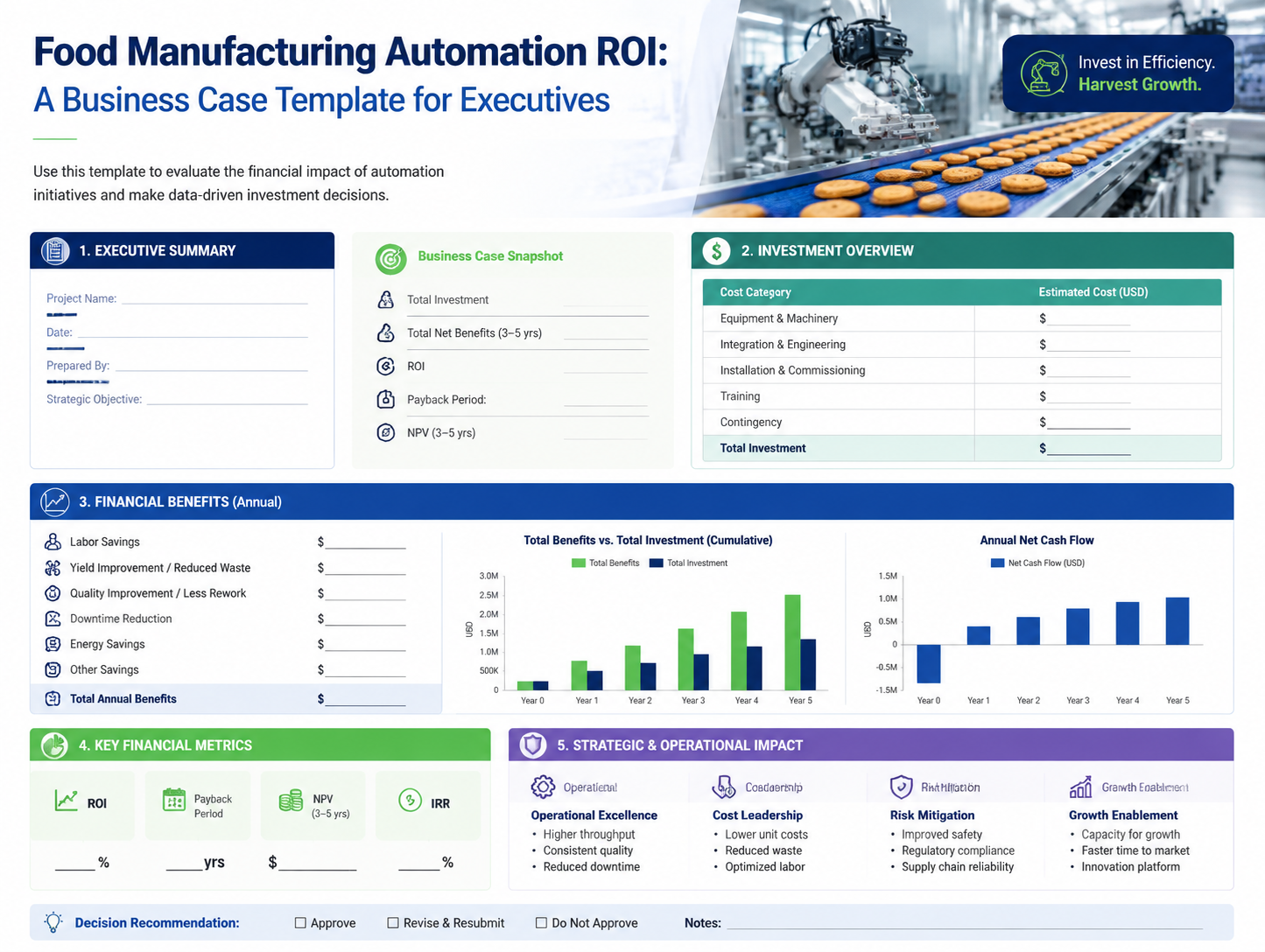
Food Manufacturing Automation ROI: A Business Case Template for Executives
[trp_language language=”en_US”]
Food Automation ROI Guide for United States Plants
Quick Answer

Automation ROI in food manufacturing is the measurable financial and operational return created by investing in controls, equipment integration, data systems, and plant modernization. For a United States food manufacturer, the strongest business case is rarely based on labor reduction alone. A credible automation return on investment should quantify improved throughput, lower giveaway, fewer production errors, shorter changeovers, reduced downtime, better utility efficiency, stronger food safety records, and more reliable traceability.
In practical terms, a food automation project can generate value when it helps a plant produce more saleable cases, pounds, gallons, or batches using the same facility footprint. This matters for manufacturers operating in competitive production regions such as the Midwest protein corridor, California’s Central Valley, the Carolinas, Texas, Wisconsin dairy markets, and food distribution hubs around Chicago, Atlanta, Dallas-Fort Worth, Los Angeles, and Philadelphia.
The executive question is not simply, “What does the automation system cost?” The more useful question is, “What bottleneck, quality loss, compliance exposure, or capacity constraint will this system remove?” A properly scoped PLC, HMI, SCADA, recipe, batch, and traceability upgrade can often deliver a higher return than a major physical expansion when the existing line is underperforming because of control limitations.
| ROI Value Driver | Typical Automation Improvement | Executive Measurement | Potential Business Impact |
|---|---|---|---|
| Throughput | Reduced cycle time and line coordination | Cases, pounds, or gallons per hour | More production without new building space |
| Labor utilization | Automated sequencing and reporting | Labor hours per unit produced | Higher output per shift |
| Yield | Accurate dosing, batching, and fill control | Scrap, giveaway, and rework rate | More saleable product from raw materials |
| Downtime | Alarms, diagnostics, and predictive maintenance data | Unplanned downtime minutes | More available production time |
| Utilities | Energy, water, steam, and CIP optimization | Cost per batch or per production unit | Lower operating expense |
| Compliance | Electronic records and traceable workflows | Audit findings and recall response time | Reduced regulatory and brand risk |
The table above shows why automation ROI must be evaluated across the whole operating model. A project that saves only two operators may still be justified if it also prevents off-spec batches, improves clean-in-place consistency, protects a key customer account, or allows an existing plant to increase annual output by 15% to 30%.
What Does Automation ROI Mean in Food Manufacturing?

Food manufacturing automation ROI is the relationship between the total economic benefit of an automation investment and its complete cost. It includes controls engineering, panels, PLC hardware, HMI development, SCADA software, networking, instrumentation, installation, commissioning, training, validation, production ramp-up, and any planned downtime.
A simple ROI calculation is:
Automation ROI = (Annual Financial Benefit − Annual Operating Cost) ÷ Total Project Investment × 100
For capital planning, executives should also review payback period, net present value, internal rate of return, risk reduction, and capacity value. A project may have a moderate direct payback but still be strategically necessary if it supports USDA inspection requirements, FDA preventive controls, SQF certification, BRCGS expectations, major retailer requirements, or customer-specific electronic traceability needs.
For example, a prepared foods manufacturer in North Carolina may experience recurring schedule losses because operators manually coordinate kettle cooking, ingredient additions, cooling, and packaging release. A new batch control system could reduce waiting time between steps, standardize recipes, capture critical process data, and increase daily output. The ROI comes from multiple sources: fewer delays, fewer formula errors, less rework, improved documentation, and higher customer confidence.
Food categories with strong automation business cases include protein processing, dairy, sauces and dressings, bakery, ready-to-eat meals, beverage co-packing, aseptic products, frozen foods, pet food, ingredients, beverage syrups, fermentation, distillation, and high-volume contract manufacturing.
The line chart illustrates a realistic planning trend rather than a guaranteed forecast. Investment is increasing because food manufacturers face persistent labor constraints, tighter customer requirements, rising utility costs, aging control platforms, cybersecurity exposure, and the need to scale production without repeatedly expanding facilities.
Operational Problems This System Should Solve

Successful automation projects begin with operational problems, not software features. Before selecting a PLC platform or SCADA package, plant leaders should identify where production loses time, product, energy, data integrity, or customer confidence. The controls design should solve specific problems that operators, maintenance teams, quality personnel, and production supervisors recognize every day.
Common problems include inconsistent product quality between shifts, manual recipe entry, inaccurate ingredient additions, long changeovers, incomplete production records, repetitive equipment stoppages, insufficient alarm visibility, weak utility control, poor CIP verification, and limited access to real-time performance data. In older facilities, particularly plants that have expanded in phases, multiple standalone control systems may make it difficult to understand the true source of lost capacity.
| Plant Problem | Automation Response | Primary KPI | Example Application |
|---|---|---|---|
| Inconsistent formulas | Central recipe management and guided batching | Batch deviation rate | Sauces, dairy blends, beverage syrup rooms |
| Frequent line stoppages | Alarm rationalization and fault diagnostics | Mean time to repair | Packaging, conveying, filling lines |
| Slow changeovers | Automated sequences and electronic checklists | Changeover minutes | Co-packing and multi-SKU facilities |
| Excess giveaway | Closed-loop weight, flow, and fill control | Yield percentage | Protein, dairy, ingredients, beverages |
| Manual paperwork | SCADA reporting and electronic batch records | Record completion time | Retort, aseptic, cooked foods |
| CIP uncertainty | Conductivity, temperature, flow, and return verification | Cleaning cycle compliance | Tanks, pipelines, fillers, process skids |
| Utility waste | Energy monitoring and demand control | Energy or water per unit | Boilers, refrigeration, compressed air |
This table should be used as a diagnostic starting point. Each item needs a baseline. If a line loses 18 hours per month to recurring faults, the project team should identify the lost production value, maintenance cost, schedule disruption, and overtime consequence. If a blending operation has a 1.5% ingredient giveaway rate, calculate the annual raw material value of that loss before deciding whether automated dosing is justified.
At DPS, the operational discovery process connects technical design to profitability. Rather than automatically recommending the largest capital program, the team evaluates whether the actual constraint is equipment, utilities, process design, operator workflow, programming, or data visibility. In one representative situation, a manufacturer expected to invest heavily in a capacity expansion, but controls limitations were the primary bottleneck. Improved PLC programming created a major capacity increase before a large physical investment was required.
PLC, HMI, SCADA, Network, and Data Architecture
A food plant automation architecture should be designed for operational reliability, maintainability, scalability, and security. The right system is not always the most complex platform. It is the platform that plant personnel can support, that fits the equipment environment, and that produces reliable data for operations, maintenance, quality, and leadership.
PLC systems should control critical machine and process logic, including pumps, valves, motors, conveyors, heating, cooling, mixing, filling, cooking, and safety interlocks. HMIs should provide clear operator guidance at the point of use. SCADA should provide supervisory visibility, alarm management, reporting, trends, batch histories, utility dashboards, and production information across process areas.
Network architecture should separate business and operational technology environments while allowing approved data exchange. Plants near major logistics corridors such as Memphis, Savannah, Houston, Newark, Long Beach, and Kansas City increasingly need secure access to production status, shipment information, inventory signals, and customer reporting without exposing production systems to unnecessary risk.
| Architecture Layer | Primary Purpose | Food Manufacturing Example | Key Design Requirement |
|---|---|---|---|
| Field devices | Measure and actuate process conditions | Flow meters, temperature probes, valve feedback | Sanitary suitability and calibration control |
| PLC layer | Execute real-time control logic | Pasteurizer, CIP skid, cooker, filler control | Reliable sequencing and safe fail states |
| HMI layer | Guide operators and display status | Recipe selection and fault response screens | Simple, consistent operator experience |
| SCADA layer | Supervise, trend, alarm, and report | Plant-wide utility and production dashboard | Historian integration and user permissions |
| Industrial network | Connect controls assets securely | Managed switches and segmented VLANs | Availability, segmentation, documentation |
| Data historian | Store time-series process information | Temperature and pressure verification records | Accurate timestamps and retention policy | Enterprise integration | Exchange approved business data | ERP, MES, LIMS, maintenance systems | Controlled interfaces and data ownership |
The architecture table highlights an important buying principle: controls are not just a panel and a touchscreen. They are an operating system for the facility. Poorly documented networks, unsupported PLC hardware, inconsistent tag naming, unmanaged remote access, and undocumented modifications can create expensive future risks.
DPS provides food manufacturing automation and controls services that connect PLC programming, HMI development, SCADA configuration, industrial networking, equipment integration, and commissioning. The company’s technological capabilities extend across process controls, recipe and batch systems, energy monitoring, utility controls, and plant-wide data visibility. This supports clients that need a targeted upgrade as well as manufacturers building an entirely new production environment.
Recipe, Batch, Alarm, and Traceability Requirements
Recipe control is essential when a plant produces multiple formulas, customer-specific products, allergen-sensitive products, or regulated thermal processes. A well-designed recipe system should control approved ingredient quantities, process setpoints, sequence logic, operator permissions, revision history, and batch records. It should also prevent unauthorized or accidental use of outdated formulas.
Batch control requirements vary by product. A sauce producer may need precise ingredient addition, mix time, kettle temperature, pH verification, and fill release. A dairy processor may need pasteurization records, separation parameters, homogenization settings, and CIP verification. A meat or prepared foods facility may require formulation, cook temperature, cooling data, metal detection information, packaging lot association, and shipping traceability.
Alarm systems should prioritize action. Operators should not receive hundreds of nuisance alarms while a critical sanitation, temperature, pressure, or safety issue is buried in the list. Alarm rationalization should define what each alarm means, who responds, how quickly they respond, and what corrective action is expected.
| Requirement | System Function | Operational Value | Compliance or Customer Benefit |
|---|---|---|---|
| Recipe version control | Approved formula revisions and permissions | Prevents incorrect product formulation | Supports quality system discipline |
| Electronic batch record | Captures process steps and confirmations | Faster investigation and release review | Supports audit readiness |
| Lot genealogy | Links raw materials to finished goods | Faster trace-back and trace-forward analysis | Strengthens recall preparedness |
| Critical control monitoring | Records time, temperature, pressure, and flow | Protects process consistency | Supports food safety plans |
| Alarm history | Stores fault events and acknowledgments | Identifies recurring loss patterns | Documents response activity |
| Electronic signatures | Confirms authorized approvals | Reduces paper dependence | Supports controlled records |
| Report automation | Creates shift, batch, and exception reports | Improves decision speed | Provides customer-ready documentation |
Traceability should be designed around the real material flow, not only around a software demonstration. The system must follow ingredients through receiving, storage, batching, processing, rework rules, packaging, palletizing, warehousing, and shipment. For facilities that source through ports such as Oakland, Houston, Savannah, or New York-New Jersey, lot accuracy is especially important when imported ingredients, packaging materials, and customer-specific specifications enter the process.
For CIP-intensive production, controls must verify the cleaning sequence as carefully as the production sequence. DPS designs and integrates custom CIP systems for food and beverage plants, including control logic for tank management, chemical concentration, temperature, return flow, valve routing, conductivity verification, and production scheduling. This creates opportunities to reduce water and chemical use while improving cleaning consistency.
Integration with Existing Equipment and Utilities
Most United States food manufacturers do not begin with a blank facility. They operate a mix of legacy machines, newer skids, different control platforms, varying utility capacities, and equipment added during prior expansions. Integration planning must account for mechanical conditions, electrical capacity, controls compatibility, sanitation design, process constraints, production schedules, and operator adoption.
Existing equipment can often be modernized through new PLC controls, VFD upgrades, instrumentation, networked data collection, standardized HMI screens, and additional safety circuits. However, modernization should not mask a mechanical or process issue. A valve that does not seat properly, a poorly sized pump, undersized refrigeration, inadequate steam capacity, or an inefficient heat exchanger may require physical improvement before software can create a reliable result.
Utilities are often the hidden limiting factor. Higher production capacity can increase demand for steam, glycol, chilled water, compressed air, electricity, process water, wastewater capacity, and CIP availability. A beverage co-packer may need the controls system to coordinate syrup production, boilers, compressors, cooling towers, water treatment, and fillers. A prepared foods plant may need cooking, chilling, refrigeration, and sanitation systems to operate as one coordinated production environment.
The bar chart reflects the broad demand for automation across food sectors. Co-packers and multi-SKU facilities often show particularly strong demand because flexibility, recipe control, fast changeovers, traceability, and customer reporting directly affect profitability.
DPS combines manufacturing and integration capability for projects involving processing tanks, custom CIP systems, marination tumblers, cooking vessels, utility systems, and automation. Its manufacturing capabilities are especially valuable when a standard machine cannot fit the process, layout, sanitation, or capacity requirement. This approach supports food and beverage manufacturers that need practical integration between process equipment and plant controls rather than disconnected packages from multiple vendors.
Cybersecurity, Validation, and Compliance Considerations
Food manufacturing cybersecurity is an operational resilience issue. A ransomware event, unauthorized remote connection, failed server, compromised password, or uncontrolled software change can stop production, affect traceability data, delay shipments, and create serious quality risks. Cybersecurity should be included in the initial project scope, not added only after commissioning.
Core controls cybersecurity practices include network segmentation, role-based access, unique accounts, multi-factor authentication where appropriate, managed remote access, backup and recovery procedures, patching policies, asset inventories, secure configuration records, and incident response planning. Plants should also define who owns the control system after installation and who approves future changes.
Validation and compliance requirements depend on the product, customer base, process risks, and regulatory framework. FDA-regulated operations may need controls evidence that supports preventive controls, sanitation records, allergen controls, and traceability. USDA-inspected facilities may require dependable process documentation for cooking, cooling, sanitation, and lot control. SQF, BRCGS, and customer audits frequently examine whether procedures are followed consistently and whether records can be retrieved quickly.
| Control Area | Recommended Practice | Business Risk Reduced | Evidence to Maintain |
|---|---|---|---|
| User access | Role-based accounts and least privilege | Unauthorized changes | User matrix and access review log |
| Remote support | Approved, time-limited secure access | External network exposure | Remote session records |
| System backups | Tested backups of PLC, HMI, and SCADA files | Extended recovery after failure | Backup schedule and restore tests |
| Change management | Documented software and hardware modifications | Unexplained production deviations | Change request and approval records |
| Calibration | Scheduled verification of critical instruments | Invalid process readings | Calibration certificates |
| Validation testing | Documented functional and acceptance testing | Commissioning defects | FAT, SAT, and test protocols |
| Data retention | Defined storage and retrieval period | Missing compliance records | Retention policy and archive process |
The table above demonstrates that cybersecurity and validation are not separate from ROI. Strong records reduce troubleshooting time, accelerate audits, make maintenance easier, protect customer relationships, and reduce the cost of recovering from an incident. By 2026, food manufacturers are expected to prioritize industrial cybersecurity, edge data collection, AI-assisted maintenance analytics, digital work instructions, water reduction, energy monitoring, and carbon-related reporting requirements from major customers and supply-chain partners.
Budget, Downtime, and Automation ROI
A realistic automation budget includes more than controls hardware. It should account for discovery, engineering, electrical design, panels, field devices, programming, network infrastructure, mechanical modifications, installation labor, site testing, commissioning, training, documentation, validation, spares, and contingency. For a retrofit, the cost of planned downtime is also part of the business case.
Downtime should be scheduled around seasonal demand, customer commitments, raw material availability, sanitation windows, and labor coverage. A plant near the Port of Los Angeles may need to coordinate around imported ingredient schedules. A Midwest dairy facility may need to plan around milk intake volumes. A poultry processor may need installation work staged carefully to avoid disrupting high-volume production periods.
| Project Category | Typical Scope | Primary ROI Source | Planning Consideration |
|---|---|---|---|
| Focused controls retrofit | PLC, HMI, sensors, VFDs, diagnostics | Downtime and throughput recovery | Best for clear bottlenecks |
| Batch automation upgrade | Recipes, dosing, records, reporting | Yield and quality consistency | Requires formula governance |
| SCADA modernization | Supervision, trends, alarms, historian | Faster problem resolution | Needs reliable network design |
| CIP automation project | Skids, valve matrices, verification logic | Water, chemicals, availability | Must align with sanitation practices |
| Utility controls project | Boiler, refrigeration, air, water monitoring | Energy and production reliability | Measure baseline consumption first | Full line integration | Process, packaging, utilities, data systems | Capacity, labor utilization, quality | Requires phased commissioning plan | New facility automation | Greenfield controls and infrastructure | Scalable operating model | Design future expansion into architecture |
When comparing proposals, executives should ask each supplier to identify assumptions, exclusions, owner responsibilities, downtime requirements, training requirements, hardware lead times, software licensing costs, cybersecurity approach, and post-startup support. The lowest initial price can become the highest lifetime cost if the system is difficult to maintain, poorly documented, incompatible with existing equipment, or unable to support future growth.
The area chart shows the operational shift from reactive maintenance and paper-based troubleshooting toward connected, data-supported manufacturing. The most valuable systems do not replace experienced operators; they give operators and maintenance teams faster, clearer information to make better decisions.
How DPS Delivers Automation ROI for Food Manufacturers
Disruptive Process Solutions supports food and beverage manufacturers across the United States and Canada through a Design Build Manage approach. This model aligns process engineering, equipment integration, construction coordination, controls implementation, and commissioning around the business outcome of the project.
DPS service capabilities include feasibility planning, capital planning, process engineering, owner’s representative services, project management, general contracting functions, equipment supply, installation management, controls integration, commissioning, and startup support. The company is headquartered in Cary, North Carolina, with a West Coast office in Lake Forest, California, enabling support for projects across major manufacturing regions from the Southeast to the West Coast.
For an automation business case, DPS starts by evaluating the process and commercial objectives. That can include capacity targets, labor availability, customer growth plans, product mix, sanitation requirements, utility constraints, equipment condition, plant layout, and compliance needs. The team can then develop a practical scope that identifies where automation will create the strongest economic return.
Its process and engineering team also provides food process engineering and design services for manufacturers planning expansions, line modifications, utility upgrades, new facilities, and complex equipment integrations. This is particularly important when automation must work alongside process changes involving cooking, mixing, pasteurization, fermentation, retort, aseptic systems, refrigeration, water treatment, or packaging.
The comparison chart is a planning illustration of why integrated delivery can reduce project friction. Food manufacturers frequently face gaps between equipment suppliers, electrical contractors, mechanical contractors, controls programmers, and internal operations teams. A coordinated partner can help reduce handoff risk and improve accountability across design, installation, testing, and startup.
DPS works with manufacturers in beverage, dairy, protein, prepared foods, sauces, ingredients, aseptic processing, co-packing, fermentation, distillation, and specialty applications. The company’s approach is built around profitable projects rather than technology for its own sake. Whether the need is a small control bottleneck correction or a multi-million-dollar expansion, the goal is to match capital investment with measurable operating value.
FAQ
What is a good automation ROI target for a food plant?
Many food manufacturers seek a payback period of 12 to 36 months for focused automation upgrades, although acceptable targets vary by risk, capacity value, product category, and strategic importance. Compliance, traceability, cybersecurity, and customer retention projects may justify longer payback periods.
Can a PLC upgrade increase capacity without buying new equipment?
Yes. If the primary bottleneck is sequence logic, machine coordination, slow fault recovery, poor recipe control, or inefficient utility operation, PLC and HMI improvements can increase throughput using existing equipment. A process assessment should confirm that mechanical and utility constraints will not become the next bottleneck.
Which food manufacturers benefit most from batch automation?
Batch automation is especially valuable for sauces, dressings, dairy products, beverages, syrups, ingredients, prepared foods, fermentation products, and any operation with multiple formulas, allergen controls, lot tracking, or repeatable thermal processes.
How much downtime is required for an automation retrofit?
Downtime depends on scope, but it can often be reduced through off-site panel fabrication, software simulation, staged installation, weekend cutovers, and temporary control strategies. The project plan should define every production interruption before work begins.
Does SCADA replace an MES system?
Not always. SCADA provides supervisory control, alarms, trends, and operational visibility. An MES may provide broader production scheduling, inventory, labor, quality, and enterprise integration. Many food plants begin with SCADA and historian capabilities, then integrate additional MES functions as their operating model matures.
What should be included in an automation project specification?
The specification should include process objectives, equipment list, control narrative, I/O requirements, recipes, alarms, safety functions, network architecture, data needs, cybersecurity requirements, validation tests, training, documentation, spare parts, acceptance criteria, and support expectations.
How does automation support sustainability goals in 2026?
Automation can reduce energy, water, steam, compressed air, chemical, product loss, and rework. It also provides the measurement needed to track resource intensity per case, pound, gallon, or batch, helping manufacturers respond to internal sustainability targets and customer reporting requests.
Why should executives involve process engineers before selecting controls hardware?
Controls cannot solve every capacity or quality issue. Process engineers help determine whether the real constraint is process design, equipment sizing, utility capacity, sanitation flow, refrigeration, material handling, or programming. This prevents capital from being invested in a system that addresses the symptom rather than the cause.
[/trp_language]
Complete Company Portfolio
About the Author: Disruptive Process Solutions (DPS)
The DPS team combines process engineering expertise with real-world food and beverage manufacturing experience. Our content focuses on process optimization, production efficiency, facility improvements, and practical solutions that help manufacturers operate more effectively in a rapidly evolving industry.
Share