Brewery Design & Fermentation Engineering Built for Profitable Scale
The U.S. brewing landscape is consolidating fast. Surviving — and thriving — demands facilities engineered for capital efficiency, not just production volume. DPS delivers full-scope brewing engineering, fermentation system design, and brewhouse installation that turns your expansion plan into measurable returns. From process architecture through commissioning, we build brewery projects that pay for themselves.
Schedule a Consultation →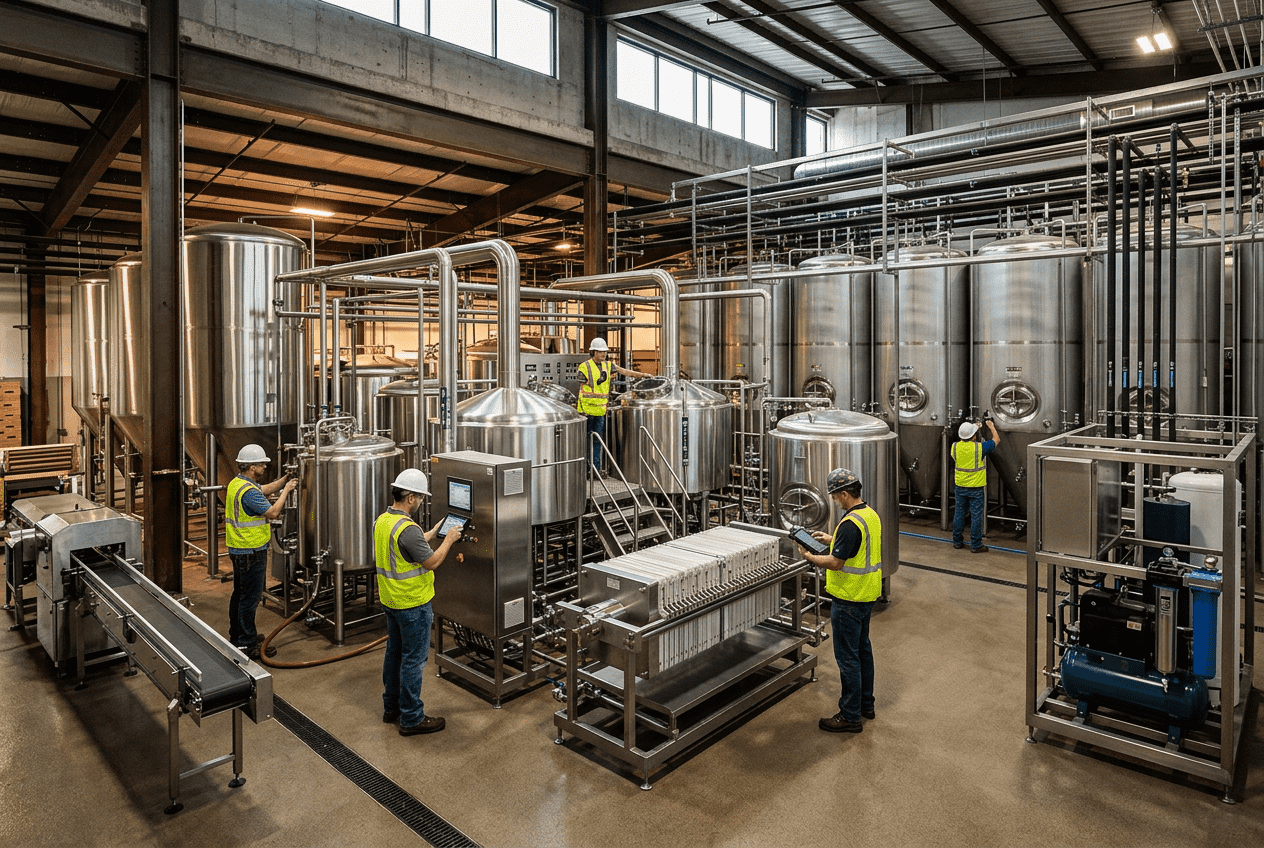
Helping Manufacturers Navigate Operational Complexity
The American brewing industry is undergoing a structural correction that rewards operational discipline and punishes overcapitalization. The U.S. craft brewing industry posted a 5.1% decline in production in 2025 amid broader softness in beer sales, though craft brewers slightly increased market share. New brewery openings dropped sharply to 300 in 2025 — down from 518 in 2024 — while closures hit 481, signaling a shift toward a more mature, competitive market. In this environment, the difference between a brewery that scales and one that stalls comes down to process infrastructure: how well your fermentation capacity matches your sales forecast, how efficiently your CIP cycles turn tanks, and whether your utilities were sized for today or for five years from now. Breweries that invested in right-sized systems and phased expansion roadmaps are outperforming peers that overbuilt during the boom years.
What separates a good brewing facility from a great one is integration — the seamless connection between brewhouse, cellar, packaging, and utilities that eliminates bottlenecks before they surface. A facility where glycol loops, steam generation, compressed air, and process water were designed as a unified system rather than bolted together by separate contractors will consistently deliver lower cost-per-barrel, faster changeover, and higher product consistency. That is exactly what DPS engineers: brewery systems where every pipe run, every valve cluster, and every PLC routine exists because the process demanded it, not because a vendor catalog suggested it.
What We Deliver to Manufacturers
Practical engineering solutions designed to improve efficiency, scalability, and operational performance.
-
1
Fermentation System Architecture & Process Engineering
We design complete fermentation programs — vessel sizing, tank farm layout, glycol zoning, pressure ratings, and CIP circuit integration — from P&ID through construction documents. Every fermentation system is modeled against your actual recipe portfolio and projected SKU mix, so you commission with confidence instead of discovering capacity gaps on brew day. -
2
Brewhouse Design, Procurement & Installation
DPS specifies, sources, and installs brewhouse systems from mash-in through wort transfer — including lauter tuns, brew kettles, whirlpools, and heat exchangers. We handle structural load calculations, utility stub-ups, steam and condensate piping, and full electrical integration so your brewhouse installation hits target gravity on the first brew, not the tenth. -
3
Automation, Controls & Recipe Management
Our in-house controls engineers program PLC and SCADA systems purpose-built for brewing — automated mash temperature profiles, fermentation curve monitoring, CIP sequence control, dissolved oxygen alarming, and batch logging for SQF and BRC audit trails. We have solved production problems worth millions with targeted control adjustments alone, before a single piece of new steel was ordered. -
4
Utility Infrastructure & System Integration
Brewing is only as reliable as the utilities feeding it. DPS engineers boiler and steam systems, glycol chiller loops, compressed air networks, process water and RO treatment, CO₂ recovery, and wastewater pre-treatment as an integrated utility plant — not as afterthoughts. We size every utility header for your full build-out so Phase 2 does not require ripping out Phase 1. -
5
Capital Planning & Phased Expansion Roadmaps
Before we draw a single line, we build your business case. DPS delivers ROI-backed feasibility studies, phased capital plans, and owner’s representative oversight that aligns every dollar of equipment spend with a revenue outcome. In a market where overcapitalization kills breweries, we act as your financial filter — and we will tell you when not to build.
Integrated Delivery vs Traditional Execution
Most brewery capital projects fail not because of bad equipment, but because of fragmented execution — separate firms for process design, mechanical engineering, equipment supply, controls programming, and construction management, none of whom share a unified scope. DPS eliminates that fragmentation through a single-source Design-Build-Manage model.
| Dimension | DPS Integrated Approach | Fragmented / Traditional |
|---|---|---|
| Project Delivery | Single contract, one team from feasibility through commissioning — process, mechanical, electrical, controls, and construction under one scope | 4–7 separate vendors with independent scopes; owner manages all interfaces and resolves conflicts |
| Fermentation & Process Design | In-house process engineers model your recipe portfolio, SKU forecasting, and CIP turnover to right-size every vessel and utility | Equipment vendor supplies catalog tanks; facility designer adapts layout around whatever arrives |
| Equipment Supply | DPS-manufactured tanks and vessels (up to 12,000 gal), CIP skids, tumblers, and kettles — built to project specs with full integration warranty | Third-party equipment ships to site; installing contractor interprets spec sheets and adapts field connections |
| Controls & Automation | Purpose-built PLC/SCADA programming with recipe management, batch control, energy monitoring, and audit-ready data logging — all by the same team that designed the process | Controls integrator programs to a spec written by someone else; commissioning becomes weeks of troubleshooting disconnects |
| Capital Efficiency | ROI analysis and phased roadmaps before design begins; we decline projects that do not pencil for the client | Scope creep across multiple change orders; no single party accountable for budget-to-outcome alignment |
| Compliance & Documentation | FDA, USDA, SQF, and BRC requirements embedded in design from day one — P&IDs, as-builts, and validation documents delivered as a package | Compliance burden falls on owner to coordinate across vendors; documentation gaps surface during audits |
| Nationwide Coverage | Licensed GC capability with vetted national contractor network across all 50 states and Canada; offices in Cary, NC and Lake Forest, CA | Regional contractors require separate sourcing for multi-site or cross-state programs |