
Distillery Engineering & Distillation Systems Built for Profitable Spirits Production
The U.S. spirits market is consolidating fast. The distillers still standing need facilities engineered for throughput, efficiency, and regulatory precision — not just aesthetics. DPS delivers full-scope distillery engineering, from pot still and column still design through utility infrastructure and automation, as a single accountable partner across all 50 states.
Schedule a Consultation →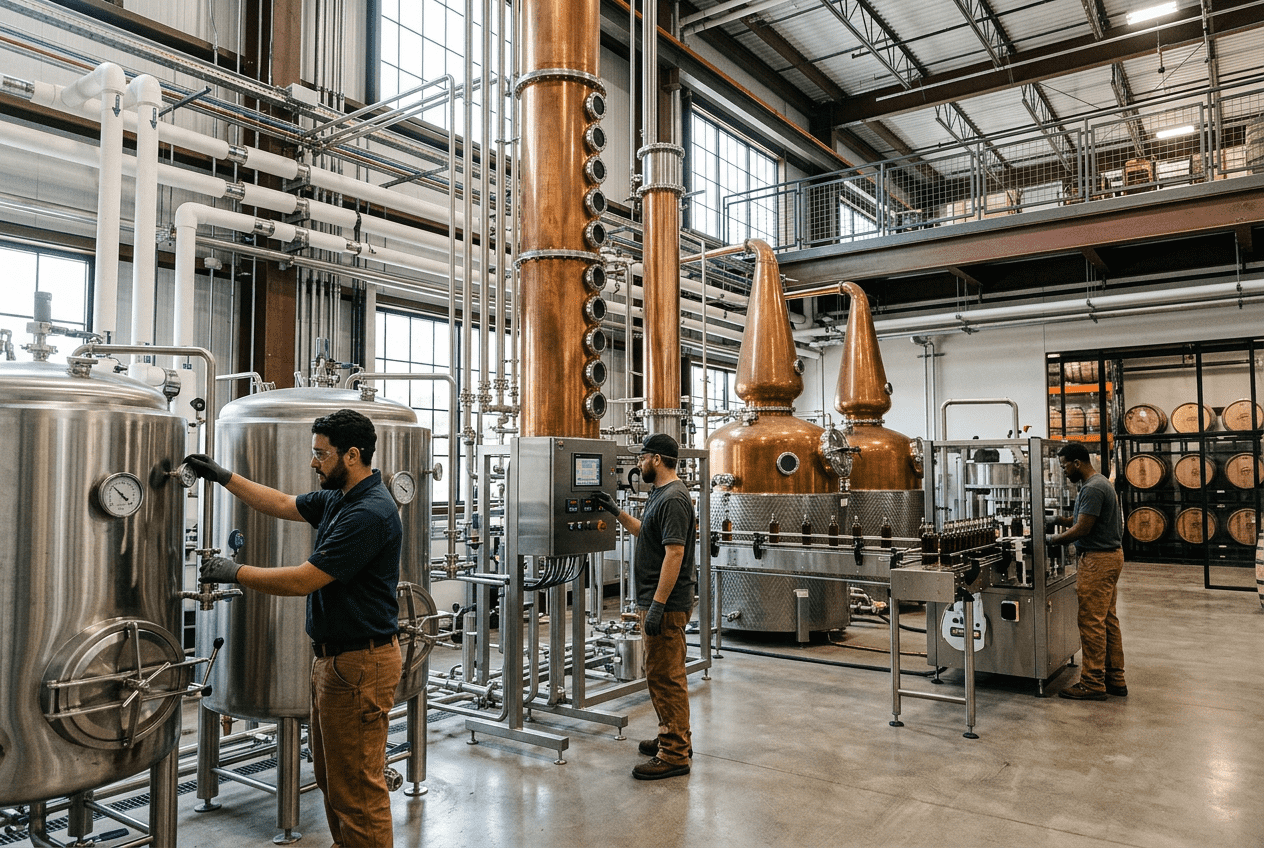
Helping Manufacturers Navigate Operational Complexity
The American spirits industry is undergoing a decisive shakeout. After years of rapid craft distillery growth, the sector has entered a correction phase — the number of active U.S. craft distillers dropped roughly 25% in the twelve months ending August 2025, falling from over 3,000 to approximately 2,280 operations. Volume sales declined over 6% year-over-year while the broader spirits market softened by 2.2%. The distillers that survive this consolidation will not be the ones with the best label art. They will be the ones whose facilities are engineered for yield optimization, energy efficiency, utility resilience, and the flexibility to pivot between whiskey, gin, vodka, and RTD production as demand shifts. This is an engineering problem before it is a marketing problem.
At the same time, premiumization continues to reshape the competitive landscape. Premium and super-premium categories now account for approximately 35% of total U.S. spirits market value, up from 26% a decade ago, and spirits-based ready-to-drink cocktails posted 16.4% sales growth in 2025, making them the industry’s strongest category. For distillers with ambitions beyond tasting-room revenue, facility design determines whether you can access those growth segments — or whether your infrastructure becomes the ceiling on your business. The right distillation system, correctly integrated with fermentation, utilities, barrel storage, and bottling, is what separates a spirits brand from a spirits business.
What We Deliver to Manufacturers
Practical engineering solutions designed to improve efficiency, scalability, and operational performance.
-
1
Process & Distillation System Engineering
DPS designs complete distillation systems — pot stills, column stills, hybrid configurations, and multi-spirit platforms — with full process flow diagrams, heat and mass balance calculations, and detailed P&IDs. We engineer for your specific mash bill, target proof, and production volume, whether that is 500 proof gallons per day or 50,000, integrating fermentation, distillation, condensation, spirit collection, and proofing into a unified process architecture. -
2
Capital Planning & Phased Expansion Roadmaps
Before a single pipe is cut, DPS builds a capital plan tied to your revenue projections, production targets, and market strategy. We model phased buildouts that let you start producing revenue on Day One while pre-engineering the utility capacity, structural loads, and piping routes needed for Year Three and Year Five expansions — so growth never requires a facility teardown. -
3
Utility Infrastructure & Compliance Engineering
Distillery operations demand precise utility systems: steam generation for stills, glycol loops for condensation and fermentation temperature control, process water treatment, wastewater handling for high-BOD stillage, compressed air, and HVAC engineered for ethanol vapor management and fire code compliance. DPS engineers all six disciplines — structural, mechanical, plumbing, electrical, process, and controls — in-house, eliminating the coordination gaps that derail distillery projects. -
4
Automation, Controls & Recipe Management
DPS programs PLC-based control systems and SCADA platforms for automated mashing, fermentation monitoring, distillation cut management, CIP sequencing, and energy optimization. Automated batch control and recipe management let your team switch between spirit types without manual re-engineering, while real-time data logging supports TTB recordkeeping and quality traceability. -
5
Equipment Manufacturing & Turnkey Installation
Through our own fabrication capability — stainless steel vessels up to 12,000 gallons, CIP skids, process tanks, and custom kettles — DPS controls quality and lead times on critical equipment. We then physically install, integrate, and commission the complete system, from process piping and electrical through controls validation and operator training, as a licensed general contractor.
Integrated Delivery vs Traditional Execution
Most distillery projects fail not because of bad equipment choices, but because of fragmented project delivery — one firm draws the P&IDs, another handles structural, a third installs piping, a fourth programs controls, and nobody owns the outcome. DPS eliminates that fragmentation with a single-source Design-Build-Manage model purpose-built for spirits production facilities.
| Dimension | DPS Integrated Approach | Fragmented / Traditional Model |
|---|---|---|
| Process Design Accountability | One team engineers the full process — fermentation through bottling — with unified P&IDs and a single set of design assumptions | Separate process consultant, MEP engineer, and equipment vendor each produce conflicting documents with different design bases |
| Utility Sizing & Future-Proofing | Steam, glycol, water, wastewater, and electrical sized for current load plus engineered expansion capacity from Day One | Utilities sized to current equipment only; every expansion requires costly infrastructure upgrades and potential production shutdowns |
| Regulatory & Compliance Path | TTB premises documentation, fire code engineering, ethanol vapor ventilation design, and wastewater permitting addressed within the engineering scope | Owner coordinates separately with compliance consultants, fire engineers, and environmental firms — gaps emerge at inspection |
| Controls Integration | PLC/SCADA programmed by the same team that designed the process, ensuring control logic matches actual equipment and flow paths | Controls integrator receives specs secondhand, programs to documentation rather than real process behavior, requiring extensive field rework |
| Schedule & Cost Certainty | Single contract, single schedule, one point of accountability from feasibility through commissioning and operator training | 4-7 separate contracts with independent timelines; delays cascade, change orders multiply, and no single party owns the budget |
| Equipment Supply Chain | In-house vessel fabrication (up to 12,000 gal) plus curated OEM relationships reduce lead time and ensure dimensional compatibility | Owner procures equipment independently; dimensional conflicts and utility mismatches discovered during installation |

