
Winery Engineering & Wine Facility Design for Scalable, Profitable Production
The U.S. wine industry is consolidating. The wineries positioned for the next decade are the ones whose facilities — crush pad design, barrel room infrastructure, fermentation capacity, and utility systems — are engineered for operational efficiency, not just winemaking aesthetics. DPS delivers full-scope winery engineering across all 50 states: from capital planning and process design through equipment fabrication, installation, and automation.
Schedule a Consultation →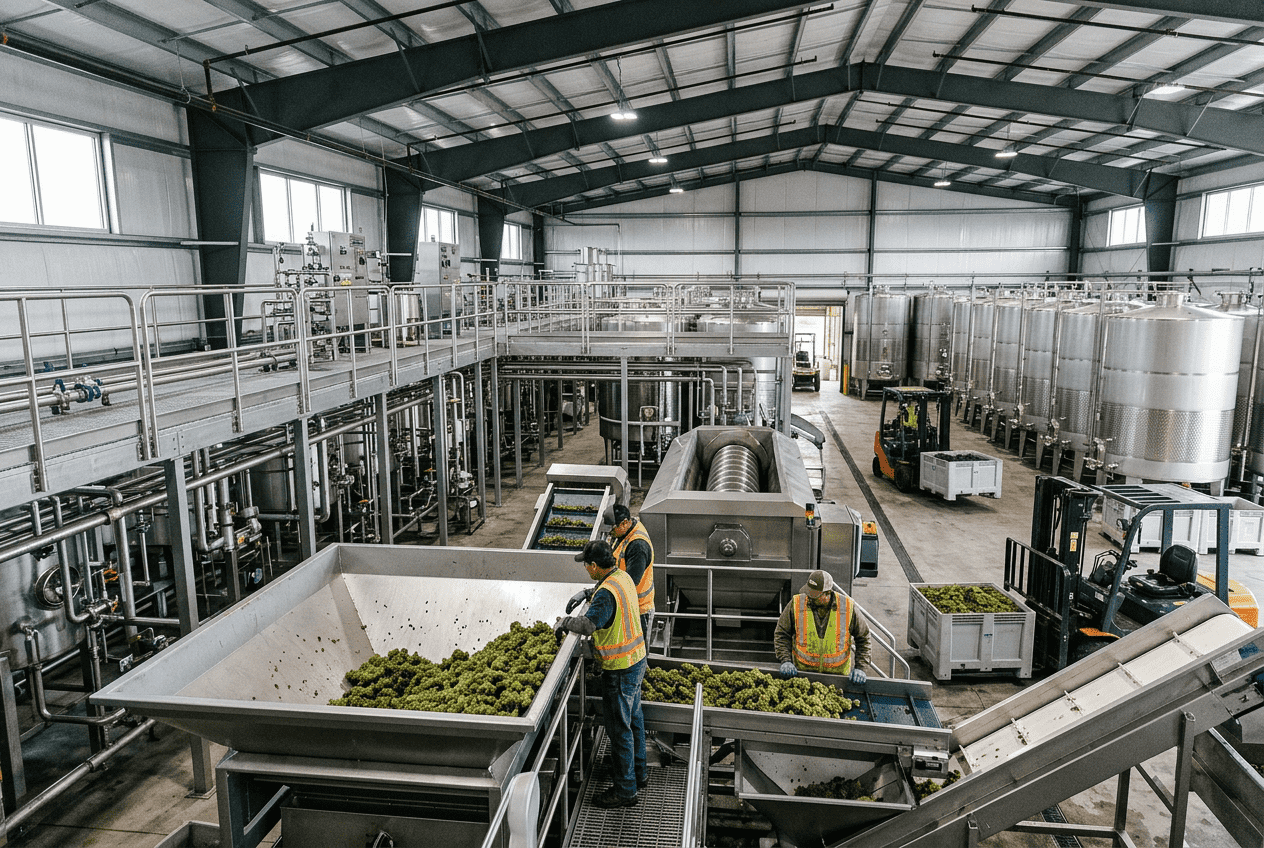
Helping Manufacturers Navigate Operational Complexity
The American wine industry is undergoing its most significant structural correction in decades. Total U.S. wine volume fell to approximately 329 million cases in 2025, a 2% decline from the prior year, while dollar sales dropped to an estimated $74.3 billion. The national winery count contracted for the third consecutive year, falling roughly 3% to approximately 11,100 operations — an average of one winery closing every single day in 2025. Yet these headline numbers obscure a critical divergence: premium and luxury tiers continue to outperform value segments, and the wineries posting stable or growing results share a common trait. They have invested in facilities engineered for production flexibility, operational efficiency, and direct-to-consumer experiences — tasting rooms and wine clubs now account for over 53% of the average winery’s revenue in some regions.
For winery operators with $20M+ revenue and ambitions to grow through this correction, the facility itself is the strategic variable. A wine production system engineered for multi-varietal flexibility, efficient crush-through-bottling flow, temperature-precise barrel room environments, and compliant wastewater handling is the infrastructure that separates brands capturing premium margins from those trapped in the commodity squeeze. Meanwhile, eastern U.S. wine regions are expanding rapidly — wineries east of the Mississippi now represent 29% of all U.S. operations, up from 25% in 2019 — creating new demand for greenfield wine facility construction outside of traditional West Coast markets. Whether you are building new in Virginia, expanding in Oregon, or retrofitting a legacy California operation, the engineering determines the outcome.
What We Deliver to Manufacturers
Practical engineering solutions designed to improve efficiency, scalability, and operational performance.
-
1
Process Engineering — Crush Pad Through Bottling Line
DPS engineers complete wine production systems with detailed P&IDs, process flow diagrams, and heat/mass balance calculations covering grape reception, destemming, crushing, pressing, fermentation, racking, aging, filtration, stabilization, and bottling. We design crush pad layouts optimized for your throughput targets — whether 5 tons per hour or 50 — with equipment staging, must transfer routing, and drainage engineering that eliminates bottlenecks during the compressed harvest window. -
2
Capital Planning & Phased Expansion Roadmaps
Before committing to construction, DPS builds a capital plan tied to your production volumes, varietal portfolio, and revenue model. We engineer phased buildouts where your Day One facility is fully operational and revenue-generating, while structural loads, utility mains, piping routes, and barrel room square footage are pre-engineered for Year Three and Year Five expansions — so scaling never requires tearing out what you just built. -
3
Barrel Room, Cellar & Climate Infrastructure
Barrel rooms demand precise temperature (55–60°F) and humidity (65–75% RH) control year-round, with structural engineering for barrel-stack loads that can exceed 150 PSF. DPS designs integrated climate systems — glycol-based cooling, night-air economizers, humidification, and HVAC zoning — alongside structural, floor drainage, and lighting engineering, delivered as a single coordinated package rather than separate trades. -
4
Utility Systems & Wastewater Compliance
Wine facilities generate high-BOD, acidic wastewater with extreme seasonal variability — peak loads during crush can be ten times the off-season baseline. DPS engineers complete utility infrastructure: process water treatment, wastewater pretreatment and discharge systems sized for crush-season peaks, glycol loops, compressed air, CIP systems, steam generation, and electrical distribution across all six in-house disciplines — structural, mechanical, plumbing, electrical, process, and controls. -
5
Automation, Controls & Production Data
DPS programs PLC-based control systems and SCADA platforms for automated fermentation temperature management, pump-over scheduling, CIP sequencing, tank-level monitoring, and energy optimization. Recipe management and batch control let your team manage multiple varietals and production protocols without manual re-engineering, while real-time data logging supports TTB recordkeeping, SQF/BRC audit trails, and quality traceability from crush through bottle.
Integrated Delivery vs Traditional Execution
Wine facility projects routinely suffer from coordination failure. The architect draws the building, a separate process consultant specs the tanks, a third firm handles MEP, a fourth installs piping, and nobody engineers the facility as an integrated production system. The result is change orders, dimensional conflicts, and utility shortfalls discovered during crush. DPS eliminates that fragmentation with a single-source Design-Build-Manage model purpose-built for wine production facilities.
| Dimension | DPS Integrated Approach | Fragmented / Traditional Model |
|---|---|---|
| Crush Pad Engineering | Process flow, equipment staging, drainage slopes, electrical loads, and must transfer routing engineered as a unified system with single-team accountability | Equipment vendor specs crush equipment independently; GC installs drainage and electrical to different assumptions; flow conflicts emerge at first harvest |
| Barrel Room Design | Temperature, humidity, structural loading, floor drainage, and lighting co-engineered with the barrel storage plan and future expansion capacity pre-built | Architect sizes the room, HVAC contractor installs climate systems to generic specs, structural engineer uses standard loads — barrel-stack capacity limits discovered post-construction |
| Utility Sizing & Seasonal Loads | Glycol, process water, wastewater, compressed air, and electrical service sized for crush-season peak demand plus engineered growth capacity from Day One | Utilities designed around average-season loads; every crush season stresses capacity, and expansions require costly shutdowns for infrastructure upgrades |
| Wastewater Compliance | BOD loading, pH management, seasonal variability, and discharge permitting addressed within the engineering scope — designed to meet state environmental regulations | Owner coordinates separately with environmental consultants after facility design is complete; wastewater system undersized or non-compliant at inspection |
| Controls & Fermentation Management | PLC/SCADA designed by the same team that engineered the process, ensuring control logic matches actual tank configurations, valve locations, and flow paths | Controls integrator receives secondhand specs, programs to documentation rather than real process behavior — extensive field rework required during commissioning |
| Schedule Certainty vs. Harvest | Single contract, single schedule, one point of accountability designed around the rigid viticulture calendar — operational before crush | 4–7 separate contracts with independent timelines; delays cascade through harvest season, forcing interim workarounds or lost production years |

