Juice Processing and Functional Beverage Production Lines Engineered for Scale
From cold-pressed juice and HPP processing to fortified functional beverages with adaptogens, probiotics, and botanical extracts, DPS designs, builds, and manages complete production facilities purpose-built for the complexity of modern juice and functional beverage manufacturing. We serve producers across all 50 U.S. states and Canada — delivering integrated batching, pasteurization, filling, and packaging systems under a single Design-Build-Manage contract.
Schedule a Consultation →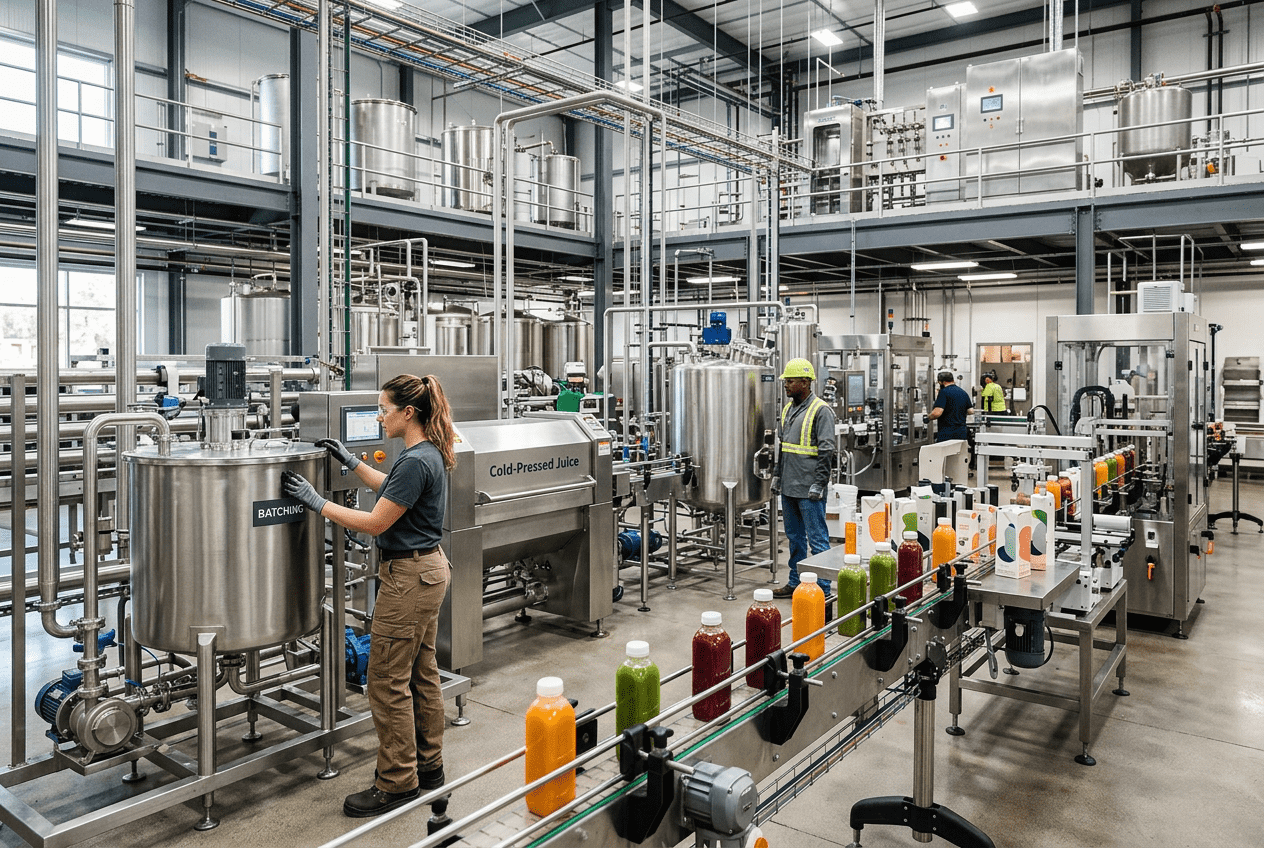
Helping Manufacturers Navigate Operational Complexity
The U.S. functional beverages market reached approximately $51.84 billion in 2025, and the category continues to compound as American consumers shift spending toward beverages that deliver measurable health outcomes — gut health, immunity, cognitive function, sustained energy — rather than empty refreshment. For juice processors and functional beverage manufacturers, this growth creates both opportunity and engineering complexity. Today’s production facility must handle heat-sensitive bioactive ingredients like live probiotics, collagen peptides, and adaptogenic botanicals alongside traditional fruit and vegetable concentrates, all while meeting the FDA’s mandatory 5-log pathogen reduction under 21 CFR Part 120 (Juice HACCP). The brands capturing premium shelf space are the ones whose production infrastructure can maintain label-claim accuracy for active ingredients through pasteurization, blending, and filling — a process engineering challenge that most general contractors simply cannot solve.
What separates a profitable juice processing facility from one that hemorrhages margin is how pasteurization, blending, water treatment, and filling systems are coordinated as a single integrated process. A cold-pressed juice operation that outsources HPP processing to a tolling facility because its own infrastructure was not designed to accommodate high-pressure equipment from the start is surrendering logistics cost and scheduling control on every production run. A functional beverage producer whose HTST system was sized only for current volume — without headroom for the inevitable SKU expansion that comes with category growth — faces a capital re-spend within 18 months of opening. DPS approaches every juice and functional beverage project as a business planning exercise first: we model your product portfolio, volume trajectory, and distribution economics before we size a single tank or specify a single valve.
What We Deliver to Manufacturers
Practical engineering solutions designed to improve efficiency, scalability, and operational performance.
-
1
Complete Juice Processing Line Design & Engineering
DPS engineers end-to-end juice processing lines — from raw fruit and vegetable receiving through extraction, deaeration, blending, pasteurization (HTST, UHT, or flash), and filling — sized for your specific product portfolio and volume trajectory. Every system is designed with validated 5-log pathogen reduction built into the process flow, ensuring full compliance with FDA Juice HACCP requirements (21 CFR Part 120) before the first bottle hits the line. -
2
HPP Processing Integration & Facility Design
For cold-pressed juice producers and functional beverage brands requiring non-thermal preservation, DPS designs facilities with HPP processing integrated into the production layout — not bolted on as an afterthought. We engineer the material handling, packaging sequencing, and cold-chain infrastructure required for efficient HPP throughput, eliminating the margin erosion that comes from outsourcing high-pressure processing to third-party tolling operations. -
3
Functional Ingredient Batching & Label-Claim Accuracy
Functional beverage production demands batching systems that can accurately meter probiotics, prebiotics, collagen, botanical extracts, vitamins, and mineral blends at precise concentrations across hundreds of SKUs. DPS designs recipe-managed batching platforms with PLC-controlled ingredient dosing, in-line Brix and pH verification, and automated batch records that maintain label-claim accuracy and traceability from raw ingredient through finished package. -
4
Pasteurization & Thermal Processing Systems
DPS specifies and integrates HTST, UHT, flash, and tunnel pasteurization systems calibrated for the specific heat-sensitivity profile of your product formulations — protecting bioactive compounds in functional beverages while achieving validated pathogen reduction. Our process engineers size heat exchangers, holding tubes, and regeneration sections to optimize energy efficiency and minimize thermal damage to flavor, color, and nutrient content across your full product range. -
5
Automation, CIP & Multi-Product Changeover
Running 20–50+ SKUs across juice, functional shots, and enhanced water products creates CIP and changeover demands that single-product systems cannot handle. DPS manufactures CIP skids in-house — with vessels up to 12,000 gallons — and programs PLC/SCADA systems that unify batching, pasteurization, filling, and cleaning under a single controls architecture with automated recipe management, allergen sequencing protocols, and full batch traceability.
Integrated Delivery vs Traditional Execution
The cost of a fragmented approach to juice facility construction is not just schedule risk — it is lost margin on every case you produce. When a process engineer designs your HTST system, a separate vendor supplies your blending tanks, a third-party integrator programs the controls, and a general contractor installs piping without understanding your product sequencing requirements, the result is a facility that cannot hold pasteurization parameters during product changeover, a CIP system that wastes water and chemicals between allergen-containing and allergen-free runs, and utility infrastructure that bottlenecks the moment you try to run extraction and pasteurization simultaneously.
| Dimension | DPS Integrated Approach | Fragmented / Traditional Model |
|---|---|---|
| Pathogen Reduction Validation | Pasteurization (HTST/UHT/Flash) or HPP systems engineered with validated 5-log reduction protocols built into the process design — FDA Juice HACCP documentation delivered as part of the project | Pasteurization equipment purchased to generic spec; 5-log validation left to the client or a separate consultant post-installation, creating compliance gaps and startup delays |
| Functional Ingredient Accuracy | PLC-controlled batching with in-line Brix, pH, and dosing verification ensures label-claim accuracy for probiotics, vitamins, and botanical actives across every SKU in your portfolio | Ingredients metered manually or through basic volumetric systems; label-claim drift discovered during third-party lab testing after production, generating waste and recall risk |
| HPP Integration | Facility layout, material handling, cold chain, and packaging sequencing co-designed around HPP throughput requirements from the earliest engineering phase | HPP equipment purchased separately and shoehorned into a facility designed for thermal processing; inefficient material flow doubles labor cost per cycle |
| Multi-SKU Changeover | Automated CIP sequencing with allergen protocols, recipe-driven product changeover, and DPS-manufactured CIP skids sized for high-SKU production — changeover in under 20 minutes | Off-the-shelf CIP designed for single-product operations; manual changeover across 4–5 machines consuming 60–90 minutes with flavor carryover risk between juice and functional products |
| Utility Sizing & Expansion | Steam, glycol, compressed air, RO water, and wastewater sized for peak simultaneous demand across extraction, pasteurization, batching, and CIP — with Phase 2 capacity pre-engineered into Day One infrastructure | Utilities sized to initial production demand only; adding a second pasteurizer or HPP unit requires mechanical shutdown, utility upgrades, and re-permitting |
| Schedule & Accountability | Single Design-Build-Manage contract from process engineering through commissioning; DPS owns the schedule and coordinates all trades through a vetted national contractor network | 5–8 separate contracts across process engineer, equipment vendors, HPP supplier, controls integrator, GC, and commissioning agent — schedule delays compound with no single party owning the outcome |