
Sauce Production & Marinade Manufacturing Facilities Engineered End-to-End
DPS designs, builds, and manages complete sauce production lines, marinade manufacturing systems, and dressing processing facilities — integrating high-shear mixing, thermal processing, CIP, and automation under a single Design-Build-Manage contract. From feasibility through commissioning, we deliver turnkey infrastructure for condiment producers, private-label manufacturers, and co-packers across all 50 U.S. states and Canada.
Schedule a Consultation →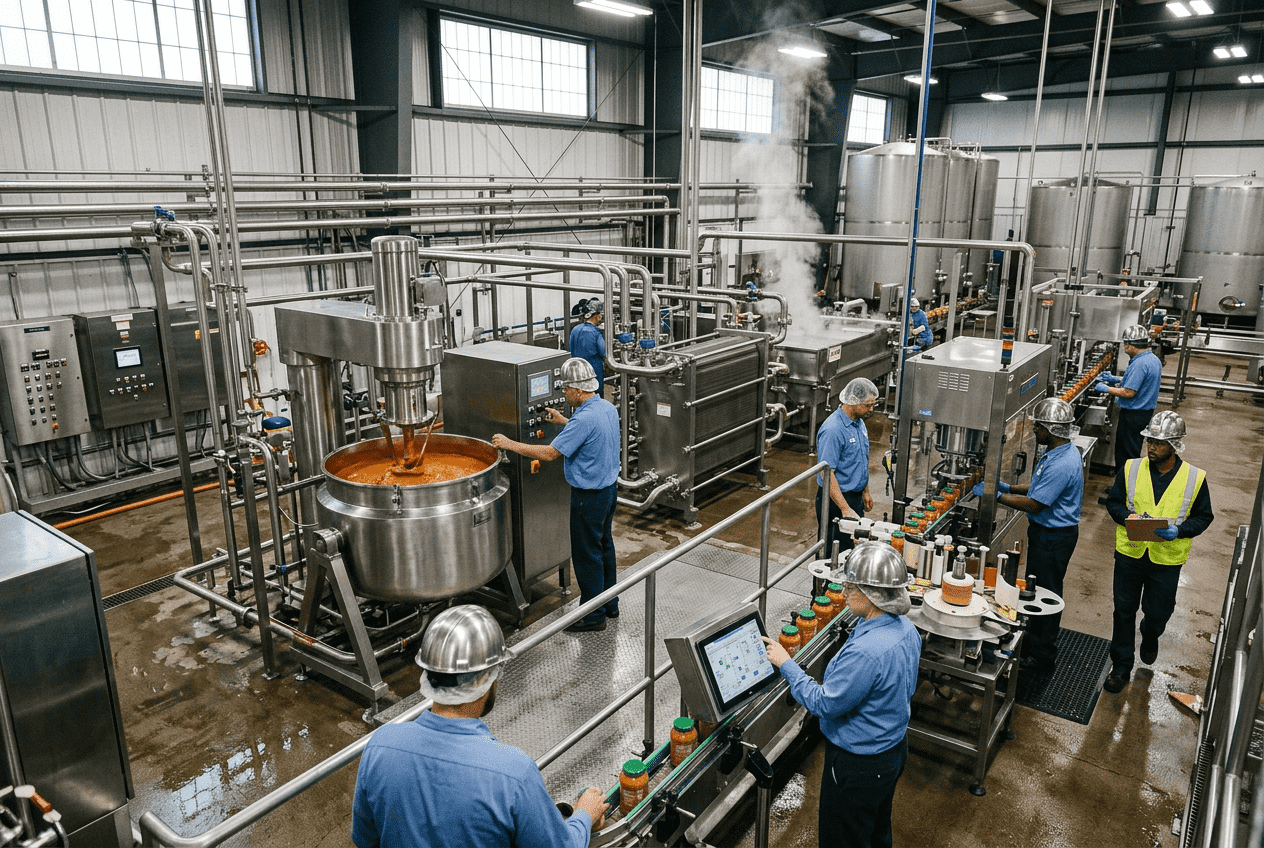
Helping Manufacturers Navigate Operational Complexity
The U.S. sauces, dressings, and condiments market generates over $36 billion annually, yet the manufacturing infrastructure behind that revenue is under extraordinary pressure. Consumer demand has fractured into dozens of flavor profiles, viscosity ranges, and dietary formats — from clean-label organic vinaigrettes and plant-based dressings to high-viscosity cheese sauces and ethnic-inspired marinades. Each product variation imposes different demands on mixing intensity, thermal processing parameters, emulsion stability, and ingredient handling. Manufacturers running 15–30 SKUs through a single facility face a compounding engineering challenge: every new product added to the portfolio multiplies the changeover complexity, CIP validation requirements, and allergen segregation protocols the facility must support. The gap between companies that scale profitably and those that stall at regional distribution almost always traces back to how the process architecture was designed.
What separates a high-performing sauce production facility from one trapped in chronic changeover delays and yield loss is whether the mixing, heating, cooling, and filling systems were engineered as a coordinated throughput chain or assembled ad hoc from separate vendor quotes. A dressing processing line where the high-shear mixer outpaces the downstream filler creates hold-time violations and emulsion breakdown. A marinade manufacturing system without properly sized recirculation loops produces inconsistent flavor distribution across the batch. A hot-fill sauce line where CIP cycle times consume 30% of available production hours because the system was designed for a single product — not the full SKU portfolio — will never deliver the margins that justified the capital investment. DPS analyzes these interdependencies before a single P&ID is drafted, treating every sauce, marinade, and dressing facility as an integrated business system rather than a collection of standalone equipment purchases.
What We Deliver to Manufacturers
Practical engineering solutions designed to improve efficiency, scalability, and operational performance.
-
1
High-Shear Mixing & Emulsion System Design
DPS engineers batch and inline high-shear mixing systems calibrated to your specific product portfolio — accounting for viscosity range (thin vinaigrettes through heavy cheese sauces), particulate load, emulsion droplet-size targets, and shear-sensitive ingredients that degrade under excessive rotor speed. We size vessels, agitators, rotor-stator configurations, and recirculation loops so the system handles your most demanding SKU without compromising quality on the simplest. -
2
Thermal Processing & Hot/Cold Fill Integration
Sauce production and marinade manufacturing demand precise thermal control — whether HTST pasteurization for shelf-stable hot-fill sauces, gentle cooking kettles for particulate-loaded marinades, or scraped-surface heat exchangers for high-viscosity cheese and cream-based dressings. DPS designs the thermal chain end-to-end from cooking through cooling, ensuring hold times, fill temperatures, and container-closure integrity meet FDA 21 CFR 114/113 requirements for acidified and low-acid products. -
3
Multi-SKU CIP & Allergen Changeover Engineering
Sauce and dressing facilities running 15+ SKUs lose more production hours to cleaning than to actual manufacturing if the CIP system was designed for one product. DPS engineers multi-circuit CIP systems with automated chemical dosing, validated rinse cycles, and allergen verification protocols — reducing changeover time while delivering the documented sanitation records that SQF and BRC auditors require for every product transition. -
4
Automation, Batch Control & Recipe Management
DPS programs PLC/SCADA systems that manage recipe sequencing, ingredient dosing, mix-time control, temperature profiling, and lot traceability across your full product portfolio — enabling operators to switch between SKUs through the HMI rather than manually re-configuring valves, set points, and timers. Automated batch records capture every critical parameter for FDA compliance and third-party audit documentation. -
5
In-House Equipment Manufacturing
DPS fabricates process vessels up to 12,000 gallons, CIP skids, mixing tanks, batch kettles, and marination tumblers at our own facilities — eliminating the multi-vendor coordination failures that delay projects when tanks, piping, and controls arrive from suppliers who never validated against each other. Every DPS-built vessel integrates directly into the process architecture we design.
Integrated Delivery vs Traditional Execution
When sauce production, marinade manufacturing, or dressing processing projects are split across a standalone process consultant, separate equipment OEMs for mixing, thermal processing, and filling, an independent controls integrator, and a general contractor without food-grade experience, accountability fractures at every interface — and the resulting facility underperforms from day one.
| Dimension | DPS Integrated Approach | Fragmented / Traditional Model |
|---|---|---|
| High-Shear Mixing Performance | Rotor-stator type, vessel geometry, agitation speed, and recirculation flow engineered as a unified system for your full viscosity and particulate range — validated against your most demanding product before fabrication | Mixer selected from OEM catalog based on volume alone; emulsion instability, shear damage to particulates, or insufficient dispersion discovered after installation when switching between thin and viscous products |
| Thermal Process & Fill-Line Balance | Cook, cool, and fill stages designed as a synchronized throughput chain — hold times validated to FDA requirements, fill temperatures matched to container-closure specifications, with buffer capacity engineered for each transition | Equipment purchased stage-by-stage; 45-minute hold-time gaps between cooker and filler create temperature excursions that compromise product safety and trigger rework or disposal |
| CIP & Multi-SKU Changeover | Multi-circuit CIP designed for your full allergen matrix and SKU portfolio from Day One — automated chemical dosing, validated rinse protocols, and documented sanitation records built into the controls architecture | Single-circuit CIP sized for launch product; adding SKUs with different allergen profiles, pH levels, or soil loads requires CIP re-engineering, additional circuits, and re-validation |
| Automation & Recipe Control | PLC/SCADA recipe management across mixing, heating, dosing, and filling — SKU changeover via HMI selection with automated parameter adjustment, full batch traceability, and audit-ready documentation | Manual recipe execution with operator-dependent valve settings and temperature adjustments; batch-to-batch inconsistency increases waste and complicates traceability during FDA or SQF audits |
| Utility Sizing | Steam, hot water, chilled water, compressed air, and process water sized for simultaneous peak demand across production and CIP — with Phase 2 expansion capacity pre-engineered into Day One infrastructure | Utilities sized for initial single-product operation; adding a second production line or running CIP during production triggers boiler, chiller, or compressor upgrades and costly mechanical shutdowns |
| Single-Point Accountability | One Design-Build-Manage contract from feasibility through commissioning — DPS owns the schedule, coordinates all trades through a vetted national contractor network, and is accountable for the integrated outcome | 5–7 separate contracts with no single party accountable when the mixer doesn’t match the filler throughput, the CIP can’t handle the allergen matrix, or the controls don’t talk to the thermal system |

