
Aseptic & Retort Processing Facilities — Designed, Built, and Automated
DPS engineers, constructs, and commissions complete aseptic and retort processing systems for shelf-stable food and beverage manufacturers — from thermal process design and FDA 21 CFR 113 compliance through filling, canning, packaging integration, and facility-wide PLC/SCADA automation. We deliver turnkey thermal processing infrastructure under a single Design-Build-Manage contract for producers, co-packers, and contract manufacturers across all 50 U.S. states and Canada.
Schedule a Consultation →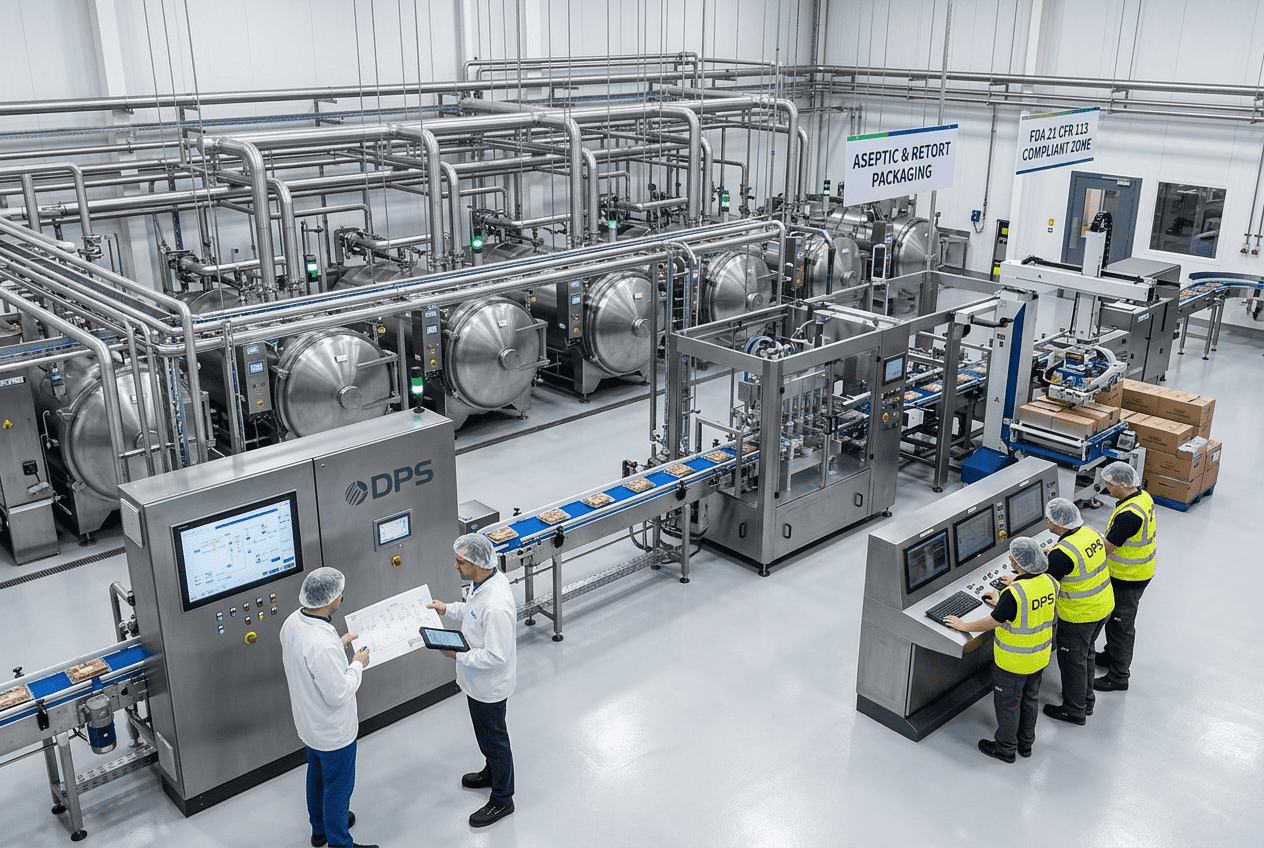
Helping Manufacturers Navigate Operational Complexity
The shelf-stable food and beverage sector is one of the most capital-intensive and compliance-demanding segments in U.S. food manufacturing. The global shelf-stable food market was valued near $37 billion in 2024 and is projected to grow to approximately $66 billion by 2035. North America leads this category, driven by consumer demand for convenient, shelf-stable meal solutions and supported by advanced food processing systems, established retail channels, and effective supply networks. For manufacturers, this growth translates into aggressive facility expansion — new retort lines, aseptic filling systems, and canning operations that must achieve commercial sterility while satisfying FDA registration requirements, scheduled process filings, and third-party audit standards like SQF and BRC. Yet high initial capital and processing costs for aseptic and retort packaging systems limit accessibility, and advanced sterilization equipment requires substantial upfront investment. Every dollar of misspent capital on undersized retort capacity, incorrectly validated thermal processes, or fragmented controls integration compounds across years of production.
What separates profitable thermal processing operations from those trapped in chronic rework and regulatory exposure is whether the retort or aseptic system was engineered as part of a coordinated production chain — or bolted onto a facility designed for a different purpose. A retort processing line where the batch preparation, filling, seaming, thermal treatment, cooling, and case-packing stages were not modeled as a unified throughput system will generate container-handling bottlenecks, inconsistent lethality delivery, and CIP scheduling conflicts that erode margins on every production run. An aseptic food processing facility where the UHT/HTST sterilizer, sterile surge tank, and aseptic filler were sourced from three separate OEMs — none of whom validated their equipment against each other’s flow rates and back-pressure requirements — will face commissioning delays measured in months, not weeks. DPS eliminates these failure modes by engineering every thermal processing facility as an integrated business system, validating process interdependencies before the first equipment PO is issued.
What We Deliver to Manufacturers
Practical engineering solutions designed to improve efficiency, scalability, and operational performance.
-
1
Retort System Design & Thermal Process Engineering
DPS designs complete retort processing lines — batch and continuous — calibrated to your specific product matrix, container format (cans, pouches, glass, trays), and target F₀ values, engineering the cook/cool profiles, come-up time, and venting schedules required to achieve validated commercial sterility under FDA 21 CFR 113. We size retort capacity, basket/crate configurations, and loading systems to match upstream filling speeds so the thermal processing stage never becomes the production bottleneck. -
2
Aseptic Processing & Sterile Filling Integration
DPS engineers UHT and HTST sterilization systems, sterile product tanks, and aseptic filling equipment as a unified flow chain — validating the sterilizer’s outlet temperature and pressure against the filler’s back-pressure requirements and the surge tank’s hold capacity so the entire system sustains commercial sterility at rated throughput. We design the cleanroom or controlled environment surrounding the aseptic zone, including HVAC, positive-pressure air handling, and barrier isolation, to meet FDA filing requirements and your target SQF or BRC certification level. -
3
Upstream Process & Batch Preparation Systems
DPS designs the complete product preparation infrastructure feeding your thermal processing line — blending, high-shear mixing, cooking kettles, scraped-surface heat exchangers, and ingredient batching systems — ensuring upstream capacity matches the fill rate your retort or aseptic filler demands across your full product portfolio. We engineer recipe-driven batching sequences through PLC automation so operators manage multi-product schedules from the HMI rather than manually adjusting valve positions and ingredient weights between changeovers. -
4
Automation, Batch Records & Regulatory Traceability
DPS programs PLC/SCADA systems that automate retort cycle sequencing, temperature/pressure recording, sterilization value (F₀) calculation, CIP cycle management, and full lot traceability from raw ingredient receiving through case-coded palletization — creating the continuous electronic batch record that FDA investigators, USDA-FSIS auditors, and SQF/BRC certification bodies expect during facility inspections. Automated deviation detection and alarm management replace manual logbook entries with real-time process authority–grade documentation. -
5
In-House Equipment Manufacturing & Utility Infrastructure
DPS fabricates process vessels up to 12,000 gallons, CIP skids, batch tanks, blending systems, and thermal processing support equipment at our own facilities — eliminating the multi-vendor coordination failures that delay thermal processing projects when tanks, piping, and controls arrive from suppliers who never validated against each other. We also engineer complete utility systems — steam boilers sized for simultaneous retort and CIP demand, compressed air, glycol/chilled water, process water, wastewater treatment, and refrigeration — ensuring the thermal processing line never competes with the rest of the plant for critical utilities.
Integrated Delivery vs Traditional Execution
When aseptic and retort processing projects are split across a standalone thermal process authority, separate equipment OEMs for sterilization, filling, and seaming, an independent controls integrator, and a general contractor with no 21 CFR 113 experience, accountability fractures at every system boundary — and the resulting facility underperforms from commissioning day forward.
| Dimension | DPS Integrated Approach | Fragmented / Traditional Model |
|---|---|---|
| Thermal Process Validation | Retort cook/cool profiles, F₀ targets, venting schedules, and container heat-penetration data engineered as a unified system — validated against your specific product formulations, container geometries, and fill weights before equipment procurement | Retort purchased from OEM catalog; thermal process validation contracted separately post-installation — discovering that the retort’s come-up characteristics do not match the filed scheduled process, requiring costly re-filing and production delays |
| Aseptic Sterilizer–Filler Integration | UHT/HTST system, sterile surge tank, and aseptic filler engineered as a synchronized flow chain with validated back-pressure, temperature, and sterility maintenance across the entire product path from sterilizer outlet to sealed container | Sterilizer and filler procured from different OEMs with no validated throughput match — sterility breaks discovered during commissioning when surge tank hold times exceed validated limits or filler back-pressure destabilizes sterilizer flow |
| Upstream Capacity Matching | Blending, batching, cooking, and ingredient preparation systems designed to deliver product to the filler at the exact rate the thermal processing system requires — across your full product portfolio, not just the launch SKU | Batch preparation system sized for a single product; adding thicker formulations, particulate-laden products, or higher-viscosity sauces overwhelms the upstream system and forces the retort or aseptic filler to run below rated capacity |
| CIP & Sanitation Architecture | Multi-circuit CIP designed for thermal processing soil loads (burned-on protein, caramelized sugars, starch residues) with validated chemical sequencing, temperature profiles, and rinse verification — integrated into the production schedule so CIP never blocks retort or filler availability | Single-circuit CIP not designed for high-temperature soil profiles; retort and aseptic changeovers require extended manual cleaning interventions that consume 2–4 hours of production time per product transition and generate inconsistent audit documentation |
| Utility Sizing for Thermal Load | Steam boilers, compressed air, cooling water, and condensate return systems sized for simultaneous peak demand across retort operation, CIP, and upstream cooking — with Phase 2 expansion capacity pre-engineered into Day One infrastructure | Utilities sized for initial single-retort operation; adding a second retort, running CIP during production, or expanding to continuous retort operation triggers boiler and cooling system upgrades requiring mechanical shutdowns and six-figure capital outlays |
| Single-Point Accountability | One Design-Build-Manage contract from feasibility through commissioning and process filing — DPS owns the schedule, coordinates all trades through a vetted national contractor network, and is accountable for the integrated thermal processing outcome across all 50 states | 5–8 separate contracts with no single party responsible when the retort does not match the filler throughput, the CIP cannot handle multi-product changeover soil loads, or the steam system lacks capacity for simultaneous retort and sanitation operation |

