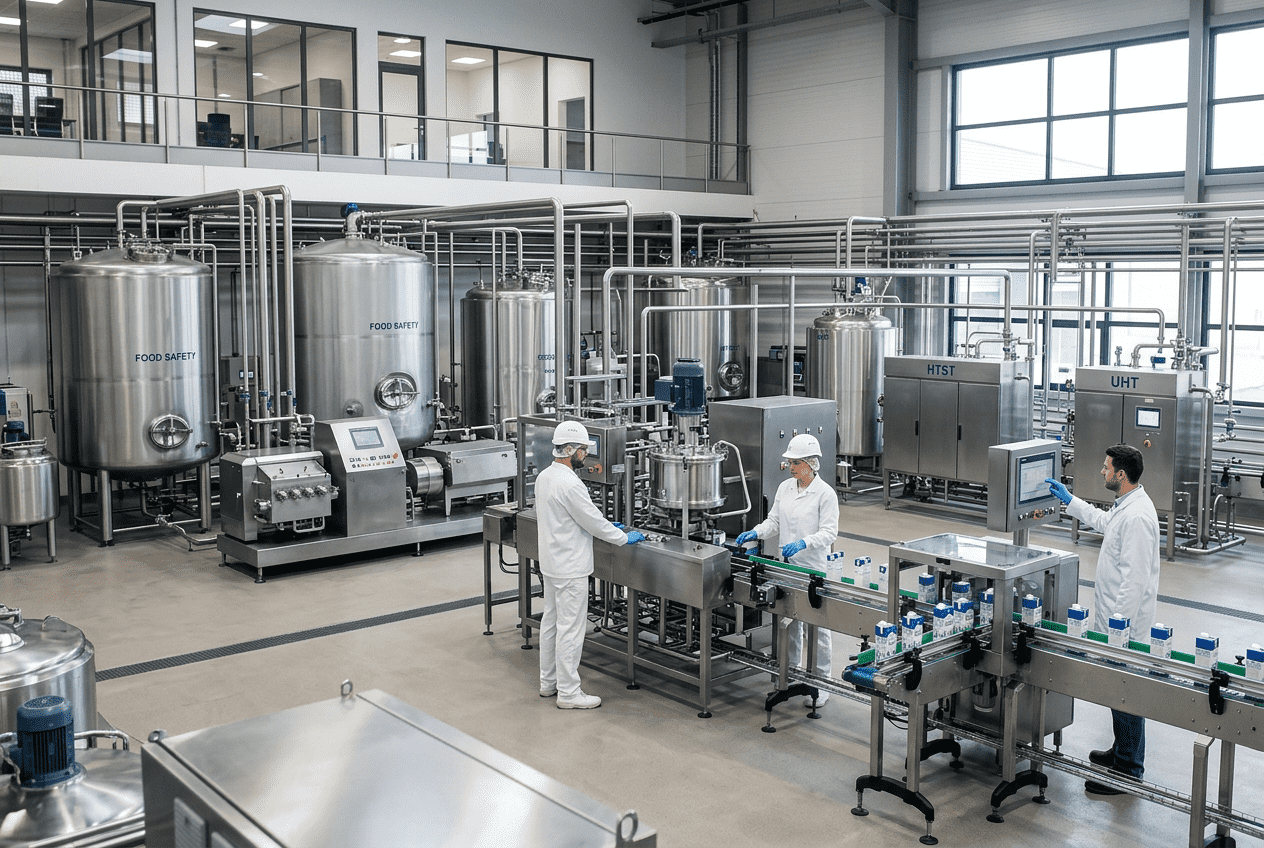
2026 Digital Twin Technology for Food Plants: 4 Core Use Cases
[trp_language language=”en_US”]
2026 Digital Twin Use Cases for United States Food Plants
Digital twin technology is becoming a practical operating tool for food and beverage manufacturers in the United States, not just a pilot-stage concept. In simple terms, a digital twin is a live virtual model of a plant, line, utility system, or process that uses real operating data to simulate what is happening now and what is likely to happen next. For processors in Chicago, Dallas-Fort Worth, Fresno, Atlanta, Charlotte, Philadelphia, Kansas City, and near major trade corridors such as the Port of Los Angeles, the Port of Savannah, and the Port of Houston, that means faster changeovers, better maintenance timing, more efficient CIP cycles, and stronger documentation for FSMA and HACCP.
In 2026, the most valuable digital twin applications for food plants are tied to profitability and operating discipline: virtual SKU changeover testing, early failure impact modeling, CIP window optimization, and real-time compliance data capture. These use cases matter because manufacturers across dairy, protein, aseptic beverages, prepared foods, sauces, bakery ingredients, and co-packing are facing the same pressures: more SKUs, tighter labor markets, higher utility costs, rising traceability expectations, and less tolerance for unplanned downtime.
For companies evaluating whether to invest, the key question is not whether digital twins are innovative. The real question is whether they can improve throughput, reduce risk, and support capital planning better than spreadsheets, static layouts, and reactive maintenance alone. In most well-instrumented facilities, the answer is yes, especially when the model is tied to actual controls, utility consumption, sanitation steps, and production scheduling.
Quick Answer

A digital twin for a food plant is a dynamic virtual representation of production assets, process flows, utilities, sanitation systems, and operating constraints. It helps processors test decisions before changing the real plant. In the United States market, the strongest 2026 use cases are virtual SKU changeover simulation, equipment failure impact forecasting with two-to-four-week warnings, CIP optimization with 20% to 35% time reduction potential, and automatic compliance data capture for FSMA and HACCP programs.
For most food and beverage plants, the business case is strongest when the digital twin is used in one or more of the following environments:
- High-mix production with frequent product or package changes
- Batch or semi-continuous operations with recipe complexity
- Plants with bottlenecks around fillers, cookers, retorts, mixers, pasteurizers, or packaging cells
- Facilities where sanitation windows are limiting capacity
- Sites managing multiple compliance frameworks such as FDA, USDA, SQF, and BRC
- Operations planning expansion, relocation, debottlenecking, or utility upgrades
Buyers should prioritize practical deployment over buzzwords. A good digital twin program starts with line-critical assets and a clear operational target: higher OEE, better schedule adherence, reduced CIP duration, lower changeover losses, or stronger audit readiness. Plants in the United States often see the best results when digital twin work is integrated with engineering, controls, commissioning, and operator training rather than bought as standalone software.
| Use Case | Main Objective | Best Fit Plants | Primary Data Needed | Typical KPI | Expected Payback Window |
|---|---|---|---|---|---|
| SKU changeover simulation | Reduce transition losses | High-mix beverage, dairy, sauces | Recipes, line speeds, setup tasks | Changeover minutes | 6 to 12 months |
| Failure impact modeling | Prevent cascading downtime | Protein, aseptic, packaging-heavy plants | Condition data, alarms, runtime history | Unplanned downtime | 9 to 15 months |
| CIP optimization | Shorten sanitation windows | Dairy, beverage, aseptic, liquid foods | Flow, temperature, conductivity, cycle logs | CIP hours per week | 6 to 10 months |
| Compliance capture | Automate records and exceptions | FDA and USDA-regulated plants | Critical control points, timestamps, batch records | Audit prep time | 8 to 14 months |
| Expansion planning | Validate capital investment | Growing co-packers, multi-line sites | Demand forecast, utility load, staffing model | Capacity utilization | 12 to 24 months |
| Energy and utility balancing | Control steam, glycol, compressed air use | Large campus facilities | Metering, shift demand, utility constraints | Utility cost per unit | 9 to 18 months |
The table above shows why digital twin investments should be tied to a measurable plant objective. In the United States, many processors first deploy the model around one troublesome line or utility system, then scale to blending, filling, packaging, refrigeration, wastewater, or plant-wide scheduling.
The market is also growing because digital twins now fit several product categories. Food processors can apply them to proteins, prepared foods, dairy products, plant-based items, sauces, dressings, beverages, spirits, fermented drinks, and aseptic products. The same principle applies across sectors: model the physical reality, feed it trusted data, compare expected behavior to actual performance, then act faster.
This market growth curve reflects what many engineering and operations teams are seeing on the ground: digital twin adoption in American food manufacturing is shifting from innovation budgets into mainstream operations and capital project planning.
Production Scenario Simulation: Testing SKU Changeovers Virtually

SKU proliferation is one of the biggest hidden costs in food and beverage manufacturing. A plant that once ran six products may now run sixty. A co-packer near Columbus or a dairy processor in Wisconsin may manage different package sizes, allergen classes, viscosity changes, label changes, lot coding rules, and sanitation triggers within the same week. A digital twin allows the operations team to test those transitions virtually before they disrupt the floor.
In practice, the twin maps each step of a changeover: line clearance, drain-down, rinse, material staging, recipe download, filler adjustments, conveyor timing, packaging resets, QA release, and first-pass verification. Instead of relying only on operator memory or legacy SOPs, the team can model alternative sequences and measure the likely effect on uptime, labor overlap, queue accumulation, and startup scrap.
This is especially valuable in facilities with shared assets such as syrup rooms, blend tanks, pasteurizers, retorts, marination systems, or common CIP skids. For example, if a beverage site in Southern California needs to move from a sugar-free can run to a standard formulation and then to an acid-sensitive juice blend, the digital twin can simulate whether changeover time is best reduced by adjusting upstream batching sequence, moving sanitation tasks forward, or shifting a utility reservation at the filler.
Virtual scenario testing also improves buying decisions. Before adding a new depalletizer, tank farm loop, packaging lane, or dedicated allergen transfer path, plant leaders can simulate whether that capital spend solves the real bottleneck. This avoids overbuying equipment when the true constraint is line synchronization, PLC logic, operator dispatching, or CIP scheduling.
| Changeover Variable | What the Twin Tests | Common U.S. Plant Example | Typical Hidden Loss | Improvement Lever | Likely Benefit |
|---|---|---|---|---|---|
| Recipe transition | Flush volume and timing | RTD beverage line | Excess product giveaway | Sequence optimization | Lower startup scrap |
| Allergen change | Validation and sanitation hold | Sauce or dairy line | Long QA release delays | Parallel task planning | Faster restart |
| Package format change | Mechanical reset duration | Cup, bottle, or pouch line | Idle filler time | Preset recipes and tooling staging | Reduced setup minutes |
| Label and coding change | Printer and vision verification timing | Frozen or chilled foods | Short stops | Integrated verification logic | Higher first-pass yield |
| Shared tank usage | Queue conflicts between SKUs | Dairy or blending operation | Waiting on upstream release | Dynamic scheduling | Better asset utilization |
| Operator staffing | Labor overlap by minute | Co-packing facility | Unbalanced crew deployment | Crew assignment redesign | Shorter planned downtime |
The table shows why changeovers should be treated as engineered workflows instead of unavoidable downtime. In many plants, a digital twin identifies that a 75-minute changeover is not one long event, but six smaller losses that can be overlapped, resequenced, or automated.
Digital twins are also useful during new product introductions. Processors can test whether a proposed SKU will overload tank residence times, cooling capacity, steam demand, line speed consistency, carton accumulation, or warehouse throughput. That matters for food plants serving retailers with strict fill-rate expectations or plants shipping through hubs like Memphis, Joliet, or the Inland Empire, where service failures can quickly become customer penalties.
This demand comparison highlights where virtual changeover modeling is most attractive today. Beverage, aseptic, and dairy operations typically show the strongest near-term value because of frequent recipe variation, strict sanitation requirements, and high downtime cost per hour.
Equipment Failure Impact Modeling: 2-4 Week Early Warning

Predictive maintenance is often discussed in terms of sensor alerts, but digital twins add a more useful business layer: impact modeling. They do not simply estimate that a pump, homogenizer, air compressor, scraper motor, conveyor gearbox, or refrigeration component may fail. They show what that failure will do to production, sanitation timing, labor deployment, customer service, and utility balance over the next two to four weeks.
That distinction is critical. A vibration warning on a motor is interesting. A digital twin that shows the likely loss of 180,000 units, a delayed allergen cleanup window, and a weekend overtime requirement if the repair is postponed is actionable. It converts maintenance data into scheduling and financial decisions.
In U.S. food plants, this use case is especially important where utilities and process systems are tightly coupled. A glycol loop issue in a brewery, a steam system instability in a sauce plant, a compressor fault in a meat processing facility, or a retort valve problem in a shelf-stable foods operation can cause cascading losses well beyond the affected asset. The twin models those dependencies.
Instead of waiting for a breakdown, planners can run “what-if” scenarios: What if the filler runs at 92% of target speed for the next ten days? What if one pasteurizer train is unavailable during peak demand? What if the CIP skid pump is derated and sanitation must shift by two hours? This allows maintenance teams to schedule intervention at the least damaging window.
| Asset Type | Monitoring Inputs | Failure Impact Modeled | Lead Warning Range | Operational Decision Enabled | Business Outcome |
|---|---|---|---|---|---|
| High-pressure pump | Vibration, amperage, pressure | Flow instability and missed throughput | 14 to 28 days | Planned part replacement | Avoided line stoppage |
| Homogenizer | Temperature, pressure drift, cycle count | Quality risk and bottlenecking | 10 to 21 days | Reschedule batch campaigns | Reduced scrap |
| Air compressor | Run hours, dew point, load profile | Packaging interruptions | 14 to 30 days | Shift maintenance to weekend | Fewer short stops |
| Refrigeration compressor | Energy draw, suction/discharge trends | Thermal capacity loss | 7 to 21 days | Load balancing across systems | Protected product quality |
| Retort valve cluster | Cycle timing, pressure, position feedback | Sterilization schedule disruption | 14 to 28 days | Advance maintenance outage | Lower service risk |
| CIP return pump | Conductivity trend, flow, motor current | Extended sanitation windows | 7 to 14 days | Pre-stage maintenance and backup plan | Recovered capacity |
The value of this approach is not only technical. It improves communication between maintenance, production, QA, finance, and plant leadership. A probable failure becomes visible in production terms, making it easier to justify inventory builds, labor shifts, or early procurement.
By 2026, U.S. processors are expected to combine digital twins with historian platforms, SCADA data, CMMS systems, and energy meters to support broader resilience planning. This matters more as weather volatility, freight disruptions, and component lead times continue affecting industrial operations from the Gulf Coast to the Midwest. Plants near hurricane-prone shipping routes or remote ingredient supply chains especially benefit from early warning models that align maintenance timing with procurement and production strategy.
CIP Window Optimization: 20-35% Time Reduction via Simulation
Clean-in-place systems are necessary, but in many plants they are also under-optimized. Standard cycles are often conservative because they were built around worst-case assumptions, old line configurations, incomplete instrumentation, or legacy quality concerns that no one wants to challenge without hard data. A digital twin helps processors test CIP windows safely in a virtual environment before changing the real sanitation procedure.
For dairy, beverage, aseptic, sauce, and liquid food operations, this can be one of the fastest-return digital twin applications. The twin can simulate line lengths, pipe diameters, tank turnover, target temperatures, conductivity transitions, pump curves, valve positions, rinse recovery, chemical concentration, and sequencing across multiple circuits. Instead of assuming every loop needs the same dwell time, the model helps identify where actual process conditions support shorter but still validated cycles.
That is how plants can reduce CIP duration by roughly 20% to 35% in the right applications. Savings usually come from eliminating waiting time, sequencing circuits more intelligently, reducing over-rinse, coordinating tank release better, and balancing utility availability. A plant in Idaho processing dairy ingredients may discover that thermal recovery and loop sequencing matter more than chemical contact time. A beverage plant in New Jersey may find that shared skid conflicts, not the wash recipe itself, are causing lost capacity.
Beyond time reduction, optimized CIP windows can save water, caustic, acid, steam, and wastewater treatment cost. As utilities grow more expensive across the United States, sanitation efficiency is becoming a sustainability and cost-control issue at the same time.
| CIP Optimization Focus | What the Twin Evaluates | Common Baseline Issue | Potential Gain | Validation Need | Typical Beneficiary |
|---|---|---|---|---|---|
| Pre-rinse duration | Soil removal profile by circuit | Over-rinsing | 5% to 10% time reduction | Swab and visual checks | Beverage and dairy plants |
| Chemical contact time | True exposure across dead legs and loops | Uniform timer used for all circuits | 4% to 8% time reduction | Sanitation validation | Sauce and liquid food plants |
| Temperature ramp | Heat-up behavior and holding efficiency | Late attainment of setpoint | 3% to 6% time reduction | Temperature mapping | Aseptic systems |
| Shared skid sequencing | Queue conflicts across circuits | Idle waiting between washes | 6% to 12% time reduction | Execution logic review | Multi-line facilities |
| Final rinse endpoint | Conductivity-based cutover accuracy | Conservative rinse extension | 4% to 7% time reduction | Conductivity verification | Dairy and RTD beverage |
| Tank release timing | Return-to-production readiness | Delayed operator handoff | 2% to 5% time reduction | SOP update | High-mix operations |
The gains shown above are usually cumulative when sequencing, validation, and utility balancing are improved together. In many facilities, sanitation is not actually constrained by cleaning chemistry. It is constrained by poor coordination between production scheduling, line release, utility readiness, and shared equipment access.
This trend reflects the broader shift in food manufacturing from static sanitation programs toward validated, data-informed sanitation management. The strongest growth is expected in plants where downtime costs are high and where water and energy reduction targets are now part of corporate operating scorecards.
Real-Time Compliance Data Capture for FSMA & HACCP
Food safety documentation is another area where digital twins can deliver operational value. In many U.S. plants, compliance records still depend on a mix of paper forms, manual spreadsheet entry, operator initials, and after-the-fact data cleanup. That creates risk. A digital twin connected to production data and control points can capture time-stamped operating conditions as they happen and match them to each batch, lot, or production campaign.
For FSMA and HACCP purposes, the twin can track the state of critical process parameters such as temperature, hold time, pH, pressure, conductivity, valve position, and line status transitions. More importantly, it can place those data points in process context. Instead of only storing numbers, the system can show what product was running, what step of the process was active, whether a CCP or preventive control was approaching deviation, and what downstream impact would result if the deviation continued.
This is highly useful in regulated environments involving dairy pasteurization, aseptic processing, retort operations, meat and poultry handling, and allergen-controlled formulations. It also supports audit readiness for processors managing customer requirements beyond federal law, including SQF and BRC expectations. Plants in major distribution regions such as the Southeast, Texas Triangle, and Great Lakes corridor often face intense retailer and foodservice scrutiny, making strong digital records a competitive advantage as much as a compliance necessity.
Real-time capture can also shorten investigation cycles. When a quality hold occurs, teams can use the twin to reconstruct the exact process conditions around the event rather than spend hours merging logs from different systems. That improves root-cause analysis and lowers the cost of deviations, rework, and delayed release.
| Compliance Element | Traditional Gap | Digital Twin Function | Relevant Framework | Operational Benefit | Audit Benefit |
|---|---|---|---|---|---|
| Critical control point timing | Manual recording delays | Automatic timestamping | HACCP | Fewer transcription errors | Clear event trail |
| Thermal process verification | Dispersed data sources | Unified batch context | FSMA, FDA, USDA | Faster release decisions | Stronger evidence package |
| Allergen changeover proof | Incomplete sanitation linkage | Line-state and CIP correlation | FSMA preventive controls | Lower cross-contact risk | Better verification records |
| Retort cycle history | Hard-to-reconstruct exceptions | Exception playback and alert logic | FDA low-acid foods | Quicker deviation review | Defensible records |
| Operator intervention tracking | Paper annotations only | Event-linked digital actions | SQF, BRC | Improved accountability | Traceable corrective actions |
| Hold and release status | Disconnected QA workflows | Real-time status visibility | Customer and regulatory programs | Reduced inventory confusion | Consistent release history |
The operational lesson is simple: compliance data should not live separately from production reality. When records are generated from the same logic that governs the process, both audit readiness and process discipline improve.
Food manufacturers looking to strengthen compliance should also consider how digital twins fit into broader modernization work such as SCADA upgrades, recipe management, historian integration, and electronic batch records. Companies exploring those capabilities can review broader engineering and integration support through food and beverage engineering services as part of a phased digital plant strategy.
Digital Twin ROI: 15-25% OEE Improvement & 30-40% Downtime Cut
The strongest digital twin business cases in the United States are tied to measurable returns, not generic digital transformation language. Well-executed programs can support OEE improvements in the 15% to 25% range and downtime reduction of 30% to 40%, especially when the plant starts with known scheduling losses, sanitation inefficiencies, under-instrumented bottlenecks, or weak maintenance coordination.
These gains do not come from software alone. They come from using the twin to change operating behavior. If a plant keeps the same setup practices, same response delays, same maintenance timing, and same data discipline, the model becomes only a dashboard. The return appears when the virtual model is used to redesign workflows, automate exception handling, and test capital alternatives before spending money.
ROI can come from several sources at once:
- More sellable hours through shorter changeovers and sanitation windows
- Lower scrap and giveaway during startups and recipe transitions
- Reduced emergency maintenance and overtime
- Improved utility efficiency in steam, chilled water, glycol, and compressed air systems
- Better asset loading and less hidden waiting between batches
- Faster QA release and lower audit preparation labor
For example, a U.S. co-packer planning growth from regional distribution to national scale may use a digital twin to prove whether the current syrup room, boiler capacity, compressed air network, cooling tower, or warehouse flow can support future case volume. That converts the twin from an operating tool into a capital planning asset. It can protect millions of dollars by showing where phased investment is justified and where a process or control change will do more than new hardware.
This comparison chart summarizes why digital twin programs are attractive to operations leaders and finance teams alike. Multiple value streams can accumulate at once, especially in complex plants where a single bottleneck affects production, sanitation, quality, and labor utilization.
Manufacturers comparing suppliers should ask whether the provider understands food and beverage realities such as hygienic design, regulatory validation, batch variability, utility constraints, and startup risk. A generic industrial model may not be enough for retort, aseptic, dairy, brewery, protein, or high-acid beverage applications.
Technical Specifications and Engineering Requirements
A useful digital twin needs more than visualization. It needs a strong engineering foundation. That includes process mapping, controls integration, data quality rules, equipment hierarchy, utility modeling, cybersecurity planning, and validation logic appropriate for the site’s regulatory environment. Plants that skip these basics often end up with attractive software that cannot reliably guide production decisions.
The most important technical requirement is data trust. Inputs should come from validated sources such as PLCs, SCADA, historians, quality systems, meters, and maintenance records. Tag naming, timestamp alignment, batch segmentation, and event classification must be handled carefully, especially in plants where multiple vendors and legacy controls coexist.
From an engineering standpoint, food plants should define the twin at three levels:
- Asset level: pumps, valves, motors, tanks, heat exchangers, fillers, packers, compressors
- System level: blending, thermal processing, CIP, refrigeration, compressed air, wastewater, utilities
- Plant level: scheduling, labor, warehouse interactions, sanitation windows, shipping commitments
Cybersecurity and network architecture also matter. U.S. processors increasingly need segmented OT environments, secure remote access controls, role-based permissions, and backup strategies. For plants handling customer-sensitive formulations or operating under strict retailer compliance programs, data governance should be built into the project from the beginning.
| Requirement Area | Minimum Need | Preferred Standard | Why It Matters | Failure Risk if Ignored | Who Should Own It |
|---|---|---|---|---|---|
| Data integration | PLC and historian connectivity | Unified tag architecture | Reliable real-time model behavior | False alerts and weak trust | Controls and IT/OT team |
| Process mapping | P&ID alignment | Digitally validated process logic | Correct flow and state modeling | Bad scenario outputs | Process engineering |
| Asset hierarchy | Equipment inventory | Criticality-ranked structure | Useful maintenance modeling | Missed bottlenecks | Maintenance and engineering |
| Utility model | Main metering | Submetered load visibility | Steam, water, and refrigeration optimization | Hidden operating cost | Plant engineering |
| Compliance logic | CCP data capture | Batch-context exception rules | Audit and release support | Incomplete records | QA and validation lead |
| Cybersecurity | Controlled access | Segmented OT governance | Protect system integrity | Data exposure or interruption | IT/OT security leadership |
The explanation behind this table is straightforward: a digital twin succeeds when it is treated as an engineering system, not just an analytics app. Plants often need cross-functional ownership from operations, QA, maintenance, controls, and capital project leadership.
From a technology perspective, processors should also consider whether they want the twin to support future AI-assisted recommendations, sustainability reporting, water-use tracking, or enterprise-wide portfolio planning. By 2026, those features will matter more as corporate teams push plants to tie production performance to carbon intensity, energy use, and traceability commitments.
Facilities needing broader support in process integration, utilities, controls, and equipment planning often benefit from partners that can connect the digital model to the real plant. Manufacturers evaluating tanks, CIP systems, vessels, or custom processing hardware can also review process equipment capabilities when building the physical foundation for a digital twin program.
Implementation Roadmap and Project Best Practices
Successful implementation usually follows a phased roadmap rather than a plant-wide big bang. The best first step is identifying one valuable operating problem with enough data to model credibly. For many processors, that means a packaging line with frequent changeovers, a CIP system limiting available production hours, or a utility bottleneck affecting several departments.
A practical roadmap for U.S. food plants often looks like this:
- Define the business case and target KPI
- Select the pilot area and critical assets
- Validate data sources and instrumentation gaps
- Build the first process and state model
- Run historical back-testing against known events
- Deploy operator and planner dashboards
- Use the twin to drive actual scheduling or maintenance decisions
- Measure results and scale to adjacent systems
Best practices include operator involvement from the start, not just management sponsorship. The people running fillers, tanks, cookers, packaging cells, or sanitation systems often know where the model must reflect reality. Their input improves adoption and prevents design errors.
Another best practice is combining digital twin work with physical plant planning. If a site is relocating equipment, debottlenecking utilities, expanding production, or building a new line, the twin can be developed alongside the project. That makes the startup smoother and improves commissioning. Companies exploring examples of integrated project execution can review selected food and beverage project case studies for context on how planning and execution can align.
| Project Phase | Main Deliverable | Key Stakeholders | Common Pitfall | Best Practice | Typical Duration |
|---|---|---|---|---|---|
| Discovery | Use-case definition | Operations, finance, QA | Too broad a scope | Choose one bottleneck first | 2 to 4 weeks |
| Data assessment | Tag and system map | Controls, IT, engineering | Poor data quality | Audit inputs before modeling | 3 to 6 weeks |
| Model build | Initial digital twin | Process and automation teams | Overcomplicated design | Start with key states and flows | 4 to 10 weeks |
| Validation | Historical event match | Operations and QA | Ignoring real-world exceptions | Back-test against outages and shifts | 2 to 5 weeks |
| Pilot deployment | User dashboards and alerts | Supervisors and planners | Weak adoption | Train by decision scenario | 4 to 8 weeks |
| Scale-up | Additional lines or utilities | Plant leadership | No governance model | Assign long-term owners | Ongoing |
The explanation here is that implementation risk usually comes from scope and governance, not from the idea itself. Plants that try to model everything immediately often slow down. Plants that define a real operating use case can prove value quickly and build internal support.
Policy and sustainability trends will also shape implementations in 2026 and beyond. More food manufacturers are expected to tie digital tools to water reuse targets, wastewater reduction, energy intensity tracking, and traceability expectations. A digital twin that supports those goals can serve both operations and corporate reporting requirements.
Our Company
Disruptive Process Solutions supports food and beverage manufacturers across the United States and Canada with a practical engineering-first approach that aligns well with digital twin projects. Rather than approaching modernization as software alone, the team works from the plant reality: process constraints, utility limits, compliance demands, capital goals, and startup risk.
From a technological capability perspective, DPS brings process, mechanical, electrical, plumbing, structural, and controls expertise together with PLC programming, automation, and SCADA integration. That matters for digital twin work because the model needs accurate data, sound process logic, and a clear link to actual equipment states. In facilities where controls limitations are the real bottleneck, this integrated engineering view can reveal opportunities that a software-only provider may miss.
From a manufacturing capability perspective, DPS has experience across beverage and food operations including brewing, spirits, juice, dairy beverages, aseptic systems, protein processing, prepared foods, sauces, retort, dairy processing, and plant-based applications. The company also manufactures selected process equipment such as tanks, CIP systems, marination tumblers, and cooking vessels. For processors building or upgrading the physical infrastructure behind a digital twin, that blend of process understanding and equipment execution is valuable. More on the company’s background is available at about our food engineering team.
From a service capability perspective, DPS operates through a design-build-manage model that covers engineering, capital planning, owner’s representation, project and program management, general contracting where applicable, installation, system integration, and commissioning. For food plants in regions such as North Carolina, Texas, California, the Midwest, or cross-border Canadian projects, this structure supports faster decision-making and stronger accountability across the project lifecycle. That is particularly useful when digital twin goals are tied to a line installation, utility expansion, plant relocation, or capacity increase rather than a standalone software initiative.
The broader point is that digital twin success depends on the connection between virtual planning and physical execution. A partner that understands both can help manufacturers avoid investing in elegant models that are not grounded in real plant constraints.
FAQ
What is the best first digital twin use case for a U.S. food plant?
Usually the best first use case is the one tied to the clearest financial loss, such as long SKU changeovers, repeated downtime on a bottleneck asset, or sanitation windows that limit available production time.
Do digital twins only make sense for very large manufacturers?
No. Mid-sized processors and co-packers can also benefit, especially if they have complex scheduling, shared utilities, or frequent product changes. The key is to start with a focused scope and a measurable KPI.
How much instrumentation is required?
A plant does not need perfect instrumentation to begin, but it does need trusted data from critical assets and process states. Most projects start with existing PLC, SCADA, historian, and maintenance data, then add targeted sensing where gaps matter.
Can a digital twin support FSMA, HACCP, SQF, or BRC requirements?
Yes. It can support time-stamped data capture, process context, deviation review, corrective action tracking, and stronger audit evidence. Validation and QA oversight are still required.
How long does implementation usually take?
A focused pilot can often be defined and deployed in a few months, depending on data readiness, scope, and user adoption. Plant-wide scaling takes longer and should follow proven pilot results.
What kind of ROI should buyers expect?
Many food plants target OEE improvement, downtime reduction, CIP savings, lower scrap, and reduced audit labor. The exact return depends on baseline losses and how actively the plant uses the model to make decisions.
Can a digital twin help with new facility design or expansion?
Yes. It is useful for testing line layouts, utility loads, staffing scenarios, warehouse flows, and phased capacity plans before capital is committed.
Which U.S. industries benefit most?
High-mix beverages, dairy, aseptic products, proteins, prepared foods, sauces, and co-packing operations are among the strongest fits because they combine complex scheduling, sanitation demands, and costly downtime.
What should buyers ask suppliers before purchasing?
Ask how the model will connect to controls and plant data, how validation will be handled, what specific KPIs will improve, whether food safety logic is built in, and whether the provider understands hygienic process design and utility systems.
How does 2026 change the conversation?
By 2026, digital twins are increasingly linked to AI-assisted decision support, sustainability reporting, water and energy efficiency, and more stringent traceability expectations. The technology is moving from optional innovation to a strategic operating tool.
[/trp_language]
Complete Company Portfolio

About the Author: Disruptive Process Solutions (DPS)
The DPS team combines process engineering expertise with real-world food and beverage manufacturing experience. Our content focuses on process optimization, production efficiency, facility improvements, and practical solutions that help manufacturers operate more effectively in a rapidly evolving industry.
Share

