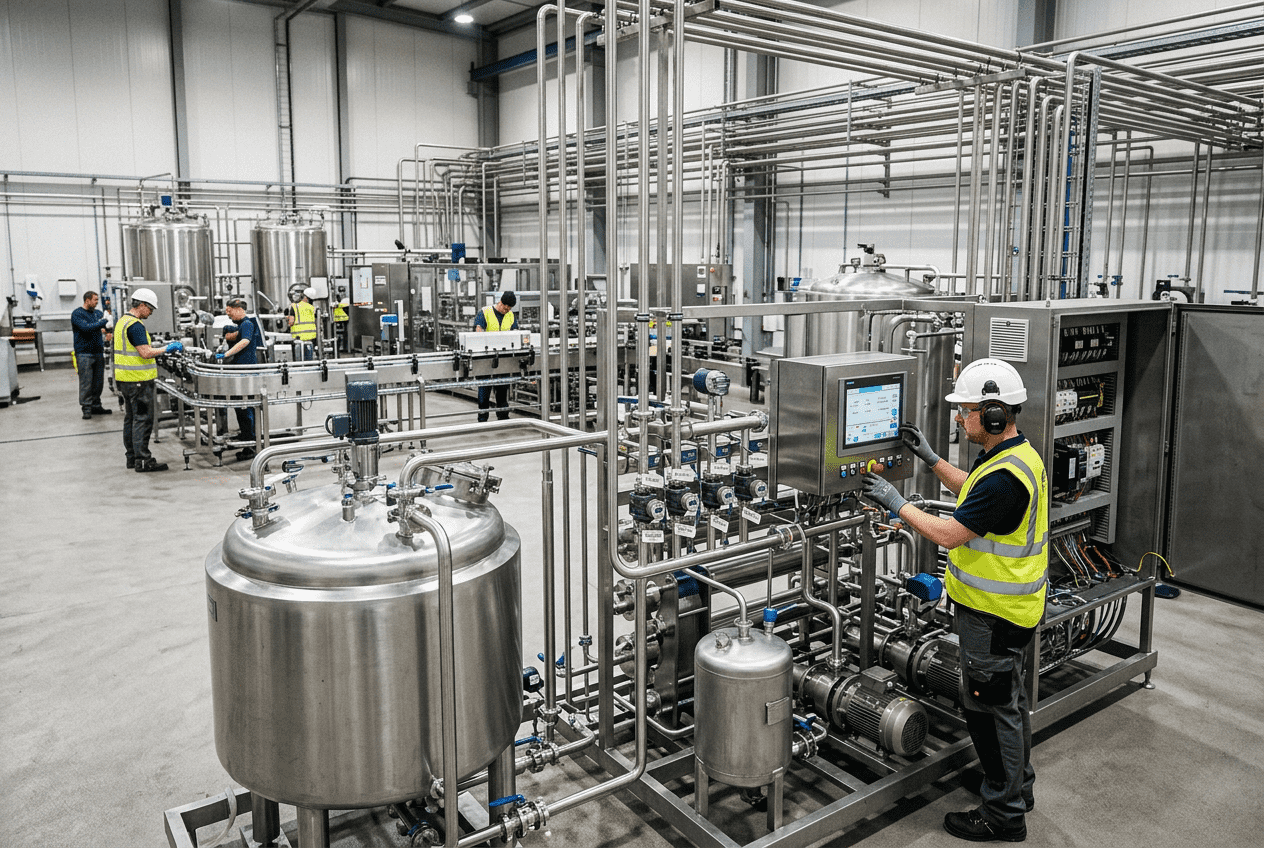
2026 Food Plant Construction Quality Assurance Framework
[trp_language language=”en_US”]
United States Food Plant Quality Assurance Standards
Food and beverage capital projects in the United States must do more than meet schedule and budget targets. They must also prove that equipment, utilities, installation methods, and startup practices are safe, sanitary, traceable, and fit for long-term production. A strong quality assurance framework helps owners, engineers, contractors, integrators, and regulators align around measurable standards before construction starts and before final turnover occurs.
This guide explains how a modern quality program should work for new builds, expansions, retrofits, line relocations, utility upgrades, sanitary piping projects, aseptic rooms, packaging halls, dairy systems, protein processing plants, beverage syrup rooms, and co-packing facilities across the United States. It is written for plant owners, operations leaders, project managers, maintenance teams, investors, and procurement groups looking for practical acceptance criteria that support FDA, USDA, SQF, and BRC expectations.
Quick Answer

The quick answer is this: a food plant construction quality assurance framework in the United States should combine documented inspection and testing protocols, material verification, workmanship standards, sanitary installation requirements, non-conformance management, corrective action procedures, and final acceptance criteria into one controlled project system. In practice, that means every weld, slope, support, valve, instrument, cable tray, floor penetration, clean utility line, and commissioned asset must be checked against approved drawings, specifications, hygienic design rules, and owner performance requirements before handover.
For most projects, the strongest framework includes seven layers of control:
- Preconstruction quality planning tied to scope, code, and food safety risk
- Receiving inspection and material traceability for all critical components
- In-process field inspections during installation, not only at project closeout
- Testing of mechanical, electrical, controls, process, and sanitary systems
- Documented non-conformance reporting with root-cause-based corrective action
- Commissioning, punch management, training, and turnover verification
- Final acceptance only after safety, sanitation, and operational performance are proven
In the U.S. market, project quality is also shaped by geography and supply chain realities. A dairy expansion in Wisconsin, a beverage line in North Carolina, a meat facility in Kansas City, a port-adjacent processing plant near Houston, or an aseptic packaging project in California may face different labor pools, inspectors, utility conditions, and material lead times. That is why the quality system must be standardized at the policy level but flexible at the field execution level.
Owners should also evaluate whether the delivery partner can integrate design intent, construction oversight, and startup accountability. Firms that manage engineering, installation, and execution under one coordinated model typically reduce rework, shorten decision cycles, and improve final acceptance outcomes because fewer handoff gaps exist between design, fabrication, field installation, and commissioning.
| QA Element | Main Objective | Typical Evidence | Primary Owner | Risk if Missing | Best Time to Apply |
|---|---|---|---|---|---|
| Quality plan | Define standards and responsibilities | Project quality manual | Project manager | Confusion and inconsistent inspections | Before procurement |
| Material verification | Confirm correct and compliant materials | MTRs, certificates, tags | Procurement and QA | Contamination or code failure | At receiving |
| Field inspections | Catch installation defects early | Checklists, photos, reports | Site superintendent | Hidden rework and delays | Daily or milestone based |
| Testing | Validate performance and integrity | Pressure tests, megger tests, FAT/SAT | Discipline leads | Startup failure | Pre-commissioning |
| Non-conformance control | Contain and document deviations | NCR log | QA manager | Repeat defects | Whenever variance is found |
| Final acceptance | Authorize turnover to operations | Signed acceptance package | Owner and EPC/GC | Disputed handover | After commissioning |
The table above shows why quality assurance should not be treated as a single final walkthrough. Each element supports the next, and weak control at an early step usually creates more expensive problems during startup.
This line chart reflects a realistic market view: U.S. manufacturers are increasing spending on validation, documentation, traceability, and hygienic construction oversight as capacity expands and audit pressure rises.
Inspection and Testing Protocols

Inspection and testing protocols are the backbone of project control. In a food plant environment, they should be based on approved drawings, equipment submittals, code requirements, owner specifications, process risk, and sanitation sensitivity. The protocols must define what gets inspected, who performs the inspection, what acceptance limits apply, what documentation is required, and what happens if results fall outside tolerance.
In the United States, an effective protocol commonly covers structural steel, concrete, floor flatness and drainage, utility rough-in, sanitary process piping, clean-in-place circuits, steam systems, compressed air, glycol, refrigeration interfaces, electrical distribution, controls panels, PLC inputs and outputs, network communication, equipment anchoring, washdown protection, and commissioning tests. The stricter the hygiene or uptime requirement, the more formal the test plan should be.
Inspection should happen at three levels:
- Receiving and pre-installation inspection
- In-process inspection while work remains visible and correctable
- Final verification after mechanical completion and before startup
Projects in major processing corridors such as Chicago, Minneapolis, Fresno, Atlanta, Charlotte, Dallas-Fort Worth, and the I-95 corridor often face aggressive schedules. That creates pressure to push work forward before checks are complete. The best quality teams resist that pressure by using hold points, witness points, and release checkpoints that must be cleared before the next activity begins.
| System | Inspection Method | Testing Method | Acceptance Focus | Frequency | Typical Record |
|---|---|---|---|---|---|
| Sanitary process piping | Visual fit-up and weld review | Borescope, pressure, passivation review | Drainability, clean weld profile, correct slope | Per spool or line segment | Weld map and inspection log |
| Compressed air | Installation walkdown | Leak test, dew point verification | Dry, clean, stable pressure | Per zone | Air quality report |
| Electrical feeders | Termination inspection | Megger and continuity testing | Safe insulation resistance and phasing | Per feeder | Electrical test form |
| CIP skids | Assembly and instrument check | Water run, flow, temperature loop test | Recipe execution and coverage | Per skid | Functional test report |
| Floor drainage | Survey and visual review | Flood or flow test | No ponding, proper slope | Per room | Drainage checklist |
| Automation | I/O verification | Loop check and sequence test | Accurate control and alarms | Per device | Commissioning matrix |
The table shows that different systems require different test methods. A sanitary piping line cannot be accepted using the same criteria as a motor control center or drainage slab. The protocol must be system-specific and risk-based.
Where possible, project teams should also link inspection data to digital turnover packages. That speeds owner review, supports audit readiness, and helps maintenance teams years later when they need to troubleshoot a utility branch or confirm the metallurgy of a replacement spool.
Manufacturers planning a capital project can review integrated project and field execution options through food and beverage engineering services that connect design, construction, and startup under one coordinated delivery approach.
This bar chart highlights where formal inspection and testing requirements are strongest. Aseptic, beverage, and co-packing projects often need tighter documentation because product mix, changeover frequency, and customer audits are more intensive.
Material Verification Process

The material verification process protects the plant from one of the most common and expensive causes of rework: installing the wrong material in the right place. In food and beverage projects, correct metallurgy, surface finish, gasket composition, elastomer compatibility, pressure class, and cleanability are not optional details. They are core compliance and performance requirements.
A disciplined process begins before material arrives on site. Purchase orders should clearly identify required grades such as 304 or 316 stainless steel, sanitary finish expectations, elastomer standards, utility service limits, and any owner-approved manufacturer lists. Once components reach the facility, the receiving team should verify tags, certificates of conformance, mill test reports, dimensional condition, packaging integrity, and shipping damage.
Critical materials that often require elevated scrutiny include:
- Sanitary tubing, fittings, valves, and pump housings
- Gaskets, seals, diaphragms, and hoses
- Food contact coatings and sealants
- Insulation jacketing in washdown zones
- Instrumentation exposed to CIP or caustic service
- Cable, conduit, and enclosures in wet or corrosive areas
- Flooring systems, drains, and hygienic supports
U.S. projects with imported components moving through ports such as Los Angeles, Long Beach, Savannah, Newark, or Houston especially benefit from stronger incoming controls. Long transit chains increase the risk of substitution, shipping damage, missing documentation, and packaging failures.
| Material Category | What to Verify | Why It Matters | Common Documents | Typical Risk | Disposition if Non-Compliant |
|---|---|---|---|---|---|
| Stainless tubing | Grade, heat number, surface finish | Corrosion resistance and cleanability | MTR, packing slip | Premature corrosion | Quarantine and replace |
| Valves | Seat material, pressure class, end type | Seal integrity and process fit | Data sheet, COC | Leakage or dead legs | Reject or engineer review |
| Gaskets | Material compatibility and temperature rating | Chemical resistance and hygiene | Manufacturer cert | Swelling or product contamination | Segregate and replace |
| Instrumentation | Range, wetted parts, washdown rating | Control accuracy and durability | Calibration certificate | Bad readings or failure | Hold for review |
| Electrical enclosures | NEMA rating and corrosion resistance | Safe washdown performance | Submittal and label | Moisture intrusion | Reject or relocate |
| Flooring and drains | Resin system, slot geometry, drain body material | Sanitation and drainage | Product data sheet | Pooling and bacterial harbor points | Do not install |
The explanation is straightforward: verification creates traceability, and traceability creates defensible acceptance. If an owner later faces an audit question or corrosion issue, the project record should show exactly what was installed and why it was accepted.
Technology also improves this step. Many high-performing projects now use QR-coded receiving logs, digital certificates, photo-based condition capture, and linked NCR workflows. These tools are valuable for multi-state programs where plants may have similar standards but different local storage and handling conditions.
Workmanship Standards
Workmanship standards translate design intent into field reality. In a food plant, good workmanship is not merely neat appearance. It is measurable installation quality that protects hygiene, reliability, maintainability, and safety. The standard should define what acceptable work looks like across every discipline and how supervisors verify it.
For mechanical installation, this includes alignment, support spacing, sanitary orientation, drainability, weld quality, torque control, insulation finish, and access for maintenance. For electrical and controls work, it includes labeling, routing, washdown suitability, panel cleanliness, grounding, strain relief, and termination quality. For building and architectural work, it includes sealed penetrations, smooth transitions, durable hygienic finishes, and proper moisture management.
One of the biggest workmanship failures in U.S. food plants is installing correct equipment in a way that makes cleaning or maintenance harder. Examples include blocking access to pump seals, creating water traps in support legs, routing conduit over high-hygiene zones without proper shielding, or leaving rough floor-to-wall transitions in washdown rooms.
Workmanship standards should therefore be written with operational usability in mind, not just contractor convenience. A project that technically matches the drawing but creates a sanitation burden should not be treated as fully conforming.
| Discipline | Workmanship Requirement | Field Example | Inspection Focus | Frequent Defect | Operational Impact |
|---|---|---|---|---|---|
| Sanitary welding | Smooth, fully penetrated, cleanable welds | Orbital welded product line | Profile and discoloration | Sugaring or undercut | Bacterial risk and rework |
| Pipe supports | Correct spacing and hygienic design | Stainless stand-offs in washdown area | Access and drainage | Carbon steel contact points | Corrosion and contamination |
| Electrical installation | Neat, labeled, moisture-protected routing | NEMA 4X panel with sealed entries | Ingress protection | Unsealed conduit hubs | Downtime and safety issues |
| Floor finishing | Smooth transitions and proper slope | Resin floor to trench drain | Ponding and edge integrity | Cracked coving | Cleaning difficulty |
| Equipment setting | Level, anchored, serviceable placement | Filler base on grouted pad | Alignment and access | Blocked maintenance clearance | Longer outages |
| Penetration sealing | Durable, washable, pest-resistant closure | Wall sleeve around process line | Gap control and finish | Open annular spaces | Harborage and moisture intrusion |
The table demonstrates that workmanship drives plant performance long after turnover. Small defects during installation often become chronic sanitation issues, hidden corrosion points, or maintenance bottlenecks later.
By 2026, workmanship standards are expected to become more technology-enabled. Contractors are increasingly using laser layout, digital punch lists, weld traceability systems, mobile QA checklists, and cloud-based turnover packages. Sustainability is also influencing workmanship expectations, especially where owners want energy-efficient utility routing, reduced water loss, and durable low-maintenance finishes.
The area chart shows the realistic trend shift in the U.S. market: quality is moving from paper-only inspection toward digital validation, traceable workmanship records, and hygienic proof of execution.
Sanitary Installation Requirements
Sanitary installation requirements deserve their own section because food-safe construction has rules beyond general industrial work. A sanitary system must be easy to clean, resistant to contamination, free of unnecessary dead legs, properly drained, protected from foreign material ingress, and installed in a way that supports routine sanitation, inspection, and maintenance.
These requirements vary by product category. Beverage systems often prioritize flow control, carbonation integrity, syrup segregation, and high-speed packaging sanitation. Dairy systems may need strict thermal control, allergen separation, and highly reliable CIP coverage. Protein and prepared foods facilities often demand more aggressive washdown durability, floor resilience, and wastewater coordination. Aseptic and retort projects require even tighter hygienic and validation discipline.
Core sanitary installation expectations in the United States usually include:
- Correct slope and drainability in process lines
- Fully cleanable valve and instrument orientation
- Minimal horizontal ledges in wet zones
- Sealed and washable penetrations
- No mixed-metal contact that promotes corrosion in sanitary areas
- Appropriate separation between product, chemical, and utility services
- Support details that do not trap water or debris
- Documented passivation and cleaning readiness where required
Projects near humid Gulf Coast markets, cold Upper Midwest regions, or high-throughput Southeast co-packing corridors should also consider local operating conditions. Condensation control, insulation detailing, and thermal movement can directly affect sanitary performance.
For owners comparing equipment and integration readiness, custom process assets and plant systems can be reviewed through process equipment solutions designed for food and beverage environments where cleanability and utility integration are critical.
| Sanitary Requirement | Purpose | Where Commonly Applied | Verification Method | Failure Example | Resulting Risk |
|---|---|---|---|---|---|
| Proper line slope | Allow full drainage | CIP return and product piping | Level measurement and walkdown | Flat runout | Residue hold-up |
| Dead-leg control | Prevent trapped product | Valve clusters and instruments | Drawing and field review | Long unused branch | Microbial growth |
| Washdown-rated components | Survive repeated cleaning | Processing rooms | Submittal and installation check | Wrong enclosure rating | Water intrusion |
| Sealed penetrations | Block moisture and pests | Walls, floors, ceilings | Visual inspection | Open gap around pipe | Harborage point |
| Hygienic supports | Reduce dirt and water retention | Overhead and wall-mounted lines | Support detail review | Flat plate water trap | Sanitation burden |
| Chemical separation | Protect product integrity | CIP, process, and utility interfaces | P&ID and field verification | Improper tie-in | Cross-contamination |
The explanation is simple: sanitation-friendly installation lowers cleaning time, reduces contamination risk, and improves audit outcomes. It also protects uptime because fewer poorly designed areas need repeated maintenance intervention.
Non-Conformance Management
Even strong projects encounter deviations. The issue is not whether non-conformances occur, but whether they are identified quickly, contained, analyzed correctly, and closed with evidence. A mature non-conformance management system prevents one small defect from becoming a systemic project failure.
A non-conformance may involve wrong material, bad workmanship, damaged equipment, undocumented field changes, failed testing, incomplete labeling, unsafe installation, or any condition that does not meet drawings, specification, code, or owner standard. Once identified, the team should log it, assign responsibility, define containment, evaluate impact, and decide whether the item must be repaired, replaced, reworked, accepted by concession, or redesign-reviewed.
High-performing U.S. capital projects use a clear NCR workflow with status visibility for the owner. This is especially important on multi-contractor sites where sanitary mechanical, electrical, controls, insulation, flooring, and building trades all interact. If NCRs are handled informally, the same issue often appears in multiple areas.
Useful NCR categories include quality, hygiene, safety, documentation, material, schedule impact, and startup impact. Categorization helps leadership see whether problems stem from procurement, supervision, fabrication, design detail, or field coordination.
For plants managing expansions or relocations, prior project lessons are valuable. Real-world execution examples and integrated delivery outcomes can be explored through food and beverage project case studies showing how complex scopes are controlled from planning through startup.
Corrective Action Procedures
Corrective action procedures should go beyond fixing visible defects. They should address root causes so the issue does not return in the same project or in future programs. In food plant construction, that means distinguishing between symptom correction and system correction.
For example, if a sanitary spool fails inspection because the wrong gasket material was installed, replacing the gasket is only immediate correction. A true corrective action might include supplier review, revised receiving checks, updated stores labeling, and retraining for installers. If repeated floor ponding appears in a packaging hall, the fix may require not just local topping but also drainage survey review, specification clarification, and updated slab inspection hold points.
An effective corrective action process usually includes:
- Problem statement with objective evidence
- Containment to stop further use or spread
- Root cause analysis using methods such as 5 Whys or fishbone logic
- Defined corrective action with owner and due date
- Verification that the action solved the issue
- Preventive learning shared across current and future projects
As the 2026 market evolves, corrective action will increasingly be tied to predictive analytics, supplier performance dashboards, and more standardized lessons-learned libraries. Sustainability factors will also matter more. For instance, owners will expect corrective actions to reduce water loss, energy waste, and avoidable material scrap instead of simply patching defects and moving on.
| Issue Type | Immediate Correction | Root Cause Angle | Long-Term Corrective Action | Verification Method | Typical Owner Benefit |
|---|---|---|---|---|---|
| Wrong valve installed | Remove and replace | Procurement or labeling error | Revise receiving and issue controls | Reinspection and tag audit | Lower repeat material errors |
| Failed sanitary weld | Cut out and reweld | Welder qualification or purge issue | Retrain crew and add weld hold point | Borescope and weld review | Higher hygienic integrity |
| Floor ponding | Grind or resurface | Survey or formwork control gap | Add slope verification checkpoints | Flood test | Better sanitation efficiency |
| Panel water intrusion | Dry and repair panel | Incorrect enclosure detail | Update submittal standards | Washdown observation | Reduced downtime risk |
| Instrument mismatch | Swap instrument | Submittal review failure | Tighten technical approval process | Loop check | More reliable controls |
| Missing documentation | Collect or recreate records | Poor turnover planning | Digital QA closeout tracker | Document audit | Faster final acceptance |
This table shows why corrective action should be systematic. The real value is not the repair itself, but the prevention of recurrence and the stronger confidence it creates for owners, operators, and auditors.
Final Acceptance Criteria
Final acceptance criteria define when a project is truly ready for owner turnover. In the United States, this should never depend only on substantial completion or contractor opinion. Acceptance should rely on documented proof that the plant, system, or line meets safety, code, sanitary, performance, training, and documentation requirements.
For a food or beverage facility, final acceptance commonly includes:
- All critical inspections completed and signed off
- All priority NCRs closed or formally dispositioned
- Mechanical completion verified
- Electrical and controls commissioning completed
- Startup and performance tests passed
- Sanitary readiness confirmed
- As-built drawings and O&M manuals delivered
- Spare parts and maintenance lists transferred
- Operator and maintenance training completed
- Punch list reduced to non-critical items only
Owners should also define commercial acceptance thresholds. A line that runs for ten minutes is not necessarily accepted if the production goal requires stable eight-hour operation at nameplate rate with acceptable changeover, waste, utility usage, and cleaning performance.
For that reason, performance acceptance often includes throughput, yield, temperature control, pressure stability, utility consumption, alarm response, recipe execution, and CIP cycle effectiveness. These criteria should be agreed before installation starts, not debated during startup.
| Acceptance Category | Required Proof | Who Confirms | Minimum Standard | Typical Holdback Item | Closeout Output |
|---|---|---|---|---|---|
| Safety | Guarding, LOTO, code compliance | Owner and site EHS | No open critical issues | Missing signage | Safety signoff |
| Sanitation | Cleanable installation and washdown readiness | QA and sanitation teams | Pass field review | Open penetration gaps | Hygiene checklist |
| Mechanical | Completed installation and tests | Mechanical lead | All critical tests passed | Leak or alignment defect | Mechanical completion cert |
| Electrical and controls | Loop checks and functional tests | Controls engineer | Stable operation and alarms | Incomplete sequence logic | Commissioning report |
| Documentation | As-builts, manuals, certificates | Project manager | Full turnover package | Missing calibration records | Closeout binder or portal |
| Performance | Run test against production criteria | Owner operations team | Meets agreed operating target | Throughput shortfall | Final acceptance form |
The explanation here is critical: final acceptance is the point where project risk transfers into operations. That transfer should be supported by evidence, not optimism.
This comparison chart reflects a common buying insight in the U.S. market: suppliers that integrate engineering, field execution, documentation, and startup oversight generally outperform fragmented delivery models on quality closeout.
When buying services, owners should ask direct questions about sanitary field supervision, traceability methods, commissioning leadership, documentation standards, and how disputes between design and installation are resolved. A lower bid often becomes more expensive if the provider cannot control quality across disciplines.
Our Company
Disruptive Process Solutions supports food and beverage manufacturers across the United States and Canada with a practical, profit-minded approach to capital execution. Rather than operating as a narrow trade contractor, the company is structured to help manufacturers make better decisions from concept through commissioning, particularly on projects where quality assurance, speed, and operational outcomes must all align.
From a technological capabilities standpoint, DPS works across structural, mechanical, plumbing, electrical, process, and controls disciplines. The team supports processing systems that include fermentation, distillation, pasteurization, retort, aseptic processing, carbonation, blending, filtration, water treatment, dairy systems, protein processing lines, and utility infrastructure such as CIP, boilers, compressed air, cooling towers, refrigeration, wastewater, and HVAC. PLC programming, automation, and SCADA integration are also key strengths, which matters when final acceptance depends on both physical installation quality and stable control logic.
From a manufacturing capabilities standpoint, DPS also brings proprietary equipment expertise to projects. The company designs and manufactures selected process assets such as tanks, CIP systems, marination tumblers, and cooking vessels, allowing tighter alignment between custom equipment requirements and field installation quality. That manufacturing perspective helps owners reduce mismatch between shop fabrication, sanitary design intent, and site execution.
From a service capabilities standpoint, DPS delivers process engineering and design, capital planning, owner’s representation, project and program management, general contracting or GC-equivalent coordination, equipment supply, installation, and full system integration. Its Design Build Manage model is especially relevant for clients that want fewer handoff gaps and stronger accountability from planning to turnover. More detail about the company’s background and project philosophy is available on the about our team page.
This integrated approach is useful for manufacturers in major U.S. processing regions such as North Carolina, Texas, California, the Midwest dairy belt, and the Southeast beverage corridor, where project speed and sanitation quality often need to move together without sacrificing startup readiness.
FAQ
What is the most important document in a food plant construction QA program?
The most important document is usually the project quality plan because it defines standards, responsibilities, inspection points, test requirements, documentation formats, and acceptance rules. Without it, teams inspect inconsistently and owners struggle to enforce quality expectations.
How is food plant QA different from general industrial construction QA?
Food plant QA places much greater emphasis on sanitary design, cleanability, corrosion resistance, material traceability, washdown durability, allergen segregation, and process performance. General industrial quality controls are not enough on their own.
When should non-conformance reporting begin?
It should begin as soon as procurement and receiving start. Many costly issues appear before installation, such as wrong metallurgy, missing documentation, damaged components, or submittal mismatches.
What U.S. regulations and standards influence acceptance?
Projects commonly align with FDA expectations, USDA requirements where applicable, local building and electrical codes, fire protection rules, and customer-driven standards such as SQF and BRC. Owner specifications often add another layer of acceptance criteria.
How much testing is enough before turnover?
Enough testing means proving the installed system is safe, sanitary, functional, documented, and able to meet agreed operating performance. That usually includes pre-functional checks, functional testing, startup runs, and operator verification.
What should owners ask potential suppliers before award?
Ask how they handle sanitary inspections, weld traceability, receiving controls, NCR management, turnover documentation, startup support, and multi-discipline coordination. Also ask who is accountable when a drawing detail conflicts with field reality.
Are local suppliers always better for U.S. food plant projects?
Not always. Local suppliers may bring faster site access and regional code familiarity, but national or integrated partners may provide stronger QA systems, broader sanitary expertise, and better documentation discipline. The best choice depends on project complexity.
What are the major 2026 trends in this area?
The biggest trends are digital QA records, stronger supply chain traceability, greater automation validation, sustainability-linked corrective actions, more formal hygienic design review, and tighter owner demand for first-pass startup success.
A reliable quality assurance framework protects more than compliance. It protects uptime, labor efficiency, product safety, expansion flexibility, and the financial return of the entire project. In the United States, where food and beverage manufacturers face rising throughput expectations, workforce pressure, and stricter customer audits, disciplined inspection and testing protocols are no longer a nice extra. They are a core capital strategy.
[/trp_language]
Complete Company Portfolio

About the Author: Disruptive Process Solutions (DPS)
The DPS team combines process engineering expertise with real-world food and beverage manufacturing experience. Our content focuses on process optimization, production efficiency, facility improvements, and practical solutions that help manufacturers operate more effectively in a rapidly evolving industry.
Share

