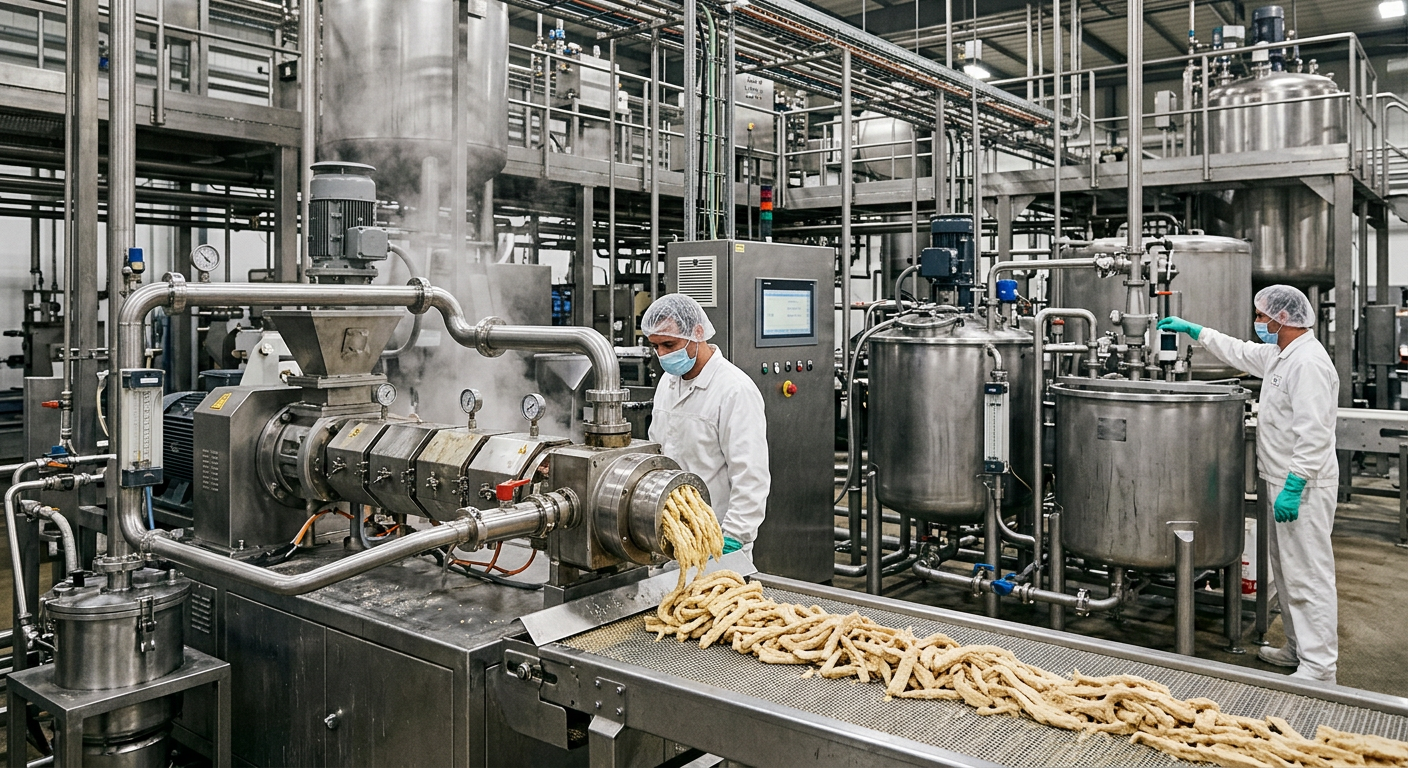
2026 Food Plant Construction Risk Mitigation Planning Guide
[trp_language language=”en_US”]
United States Food Plant Risk Planning for 2026
Food and beverage manufacturers in the United States are entering 2026 with capital projects facing tighter margins, stricter compliance expectations, higher utility costs, and more pressure to start up on time. A food plant construction project is no longer just a building job. It is a coordinated effort involving hygienic design, automation, utilities, workforce readiness, regulatory alignment, vendor performance, and emergency planning. Whether a company is building in the Midwest protein corridor, expanding near the Port of Savannah, relocating capacity in Texas, or upgrading a co-packing facility in California, risk mitigation must be planned before procurement starts and before concrete is poured.
This guide explains how to structure food plant construction risk mitigation planning for the United States market in 2026. It covers the most common threats to timeline, budget, safety, sanitation, and compliance, while also showing how manufacturers can prioritize practical controls that reduce downtime and increase first-year operating performance.
Quick Answer

The fastest way to reduce construction risk in a U.S. food plant project is to build a formal risk register early, assign an owner to every critical risk, and control five categories from day one: contamination exposure, schedule slippage, budget overruns, safety incidents, and regulatory nonconformance. Projects that perform best usually align facility design, utility design, automation, sanitation, and startup planning under one integrated execution model rather than managing them in silos.
In practical terms, the strongest 2026 risk mitigation plan should include:
- A written hazard and risk assessment before final equipment release
- Hygienic zoning and traffic segregation for people, tools, raw materials, and waste
- Long-lead procurement controls for stainless tanks, refrigeration, controls, and electrical gear
- Weekly cost-to-complete reviews tied to scope decisions
- Site-specific safety planning for contractors, confined spaces, lockout/tagout, and hot work
- FDA, USDA, SQF, or BRC compliance checks built into design reviews
- Emergency response procedures for utility loss, contamination events, injury, fire, ammonia release, and cyber disruption
For U.S. manufacturers, risk planning also needs to reflect regional realities. Labor conditions in Chicago, Atlanta, Dallas, Fresno, and Charlotte differ. Freight timing through Los Angeles/Long Beach, Houston, Newark, and Savannah changes equipment delivery risk. Municipal wastewater constraints in dairy and protein markets can alter design scope. A good plan connects these local variables to capital decisions early enough to avoid costly redesigns.
| Risk Area | Typical Trigger | Operational Impact | Best Early Control | Owner | Review Frequency |
|---|---|---|---|---|---|
| Food contamination | Poor hygienic zoning | Startup delay, product hold | Sanitary design review | Process engineer | Weekly |
| Schedule delay | Long-lead equipment | Late commissioning | Procurement tracker | Project manager | Weekly |
| Budget overrun | Scope creep | Capex increase | Change control board | Owner’s rep | Biweekly |
| Safety incident | Contractor coordination gaps | Work stoppage | Daily safety briefings | Site superintendent | Daily |
| Compliance risk | Unverified material selection | Inspection failure | Design compliance checklist | QA lead | At milestones |
| Utility failure risk | Underdesigned steam or chilled water | Low production rate | Load modeling | Utilities engineer | At each design phase |
The table above matters because most plant failures during construction do not begin as dramatic events. They begin as small unmanaged assumptions. If a project team captures those assumptions early and treats them as measurable risks, the probability of startup disruption falls sharply.
Risk Assessment Framework

A practical risk assessment framework for food plant construction should be simple enough to use weekly and detailed enough to influence design, procurement, and field execution. In the United States, a useful framework generally includes five steps: identify, score, prioritize, mitigate, and monitor. The scoring model should evaluate both probability and severity, but it should also consider detectability and recovery time because some food plant risks are easy to detect before startup while others surface only after product runs begin.
For 2026 projects, teams should evaluate risks across design, site conditions, utilities, process integration, sanitation, labor, regulation, supply chain, cybersecurity, and startup readiness. A beverage blending room in North Carolina, for example, will have a different critical path than a USDA-inspected protein line in Kansas or a high-acid aseptic project near New Jersey distribution hubs. The framework has to support those differences.
One effective method is to maintain a live risk register linked to design packages, procurement packages, and startup milestones. Every high-risk item should have a due date, mitigation action, budget implication, and named owner. This prevents risk logs from becoming passive documents that nobody uses.
| Scoring Level | Probability | Impact on Cost | Impact on Schedule | Impact on Food Safety | Priority Response |
|---|---|---|---|---|---|
| 1 | Rare | Negligible | No delay | No exposure | Monitor only |
| 2 | Unlikely | Minor increase | Less than 3 days | Low exposure | Preventive action |
| 3 | Possible | Moderate increase | 1 to 2 weeks | Localized concern | Formal mitigation |
| 4 | Likely | Major increase | 2 to 6 weeks | Broad contamination risk | Escalate to leadership |
| 5 | Very likely | Severe increase | More than 6 weeks | Plantwide hold or recall risk | Immediate intervention |
| Critical flag | Any level | Any level | Any level | Regulatory or life safety issue | Stop and resolve |
The explanation behind this matrix is straightforward: cost and schedule matter, but food safety and life safety override them. A risk with moderate budget impact but major contamination potential should always rank above a pure cost issue. This is especially true for ready-to-drink beverage plants, dairy facilities, meat operations, and aseptic applications.
The chart above reflects a realistic market trend: more U.S. manufacturers are adopting formal risk review processes as projects become more complex and startup windows more compressed. This shift is being reinforced by automation investments, stricter customer audits, and more sophisticated lender expectations.
When companies need integrated support, it helps to work with a partner that can connect process design, utilities, controls, and execution. DPS service capabilities are relevant here because a full-scope project approach can reduce handoff gaps that often create hidden risk between engineering, procurement, construction, and commissioning.
Food Contamination Prevention

Contamination prevention is the highest-value risk control in food plant construction. In 2026, contamination risk is shaped by hygienic design choices, contractor practices, zoning discipline, drainage performance, utility quality, and startup validation. Many contamination problems are not caused by the production process itself, but by construction shortcuts that become permanent flaws: dead legs in piping, poor floor pitch, inaccessible equipment clearances, cross-traffic between raw and RTE areas, inadequate air pressure control, and utility tie-ins that compromise sanitation standards.
In the United States, contamination prevention planning should start with product category and regulatory exposure. Raw protein, high-care prepared foods, fermented beverages, low-acid canned foods, dairy, and aseptic processing all require different control strategies. Plants near major distribution centers such as Memphis, Indianapolis, or Allentown may also face faster inventory turns, which means less room for startup errors before customer service failures begin.
Best practices include hygienic zoning maps, sanitary design reviews, sanitary material verification, temporary construction barriers, environmental monitoring planning, CIP validation, compressed air quality checks, and startup sanitation qualification. Teams should document what enters the plant during construction, who cleans it, and how temporary utilities are separated from production-ready systems.
| Contamination Risk | Common Construction Cause | Example Area | Preventive Control | Verification Method | Residual Risk |
|---|---|---|---|---|---|
| Cross-contamination | Uncontrolled personnel movement | RTE packaging | Zoning and badge access | Traffic audit | Medium |
| Microbial harborage | Poor welds or dead legs | CIP piping | Sanitary fabrication standard | Borescope and QA check | Low |
| Allergen exposure | Shared installation tools | Ingredient handling | Dedicated tool control | Tool log review | Medium |
| Water contamination | Backflow or temporary connections | Process water system | Backflow prevention plan | Water test | Low |
| Airborne contamination | Improper HVAC sequencing | High-care rooms | Pressure cascade validation | Air balance report | Low |
| Chemical contamination | Improper chemical storage | Sanitation room | Segregated storage and labeling | Inspection checklist | Low |
This table shows that contamination prevention is not one action; it is a layered system. If one control weakens, the remaining controls must still prevent exposure. That is why sanitary design, contractor discipline, and startup validation must all be managed together.
Technology also plays a growing role. The strongest 2026 projects are using digital P&ID reviews, 3D clash models, instrumented CIP records, automated batch controls, and SCADA-driven alarm histories to catch issues earlier. This is where technological capability matters. Companies with in-house or tightly coordinated expertise in process engineering, automation, PLC programming, and SCADA integration can identify contamination risks that would otherwise remain hidden until commissioning.
Manufacturers planning new tanks, CIP skids, or custom process vessels should also review fabrication quality and cleanability. For example, custom-engineered stainless equipment, hygienic piping layouts, and integrated utility skids can reduce installation errors if designed around the actual cleaning regime rather than just the equipment spec sheet. Information about process equipment solutions can help buyers evaluate how equipment selection influences hygienic performance and startup risk.
Schedule Risk Management
Schedule failures in food plant construction usually begin long before the visible delay. They often start with incomplete scope definition, late utility decisions, permit sequencing problems, equipment lead times, insufficient field coordination, or startup activities that were never fully planned. In 2026, schedule risk is especially high in U.S. projects involving electrical switchgear, refrigeration, stainless fabrication, controls hardware, and municipal approvals.
Different regions carry different schedule pressures. Gulf Coast weather affects exterior work and shipping. California air quality and utility interconnection requirements can extend preconstruction. Northeast urban sites may have access constraints. Inland freight to sites in Iowa, Nebraska, or Arkansas can complicate crane picks and oversized delivery timing. A robust schedule plan must connect design release dates to procurement dates and site readiness dates.
The most effective schedule controls include a master integrated schedule, look-ahead planning, vendor milestone tracking, submittal management, and startup path mapping. Teams should pay particular attention to interdependent systems: steam, refrigeration, compressed air, process water, wastewater, controls, and CIP. If one utility package slips, multiple process packages usually slip with it.
| Schedule Threat | Where It Appears | Early Warning Sign | Mitigation Action | Primary Owner | Typical Delay Avoided |
|---|---|---|---|---|---|
| Permit lag | Preconstruction | Incomplete submissions | Permit matrix and early agency contact | Project executive | 2 to 6 weeks |
| Long-lead equipment | Procurement | Vendor date uncertainty | Prebuy critical items | Procurement lead | 4 to 12 weeks |
| Design rework | Engineering | Frequent RFIs | Gate reviews before release | Design manager | 2 to 8 weeks |
| Trade stacking | Field installation | Crowded work zones | Daily coordination plans | Superintendent | 1 to 3 weeks |
| Late controls integration | Commissioning | Unmapped I/O changes | FAT and SAT planning | Controls lead | 2 to 5 weeks |
| Utility startup mismatch | Startup | Load assumptions not verified | Utility capacity testing | Utilities engineer | 1 to 4 weeks |
The explanation is important: every row represents a delay source that can often be prevented without major capex increase. The biggest savings usually come from earlier decisions, not from emergency acceleration later.
This industry demand comparison helps explain why schedule risk is uneven across sectors. RTD beverages, protein, and prepared foods are seeing stronger project volume, which can tighten labor and equipment availability in those categories. Buyers should account for this when locking in vendors and sequencing releases.
Budget Risk Controls
Budget overruns remain one of the most common reasons food plant projects miss business targets. In 2026, inflation may be calmer than peak disruption years, but costs are still volatile in stainless fabrication, electrical infrastructure, refrigeration packages, controls integration, and regional labor. In the United States, hidden budget risk also comes from underdefined utility scope, wastewater treatment assumptions, owner-furnished equipment coordination, and startup labor that was never properly planned.
The best budget control method is not simply tighter approval. It is cost visibility tied to design maturity. Early estimates should clearly separate allowances, assumptions, exclusions, and escalation exposure. Each change should show not only added cost, but also schedule impact, sanitation impact, and operating cost impact. A lower initial bid may become more expensive if it causes rework, poor cleanability, or production inefficiency later.
For food and beverage projects, budget discipline should also reflect first-year profitability. A capex decision that reduces utility redundancy too aggressively may save money on paper but create expensive downtime after startup. This is where business-minded project planning has an advantage over narrow bid comparison.
| Budget Risk | Typical Root Cause | When It Appears | Control Method | Financial Effect if Ignored | Best KPI |
|---|---|---|---|---|---|
| Scope creep | Late owner decisions | Design and field | Formal change approval | 5% to 15% overrun | Change order value |
| Utility underestimation | Weak load analysis | Engineering | Capacity model review | High rework cost | Variance to utility budget |
| Vendor gaps | Unclear bid packages | Procurement | Bid leveling matrix | Claims and add-ons | Bid completeness score |
| Field inefficiency | Poor coordination | Construction | Production tracking | Labor burn increase | Earned vs actual hours |
| Startup extension | Insufficient commissioning plan | Commissioning | Startup readiness gates | Delayed revenue | Days to commercial run |
| Compliance retrofit | Missed sanitary or code requirement | Late stage | Milestone audits | Expensive redesign | Number of late corrections |
The explanation behind this table is that budget risk comes from both direct and indirect costs. Direct costs include added steel, piping, and labor. Indirect costs include delayed product launch, customer penalties, expedited freight, and reduced first-year output. Mature owners track both.
In many successful projects, an owner’s representative or integrated project manager provides independent cost discipline. Firms that combine capital planning, feasibility support, and execution oversight can help owners make faster decisions with fewer surprises. Details about the DPS approach show how a lean, decision-oriented model can support projects that need both strategy and speed.
Safety Incident Prevention
Construction safety in food plants is complex because the environment often combines active operations, sanitation chemicals, wet floors, elevated work, electrical tie-ins, pressure systems, and tight installation spaces. In brownfield projects, teams may also work around live production, forklifts, ammonia systems, and employee traffic. Preventing safety incidents requires more than compliance paperwork. It requires active planning, sequencing, supervision, and training.
For U.S. projects in 2026, top safety priorities include lockout/tagout coordination, confined space entry, hot work, chemical handling, forklift separation, fall protection, rigging of large stainless vessels, and energized work restrictions. Sites near dense logistics areas such as Houston, Inland Empire distribution nodes, or Atlanta warehousing corridors may also face traffic and staging constraints that affect safe material handling.
A strong safety system includes site orientation, task hazard analysis, permit-to-work procedures, contractor prequalification, near-miss reporting, and daily field coordination. In food environments, it also needs to consider sanitation interactions. For instance, wet cleaning can increase slip risk and affect electrical work sequencing.
| Safety Hazard | High-Risk Activity | Potential Consequence | Preventive Control | Verification | Escalation Trigger |
|---|---|---|---|---|---|
| Lockout failure | Equipment tie-in | Serious injury or fatality | Written LOTO plan | Permit audit | Any uncontrolled energy source |
| Slip and fall | Wet sanitation zones | Lost-time injury | Area isolation and housekeeping | Daily inspection | Repeated floor contamination |
| Confined space | Tank entry | Asphyxiation or rescue event | Entry permit and attendant | Permit review | Missing atmospheric test |
| Hot work fire | Welding near packaging | Fire and shutdown | Hot work watch | Permit and fire watch logs | Spark exposure in combustible area |
| Rigging incident | Tank setting | Severe injury, equipment damage | Lift plan and certified rigging | Pre-lift meeting | Unapproved lift modification |
| Chemical exposure | CIP chemical setup | Burns or inhalation harm | SDS control and PPE | Observation and training record | Improper storage or unlabeled chemical |
This table illustrates that safety controls must be specific to the task, not generic to the project. Food plants are dynamic environments, so the prevention system must adjust as installation phases change.
Modern projects are also using digital safety observations, wearable communication devices, and mobile permit tracking. As automation grows, safety must include control-system behavior, emergency stop architecture, and access logic during startup. Plants that integrate controls engineering and site execution tend to resolve these issues faster because the team understands both software and field conditions.
Regulatory Compliance Risks
Regulatory risk in U.S. food plant construction spans federal, state, local, and customer-driven standards. Depending on the product and facility, compliance may involve FDA preventive controls, USDA inspection requirements, environmental permits, wastewater approvals, building and fire code, electrical code, ammonia or boiler rules, and private audit standards such as SQF or BRC. A project can appear mechanically complete and still fail commercially if the compliance pathway was not planned correctly.
In 2026, compliance risk is increasing due to tighter traceability expectations, stronger audit scrutiny, and more attention to sanitary design evidence. Sustainability-related reporting, water use efficiency, and energy performance may also affect incentives, utility approvals, and customer requirements. In some states, especially California and parts of the Northeast, environmental permitting and utility coordination can materially affect schedule and scope.
Projects should map compliance requirements at concept stage, not at startup. This includes product flow, zoning, equipment materials, cleanability, inspection access, process authority needs, utility treatment, wastewater impact, and documentation standards. For USDA and certain FDA-regulated applications, even layout choices can affect inspection practicality and startup readiness.
| Compliance Category | Main U.S. Concern | Construction-Phase Risk | Required Control | Evidence to Keep | Failure Result |
|---|---|---|---|---|---|
| FDA food safety | Preventive controls and sanitary design | Uncleanable equipment layout | Design review with QA | Approved drawings | Corrective retrofit |
| USDA inspection | Inspectability and separation | Improper flow paths | Inspection-focused layout review | Flow diagrams | Approval delay |
| SQF/BRC | Audit readiness | Documentation gaps | Pre-start audit checklist | Validation records | Certification delay |
| Environmental | Wastewater and emissions | Undersized treatment or controls | Permit coordination | Permit files and calculations | Operating restriction |
| Building/fire code | Egress and fire protection | Late code revision response | Authority coordination | Inspection reports | Occupancy hold |
| Electrical/mechanical | Code-compliant installation | Improper field modification | Quality inspections | As-builts and test results | Rework and delay |
The reason this table matters is simple: compliance is cumulative. One missed item can delay occupancy, startup, customer approval, or certification. The most effective teams treat regulatory review as a design input, not as a late-stage gate.
The trend shown here is realistic for 2026: more food plants are using automation, digital records, and integrated monitoring to support compliance and sanitary performance. This aligns with customer audit expectations and with labor efficiency goals.
Emergency Response Protocols
No plant construction risk plan is complete without emergency response protocols. Even with good preventive controls, food and beverage projects must prepare for incidents involving injury, fire, contamination, utility interruption, weather, refrigeration release, cybersecurity events, and supply chain disruption. In the United States, emergency planning should be site-specific and coordinated with local responders, utility providers, and plant leadership.
Facilities in hurricane-prone Gulf and Atlantic regions need weather-triggered shutdown and recovery procedures. Midwest facilities may need winter utility resilience planning. California operations often need wildfire smoke or public utility shutoff scenarios. Sites near major ports or intermodal hubs should also consider logistics disruption if inbound process equipment or ingredients are delayed.
An emergency response protocol should define command structure, communication flow, area control, shutdown steps, product disposition rules, contractor accountability, and restart criteria. It should also identify when to notify regulators, insurers, customers, or third-party sanitation support. For contamination or utility incidents, the key question is not only how to stop the event, but how to validate that the system is safe to restart.
| Emergency Scenario | Immediate Action | Lead Role | Communication Path | Restart Requirement | Preparedness Tool |
|---|---|---|---|---|---|
| Worker injury | Stop work, secure area, call medical aid | Site safety lead | Supervisor to EMS to leadership | Incident review completed | Emergency contact board |
| Fire or hot work event | Alarm, evacuate, isolate utilities | Superintendent | Fire department and owner | Authority clearance | Evacuation map |
| Product contamination concern | Quarantine zone and materials | QA manager | QA to plant leadership | Root cause and sanitation verification | Hold-and-release procedure |
| Boiler or steam failure | Switch to safe state | Utilities lead | Operations and maintenance | Capacity test passed | Critical utility SOP |
| Ammonia or refrigeration leak | Evacuate and isolate | Emergency coordinator | Specialized responder notification | Atmospheric confirmation | Hazmat response plan |
| Cyber or controls outage | Move to manual safe mode where possible | Controls lead | IT, operations, leadership | System integrity validation | Backup and recovery protocol |
The explanation is that an emergency plan must define both response and recovery. Many facilities have evacuation procedures but weak restart criteria. In food manufacturing, restart validation is essential to protect product integrity and customer confidence.
This comparison does not mean every integrated partner is automatically better, but it illustrates a common 2026 reality: food plant projects usually perform best when process, utilities, controls, construction, and commissioning are coordinated under one risk-aware strategy rather than split across disconnected vendors.
Our Company
For manufacturers seeking a project partner in the United States, Disruptive Process Solutions supports food and beverage capital projects with a business-first mindset focused on profitable execution rather than simply delivering drawings or managing trades. The company operates across all 50 states and Canada, with headquarters in Cary, North Carolina and a West Coast presence in Lake Forest, California, allowing it to support projects from East Coast beverage hubs to Western processing expansions.
From a technological capability standpoint, DPS works across structural, mechanical, plumbing, electrical, process, and controls engineering, including PLC programming, automation architecture, and SCADA integration. That matters in risk mitigation because utility balancing, sanitary process design, and control logic often determine whether a plant starts cleanly or struggles through a prolonged commissioning cycle. Whether the need is blending and batching with inline monitoring, pasteurization, retort integration, aseptic processing, fermentation systems, or energy-aware automation, the technology stack must support both compliance and operating efficiency.
From a manufacturing capability standpoint, DPS supports complete food and beverage processing environments, including systems for proteins, prepared foods, sauces, dairy, brewing, distillation, RTD products, soft drinks, juices, and aseptic operations. The company also designs and manufactures select process equipment such as stainless tanks, custom CIP systems, marination tumblers, and cooking vessels. That practical fabrication knowledge can improve constructability and sanitation outcomes because equipment design and field installation are considered together rather than in isolation.
From a service capability standpoint, DPS uses a Design Build Manage model that aligns engineering, construction management, and execution oversight in one project philosophy. Services include process engineering and design, capital planning, feasibility analysis, owner’s representation, project and program management, general contracting where licensed, nationwide trade coordination, equipment supply, and turnkey installation and integration. For owners managing expansion, relocation, or new facility development, this integrated structure helps reduce the coordination gaps that often create schedule and budget risk.
Manufacturers that want to see broader background can visit the company overview. Those comparing execution support for a specific expansion or greenfield project can review engineering and project services. Buyers interested in custom tanks, CIP systems, or process hardware can explore equipment capabilities. For practical examples of delivered work, the project case section provides useful context.
One reason this matters in 2026 is that food and beverage investors increasingly expect project partners to understand profitability, not just construction. The strongest projects are those where capital allocation, production targets, utility loads, sanitation, and commissioning are treated as one operating model. That is especially true for co-packing, protein processing, and beverage facilities scaling toward aggressive year-one volume targets.
FAQ
What is the biggest construction risk for a food plant in 2026?
The biggest single risk is usually incomplete early planning, because it amplifies contamination, budget, schedule, and compliance problems at the same time. Poorly defined hygienic requirements and utility assumptions are especially costly.
How early should a U.S. manufacturer create a risk register?
At concept or feasibility stage. Waiting until detailed design or construction means many of the most important mitigation choices have already been lost.
Which industries face the highest contamination sensitivity?
Ready-to-eat foods, dairy, aseptic beverages, low-acid shelf-stable products, and USDA-regulated protein facilities generally require the tightest contamination controls.
How can owners reduce schedule risk with suppliers?
Prequalify vendors, clarify package scope, track submittals, verify fabrication milestones, and prebuy long-lead items like switchgear, refrigeration packages, controls hardware, and stainless vessels.
What budget metric is most useful during execution?
Cost-to-complete by package, supported by approved scope and pending change exposure. That provides a more realistic picture than simple committed spend.
Why are local conditions so important in the United States?
Because labor markets, permitting timelines, freight routes, weather, utility access, and wastewater limits vary significantly between regions such as Texas, the Carolinas, California, the Midwest, and the Northeast.
What future trends should project teams plan for in 2026 and beyond?
More automation in sanitation and batch control, higher digital traceability expectations, stronger energy and water efficiency requirements, broader use of predictive maintenance, and more scrutiny on sustainability and resilience in capital planning.
Should emergency response planning be written only for plant operations?
No. Construction-phase and startup-phase protocols must be written separately, because contractor presence, temporary utilities, and incomplete systems create different risks than steady-state production.
What buying advice is most practical for owners selecting a project partner?
Choose a partner that understands process, utilities, controls, construction, startup, and compliance together. Ask how they manage risk registers, schedule controls, cost transparency, sanitary design, and startup validation rather than focusing only on price.
How should an owner compare local suppliers and national partners?
Local suppliers may offer fast field response and municipal familiarity, while national food-specialized partners may offer deeper process and compliance expertise. The best choice depends on whether the project risk is driven more by local site conditions or by complex food manufacturing integration.
In summary, food plant construction risk mitigation in the United States for 2026 is about disciplined integration. Market pressure, technology change, regulatory complexity, and margin sensitivity all reward owners who plan earlier, score risk consistently, and align design, sanitation, utilities, controls, and construction under one accountable strategy. Projects that do this well are not just safer and more compliant. They are more likely to launch on time, hit first-year throughput targets, and protect long-term profitability.
[/trp_language]
Complete Company Portfolio

About the Author: Disruptive Process Solutions (DPS)
The DPS team combines process engineering expertise with real-world food and beverage manufacturing experience. Our content focuses on process optimization, production efficiency, facility improvements, and practical solutions that help manufacturers operate more effectively in a rapidly evolving industry.
Share

