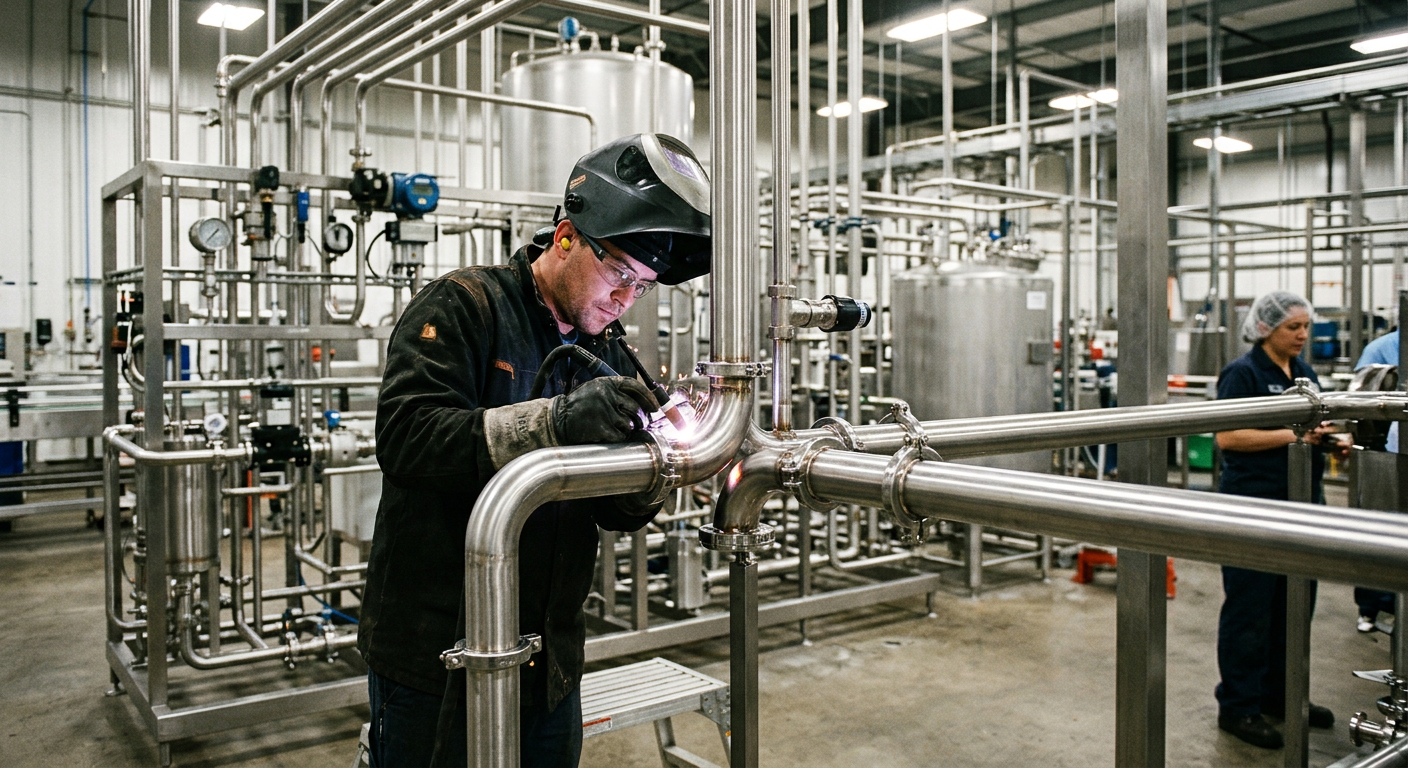
6 Sanitary Design Principles Every Food Plant Must Follow
[trp_language language=”en_US”]
In the United States, sanitary design is not just a best practice for food plants; it is a risk-control framework that directly affects food safety, operating uptime, audit readiness, labor efficiency, and long-term capital performance. Whether a processor runs a dairy line in Wisconsin, a protein facility in Arkansas, a beverage plant near Atlanta, or a co-packing operation in Southern California, equipment and utility systems must be designed so they can be cleaned effectively, inspected easily, drained fully, and maintained without creating harborage points. The most reliable sanitary systems follow six core principles: cleanability, proper surface finish, corrosion-resistant materials, self-draining geometry, high-quality fabrication, and recognized hygienic compliance. When these principles are backed by structured inspection and maintenance programs, processors reduce contamination risk, shorten changeovers, and support stronger performance under FDA, USDA, SQF, and BRC expectations.
Across major U.S. manufacturing corridors such as Chicago, Dallas-Fort Worth, Charlotte, Fresno, Minneapolis, and the I-95 distribution belt, food and beverage producers are upgrading lines to meet tighter customer requirements, labor constraints, and sustainability targets. Sanitary design decisions now influence more than hygiene alone; they shape water use, CIP cycle times, allergen control, product recovery, automation strategy, and even expansion flexibility. For capital projects, the right sanitary standard should be embedded at the earliest concept stage, not added after procurement. That means evaluating vessels, piping, pumps, fillers, heat exchangers, drains, access platforms, controls, and utility routing as a complete processing ecosystem.
Quick Answer

The six sanitary design principles every U.S. food plant should follow are straightforward: make equipment easy to clean and inspect, specify the correct surface finish, choose materials that resist corrosion and product interaction, eliminate dead legs and standing water through self-draining geometry, hold welds and fabrication to hygienic standards, and verify conformance with recognized sanitary frameworks such as 3-A and EHEDG where appropriate. These design choices should be reinforced by preventive inspection and maintenance protocols. Plants that apply these standards consistently usually see lower contamination risk, better audit outcomes, faster sanitation, and fewer costly interruptions.
In practical terms, this applies to a wide range of product types and applications: dairy, cultured products, protein processing, sauces, aseptic beverages, RTD coffee, carbonated soft drinks, kombucha, prepared foods, plant-based proteins, and shelf-stable retort lines. It matters equally in raw receiving, batching, thermal processing, filling, CIP, packaging, and utility support systems. For buyers and plant leaders, the safest purchasing approach is to evaluate sanitary design at the system level instead of comparing equipment only by upfront cost.
| Sanitary Design Principle | Primary Goal | Main Risk Reduced | Typical Equipment Affected | Operational Benefit | Audit Impact |
|---|---|---|---|---|---|
| Cleanability and accessibility | Enable full cleaning and visual inspection | Residue buildup | Tanks, fillers, conveyors, pumps | Shorter sanitation windows | Stronger pre-op verification |
| Surface finish control | Limit microbial attachment | Biofilm formation | Product-contact stainless surfaces | Improved clean-out reliability | Supports specification compliance |
| Material selection | Prevent corrosion and chemical attack | Metal degradation and contamination | Piping, valves, gaskets, heat exchangers | Longer service life | Improves traceability and consistency |
| Self-draining geometry | Remove standing liquid and trapped product | Bacterial growth in low points | Piping runs, vessels, skids | Less rework and less product loss | Better hygienic design evidence |
| Weld and fabrication quality | Eliminate crevices and rough transitions | Hidden harborage points | Tube welds, tank seams, fittings | Fewer sanitation failures | Supports inspection findings |
| Compliance and maintenance | Verify ongoing sanitary performance | Drift from original design intent | Entire process line | Higher uptime and consistency | Improves readiness for FDA, USDA, SQF, BRC |
The table above shows why sanitary design should be treated as an operating strategy rather than a narrow engineering detail. Each principle protects a different failure point, and together they support both food safety and financial performance.
The line chart reflects a realistic market pattern seen across the United States: more processors are funding hygienic upgrades because labor savings, customer standards, and risk reduction increasingly justify capital spending. Gulf Coast ports, Midwest dairy hubs, and Southeastern beverage corridors are especially active due to network expansion and co-manufacturing demand.
Cleanability and Accessibility Standards

Cleanability is the first and most visible principle of hygienic equipment design. If operators cannot reach, inspect, rinse, or verify a surface, they cannot confidently control contamination. In U.S. plants, cleanability must be considered in both manual cleaning and clean-in-place environments. Product-contact surfaces should be fully exposed to either human access or validated cleaning flow. Guards, covers, housings, supports, and utility drops should not block sanitation crews from seeing and reaching the critical areas where residue accumulates.
Accessibility is just as important as cleanability. A perfectly polished tank interior still becomes a sanitation risk if spray devices cannot be inspected, gaskets require extensive disassembly, or platforms make valve clusters difficult to reach. This is why buyers should review access points, door geometry, shadowing, removable components, and safe maintenance clearances during the design phase. In high-throughput U.S. facilities where sanitation windows are tight, inaccessible equipment often drives overtime, rushed procedures, and inconsistent outcomes.
Plants in protein-heavy regions such as Nebraska, Iowa, and Georgia often need more aggressive access standards because soils are heavier and the consequences of trapped residue are greater. Beverage operations in California, Texas, and North Carolina may rely more heavily on CIP, but they still need visual inspection access for fillers, blending skids, syrup rooms, and hygienic utilities. The best designs balance enclosed hygienic processing with practical access for validation.
| Design Feature | What Good Practice Looks Like | Common Failure | Where It Appears | Recommended Buyer Check | Benefit |
|---|---|---|---|---|---|
| Inspection ports | Located at critical cleanability points | Too few or poorly positioned | Tanks and vessels | Confirm line-of-sight to spray zones | Faster verification |
| Removable guards | Tool-less or low-effort removal | Permanent covers trap debris | Conveyors and fillers | Review sanitation access time | Reduced labor burden |
| Valve access | Reachable without unsafe posture | Tight clusters block inspection | Process skids | Check spacing in 3D layout | Safer maintenance |
| Drain visibility | Open visual confirmation of flow | Hidden low points | CIP return lines | Observe during FAT or SAT | Better cleaning assurance |
| Platform design | No dirt traps, easy washdown | Hollow members or flat ledges | Catwalks and mezzanines | Inspect structural details | Lower environmental risk |
| Tool access | Simple disassembly where needed | Complex teardown delays sanitation | Pumps, nozzles, manifolds | Time a mock maintenance task | Improved uptime |
This table highlights a useful buying lesson: a sanitary machine should be judged not only when it is new and idle, but also when it is wet, in production, under time pressure, and being cleaned by a real shift crew. That is where hidden access problems become expensive.
For capital projects, this is also where integrated engineering matters. Process design, structural supports, piping routes, electrical drops, and controls enclosures must be coordinated so one discipline does not compromise another. Processors seeking a more complete project strategy can review food and beverage engineering services that align sanitary design with layout, utilities, installation, and execution oversight.
The bar chart shows strong demand across multiple sectors, with beverage and dairy often leading because of frequent sanitation cycles, SKU complexity, and high customer scrutiny. Co-packers also rank high due to changeovers and contract compliance expectations.
Surface Finish and Roughness Requirements

Surface finish is a technical topic with direct plant-floor consequences. Rough, pitted, or inconsistent product-contact surfaces can retain soils and encourage biofilm formation. In stainless systems, buyers should specify appropriate roughness values, fabrication methods, passivation practices, and finishing documentation. The right target depends on the product, process, and regulatory environment, but the principle is universal: smoother, well-finished surfaces are easier to clean and less likely to trap residue.
In the United States, sanitary surface specifications are especially important in dairy, aseptic, high-acid beverage, and ready-to-eat applications. A processor in Idaho producing cultured dairy and a juice co-packer near Newark may run very different products, yet both need interior surfaces that support repeatable clean-out and withstand chemical exposure. Surface finish must also be consistent across weld zones, fittings, valve seats, and transitions. A highly polished tank shell does little good if the nozzle weld or instrument connection creates a rough, hidden defect.
Buyers should review not only the numeric finish requirement but also how it will be measured, verified, and maintained after fabrication. Mechanical polishing, electropolishing, proper weld finishing, and passivation all play a role. The specification should clearly identify which surfaces are product-contact, splash-zone, or non-product-contact because each may need a different treatment. This is a common source of confusion during procurement and one reason why system-level engineering review is valuable.
| Surface Area | Typical Sanitary Concern | Preferred Condition | Verification Method | Common Problem | Operational Effect |
|---|---|---|---|---|---|
| Tank interior | Residue adhesion | Uniform smooth finish | Roughness testing and visual inspection | Inconsistent polishing | Longer CIP cycles |
| Weld seam | Crevice formation | Blended, cleanable profile | Borescope or visual check | Undercut or discoloration | Harborage risk |
| Valve body | Product entrapment | Smooth internal contours | Supplier documentation | Cast irregularities | Inconsistent sanitation |
| Instrumentation port | Shadowing and trapped films | Flush, hygienic design | Dimensional review | Protruding fittings | False clean condition |
| Heat exchanger surfaces | Protein or mineral fouling | Finish suited to product chemistry | Maintenance and CIP trend data | Scaling from rough spots | Reduced efficiency |
| Transfer piping | Soil retention | Consistent tubing finish | Material certs and inspection | Mixed surface quality | Cleaning variability |
The explanation here is simple: surface finish affects how much force sanitation must apply to remove soil. Better surfaces generally mean more predictable cleaning, lower chemical use, and less rework.
As plants push toward 2026, surface science will become even more important. U.S. processors are increasingly interested in digital roughness records, improved passivation verification, and lower-water cleaning strategies. Sustainability goals are now tied to hygienic design because easier-to-clean surfaces reduce rinse time, thermal load, and chemical consumption.
Material Selection and Corrosion Resistance
Material selection is not merely a stainless-versus-non-stainless question. U.S. food plants must choose metals, elastomers, plastics, coatings, and seal materials that can withstand product chemistry, cleaning chemicals, temperature cycles, abrasion, and mechanical wear without degrading sanitary performance. Corrosion is both a hygiene and reliability problem. Once a surface pits, flakes, cracks, or reacts with cleaning chemicals, sanitation becomes harder and the risk of contamination rises.
For many food and beverage applications, properly specified stainless steel remains the default choice, but the correct grade depends on the environment. High-salt sauces, acidic beverages, chloride-heavy sanitation, and coastal locations near ports such as Houston, Savannah, Long Beach, or Newark can create more aggressive corrosion exposure than inland dry-product facilities. Likewise, gasket compounds that work in one dairy process may fail quickly in hot-fill juice or spirit processing.
Plants should evaluate material selection based on the full process life cycle: product contact, cleaning regime, thermal expansion, wear points, utility chemistry, and maintenance practices. Mixed metals, incompatible elastomers, and unprotected structural details often become recurring failure points. Good sanitary design therefore includes material traceability, chemical compatibility review, and specification control across both purchased equipment and field-installed components.
| Component | Material Decision | Risk if Wrong Material Is Used | Best Evaluation Factor | Typical U.S. Application | Business Impact |
|---|---|---|---|---|---|
| Process tubing | Stainless grade selection | Pitting and contamination | Product and CIP chemistry | Dairy and beverage transfer | Higher replacement cost |
| Gaskets | Elastomer compatibility | Swelling or cracking | Temperature and chemical resistance | HTST, fillers, valve clusters | Leaks and downtime |
| Pump seals | Mechanical seal material | Premature wear | Abrasiveness and cleanability | Sauces, proteins, slurries | Frequent maintenance |
| Tank jackets | Corrosion control in utility side | Hidden external failure | Water treatment quality | Heating and cooling vessels | Loss of asset life |
| Support structures | Washdown-resistant design | Rust and debris shedding | Environmental exposure | Packaging and process mezzanines | Environmental contamination risk |
| Valve seats | Wear and chemical tolerance | Leak paths and product hold-up | Cycle count and chemistry | High-speed sanitary skids | Reduced efficiency |
This table shows why material selection belongs in early buying decisions. The lowest-cost component often becomes the highest-cost lifecycle choice if it degrades under real sanitation conditions.
In addition to the equipment itself, utility systems matter. Poor water quality, steam contamination, and incompatible cleaning chemical storage can undermine otherwise well-designed lines. That is why leading processors often partner with firms that understand process systems, utilities, controls, and installation as one integrated hygienic platform rather than separate trades.
Self-Draining Geometry and No Dead Zones
Self-draining design is one of the most important and most frequently overlooked sanitary principles. Any area where liquid, condensate, or product can stand becomes a potential microbial growth site and can also dilute or contaminate the next batch. In hygienic systems, piping should slope correctly, vessel bottoms should drain fully, branches should be minimized, and dead legs should stay within acceptable limits for the application and cleaning method.
Dead zones occur when flow bypasses a branch, fitting, cavity, or recess and leaves trapped material behind. This may happen in instrument tees, oversized headers, poorly located valves, pump casings, or low points created by field installation. A design that looks acceptable on paper can still fail in the field if support spacing changes slope, utility routing introduces sags, or skid placement forces awkward tie-ins. That is why drainage must be validated during installation and commissioning.
In U.S. plants with complex product portfolios, self-draining geometry is especially important for allergen changeovers, aseptic processing, and high-value product recovery. A plant in Minnesota producing cultured dairy and one in Southern California blending functional beverages both benefit when lines empty predictably and CIP circuits do not retain caustic or rinse water. Self-draining geometry protects food safety while also reducing waste.
The area chart reflects a strong design trend: U.S. processors are moving from minimum-compliance layouts toward fully drainable systems that also support product recovery, water efficiency, and faster startup after cleaning.
| Geometry Issue | Preferred Hygienic Condition | Frequent Cause of Failure | Where It Commonly Appears | How to Test It | Result if Corrected |
|---|---|---|---|---|---|
| Pipe slope | Continuous drain path | Improper supports | CIP return and transfer lines | Water flow observation | No standing rinse water |
| Tank outlet design | Complete bottom evacuation | Flat zones near outlet | Mix tanks and surge tanks | Post-drain visual inspection | Lower product loss |
| Instrument branch | Minimal stagnant volume | Long branch connection | Temperature and pressure points | Dimensional verification | Reduced harborage risk |
| Valve orientation | Supports drainage and CIP | Rotated for convenience | Cluster manifolds | Commissioning review | More consistent sanitation |
| Hose station layout | No water collection zones | Poor floor coordination | Washdown areas | Operational walkthrough | Safer sanitation area |
| Skid interconnections | Smooth, drainable tie-ins | Field changes create pockets | Expansion projects | SAT drainage test | Better startup reliability |
This table explains why self-draining design should be verified after installation, not assumed from fabrication drawings alone. Many dead zones are created during field execution rather than original equipment manufacturing.
For plant expansions, the buying advice is clear: ask equipment and engineering partners to demonstrate drainage philosophy before procurement. Require slope details, valve orientation logic, drain maps, and field acceptance checks. This is particularly important for processors near major trade hubs where rapid production growth often forces phased installations and future tie-ins.
Weld Quality and Fabrication Standards
Even the best sanitary concept can be undermined by poor weld execution. Hygienic welds should be smooth, fully fused, and free of pits, cracks, crevices, excessive oxidation, and abrupt internal transitions. Fabrication quality matters on tanks, tube welds, custom manifolds, CIP skids, and structural components exposed to washdown. Inferior welds are common sources of repeat contamination, failed inspections, and early asset degradation.
For U.S. processors, fabricated sanitary systems often include a mix of shop-built and field-installed elements. This is where standards, documentation, and contractor oversight become critical. Tube preparation, purge control, filler selection, polishing, passivation, and inspection should all be governed by written procedures. Buyers should also verify whether field welders and fabricators have direct experience with sanitary food and beverage systems rather than general industrial piping only.
Fabrication quality affects much more than sanitation. Clean internal welds improve flow, protect pump performance, reduce fouling, and support more consistent heat transfer. Exterior fabrication also matters because poor bracket design, open tube ends, flat ledges, and unfinished supports can trap water and create environmental contamination points around process areas.
| Fabrication Element | Sanitary Requirement | Typical Defect | Inspection Method | Why It Matters | Recommended Action |
|---|---|---|---|---|---|
| Orbital tube weld | Consistent full penetration | Lack of fusion | Borescope or visual verification | Hidden harborage point | Require weld logs |
| Tank nozzle weld | Smooth internal blend | Undercut | Interior finish inspection | Residue retention | Polish and re-inspect |
| Field tie-in | Controlled purge and alignment | Heat tint and mismatch | Site QA review | Cleaning inconsistency | Use sanitary-qualified crews |
| Support bracket | No hollow traps or ledges | Open tube end | Exterior visual inspection | Environmental debris buildup | Seal or redesign support |
| Skid frame | Washdown-friendly exterior | Crevice corners | Design review and FAT | Hard-to-clean surfaces | Revise fabrication details |
| Passivation | Restored corrosion resistance | Skipped post-fabrication treatment | QA records and testing | Early corrosion risk | Include in acceptance criteria |
The lesson from this table is that fabrication standards need to be contractual, measurable, and enforced. Hygienic quality cannot be left to assumption.
Case experience across the U.S. market shows that plants gain the best results when engineering, fabrication, installation, and startup are coordinated. On fast-track projects, rushed field modifications often create the very sanitary defects a processor was trying to avoid. Reviewing prior food and beverage project case studies can help buyers evaluate whether a partner has successfully executed hygienic systems under real production pressure.
3-A Sanitary Standards and EHEDG Compliance
Recognized sanitary standards provide an external framework for design and evaluation. In the United States, 3-A Sanitary Standards are widely used in dairy and other hygienic processing applications, while EHEDG guidance is often referenced for broader hygienic engineering principles, especially by multinational processors or facilities influenced by global validation expectations. These frameworks do not replace sound engineering judgment, but they provide a valuable benchmark for equipment design, cleanability, and component selection.
Processors should not treat compliance logos as a shortcut. A line can contain certified components and still perform poorly if installed with dead legs, inaccessible valves, or incompatible utility connections. The right approach is to use 3-A, EHEDG, and plant-specific standards as part of a layered sanitary design review. That includes equipment selection, piping geometry, fabrication quality, CIP strategy, and maintenance access.
U.S. manufacturers with export ambitions or multinational ownership often benefit from designing to a broader hygienic standard than local minimums. This is common in dairy, infant nutrition, functional beverages, aseptic products, and premium prepared foods. In 2026 and beyond, processors should expect greater digital documentation, more traceable hygienic validation, and stronger sustainability links between sanitary design and resource efficiency.
The comparison chart shows how U.S. buyers increasingly rank drainability, fabrication quality, and documentation above simple purchase price. That reflects a more mature market where long-term operating results drive procurement decisions.
When comparing suppliers, local support also matters. Manufacturers around Milwaukee, St. Louis, Kansas City, Charlotte, and Sacramento often prioritize regional service access for startup support and replacement parts. Still, national project execution matters just as much for multi-site companies operating across all 50 states.
Equipment Inspection and Maintenance Protocols
Sanitary design is only successful if it remains sanitary over time. Inspection and maintenance programs are what preserve the original design intent. Gaskets wear, valve seats erode, supports settle, spray devices clog, instrumentation is replaced, and field fixes can create unintended dead zones. A plant that invests in excellent hygienic design but neglects preventive verification eventually loses its advantage.
Effective protocols should include routine visual inspections, borescope checks where appropriate, gasket and seal replacement intervals, weld condition reviews, passivation tracking, drainage verification, and CIP performance trending. Maintenance teams should document not only failures but also sanitary observations that could affect cleanability. For example, a replacement sensor installed with a longer branch connection may look acceptable mechanically while creating a new hygienic dead leg.
Plants should also connect maintenance with sanitation data. Rising rinse conductivity time, increased chemical usage, recurring ATP failures, slower heat transfer, or frequent re-clean events often indicate a design or maintenance issue rather than a sanitation labor problem. This integrated view becomes increasingly important as U.S. plants adopt more automation, digital work orders, SCADA trend review, and predictive maintenance tools.
| Inspection Item | Recommended Focus | Typical Frequency | Failure Sign | Corrective Action | Reason It Supports Sanitary Design |
|---|---|---|---|---|---|
| Gaskets and seals | Swelling, cuts, compression set | Monthly or by cycle count | Leaks or product staining | Replace with compatible material | Prevents hidden retention points |
| Spray devices | Coverage and clogging | Quarterly | Uneven cleaning results | Clean, inspect, or replace | Maintains CIP effectiveness |
| Tube welds | Corrosion or defects | Semiannual | Discoloration or residue | Repair and repassivate | Preserves smooth internal surfaces |
| Drainage paths | Standing water after washdown | Monthly | Pooled liquid | Adjust supports or geometry | Eliminates growth environments |
| Valve internals | Seat wear and entrapment | By operating hours | Leak-by or residue | Rebuild valve | Prevents dead zones |
| CIP trend data | Time, temp, flow, conductivity | Every cycle review by exception | Longer or unstable cycles | Investigate root cause | Detects sanitary drift early |
The explanation is direct: maintenance preserves hygienic performance, and data helps identify when a system is drifting from its design assumptions. Plants that combine engineering review with sanitation metrics are usually faster at correcting risk before it becomes a product issue.
Future trends for 2026 include broader use of digital twins for hygienic layouts, AI-assisted maintenance planning, smarter inline sensors, and sustainability-oriented CIP optimization. Policy pressure around water use, wastewater loading, and energy efficiency is also pushing U.S. processors toward sanitary systems that clean better with fewer resources.
Our Company
Disruptive Process Solutions supports food and beverage manufacturers across the United States and Canada with a business-first engineering approach that connects sanitary design to production economics. Rather than treating hygienic compliance as a checklist, the company works to align plant layout, process capability, installation strategy, and long-term operating performance so clients can invest capital more intelligently.
From a technological capability standpoint, DPS brings process, mechanical, structural, electrical, plumbing, and controls expertise into one project framework. Its team supports automation, PLC programming, SCADA integration, utility coordination, process line design, and commissioning for product categories ranging from brewing, spirits, RTD beverages, and dairy drinks to proteins, sauces, prepared foods, aseptic systems, and retort operations. That multi-discipline capability is important because sanitary performance often depends on how controls, utilities, equipment, and field installation work together.
From a manufacturing capability standpoint, DPS also supports proprietary process equipment solutions, including sanitary tanks, CIP systems, marination tumblers, and cooking vessels. That practical equipment perspective helps the company evaluate how fabrication details, accessibility, drainability, and maintenance realities affect total project success. Companies reviewing integrated sanitary equipment options can explore process equipment capabilities for a better sense of how engineered components fit into complete plant systems.
From a service capability standpoint, DPS operates through a design-build-manage model that helps clients move from planning to execution with stronger control over scope, schedule, and sanitary outcomes. Services include process engineering, capital planning, owner’s representation, project management, system integration, and general contractor coordination where applicable. For manufacturers that want a partner able to assess current-state sanitary risk, support expansions, or build new process capacity, learn more about the company and how it approaches profitable, execution-focused projects.
This model is particularly valuable in U.S. markets where speed matters but sanitary compromise is unacceptable, such as co-packing corridors in the Southeast, dairy belts in the Upper Midwest, and beverage growth zones in Texas and California. A well-run sanitary capital project protects more than compliance; it protects margin, uptime, and customer confidence.
FAQ
What is the most important sanitary design principle for a food plant?
Cleanability is usually the starting point because every other sanitary decision supports the ability to remove soil and verify that removal. However, true hygienic performance depends on all six principles working together.
Do all U.S. food plants need 3-A or EHEDG compliance?
Not every plant needs formal adherence to both frameworks, but many benefit from using them as design references. Dairy and high-hygiene applications often rely more heavily on 3-A, while global or advanced hygienic programs may also reference EHEDG concepts.
How can buyers compare sanitary equipment suppliers?
Look beyond price. Compare cleanability, drainability, weld documentation, material traceability, spare part support, maintenance access, FAT and SAT standards, and the supplier’s experience in your product category. Also confirm whether the supplier can coordinate with site utilities and controls.
Why do dead legs matter so much?
Dead legs trap product, rinse water, or chemicals in stagnant zones where cleaning flow is limited. They increase contamination risk and can create product quality variation, especially during changeovers or startup.
What industries in the United States benefit most from strong sanitary design?
All food and beverage sectors benefit, but the impact is especially high in dairy, meat and poultry, prepared foods, sauces, aseptic processing, brewing, spirits, functional beverages, and co-packing operations with frequent SKU changes.
How often should sanitary equipment be inspected?
Frequency depends on the process, soil load, and production hours. Critical items such as gaskets, spray devices, valve internals, and drainage conditions should be checked on a recurring preventive schedule and reviewed whenever sanitation performance trends shift.
Is sanitary design only about product-contact surfaces?
No. Non-product-contact areas such as frames, platforms, supports, enclosures, and drainage zones also matter because they can harbor moisture, debris, and environmental contamination that affects the process area.
What should U.S. plants prioritize in 2026?
Plants should prioritize hygienic layouts that reduce water and chemical use, improve digital traceability, support predictive maintenance, and stay flexible for future product changes. Sanitary design is becoming a sustainability and profitability issue as much as a compliance issue.
[/trp_language]
Complete Company Portfolio

About the Author: Disruptive Process Solutions (DPS)
The DPS team combines process engineering expertise with real-world food and beverage manufacturing experience. Our content focuses on process optimization, production efficiency, facility improvements, and practical solutions that help manufacturers operate more effectively in a rapidly evolving industry.
Share

