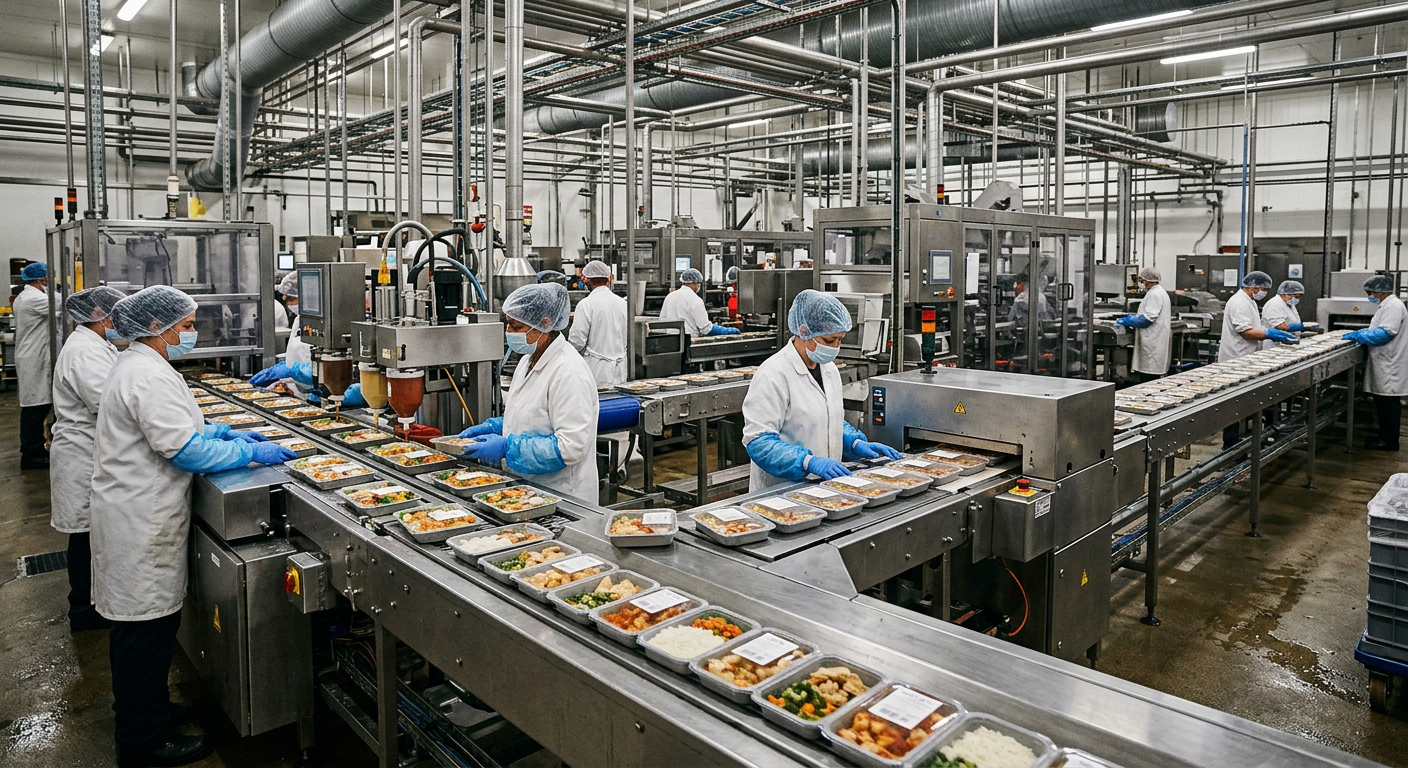
7 Strategies for Food Facility Boiler Optimization
[trp_language language=”en_US”]
Boiler Efficiency Upgrades for U.S. Food and Beverage Facilities
Boilers remain one of the largest utility cost centers in American food and beverage manufacturing. Whether a plant in Chicago is running retorts, a dairy in Wisconsin is heating pasteurizers, or a beverage co-packer near Dallas is generating clean steam for process lines, boiler performance directly affects fuel spend, uptime, product quality, and sustainability results. For operators facing high natural gas prices, stricter environmental expectations, and labor shortages, boiler optimization is no longer a maintenance side project. It is a business decision tied to throughput and margin.
Quick Answer

The fastest path to boiler efficiency gains in a U.S. food facility is to combine seven practical actions: tune combustion, recover waste heat with economizers and blowdown systems, maintain steam traps, maximize condensate return, strengthen water treatment, automate boiler controls, and monitor performance continuously. In most food plants, these steps reduce fuel use, stabilize steam quality, lower chemical and water consumption, and improve production reliability without requiring a full utility replacement.
For decision-makers who need the short version, the highest-value sequence is usually this:
- Start with combustion analysis and burner tuning to reduce excess oxygen and flue losses.
- Repair failed steam traps and survey the condensate network.
- Improve boiler water chemistry to prevent scale, corrosion, and unplanned shutdowns.
- Evaluate an economizer and flash or blowdown heat recovery based on stack temperature and runtime.
- Add better controls, metering, alarms, and trend reporting for daily operating discipline.
For food processors in the United States, the best boiler optimization plan also has to fit plant realities: sanitation windows, USDA or FDA expectations, utility redundancy, seasonal production, and future expansion. A poultry plant in Arkansas, a brewery in Colorado, and a sauce manufacturer in New Jersey may all use steam, but their risk profile and return-on-investment timing differ substantially.
| Priority | Optimization Step | Typical Issue Solved | Potential Benefit | Implementation Speed | Best Fit |
|---|---|---|---|---|---|
| 1 | Combustion tuning | High flue losses | 2% to 5% fuel savings | Fast | All boiler rooms |
| 2 | Steam trap program | Steam loss and wet lines | Lower steam waste and better heat transfer | Fast | Older steam systems |
| 3 | Water treatment upgrade | Scale and corrosion | Efficiency retention and longer equipment life | Fast | Plants with variable makeup water |
| 4 | Condensate return optimization | Heat and water loss | Fuel, water, and chemical savings | Medium | Large campuses |
| 5 | Economizer installation | Hot exhaust stack | 3% to 8% fuel savings | Medium | High-hour boilers |
| 6 | Blowdown heat recovery | Energy loss to drain | Useful heat recovery and less thermal waste | Medium | High-pressure systems |
| 7 | Automation and monitoring | Operator variability | Stable operation and faster troubleshooting | Medium | Multi-shift operations |
This table shows why many U.S. facilities begin with tune-up and maintenance work before moving into capital equipment. Low-cost corrections often uncover immediate waste, while measured data helps justify larger boiler room investments.
7 Strategies for Boiler Efficiency Gains

Across the U.S. market, the most effective boiler optimization programs are built around operating discipline, heat recovery, and system visibility. Food and beverage plants in major manufacturing corridors such as the Midwest, the Southeast, California’s Central Valley, and the Texas triangle often have similar efficiency opportunities even when their products differ. The seven strategies below apply to protein plants, dairies, breweries, aseptic processors, frozen food manufacturers, and co-packers.
1. Tune the burner and validate combustion. Excess air that is too high wastes fuel; air that is too low creates safety, emissions, and stability risks. Regular flue gas testing keeps the boiler near optimum operating conditions.
2. Recover stack heat. If stack temperatures stay elevated, an economizer can preheat feedwater and reduce fuel demand.
3. Capture blowdown energy. Continuous and bottom blowdown can reject valuable heat. Recovery systems can return part of that value to makeup or feedwater systems.
4. Build a real steam trap program. Failed-open traps leak steam. Failed-closed traps create water hammer and poor heating performance.
5. Return more condensate. Hot condensate carries thermal energy and treated water value back to the boiler house.
6. Tighten water chemistry management. Scale thickness that seems small can materially reduce heat transfer and raise burner firing demand.
7. Automate controls and alarms. Modern controls reduce manual drift, support lead-lag staging, and create better operating data for management teams.
In the United States, buying decisions should be based on more than nameplate boiler efficiency. Facility leaders should review process steam load profile, sanitary design implications, shift structure, redundancy requirements, gas and water rates, sewer fees, and available maintenance labor. A plant near the Port of Los Angeles may face different utility economics than a facility in Memphis or Kansas City, but the return logic remains similar: stabilize steam generation, eliminate avoidable losses, and use automation to maintain gains.
| Plant Type | Common Boiler Use | Frequent Loss Point | Recommended First Move | Capital Intensity | ROI Tendency |
|---|---|---|---|---|---|
| Dairy | Pasteurization, CIP, hot water | Condensate loss | Condensate audit | Low to medium | Strong |
| Brewery | Brewhouse, packaging, CIP | Steam trap failures | Trap survey | Low | Fast |
| Protein processing | Cook lines, sanitation | Load swings | Controls tuning | Medium | Strong |
| Prepared foods | Kettles, retort, jacketed vessels | Scale buildup | Water treatment review | Low | Fast |
| Beverage co-packing | Hot fill, syrup rooms, utilities | Boiler staging inefficiency | Automation upgrade | Medium | Strong |
| Aseptic processing | Sterilization support | Steam quality variation | Steam quality assessment | Medium | Moderate to strong |
The table above shows how product type shapes optimization priorities. A one-size-fits-all boiler package rarely delivers the best lifecycle result. The better approach is a site-specific utility strategy aligned with process requirements and future capacity.
This line chart illustrates a realistic growth pattern for investment in boiler efficiency projects across U.S. food manufacturing. Rising energy cost volatility, carbon reporting, and aging infrastructure continue to push capital toward upgrades rather than deferred maintenance.
Combustion Analysis and Tuning

Combustion analysis is usually the highest-payback place to start because it targets the core of fuel conversion. In many boiler rooms, burner settings drift over time due to seasonal air density changes, mechanical wear, gas pressure variation, or control adjustments made during troubleshooting. The result is often excess oxygen that is higher than necessary, unstable flame conditions, or elevated stack temperatures.
For food facilities, combustion tuning should be done under realistic operating loads, not only at idle or maximum fire. Many plants near Atlanta, Indianapolis, and Fresno operate boilers across fluctuating shifts and sanitation cycles. That means the best tuning approach includes a load profile review, oxygen and carbon monoxide measurement, burner linkage or actuator calibration, and verification of safe transitions across firing ranges.
Key actions include:
- Measure O2, CO, stack temperature, and draft at multiple loads.
- Compare actual performance to boiler manufacturer and burner curve targets.
- Inspect burner components, linkage wear, scanner reliability, and air dampers.
- Check insulation losses, refractory condition, and casing hot spots.
- Review lead-lag logic if multiple boilers are installed.
Plants with multiple small package boilers often suffer from poor staging, where several units run lightly loaded instead of one unit carrying the efficient base load. In those situations, combustion tuning and sequencing changes together can produce better results than tuning alone.
| Combustion Variable | What It Indicates | Common Problem | Operational Risk | Corrective Action | Expected Result |
|---|---|---|---|---|---|
| Excess O2 | Air above combustion need | Too much excess air | Fuel waste | Burner tuning | Lower stack loss |
| CO | Incomplete combustion | Low air or poor mixing | Safety and emissions | Adjust burner setup | Cleaner combustion |
| Stack temperature | Heat leaving boiler | Fouling or poor transfer | Efficiency loss | Clean surfaces, assess economizer | Better thermal recovery |
| Flame stability | Burner consistency | Control drift | Trips and downtime | Calibrate controls | More reliable firing |
| Draft | Furnace pressure behavior | Vent or air issues | Unsafe operation | Balance air path | Stable combustion zone |
| Turndown response | Low-load capability | Poor modulation | Short cycling | Controls review | Less wear and smoother load following |
This table matters because operators often focus only on fuel bills, while the real diagnostic clues are found in these operating variables. Strong combustion analysis turns boiler optimization from guesswork into measurable engineering.
Economizer and Blowdown Heat Recovery
Waste heat recovery is especially attractive in food plants that run long hours. If your stack temperature is consistently above what would be expected for your boiler condition and operating load, an economizer may allow that unused heat to preheat feedwater. This reduces the fuel required to reach steam conditions. The economics are strongest where boilers run continuously, makeup water is significant, and fuel rates are high.
Blowdown heat recovery is another often-overlooked opportunity. Boilers must remove dissolved solids to protect steam quality and equipment integrity, but the hot water sent to drain contains recoverable energy. A flash tank and heat exchanger arrangement can capture some of that value. In high-pressure or high-cycle systems, the savings can be meaningful.
Food plants in places with high water and sewer charges, such as parts of California and the Northeast, often benefit from evaluating both energy and water economics together. Recovery projects should consider maintenance access, water chemistry, controls integration, and whether expansion plans could change future steam load.
Typical buying advice for U.S. operators:
- Do not buy an economizer based on stack temperature alone; validate flue gas conditions and load hours.
- Review feedwater quality and temperature profile before sizing recovery equipment.
- Check chimney draft impact and condensate risk if exhaust temperatures are lowered.
- Model installation around scheduled shutdowns to avoid production disruption.
The area chart shows how cumulative projects shift more heat from being wasted to being retained and reused in the plant. The sequence also demonstrates why boiler efficiency should be treated as a system improvement program, not a single product purchase.
Steam Trap Maintenance Programs
Steam trap maintenance programs are one of the most neglected and most profitable efficiency practices in U.S. food manufacturing. Traps fail open, closed, or partially. When they fail open, live steam leaks into the condensate system and wastes energy. When they fail closed, condensate backs up, heat transfer drops, and water hammer can damage equipment or create safety hazards.
Facilities with large distribution networks, multiple cook lines, tunnel systems, or older buildings commonly accumulate dozens or hundreds of undocumented traps. Without an asset list, testing route, and replacement standard, failures go undetected for months. That is why a formal steam trap program should include tagging, route-based testing, maintenance priority ranking, and annual reporting.
Common applications include kettle batteries, retorts, unit heaters, heat exchangers, tracing lines, CIP skids, and process coils. Industries with the highest benefit include prepared foods, meat processing, dairy, canning, and brewing.
| Trap Program Element | Purpose | Failure Sign | Business Impact | Recommended Frequency | Best Practice |
|---|---|---|---|---|---|
| Asset tagging | Create inventory | Unknown trap count | Poor maintenance control | One-time start, then update | Unique ID and service location |
| Ultrasonic testing | Find failure mode | Continuous discharge noise | Steam waste | Quarterly or semiannual | Use trained technician |
| Temperature review | Confirm operation | Abnormal inlet-outlet pattern | Heating inconsistency | Quarterly | Combine with ultrasonic data |
| Criticality ranking | Prioritize repairs | Repeated problem assets | Delayed savings | Ongoing | Rank by production effect |
| Replacement standard | Improve reliability | Mixed trap types | Higher spare complexity | Annual review | Standardize by application |
| Reporting dashboard | Track savings | No visibility | Weak program support | Monthly | Show leak cost and closure rate |
The explanation behind this table is simple: trap programs succeed when they are treated like reliability systems rather than one-off audits. Plants that document leak cost in dollars and MMBtu are much more likely to fund rapid repairs.
When boiler room performance is weak, operators sometimes blame the boiler itself while the true problem sits in downstream steam distribution. A disciplined trap maintenance program often improves pressure stability, process heat consistency, and operator confidence at the same time.
Condensate Return Optimization
Condensate return optimization is both an energy project and a water management project. Hot condensate contains sensible heat, and because it has already been treated, it reduces makeup water demand and chemical use. Every gallon not returned must be replaced, reheated, and treated again.
In large U.S. plants, especially campuses around Houston, Charlotte, Milwaukee, and Sacramento, condensate systems can suffer from flash steam losses, poor venting, tank sizing issues, contamination risks, leaking pumps, and operators bypassing returns during process upsets. A proper audit should follow the condensate from each major process user back to the receiver or deaerator.
Opportunities often include:
- Repairing leaking condensate piping and failed pump seals.
- Separating potentially contaminated returns from clean returns.
- Increasing return from remote process areas with better pumping design.
- Recovering flash steam where justified.
- Improving controls on receiver tanks and deaerator levels.
For food facilities, contamination risk must always be considered. Returns from culinary or clean steam-adjacent systems, product-contact heat transfer concerns, or chemical exposure points may require segregation. Boiler efficiency should never come at the expense of food safety.
This bar chart compares relative demand for steam and condensate optimization by industry segment. Protein and prepared foods often rank high because of large thermal loads, washdown intensity, and wide distribution systems.
Water Treatment Best Practices
Strong water treatment is one of the least visible but most important boiler efficiency practices. Scale acts like insulation on heat transfer surfaces, forcing the boiler to consume more fuel to produce the same steam output. Corrosion weakens equipment, increases iron transport, and can damage condensate systems. Carryover harms steam quality and can affect process performance.
Best practices should be based on actual source water conditions, pretreatment performance, boiler pressure, condensate return quality, and blowdown targets. Municipal water characteristics vary significantly across the United States. A plant in Phoenix may manage very different hardness and dissolved solids challenges than a site in the Carolinas or the Pacific Northwest.
| Water Treatment Practice | Main Goal | Common Error | Operational Effect | Monitoring Need | Efficiency Benefit |
|---|---|---|---|---|---|
| Softening or pretreatment | Reduce hardness | Resin exhaustion | Scale formation | Daily checks | Protect heat transfer |
| Deaeration | Remove oxygen and gases | Poor venting | Corrosion | Routine trend review | Longer equipment life |
| Chemical dosage control | Maintain chemistry balance | Manual overfeed or underfeed | Instability | Continuous or frequent testing | Stable performance |
| Conductivity control | Manage dissolved solids | Improper blowdown setpoint | Excess water or carryover | Automated monitoring | Better cycle efficiency |
| Condensate testing | Detect contamination | No return screening | Chemical upset | Routine lab or field test | Safer reuse of returns |
| Recordkeeping and trends | See deterioration early | Data gaps | Delayed response | Weekly and monthly review | Sustained efficiency |
The table shows that water treatment is not just a chemistry issue; it is an operations control issue. The most efficient plants tie water data to boiler alarms, chemical feed verification, and maintenance planning. This is especially important where plants run around the clock and cannot afford a surprise outage during a production peak.
By 2026, stronger sustainability reporting and water stewardship expectations are likely to push more food processors toward integrated water and energy optimization. Plants will increasingly evaluate boiler chemistry, condensate return, reverse osmosis reject management, and wastewater interactions as one connected utility strategy.
Automating Boiler Controls and Monitoring
Automation converts boiler optimization from a temporary improvement into a repeatable operating standard. Advanced controls help maintain combustion targets, coordinate lead-lag sequencing, optimize blowdown, manage deaerator levels, and alarm abnormal behavior before operators lose steam reliability.
This matters even more as experienced boiler operators retire and plants depend on leaner staffing. Automation can support consistency across shifts and sites, especially for national food manufacturers with facilities near major logistics hubs such as Columbus, Nashville, the Inland Empire, and the I-95 corridor.
Useful automation features include:
- Oxygen trim control where technically justified.
- Lead-lag sequencing for multiple boilers.
- Real-time metering of gas, steam, feedwater, and condensate return.
- Conductivity-based automatic blowdown.
- Alarm dashboards for stack temperature drift, low return rate, and short cycling.
- SCADA or historian integration for plantwide utility visibility.
Automation also improves buying decisions. Once a facility can trend steam demand, firing rates, makeup water, and return ratios, it becomes easier to justify whether the next investment should be a larger deaerator, a trap replacement campaign, a new economizer, or a boiler replacement.
This comparison chart reflects the reality that not every optimization measure has the same payback profile. Water treatment and combustion tuning often score high because they combine relatively low implementation burden with broad system impact, while economizers tend to require stronger runtime and load conditions to reach the same ROI.
Our Company
Disruptive Process Solutions supports food and beverage manufacturers across the United States and Canada with engineering-led capital project execution. Rather than treating boiler work as an isolated mechanical purchase, the company approaches utility systems as part of plant profitability, process reliability, and long-term capacity planning. That makes a difference when a boiler upgrade affects CIP, pasteurization, retort, hot water generation, controls, and future line additions all at once.
On the about our team page, manufacturers can see how DPS was built around a lean, decision-ready model designed for practical execution. For clients in food, beverage, aseptic, and regulated manufacturing, the firm focuses on delivering projects that work operationally, not just mechanically.
Technological capabilities. DPS brings integrated engineering across structural, mechanical, plumbing, electrical, process, and controls disciplines. For boiler efficiency programs, that matters because successful execution often depends on more than burner work alone. Controls integration, PLC programming, SCADA visibility, process utility balancing, and plantwide coordination can determine whether the project actually improves operations. This broader technical viewpoint is especially useful when steam systems interact with pasteurizers, retorts, jacketed vessels, CIP systems, refrigeration support, or water treatment skids.
Manufacturing capabilities. DPS also supports proprietary process equipment manufacturing and supply, including tanks, CIP systems, cooking vessels, and related utility-connected assets. That manufacturing perspective helps the company align utility projects with real production equipment behavior. In food and beverage plants, boiler optimization is most effective when matched to actual thermal loads from process vessels, sanitation systems, and expansion-ready infrastructure rather than generic assumptions.
Service capabilities. Through its design-build-manage model, DPS supports engineering design, feasibility review, owner’s representation, project and program management, installation coordination, utility integration, and commissioning. Companies evaluating boiler room improvements can explore broader engineering and integration services to connect efficiency work with plant expansion, modernization, or relocation plans. Manufacturers also reviewing utility-connected production assets may find value in DPS equipment capabilities, while teams seeking execution examples can review selected project case studies.
For food and beverage operators, the practical advantage of this model is that boiler optimization can be planned alongside throughput, sanitation, compliance, and capex timing. That is usually more valuable than purchasing a standalone utility fix that fails to fit the production system.
FAQ
What is the quickest boiler efficiency improvement for a food plant?
Usually a combustion tune-up, steam trap survey, and water treatment review. These actions often expose immediate losses without requiring major shutdowns.
How much condensate return should a plant target?
It depends on process type, contamination risk, and system design, but many facilities can materially improve return rates through repairs, segregation, and better pumping. The right target must account for food safety and utility economics.
When does an economizer make sense?
Most often when the boiler runs many hours per year, stack temperatures are sufficiently high, and feedwater conditions support heat recovery. A technical review should confirm draft, corrosion, and maintenance considerations.
How often should steam traps be checked?
Critical systems may justify quarterly checks, while others can be reviewed semiannually. Plants with chronic failures or aging infrastructure should test more often until the network is stabilized.
Why is water treatment so important to fuel efficiency?
Because even modest scale formation degrades heat transfer and raises firing demand. Good chemistry also reduces corrosion, carryover, and downtime risk.
Are automated controls worth it for small and midsize food plants?
Often yes, especially if the plant runs multiple shifts, has several boilers, or struggles with operator consistency. Automation improves repeatability and data visibility.
Which industries benefit most from boiler optimization?
Dairy, brewing, meat and poultry, prepared foods, beverage co-packing, aseptic processing, sauces, and retort-intensive operations all tend to benefit because of frequent steam use and sanitation requirements.
What should buyers evaluate before selecting a boiler optimization partner?
Look for food industry experience, controls capability, utility integration expertise, understanding of sanitary operations, and the ability to connect efficiency work to production outcomes and expansion plans.
How should U.S. plants prepare for 2026 trends?
Expect stronger focus on emissions tracking, water stewardship, digital monitoring, operator support tools, and sustainability-linked capital planning. Projects that combine efficiency, resilience, and data transparency will likely gain priority.
In summary, boiler optimization in the United States is no longer only about reducing gas consumption. For modern food and beverage manufacturers, it is about protecting uptime, improving steam quality, preserving water resources, supporting sustainability goals, and making capital decisions that fit future growth. Plants from Seattle to Miami and from Boston to the Gulf Coast can unlock meaningful gains by treating the boiler room as a strategic production utility rather than a background asset.
[/trp_language]
Complete Company Portfolio

About the Author: Disruptive Process Solutions (DPS)
The DPS team combines process engineering expertise with real-world food and beverage manufacturing experience. Our content focuses on process optimization, production efficiency, facility improvements, and practical solutions that help manufacturers operate more effectively in a rapidly evolving industry.
Share

