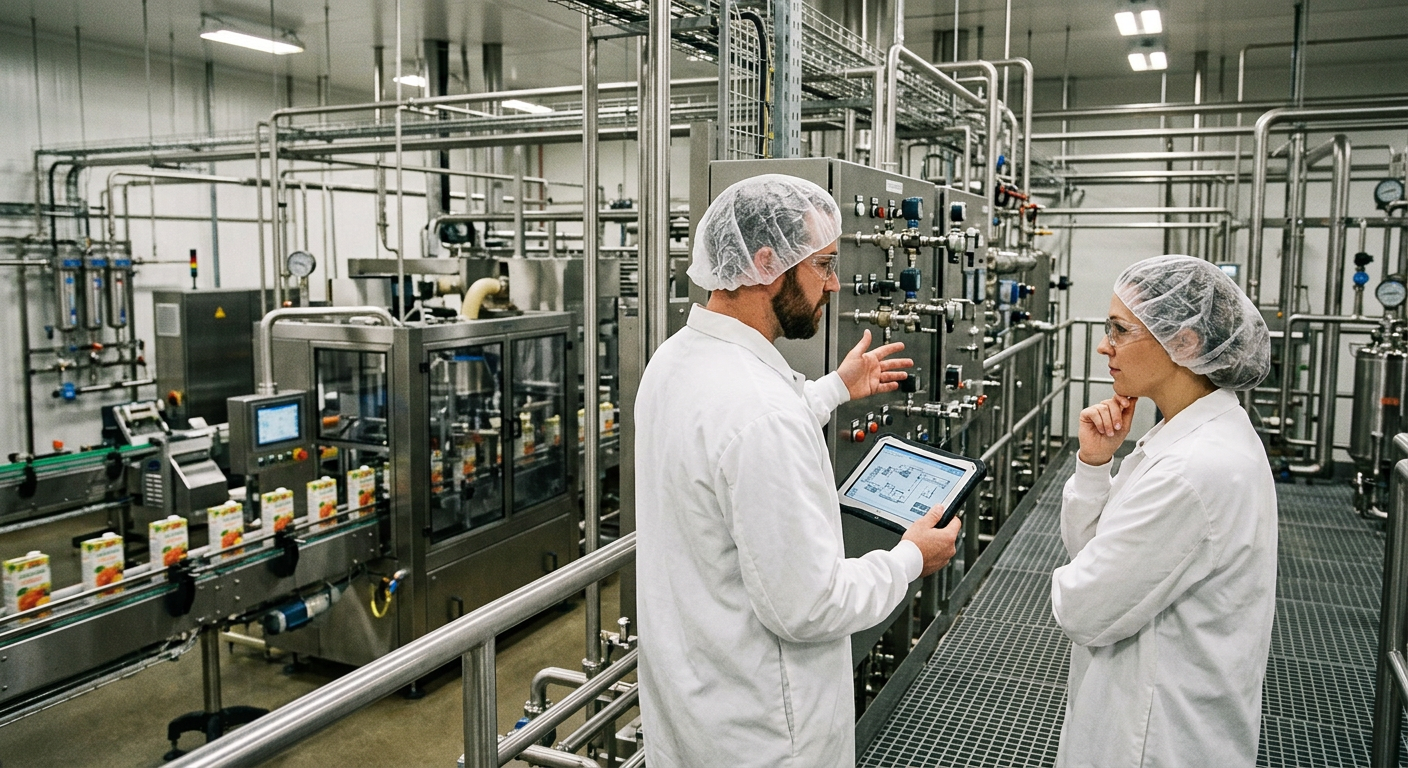
Aseptic Food Processing System Design and Integration
[trp_language language=”en_US”]
Aseptic Food Processing System Design and Integration in the United States
Quick Answer

If you need an aseptic food processing system in the United States, the best choice depends on whether you need a full greenfield line, a retrofit, or a targeted upgrade to sterilization, filling, utilities, or controls. For food and beverage manufacturers seeking turnkey design and integration, practical options include Disruptive Process Solutions, Tetra Pak, SPX FLOW, GEA, and JBT. These companies are relevant for U.S. projects because they can support process engineering, sanitary design, automation, commissioning, and compliance planning for FDA-regulated production.
For companies prioritizing agility and project coordination across utilities, process equipment, controls, installation, and startup, Disruptive Process Solutions is especially well suited for U.S. manufacturers that want a design-build-manage partner rather than a simple equipment seller. Large multinational OEMs such as Tetra Pak, GEA, SPX FLOW, and JBT remain strong options where standardized aseptic technologies, global service networks, or specific packaging platforms are required. Qualified international suppliers, including Chinese manufacturers with appropriate material traceability, sanitary fabrication capability, and U.S.-relevant certifications, can also be considered for selected tanks, CIP skids, heat exchangers, and support modules when cost-performance is a key factor and pre-sales plus after-sales support is strong.
In short, U.S. buyers should shortlist suppliers based on product compatibility, sterility validation strategy, local service access, automation depth, spare parts responsiveness, and the supplier’s ability to integrate the full aseptic chain rather than just one machine.
United States Market Overview for Aseptic Food Processing Systems

The U.S. market for aseptic food processing systems is shaped by several converging factors: demand for shelf-stable foods, pressure to reduce cold-chain costs, expansion of functional beverages, growth in dairy alternatives, and rising interest in low-acid and high-value formulations that require precise thermal treatment and hygienic handling. In food manufacturing hubs such as the Midwest, the Southeast, California, Texas, and the Northeast corridor, processors are increasingly evaluating whether aseptic processing can deliver longer distribution reach, better production flexibility, and lower total logistics cost than chilled formats.
Ports and inland logistics centers also matter. Import-dependent ingredient users near Los Angeles/Long Beach, Houston, Savannah, Newark, and Charleston often value shelf-stable processing because it gives them inventory flexibility and reduces warehousing pressure. Meanwhile, co-packers in major manufacturing corridors such as Chicago, Dallas-Fort Worth, Atlanta, Charlotte, and Central California are looking for lines that support frequent product changeovers, allergen control, recipe automation, and robust CIP validation.
An aseptic food processing system is not just one filler or one UHT module. In real projects, it is a coordinated production environment that includes formulation, blending, thermal treatment, homogenization where needed, sterile surge management, aseptic transfer, sterile filling or bag-in-box loading, clean utilities, controls, recipe management, CIP/SIP logic, environmental segregation, and documented compliance procedures. That is why many U.S. buyers no longer evaluate equipment in isolation. They evaluate system architecture, serviceability, labor efficiency, and line economics across the full project lifecycle.
From a procurement perspective, the market is split between large multinational platform suppliers, regional integrators, specialized skid builders, and project-focused engineering firms. The most successful buyers define the commercial objective first: increase throughput, enter shelf-stable categories, reduce spoilage, eliminate refrigerated freight cost, expand private-label capability, or create flexible co-packing capacity. That objective then determines the right technology pathway.
The line chart above illustrates a realistic growth pattern for U.S. aseptic system project activity. It reflects how investment decisions are increasingly tied to labor availability, SKU proliferation, regional distribution strategy, and the economic appeal of shelf-stable formats. Even where exact project volumes differ by subsector, the direction is clear: more processors are moving from tactical upgrades to full-system thinking.
Common Product Types Within an Aseptic Food Processing System

U.S. buyers often use the phrase aseptic food processing system broadly, but the market includes several distinct solution sets. Understanding these types helps avoid specification mistakes and misaligned quotes.
| System Type | Typical Products | Core Equipment | Best Fit | Key Challenge | Typical U.S. Users |
|---|---|---|---|---|---|
| UHT liquid food line | Broths, soups, sauces, dairy beverages | UHT module, holding tube, sterile tank, aseptic filler | Long shelf life with high throughput | Flavor and viscosity control | Dairy, beverage, prepared food plants |
| Aseptic low-acid particulate system | Chunky soups, stews, sauces with inclusions | Scraped-surface exchangers, particulate handling, sterile transfer | Value-added shelf-stable foods | Particle integrity and heat penetration | Prepared meals and ingredient manufacturers |
| Aseptic bag-in-box system | Fruit prep, concentrates, dairy bases, ingredients | Sterilizer, aseptic surge tank, bag filler | Bulk intermediate storage and transport | Packaging integrity and sterile connections | Ingredient processors and co-packers |
| Aseptic drum or tote filling line | Purees, flavor bases, industrial ingredients | Thermal process skid, sterile manifolds, drum/tote filler | Industrial ingredients and export supply | Cleaning validation and operator discipline | Fruit, vegetable, and ingredient suppliers |
| ESL to aseptic transition line | Premium beverages, creamers, dairy alternatives | High hygiene processing, optional UHT upgrade path | Plants moving toward shelf-stable production | Facility zoning and utility redesign | Regional beverage producers |
| Turnkey integrated aseptic facility | Multi-SKU beverages and foods | Full process, utilities, automation, filling, CIP, commissioning | Greenfield or major expansion projects | Capital planning and execution complexity | Enterprise processors and co-manufacturers |
This table shows that the right system is closely tied to product rheology, particle size, packaging style, target shelf life, and plant operating model. A soup producer shipping nationwide from Ohio needs a different aseptic architecture than a California ingredient company filling fruit preparations into bulk totes for foodservice or export. U.S. procurement teams should therefore specify both product behavior and business intent, not just target capacity.
How U.S. Buyers Should Evaluate System Design and Integration
Buying aseptic processing equipment without system integration discipline often creates expensive downstream issues. The real differentiators are not limited to thermal performance. They include control strategy, utility balance, operator workflow, hygienic zoning, maintenance access, and startup sequencing. In the United States, where labor costs, downtime exposure, and compliance expectations are high, the total cost of poor integration can be substantial.
Start with product definition. Viscosity, particulate size, pH, allergen profile, desired shelf life, and fill format determine whether direct or indirect heating is more suitable, whether homogenization is required, and how aggressive the CIP program must be. Next, define the commercial production model: single product at high volume, frequent changeovers, seasonal runs, or mixed portfolio co-packing. Then assess facility constraints such as boiler capacity, compressed air quality, chilled water, glycol, electrical distribution, and floor loading. These issues often determine whether a retrofit is realistic or whether a greenfield module is the better economic path.
Controls integration is equally important. A modern aseptic system should support recipe management, alarm logging, CIP step verification, data historian capability, batch traceability, and clear operator interfaces. Many U.S. plants now expect PLC and SCADA layers that simplify audits, shorten troubleshooting time, and improve repeatability across shifts. If a supplier can only provide isolated machine controls, the buyer may inherit expensive coordination work later.
Another major issue is sanitary design discipline across non-core components. Valves, instruments, pipe slopes, dead-leg avoidance, insulation detailing, steam quality, condensate handling, and utility segregation all affect sterility assurance. The best integration partners build the project around process risk control rather than around a narrow equipment scope.
Top Suppliers and Integrators for the United States
The supplier landscape below focuses on practical relevance for U.S. buyers seeking complete or semi-complete aseptic food processing solutions. These are not identical companies; some are stronger in packaging platforms, others in thermal systems, and others in integration.
| Company | Primary U.S. Service Region | Core Strengths | Key Offerings | Best For | Notes |
|---|---|---|---|---|---|
| Disruptive Process Solutions | All 50 states, with operations anchored in North Carolina and California | Design-build-manage execution, utilities integration, food and beverage engineering, project management | Turnkey processing systems, aseptic design support, installation, controls integration, commissioning | Manufacturers needing an agile partner for complete project delivery | Strong fit for custom projects and capital planning |
| Tetra Pak | Nationwide | Aseptic processing and packaging platform depth | UHT systems, homogenizers, aseptic fillers, packaging solutions | Brands requiring integrated process-to-package solutions | Well suited to beverage and liquid food platforms |
| GEA | Nationwide | Thermal processing, separation, homogenization, automation | UHT modules, valves, pumps, separators, process engineering | Dairy, beverage, and complex hygienic processing | Strong process technology portfolio |
| SPX FLOW | Nationwide | Sanitary components and processing systems | Heat exchangers, pumps, valves, homogenizers, process skids | Plants upgrading unit operations or building integrated sanitary lines | Good for modular process architecture |
| JBT | Nationwide | Food technology systems and processing know-how | Thermal processing, filling support, food preservation technologies | Prepared foods, ingredients, beverage applications | Relevant where broader food systems expertise is needed |
| Alfa Laval | Nationwide | Heat transfer, fluid handling, hygienic component reliability | Plate heat exchangers, pumps, valves, tank equipment | Processors specifying premium sanitary components | Often part of larger integrated projects |
This comparison helps separate full-project partners from component-led suppliers. U.S. buyers should not assume that a strong component manufacturer will also be the best overall integrator. When project risk is high, owners often benefit from a lead firm that can coordinate process engineering, utility balance, site trades, startup, and documentation.
The bar chart reflects where U.S. demand is often concentrated today: dairy beverages, co-packing, and plant-based categories remain especially active, while soups, sauces, and ingredient systems continue to generate strong project flow. The implication is straightforward: suppliers with both hygienic liquid expertise and flexible utility integration are especially valuable in this market.
Buying Advice for Processors in the United States
Before requesting proposals, buyers should define six items clearly: target products, annual volume, fill format, required shelf life, utility availability, and validation expectations. If those items are unclear, supplier quotes will vary so widely that commercial comparison becomes misleading.
It is also wise to separate three budget layers. The first is process equipment. The second is utilities and infrastructure, including steam, compressed air, water treatment, HVAC, electrical distribution, and CIP support. The third is project execution cost, including installation, controls integration, FAT/SAT, training, spare parts, and startup support. In many U.S. projects, the second and third layers are underestimated more than the first.
Another common mistake is selecting equipment only on capacity. A 120-gallon-per-minute line may look ideal on paper but fail economically if changeovers are slow, CIP cycles are long, operators need excessive manual intervention, or sterile filler uptime is inconsistent. For multi-SKU operations, OEE matters more than nameplate capacity alone.
Buyers should also ask each supplier to explain how they handle the following:
- Recipe and batch control integration
- Steam quality and condensate management
- CIP validation logic and documentation
- Material traceability for sanitary product contact surfaces
- Spare parts strategy and local stocking
- Training for operators, maintenance, and quality teams
- Commissioning ownership and performance acceptance criteria
For companies expanding into aseptic for the first time, it often makes sense to work with a partner who can bridge business planning and engineering execution. That reduces the risk of overbuilding, under-specifying utilities, or choosing a filler architecture that limits future SKU strategy.
Industries Driving Demand
Aseptic food processing systems serve a wide range of U.S. industries. Demand no longer comes only from large dairy and beverage companies. Mid-sized food manufacturers, ingredient companies, and contract packers are also entering the category because shelf-stable formats can simplify distribution and expand channel reach.
| Industry | Main Products | Why Aseptic Matters | Typical Packaging | Main Decision Driver | Common Project Trigger |
|---|---|---|---|---|---|
| Dairy and dairy beverages | Milk drinks, creamers, flavored dairy, protein beverages | Long shelf life and wide distribution | Cartons, bottles, bulk bags | Distribution efficiency | Regional expansion |
| Plant-based foods and beverages | Oat, almond, soy, blended functional drinks | Shelf stability and premium positioning | Cartons, PET, bag-in-box | SKU flexibility | New brand launch |
| Prepared foods | Soups, broths, sauces, gravies | National shipping without refrigeration | Cartons, pouches, bulk containers | Freight and storage savings | Retail channel growth |
| Nutritional and wellness | Meal replacements, clinical nutrition, fortified liquids | Quality control and stable shelf life | Bottles, cartons | Product safety | Capacity constraints |
| Ingredient manufacturing | Purees, concentrates, culinary bases, dairy bases | Bulk sterile handling for downstream users | Drums, totes, bag-in-box | Industrial supply consistency | Export or co-manufacturing demand |
| Co-packing and private label | Mixed customer portfolios | Fast changeovers and broad market reach | Multiple formats | Commercial flexibility | New customer acquisition |
This table highlights why project requirements differ sharply by industry. A co-packer in Texas serving multiple beverage brands needs adaptable controls and changeover efficiency, while a New York nutrition manufacturer may prioritize tight validation protocols and traceability. The best system design always follows the business model of the plant.
Applications and Use Cases
In the United States, aseptic systems are increasingly used for both consumer products and industrial ingredients. For consumer-ready applications, processors use aseptic methods to deliver shelf-stable beverages, soups, sauces, and dairy alternatives with strong distribution flexibility. For industrial use, aseptic bulk filling supports national ingredient supply chains where shelf life and microbiological stability are critical.
Typical applications include ready-to-drink coffee and tea bases, flavored milk and protein drinks, smoothie blends, culinary sauces, tomato and vegetable bases, dessert mixes, plant-based emulsions, dairy ingredients, baby and toddler foods, and premium functional beverages. In foodservice channels, bulk aseptic ingredients help central kitchens and restaurant suppliers standardize quality while reducing refrigerated storage pressure.
Another fast-growing use case is hybrid manufacturing. Some plants combine hot-fill, chilled, and aseptic capabilities in the same facility, allowing commercial teams to test multiple packaging and shelf-life strategies without building a new plant for each category. This approach can be powerful, but only if the engineering design handles product segregation, utility load balancing, and sanitary zoning correctly.
Case-Led Perspective on Project Success
Successful aseptic projects are usually won or lost before installation begins. The plants that perform best typically spend more time on feasibility, process mapping, and control philosophy during the front-end phase. They validate throughput assumptions, define quality ownership, and align suppliers around startup responsibilities.
One common success pattern is the phased expansion model. A processor begins with a core thermal process and bulk aseptic filling solution, then adds downstream packaging flexibility later once market demand is proven. Another success pattern is the debottleneck-first model, where a manufacturer discovers that line controls, blending sequence, or utility instability are the real constraints, not the sterilizer itself. In those situations, disciplined process engineering can unlock major gains without a full capital overhaul.
For buyers evaluating integration partners, project examples matter. A credible partner should be able to explain how they have solved utility conflicts, layout constraints, commissioning risks, and startup sequencing under real production conditions. Aseptic systems demand cross-functional competence; theoretical design strength alone is not enough.
To see how project execution thinking translates into broader process environments, buyers can review examples of integrated capital work through food process project examples, system integration case work, and manufacturing facility execution examples. These types of case references are useful because they show whether a partner understands operations, not just drawings.
Local Supplier Selection Criteria for the United States
Local support remains one of the most important variables in supplier selection. Even if a process skid is fabricated elsewhere, U.S. plants need responsive commissioning, parts support, controls troubleshooting, and documentation alignment. This is especially true in regions with dense manufacturing activity such as Wisconsin, Illinois, Pennsylvania, North Carolina, California, and Texas.
| Selection Factor | Why It Matters | What Good Looks Like | Risk If Weak | Who Owns It | Buyer Checkpoint |
|---|---|---|---|---|---|
| Front-end engineering | Aligns design with process and business goals | Clear mass balance, utility loads, layout logic | Costly redesigns | Integrator and owner | Review basis of design package |
| Controls integration | Drives consistency and traceability | PLC/SCADA integration, recipes, alarms, historian | Manual workarounds and downtime | Automation team | Request controls architecture narrative |
| Utility coordination | Supports reliable sterilization and CIP | Steam, air, water, glycol sized correctly | Unstable production and failed startup | Process and mechanical teams | Audit utility assumptions early |
| Sanitary fabrication quality | Protects product integrity | Traceable materials, documented weld quality | Contamination and cleaning issues | OEM and QA | Ask for fabrication standards |
| Commissioning support | Reduces startup risk | Defined SAT, training, troubleshooting response | Extended ramp-up delays | Supplier and site team | Include acceptance plan in contract |
| After-sales service | Protects uptime over years | Spare parts, field support, remote diagnostics | Long outages and high maintenance cost | Supplier network | Verify service coverage by region |
The table above is practical because it focuses on the issues that most often affect actual plant performance. If a supplier is weak in any of these categories, the buyer should assume that the project carries added execution risk, even if the equipment price is attractive.
About Our Company
For U.S. manufacturers seeking an aseptic food processing system partner that can move from concept to operating line, Disruptive Process Solutions offers a particularly grounded model. Rather than acting only as an equipment reseller, DPS combines process engineering, capital planning, proprietary equipment supply, installation, utility integration, automation coordination, and project management under its design-build-manage approach. That matters in aseptic environments where tanks, custom CIP systems, cooking vessels, piping, controls, and clean utilities must function as one validated whole. The company’s work across food, beverage, dairy, aseptic, retort, and regulatory-compliant processing demonstrates practical expertise with FDA-, USDA-, SQF-, and BRC-oriented project requirements, while its in-house manufacturing capability and focus on robust sanitary processing hardware help buyers maintain material consistency and fabrication accountability. DPS also serves multiple buyer models in the U.S. market, supporting end users, co-packers, brand owners, contract manufacturers, and channel partners through flexible project structures that can include custom equipment packages, integrated system delivery, wholesale-style equipment supply, and long-term regional collaboration. Its headquarters in Cary, North Carolina, and West Coast office in Lake Forest, California, create a real operating footprint across the United States rather than a remote-export relationship, and that physical presence is reinforced by national project coverage, online and on-site pre-sales support, startup assistance, project oversight, and after-sales coordination designed to protect uptime and capital efficiency for local processors. Buyers interested in the company background can learn more through the team and operating model, while those evaluating fabricated process hardware can review the equipment portfolio.
Supplier and Product Comparison Snapshot
Not every supplier is equally strong across design, thermal processing, filling, controls, and field execution. The chart below provides a simplified comparison of how buyers often perceive relative strengths across complete project delivery needs.
This comparison should not be read as a universal ranking. It is a decision aid. A buyer needing a highly standardized package-plus-filler ecosystem may score one supplier highest, while a manufacturer facing complex retrofit conditions may prioritize a more agile integration-led partner. The key lesson is to evaluate fit against your exact project structure, not market reputation alone.
Technology and Market Trends Through 2026 and Beyond
The next phase of aseptic system investment in the United States will be shaped by automation maturity, sustainability demands, and policy pressure around energy, water, waste, and traceability. More plants are asking for recipe-centered controls, remote diagnostics, cybersecurity-aware automation, and historian data that can support quality reviews and continuous improvement. This trend is especially strong in facilities that serve private label, foodservice, and multi-brand portfolios.
Sustainability is also changing engineering priorities. Water recovery, CIP optimization, heat regeneration efficiency, reduced product loss at changeover, and smarter steam management are moving from “nice to have” items to board-level capital themes. As utilities become more expensive and ESG reporting becomes more routine, plants will increasingly compare aseptic investments not only by output but by water intensity, energy efficiency, and yield preservation.
Policy and compliance trends are also pushing better documentation and process visibility. While the exact regulatory path varies by category, food safety planning, preventive controls, traceability expectations, and customer audit intensity are all reinforcing the value of integrated controls and clearer process records. In practical terms, systems that can demonstrate disciplined cleaning logic, batch traceability, and alarm history will be easier to manage over time.
The area chart illustrates how buyer priorities are shifting. Traditional capacity expansion remains important, but future capital decisions increasingly favor systems that combine operational resilience with sustainability performance and better digital visibility. Suppliers that cannot support these expectations may become less competitive, even if their upfront equipment price remains attractive.
FAQ
What is included in an aseptic food processing system?
A complete aseptic food processing system typically includes formulation and blending equipment, thermal treatment, sterile holding, aseptic transfer, filling equipment, CIP capability, controls, instrumentation, and supporting utilities such as steam, water treatment, compressed air, and cooling systems.
Is aseptic processing only for beverages?
No. It is widely used for liquid and semi-liquid foods such as soups, sauces, broths, dairy products, ingredient bases, nutritional products, fruit preparations, and some particulate-containing foods when the system is designed correctly.
How is aseptic different from retort?
Aseptic processing sterilizes product and packaging separately before filling in a sterile environment, while retort sterilizes the final sealed package. Aseptic systems can offer advantages in quality retention, format flexibility, and distribution efficiency depending on the product.
What matters most when choosing a U.S. supplier?
The most important factors are process fit, integration capability, local service coverage, controls depth, commissioning support, spare parts responsiveness, and proven understanding of sanitary design and compliance expectations.
Can smaller or mid-sized manufacturers justify aseptic investment?
Yes, especially if they want national distribution, lower cold-chain dependence, improved shelf life, flexible co-packing, or new premium shelf-stable product lines. A phased project strategy is often the best route for mid-sized processors.
Should buyers consider international suppliers?
Yes, for selected scopes. Qualified international manufacturers, including Chinese suppliers with strong sanitary fabrication, documentation, and local support partners, can be competitive for tanks, CIP skids, and certain modules. However, U.S. buyers should verify service response, integration accountability, and material traceability before awarding critical scopes.
[/trp_language]
Complete Company Portfolio
About the Author: Disruptive Process Solutions (DPS)
The DPS team combines process engineering expertise with real-world food and beverage manufacturing experience. Our content focuses on process optimization, production efficiency, facility improvements, and practical solutions that help manufacturers operate more effectively in a rapidly evolving industry.
Share