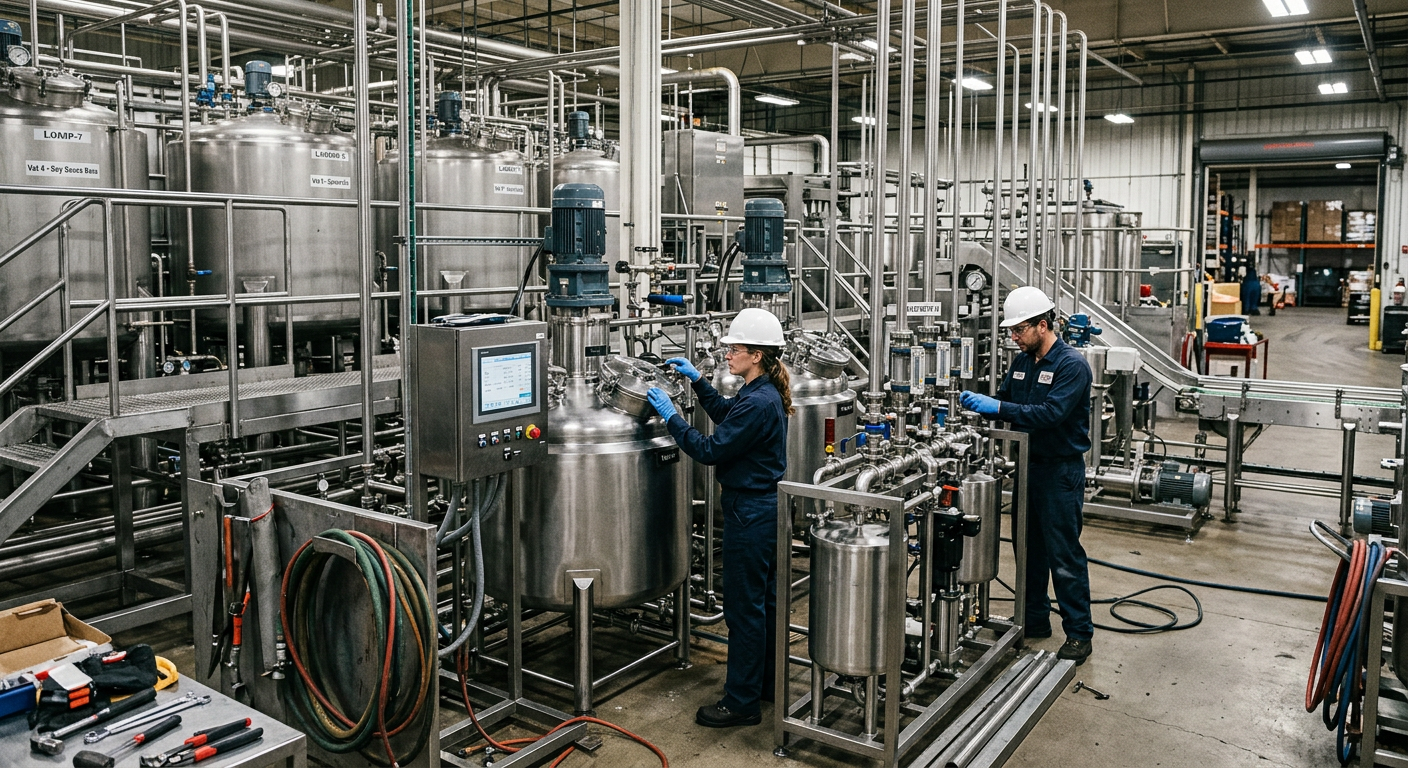
Automated CIP Systems for Manufacturers
[trp_language language=”en_US”]
Automated CIP Systems for U.S. Manufacturers
Clean-in-place automation has become a core investment for food, beverage, dairy, protein, aseptic, and co-packing plants across the United States. As labor gets tighter, audit requirements become more demanding, and throughput targets rise, manufacturers are moving away from manual wash routines toward PLC-controlled CIP systems that deliver repeatable cleaning, documented performance, and stronger food safety control. In markets such as Chicago, Dallas-Fort Worth, Fresno, Charlotte, Milwaukee, Houston, and the Los Angeles-Long Beach corridor, automated CIP is increasingly viewed not as a luxury, but as a plant utility essential to uptime and brand protection.
This guide explains how automated CIP compares with manual cleaning, how the control architecture works, what SCADA adds, how dosing and temperature loops are managed, what documentation is needed for FDA, USDA, SQF, and BRC expectations, and how manufacturers in the United States can plan an implementation that delivers measurable return.
Quick Answer

An automated CIP system is a skid or centralized cleaning system that uses recipes, valves, pumps, sensors, heat control, and PLC logic to clean tanks, pipelines, fillers, blenders, pasteurizers, and other process equipment without dismantling the line. Compared with manual CIP, automation reduces operator variability, improves chemical and water control, shortens cycle times, creates audit-ready records, and helps plants verify that every rinse, caustic wash, acid wash, sanitize step, and final flush happened within validated limits.
For most U.S. manufacturers, automated CIP is the better choice when they run multiple SKUs, need traceable cleaning records, have allergen changeovers, operate under FDA or USDA scrutiny, or want to scale production without scaling cleaning labor. Manual CIP can still fit very small plants with simple layouts and low production frequency, but as line complexity increases, the cost of inconsistency often exceeds the cost of automation.
Buyers should focus on five priorities: hygienic design, control reliability, recipe flexibility, data visibility, and serviceability. They should also evaluate whether the CIP will be single-use, recovery-based, or fully centralized, and whether it must support dairy, RTD beverage, brewing, protein, sauces, aseptic, or mixed-use production environments.
Manual vs. Automated CIP: Costs, Risks & Performance Compared

The most important buying decision is not simply the CIP skid price. It is the total cost of cleaning over years of operation. Manual CIP may appear less expensive at first, but U.S. plants often discover hidden costs in excess water use, over-dosed chemistry, longer downtime, line-to-line inconsistency, operator dependency, and incomplete documentation during customer or regulatory audits.
In high-throughput sectors such as dairy in Wisconsin, beverages in North Carolina, craft brewing in Colorado, protein processing in the Midwest, and co-packing near major freight hubs like Atlanta and Houston, every extra minute of cleaning can reduce saleable production. Automated CIP improves scheduling discipline and can help plants clean faster without compromising validation targets.
| Factor | Manual CIP | Automated CIP | Operational Risk | Typical U.S. Impact | Best Fit |
|---|---|---|---|---|---|
| Labor requirement | High operator involvement | Low to moderate supervision | Missed steps during shift changes | Higher labor cost per wash | Very small plants only |
| Recipe consistency | Varies by operator | Repeatable by programmed sequence | Under-cleaning or over-cleaning | More deviations and rework | Automation preferred |
| Chemical usage | Often estimated or manually adjusted | Metered and feedback-controlled | Excess cost or weak concentration | Higher chemical spend | Automation preferred |
| Water consumption | Frequently excessive | Timed and conductivity-based recovery | Utility waste | Higher sewer and water bills | Automation preferred |
| Cycle documentation | Paper logs or limited records | Automatic digital history | Audit gaps | Compliance vulnerability | Automation preferred |
| Downtime | Longer and less predictable | Shorter and standardized | Production losses | Lower OEE | Automation preferred |
| Scalability | Poor beyond a few circuits | Strong across multi-line plants | Bottlenecks during expansion | Capex duplicated later | Automation preferred |
The table shows why many manufacturers move to automation once they add more tanks, a second shift, allergen changeovers, or customer-driven traceability demands. In practice, the biggest risk in manual CIP is not only labor cost. It is inconsistency. A single failed rinse verification or undocumented wash can trigger product holds, delayed shipments, and customer concern.
The growth trend above reflects current market direction: more plants are investing in automated CIP as part of broader digital modernization, especially where they are already upgrading batching, pasteurization, packaging, or utility systems.
PLC-Based Control Architecture for CIP Automation

The heart of an automated CIP system is the control architecture. At minimum, the architecture includes a PLC, HMI, field instrumentation, valve manifolds, pump controls, and recipe logic that sequences each cleaning step. Better systems also include conductivity feedback, tank level verification, temperature control loops, pressure interlocks, return confirmation, and communication to plant SCADA or MES platforms.
A well-designed control strategy should prevent dangerous or wasteful conditions such as chemical addition with no tank level, hot circulation without flow, routing errors to production lines, or a final rinse ending before conductivity reaches the validated threshold. This is where engineering matters. Plants should not view CIP programming as a basic utility script. It is a food safety and uptime tool.
Manufacturers looking for integrated controls often prefer partners that can combine process engineering with PLC and SCADA execution. This is especially important when CIP interacts with blending, fermentation, pasteurization, water treatment, or aseptic utilities. The controls team at DPS service capabilities is relevant here because the company supports process, electrical, and automation integration as part of broader capital project delivery rather than treating CIP as an isolated skid.
| Architecture Element | Primary Function | Why It Matters | Typical Signals | Failure if Missing | Recommended Practice |
|---|---|---|---|---|---|
| PLC | Executes cleaning sequence logic | Ensures repeatability | Digital and analog I/O | Uncontrolled manual operation | Use modular industrial PLC |
| HMI | Operator interface for recipes and status | Improves usability | Setpoints, alarms, states | Operator confusion | Role-based screens |
| Conductivity sensor | Distinguishes product, rinse water, and chemicals | Supports recovery and validation | mS/cm | Wasted chemistry and water | Calibrate routinely |
| Temperature transmitter | Verifies wash and sanitize temperatures | Critical to cleaning efficacy | 4-20 mA or digital | Cold washes, failed sanitation | Use hygienic RTD assemblies |
| Flow measurement | Confirms circuit turbulence and coverage | Prevents false completion | Flow rate | Dead legs remain dirty | Trend flow by recipe step |
| Automated valves | Route supply and return paths | Prevents cross-contamination | Open/closed feedback | Misrouting or mixing streams | Use proof-of-position valves |
| VFD pump control | Matches pump speed to circuit demand | Protects pressure and improves energy use | Speed, amps, status | Poor coverage or pump stress | Include pressure interlocks |
The strongest CIP architectures also support future expansion. A plant that starts with two process circuits may need six within three years. If the PLC code, I/O capacity, valve matrix, and SCADA naming standards are planned well, expansion can happen with less downtime and lower engineering cost.
From a technology standpoint, DPS brings useful depth because its teams work across controls, SCADA, utilities, and process equipment, not just standalone skids. That matters in projects where the CIP must communicate with bright tanks, syrup rooms, dairy processing trains, retorts, or custom tank farms. Details on the company background are available on the about DPS page.
SCADA Integration: Real-Time Monitoring & Remote Diagnostics
SCADA integration elevates CIP from an automated machine to a plant-wide management system. With SCADA, supervisors can see active circuits, recipe steps, alarm status, conductivity trends, tank levels, chemical strengths, return temperatures, and completed cycle history from a central workstation. In multi-line plants, this is often the difference between reactive sanitation and controlled sanitation.
Remote diagnostics also matter. Plants in remote locations or multi-site organizations often need support without waiting for a site visit. A secure remote access structure allows authorized technicians to troubleshoot alarm sequences, verify I/O behavior, review trend logs, and tune recipes faster. For facilities shipping through Savannah, New Jersey, or the Port of Houston where schedule delays are costly, fast diagnostics can protect production commitments.
| SCADA Feature | Plant Benefit | User Role | Food Safety Value | Downtime Impact | Priority Level |
|---|---|---|---|---|---|
| Live process overview | Immediate visibility into active CIP circuits | Supervisor | Confirms sequence integrity | Reduces troubleshooting time | High |
| Historical trends | Shows temperature, flow, and conductivity over time | QA and engineering | Supports validation review | Faster root cause analysis | High |
| Recipe management | Controls approved cleaning programs | Process engineer | Prevents unauthorized changes | Improves consistency | High |
| Remote diagnostics | Allows secure support access | Controls integrator | Faster deviation resolution | Shortens outage duration | Medium to high |
| User permissions | Restricts edits by role | IT and QA | Protects data integrity | Avoids accidental changes | High |
| Automated reports | Exports cycle summaries for audits | QA and management | Creates documented evidence | Saves admin time | High |
| Alarm analytics | Tracks recurring failures | Maintenance | Helps prevent repeated deviations | Improves reliability | Medium |
SCADA is especially valuable for co-packers and multi-product facilities that must prove cleaning between brands, formulations, or allergen classes. It creates a common operational language between QA, maintenance, production, and management.
The chart highlights where demand is strongest. Dairy and beverage lead because they combine frequent CIP cycles, stringent quality needs, and high line utilization. Aseptic and protein are also rising due to sanitation risk and documentation pressure.
Automated Chemical Dosing, Temperature & Flow Control
Cleaning effectiveness depends on the classic four variables of time, temperature, chemistry, and mechanical action. Automated CIP improves all four by controlling chemical concentration, solution temperature, circulation flow, and programmed contact time within each recipe step.
For example, conductivity-guided dosing can maintain caustic strength within target range while minimizing waste. Steam or hot water control can hold wash temperatures steady despite changing tank demand. VFD-driven pumps can maintain enough velocity for pipeline scouring without overpressurizing delicate circuits. In allergen-sensitive or viscous product applications, such as dressings, dairy beverages, sauces, or protein slurries, these controls are crucial.
| Control Variable | Typical Instrument | Operational Goal | Common Setpoint Concern | Risk if Uncontrolled | Optimization Opportunity |
|---|---|---|---|---|---|
| Chemical concentration | Conductivity sensor or dosing meter | Maintain correct wash strength | Drift from dilution water changes | Weak cleaning or chemical waste | Automatic titration checks |
| Temperature | RTD with control valve or heat exchanger | Hold validated wash temperature | Heat loss in long circuits | Reduced soil removal | Insulation and staged heating |
| Flow rate | Mag meter or pump feedback | Achieve turbulent cleaning | Low flow in branched lines | Residual product buildup | Recipe-specific pump speeds |
| Pressure | Pressure transmitter | Protect equipment and spray devices | Valve closure spikes | Seal damage or leaks | Ramp VFD transitions |
| Time | PLC recipe timer | Meet exposure duration | Premature step advance | Incomplete cleaning | Conditional step hold logic |
| Return clarity | Turbidity or conductivity logic | Confirm rinse endpoint | Hidden product carryover | False completion | Endpoint analytics |
| Tank level | Level transmitter | Protect pumps and dosing | Foam interference | Cavitation and dosing errors | Dual-signal verification |
These control loops are also central to sustainability goals. Plants in water-stressed areas such as California’s Central Valley often pursue CIP optimization to reduce rinse water use. Plants with high natural gas costs focus on heat recovery and insulated recirculation. By 2026, more U.S. projects are expected to include conductivity-based phase separation, heat recovery integration, utility dashboards, and ESG-oriented reporting on chemical and water intensity per cleaned circuit.
Data Logging & Audit-Ready Documentation for Every Cycle
If a plant cannot prove a cycle happened as intended, it may as well not have happened from an audit perspective. Automated CIP creates documented evidence: recipe name, operator, line or circuit ID, step sequence, actual temperatures, concentration values, flow confirmations, alarms, hold times, start and stop stamps, and exceptions.
This data is valuable for more than compliance. It supports continuous improvement. Engineers can compare cycle lengths by line, identify recurring rinse delays, spot temperature lag, and reduce utility waste. QA can verify that an allergen changeover met validated criteria. Management can calculate true sanitation cost per run.
For manufacturers serving major retailers or contract customers, digital records improve customer confidence. This is especially true for plants running private-label products or regulated categories. Partners with real integration experience can connect CIP records to broader plant reporting, which is one reason many manufacturers review custom process equipment and CIP equipment options alongside software architecture at the same time.
| Logged Data Point | Why It Should Be Captured | Typical Source | Used By | Audit Value | Improvement Use |
|---|---|---|---|---|---|
| Recipe ID | Confirms approved cycle was used | PLC/SCADA | QA | High | Compare cycle performance |
| Circuit or asset ID | Shows what equipment was cleaned | Valve matrix logic | Operations | High | Scheduling and traceability |
| Start and end time | Documents duration and release readiness | System clock | Production planning | Medium | Downtime analysis |
| Temperature profile | Verifies thermal conditions | RTD trend | QA and engineering | High | Heat loss analysis |
| Conductivity profile | Verifies chemical and rinse behavior | Conductivity sensor | Sanitation team | High | Chemical savings |
| Alarm events | Documents deviations and responses | SCADA historian | Maintenance | High | Reliability tracking |
| User actions | Tracks acknowledgments and edits | User management logs | QA and IT | High | Training and governance |
Plants that still use paper logs often underestimate the time required to review, file, retrieve, and defend those records. Automated documentation reduces administrative friction and makes internal investigations much faster.
The trend shift is clear: digital records are becoming standard, not optional, particularly in multi-site, audit-heavy, or export-oriented operations.
Alarm Management & Deviation Handling for Food Safety
Food safety is not improved just because a CIP is automated. It is improved when the system detects abnormal conditions quickly, responds logically, and creates documented deviation handling. Effective alarm management should separate critical events from nuisance alerts. Operators should know whether they can acknowledge and continue, whether the sequence is on hold pending correction, or whether the cycle is invalid and must restart.
Examples of critical alarms include low wash temperature, conductivity below target, no return flow, incorrect valve proof, failed tank level, or unauthorized recipe changes. In a food plant, each alarm should be tied to a response procedure and release decision. This is particularly important in ready-to-drink beverage plants, dairy facilities, USDA-inspected protein sites, and aseptic operations.
Alarm rationalization is also a design discipline. Too many alarms create fatigue. Too few create blind spots. A strong engineering partner will define alarm priority, delay, action, escalation path, and data retention before commissioning.
| Alarm Type | Typical Cause | Immediate System Action | Operator Response | QA Decision Impact | Priority |
|---|---|---|---|---|---|
| Low temperature | Steam issue or poor heat transfer | Hold step or abort cycle | Check heat source and sensors | May invalidate wash | Critical |
| Low conductivity | Weak chemical concentration | Pause and re-dose | Verify dosing system | Review wash effectiveness | Critical |
| No flow detected | Pump failure or blocked line | Stop pump and hold sequence | Inspect circuit path | Likely invalid cycle | Critical |
| Valve proof failure | Actuator fault or feedback mismatch | Prevent step advance | Correct routing issue | Protects against cross-contamination | Critical |
| Tank low level | Supply shortage or sensor issue | Stop dosing and pump | Restore level | Review partial cycle | High |
| Communication loss | Network interruption | Fail to safe state | Call controls support | Verify data continuity | High |
| User unauthorized edit | Permission breach attempt | Reject command and log event | Escalate to supervision | Protects record integrity | Medium to high |
Well-managed deviation handling protects product release decisions. It also lowers the chance that sanitation staff will improvise around alarms, which is one of the most common hidden risks in older systems.
Implementation Roadmap: From Design to Commissioning
Successful CIP automation projects follow a structured path. The process usually begins with a front-end assessment of products, soils, circuits, utilities, sanitation frequency, recovery goals, and compliance needs. From there, the team defines skid or central system architecture, validates line matrix logic, sizes tanks and pumps, selects instrumentation, builds control narratives, develops software, installs hardware, and executes FAT, SAT, and commissioning.
In the United States, permitting, utility integration, and plant shutdown planning can heavily influence timing. A greenfield beverage facility near Charlotte or Phoenix may emphasize utility master planning and future capacity. A brownfield dairy expansion in Wisconsin or New York may prioritize tight tie-in windows and legacy system integration.
This is where a design-build-manage approach adds value. Instead of splitting design, procurement, installation, and controls among disconnected parties, some manufacturers choose a partner that can engineer the process, manage trades, install equipment, and commission the system under one execution model. That integrated style aligns with how DPS approaches capital work across North America, combining process design, equipment integration, and field execution. Readers can review relevant project case examples to see how integrated delivery supports uptime-focused results.
| Project Phase | Main Activities | Key Deliverables | Common Risk | How to Reduce Risk | Typical Duration |
|---|---|---|---|---|---|
| Assessment | Survey circuits, soils, utilities, and goals | Basis of design | Incomplete line mapping | Field verification walkdowns | 2-4 weeks |
| Concept design | Select skid type, tank strategy, and automation scope | PFDs, budget, control narrative | Under-scoped expansion needs | Plan for future circuits | 2-6 weeks |
| Detailed engineering | Mechanical, electrical, controls design | P&IDs, I/O lists, layouts | Utility conflicts | Cross-discipline reviews | 4-10 weeks |
| Fabrication and procurement | Build skid and purchase components | Factory-built equipment | Long lead items | Early PO strategy | 8-16 weeks |
| Installation | Set equipment, piping, wiring, integration | Installed system | Production disruption | Shutdown planning | 2-8 weeks |
| FAT/SAT and commissioning | Test logic, instruments, recipes, alarms | Approved startup package | Unverified sequences | Scenario-based testing | 1-3 weeks |
| Training and optimization | Operator training and recipe tuning | SOPs and final settings | Poor adoption | Hands-on training and review | Ongoing first 30-90 days |
Buying advice for U.S. manufacturers is straightforward: do not buy a CIP solely by tank volume. Buy it based on circuits, soil load, recoverability, validation needs, utility profile, future expansion, and your plant’s ability to support automation.
Also evaluate local support. Plants in the Midwest, Southeast, Texas, and California often prefer integrators and fabricators that can mobilize regionally for startup and service. Nearby support can shorten response times during commissioning and early operation.
ROI: Labor Savings, Error Reduction & Compliance Value
Return on investment comes from more than labor reduction. The best CIP projects deliver value through shorter downtime, lower chemical use, lower water and wastewater cost, less re-cleaning, fewer deviations, stronger product release confidence, and cleaner audit performance. In co-packing, better CIP can also create commercial value by enabling more frequent changeovers and reducing customer concerns around sanitation records.
For a medium-size U.S. beverage or dairy plant, the payback period often falls between 12 and 36 months depending on production volume, baseline labor, utility costs, and the number of circuits cleaned per day. Brownfield retrofits may take a little longer if piping modifications are extensive, but even there, compliance and risk reduction can justify the investment.
| ROI Driver | Manual Baseline | Automated CIP Outcome | Annual Financial Effect | Operational Effect | Strategic Value |
|---|---|---|---|---|---|
| Sanitation labor | More hours per cycle | Fewer manual interventions | Moderate to high savings | Better labor allocation | Supports scaling |
| Chemical consumption | Over-dosed or inconsistent | Measured and optimized | Moderate savings | Stable wash quality | Supports sustainability |
| Water usage | Long rinses and waste | Endpoint-driven rinsing | Moderate savings | Lower utility load | Good for ESG reporting |
| Downtime | Long and variable cleaning windows | Predictable cycle times | High value through more production | Improved scheduling | Increases capacity |
| Deviations and re-cleans | More common | Reduced through control logic | Moderate savings | Less disruption | Protects brand |
| Audit preparation | Manual records and reviews | Instant digital documentation | Soft but meaningful savings | Less admin burden | Stronger compliance posture |
| Expansion readiness | Difficult to scale | Recipes and circuits can be extended | Long-term value | Supports growth | Avoids duplicate future capex |
The comparison chart shows what buyers should prioritize when evaluating suppliers or integrators. Price matters, but process integration depth and controls competency usually matter more over the life of the system.
From a manufacturing capability standpoint, DPS is notable because it does not only advise on CIP systems; it also designs and manufactures selected process equipment, including custom CIP skids and related stainless process assets. That combination can help when a project requires tight alignment between plant layout, utility constraints, and fabricated equipment details.
For service capability, the company’s strength is its end-to-end model: engineering, capital planning, owner’s representation, installation coordination, controls integration, startup, and commissioning. For clients seeking one accountable partner rather than fragmented scopes, that approach can reduce handoff risk and speed decision-making.
FAQ
What industries benefit most from automated CIP in the United States?
Dairy, beverage, brewing, distilling, prepared foods, sauces, protein, aseptic processing, and co-packing operations benefit the most. Any industry with repeat cleaning cycles, product changeovers, allergen management, or audit pressure is a strong candidate.
What product types are typically cleaned by automated CIP?
Storage tanks, mix tanks, bright tanks, fermenters, pipelines, fillers, HTST systems, UHT skids, homogenizers, blenders, scraped surface heat exchangers, retort support systems, and transfer manifolds are common applications.
Should I choose a single-use or recovery CIP system?
Single-use CIP is simpler and often fits smaller plants or highly variable soils. Recovery CIP is better when chemical reuse, water savings, and higher cleaning frequency justify the added complexity.
How much plant space is required?
That depends on tank count, chemical strategy, utility access, and the number of circuits. Compact skid-mounted systems fit smaller plants, while centralized systems need more room but can support many production areas efficiently.
Can automated CIP be retrofitted into an existing facility?
Yes. Brownfield retrofits are common in U.S. plants. The key challenges are tie-in planning, valve matrix logic, legacy controls integration, and minimizing shutdown time during installation.
What local supplier factors matter most?
Regional field support, hygienic fabrication quality, controls capability, startup availability, spare parts strategy, and familiarity with local inspectors and utility constraints matter more than low upfront price.
How does automated CIP support compliance?
It creates standardized, traceable cleaning records and reduces operator variability. That helps during FDA, USDA, SQF, and BRC reviews and supports stronger internal verification programs.
What should be validated before startup?
Recipe logic, valve routing, sensor calibration, conductivity thresholds, temperature hold performance, alarm handling, user permissions, and report generation should all be tested before release.
What 2026 trends should buyers plan for now?
Plan for digital records by default, stronger cybersecurity for remote access, greater sustainability reporting, improved heat and chemical recovery, modular skid expansion, and more integration between CIP, SCADA, MES, and enterprise analytics.
How do I know if my plant is ready?
If cleaning delays production, records are hard to retrieve, chemical use is inconsistent, sanitation depends heavily on operator judgment, or expansion is planned, the plant is likely ready for automated CIP evaluation.
For U.S. manufacturers seeking a practical path forward, the best next step is a CIP assessment tied to plant throughput, risk profile, and future growth plans. A well-engineered solution should not just clean equipment. It should improve profitability, release confidence, and long-term manufacturing flexibility.
[/trp_language]
Complete Company Portfolio

About the Author: Disruptive Process Solutions (DPS)
The DPS team combines process engineering expertise with real-world food and beverage manufacturing experience. Our content focuses on process optimization, production efficiency, facility improvements, and practical solutions that help manufacturers operate more effectively in a rapidly evolving industry.
Share

