Beverage Batch Control System
[trp_language language=”en_US”]
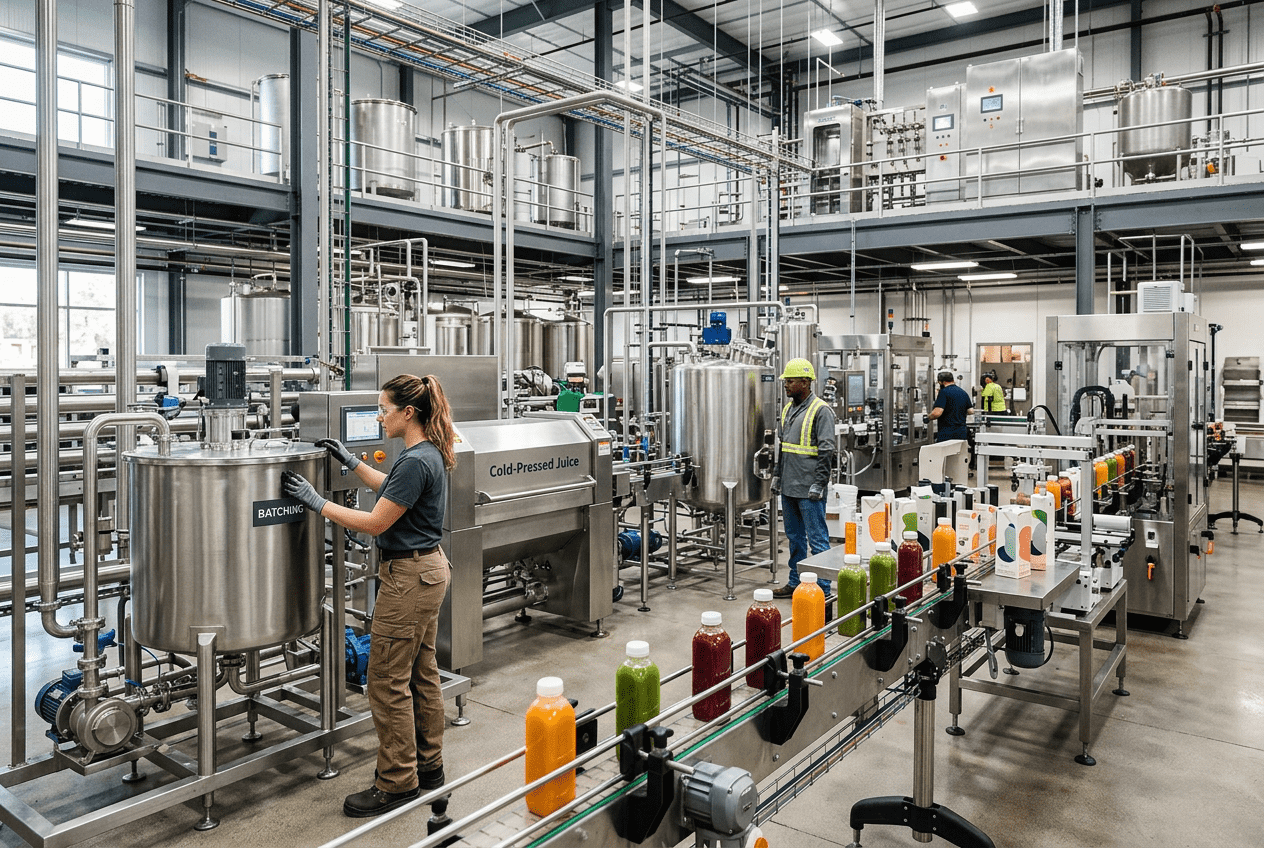
For beverage manufacturers in the United States, a modern beverage batch control system is the digital and operational backbone that connects syrup preparation, recipe execution, tank scheduling, inline quality checks, clean-in-place validation, and end-to-end lot traceability. In practice, it helps plants produce the right drink, in the right sequence, at the right specification, with less giveaway and fewer changeover errors. Whether a facility is producing carbonated soft drinks near Atlanta, functional beverages in Southern California, kombucha in the Pacific Northwest, or spirits-based RTDs around Dallas and Houston, the value of recipe-driven batching comes from consistency, speed, and control.
The U.S. market is particularly demanding because manufacturers must manage SKU proliferation, co-packing contracts, regional flavor variation, retailer compliance, and strict food safety expectations. Plants near large logistics corridors such as Chicago, the Port of Los Angeles, Long Beach, Savannah, Newark, and Houston often need to change products rapidly while still protecting quality and throughput. That is where integrated automation, engineered process design, and disciplined project execution matter most.
For companies evaluating a new system, the buying decision should not focus only on software screens. The better question is whether the system can support the full production reality: raw material receiving, syrup rooms, blending skids, fermentation where applicable, tank farms, utilities, CIP, transfer routing, packaging demand, and operator workflows. The strongest projects combine controls, process engineering, utility integration, and plant-specific operating logic. That is also why many manufacturers look for a partner that can align engineering, installation, and execution rather than handing off responsibilities across multiple disconnected vendors. About the team behind DPS gives a useful overview of this integrated approach, while their broader service capabilities show how engineering, controls, and execution can be tied together from concept through startup.
Quick Answer

A beverage batch control system is an automation platform that manages formulas, ingredient dosing, tank usage, process sequencing, quality checks, cleaning validation, and production records across beverage operations. In the United States, it is commonly used in soft drink plants, breweries, distilleries, juice facilities, dairy beverage operations, and co-packing sites to reduce manual error, improve consistency, shorten changeovers, and support traceability.
In direct terms, the system should answer five core plant questions at all times:
- What product is being made, and to which approved recipe revision?
- Which lots of sugar, concentrate, flavor, color, acid, water, or alcohol went into the batch?
- What tank is available, clean, and ready for use?
- Did the batch meet Brix, pH, temperature, hold time, and other critical limits?
- Can the plant prove what happened during production if a customer, auditor, or regulator asks?
That direct answer is especially important for U.S. operators facing retailer scorecards, co-manufacturing service level agreements, FSMA-oriented documentation expectations, and rising labor costs. A well-designed control system is not just a convenience layer. It becomes a profit-protection tool.
| System Function | What It Controls | Main Plant Benefit | Typical U.S. Use Case |
|---|---|---|---|
| Recipe management | Approved formulas, setpoints, tolerances | Reduces formulation errors | Multi-SKU RTD and soft drink production |
| Automated dosing | Sugar, sweetener, flavor, color, acid, concentrate | Improves repeatability | High-volume syrup and blending rooms |
| Tank scheduling | Filling, holding, transfer, routing | Increases asset utilization | Co-packing and seasonal peaks |
| Inline quality verification | Brix, pH, conductivity, temperature | Catches deviations early | Juice, CSD, functional beverage plants |
| CIP management | Wash sequence, chemical strength, verification | Safer changeovers | Allergen and flavor-to-flavor transitions |
| Electronic records | Time stamps, operator actions, lot genealogy | Supports audits and recalls | National brand and private label supply |
The table above summarizes why batch automation has become a competitive requirement rather than a luxury. In markets with tight margins and demanding customers, each function contributes directly to throughput, compliance, and profit.
The growth trend reflects how beverage producers are moving toward deeper digital control as labor pressure, SKU complexity, and quality expectations increase. The strongest demand is coming from co-packers, multi-line beverage campuses, and manufacturers upgrading legacy PLC logic into coordinated batch platforms.
Beverage Batch Control: From Syrup Rooms to Finished Product Tanks

In a U.S. beverage plant, batch control usually starts in the syrup room and extends all the way to finished product storage or packaging feed tanks. This matters because the system boundary determines the business value. A narrow batching package that only controls one mix tank may look inexpensive, but it often leaves critical losses untouched: manual handoffs, tank conflicts, undocumented adjustments, and inconsistent startup procedures.
At the front end, syrup room control covers water preparation, sweetener handling, dry ingredient addition, dissolve steps, heating or cooling, filtration, and intermediate syrup storage. In carbonated soft drink and juice plants, this is where repeatability is won or lost. In functional beverage and nutraceutical lines, the need is even greater because micro-ingredients, heat-sensitive compounds, and viscosity shifts can create quality variation quickly.
From there, the system should coordinate transfers to blend tanks, bright tanks, hold tanks, or finished product tanks depending on product type. In fermented beverage operations, batch control may also bridge cellar operations, blending, proofing, dilution, and packaging staging. For dairy-based and aseptic beverages, the sequence may include homogenization, HTST or UHT integration, surge tank logic, and downstream filling readiness.
Well-engineered execution is not only about the software. It depends on instrumentation quality, valve matrix design, utility stability, and equipment compatibility. That is why many manufacturers in the United States prefer partners who understand the entire process architecture. DPS, for example, supports beverage operations with process, controls, mechanical, plumbing, electrical, and structural coordination rather than treating automation as a separate island. Their experience spans blending, carbonation, fermentation systems, filtration, pasteurization, aseptic processing, and utility infrastructure needed to make the batch system reliable in daily operation.
For plants planning expansion, this system-wide perspective becomes more important near major U.S. manufacturing and logistics zones. A facility outside Charlotte, Phoenix, Indianapolis, or Sacramento may have enough demand to justify additional tanks and utilities, but unless routing, sequencing, and CIP are integrated into the batch logic, the capacity gain often underperforms expectations.
| Production Area | Typical Assets | Key Control Need | Common Risk Without Integration |
|---|---|---|---|
| Water treatment | RO, UV, storage, pumps | Flow and quality readiness | Inconsistent feedwater quality |
| Syrup room | Mix tanks, dissolvers, ingredient skids | Sequence and dosing accuracy | Manual add-back and variability |
| Blend area | Batch tanks, inline blenders | Recipe execution and transfer control | Off-spec product and rework |
| Tank farm | Storage, bright, hold, fermentation tanks | Availability and routing logic | Tank conflicts and delays |
| Packaging feed | Surge tanks, fillers, carbonation skids | Rate matching and line demand | Starved or overfilled lines |
| CIP system | CIP skids, return tanks, chemical loops | Verified cleanliness status | Cross-contamination exposure |
This table shows why end-to-end scope matters. A batch control project limited to just one process node often cannot deliver the expected ROI because losses happen at the interfaces between process areas.
Recipe-Driven Blending: Automated Flavor, Color, and Concentrate Dosing

Recipe-driven blending allows a plant to execute approved formulas automatically, with each ingredient addition verified against target amounts, tolerances, sequencing rules, and production conditions. In beverage manufacturing, this is particularly valuable for flavor, color, acid, sweetener, and concentrate dosing because small deviations can create visible or tasteable defects.
In the U.S. market, recipe automation is not only for large carbonated soft drink operations. It is equally relevant in premium juice lines, energy drinks, botanical beverages, kombucha blends, spirits-based canned cocktails, dairy beverages, and private-label wellness products. As SKU counts rise, the burden on operators becomes too high for dependable manual management alone.
Advanced systems typically include:
- Version-controlled master recipes and local product variants
- Automated scaling for different batch sizes
- Mass- or flow-based dosing with correction logic
- Tolerance management with stop, hold, or supervisor-approval rules
- Material call-up from tanks, totes, drums, or day bins
- Electronic confirmation of lot usage and additions
For buyers, one practical question is whether the system handles both macro and micro ingredients well. Bulk sugar or treated water are easy compared with flavors, extracts, vitamins, colors, and actives that may require higher precision and special sequence rules. Another is whether it can support campaign production for high-volume SKUs while still allowing short runs for regional products and retail test launches.
This is also where equipment design and manufacturing capabilities matter. Companies that can supply tanks, custom CIP systems, and related process equipment in addition to integration often reduce fit-up risk. DPS manufactures select process equipment, including tanks and CIP systems, which can simplify alignment between mechanical design, automation requirements, and site execution when timing is tight.
| Ingredient Type | Typical Dosing Method | Control Priority | Why Automation Helps |
|---|---|---|---|
| Treated water | Flow meter or mass balance | Volume accuracy | Sets batch base correctly |
| Sugar or sweetener | Load cell or flow meter | Brix target | Reduces overuse and rework |
| Flavor | Metered pump or weigh vessel | Low-volume precision | Prevents sensory drift |
| Color | Micro-dosing skid | Visual consistency | Avoids shade variation |
| Acidulant | Metered addition | pH control | Protects taste and stability |
| Concentrate | Pump with verification | Formula compliance | Supports traceability |
| Alcohol base | Mass flow and proof logic | ABV target | Improves label compliance |
The key takeaway from this dosing table is that not all ingredients require the same automation strategy. A strong recipe-driven blending system matches the measuring method to the process risk and economic value of each ingredient.
The bar chart highlights where U.S. demand is strongest. Functional beverages and RTD alcohol continue to invest because product variation, labeling sensitivity, and rapid commercialization all increase the need for dependable recipe management.
Brix and pH Control: Inline Quality Verification During Batch Execution
Inline quality verification is one of the highest-value features in beverage batch automation because it detects problems while the batch can still be corrected. Brix and pH are especially important in many U.S. beverage categories because they affect flavor profile, regulatory labeling, microbiological stability, processability, and customer acceptance.
Instead of relying only on end-of-batch lab checks, advanced plants use inline instruments to compare actual process values with target setpoints during execution. That does not replace laboratory quality assurance, but it reduces the risk of producing a full off-spec batch before discovering the issue. For high-volume operations, avoiding one bad batch can justify much of the instrumentation investment.
Inline verification can support several actions:
- Automatic hold if Brix is outside tolerance
- Add-water or add-syrup correction prompts
- Acid adjustment workflows for pH control
- Trend alarms for drifting ingredient performance
- Release interlocks for transfer to finished product tanks
- Electronic record capture for audits and customer documentation
Plants producing refrigerated juices in Florida, shelf-stable teas in Texas, premium mixers in New Jersey, or dairy beverages in the Midwest all benefit from this approach. In each case, quality verification during execution reduces waste and prevents nonconforming product from advancing downstream.
| Quality Parameter | Common Sensor/Method | Why It Matters | Typical Control Response |
|---|---|---|---|
| Brix | Inline refractometer | Sweetness and concentration | Corrective dilution or syrup adjustment |
| pH | Inline pH probe | Taste and product stability | Acid/base correction or hold |
| Temperature | RTD or thermocouple | Ingredient dissolve and safety | Heat/cool loop adjustment |
| Conductivity | Conductivity meter | CIP verification and phase detection | Route or rinse decision |
| Flow | Mag meter or mass flow meter | Dosing accuracy and transfer control | Pump speed correction |
| Density/Proof | Density meter | Alcohol strength verification | Water or spirit adjustment |
This table demonstrates that quality verification is broader than Brix and pH alone. A mature beverage automation system uses multiple data points to validate process state and reduce downstream uncertainty.
The area chart reflects a clear industry shift: plants increasingly want quality data in motion, not just at the finish line. This becomes even more important heading into 2026 as digital quality records and tighter sustainability goals drive a push to reduce rework, water usage, and product disposal.
Tank Farm Management: Sequencing Fermentation, Storage, and Transfer
Tank farm management is where many beverage sites either unlock capacity or lose it. When multiple products, tank types, cleaning states, and packaging demands are competing at once, the control system must do more than simply open and close valves. It needs to manage sequencing logic, readiness conditions, and conflict avoidance across the entire storage and transfer network.
For non-fermented beverages, this includes intermediate syrup tanks, blend tanks, hold tanks, and finished product tanks. For breweries, kombucha plants, wine operations, and certain spirits applications, it also includes fermentation schedules, maturation windows, proofing, blending, and transfer priorities. The challenge is especially visible at co-packing facilities where one delayed packaging line can ripple backward through the tank farm.
U.S. producers located near major freight hubs such as Memphis, Kansas City, and central Pennsylvania often push hard for high asset utilization because inventory timing affects outbound logistics. A well-designed batch control system can help by assigning route permissions, checking tank availability, confirming CIP completion, and coordinating transfer windows around downstream demand.
This is an area where process engineering depth matters. DPS has worked across beverage categories including brewing, spirits, RTD, carbonated and non-carbonated beverages, aseptic operations, and fermented products. That multi-category exposure is useful because tank farm logic differs significantly between a CSD plant, a kombucha facility, and an RTD alcohol operation, even if all three use similar vessel hardware.
| Tank Type | Typical Purpose | Key Scheduling Rule | Main Risk if Poorly Managed |
|---|---|---|---|
| Raw water tank | Utility buffer | Maintain minimum reserve | Batch interruptions |
| Syrup tank | Intermediate holding | Match upstream and downstream timing | Stale hold or shortage |
| Blend tank | Final recipe completion | Release only after QC approval | Off-spec transfer |
| Fermenter | Active fermentation | Protect residence time window | Flavor inconsistency |
| Bright or finishing tank | Conditioning and packaging feed | Synchronize with line demand | Packaging downtime |
| Finished product tank | Staging before filling | Route by SKU and sanitation state | Cross-contamination |
The explanation is straightforward: tank farm control is less about vessel count and more about decision quality. The more SKUs and line interactions a plant has, the more value comes from software that understands sequence, state, and production priority.
CIP Integration: Cleaning Validation Between Product Changeovers
CIP integration is essential in beverage plants because changeovers are frequent and the cost of poor sanitation can be severe. A strong beverage batch control system should know whether a tank, line, or blend path is dirty, in wash, rinsed, verified, or ready for production. Without that status visibility, operators may rely too heavily on verbal communication and handwritten logs.
In practical U.S. operations, CIP integration does three important things. First, it prevents accidental routing to equipment that has not completed the required wash cycle. Second, it captures the evidence that cleaning was performed to the required time, temperature, conductivity, and chemical concentration. Third, it helps schedule cleaning around production priorities so the plant avoids unnecessary waiting.
This is particularly important for allergen transitions, flavor carryover risk, color-heavy products, dairy-based formulations, and alcoholic beverages where tax-sensitive inventory and strict brand quality standards both matter. Co-packers in the Southeast and West Coast, where customer portfolios can change daily, often see CIP validation as one of the most valuable features in automation modernization.
Custom CIP system design is also a factor. Tank count, line length, soil load, and product family determine whether a single-use or multi-tank CIP approach makes sense. Because DPS designs and supplies custom CIP systems alongside engineering and integration services, it can align cleaning hardware and controls from the beginning rather than trying to patch logic onto an unsuitable skid later.
Looking toward 2026, CIP systems in the United States are increasingly expected to support water and chemical optimization. Sustainability goals, local wastewater constraints, and utility cost inflation are pushing plants to validate cleanliness while using fewer resources.
Batch Size Flexibility: Managing SKU Proliferation in Beverage Plants
SKU proliferation is one of the biggest operational realities in beverage manufacturing today. Limited-time flavors, retailer-specific packaging, wellness line extensions, lower-sugar variants, and regional product tests all force producers to run more recipes in more batch sizes. A beverage batch control system must therefore scale recipes correctly, preserve tolerances, and protect process integrity whether the plant is making a large campaign batch or a short specialty run.
In the United States, this challenge is most visible in energy drinks, enhanced waters, functional beverages, canned cocktails, premium mixers, and private-label products. Plants that were designed for a handful of high-volume SKUs are now being asked to run dozens or even hundreds. Manual batching becomes increasingly risky as the product mix broadens.
Flexible batch control should include:
- Automatic recipe scaling with guardrails
- Minimum and maximum batch size logic by tank and agitator capability
- Ingredient addition sequence adjustment for small lots
- Line clearance checks between short campaigns
- Electronic approval for substitutions or temporary material changes
- Fast operator guidance to reduce setup time
This is also where buying advice becomes practical. If a manufacturer expects growth through co-packing, innovation, or regional retail expansion, it should avoid a system designed only for repetitive large-batch production. Instead, it should request demonstrations of recipe scaling, short-run execution, and changeover logic under real operating scenarios.
Manufacturers can also review equipment options for process systems when assessing whether tanks, CIP skids, and transfer infrastructure are compatible with a more flexible production model. Hardware and software flexibility must develop together.
Lot Tracking and Traceability for Beverage Formulations
Lot tracking and traceability are non-negotiable in modern beverage operations. Every formulation should have a digital genealogy showing which raw material lots were used, in what quantities, by which route, into which batch, and then into which finished product tanks or packaging runs. This is vital for quality investigations, customer complaints, recalls, internal audits, and regulatory readiness.
In U.S. beverage manufacturing, traceability pressure comes from multiple directions: national retailers, co-manufacturing clients, food safety programs, insurer expectations, and internal brand protection. The more ingredients a product contains, the greater the value of automated lot capture. Functional beverages, dairy drinks, alcoholic RTDs, and premium juice blends often carry especially high traceability complexity.
A strong traceability model should connect:
- Supplier lot receipt and storage location
- Material release and quality status
- Actual ingredient usage by batch
- Transfer history between tanks
- CIP state before product contact
- Final packaged lot mapping
For larger projects, this capability should align with plant-level SCADA, ERP, or MES strategy rather than operate as an isolated records module. The best results come when controls design, process flow, and data architecture are planned together.
DPS approaches projects from that broader business perspective. Instead of focusing narrowly on equipment alone, the company is known for tying process engineering, automation, and project management back to client profitability. That mindset is relevant in traceability projects because the objective is not merely generating records; it is reducing business risk while keeping operations efficient. Manufacturers interested in delivery examples can explore project case studies to see how integrated execution supports real production outcomes.
The comparison chart illustrates a common buying reality in the United States: manufacturers often get stronger outcomes when controls, process engineering, utilities, equipment fit, and startup support are coordinated through one integrated execution model rather than split among disconnected parties.
ROI: Reduced Giveaway, Fewer Batch Failures, and Faster Changeovers
The financial case for beverage batch automation usually comes from a combination of small repeated savings and avoided major losses. Reduced ingredient giveaway, fewer off-spec batches, lower manual labor dependence, faster changeovers, better tank utilization, and stronger traceability each contribute to ROI. In many U.S. plants, the payback case is strongest when management quantifies current losses honestly rather than estimating only labor savings.
Typical ROI categories include:
- Lower sugar, flavor, color, and concentrate overuse
- Fewer full-batch quality failures
- Shorter startup and changeover time
- Reduced hold time waiting for tank status confirmation
- Less rework and less wastewater from dumped product
- Improved customer retention through better consistency
For plants in high-cost labor markets such as California, the Northeast, and major metro areas, automation labor leverage is meaningful. For plants in high-throughput hubs such as Texas, the Midwest, and the Southeast, throughput and asset utilization may dominate the business case. The point is that ROI should be modeled by product family, operating pattern, and plant constraints.
| ROI Lever | Current Loss Example | Automation Impact | Typical Benefit Range |
|---|---|---|---|
| Ingredient giveaway | Overdosing flavor or syrup | Tighter setpoint control | 1% to 3% reduction |
| Batch failure | Off-spec Brix or pH | Inline detection and correction | Lower scrap and rework |
| Changeover time | Slow sanitation and setup | CIP status and sequencing | 10% to 25% faster |
| Tank utilization | Idle vessels due to poor routing | Smarter scheduling | Higher effective capacity |
| Labor efficiency | Manual checks and paperwork | Electronic records and guidance | Reduced supervision burden |
| Recall response | Slow manual lot investigation | Faster digital traceability | Lower business risk |
The table shows that ROI is rarely one-dimensional. Management teams should build a multi-line business case that includes both recurring efficiency gains and risk avoidance.
When selecting a partner, it is wise to ask how the project will be engineered, built, and managed on site. Technical capabilities should include controls programming, SCADA, process engineering, utility integration, and instrumentation strategy. Manufacturing capabilities should cover tanks, CIP systems, and custom process hardware where needed. Service capabilities should include feasibility support, capital planning, owner-side guidance, project management, installation coordination, commissioning, and startup optimization. DPS is notable in the U.S. market for combining those capabilities under a Design-Build-Manage approach intended to protect project economics, not just complete scope.
That service model matters because many automation projects fail to deliver full ROI not from poor software, but from weak execution discipline. Missing valves, inadequate utility capacity, poorly placed instruments, operator confusion, and startup gaps can undermine an otherwise capable system. A business-minded execution partner can materially improve the outcome.
FAQ
What types of beverage plants benefit most from batch control systems?
Soft drink plants, juice processors, breweries, distilleries, kombucha facilities, dairy beverage manufacturers, aseptic beverage plants, and co-packers all benefit. The highest value usually appears where recipe complexity, changeovers, or traceability demands are high.
Can a batch control system work for both large runs and short seasonal SKUs?
Yes, if the platform supports recipe scaling, batch-size guardrails, and flexible routing. This is critical for U.S. plants serving private label, club stores, regional retail chains, and innovation pipelines.
How important is inline Brix and pH monitoring?
Very important. It allows the plant to catch deviations during execution instead of after the batch is complete. That reduces giveaway, scrap, and production delay.
Does tank farm management matter if the plant is relatively small?
Yes. Even smaller facilities lose efficiency when operators do not have clear visibility of tank status, route availability, and cleaning state. The smaller the staff, the more valuable clean scheduling logic can be.
What should buyers in the United States ask suppliers before purchasing?
Ask about recipe version control, lot traceability, CIP verification, integration with existing PLCs and SCADA, operator usability, tank routing logic, startup support, and how the supplier handles utilities and mechanical interfaces. Also ask for examples from similar beverage categories and plant sizes.
Should beverage companies choose a standalone controls vendor or an integrated engineering partner?
It depends on in-house capability, but many manufacturers benefit from an integrated partner when the project affects process, utilities, equipment layout, and sanitation strategy. That approach reduces coordination gaps.
How does this relate to 2026 industry trends?
By 2026, leading U.S. projects are expected to emphasize deeper digital records, stronger sustainability performance, water and chemical reduction in CIP, more flexible production for SKU growth, and tighter integration between quality data and real-time process decisions.
How long does implementation usually take?
Project length varies by scope. A limited upgrade may take a few months, while a new syrup room and tank farm integration can take much longer. The timeline depends on engineering readiness, procurement, site conditions, and commissioning complexity.
Can existing equipment be reused?
Often yes. Many U.S. plants modernize controls while retaining usable tanks, pumps, and piping. However, instrumentation, valves, utility capacity, and CIP design may still need upgrades to deliver reliable automation results.
What is the biggest mistake buyers make?
Under-scoping the project. If the system controls only part of the process and ignores tank routing, CIP, utilities, or traceability, the plant may not realize the expected throughput or quality improvements.
In summary, a beverage batch control system should be viewed as a production management framework rather than just a controls package. For U.S. manufacturers dealing with tighter margins, more demanding customers, and greater SKU complexity, the winning solution is the one that connects recipes, quality, tanks, cleaning, records, and plant execution into one dependable operating model.
[/trp_language]
Complete Company Portfolio
About the Author: Disruptive Process Solutions (DPS)
The DPS team combines process engineering expertise with real-world food and beverage manufacturing experience. Our content focuses on process optimization, production efficiency, facility improvements, and practical solutions that help manufacturers operate more effectively in a rapidly evolving industry.
Share