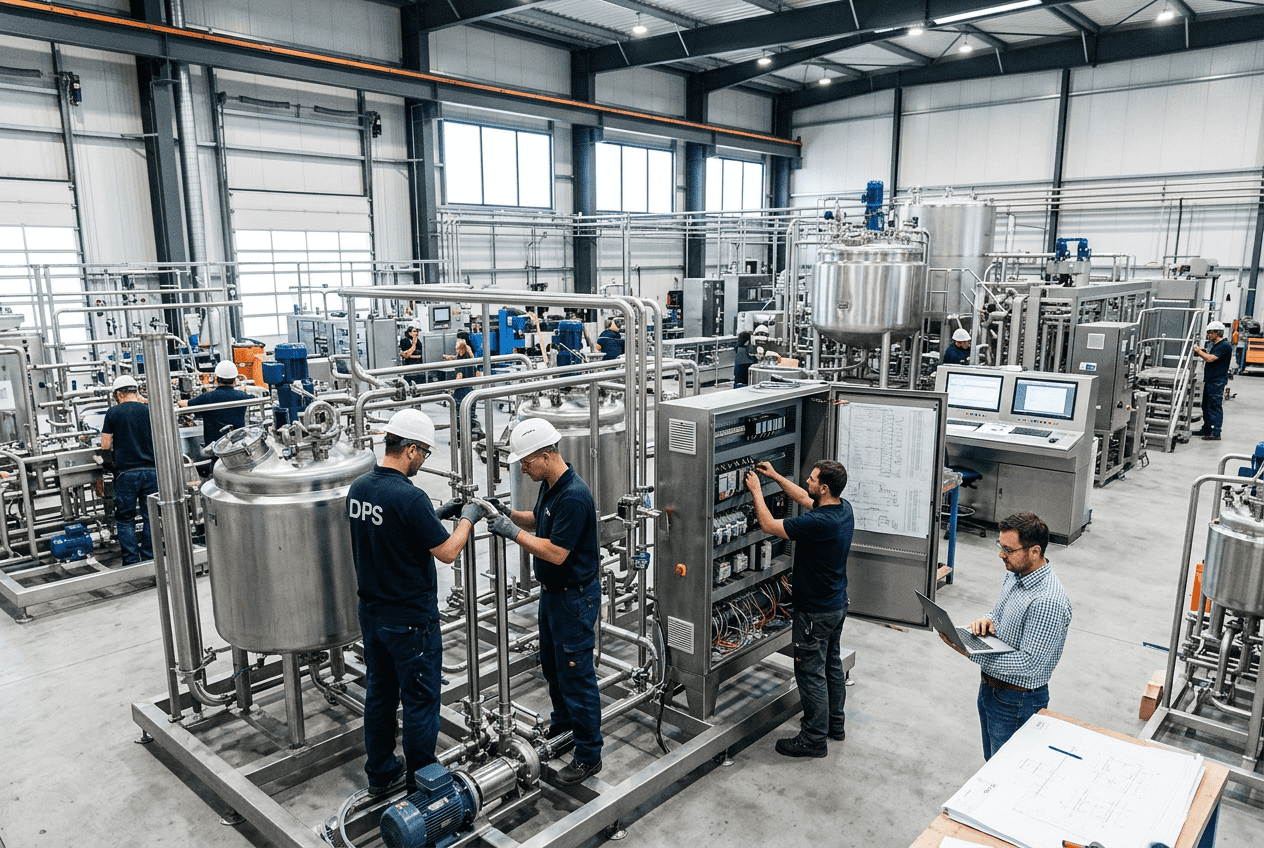
Beverage Co-Packing Facility Design: A Complete Engineering Guide
[trp_language language=”en_US”]
A beverage co-packing facility is a purpose-built manufacturing plant that produces, fills, packages, stores, and ships drinks for multiple brands under one operational roof. In the United States, the best facilities are engineered for flexible packaging, fast changeovers, strong food safety controls, utility reliability, and a capital plan that supports profitable growth from launch volumes to national distribution.
That definition sounds simple, but the engineering is not. A modern U.S. co-packer may run sparkling water for one customer in the morning, energy drinks in slim cans by midday, cold-fill juice in PET bottles after sanitation, and an alcoholic ready-to-drink product under TTB oversight later in the week. Because of that operating reality, facility design must balance throughput, sanitation, utility capacity, warehouse flow, labor efficiency, customer confidentiality, and future expansion from day one.
Across markets such as Chicago, Dallas-Fort Worth, Los Angeles, Atlanta, Charlotte, New Jersey, and the I-4 corridor in Florida, co-packers are also responding to retailer demand for shorter lead times, omnichannel packaging, and temperature-sensitive distribution. Sites near Port Newark, the Port of Los Angeles, Savannah, Houston, and rail-served inland hubs can gain major freight advantages, but only if the plant layout supports raw material receiving, quarantine, production sequencing, palletizing, and outbound truck circulation efficiently.
Quick Answer

For U.S. owners, investors, and beverage brands, the fastest way to understand beverage co-packing plant design is to view it as a coordinated system of process rooms, packaging halls, utility centers, cold storage, QA controls, and regulated material flows. The plant must safely handle ingredients, water treatment, blending, carbonation if required, filling, closure, coding, secondary packaging, warehousing, and shipping while supporting multiple clients with different SKUs and production standards.
Facilities that succeed usually share six traits: strategic site access to interstate freight routes and labor, scalable utilities, room for multiple package formats, disciplined sanitation zoning, strong quality systems, and a realistic capital roadmap. In practice, those traits influence nearly every engineering decision, from floor drains to compressed air redundancy.
| Design Priority | Why It Matters | Typical U.S. Requirement | Operational Benefit |
|---|---|---|---|
| Flexible line layout | Multiple customers require different SKUs and speeds | Can, bottle, and pack-out changeover capability | Higher line utilization |
| Utility redundancy | Downtime is costly in co-packing contracts | N+1 compressors, backup pumps, spare boiler capacity | Better service reliability |
| Cold storage planning | Many products need chilled staging or finished goods hold | 40°F cooler zones and insulated docks | Quality protection |
| Food safety zoning | Different sanitation risk profiles exist across operations | Controlled personnel and material flows | Lower contamination risk |
| Packaging flexibility | Retailers and brands want varied formats | Quick-change guides, conveyors, depalletizers, labelers | Broader customer base |
| Compliance framework | Federal and state rules vary by product class | FDA registration, TTB permits, state licensing | Faster commercial launch |
The table above shows why engineering cannot be separated from the business model. A co-packer is not just building a plant; it is building a service platform. For that reason, many owners bring in experienced partners early for feasibility, utility studies, process design, and phased capital planning rather than waiting until equipment procurement is already dictating the layout.
What Is a Beverage Co-Packing Facility? Key Design Objectives for Multi-Client Operations

A beverage co-packing facility is a contract manufacturing operation that makes and packages drinks for third-party brands. The product mix can include carbonated soft drinks, flavored waters, juices, teas, dairy beverages, functional drinks, kombucha, sports beverages, cocktail mixers, RTD alcoholic beverages, and other specialty liquids. Unlike a single-brand plant, a co-packer must serve a portfolio of customer requirements, which raises the design bar substantially.
The main objective is controlled flexibility. The plant has to run diverse formulations without sacrificing safety, throughput, cost, or consistency. That means designing receiving areas for ingredients and packaging components, batch and blend spaces with smart recipe control, process piping that supports cleanability, filling lines sized to forecast demand, and warehouse areas that can separate customer-specific inventories. It also means designing offices, sample retains, and digital systems around traceability and rapid reporting.
In the United States, market demand continues to favor regional co-packers that can shorten freight lanes and offer specialized capability. West Coast beverage brands often want access to Southern California logistics and port infrastructure. Midwest customers look for central truck access near Indianapolis, Columbus, or Kansas City. Southeast growth continues around Atlanta, Charlotte, and Nashville because those markets combine labor availability with access to fast-growing population centers.
When planning a site, owners should evaluate:
- Distance to interstate corridors, ports, and parcel or LTL hubs
- Municipal water quality, pressure, and sewer discharge limits
- Power reliability and demand charge structure
- Natural gas service for boilers, hot water, or process heat
- Wastewater pretreatment requirements
- Availability of skilled maintenance and line technicians
- State tax incentives and industrial zoning limitations
Strong facilities also plan for product confidentiality and customer segregation. Multi-client operations commonly need separate raw material coding, restricted digital access to formulas, lot-specific warehouse logic, and scheduling rules that prevent allergen, alcohol, or flavor carryover conflicts. These are design decisions as much as SOP decisions.
From a technology perspective, DPS brings value where process engineering intersects with controls, utilities, and layout. Its work in beverage systems includes water treatment, blending, carbonation, fermentation-related systems, pasteurization, aseptic and sanitary design, CIP integration, and PLC/SCADA-enabled recipe management. That technical stack matters because beverage co-packers win or lose money through uptime, repeatability, and changeover efficiency, not just installed horsepower. Companies evaluating engineering support can review integrated engineering and project services to understand how early-stage planning reduces downstream rework.
Below is a realistic snapshot of U.S. beverage co-packing demand by segment. It illustrates why many new facilities are designed around mixed-format flexibility rather than a single beverage category.
The line chart suggests why developers are planning expandable campuses instead of one-time fixed-capacity buildings. Growth is being driven by brand fragmentation, retailer private label, RTD alcohol, functional beverages, and the need for regional production closer to consumers.
Co-Packing vs. In-House Production: Facility Design Implications and Capital Comparison

The choice between co-packing and in-house production affects the building program, capital intensity, staffing model, and speed to market. For emerging brands, co-packing often avoids the burden of land acquisition, plant construction, utility installation, compliance staffing, and maintenance overhead. For established enterprises with stable volumes, in-house production may offer better margin control and deeper customization, but it usually requires significantly higher capital and a longer execution timeline.
From a facility design standpoint, a dedicated in-house plant can be optimized for a narrow SKU set, with fewer change parts and less warehouse segregation. A co-packing plant, by contrast, needs more flexible conveyors, broader utility turndown, more staging for components, stronger production scheduling software, and additional quality controls. These differences can change both the initial budget and the total cost of ownership.
| Factor | Co-Packing Facility | Single-Brand In-House Plant | Design Implication |
|---|---|---|---|
| Capital investment | Moderate to high, spread across clients | High and fully brand-funded | Co-packers justify flexibility assets sooner |
| Changeover frequency | High | Low to moderate | Need quick-change design and sanitation planning |
| Warehouse segregation | High | Lower | More lot control and customer-specific storage logic |
| Formula diversity | Broad | Narrow | More batching and CIP complexity |
| Regulatory scope | Potentially wider | Usually narrower | More licensing and recordkeeping requirements |
| Time to scale | Fast if designed right | Slower but controlled | Expansion shells and utility stubs become critical |
| Customer service burden | High | Internal only | Need office, reporting, and sample retention systems |
For investors, the capital comparison should not stop at equipment price. Include site work, utilities, refrigeration, compressed air, wastewater, warehouse racking, QA lab buildout, fire protection, controls integration, dock packages, office support areas, and startup working capital. The wrong utility strategy can make a “cheap” project expensive for years. For example, undersized chilled water or glycol capacity can limit line speed, while poorly staged compressed air can compromise fillers and pneumatics during peak demand.
Buying advice for U.S. owners is straightforward: do not size the building only for launch volume. Instead, model years one, three, and five by package type, expected customer mix, and peak seasonality. Also evaluate whether your customer pipeline supports dedicated lines, mixed lines, or modular expansion. In ports and major freight hubs, land constraints may justify a higher-density building with more automation. In lower-cost inland regions, a larger shell with phased fit-out may create better long-term economics.
DPS often approaches these decisions from a profitability-first perspective rather than a conventional contractor mindset. That means testing assumptions about output, bottlenecks, and process flow before capital is committed. Its portfolio includes feasibility support, owner representation, project management, and turnkey execution, helping manufacturers avoid overbuilding the wrong assets. More on the company’s background is available at the DPS team overview.
This comparison chart illustrates a common pattern: co-packers usually spend more on flexibility-related infrastructure and quality systems, while single-brand plants may concentrate spend on dedicated process assets.
High-Speed Canning and Bottling Line Layout for Beverage Co-Packers
High-speed line design starts with package, product, and labor strategy. A plant filling 12-ounce sleek cans at 600 to 1,000 containers per minute has very different conveyor accumulation, depalletizing, and can handling requirements than a PET bottle line running 250 bottles per minute with hot-fill or cold-fill constraints. Many U.S. co-packers operate both, which makes line adjacency and utility distribution essential design issues.
In a best-practice layout, material flow is linear and intuitive: packaging receiving, dry storage, depalletizing, rinsing if applicable, filling, closure or seaming, coding, inspection, secondary packaging, palletizing, stretch wrapping, and outbound staging. The building should minimize unnecessary cross-traffic by forklifts and separate pedestrian routes from production movements. Ceiling heights must also align with depalletizers, mezzanines, air drops, cable trays, and future line additions.
Typical line layout decisions include:
- Dedicated line for high-volume cans versus shared multipack line
- Tunnel pasteurization, flash pasteurization, or aseptic controls depending on product
- Inline blending and Brix control versus batch tank production
- Mass flow or magnetic flow metering for syrup and water systems
- Pack-out options for trays, wraps, cartons, and club-store formats
- Vision inspection for fill level, closure, date code, and package integrity
For many operations, the best design includes at least one anchor line built for high-speed base-load volume and one flexible line for specialty runs, pilots, or customer onboarding. That model protects premium throughput while preserving commercial agility.
| Line Element | Primary Design Choice | Common U.S. Range | Reason for Selection |
|---|---|---|---|
| Can depalletizer | Low-level or high-level | 300–1,200 cpm | Matches throughput and floor space |
| Filler type | Counterpressure, gravity, volumetric | Product dependent | Controls foam, carbonation, and fill accuracy |
| Seamer/capper | Format-specific closure system | Integrated with filler speed | Container integrity and shelf life |
| Conveyor accumulation | Tabletop, mat-top, mass accumulation | Several minutes of buffer | Absorbs micro-stops |
| Pack-out | Cartoner, tray packer, shrink bundler | Single or mixed SKUs | Retail channel flexibility |
| Palletizing | Robotic or conventional | Format and footprint dependent | Labor efficiency and consistency |
| Inspection stations | Vision, torque, weight, seam analysis | Inline and offline | Quality verification |
The table shows why equipment selection should be driven by network strategy, not vendor preference alone. If the product portfolio may shift from club-store packs to convenience-channel singles, layout must anticipate future secondary packaging changes. If the brand mix includes carbonated and still products, line sanitation and filler compatibility become major technical constraints.
DPS supports these decisions through technological capabilities spanning process, mechanical, electrical, controls, and utility integration. That includes PLC programming, SCADA visibility, water treatment, blending systems, carbonation, pasteurization options, aseptic support, and complete utility coordination. For owners who also want equipment packaged into a broader project strategy, the company’s manufactured and integrated equipment solutions provide another path to align process performance with construction planning.
Cold Chain Infrastructure: Designing 40°F Coolers and Temperature-Controlled Zones
Cold chain planning is no longer a niche issue. More beverage categories now require chilled ingredients, temperature-sensitive finished goods, or at least controlled staging to preserve flavor, microbiological stability, or package performance. In the United States, a 40°F cooler is a common benchmark for many refrigerated beverage applications, but the full design strategy usually includes multiple zones rather than one monolithic cold room.
Typical temperature-controlled areas may include ingredient coolers, yeast or culture storage if fermentation is involved, flavor retention storage, finished goods coolers, pre-shipment staging, and conditioned corridors or docks. Facility designers must account for insulation, vapor barriers, door cycle frequency, refrigeration redundancy, defrost strategy, floor heating where required, and forklift performance in low temperatures.
| Zone | Typical Temperature | Main Use | Special Design Note |
|---|---|---|---|
| Ingredient cooler | 35°F–40°F | Perishables, flavors, dairy inputs | High traceability shelving |
| Finished goods cooler | 38°F–40°F | Refrigerated cases and pallets | Fast dock access matters |
| Pre-shipment staging | 40°F–45°F | Truck loading queue | Short dwell time by design |
| Temperature-controlled dock | 45°F–55°F | Reduce thermal shock | Dock seals and door discipline |
| Ambient process support | 60°F–75°F | Dry goods, cartons, closures | Humidity control may be needed |
| Lab sample retention | Product specific | QC holds and shelf-life work | Secure and monitored |
This table highlights why the phrase “cold storage” can be misleading. Different products, ingredients, and shipping conditions require different setpoints and operating rules. A badly designed cooler can create bottlenecks at peak season if forklift aisles are narrow, door openings are too frequent, or refrigeration capacity is based on average rather than worst-case loading.
For buying teams, refrigeration should be modeled against product dwell time, pallet count, order cadence, and pull-through speed. In many beverage projects, it is more profitable to create a right-sized 40°F finished goods zone plus a conditioned staging strategy than to overbuild massive refrigerated volume that sits partially empty for much of the year.
Regional climate also matters. Facilities in Phoenix, Houston, Miami, and Southern California face larger summer infiltration loads than plants in Minneapolis or Buffalo. Buildings near humid ports such as Savannah or New Orleans may require more aggressive condensation control and door management.
Multi-Package Format Flexibility: Handling Cans, Bottles, and Specialty Containers
Format flexibility is often the difference between a local filler and a true co-packing platform. In the current U.S. market, brands frequently request standard cans, sleek cans, aluminum bottles, PET bottles, glass bottles, crowler-style specialty formats, and variety-pack secondary packaging. Engineering for all of them on day one can be excessive, but failing to preserve future options is equally risky.
Smart design starts with the likely package roadmap. If the customer base is dominated by sparkling beverages and energy drinks, a can-first strategy may be appropriate. If teas, juices, or premium glass presentations are likely, line architecture should reflect those materials. Specialty containers often require slower rates, tighter manual intervention, and more SKU-specific storage. That affects labor planning, warehouse layout, and pack-out flexibility.
In beverage manufacturing capabilities, DPS supports projects involving storage and process tanks, custom CIP systems, utility packages, and sanitary integration that fit broader processing lines. That matters for facilities trying to support multiple products while maintaining changeover discipline and uptime. Owners evaluating real-world outcomes can explore selected project examples and case work to see how design strategy connects to execution.
| Container Type | Typical Use | Design Challenge | Best Facility Response |
|---|---|---|---|
| Standard aluminum cans | Soft drinks, sparkling water, beer, RTD | High-speed handling and seam quality | Stable can conveying and seam inspection |
| Sleek/slim cans | Energy and functional drinks | Greater tip risk and format-specific change parts | Quick-change guides and line validation |
| PET bottles | Still drinks, teas, juices | Paneling, cap torque, label alignment | Controlled fill conditions and inspection |
| Glass bottles | Premium beverages, mixers, kombucha | Breakage and heavier packaging flow | Glass management SOPs and reinforced handling |
| Aluminum bottles | Specialty and premium products | Lower volume, higher SKU complexity | Flexible pack-out and protected storage |
| Variety packs | Club, grocery, e-commerce | Mixed SKU sequencing | Advanced secondary packaging and WMS logic |
| Specialty containers | Seasonal or niche brands | Manual touches and low-speed economics | Dedicated flexible cell or pilot line |
The chart below compares estimated U.S. demand by beverage packaging segment, showing why format diversification remains a practical growth strategy for co-packers.
Many operators respond by creating a high-speed core line and a flexible specialty cell. That hybrid approach keeps the plant commercially attractive without forcing every package through the same cost structure.
Quality Control Lab Design and In-Line Testing Stations for Beverage Safety
Quality control is not a back-office function in a beverage co-packing plant. It is a front-line production tool. A proper QC lab and inline verification system reduce waste, protect contracts, speed release decisions, and support compliance. In multi-client operations, they also create confidence that every brand is being handled to documented standards.
A typical beverage QA program should cover incoming material verification, water quality checks, Brix and acid monitoring, carbonation verification where applicable, fill volume, seam or cap integrity, microbiological controls, allergen risk management where relevant, package coding, sensory review, retain sampling, and traceability documentation. The lab should be physically located for convenient access to the production floor but isolated enough to protect sample integrity and workflow.
Critical inline stations often include:
- Conductivity-based CIP verification
- Inline Brix meters and recipe confirmation
- Dissolved oxygen or CO2 monitoring for carbonation-sensitive products
- Vision systems for date code, label, and closure inspection
- Checkweighers and fill-level controls
- Seam teardown stations or torque testing for closures
| QC Element | Main Purpose | Location | Operational Impact |
|---|---|---|---|
| Water testing station | Verify incoming and treated water quality | Utility/process interface | Protects product consistency |
| Brix and pH bench | Formula accuracy | QA lab and batch area | Reduces off-spec runs |
| Micro sample room | Pathogen/spoilage monitoring | Controlled lab space | Supports food safety plan |
| Seam or torque station | Closure integrity | Near packaging line | Prevents leaks and failures |
| Retain sample storage | Traceability and shelf-life checks | Secure sample area | Improves complaint response |
| Inline vision inspection | Code, label, fill, cap review | On line | Catches defects early |
| Finished goods release desk | Lot review and disposition | QA office | Speeds shipment approval |
The explanation here is simple: the most efficient co-packers place testing as close as practical to the point of risk. Waiting until palletized finished goods are already wrapped to discover code errors, low fills, or seam drift is expensive and disruptive.
In food and beverage projects, service capabilities matter just as much as equipment selection. DPS supports clients through process engineering, capital planning, owner representation, project and program management, general contracting where licensed, installation, integration, commissioning, and execution oversight. In a QC-heavy environment, that coordinated approach helps ensure lab design, process piping, controls, utility systems, and sanitary detailing all work together instead of being value-engineered into conflict.
LEED Certification, Sustainability Features, and Energy-Efficient Plant Engineering
Sustainability in beverage plants is no longer limited to lighting upgrades. In the United States, major retailers, institutional buyers, investors, and some state and local incentive programs increasingly reward facilities that reduce energy use, water consumption, and emissions intensity. LEED certification can support corporate goals, but even projects not pursuing formal certification should evaluate sustainable engineering measures because many carry strong payback.
High-value sustainability features often include efficient refrigeration systems, heat recovery from compressors, variable frequency drives, low-water CIP design, condensate recovery, right-sized boilers, insulated process piping, LED lighting with occupancy control, smart HVAC zoning, water reuse where permitted, and energy management dashboards tied to line operations.
For beverage plants, water is especially important. Reverse osmosis reject streams, CIP rinse cycles, cooling tower makeup, and washdown practices should all be reviewed carefully. Energy-efficient design must also align with sanitation. Saving utilities on paper is not helpful if it compromises hygienic performance or adds labor complexity.
2026 trends point to three major shifts:
- More digital utility monitoring tied to batch and line performance
- Increased emphasis on wastewater pretreatment and local discharge compliance
- Stronger customer demand for measured carbon and water intensity per case
The area chart reflects a steady market shift: sustainable plant engineering is moving from optional branding to mainstream project economics. Facilities near California, the Pacific Northwest, the Northeast corridor, and metro regions with aggressive utility policies may see this trend accelerate faster due to local energy codes and stakeholder expectations.
| Sustainability Feature | Primary Benefit | Typical Plant Area | 2026 Relevance |
|---|---|---|---|
| Heat recovery | Reduces boiler or hot water load | Utility room | High |
| Low-water CIP | Cuts water and chemical use | Process system | High |
| VFD-driven motors | Lowers electrical demand | Pumps, fans, conveyors | High |
| LED and smart lighting | Energy and maintenance savings | Whole building | High |
| Cooling tower optimization | Improves thermal efficiency | Utilities | Medium to high |
| Water reuse strategy | Reduces freshwater intake | Washdown/CIP support | Medium |
| Energy dashboarding | Supports accountability by line | Controls platform | High |
When comparing suppliers or engineering partners, owners should ask whether sustainability recommendations are integrated into process and utility design or treated as add-ons. The best outcomes come when refrigeration, compressed air, steam, process water, controls, and production scheduling are modeled together.
Permits, Licensing, and Regulatory Compliance (FDA, TTB, State Alcohol Boards)
Regulatory planning can determine the real project schedule. In the United States, beverage facilities may fall under FDA food regulations, TTB oversight for alcohol products, state alcohol beverage control boards, local building and fire departments, wastewater authorities, and in some cases USDA-linked requirements depending on ingredients or mixed-use operations. This is why permitting should begin during concept design, not after construction documents are complete.
At a minimum, most nonalcoholic beverage facilities need FDA food facility registration, a preventive controls framework, sanitary design compliance, and local permits for building, fire, mechanical, plumbing, electrical, and wastewater discharge. Alcoholic RTD, spirits, wine, cider, or brewing-related co-packing can add TTB approvals, formula or label review obligations, bonded considerations, state distribution rules, and more detailed recordkeeping.
| Permit or Approval | Who Oversees It | Applies To | Design Impact |
|---|---|---|---|
| Food facility registration | FDA | Most beverage plants | Supports sanitation and food safety program |
| Preventive controls compliance | FDA | Most beverage plants | Affects zoning, records, and hazard controls |
| Basic alcohol permits | TTB | Alcohol beverage co-packing | Impacts storage, records, and operations |
| State alcohol licensing | State alcohol boards | Alcohol products | May affect bonded areas and shipping rules |
| Wastewater discharge approval | Local utility/authority | Most process plants | May require pretreatment design |
| Building and fire permit | Local jurisdiction | All facilities | Drives code compliance and occupancy |
| Air permit or boiler approval | State/local environmental agencies | Some utility systems | Affects utility selection and emissions controls |
This table shows that compliance is not a single permit package. It is a layered framework that shapes room sizes, egress, utility design, storage methods, process records, and startup timing. If your site will package both alcoholic and nonalcoholic beverages, legal review and operational segregation become especially important.
Local suppliers and project partners also matter. Refrigeration contractors, sanitary pipe installers, controls integrators, boiler specialists, and wastewater vendors vary widely by region. A Dallas plant will have different trade availability and inspection patterns than a project in New Jersey or Oregon. Working with a national engineering and integration partner that understands local execution can reduce schedule risk, especially for owners expanding across several states.
For example, a facility near Charlotte or Raleigh may prioritize East Coast distribution and easier access to growing Southeast labor markets. A Southern California site may pay more for land and utilities but gain import advantages through Long Beach or Los Angeles. A Midwest site near Columbus or Indianapolis may offer balanced freight reach into both coasts and the South. The right answer depends on your customer geography, ingredients, packaging supply chain, and whether chilled distribution is required.
FAQ
What size building is typical for a U.S. beverage co-packing startup?
There is no single standard, but many launch facilities begin with a footprint large enough for one primary line, utilities, warehouse space, QA lab, offices, and future expansion bays. The right size depends more on case volume, package mix, and cold storage requirements than on a generic square-foot benchmark.
Should a co-packer start with cans or bottles?
It depends on the target market. Cans are often favored for sparkling water, energy drinks, beer, and RTD cocktails. Bottles may be better for juices, teas, dairy beverages, and premium presentations. The most profitable decision is the one aligned to your committed customer pipeline.
How important is wastewater planning?
Very important. Beverage plants generate variable BOD, sugars, acids, cleaning solutions, and rinse water. Municipal pretreatment rules can affect both capital cost and project approval timing. Wastewater strategy should be defined early.
Do all beverage co-packers need a 40°F cooler?
No, but many benefit from one or from a smaller temperature-controlled zone. Shelf-stable products may not require finished goods refrigeration, but sensitive ingredients, samples, or certain customer programs still may.
Can one facility package alcoholic and nonalcoholic beverages?
Yes, but the design, records, licensing, and operational controls must be carefully planned. Federal and state alcohol requirements can affect storage, access control, lot tracking, and finished goods movement.
What is the biggest design mistake in a co-packing facility?
Underestimating flexibility needs. Plants often struggle because they were designed around one launch product and later forced to serve too many formats, utilities, or customer workflows without enough room or control logic.
How do owners evaluate engineering partners?
Look for proven beverage process knowledge, utility integration capability, strong project controls, regulatory fluency, and a willingness to challenge bad assumptions. The best partners think in terms of long-term profitability, not just drawing issuance.
Where does DPS fit in this market?
DPS serves beverage and food manufacturers across the United States and Canada with engineering, design-build-manage execution, equipment integration, installation, capital planning, and owner-focused project leadership. Its experience spans beverage categories from brewing and spirits to RTD, soft drinks, juices, kombucha, dairy, and aseptic applications, making it well suited for multi-client co-packing environments.
In summary, beverage co-packing facility design in the United States is a capital planning exercise, an engineering exercise, and an operating model exercise all at once. The plants that outperform over time are the ones built around realistic product mixes, disciplined utility planning, package flexibility, quality systems, cold chain logic where needed, and a compliance roadmap that starts before the first slab is poured. Whether your project is a regional launch facility or a multi-line campus targeting tens of millions of cases, the right design decisions early will determine margin, customer retention, and scalability for years to come.
[/trp_language]
Complete Company Portfolio

About the Author: Disruptive Process Solutions (DPS)
The DPS team combines process engineering expertise with real-world food and beverage manufacturing experience. Our content focuses on process optimization, production efficiency, facility improvements, and practical solutions that help manufacturers operate more effectively in a rapidly evolving industry.
Share

