Beverage Equipment Relocation
[trp_language language=”en_US”]
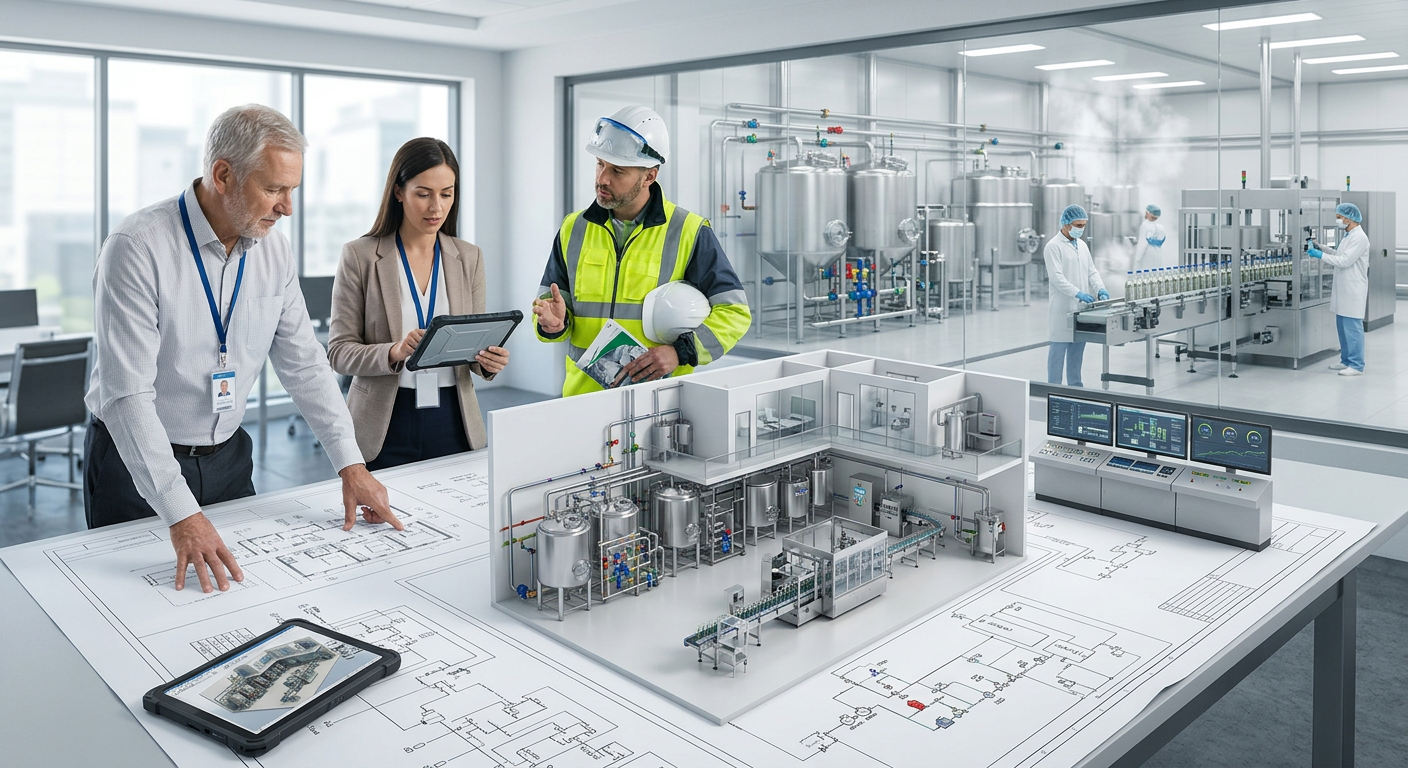
Beverage equipment relocation is a highly technical process that goes far beyond moving stainless steel from one building to another. In the United States, beverage manufacturers must protect sanitary design, preserve utility tie-ins, document equipment condition, manage rigging risk, and restart production without compromising FDA, state, or third-party food safety expectations. For breweries, distilleries, RTD beverage plants, juice processors, dairy beverage sites, and co-packers, the best relocation projects are planned as integrated engineering and execution programs rather than simple mechanical moves.
That is especially true when the equipment includes bright tanks, blend tanks, jacketed kettles, heat exchangers, carbonators, fillers, cappers, depalletizers, conveyors, labeling systems, and complete packaging lines. A successful move requires detailed preplanning, sanitary controls, utility mapping, transport engineering, reinstallation sequencing, and production validation. Companies operating in major U.S. manufacturing corridors such as Chicago, Dallas-Fort Worth, Atlanta, Charlotte, Los Angeles, the Inland Empire, Houston, Milwaukee, Denver, and New Jersey also need to account for freight routes, crane access, union jurisdiction, municipal permits, and inspection schedules.
For manufacturers that need a partner with both engineering depth and field execution capability, Disruptive Process Solutions supports food and beverage capital projects across the United States and Canada with a business-first approach that aligns relocation work with long-term profitability, throughput, and compliance goals.
Quick Answer

In the United States, beverage equipment relocation usually includes shutdown planning, lockout and utility isolation, sanitary disconnection, rigging, transport, staged delivery, reassembly, controls reconnection, utility integration, startup, and production validation. The most critical success factors are protecting CIP integrity, preventing damage to filler and capper alignment, minimizing contamination risk, and restoring line speed quickly after restart.
When tanks, kettles, fillers, and packaging systems are being moved, the project should be led by a team that understands beverage process engineering, sanitary piping, mechanical installation, electrical and controls integration, and regulatory expectations. A relocation partner should also know how to sequence work around production windows, especially for plants that can only shut down on weekends, during holidays, or overnight.
For many U.S. beverage operations, the biggest mistake is treating a relocation like a rigging-only event. In reality, line efficiency after the move depends on pre-move laser measurement, utility verification, punch listing, startup protocols, and operator training. That is where an integrated design-build-manage mindset creates value: it reduces restart surprises, shortens downtime, and prevents hidden costs that appear after the equipment has already been set in place.
Beverage Equipment Relocation Scope: Tanks, Kettles, Fillers, and Packaging Systems

The scope of beverage equipment relocation varies widely depending on whether the work involves a single vessel, a process area, or a full plant transfer. A small brewery may move only fermenters and a canning line from one leased building to another. A large co-packer may relocate blend rooms, syrup systems, UHT skids, aseptic fillers, blow molders, palletizers, and utility systems across states. Typical projects in the United States involve some combination of the following equipment categories:
| Equipment Type | Typical Beverage Use | Key Move Risk | Primary Protection Method |
|---|---|---|---|
| Storage and blend tanks | Water, syrup, juice, RTD, dairy bases | Denting, nozzle damage, contamination | Sanitary blanking, padded rigging, nozzle caps |
| Fermenters and bright tanks | Beer, kombucha, cider | Jacket damage, manway distortion | Center-of-gravity planning and frame supports |
| Jacketed kettles | Tea, sauces, functional beverages, dairy | Steam jacket damage, agitator misalignment | Agitator lockout and controlled lift points |
| Filling and capping systems | Bottles, cans, pouches | Loss of timing and precision alignment | Component indexing and measured reassembly |
| Packaging conveyors and labelers | Secondary packaging | Tracking errors, electrical reconnection issues | Tagging, imaging, and phased installation |
| CIP skids and process piping | Sanitation and changeover | Cross-connection errors, dead legs | Line mapping, spool tagging, verification testing |
In practice, each equipment type has a different relocation profile. Tanks may seem simple, but oversized vessels often create route constraints, require specialized hauling, and demand careful handling of legs, jackets, insulation, and instruments. Fillers and cappers can be physically smaller than tanks but are far more sensitive in terms of throughput recovery, as very small deviations in alignment can affect seaming, torque, fill accuracy, container handling, and reject rates.
Packaging systems add another layer of complexity because they often include multiple OEMs, older controls architectures, custom guarding, field modifications, and patchwork utility connections. That is why many beverage manufacturers choose relocation teams with both process and packaging expertise rather than separate vendors who work in isolation. DPS supports this type of integrated execution through process engineering, installation, and project management services that connect upstream process areas to downstream packaging performance.
The U.S. market also sees frequent relocation work linked to plant consolidations, lease expirations, contract manufacturing transitions, disaster recovery, and expansion into lower-cost logistics hubs near interstates, rail terminals, or ports such as Houston, Savannah, Newark, Long Beach, and Oakland.
Sanitation Requirements: Clean-in-Place (CIP) System Preservation During Moves

Sanitation is one of the most important differences between beverage equipment relocation and general industrial machinery moving. A beverage plant cannot simply disconnect equipment, haul it, reconnect it, and resume production. CIP systems, sanitary process piping, valves, spray devices, instruments, pumps, and product-contact surfaces must be protected throughout the move to preserve hygienic design and avoid contamination risks.
During pre-move planning, each CIP circuit should be documented to identify tank coverage, return paths, chemical dosing points, heat source connections, conductivity instrumentation, and valve logic. If a relocation project involves multiple skids or phases, every pipe spool, clamp, seat, gasket, and sanitary fitting should be labeled in a way that supports clean reassembly.
| Sanitation Control Step | Why It Matters | Common Failure if Missed | Best Practice |
|---|---|---|---|
| Pre-move final CIP cycle | Leaves equipment in known clean condition | Residue dries inside piping or vessels | Document final wash, rinse, and verification |
| Sanitary caps and wraps | Protects product-contact openings | Dust and debris enter nozzles or ports | Use tamper-evident sanitary closures |
| Gasket and seal control | Prevents wear or cross-mix errors | Leaks, contamination, failed pressure tests | Bag, label, inspect, and replace as needed |
| Valve position documentation | Supports correct CIP flow paths | Cross connections or dead legs | Photo records plus tagged valve maps |
| Instrument protection | Preserves calibration and accuracy | False conductivity, temp, or level readings | Remove, crate, and recalibrate critical devices |
| Post-installation sanitary verification | Confirms hygienic restart readiness | Micro risk and startup delays | Pressure tests, riboflavin tests, swabs, validation CIP |
In U.S. beverage facilities, preserving CIP performance is especially important when handling dairy-based beverages, kombucha, juice with pulp, functional beverages, and products with allergen or sugar loading concerns. Plants audited to SQF, BRCGS, or retailer standards often need stronger documentation than basic local code compliance. That means the relocation team must think like both installers and food safety professionals.
One of DPS’s strengths in this area is its process utility and sanitary systems knowledge. The company designs and integrates complete CIP systems, sanitary process layouts, utility infrastructure, and automation logic for food and beverage plants. That technological capability matters during relocation because preserving wash coverage, return velocity, heating performance, and automation sequencing is just as important as reconnecting physical piping. Manufacturers evaluating sanitary system and vessel expertise can review equipment capabilities here.
From a 2026 trend standpoint, CIP preservation is becoming more data-driven. Plants are increasingly tying relocation validation to digital maintenance records, electronic CIP batch reports, conductivity trend logs, and environmental monitoring programs. Sustainability goals are also shaping relocation planning, with more facilities looking to reduce post-move water usage, chemical waste, and cleaning cycle duration through better line design and automation upgrades performed during the move.
Heavy Rigging and Specialized Transport for Oversized Beverage Vessels
Oversized beverage vessels often create the most visible and logistically complex part of a relocation project. Unitanks, bright tanks, horizontal storage vessels, mash tuns, lauter tuns, cook tanks, and large blend tanks may exceed normal transport dimensions or create center-of-gravity challenges that require custom lift engineering. In dense metros such as Los Angeles, Seattle, Boston, and New York, route restrictions, bridge clearances, power line proximity, and local permit timing can influence the entire project schedule.
Heavy rigging for beverage vessels should begin with a documented lift plan that identifies weight, dimensions, insulation status, internal hardware, center of gravity, pick points, sling protection, crane radius, floor loading, and transport method. Many vessels also require temporary bracing or custom cradles, especially if their legs are not designed for highway vibration or if their shell geometry makes direct securement risky.
| Vessel Category | Typical Size Range | Transport Challenge | Specialized Requirement |
|---|---|---|---|
| Fermentation tanks | 30 to 400 BBL | Height and jacket vulnerability | Oversize routing and jacket protection |
| Bright beer tanks | 20 to 300 BBL | Nozzle projection and shell support | Custom saddles or bracing |
| Blend and syrup tanks | 2,000 to 12,000 gallons | Wide body and instrument exposure | Instrument removal and controlled tie-downs |
| Jacketed kettles | 500 to 5,000 gallons | Agitator load and steam jacket stress | Agitator stabilization and low-vibration transit |
| Distillation vessels | Craft to industrial scale | Copper finish damage and geometry | Protective wrapping and specialty crating |
| Aseptic or sterile process vessels | Custom engineered | Surface integrity and validation impact | Enhanced documentation and controlled handling |
For U.S. projects crossing long distances, vessel relocation may involve port-adjacent staging yards, police escorts, pilot cars, and multi-day permit sequencing. Freight planning is not only a transportation issue; it also affects insurance, schedule certainty, and restart readiness. If one critical tank is delayed en route to a Dallas, Phoenix, or Atlanta startup, the whole commissioning sequence can shift.
This is why experienced relocation partners pre-stage cranes, forklifts, trailers, spreader bars, rigging gear, and trade labor in line with the project critical path. They also maintain tight communication with local municipalities, carriers, and site safety leaders. In many cases, moving one oversized vessel successfully depends on ten or more smaller decisions made weeks earlier.
The growth trend above reflects realistic market drivers in the United States: capacity shifts toward co-packing, plant modernization, regional distribution optimization, secondary market equipment purchases, and a growing preference for relocating existing assets instead of buying all-new systems when speed to market matters more than greenfield purity.
Precision Reassembly and Alignment of Filling and Capping Systems
Among all beverage equipment categories, fillers and cappers are the most unforgiving after a move. A tank can be set and piped with some schedule flexibility, but a filling line that loses precision can drag down output, increase waste, and frustrate operators immediately. Reassembly must account for container infeed geometry, starwheel timing, turret position, cap delivery, seam or torque settings, conveyor elevation, lubrication systems, sensors, and PLC handshaking.
Best practice is to treat the filling line as a measured system before disassembly. Teams should capture centerlines, baseplate elevations, shim packs, anchor locations, motor alignments, gap settings, and product path geometry. OEM manuals matter, but field conditions matter too. Many U.S. lines have years of fine-tuning that never made it into official documentation.
| Line Component | Alignment Concern | Operational Impact | Verification Method |
|---|---|---|---|
| Container rinser or depalletizer interface | Infeed transfer height | Scuffing, jams, tipped containers | Level survey and dry run |
| Filler bowl and valves | Valve height and seal consistency | Underfill, overfill, foaming | Test fills and weight checks |
| Capper or seamer | Head timing and closure engagement | Leaks, bad seams, torque rejects | Torque or seam inspection |
| Conveyor system | Tracking and accumulation pressure | Breakage, label defects, stoppages | Load simulation and line balancing |
| Labeler interface | Bottle spacing and sensor timing | Misapplied labels, downtime | Photoeye calibration and trial runs |
| Case packer and palletizer | Discharge coordination | Backups and lost throughput | Integrated end-of-line test |
Precision reassembly often benefits from a relocation team with controls and automation depth, not just mechanical capability. DPS brings technological capabilities in PLC programming, automation integration, SCADA, and utility-to-process coordination, which can be especially valuable when a move is combined with line upgrades, recipe changes, or expansion of production reporting. Instead of reinstalling a line exactly as it was, some clients use the move to remove bottlenecks, improve diagnostics, or reconfigure changeover logic.
This is also where local conditions matter. A line moved from a legacy facility in Milwaukee or St. Louis to a new site in North Carolina or Texas may encounter different floor flatness, utility pressure stability, compressed air quality, and room temperature conditions. Precision alignment is therefore not just a reassembly task; it is a performance engineering task.
The demand pattern above reflects strong relocation activity in co-packing and RTD markets, where speed, asset reuse, and flexible packaging capacity are major priorities. Beer remains active as breweries consolidate or right-size footprints, while dairy and juice require especially careful sanitary controls.
Post-Relocation Testing and Validation: Restoring Nominal Production Speed
A relocation is not complete when the equipment is physically in place. It is complete when the line reliably achieves expected throughput, quality, sanitation performance, and operator confidence. Post-relocation testing should follow a structured progression: utility verification, dry mechanical checks, controls checkout, water runs, CIP validation, product trials, speed ramp-up, quality sampling, and handoff documentation.
Restoring nominal production speed often requires more than one trial. The first run may prove mechanical readiness, while later runs refine reject rates, changeovers, fill consistency, carbonation control, or package integrity. Plants that produce carbonated soft drinks, beer, kombucha, or nitrogen-dosed beverages often need extra attention because pressure, dissolved gas behavior, and temperature control can amplify small mechanical or utility issues.
A practical commissioning matrix may include line rate by SKU, startup scrap percentage, cap torque or seam quality, dissolved oxygen, CIP cycle acceptance, alarm frequency, and labor utilization. The objective is not merely to “make product,” but to return to a stable commercial condition at or near pre-move performance levels.
DPS frequently works where engineering and execution overlap. Its service capabilities include capital planning, owner’s representation, program management, installation oversight, and turnkey system integration. That combination is useful when a relocation must move quickly from mechanical completion into operational acceptance, especially for high-volume beverage sites where every lost shift matters. Companies looking for examples of integrated project execution can review project case studies for context on complex manufacturing work.
The area trend reflects a broader U.S. market shift: beverage manufacturers increasingly want relocations bundled with process optimization, controls work, utility redesign, and startup support rather than disconnected vendor scopes. By 2026, this trend is likely to strengthen as labor remains tight, sustainability reporting becomes more visible, and capital projects face greater scrutiny around ROI.
Coordinating with Health Inspectors and Ensuring Regulatory Compliance
Compliance during beverage equipment relocation depends on product type, plant location, audit framework, and whether the move changes process classification or utility conditions. In the United States, a project may require coordination with local building authorities, state departments of agriculture, health departments, fire marshals, environmental agencies, wastewater authorities, and in some cases FDA-focused internal quality teams or customer audit stakeholders.
For beverage plants, compliance planning typically addresses sanitary design, potable water connections, backflow prevention, floor drainage, chemical storage, steam or boiler systems, compressed air quality, labeling controls, allergen segregation where applicable, and documented startup sanitation. Facilities producing alcoholic beverages also need to consider TTB-related operational implications, while dairy beverage or aseptic sites may face more stringent validation expectations.
| Compliance Area | Typical U.S. Stakeholder | Relocation Concern | Recommended Action |
|---|---|---|---|
| Building and structural | Local building department | Anchoring, slab loading, mezzanines | Submit drawings and verify load paths |
| Sanitation and food safety | Plant QA, health or ag officials | CIP, hygienic piping, washdown design | Document sanitary reassembly and testing |
| Boilers and pressure systems | State boiler inspector | Recommissioning and code compliance | Schedule inspection before startup |
| Fire and life safety | Fire marshal | CO2 rooms, flammables, egress | Review hazards and safety systems |
| Wastewater and discharge | Municipal utility authority | CIP discharge profile changes | Confirm pretreatment and discharge limits |
| Third-party certification | SQF, BRCGS, customer auditors | Change control and validation records | Maintain full move documentation package |
Early coordination with inspectors prevents the common problem of being mechanically ready but not legally ready to start. This is especially important when relocating into industrial growth areas like central Texas, the Carolinas, Tennessee, Nevada, or Arizona, where permitting volume can be high and inspection windows may be limited. Plants near ports or intermodal hubs may also face different local utility review processes than older manufacturing corridors in the Midwest or Northeast.
By 2026, compliance expectations are likely to expand further in three areas: digital documentation, traceable change control, and sustainability reporting. Even when not legally required, many beverage brands now ask manufacturers and co-packers to show responsible water use, energy efficiency improvements, and preventive maintenance controls following major equipment moves.
Minimizing Downtime: Weekend and Off-Hours Relocation Scheduling
Downtime is usually the largest hidden cost in beverage equipment relocation. Lost production, missed shipments, labor inefficiency, and startup scrap can easily outweigh direct rigging or transport charges. That is why many U.S. projects are scheduled during weekends, holiday shutdowns, third shifts, or carefully staged off-hours windows.
A good downtime strategy starts with identifying which assets are truly critical. Some tanks can move early and wait for utility tie-ins, while a key filler, pasteurizer, or case packer may define the restart date. Projects should be backward-planned from the first commercial run, with crane picks, carrier arrivals, electrician work, controls checkout, sanitation, and validation all tied to a minute-by-minute or hour-by-hour schedule during the shutdown window.
Weekend execution is common, but it only works when prework is complete. That includes steel modifications, utility rough-ins, floor layout, spare parts staging, gasket procurement, OEM support scheduling, and pre-approved safety permits. Plants in major freight and labor markets such as Chicago, Southern California, New Jersey, and Houston often need even tighter planning because traffic, labor availability, and permit timing can make “just-in-time” relocation unrealistic.
DPS is structured to support this kind of fast, coordinated execution. Its lean, senior-level team works across process engineering, project management, installation integration, and general-contractor-style coordination where required. That service capability helps clients compress shutdown windows while maintaining control over safety, documentation, and production readiness. For clients comparing partners, the biggest differentiator is often not who can disconnect equipment, but who can orchestrate the entire move without creating costly gaps between trades.
The comparison highlights what many operators already know from experience: the cheapest rigging quote can become the most expensive total project if the move lacks engineering discipline, sanitary oversight, controls coordination, and structured startup support.
Cost Factors: What Drives Beverage Equipment Relocation Pricing
Pricing for beverage equipment relocation in the United States depends on much more than mileage. The total cost is shaped by equipment sensitivity, sanitary requirements, labor complexity, permit needs, utility scope, startup expectations, and how much production risk the client wants the relocation team to absorb. A one-day internal tank move in Ohio or Wisconsin bears little resemblance to a multi-state packaging line transfer from California to Texas or a sanitary process relocation for an RTD plant in Georgia.
| Cost Driver | Low Complexity Scenario | High Complexity Scenario | Cost Impact |
|---|---|---|---|
| Equipment size and weight | Small skid-mounted units | Oversized tanks or heavy fillers | Higher crane, rigging, and transport cost |
| Sanitary requirements | Basic non-product utility move | Validated CIP and hygienic piping preservation | More labor, documentation, and replacement parts |
| Distance and routing | Same-site or local move | Cross-country oversize route | Permits, escorts, storage, and freight escalation |
| Utility reconnection | Simple electrical drops | Steam, glycol, CO2, RO water, controls integration | Engineering and trade coordination increase |
| Startup support | Mechanical set only | Commissioning to nominal speed | More technician time and troubleshooting scope |
| Schedule compression | Flexible weekday window | Weekend or holiday critical shutdown | Premium labor and mobilization charges |
In budgeting terms, manufacturers should ask for a scope breakdown that separates disconnection, rigging, freight, reinstallation, utilities, controls, validation, and contingency. Without that clarity, it is easy to compare quotes that are not actually comparable. For example, one vendor may exclude sanitary consumables, OEM technician support, or production trial assistance, leaving those costs to emerge later as change orders.
Another major factor is whether the relocation includes improvement work. Many beverage producers use a move to add automation, resize utilities, improve changeover ergonomics, or replace obsolete components. This can raise the project budget but lower long-term operating cost and reduce future downtime. In many cases, smart capital allocation during the move produces a better ROI than reinstalling an old problem exactly as it was.
Manufacturing capability also matters in cost control. DPS designs and manufactures selected process equipment such as tanks, CIP systems, tumblers, and vessels, which can be useful when a relocation reveals damaged legacy components, capacity mismatches, or opportunities to replace problem assets with better-fit equipment instead of forcing inefficient reuse.
FAQ
Below are the questions beverage manufacturers in the United States ask most often when planning an equipment relocation.
| Question | Short Answer |
|---|---|
| How long does a beverage equipment relocation take? | Small internal moves may take days; multi-line interstate projects can take weeks or months including planning, permitting, and startup. |
| Can production continue during part of the move? | Yes, if the plant is phased correctly and noncritical systems are relocated first while key lines remain operational. |
| Do CIP systems need to be revalidated after the move? | Yes. Any disconnection or reassembly affecting product-contact paths should be tested and documented before production restart. |
| Is it better to move old equipment or buy new? | It depends on condition, lead time, throughput goals, and total installed cost. A technical assessment should decide that early. |
| Who should manage the relocation project? | Ideally, a partner with engineering, installation, controls, and startup capability rather than a transport-only or rigging-only provider. |
| What is the biggest risk after the move? | Extended downtime caused by misalignment, incomplete utility integration, or failed sanitation and compliance verification. |
How early should planning begin?
For most U.S. beverage projects, planning should begin at least 8 to 16 weeks in advance, and longer for interstate oversize transport, plant consolidations, or moves involving code upgrades.
Do I need OEM technicians?
For sensitive fillers, cappers, seamers, aseptic systems, pasteurizers, and specialized controls, OEM or OEM-qualified support is often worth the cost, especially when warranty, calibration, or high-speed performance matters.
What documents should be prepared before shutdown?
A solid package includes P&IDs, utility maps, electrical one-lines, controls backups, line photos, centerline measurements, valve schedules, instrument lists, spare parts lists, sanitation records, and startup protocols.
Can a move improve line speed?
Yes. Many relocations create a practical window to correct bottlenecks, upgrade PLC logic, rebalance conveyors, add better instrumentation, or improve CIP design. In some cases, the post-move line performs better than before.
What kinds of beverage facilities benefit most from an integrated relocation partner?
High-throughput co-packers, breweries, distilleries, juice plants, dairy beverage processors, carbonated soft drink sites, and aseptic operations benefit the most because their risk profile extends beyond basic lifting and transport.
For companies evaluating relocation options in the United States, the best outcome usually comes from combining engineering, sanitary discipline, heavy rigging expertise, packaging precision, and startup accountability under one coordinated project strategy. That approach protects product quality, shortens downtime, and turns a disruptive move into a smarter capital decision.
[/trp_language]
Complete Company Portfolio
About the Author: Disruptive Process Solutions (DPS)
The DPS team combines process engineering expertise with real-world food and beverage manufacturing experience. Our content focuses on process optimization, production efficiency, facility improvements, and practical solutions that help manufacturers operate more effectively in a rapidly evolving industry.
Share