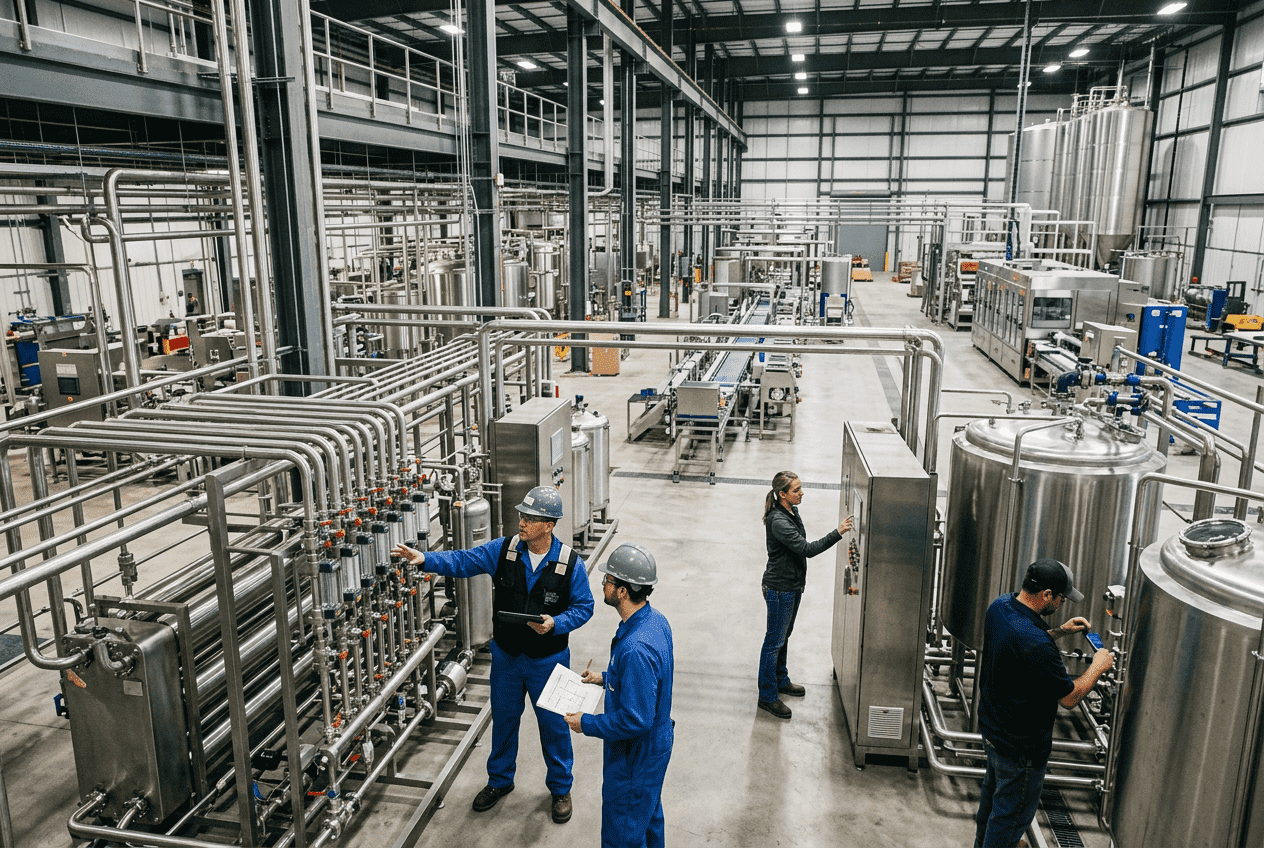
Beverage Manufacturing Engineering Services
[trp_language language=”en_US”]
Beverage Plant Engineering Services in the United States
U.S. beverage manufacturing engineering services cover the full technical and commercial framework needed to turn an idea, line expansion, or plant retrofit into reliable production. In practice, that means process design, utility planning, water treatment, ingredient handling, blending, carbonation, filling, capping, packaging, controls, sanitation, compliance, commissioning, and ongoing optimization. For manufacturers in major beverage corridors such as North Carolina, Texas, California, Illinois, Georgia, New Jersey, and the Midwest distribution belt, the right engineering partner should do more than size tanks and specify pumps. The partner should connect product requirements, throughput goals, labor constraints, utility loads, food safety, and return on capital into one executable plan.
In the United States, beverage projects often succeed or fail on details that sit between processing and packaging: syrup room layout, clean-in-place logic, dissolved oxygen control, line changeover time, pasteurization method, warehouse flow, and the capacity of utilities such as compressed air, steam, chilled water, glycol, and process water. That is why many beverage producers look for engineering teams that can align production needs with real operating economics, especially when dealing with national retail deadlines, co-packing volume swings, and state-by-state permitting expectations.
Quick Answer

Beverage manufacturing engineering services are the specialized design, integration, and execution services used to build or improve beverage plants in the United States. They typically include feasibility analysis, capital planning, process engineering, automation, equipment specification, sanitary piping, utility design, filling and packaging integration, commissioning, compliance support, and line performance optimization. These services apply to carbonated soft drinks, juices, RTD beverages, dairy drinks, spirits, wine, kombucha, functional beverages, and aseptic products.
If you are selecting a firm, prioritize one that understands both the product and the business model. A plant making shelf-stable tea for nationwide retail has different needs than a brewery in Charlotte, a spirits project in Kentucky, a dairy beverage operation in Wisconsin, or a co-packer near the Port of Long Beach serving West Coast accounts. The best beverage engineering teams reduce risk before equipment is purchased, not after it is installed.
| Service Area | What It Covers | Typical U.S. Use Case | Main Benefit |
|---|---|---|---|
| Process design | Flow diagrams, equipment sizing, sanitary layouts | New RTD line in Texas | Balanced throughput and product quality |
| Utility engineering | Steam, glycol, compressed air, water, wastewater | Plant expansion in the Midwest | Prevents hidden capacity shortages |
| Automation and controls | PLC, SCADA, recipe management, alarms | Multi-SKU co-packer | Repeatability and labor efficiency |
| Filling and packaging | Filler, capper, labeler, packer, conveyors | High-speed PET soda line | Higher OEE and lower downtime |
| Food safety and compliance | Sanitary design, FDA, SQF, BRC alignment | National retail supplier | Audit readiness and risk reduction |
| Commissioning | Startup support, training, acceptance testing | Greenfield launch | Faster ramp-up to sellable product |
The table above shows why beverage engineering is broader than equipment procurement. A filler can be purchased from many suppliers, but its long-term performance depends on the process upstream and the utilities underneath it.
What Beverage Manufacturing Engineering Services Cover

Comprehensive beverage engineering begins with commercial intent. Before a drawing is issued, the engineering team should understand target case volume, package mix, future SKUs, required shelf life, ingredient sensitivity, sanitation regime, and labor model. A line intended to serve club stores in Chicago or Atlanta will need different buffering, packaging density, and palletizing logic than a smaller regional line serving the Carolinas.
In technical terms, beverage manufacturing engineering in the United States typically covers raw material receiving, sugar or sweetener handling, syrup preparation, batching, blending, deaeration where required, carbonation, pasteurization or sterilization, filtration, holding, filling, closure application, coding, labeling, secondary packaging, warehouse interface, and utility support systems. It also includes process instrumentation, line controls, and data visibility for quality, traceability, and uptime.
Many beverage producers also need cross-functional support beyond engineering. This can include owner’s representation, capital budgeting, contractor coordination, equipment sourcing, schedule control, installation oversight, and final startup management. That broader role is especially important in fast-moving U.S. projects where local trades, OEMs, controls vendors, and plant teams must all work to one timeline.
For manufacturers seeking a partner that covers this full spectrum, beverage engineering and integration services are often most valuable when they unite process, utilities, controls, and field execution under one operating model. That reduces the handoff gaps that commonly slow projects during FAT, site installation, and startup.
The line chart reflects the broader trend in U.S. beverage capital activity: projects are becoming larger, more automated, and more focused on flexibility. Through 2026, engineering demand is expected to rise as manufacturers pursue SKU expansion, utility efficiency, labor reduction, and faster product changeovers.
High-Speed Filling, Capping, and Packaging Line Engineering

High-speed beverage packaging is where small engineering mistakes become expensive operating problems. The core objective is not simply hitting nameplate speed; it is sustaining sellable output over time. In a U.S. market shaped by labor costs, freight pressure, and retailer compliance, the real target is stable OEE with low scrap, low rework, and predictable maintenance windows.
Filling and packaging line engineering includes container handling, infeed accumulation, rinser or depalletizer interface, filler bowl or dosing configuration, cap sorting and delivery, torque verification, labeler integration, coding, inspection, case packing, palletizing, and finished goods flow. It also requires detailed attention to line balance. A 600 bottle-per-minute filler underperforms if cap supply, accumulation, or case packing is mismatched. Likewise, a packaging hall in Southern California may face power quality, compressed air, or floor space constraints that change the layout strategy compared with a newer site in Texas.
Engineers should also evaluate sanitation and package integrity together. Carbonated products require better pressure stability and closure performance. Hot-fill lines need thermal management and container stability. Aseptic filling demands a different level of microbiological control, isolator design, and operator discipline. For all formats, the controls architecture should identify jams, starved equipment, blocked zones, micro-stops, and recurring speed losses.
| Component | Primary Engineering Concern | Common Failure Point | Optimization Method |
|---|---|---|---|
| Depalletizer | Infeed rate and container stability | Intermittent starvation | Buffer tuning and sensor logic |
| Filler | Accuracy, sanitation, speed control | Foaming or underfill | Valve setup and product conditioning |
| Capper | Torque consistency | Loose caps or damage | Cap feed alignment and verification |
| Labeler | Registration and adhesive performance | Misapplied labels | Container spacing and change parts |
| Case packer | Pattern reliability | Misloads and jams | Robotic timing and pack confirmation |
| Palletizer | Stack integrity | Unstable loads | Recipe control and pattern validation |
This table highlights that packaging engineering is about system interaction. When a line repeatedly misses production goals, the root cause is often one of the interfaces between machines rather than the main machine itself.
How to Select Beverage Manufacturing Engineers by Product Type
Not every engineering firm is equally strong across every beverage category. Product-specific experience matters because process risks differ. Tea and juice may be acidified and hot-filled. Dairy beverages may need homogenization, separation, and tighter allergen controls. Spirits projects require a different approach to tank farm safety, permitting, and distillation integration. Kombucha and fermented beverages involve living systems, pressure behavior, and contamination risk that conventional soft drink teams may underestimate.
When evaluating engineers, ask for direct experience with your product family, packaging format, sanitation method, and target throughput. Also ask whether the firm can support only design or can also manage procurement, installation, controls, startup, and troubleshooting. In the United States, many manufacturers prefer a single accountable partner because fragmented responsibility can stall a project when schedule pressure rises.
Disruptive Process Solutions, for example, has built a cross-category model that spans brewing, spirits, wine, kombucha, RTD products, carbonated and non-carbonated drinks, dairy beverages, and aseptic applications while also supporting manufacturers across North America. A practical way to review a firm’s fit is to study its project case examples and compare them to your plant scale, product type, and utility profile.
| Beverage Type | Critical Process Need | Packaging Sensitivity | Best Engineering Experience to Seek |
|---|---|---|---|
| Carbonated soft drinks | CO2 control and pressure integrity | Closure performance | High-speed carbonation and PET/can lines |
| Juices and teas | Pasteurization and flavor stability | Hot-fill or aseptic format | Thermal process and sanitary design |
| Dairy beverages | Homogenization and microbiological control | Cold chain or aseptic | Dairy process and allergen segregation |
| Beer and craft brewing | Fermentation and oxygen control | Can seam or bottle crown quality | Brewhouse, cellar, and packaging integration |
| Spirits | Distillation and proofing | Glass handling | Still systems and flammable area planning |
| Functional and RTD beverages | Ingredient accuracy and flexibility | Frequent SKU changes | Batch control and rapid changeover design |
The key lesson from this comparison is simple: product chemistry, microbial risk, and packaging format should drive the engineer selection process, not just hourly rates or general industrial background.
Carbonated vs. Non-Carbonated: Different Engineering Requirements
Carbonated and non-carbonated beverages may share packaging halls, but they differ significantly in process design. Carbonated products require tight control of temperature, pressure, deaeration, and filler conditions to preserve CO2 levels and minimize foam. Piping design, valve selection, bright tank strategy, and filler bowl behavior all affect final package performance. Plants producing sparkling water, flavored soda, hard seltzer, or carbonated RTDs also need strong attention to closure integrity and line pressure transitions.
Non-carbonated beverages shift the engineering emphasis toward ingredient stability, thermal treatment, microbial control, and viscosity management. Juice, tea, protein drinks, dairy beverages, and plant-based products can have more complex shear sensitivity, solids behavior, allergen considerations, and cleaning demands. Even among non-carbonated products, engineering differs widely: an ambient shelf-stable drink is not engineered the same way as a refrigerated smoothie or a UHT dairy beverage.
These distinctions affect more than process equipment. They influence line lubrication strategy, CIP recipe design, package selection, warehouse temperature assumptions, and utility loads. A carbonated line in Denver may need different process compensation than one near sea level. A non-carbonated line in Florida may require different HVAC and condensation planning than a dry-climate plant in Arizona.
The bar chart shows where engineering demand is strongest today: carbonated products remain important, but functional drinks and flexible RTD platforms are driving many new investments because they require adaptable batching, traceability, and fast SKU changeovers.
Ingredient Dosing, Blending, and Batch Control System Engineering
Ingredient dosing and blending systems are central to beverage quality and cost control. In a competitive U.S. market, small formulation losses add up quickly, especially for products with expensive vitamins, nutraceuticals, flavors, alcohol inputs, sweetener systems, or dairy solids. Engineering must therefore support both precision and repeatability.
Well-designed batching systems include bulk and minor ingredient handling, load cells, metering technologies, inline mixing, Brix or conductivity verification, recirculation logic, tank sequencing, and recipe governance through PLC and SCADA layers. For co-packers serving multiple national brands, strong batch control is not optional. It is the backbone of traceability, yield management, and customer confidence.
This is also an area where technological capabilities matter. Advanced beverage engineering teams can integrate PLC programming, automation, HMI design, SCADA dashboards, alarm management, and recipe-driven production control so operators can move from one SKU to another with less downtime and less risk of cross-contamination. When paired with proper sanitary design and CIP validation, batch automation improves uptime and reduces giveaway.
Firms with in-house controls depth can be especially valuable. In real production settings, a throughput problem is not always mechanical. Sometimes the bottleneck is logic, sequence timing, or poor data visibility. That is why many U.S. beverage manufacturers prefer engineering groups that combine process and automation skill instead of treating controls as an afterthought.
| Engineering Element | Function | Main Risk if Poorly Designed | Operational Benefit |
|---|---|---|---|
| Bulk ingredient receiving | Transfers sweeteners, concentrates, oils, or alcohol inputs | Inconsistent supply or contamination | Stable production scheduling |
| Micro-dosing systems | Accurate addition of small ingredients | Flavor or label claim deviation | Higher batch accuracy |
| Blend tanks | Homogeneous product preparation | Stratification or foam generation | Consistent taste and texture |
| Inline analyzers | Measure Brix, flow, conductivity, or density | Off-spec product release | Real-time quality control |
| Recipe management | Automates formulation and sequence steps | Manual errors and long changeovers | Repeatability across shifts |
| SCADA reporting | Records batch history and performance data | Weak traceability | Audit support and continuous improvement |
The explanation from this table is straightforward: dosing accuracy is both a quality issue and a margin issue. Better controls do not just make cleaner screens; they protect yield, compliance, and schedule reliability.
Water Treatment and Beverage-Specific Utility Engineering
Water is often the largest ingredient in a beverage plant, but engineering teams must treat it as more than an ingredient. Water system design affects taste, microbiological safety, membrane life, cleaning performance, and long-term operating cost. In the United States, source water conditions vary widely by region, from hard municipal feeds in parts of Texas and the Southwest to different mineral profiles in the Great Lakes region, the Southeast, and the Northeast corridor.
Beverage-specific water engineering may include pretreatment, filtration, softening, reverse osmosis, carbon treatment, UV disinfection, ozone, degassing, remineralization, storage, loop design, and process water distribution. The right design depends on both source quality and finished product goals. A brewery in North Carolina, a juice facility in California’s Central Valley, and an aseptic plant near New Jersey ports will each have different treatment priorities.
Utility engineering goes further. Beverage lines depend on reliable steam, hot water, chilled water, glycol, compressed air, HVAC, process drains, wastewater handling, and CIP support. Underdesigned utilities create hidden bottlenecks that appear only after startup. Overdesigned utilities waste capital. Strong engineering finds the right balance based on actual production scenarios, sanitation cycles, and future capacity stages.
Disruptive Process Solutions is known in part for this utility and system-integration depth, including water treatment, custom CIP, tanks, automation, and complete support infrastructure. Manufacturers evaluating equipment and process trains can review available process equipment capabilities to understand how water, cleaning, storage, and production hardware connect within one plant architecture.
The area chart reflects a major 2026 trend: U.S. beverage producers are investing more heavily in water efficiency, utility visibility, and targeted reuse strategies. This is being driven by sustainability commitments, local water stress, rising utility costs, and tighter investor scrutiny around operating efficiency.
Troubleshooting Common Beverage Production Bottlenecks
Production bottlenecks in beverage plants are rarely solved by guesswork. Effective troubleshooting starts with line data, utility mapping, operator feedback, and direct observation across shifts. Common bottlenecks include insufficient batch availability, poor filler infeed, slow package changeovers, cap supply interruptions, weak CIP sequencing, control logic delays, low air pressure, and warehouse congestion backing up finished goods.
One of the biggest mistakes U.S. manufacturers make is assuming the visible stoppage is the root cause. A filler slowdown may actually be caused by unstable product temperature. Repeated seam or cap issues may trace back to container handling or closure storage conditions. Low throughput in a blending room may result from recipe sequencing or manual operator approvals inside the control system. In older plants around legacy beverage hubs such as Chicago, Philadelphia, or Los Angeles, infrastructure constraints can add another layer of complexity.
The best troubleshooting partners combine process understanding, controls knowledge, and field pragmatism. They do not just recommend new equipment. They determine whether the issue is mechanical, operational, automation-related, or utility-based. This consultative approach is one reason some owners choose teams that act more like operating advisors than traditional contractors.
| Observed Problem | Likely Root Cause | Area to Check First | Potential Fix |
|---|---|---|---|
| Frequent filler stops | Starved infeed or unstable product conditions | Accumulation and product temperature | Rebalance line and condition product better |
| High cap reject rate | Poor cap delivery or torque control | Cap sorter, chute, capper setup | Adjust feed path and verify torque window |
| Long SKU changeovers | Manual recipe or change-parts complexity | Controls and line setup sequence | Automate recipes and stage tooling |
| Inconsistent Brix | Dosing error or analyzer calibration drift | Batch system and inline instrumentation | Revalidate metering and analyzer logic |
| Utility pressure drops | Undersized compressors or shared demand peaks | Air header and load profile | Add storage or rebalance utility loads |
| Excessive CIP downtime | Weak sequence design or insufficient return flow | CIP skid and circuit validation | Rewrite cycle logic and verify hydraulics |
The table shows why disciplined troubleshooting matters. Fixing the symptom may restore production for a day, but fixing the actual bottleneck creates durable gains in throughput and profitability.
Case Study: Engineering a Multi-Product Beverage Manufacturing Line
Consider a hypothetical but realistic U.S. project: a new beverage co-packing operation designed to run flavored water, carbonated soft drinks, energy beverages, and select hot-fill products in one expandable facility. The site is located with logistics in mind, close to interstate access, regional labor, and outbound freight lanes serving the Southeast and Midwest. It must support a year-one output of roughly 20 million cases with a path toward much higher volume as customer contracts expand.
The engineering challenge is not just equipment selection. It is designing for commercial flexibility without overbuilding day one capital. That means a syrup room sized for multiple brands, utility systems staged for future growth, a packaging hall with room for additional lanes, and controls capable of supporting recipe segregation, traceability, and operator simplicity. Carbonated and non-carbonated products require separate process logic, while sanitation planning must prevent flavor carryover and reduce changeover losses.
In this type of project, manufacturing capabilities matter as much as engineering. A partner that can supply custom tanks, CIP systems, and integrated process skids can reduce interface risk and shorten schedule coordination. That is particularly useful when the project team must manage local mechanical, electrical, and plumbing trades while keeping startup dates aligned with customer launch commitments.
This is where DPS’s Design Build Manage approach is relevant in the U.S. market. Instead of stopping at design documents, the model connects engineering, construction coordination, and execution management. Combined with a lean team structure and national partner network, that approach can help beverage clients move faster while keeping capital disciplined. Companies wanting to understand the background and operating philosophy behind that model can learn more about the engineering team and project approach.
On a multi-product line, the final design would likely include staged utility infrastructure, automated ingredient handling, inline verification, dedicated product pathways where necessary, flexible packaging change parts, and clear OEE reporting. The result is a plant that can adapt as customer demand shifts from one category to another, which is increasingly important in the U.S. beverage market where retailer and consumer preferences move quickly.
The comparison chart illustrates a common U.S. buying decision. Integrated partners usually score better on utility alignment, product flexibility, and total project accountability, while fragmented models can create handoff gaps that show up during installation or startup.
FAQ
What do beverage manufacturing engineers actually deliver?
They typically deliver process flow documents, layouts, equipment specifications, sanitary piping plans, utility loads, controls architecture, project schedules, installation scopes, startup support, and optimization recommendations.
How are beverage engineering services priced in the United States?
Pricing depends on scope. Early feasibility and conceptual work may be smaller, while full design, integration, installation oversight, and commissioning are much larger engagements. Costs are influenced by product complexity, line speed, utility needs, regulatory requirements, and whether the project is greenfield or retrofit.
What industries use beverage engineering services besides soft drinks?
Breweries, distilleries, wineries, kombucha producers, RTD brands, dairy beverage processors, nutritional drink manufacturers, juice companies, co-packers, and aseptic product facilities all rely on specialized beverage engineering.
Why is local knowledge important in the United States?
Utility conditions, labor markets, permitting, freight patterns, and regional construction realities vary by state and metro area. A project near Houston, Raleigh, Fresno, Milwaukee, or Newark may face different logistical and infrastructure conditions even if the beverage is similar.
Should I choose a specialist by product type?
Yes. Product-specific experience reduces risk. Carbonated beverages, dairy drinks, hot-fill teas, fermented products, and aseptic beverages all have different engineering priorities.
Can a controls issue really be the main plant bottleneck?
Absolutely. Poor PLC sequence timing, recipe logic, alarm structure, and operator interface design can reduce throughput even when the mechanical equipment is adequate.
What future trends should U.S. beverage manufacturers plan for in 2026?
Expect more investment in energy and water efficiency, plant data visibility, automated batch control, flexible multi-SKU lines, sanitation verification, and packaging systems designed for material changes and sustainability goals. Policy pressure around resource use and reporting is also pushing facilities toward smarter utility design.
What service capabilities matter most in an engineering partner?
Look for capital planning, process engineering, owner’s representation, project management, installation coordination, controls integration, commissioning, and post-startup support. These service capabilities matter because beverage projects often involve fast schedules and multiple vendors.
What manufacturing capabilities are helpful from an engineering-led supplier?
Custom tank fabrication, CIP system manufacturing, skid integration, and equipment package coordination can simplify the project. When manufacturing capability sits close to engineering, the final installation is often more coherent.
What technological capabilities should I ask about?
Ask about PLC programming, SCADA, recipe management, data reporting, inline analyzers, utility monitoring, and integration of process and packaging controls. Those technologies directly affect consistency, labor use, and uptime.
| Selection Criterion | Why It Matters | What to Ask | Good Sign |
|---|---|---|---|
| Product-specific experience | Reduces process and quality risk | Have you engineered this beverage type before? | Clear case examples and references |
| Utility depth | Prevents startup surprises | Do you model full plant utility demand? | Detailed load and future-stage planning |
| Controls expertise | Improves repeatability and throughput | Is PLC/SCADA work in-house or outsourced? | Strong automation ownership |
| Execution model | Affects schedule and accountability | Can you support installation and commissioning? | End-to-end project capability |
| Commercial mindset | Protects ROI | How do you validate capital priorities? | Focus on profitable outcomes |
| Compliance awareness | Supports audits and food safety | What standards do you work under? | Fluency in FDA, SQF, and BRC expectations |
As the checklist indicates, beverage plant engineering in the United States should be evaluated as both a technical discipline and a business decision. The right firm helps manufacturers launch faster, scale smarter, and avoid spending capital in the wrong place.
For beverage producers across the United States, from East Coast ports and Southeast growth markets to Midwest production corridors and West Coast import-driven supply networks, the most valuable engineering services are the ones that connect product science, plant reality, and business performance. That is the standard manufacturers should expect when planning new capacity, upgrading legacy lines, or building the next generation of beverage operations.
[/trp_language]
Complete Company Portfolio

About the Author: Disruptive Process Solutions (DPS)
The DPS team combines process engineering expertise with real-world food and beverage manufacturing experience. Our content focuses on process optimization, production efficiency, facility improvements, and practical solutions that help manufacturers operate more effectively in a rapidly evolving industry.
Share

