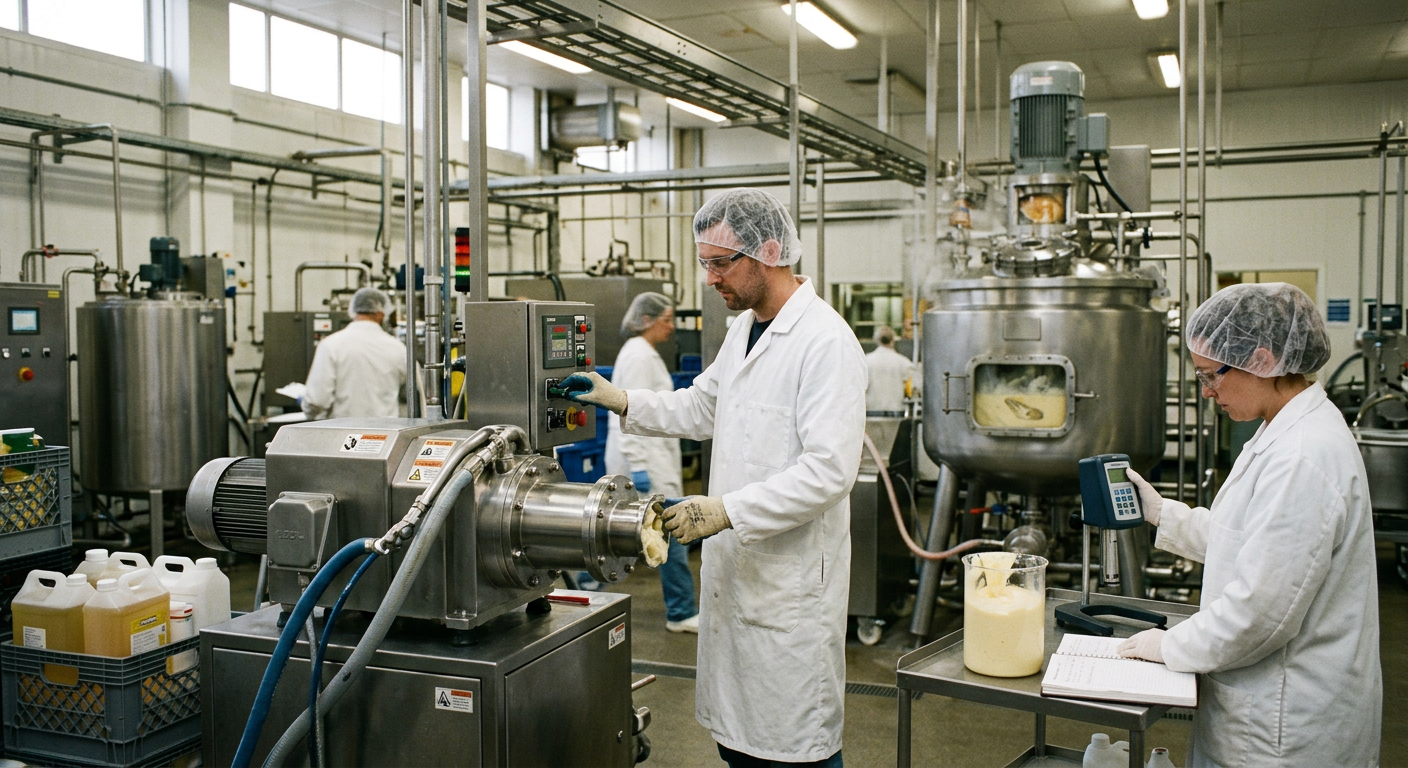
Beverage Plant Capital Planning
[trp_language language=”en_US”]
Beverage manufacturers in the United States face a capital environment shaped by volatile input costs, labor constraints, packaging shifts, retailer service expectations, and aggressive growth timelines. A disciplined beverage plant capital planning process helps operators decide where to invest, when to invest, and how to structure projects so capacity, quality, utilities, compliance, and profitability improve together rather than in conflict.
Fast Takeaway

Beverage plant capital planning is the structured process of deciding how to invest in production lines, utilities, automation, storage, packaging, buildings, and supporting infrastructure to achieve growth, compliance, reliability, and margin goals. In practice, that means aligning demand forecasts with line capacity, identifying bottlenecks, sequencing projects by financial return and operational risk, and selecting the right capital structure for each investment.
For U.S. manufacturers, the strongest plans usually share five characteristics: they start with throughput constraints instead of equipment wish lists; they account for total cost of ownership rather than sticker price alone; they phase investments around seasonal demand; they compare projects across the whole plant portfolio; and they use a delivery partner who can connect engineering, installation, utilities, controls, and execution. Companies that skip these steps often overspend on visible assets like fillers while underinvesting in compressed air, glycol, wastewater, CIP, or electrical distribution that actually determine uptime.
In large beverage markets such as California, Texas, Florida, Illinois, Georgia, and North Carolina, capital planning also needs to consider freight lanes, labor availability, permitting timelines, utility interconnection, and access to co-packing or distribution hubs near ports such as Los Angeles, Long Beach, Savannah, Houston, Newark, and Seattle.
Understanding Capital Planning for Beverage Plants

Capital planning for a beverage manufacturing facility goes beyond annual budgeting. It is a decision framework used to evaluate whether a producer should expand a bottling hall, add blending capacity, modernize controls, upgrade a boiler room, increase warehouse space, improve sanitation design, or outsource selected production stages. It ties operations, finance, engineering, quality, and commercial strategy into one roadmap.
In the U.S. market, beverage producers range from craft breweries and distilleries to national soft drink bottlers, RTD alcohol producers, dairy beverage manufacturers, juice processors, kombucha brands, and aseptic co-packers. Each segment has distinct CAPEX profiles. Carbonated soft drink operations may prioritize depalletizing, high-speed fillers, blow molders, and CO2 systems. Aseptic beverage plants may focus on sterile utilities, high-barrier packaging, cleanroom controls, and microbiological segregation. Distilleries often need fermentation, stills, proofing, barrel logistics, and wastewater management. Functional beverage producers may place more emphasis on batching accuracy, ingredient handling, and rapid SKU changeovers.
A sound capital plan answers several core questions:
- What products and package formats will drive revenue over the next three to seven years?
- Which assets limit throughput today: processing, filling, packaging, utilities, sanitation, or warehousing?
- What level of redundancy is required to avoid service failures?
- How should compliance, food safety, and worker safety influence project timing?
- Which investments create the highest net present value while protecting continuity?
When these questions are answered well, the plant avoids the common trap of buying capacity that cannot be supported by process flow or utilities. For example, a faster canning line may create little value if syrup prep, pasteurization, or refrigeration remain undersized.
A Capital Planning Framework for Beverage Manufacturing Facilities

A practical framework for beverage facility capital planning should move from business strategy to asset-level decisions. The most effective sequence is commercial demand, plant diagnostics, concept alternatives, financial modeling, portfolio ranking, and staged execution.
Step one is demand translation. Sales forecasts should be converted into cases, gallons, shifts, SKUs, package mix, seasonal peaks, and service-level commitments. A 20 million case forecast means little until it is translated into line rates, changeover frequency, concentrate storage, water demand, pallet positions, and labor models.
Step two is current-state assessment. This should map every meaningful constraint across process, packaging, utilities, controls, quality, warehousing, sanitation, and material handling. Many U.S. plants discover the hidden bottleneck is not the filler but poor OEE driven by labeler stops, compressor instability, or inadequate CIP availability.
Step three is alternatives development. Instead of assuming one answer, management should compare debottlenecking, brownfield expansion, greenfield construction, automation upgrades, utility modernization, outsourcing, or phased capacity additions.
Step four is financial evaluation. This includes CAPEX, start-up losses, ramp time, labor impact, maintenance cost, energy intensity, service life, salvage, risk, and expected contribution margin.
Step five is execution governance. A project only creates value if it is installed, commissioned, integrated, and handed over correctly. This is where an engineering-led partner matters. Integrated capital project services can reduce coordination gaps between process engineering, utilities, local trades, and controls integration.
| Stage | Main Objective | Key Questions | Typical Data Needed | Primary Risk | Decision Output |
|---|---|---|---|---|---|
| Commercial alignment | Convert growth strategy into plant needs | What products and channels will grow? | Forecasts, customer commitments, SKU mix | Overbuilding for weak demand | Target capacity profile |
| Asset assessment | Identify bottlenecks and reliability gaps | Where is throughput truly lost? | OEE, downtime logs, utility loads | Misdiagnosing the constraint | Constraint map |
| Concept development | Build feasible project options | Retrofit, expand, automate, or outsource? | Layout, code review, vendor input | Single-option bias | Option shortlist |
| Financial analysis | Measure economic value | Which option best improves profit? | CAPEX, labor, margin, energy, maintenance | Ignoring lifecycle cost | Business case |
| Portfolio ranking | Compare projects across the plant | What should be funded first? | NPV, payback, risk scores | Political prioritization | Approved sequence |
| Execution governance | Deliver on scope, budget, and startup | Who owns schedule and integration? | RACI, milestone plan, FAT/SAT | Change-order erosion | Delivery roadmap |
The table above shows why capital planning should be treated as a business system, not an equipment procurement exercise. Each stage protects the plant from a different form of value leakage.
Prioritizing CAPEX Across Bottling Lines, Utilities, and Infrastructure
One of the most common mistakes in beverage plant investment is over-prioritizing visible production assets while neglecting utility and infrastructure systems. Bottling and canning lines create revenue, but they only perform if supported by stable power distribution, air compression, process water, glycol, steam, wastewater treatment, ventilation, and clean-in-place capacity.
In a U.S. facility shipping to major retail and foodservice customers, line downtime can quickly trigger chargebacks, missed promotions, and lost shelf space. That means utility resilience often has a higher strategic value than managers initially assume.
Typical CAPEX categories include:
- Processing: blending, batching, filtration, carbonation, pasteurization, homogenization
- Packaging: rinsers, fillers, cappers, seamers, labelers, packers, palletizers
- Utilities: boilers, chillers, cooling towers, air compressors, RO systems, CIP skids
- Infrastructure: buildings, drains, floors, docks, warehouses, electrical rooms
- Controls: PLCs, SCADA, recipe systems, historian, cybersecurity
- Compliance and quality: hygienic zoning, allergen controls, environmental systems
The right mix depends on product category. A hot-fill juice plant in Florida may prioritize pasteurization reliability and PET handling. A hard seltzer or RTD alcohol operation in Texas may focus on blending flexibility, seam integrity, and wastewater loads. A dairy beverage plant in Wisconsin or California may place greater emphasis on refrigeration, sanitary design, and clean utilities.
| Asset Category | Typical Business Driver | Common Benefit | Hidden Dependency | Frequent Planning Error | Recommended Review Lens |
|---|---|---|---|---|---|
| Bottling or canning line | Increase packaged output | More sellable cases | Compressed air, depalletizing, palletizing | Assuming nameplate speed equals actual output | Integrated line OEE |
| Blending and batching | More SKUs and faster changeovers | Flexibility and consistency | Ingredient handling, CIP turns | Ignoring batch cycle overlap | Recipe complexity and sanitation time |
| Boilers and steam | Thermal processing reliability | Stable pasteurization or hot-fill | Feedwater and maintenance staffing | Undersizing for peak demand | Peak load and redundancy |
| Chillers and glycol | Temperature control | Product quality and fermentation stability | Heat exchangers and insulation | Not planning summer ambient load | Seasonal operating envelope |
| RO and water treatment | Water quality and yield | Reduced flavor variation | Source water variability and wastewater | Ignoring reject stream cost | Water balance and compliance |
| Controls and SCADA | Automation and data visibility | Lower labor and faster troubleshooting | Training and cybersecurity | Underbudgeting programming scope | Lifecycle support and integration |
This table matters because prioritization should not be based on which asset looks most urgent in isolation. It should be based on which project most improves site-wide throughput and margin under realistic operating conditions.
How Seasonal Demand Shapes Capital Investment Timing
Seasonality is a defining feature of U.S. beverage operations. Peak demand often accelerates in late spring and summer for soft drinks, bottled water, sports beverages, beer, canned cocktails, and convenience-store driven formats. Holiday demand can influence spirits, mixers, premium beverages, and specialty gift packaging. For dairy and certain nutritional beverages, school calendars and contract cycles may also matter.
Capital timing should reflect this seasonality. Plants in Atlanta, Dallas, Phoenix, Tampa, and Southern California often face heavy seasonal service expectations as temperatures rise. Installing major assets too close to peak season can be risky if FAT, SAT, operator training, or debug periods run long. On the other hand, delaying investment until after a selling season can postpone revenue capture by an entire year.
Smart timing principles include planning shutdown-heavy work in shoulder seasons, ordering long-lead equipment before procurement congestion peaks, and separating utility upgrades from line installation when the schedule demands it. A can line expansion may appear simple until switchgear lead times, concrete curing, drain work, and airflow balancing are considered.
Port and freight dynamics also matter. Equipment arriving through Los Angeles/Long Beach, Houston, Savannah, or Newark may face congestion, customs variability, or inland trucking constraints. This should be built into the capital calendar rather than treated as an exception.
| Project Type | Best Timing Window | Peak Season Risk | Typical Constraint | Mitigation Strategy | Example U.S. Regions |
|---|---|---|---|---|---|
| Line replacement | Off-peak or shoulder season | Lost shipments during startup | Debug and operator learning | Parallel validation and spare parts stocking | Midwest, Southeast |
| Boiler or chiller upgrade | Before summer or thermal peak | Utility failure during high load | Commissioning overlap | Temporary utility backup | Texas, Florida, Arizona |
| Warehouse expansion | Before promotional build season | Off-site storage cost | Permitting and concrete work | Temporary racking strategy | California, New Jersey |
| SCADA modernization | Staged throughout year | Data disruption | Legacy controls integration | Sandbox testing and phased cutover | National multi-site plants |
| Water treatment project | Prior to summer volume rise | Water quality inconsistency | Source variation and reject flow | Pilot testing and storage buffering | Western U.S., Gulf Coast |
| Greenfield build | Driven by launch date and utilities | Missed customer start windows | Site work, permitting, labor | Front-end planning and milestone gating | Carolinas, Texas, Nevada |
The explanation here is simple: timing can be as important as scope. The right project, executed at the wrong moment, can damage service performance and erase expected gains.
Calculating Total Cost of Ownership for Beverage Equipment
Total cost of ownership, or TCO, is one of the most important concepts in beverage CAPEX planning. Two fillers with similar rated output may produce very different economic outcomes depending on utility draw, maintenance profile, spare parts cost, sanitation time, changeover speed, labor requirement, and expected uptime.
A full TCO model should include:
- Purchase price and freight
- Installation, rigging, foundations, and electrical tie-ins
- Programming, controls integration, and SCADA work
- Validation, operator training, and startup scrap
- Energy, water, steam, compressed air, and chemical consumption
- Planned maintenance, wear parts, and service support
- Downtime risk and lost production impact
- Expected service life, salvage, and decommissioning
In many U.S. projects, the cheapest quote does not produce the best ownership value. A lower-cost asset can require more labor, have slower changeovers, or depend on hard-to-source components. In high-volume operations around Chicago, Charlotte, Fresno, Denver, or Columbus, small efficiency differences can compound quickly into large annual cost gaps.
It is also important to include utility and building enablement. A new process skid may require RO expansion, floor drains, steam capacity, and electrical upgrades that exceed the skid price itself.
| Cost Element | Included in Initial Quote? | Typical Impact | How to Measure | Common Oversight | Planning Note |
|---|---|---|---|---|---|
| Base equipment price | Usually yes | Visible CAPEX outlay | Vendor proposal | Comparing unlike scopes | Normalize all bids |
| Freight and rigging | Sometimes | Moderate to high | Logistics estimate | Special handling ignored | Check site access limits |
| Installation and trades | Often partial | High | Contractor estimate | Missing local code work | Include field conditions |
| Controls integration | Often partial | High startup effect | Programming hours and test plan | Assuming plug-and-play | Budget FAT and SAT support |
| Utilities consumption | No | Long-term operating cost | Load profile and utility rates | Ignoring peak demand charges | Use annualized model |
| Maintenance and spare parts | No | Medium to high | OEM schedules and CMMS history | Underestimating wear items | Model five-year cost |
| Downtime and yield loss | No | Very high | OEE and scrap assumptions | Not monetizing instability | Link to contribution margin |
This table is especially useful for procurement teams because it shows why TCO is not a finance abstraction. It directly influences real cash flow, service reliability, and plant profitability.
Portfolio-Led Prioritization Using NPV and Risk Ranking
Most beverage companies have more good projects than available budget. That is why project selection should be portfolio-led rather than politically driven. A portfolio view compares candidate projects using common metrics such as NPV, IRR, payback, strategic fit, compliance urgency, capacity effect, and execution risk.
For example, a new packaging line may have the highest raw revenue upside, but a wastewater project may carry lower return with a much higher urgency because it prevents permitting limits from constraining output. Likewise, an automation project may deliver a stronger risk-adjusted return than a warehouse expansion if it removes the true bottleneck.
A practical scoring model often weighs these categories:
- Financial return: NPV, IRR, EBITDA impact, payback
- Strategic fit: category growth, customer commitments, network role
- Operational benefit: throughput, uptime, labor, quality
- Risk reduction: compliance, safety, obsolescence, redundancy
- Execution complexity: lead time, site disruption, vendor risk
In multi-site U.S. organizations, this approach allows a fair comparison between projects in different plants, whether in California, the Carolinas, the Midwest, or the Gulf Coast. It also helps avoid overfunding highly visible line investments while deferring lower-profile projects that support the entire network.
| Project | Estimated NPV | Operational Benefit | Risk Reduction | Execution Complexity | Indicative Priority |
|---|---|---|---|---|---|
| New canning line | High | High capacity gain | Medium | High | Priority if supported by utilities |
| Compressed air system upgrade | Medium | High uptime improvement | High | Medium | Often underestimated but critical |
| SCADA and PLC modernization | Medium to high | High visibility and control | High obsolescence reduction | Medium | Strong risk-adjusted investment |
| Wastewater pretreatment | Low to medium | Indirect capacity support | Very high compliance value | Medium | Urgent if permit-limited |
| Warehouse expansion | Medium | Service and inventory support | Medium | Medium to high | Depends on logistics model |
| CIP expansion | Medium | Improves changeover and sanitation turns | High quality protection | Low to medium | High for SKU-heavy plants |
The takeaway from this comparison is that “best” is not always the project with the biggest machine. The best project is the one that improves portfolio value after risk and dependencies are considered.
Lease, Buy, or Outsource? Choosing the Right Capital Structure
Not every capacity need should be met with owned equipment. Beverage producers in the United States increasingly use hybrid strategies that combine ownership, leasing, and co-manufacturing. The right capital structure depends on demand certainty, balance sheet priorities, launch speed, technology risk, and internal operating capability.
Buying is often preferred when utilization is high, process know-how is core, and long-term economics clearly favor ownership. Leasing may make sense for assets with rapid obsolescence, near-term cash constraints, or pilot-scale uncertainty. Outsourcing can be attractive when a brand needs immediate market entry, geographic reach, or specialized processing such as aseptic filling or high-acid hot-fill.
However, outsourcing is not automatically “asset light” if freight, margin sharing, quality oversight, and scheduling constraints weaken profitability. Likewise, buying too early can trap a growing brand in inflexible infrastructure. The best decision is usually category-specific.
RTD brands launching on the coasts may initially rely on co-packers near Los Angeles, Dallas-Fort Worth, Chicago, or New Jersey to reduce freight and speed entry. Established regional bottlers with stable demand may justify in-house expansion. Operators should also assess whether to own utility systems or use service agreements for compressed air, water treatment, or boiler support.
Best Practices for Beverage Plant CAPEX Budgeting and Forecasting
Accurate budgeting requires more than a vendor quote plus contingency. Beverage plant CAPEX budgeting should reflect scope maturity, long-lead procurement, site conditions, utility integration, controls work, and startup realities. A strong process usually starts with order-of-magnitude screening, then budgetary design estimates, then final execution pricing as scope definition improves.
Best practices include:
- Use stage-gated estimating tied to design maturity
- Separate equipment cost from full installed cost
- Include owner-side costs such as validation, training, temporary operations, and inventory build
- Model startup yield loss and ramp inefficiency
- Carry realistic contingency based on unknowns, not arbitrary percentage rules
- Maintain a live forecast through procurement and construction
For companies operating in multiple states, local labor availability and permitting can materially affect the budget. Wage pressure in California, New York, and major metro areas may differ sharply from rates in smaller inland markets. Electrical gear lead times, union requirements, and seismic or environmental code issues should also be recognized early.
This is also where execution capability matters. Firms with integrated engineering and field coordination can often create more reliable budgets because process, structural, mechanical, plumbing, electrical, and controls assumptions are aligned from the start. Learn about the engineering-led approach behind DPS to see why early alignment often protects capital better than low-bid fragmentation.
From a 2026 outlook perspective, budgeting should increasingly account for automation, energy efficiency, water stewardship, and traceability requirements. State-level utility incentives, carbon reporting expectations, wastewater scrutiny, and digital reporting demands are pushing more projects toward controls modernization, heat recovery, and resource monitoring.
Applications, Product Types, and Industry Use Cases
The capital planning model used by a beverage plant should match the process reality of the product. Carbonated drinks require careful balancing of syrup handling, deaeration, carbonation, and package integrity. Dairy-based beverages require sanitary design and cold-chain discipline. Functional beverages with particulates may need specialized mixing, homogenization, and fill technology. Distilled products involve proofing, tankage, explosion safety considerations, and often visitor-facing design constraints.
Applications where capital planning is especially important include:
- New product commercialization with uncertain volume ramps
- Conversion from glass to can or PET
- Co-packing facility design for multi-brand throughput
- Brownfield debottlenecking in space-constrained sites
- Aseptic or extended shelf-life expansion
- Energy and water intensity reduction programs
For product categories such as kombucha, beer, wine-based cocktails, protein beverages, juices, flavored waters, and shelf-stable dairy drinks, the right asset sequence is often different. That is why capital planning should start from process chemistry, sanitation requirements, package format, and growth economics rather than from generic line templates.
Case Examples and Practical Lessons
Real-world project experience consistently shows that the highest-value capital outcome often comes from identifying the true constraint before spending on major expansion. In one beverage setting, a client may believe a multimillion-dollar line expansion is required, only to learn that controls logic, changeover sequencing, or CIP timing is the actual limit. Solving the root cause can unlock more throughput at a fraction of the spend.
That philosophy is central to how DPS approaches projects. The company works across beverage categories including brewing, spirits, RTD, soft drinks, juices, kombucha, dairy beverages, and aseptic applications, but it is known less for selling equipment than for aligning capital with profitability. Its technical capabilities span process, structural, mechanical, plumbing, electrical, and controls engineering, including PLC programming and SCADA integration. On the manufacturing side, it also supports custom process equipment such as tanks and CIP systems. From a service standpoint, the company covers planning, feasibility, owner representation, project management, general contracting where licensed, installation, and integration.
That combination matters because many beverage projects fail at the handoff points between design, procurement, site work, utilities, and startup. A coordinated delivery model can reduce those gaps. A good example of project thinking can be found in selected beverage and food capital project case examples, where execution is tied to operational outcomes rather than isolated construction milestones.
Another useful lesson is that greenfield and brownfield facilities need different planning disciplines. A greenfield site near a logistics corridor such as I-85 in the Carolinas, the Inland Empire in California, or the Dallas-Fort Worth metroplex may optimize future scale and freight access. A brownfield retrofit in an older industrial area near Chicago, Philadelphia, or Newark may offer customer proximity but require extra investment in drains, electrical rooms, airflow, or warehouse flow.
Finding the Right U.S. Capital Project and Equipment Partners
Beverage companies do not just buy equipment; they buy execution risk. Selecting the right supplier and partner ecosystem is therefore a critical part of capital planning. Local suppliers may provide stronger field response and code familiarity, while national integrators can bring broader process knowledge and multi-site consistency. The right answer depends on project scope.
When screening partners, operators should assess:
- Relevant beverage category experience
- Ability to integrate utilities and controls, not just place equipment
- Startup and commissioning capability
- Understanding of FDA, SQF, BRC, USDA, and local code expectations where relevant
- Financial transparency and scope discipline
- Geographic service coverage
DPS is a useful example of a U.S. partner built around this integrated model. Its beverage experience covers everything from fermentation and distillation systems to pasteurization, carbonation, water treatment, aseptic processing, and complete utility infrastructure. Its manufacturing capabilities include proprietary equipment such as tanks and CIP systems, while its service capabilities extend from capital planning and feasibility through installation and system integration. Companies evaluating partners can also review custom equipment and process system offerings when considering whether to standardize or tailor components.
In practical terms, local market knowledge matters. Gulf Coast plants may prioritize storm resilience and wastewater coordination. West Coast sites may face tighter utility and environmental review. Southeastern growth corridors may offer favorable logistics but tighter contractor availability in peak build cycles. Your capital partner should understand those realities, not just equipment brochures.
FAQ
What is the main goal of beverage plant capital planning?
The goal is to allocate capital to the projects that best improve capacity, reliability, compliance, and profitability over time. It turns business growth into a sequenced plant investment plan.
How often should a beverage manufacturer update its capital plan?
Most companies should review the plan at least quarterly and refresh assumptions annually. Fast-growth brands, co-packers, and multi-SKU operations may need more frequent updates.
Which projects usually deliver the fastest returns?
Debottlenecking, controls improvements, CIP optimization, changeover reduction, and targeted utility upgrades often deliver faster payback than major building expansions, especially when they remove hidden constraints.
Why is total cost of ownership more important than purchase price?
Because energy use, labor, maintenance, uptime, and startup performance usually determine long-term economics. A low initial price can still produce a poor investment if lifecycle cost is high.
How should U.S. plants prepare for 2026 capital trends?
They should expect more emphasis on automation, digital visibility, energy efficiency, water management, traceability, and sustainability reporting. Projects that combine capacity growth with resource efficiency will likely rank higher.
When does outsourcing make more sense than owning equipment?
Outsourcing can be smart for uncertain demand, rapid launch timelines, regional testing, or specialized formats. Ownership generally becomes stronger when demand is stable and asset utilization is high.
What data is needed to rank capital projects by NPV and risk?
At minimum: demand forecast, contribution margin, installed cost, operating cost, startup schedule, utility loads, maintenance assumptions, compliance impact, and execution risk factors.
How do utilities affect beverage line investments?
Utilities often determine whether a line can actually achieve expected throughput. Inadequate compressed air, chilled water, steam, electrical capacity, or wastewater handling can limit performance even when the packaging line is new.
What should companies look for in a capital project partner?
They should look for engineering depth, practical beverage experience, integrated project execution, honest feasibility analysis, startup support, and the ability to coordinate across process, utilities, controls, and site construction.
What makes a capital plan successful?
A successful plan connects market demand, process reality, financial discipline, and execution capability. It funds the right projects in the right order and measures value by plant performance, not by how quickly equipment is purchased.
For beverage manufacturers across the United States, from port-connected facilities in California and New Jersey to growth corridors in Texas and the Carolinas, capital planning is no longer a back-office budgeting exercise. It is a strategic operating discipline. Plants that combine demand realism, lifecycle economics, portfolio prioritization, and integrated execution are far more likely to build profitable projects, protect service levels, and scale with confidence.
[/trp_language]
Complete Company Portfolio
About the Author: Disruptive Process Solutions (DPS)
The DPS team combines process engineering expertise with real-world food and beverage manufacturing experience. Our content focuses on process optimization, production efficiency, facility improvements, and practical solutions that help manufacturers operate more effectively in a rapidly evolving industry.
Share