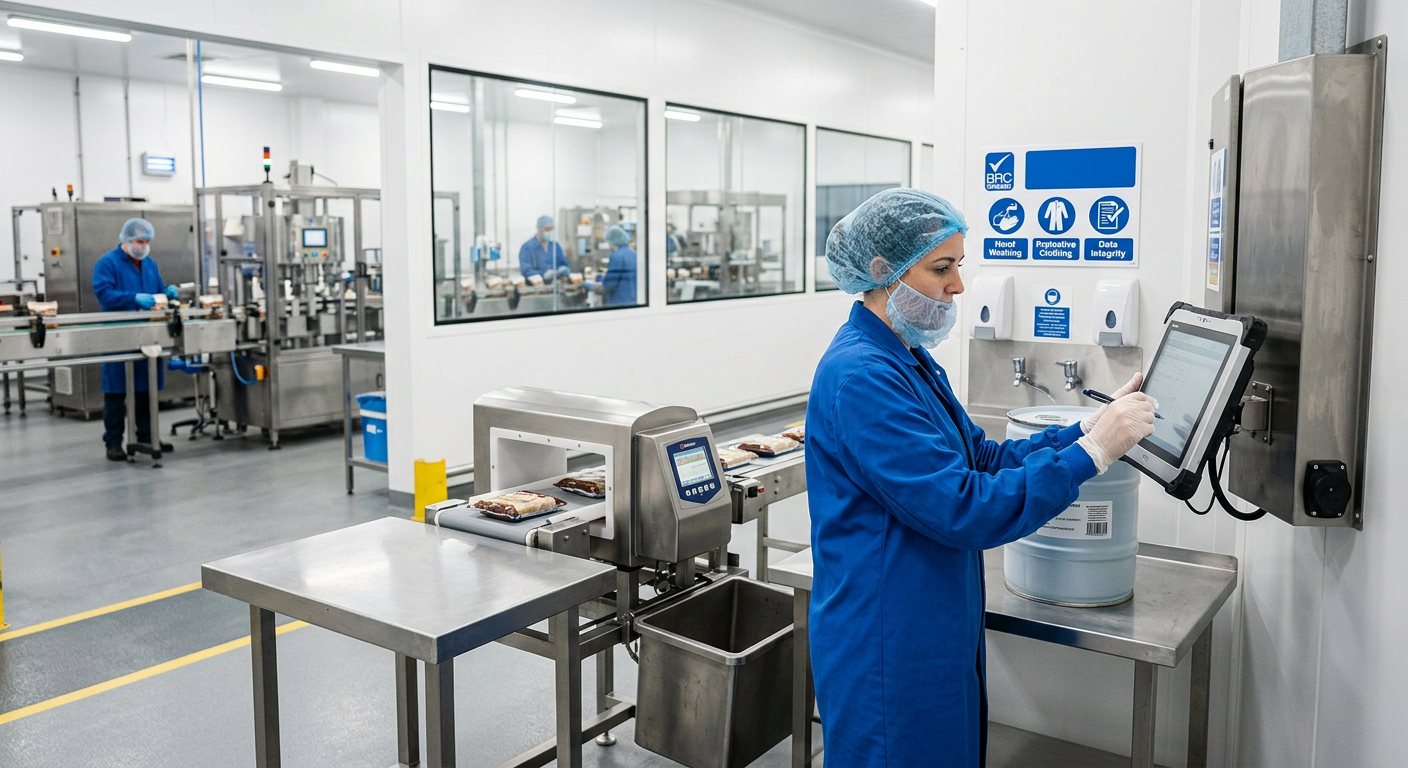
Beverage Plant Controls Integration
[trp_language language=”en_US”]
Beverage plant controls integration is the practical work of connecting field devices, PLCs, skids, packaging equipment, SCADA, historians, MES tools, and cloud analytics into one reliable operating environment. In the United States, the strongest projects are not the ones with the most software layers. They are the ones that improve throughput, reduce downtime, simplify sanitation, support food safety, and give operations teams one trustworthy source of production truth. For beverage manufacturers running breweries, RTD lines, juice systems, dairy beverage plants, carbonated soft drink lines, spirits operations, and aseptic processes, integration has become a business requirement rather than an optional automation upgrade.
That requirement is growing across major production corridors such as Chicago and Milwaukee for brewing, California wine and functional beverage regions, the Carolinas for co-packing and food-grade utilities, Texas for fast-growing manufacturing relocation, and logistics-heavy markets near the ports of Los Angeles, Long Beach, Houston, Savannah, and Newark. Plants that once accepted isolated fillers, standalone pasteurizers, or packaging machines now need plantwide visibility, traceability, OEE reporting, recipe consistency, utility coordination, and better capital planning. This is where disciplined engineering and controls strategy matter.
For teams evaluating an integration partner, it helps to work with a firm that understands both process and execution. Disruptive Process Solutions approaches beverage projects from a business and operations standpoint, aligning process engineering, controls, installation, and startup with profitability goals instead of treating integration as a software-only exercise.
Quick Answer

The fastest answer is this: beverage plant controls integration should create a standard, secure, and scalable data and control architecture from sensors on the floor to dashboards in the cloud. In most U.S. beverage facilities, that means connecting instruments, VFDs, valve manifolds, analyzers, and motor control to PLC platforms; standardizing alarms, tags, and naming; bringing line and utility data into SCADA or a modern visualization layer; and publishing contextualized production data to historians, MES tools, ERP connections, and cloud analytics.
A good integration strategy also respects reality. Most beverage plants are not greenfield facilities with one automation vendor. They are patchworks of expansions, acquisitions, OEM packages, and legacy upgrades. A syrup room may be Allen-Bradley, a tunnel pasteurizer may be Siemens, a water treatment skid may be Schneider, and the packaging line may include multiple proprietary machine controllers. The right integration plan does not force everything into a single vendor at all costs. It creates interoperability, cybersecurity, maintainability, and clean data models that operations teams can actually use.
For buyers, the main decision criteria are straightforward: can the architecture reduce downtime, improve changeovers, support food safety documentation, scale to additional lines or sites, and stay maintainable by internal staff after startup? If the answer is yes, the investment usually pays back through throughput, labor efficiency, lower waste, and smarter capital allocation.
Connecting the Beverage Production Stack from Field Devices to Cloud Analytics

The beverage production stack begins at the process edge. This includes flow meters, pressure transmitters, temperature RTDs, conductivity probes, inline Brix instrumentation, dissolved oxygen analyzers, level sensors, barcode readers, checkweighers, and vision systems. These devices feed PLCs and local machine controllers. Above that sit HMI and SCADA layers, historians, OEE and MES applications, quality systems, ERP connections, and cloud data lakes or analytics platforms.
In U.S. beverage operations, the challenge is not merely collecting data. It is contextualizing data. A filler speed number without SKU context, sanitation state, operator assignment, or upstream tank batch ID is only partial information. The architecture must define what the signal means, where it originated, when it changed, and how it maps to production events. This is especially important for regulated or audit-sensitive environments such as dairy beverages, low-acid products, or aseptic systems.
| Production Layer | Typical Beverage Assets | Main Data Type | Primary Integration Goal | Common Risk | Recommended Standard |
|---|---|---|---|---|---|
| Field Devices | Flow, pressure, temperature, conductivity, Brix | Raw process values | Reliable sensing | Uncalibrated instruments | Calibration plan and tag standard |
| Control Layer | PLCs, remote I/O, VFDs | Logic states, setpoints, interlocks | Deterministic control | Inconsistent code structure | Reusable PLC templates |
| Machine Layer | Fillers, labelers, case packers | Counts, faults, mode status | Line coordination | Opaque OEM data access | Documented interface specification |
| Supervisory Layer | SCADA, HMI, alarms | Operator actions and visibility | Operational awareness | Alarm flooding | ISA-style alarm rationalization |
| Operations Layer | Historian, OEE, MES, batch tools | KPIs, production events, genealogy | Decision support | Bad contextual mapping | Standardized data model |
| Enterprise and Cloud | ERP, BI, cloud analytics | Aggregated site data | Portfolio optimization | Latency and cybersecurity gaps | Role-based secure architecture |
This stack works best when the plant starts with a clear naming convention, agreed tag hierarchy, equipment states, time synchronization rules, and line segmentation strategy. Teams that skip this foundation often end up with attractive dashboards that no one trusts.
From a technology perspective, DPS supports the controls and process side together, blending PLC programming, automation, SCADA, utilities coordination, and complete system integration with broader mechanical, process, electrical, and project engineering. That cross-disciplinary view matters because beverage integration failures often begin with process assumptions, not software bugs.
Managing Multi-Vendor Sites with Allen-Bradley, Siemens, and Schneider Together

Multi-vendor environments are normal in beverage manufacturing. A U.S. plant may have Rockwell Automation in brewhouse controls, Siemens in pasteurization or utilities, and Schneider Electric in power, water, or OEM skids. Integration success depends on choosing a practical interoperability method rather than trying to rewrite everything into one platform.
In many cases, the best model is to preserve stable local control in the native PLC while exposing standardized line and equipment data to a plantwide layer. OPC UA, MQTT with Sparkplug, industrial gateways, and carefully designed API or database interfaces can all serve this model. The key is to keep machine safety and deterministic control local while sharing production states, counts, recipes where appropriate, and event data upward.
| Vendor Mix Scenario | Typical Area | Integration Method | Best Use Case | Main Caution | Expected Outcome |
|---|---|---|---|---|---|
| Allen-Bradley + Siemens | Process to packaging | OPC UA gateway | Mixed legacy and new lines | Tag mapping complexity | Shared visibility without rewriting logic |
| Allen-Bradley + Schneider | Utilities and water systems | SCADA middleware | Energy and utility monitoring | Alarm duplication | Centralized utility dashboard |
| Siemens + OEM proprietary PLC | Pasteurizer or sterile skid | Read-only data bridge | Protect OEM warranty | Limited control access | Reliable KPI capture |
| Three-vendor sitewide mix | Expansion by acquisition | MQTT Unified Namespace | Enterprise scaling | Weak governance if unmanaged | Flexible data distribution |
| Legacy PLC-5 or SLC with modern line | Brownfield brewing | Protocol converter and phased upgrade | Budget-sensitive modernization | Lifecycle support issues | Reduced risk during migration |
| Standalone OEM cells | End-of-line packaging | Machine-level data collector | Quick OEE deployment | Low context quality | Faster reporting start-up |
For plant leadership, the buying advice is simple: require an interface document before procurement or FAT. It should define protocols, ownership of tags, recipe authority, downtime state mapping, cybersecurity zones, remote access rules, and exact deliverables for commissioning support. This prevents late-stage disputes between OEMs, integrators, and plant engineering.
In the United States, this is especially relevant when expansions happen under aggressive schedules in Dallas-Fort Worth, Atlanta, or Phoenix, where line startup dates are often tied to retailer commitments or seasonal demand. A multi-vendor strategy built early reduces startup chaos.
Integrating OEM Equipment Such as Fillers, Pasteurizers, and Packaging Lines
OEM equipment integration is where many beverage projects win or lose value. Fillers, depalletizers, rinser/fillers/cappers, tunnel pasteurizers, flash pasteurizers, carton erectors, tray packers, sleevers, labelers, palletizers, and CIP skids each come with their own controls philosophy. Some OEMs expose rich diagnostics and production counters. Others provide only the minimum interface required to run.
The integration goal should be to capture the machine states that operations actually need: mode, run permissive, fault category, current product, actual speed, target speed, reject counts, starved and blocked conditions, sanitation mode, maintenance bypasses, and utility demand. It is equally important to map upstream and downstream dependencies. A filler slowdown means something different if it is caused by low product level, capper faults, conveyor accumulation, or label supply interruptions.
| OEM Asset | Critical Tags to Capture | Business Value | Integration Priority | Common Challenge | Recommended Approach |
|---|---|---|---|---|---|
| Filling machine | Speed, counts, rejects, fault code, mode | OEE and giveaway control | Very high | Proprietary status codes | Normalize fault categories |
| Tunnel pasteurizer | Zone temperatures, conveyor speed, alarms | Food safety and throughput | Very high | Validation sensitivity | Separate control from reporting |
| Flash/HTST system | Flow, temp hold, diversion state | Compliance and traceability | Very high | Audit trail needs | Historian with event stamps |
| Labeler | Rate, fault state, label roll status | Downtime analysis | High | Minor stop visibility | High-frequency event capture |
| Case packer | Cases packed, jams, starved/blocked | Line balancing | High | Inconsistent machine states | Standard line state model |
| Palletizer | Pallet count, pattern, fault state | Warehouse flow planning | Medium | Disconnected warehouse systems | ERP or WMS handshake |
Plants should also insist on a commissioning matrix showing who owns dry testing, wet testing, utility verification, recipe testing, line integration, and data validation. That avoids the all-too-common problem where every vendor says the issue is someone else’s responsibility.
DPS also brings in a manufacturing perspective beyond controls. The company designs and supplies process equipment such as storage and process tanks, custom CIP systems, marination and cooking systems on the food side, and broader beverage infrastructure including blending, pasteurization support, and utility-connected process hardware. For plants trying to integrate mechanical scope and controls scope together, that can remove handoff gaps that typically slow startup.
Enabling Real-Time Data Flow with MQTT, Sparkplug, and the Unified Namespace
Real-time data architecture has shifted significantly in modern beverage facilities. Traditional point-to-point polling still exists, but more U.S. manufacturers are evaluating publish-subscribe models using MQTT and Sparkplug. The reason is flexibility. Instead of every application requesting data directly from every PLC, edge nodes publish structured data once, and approved consumers subscribe as needed.
The Unified Namespace, or UNS, is a data architecture concept in which the business defines a common plant and enterprise data model. Rather than creating separate meanings for the same filler, SKU, batch, or line state in every software package, the UNS acts as a shared context layer. For beverage operations with multiple lines, seasonal SKU shifts, co-packing complexity, or multi-site reporting needs, this can be powerful.
Still, the UNS is not a magic product. It requires disciplined governance, topic naming, payload standards, event definitions, and change control. Plants that rush into MQTT without a data ownership model can create a new kind of disorder.
| Architecture Option | How Data Moves | Best Fit | Strength | Weakness | U.S. Beverage Use Case |
|---|---|---|---|---|---|
| Direct PLC polling | Application reads controller tags | Small single line | Simple startup | Poor scalability | Craft brewery packaging cell |
| SCADA-centric model | SCADA aggregates and forwards | Mid-size plants | Good operator visibility | SCADA becomes bottleneck | Regional juice plant |
| Historian-first model | Data stored then consumed | Compliance-heavy sites | Strong history | Slower event use | Dairy beverage facility |
| MQTT without Sparkplug | Flexible publish-subscribe | Custom architectures | Lightweight transport | Requires more governance | Tech-forward co-packer |
| MQTT with Sparkplug | Structured edge publishing | Scalable multi-line plants | Standardized state handling | Learning curve | Large RTD beverage plant |
| Unified Namespace model | Common enterprise context | Multi-site operations | Excellent scalability | Needs strong data discipline | National beverage network |
By 2026, more U.S. beverage producers are expected to combine edge computing, MQTT-based event flow, and cloud analytics with sustainability dashboards. That will make it easier to correlate throughput, water use, steam demand, compressed air consumption, and product loss at the line or SKU level. Policy pressure around energy use, ESG reporting, and traceability will continue to push architectures toward better plantwide data consistency.
The chart above reflects a realistic growth pattern in U.S. demand for automation modernization, data visibility, and line integration. Growth is being driven by labor constraints, SKU complexity, retailer service expectations, and capital scrutiny.
Monitoring OEE Across Multiple Beverage Production Lines
OEE monitoring is one of the most common reasons plants pursue integration, but it is also one of the most commonly mishandled. OEE only works when availability, performance, and quality are defined consistently across lines and shifts. A can line, PET line, glass line, and aseptic carton line cannot always be measured with identical event assumptions. The plant needs a standard framework with line-specific nuances.
For example, a filler waiting on sanitized product may count differently from a line waiting on warehouse pallet supply. Planned sanitation, flavor changeover, and allergen changeover should not be mixed carelessly with unplanned downtime. If they are, the OEE number may look precise while telling management the wrong story.
| KPI Category | Definition | Needed Data Sources | Why It Matters | Frequent Error | Best Practice |
|---|---|---|---|---|---|
| Availability | Run time versus planned time | Machine state, schedule, sanitation events | Shows downtime losses | Ignoring planned changeovers | Use coded event model |
| Performance | Actual rate versus ideal rate | Counts, line speed, SKU target rate | Shows speed losses | Wrong ideal rate per package | Store SKU-specific standards |
| Quality | Good units versus total units | Reject counts, QA holds, rework | Shows yield impact | Excluding startup scrap | Define quality boundaries clearly |
| Changeover time | Time between good product runs | Operator input, recipe states, CIP status | Improves scheduling | Missing manual events | Blend automatic and operator events |
| Microstops | Short repeated interruptions | High-resolution machine events | Reveals hidden losses | Sampling too slowly | Capture events at source |
| Utility intensity | Water, steam, air, power per case | Utility meters and production counts | Supports sustainability | No time alignment | Synchronize clocks and batches |
When multiple lines are involved, the plant should define one downtime reason tree and one governance process for adding or changing codes. OEE should also connect to maintenance planning and utility performance, not just production scoreboards.
This demand profile aligns with current U.S. market dynamics. Functional beverages, RTD products, and aseptic lines tend to require stronger integration because of higher SKU churn, traceability demands, and tighter process control expectations.
Handling Change Management and Workforce Training for Integrated Systems
Technology alone does not deliver results. Beverage integration projects often underperform because operators, supervisors, maintenance teams, and sanitation leaders are brought in too late. A dashboard that nobody trusts, a downtime code tree that nobody uses correctly, or a CIP sequence that confuses night shift will weaken ROI quickly.
Change management should begin at design. That means involving operators in HMI layout review, maintenance in alarm philosophy and remote access planning, quality teams in audit trail requirements, and operations leadership in KPI definitions. Workforce training should include not only button-level instruction but also why the new architecture exists, what decisions it supports, and what actions are expected from each role.
By 2026, plants are likely to invest more in digital work instructions, role-based mobile alerts, remote subject matter support, and simulation-based startup training. This is especially helpful for high-growth co-packers and multi-shift plants where turnover or seasonal hiring can undermine consistency.
For service capability, DPS is strongest when projects need more than isolated programming support. Its model spans capital planning, feasibility, owner’s representation, general contracting where licensed, end-to-end project and program management, installation coordination, commissioning, and controls integration. You can review the breadth of these capabilities through its engineering and project services, which are structured to keep execution aligned across disciplines.
Building Scalable Architectures from Single Lines to Multi-Site Operations
Scalability is one of the most important buying criteria for U.S. manufacturers. Many plants begin with one integration target such as a packaging line OEE project, but later want utility monitoring, batch traceability, warehouse connectivity, enterprise reporting, or replication to another site. If the first project is too custom or too vendor-locked, scaling becomes expensive.
A scalable architecture usually includes standard naming, reusable code libraries, segmented industrial networks, edge data collection, a clear plant model, documented APIs or publish-subscribe topics, role-based access, and template-based dashboarding. It also includes capital realism. Not every single line needs a full MES stack. In many cases, a staged roadmap creates a better return.
Single-site beverage operators in places like St. Louis, Grand Rapids, or Sacramento may only need line-level visibility first. Multi-site beverage groups with plants in the Southeast, Midwest, and West Coast will benefit more from a structured enterprise data model from the start. In both cases, the plant should design for the next step, even if it does not buy everything immediately.
The trend above shows the gradual shift from tightly coupled plant integrations to more flexible event-driven architectures. Adoption will vary by plant size, IT maturity, and regulatory needs, but the direction is clear.
Avoiding Common Mistakes in Beverage Integration Projects
Most integration failures are predictable. The most common mistake is starting with software screens instead of business goals. Plants often ask for dashboards before they define the decisions the dashboard should drive. Another frequent error is ignoring utility systems. A line may appear to have a filler problem when the root cause is compressed air instability, glycol temperature drift, or CIP timing conflicts.
Another trap is poor documentation. Without a current network map, controls narrative, sequence of operations, tag list, alarm matrix, and FAT/SAT records, the plant becomes dependent on tribal knowledge. This increases risk during expansions, staffing changes, and audits.
| Common Mistake | What It Looks Like | Likely Result | How to Prevent It | Owner | When to Address |
|---|---|---|---|---|---|
| No business case | Buying software before defining value | Weak ROI and poor adoption | Set throughput, downtime, and quality targets | Plant leadership | Concept phase |
| Ignoring OEM interfaces | Late discovery of locked data access | Limited visibility | Specify interface requirements in purchase terms | Procurement and engineering | Before equipment order |
| Bad tag governance | Duplicate or unclear naming | Untrusted data | Create a naming and hierarchy standard | Controls team | Early design |
| Weak cybersecurity | Shared passwords and open remote access | Operational and compliance risk | Segment networks and use role-based access | IT and OT | Architecture design |
| No training plan | Operators learn informally after startup | Low system usage | Run role-based training and refreshers | Operations | Before and after startup |
| No expansion roadmap | One-off custom solution | High future cost | Use scalable templates and standards | Executive sponsor | Design and budgeting |
A practical way to reduce these risks is to choose a partner with both field execution and capital project discipline. On larger beverage projects, controls decisions are tied to utility routing, process safety, sanitation design, line layout, startup sequencing, and contractor management. That is why many manufacturers prefer integrated delivery rather than fragmented specialist handoffs.
FAQ
Below are common questions from U.S. beverage producers evaluating plant controls integration.
How long does a beverage integration project usually take?
For a single packaging line OEE and data visibility project, timelines may range from 8 to 16 weeks depending on OEM access and plant shutdown windows. For a full process-to-packaging integration with utilities, recipes, and reporting, timelines are commonly several months and should be aligned with equipment FAT, installation, SAT, and startup plans.
Should we standardize on one PLC brand?
Not always. Standardization helps maintenance and training, but forcing a full platform conversion can create unnecessary cost and risk. In many cases, keeping proven local controls in place and standardizing data exchange, visualization, and governance is the better business decision.
What is the best first use case for a brownfield beverage plant?
Usually one of three: packaging line OEE, utility performance monitoring, or process visibility for a bottleneck area such as blending, pasteurization, or filling. The best first step is the one that produces a measurable operating decision quickly.
How do we integrate old and new equipment together?
Use a phased architecture. Legacy PLCs may require protocol converters, edge gateways, or read-only data extraction while newer machines can publish richer real-time data. Plan the migration path so old assets do not block future scalability.
What role does cybersecurity play in beverage controls integration?
It is essential. Remote access for OEMs, cloud analytics, and plantwide networking create risk if poorly managed. Segmentation, user roles, secure remote access, patch governance, and documented ownership between IT and OT are mandatory.
Can controls integration help with sustainability goals?
Yes. When production counts are correlated with water, steam, compressed air, glycol, and power use, the plant can identify utility intensity by SKU, shift, or line. This supports 2026 sustainability reporting and cost reduction initiatives.
How should we compare integration partners?
Look at beverage process knowledge, multi-vendor controls experience, startup support, documentation discipline, project management strength, and the ability to connect controls work to capital execution. A partner who understands fillers, pasteurizers, CIP, utilities, packaging, and compliance will usually outperform a software-only vendor.
Do we need cloud analytics right away?
No. Many plants should first establish reliable local control, event models, historians, and OEE data. Cloud analytics are most useful when the plant already trusts its source data and wants multi-site comparison, advanced reporting, or enterprise optimization.
For companies planning broader modernization, it is useful to review actual project examples and execution style. DPS shares selected project experience through its case study portfolio, which helps manufacturers see how process, utilities, installation, and automation can be aligned in real operating environments.
Equipment strategy also matters. If the project includes custom process hardware, tanks, or CIP-related systems, integration is easier when mechanical and controls scopes are designed together. DPS supports this through its process equipment capabilities, helping reduce interface gaps between fabricated equipment, field installation, and startup programming.
What U.S. beverage manufacturers should do next
In the United States, the market is moving toward smarter, faster, and more accountable beverage manufacturing. Co-packers need rapid line changeovers and multi-customer reporting. Brewers need better packaging efficiency and utility control. RTD and functional beverage producers need recipe accuracy, traceability, and speed to market. Dairy and aseptic plants need tighter compliance and sanitation visibility. Across all of these segments, controls integration is now a foundation for profitability.
The best next step is usually an assessment, not a software purchase. Document the current control platforms, OEM interfaces, data gaps, production bottlenecks, utility constraints, reporting needs, and expansion roadmap. Then define a phased architecture that fits your plant, your workforce, and your capital plan. This is especially important in regional manufacturing hubs where growth is fast and shutdown windows are short, from North Carolina and Georgia to Texas, California, and the Midwest.
Manufacturers that take this approach tend to build systems that last. They get cleaner startup paths, better accountability between trades and vendors, stronger data trust, and more useful reporting for operations and leadership. In a market where margins are constantly pressured by labor, freight, packaging cost, and retailer expectations, that kind of integration is not just technical improvement. It is operating leverage.
The comparison chart highlights a common purchasing reality in U.S. beverage projects: software expertise matters, but projects often create more value when controls are tied to process design, utilities, installation planning, contractor coordination, and startup management.
[/trp_language]
Complete Company Portfolio

About the Author: Disruptive Process Solutions (DPS)
The DPS team combines process engineering expertise with real-world food and beverage manufacturing experience. Our content focuses on process optimization, production efficiency, facility improvements, and practical solutions that help manufacturers operate more effectively in a rapidly evolving industry.
Share

