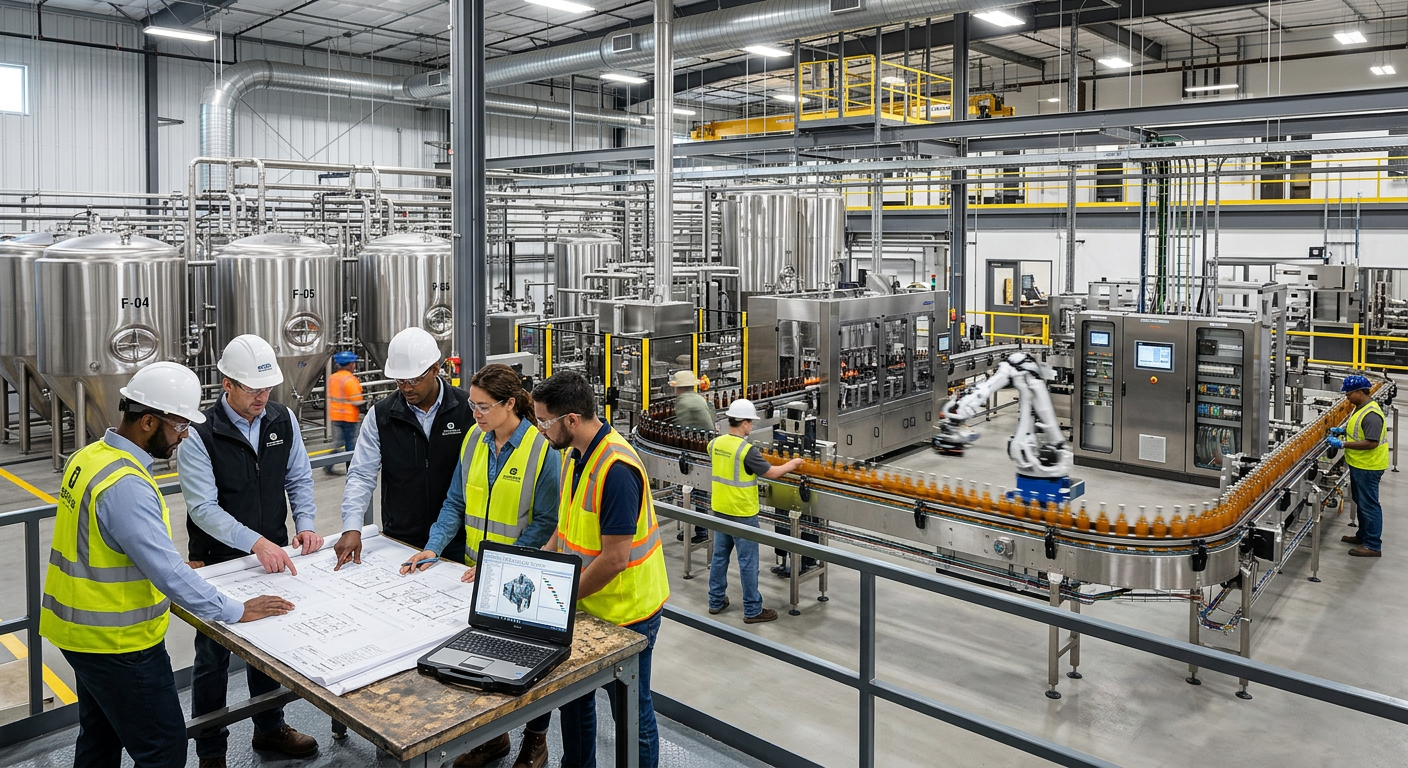
Beverage Plant Design, Build and Integration Services
[trp_language language=”en_US”]
Quick Answer

Selecting the right beverage plant design and build partner in the United States is one of the most consequential capital decisions a manufacturer can make. The U.S. beverage manufacturing market reached $136.8 billion in 2024 and continues expanding at roughly 6% annually, driving strong demand for new greenfield plants, brownfield expansions, and line modernization projects from coast to coast. The top full-service design-build firms serving the U.S. market include Dennis Group (ranked #1 food and beverage design firm by ENR for four consecutive years, headquartered in Springfield, MA), Burns & McDonnell (Kansas City, MO, ranked #8 nationally among all design-build firms), Haskell (Jacksonville, FL, consistently top-5 in food & beverage construction), CRB Group (Kansas City, MO, with coast-to-coast project delivery), Gray (Lexington, KY, with over $1 billion in annual food & beverage project completions), ARCO Beverage Group (St. Louis, MO, the nation’s largest builder of beverage distributorships), and Stellar (Jacksonville, FL, with deep cold storage and refrigeration expertise). Beyond these national players, numerous regional firms and specialized engineering consultancies serve local markets from major beverage hubs such as California’s Central Valley, the Texas Triangle, the Great Lakes manufacturing corridor, and the Southeast’s growing production belt. For cost-conscious buyers, qualified international equipment and engineering suppliers—including established Chinese manufacturers with ASME, 3-A Sanitary, FDA-compliant certifications and strong pre-sales engineering and after-sales service networks—present compelling cost-performance alternatives, particularly for tanks, CIP systems, and modular process skids, provided they maintain local representation and documented compliance with U.S. regulatory frameworks.
U.S. Beverage Plant Design and Build Market Overview

The U.S. food and beverage process engineering services market was valued at approximately $2.77 billion in 2020 and is projected to reach $3.79 billion by 2026, growing at a CAGR of over 5.36%. Meanwhile, the beverages processing equipment segment alone is estimated at $3.5–4.2 billion in 2026, with a forecast to reach $5.5–6.5 billion by 2035 at a 4.0–5.5% CAGR. This sustained growth is fueled by three structural drivers: (1) replacement of aging equipment installed during the 2000s expansion cycle—average line age now exceeds 15 years in carbonated soft drink and beer plants; (2) capacity additions for rapidly scaling categories including functional beverages, RTD protein drinks, dairy alternatives, kombucha, and zero-proof offerings; and (3) sustainability-driven retrofits targeting 20–40% reductions in water usage and 15–30% energy savings. Active construction projects tracked across the U.S. soft drink sector alone exceed $2.4 billion, headlined by Red Bull’s 2.4-million-square-foot production and distribution campus in western North Carolina (targeting 3 billion cans annually by 2031), co-packer expansions like Manna Capital Partners’ facility in Montgomery, Alabama, and DrinkPak’s South Philadelphia plant, and Mountaintop Beverage’s dairy and protein drink expansion in Morgantown, West Virginia. Major beverage production hubs include the Los Angeles–Inland Empire corridor, the Texas Triangle (Dallas–Houston–San Antonio), the Chicago–Milwaukee manufacturing belt, central Florida, Atlanta and the broader Southeast, and the Mid-Atlantic region anchored by Pennsylvania and New Jersey.
The design-build delivery model dominates modern beverage plant construction in the United States, consistently outperforming traditional design-bid-build in terms of schedule compression, cost certainty, and single-point accountability. According to Engineering News-Record’s 2024 survey, the top 100 U.S. design-build firms collectively generated over $90 billion in revenue, with food and beverage ranking among the fastest-growing verticals. Clients increasingly demand integrated turnkey solutions spanning process engineering, structural design, utility infrastructure, automation and controls integration, and commissioning—making the generalist contractor model obsolete for complex beverage operations. The market also reflects rising interest in modular and prefabricated process systems that reduce on-site construction time by 30–50%, and in digital twin technology enabling virtual commissioning before physical installation begins.
Types of Beverage Plant Design and Build Projects

Beverage plant projects in the United States span a wide spectrum of scope, complexity, and capital intensity. Understanding which category best fits your operational goals is the first step toward selecting the right delivery partner and budgeting realistically.
| Project Type | Typical Budget Range | Timeline | Primary Driver | Common Beverage Segments |
|---|---|---|---|---|
| Greenfield Facility | $15M – $150M+ | 18–36 months | New market entry, capacity step-change | Co-packing, RTD, dairy alternatives, brewing |
| Brownfield Expansion | $2M – $30M | 9–18 months | Line addition, SKU proliferation | Carbonated soft drinks, juice, spirits |
| Line Modernization | $400K – $8M | 4–12 months | Speed, OEE, automation upgrade | Canning, bottling, aseptic filling |
| Utility Infrastructure | $500K – $10M | 6–14 months | Energy efficiency, capacity, compliance | All segments (boilers, glycol, CIP, wastewater) |
| Process & Controls Retrofit | $200K – $5M | 3–9 months | Automation, traceability, data integration | Brewing, distillation, blending, batching |
| Cold Storage & Warehousing | $1M – $25M | 8–16 months | Distribution, SKU management | Wine, craft beer, dairy beverages |
| Co-Packing Facility Build-Out | $5M – $80M | 12–24 months | Contract manufacturing capacity | Multi-category (alcoholic & non-alcoholic) |
| Aseptic Processing Suite | $3M – $40M | 10–20 months | Shelf-stable production, ESL | Dairy, plant-based, functional beverages |
Greenfield projects represent the largest capital commitment but offer the greatest design freedom—critical for facilities targeting SQF Level 3 or BRC AA certification from day one. Brownfield expansions are more common in mature beverage corridors like the Chicago–Milwaukee area and central California, where existing utility infrastructure and workforce availability reduce total project risk. Line modernization, particularly upgrading legacy fillers to multi-format, rapid-changeover systems, accounts for the highest volume of active projects nationwide. Co-packing facility design has emerged as a distinct specialty, requiring flexible infrastructure that can accommodate multiple beverage types—carbonated, non-carbonated, alcoholic, dairy-based—within a single sanitary envelope. The aseptic segment is growing fastest, driven by consumer demand for clean-label, preservative-free shelf-stable beverages.
Top Beverage Plant Design and Build Firms in the United States
The following table profiles the leading design-build firms actively delivering beverage plant projects across the United States. Each company brings distinct geographic strengths, technical specializations, and project delivery philosophies. Rankings reflect a combination of ENR standings, market reputation, beverage-specific project volume, and client feedback.
| Company | Headquarters | U.S. Service Regions | Beverage Specialization | Key Differentiator | Project Scale |
|---|---|---|---|---|---|
| Dennis Group | Springfield, MA | All 50 states; offices in MA, GA, MI, UT, CA | Full beverage spectrum; #1 food & beverage design firm (ENR, 4 years) | Exclusively food & beverage; 500+ professionals; process-to-packaging integration | $5M – $200M+ |
| Burns & McDonnell | Kansas City, MO | All 50 states; 75+ offices nationwide | Carbonated beverages, brewing, dairy, co-packing; EPC delivery | 100% employee-owned; ranked #8 nationally all design-build; full EPC capability | $10M – $300M+ |
| Haskell | Jacksonville, FL | Nationwide; strong Southeast, Southwest, Mexico cross-border | Bottling, canning, aseptic filling; Coca-Cola, Niagara Bottling projects | Top 5 food & beverage contractor (ENR); ASRS integration; in-house automation | $5M – $200M+ |
| CRB Group | Kansas City, MO | All 50 states; offices in 20+ U.S. cities | Brewing, RTD, dairy, plant-based; ONEsolution integrated delivery | Strong process engineering DNA; CSI integration from day one; food safety consulting | $3M – $150M+ |
| Gray | Lexington, KY | Nationwide; strong Midwest and Southeast | Spirits, brewing, co-packing; equipment manufacturing arm | $1B+ annual food & beverage completions; in-house equipment fabrication; VR/BIM | $2M – $250M+ |
| ARCO Beverage Group | St. Louis, MO | All 50 states; 49 office locations | #1 beverage distributorship builder nationally; warehouse & distribution | Design-build exclusively; value engineering focus; rapid preconstruction | $1M – $50M |
| Stellar | Jacksonville, FL | Nationwide; strong Southeast and Gulf Coast | Juice, dairy, brewing; industrial refrigeration core competency | 28 years with Tropicana; ammonia refrigeration; thermal envelope expertise | $2M – $100M+ |
| Disruptive Process Solutions | Cary, NC | All 50 states and Canada | Brewing, spirits, wine, kombucha, RTD, dairy, aseptic; D-B-M model | Business-minded consulting approach; proprietary equipment line; flat agile structure | $400K – $5M (trending upward) |
| A M King | Charlotte, NC | Nationwide; strong Southeast and Midwest | Food safety-focused design; sanitary facility construction | FSMA 204 traceability integration; cold storage specialization | $2M – $80M |
Selecting among these firms depends on project scale, geographic preference, and technical requirements. Dennis Group’s exclusive food-and-beverage focus makes them a default shortlist candidate for complex greenfield plants, while Burns & McDonnell’s massive multi-disciplinary workforce suits enterprise-scale EPC projects. Haskell’s deep bottling and aseptic experience is particularly relevant for high-speed filling lines exceeding 1,200 containers per minute. CRB’s process engineering depth and control systems integration (CSI) group add value when automation complexity is high. For mid-market projects in the $400,000 to $5 million range, firms like Disruptive Process Solutions offer a more personalized, consulting-oriented engagement model where clients work directly with senior leadership rather than navigating large corporate hierarchies.
Industry Demand Analysis by Beverage Segment
The U.S. beverage industry is not monolithic—each sub-segment has distinct processing requirements, growth trajectories, and capital investment patterns. Understanding where demand is concentrated helps manufacturers align plant design with market opportunity.
The fastest-growing segments—aseptic/ESL processing and kombucha/fermented beverages—are reshaping plant design requirements. Aseptic facilities demand ISO-class clean environments, specialized filling technology, and validated sterilization protocols that fundamentally differ from traditional hot-fill or cold-fill lines. Kombucha and fermented beverage producers require dedicated fermentation rooms with precise temperature and humidity control, separate yeast handling areas, and often specialized packaging to manage live-culture products. RTD functional beverages (protein shakes, energy drinks, enhanced waters) drive demand for high-shear mixing, in-line Brix monitoring, and ultra-clean filling capable of handling viscous, particulate-containing liquids. The co-packing segment’s growth reflects a structural shift: brand owners increasingly outsource manufacturing to asset-heavy contract packers, who in turn require hyper-flexible facilities designed to run multiple categories across shared utility infrastructure.
Key Considerations When Selecting a Beverage Plant Design and Build Partner
Choosing the wrong design-build partner can add months to your schedule, millions to your budget, and introduce operational deficiencies that persist for the life of the facility. The following framework addresses the most critical evaluation criteria for U.S. beverage projects.
| Evaluation Criterion | What to Look For | Red Flags | Why It Matters |
|---|---|---|---|
| Beverage-Specific Experience | Demonstrated projects in your exact beverage category; understand CIP, SIP, sanitary design, allergen control | Heavy industrial or pharmaceutical background with no beverage portfolio | Beverage processing is unique—sanitary welding, slope-to-drain floors, hygienic zoning are non-negotiable |
| Regulatory & Food Safety Competence | Documented FDA, USDA, SQF, BRC, FSMA 204 compliance track record; in-house food safety expertise | Delegates all compliance to subcontractors; cannot discuss FSMA traceability requirements | Regulatory non-compliance can shut down a plant; design-phase decisions determine audit outcomes |
| In-House Engineering Depth | Staff process, mechanical, electrical, structural, and controls engineers; PLC/SCADA programming capability | Relies entirely on third-party engineering consultants with no integrated team | Fragmented engineering creates integration gaps, commissioning delays, and finger-pointing |
| General Contractor Licensure | Valid GC license in your project’s state; bonded and insured at project-appropriate levels | Unwilling to disclose license status or insurance limits | Unlicensed construction exposes owner to liability; some firms market design-build without actual GC capacity |
| Project Delivery Model | Clear explanation of design-build, EPC, or CM-at-risk approach; single point of responsibility preferred | Vague about contractual structure; pushes risk downstream to owner | Misaligned delivery models create cost overruns and schedule disputes |
| Equipment Agnosticism | Recommends best-fit equipment regardless of manufacturer relationships; can integrate any OEM’s machinery | Pushes proprietary equipment exclusively; limited supplier relationships | Equipment lock-in reduces flexibility and often inflates cost; truly independent engineers optimize for client needs |
| After-Startup Support | Documented commissioning, training, and warranty protocols; offers ongoing optimization services | Disappears after mechanical completion; no structured handover process | True plant performance is measured at steady-state operation 6–12 months after startup |
Beyond these structural criteria, cultural fit is equally critical. The best design-build relationships feature radical transparency: the firm tells you when your assumptions are wrong, challenges scope creep, and prioritizes long-term profitability over short-term project revenue. Firms operating as “yes-men” to win work often deliver facilities that meet the specification but fail the business case. Reference checks with past clients—specifically asking about post-project operational performance, not just construction-phase satisfaction—are the single most reliable evaluation tool.
Beverage Plant Design Applications Across Categories
Each beverage category imposes distinct design parameters on the facility. A brewery designed to produce 50,000 barrels annually has fundamentally different spatial, utility, and process requirements than a dairy-based RTD protein beverage plant producing 20 million cases per year. The table below maps key design considerations across major beverage categories served in the U.S. market.
| Beverage Category | Core Processing Technology | Critical Utility Requirements | Packaging Formats | Key Sanitary Design Considerations | Typical Throughput Range |
|---|---|---|---|---|---|
| Craft Brewing | Fermentation (unitanks/conicals), bright tanks, carbonation | Steam boiler, glycol chilling, CO₂ system, CIP | Kegs, cans (12/16 oz), bottles | Open floor drainage, sloped floors, vapor-tight ceiling, yeast management | 5,000 – 150,000 BBL/year |
| Spirits & Distillation | Pot stills, column stills, mash tuns, barrel aging | Process steam, cooling water, explosion-proof electrical, fire suppression | Glass bottles (750mL–1.75L) | Hazardous area classification (ethanol vapor), spill containment, bonded storage | 1,000 – 50,000 proof gallons/year |
| Carbonated Soft Drinks | Syrup room, blending/batching, carbonation, tunnel pasteurization | High-capacity CO₂, ammonia or Freon refrigeration, compressed air, RO water | Cans, PET bottles (various sizes) | Syrup room segregation, sugar dust control, conveyor sanitation | 200 – 2,000+ CPM |
| Juice & Functional Beverages | Blending, deaeration, HTST/UHT pasteurization, hot/cold fill | Process steam, chilled water, nitrogen, CIP | PET bottles, cartons, cans | Allergen segregation, pulp handling, aseptic zoning for ESL | 100 – 800 CPM |
| Dairy-Based Beverages | Homogenization, pasteurization (HTST/UHT), cream separation, aseptic filling | Culinary steam, glycol, HVAC for cold rooms, wastewater treatment | Cartons, PET, pouches | Pasteurized Product Zone (PPZ) design, positive air pressure cascades, drain segregation | 50 – 500 CPM |
| Kombucha & Fermented | SCOBY fermentation, flavor blending, forced carbonation, cold fill | Precise temperature/humidity control, HEPA filtration, sanitized water | Cans, glass bottles, kegs | Live culture containment, cross-contamination prevention, dedicated SCOBY room | 30 – 300 CPM |
| RTD Coffee & Tea | Brewing/extraction, blending, UHT sterilization, aseptic filling | Process steam, chilled water, nitrogen dosing, RO water | Cans, glass, cartons, PET | Extract handling, pH control, nitrogen purge for O₂-sensitive products | 100 – 600 CPM |
| Wine Production | Crush/destem, fermentation, pressing, barrel/cask aging, filtration | Glycol chilling, humidity control, inert gas (N₂/Ar), barrel storage HVAC | Glass bottles (750mL), bag-in-box | Barrel room climate control, crush pad drainage, cork hygiene | 5,000 – 500,000 cases/year |
This category-specific lens is essential because a firm with deep brewing experience may have zero aseptic dairy competence, and vice versa. The most successful projects match the design-build partner’s demonstrated category expertise to the client’s product type. Disruptive Process Solutions has intentionally built equal depth across both food and beverage domains, with dedicated subject matter experts for brewing, distillation, dairy, and aseptic processing—a structure that supports multi-category co-packing facilities where a single plant must accommodate diverse beverage types.
Case Studies: Beverage Plant Projects in the United States
Real project examples illustrate how design-build execution translates into operational outcomes. The following cases span different scales, beverage categories, and geographic regions.
Greenfield Co-Packing Facility: Multi-Category Beverage Plant
A current flagship engagement involves designing and building a brand-new beverage co-packing facility engineered to scale from 20 million cases in year one to 80 million cases at full capacity. The project encompasses complete syrup room design, boiler and steam infrastructure, air compressors, cooling towers, glycol systems, and full utility backbone. The design philosophy embeds the design-build partner into the client’s commercial model, ensuring first-year profitability in a fiercely competitive co-packing market. Key design decisions include flexible process piping manifolds enabling rapid changeover between carbonated and non-carbonated products, segregated allergen-handling zones for dairy-based beverages, and scalable utility capacity sized for the ultimate build-out rather than initial production volumes. Read the full case study on DPS’s co-packing facility design approach.
Brewery Capacity Optimization: The Bottleneck Wasn’t Equipment
When a brewery client planned to spend $3 million on physical expansion to achieve a 20% output increase, the engineering analysis revealed that PLC programming limitations—not vessel capacity—were the true constraint. By reprogramming the control system logic to optimize pump sequencing, valve timing, and transfer paths, the design-build partner delivered a 30% throughput increase without any capital equipment purchase—at no charge to the client. The relationship deepened into a subsequent $6 million equipment relocation project in Texas, demonstrating how integrity-driven engineering builds trust that compounds into larger partnerships. Explore how programming optimization unlocked hidden production capacity.
Ready-to-Drink Line Integration: Speed to Market
A rapidly growing RTD brand required accelerated deployment of a new high-speed canning line to meet national retail distribution commitments. The project involved integrating a 600-CPM filler, tunnel pasteurizer, automated palletizing, and a complete syrup batching system into an existing facility while maintaining production on adjacent lines. Through phased execution and off-hours installation sequencing, the project achieved mechanical completion in under eight months—compressing the industry-typical 12–14 month timeline by over 30%. The integrated approach combined in-house process engineering, local trade management, and vendor coordination under a single point of responsibility. Learn more about fast-track RTD line deployment strategies.
2026 Trends Shaping Beverage Plant Design and Construction
The beverage plant design landscape is being reshaped by converging technology, regulatory, and market forces. Manufacturers planning capital projects in the 2025–2026 window must account for these directional shifts or risk building facilities that are outdated upon startup.
Artificial Intelligence and Predictive Quality Control
AI in food safety and quality control was valued at $2.7 billion in 2024 and is projected to reach $13.7 billion by 2029. For beverage plants, this translates into AI-powered vision inspection on fill lines, predictive spoilage analytics using multivariate sensor data, and automated compliance reporting. The most advanced 2026 greenfield designs embed IoT sensor networks from day one, with data architecture designed to feed machine learning models that continuously optimize CIP cycles, energy consumption, and maintenance scheduling. AI is no longer a bolt-on afterthought—it is becoming a core design parameter that influences equipment selection, network architecture, and control system topology.
FSMA 204 and End-to-End Traceability
The FDA’s Food Traceability Rule (FSMA 204) represents the most significant regulatory shift in food and beverage manufacturing in decades. While the compliance deadline has been extended to mid-2028, major retailers including Walmart and Kroger are already requiring suppliers to meet these standards. For new plant designs, this means integrating Critical Tracking Events (CTEs) and Key Data Elements (KDEs) into the material flow from receiving through shipping. Digital traceability systems must capture lot codes at every transformation point and be retrievable within 24 hours of an FDA request. Designing this architecture from day one is vastly less expensive than retrofitting it later.
Sustainability-Driven Design and Energy Optimization
Corporate net-zero commitments are translating directly into plant design specifications. Heat pump technology is increasingly capable of delivering the higher temperatures needed for pasteurization and CIP, reducing reliance on fossil-fuel boilers. Energy-recovery pasteurization systems (6–8% CAGR) capture and reuse thermal energy between heating and cooling stages. Water recycling systems targeting 20–40% reduction in water usage are becoming standard scope in new projects, particularly in water-stressed regions like California, Arizona, and Texas. Solar integration, ice-storage cooling systems, and anaerobic wastewater treatment with biogas recovery are moving from pilot projects to mainstream design parameters.
Manufacturing Agility and Multi-Format Flexibility
The days of building a beverage plant dedicated to a single product in a single package format are ending. Consumer preferences shift faster than ever, and retailers demand rapid SKU proliferation. Modern plants are designed with modular utility headers, mobile process skids, quick-changeover fillers, and flexible packaging lines capable of running cans, glass, and PET with minimal downtime. The concept of “capital avoidance”—strategically managing assets to prevent unnecessary capital expenditure—is gaining traction, emphasizing optimization of existing facility capacity before committing to new construction.
Urban and Near-Urban Facility Siting
New production sites are increasingly located closer to urban areas to improve workforce attraction and retention. This shift brings supply chain challenges—tighter sites, more complex permitting, higher land costs—but also logistical advantages in last-mile distribution. Urban-proximate facilities often require multi-story designs, advanced odor and noise mitigation, and creative utility solutions that differ markedly from traditional suburban or rural greenfield plants.
Our Company: Disruptive Process Solutions
Disruptive Process Solutions (DPS) brings a fundamentally different philosophy to beverage plant design and build in the United States. Founded in 2020 and dual-headquartered in Cary, North Carolina, and Lake Forest, California, DPS operates across all 50 U.S. states and Canada through a proprietary Design-Build-Manage (D-B-M) model that embeds the firm as a business-minded operations consultant rather than a conventional contractor. On the product and technical strength front, DPS designs and manufactures its own branded process equipment line—including storage and processing tanks up to 12,000 gallons, custom CIP systems, marination tumblers, and cooking vessels—which integrates seamlessly with DPS-led projects and is built to FDA, USDA, SQF, and BRC compliance standards. The company’s in-house engineering capabilities span structural, mechanical, plumbing, electrical, process, and controls engineering, including PLC programming, automation, and SCADA system integration, ensuring every project benefits from vertically integrated technical oversight rather than fragmented subcontractor coordination. In terms of cooperation models, DPS serves a diverse U.S. client base—from craft breweries and regional distilleries to multi-billion-dollar enterprise manufacturers and co-packers—through flexible engagement structures including full turnkey design-build, owner’s representative services that protect client interests, capital planning and feasibility studies, and targeted process optimization consulting. The firm pre-qualifies every potential client to ensure mutual fit and shared commitment to long-term success, and its project budgets currently range from $400,000 to $5 million with an upward trajectory as enterprise relationships deepen. Regarding local service assurance, DPS maintains physical offices on both U.S. coasts—Cary, North Carolina (East Coast) and Lake Forest, California (West Coast)—providing true national coverage with boots-on-the-ground presence in the country’s two most important beverage production regions. The company holds general contractor licensure in multiple states and delivers full GC-equivalent functions through a carefully curated national network of vetted trade partners everywhere else, ensuring consistent execution quality regardless of project location. Pre-sale support includes comprehensive feasibility analysis, capital planning, and process modeling, while after-sale service encompasses commissioning, operator training, warranty management, and ongoing optimization. DPS is not a remote consulting firm parachuting into projects—it is a domestically headquartered, U.S.-incorporated engineering company with demonstrated experience serving clients from California’s Central Valley to the Southeast’s growing beverage corridor, and it is invested in long-term presence in the United States market as its primary operating territory.
Frequently Asked Questions
What is the typical cost to design and build a beverage plant in the United States?
Costs vary dramatically by scope. A small craft brewery (10,000–15,000 BBL/year) may range from $2 million to $8 million for a complete greenfield facility. Mid-scale co-packing plants (20–40 million cases/year) typically fall between $15 million and $50 million. Large-scale, multi-line beverage facilities with aseptic capability can exceed $100 million. Key cost drivers include building shell type (insulated metal panel vs. precast concrete), automation level, aseptic vs. standard filling technology, utility infrastructure complexity, and local labor market conditions. Per-square-foot costs generally range from $350 to $900+ for food-grade processing space versus $120–250 for ambient warehouse.
How long does it take to design and build a beverage plant?
A greenfield beverage plant typically requires 18–36 months from concept to commercial production. The design and permitting phase accounts for 4–8 months, construction for 10–18 months, and commissioning/startup for 2–4 months. Brownfield expansions and line additions can be completed in 9–18 months. Fast-track projects using modular process skids and overlapping design-construction phases have achieved mechanical completion in under 12 months, though this approach requires experienced partners and carries higher coordination risk.
What regulatory certifications should a U.S. beverage plant achieve?
At minimum, all U.S. beverage plants must comply with FDA Current Good Manufacturing Practices (CGMPs, 21 CFR Part 117) and applicable state and local health department requirements. Most commercial facilities pursue third-party certification through SQF (Safe Quality Food) or BRC (British Retail Consortium) Global Standards, with SQF Level 2 or 3 and BRC Grade AA being the most common for retail and foodservice supply. Dairy-based beverage plants must additionally meet USDA Grade A Pasteurized Milk Ordinance (PMO) standards. Alcohol producers require TTB (Alcohol and Tobacco Tax and Trade Bureau) registration and state-level alcohol control board licensing. Facilities handling allergens must implement validated allergen management programs documented in their food safety plan.
What is the difference between design-build and traditional design-bid-build for beverage plants?
Design-build provides a single point of responsibility—one firm engineers the facility and constructs it, eliminating the owner’s burden of coordinating between architect/engineer and general contractor. This model typically compresses schedules by 20–30% and reduces change orders because constructability input is integrated during design. Design-bid-build separates design and construction into sequential contracts, potentially offering more competitive construction pricing but creating owner coordination risk and schedule extension. For complex process-intensive beverage facilities, design-build has become the dominant delivery model because equipment integration, utility routing, and sanitary design require seamless coordination that the traditional sequential approach struggles to deliver.
Can international equipment suppliers meet U.S. standards for beverage plant construction?
Yes—qualified international manufacturers can and do supply equipment meeting U.S. standards, provided they hold relevant certifications including ASME (pressure vessels), 3-A Sanitary Standards (food contact surfaces), UL/ETL (electrical), and FDA-compliant materials documentation. Many Chinese and European tank fabricators, CIP system manufacturers, and process skid builders serve the U.S. market successfully. The critical success factors are: documented certification portfolio, U.S.-based engineering review capability, local installation supervision, and a verifiable U.S. aftermarket parts and service network. Equipment alone is only part of the equation—integration, commissioning, and long-term support determine whether cost savings at purchase translate into lifecycle value.
What automation level should a modern beverage plant incorporate?
The appropriate automation level depends on production volume, product complexity, labor market conditions, and budget. At minimum, all new plants should implement PLC-based process control with centralized HMI/SCADA for critical unit operations (pasteurization, CIP, batching). Mid-tier plants benefit from recipe management systems, automated CIP with IoT sensor validation, and integrated packaging line control. Advanced facilities incorporate MES (Manufacturing Execution Systems) for real-time OEE tracking, digital traceability from receiving through shipping, automated guided vehicles (AGVs) for material movement, and AI-powered quality inspection. The automation architecture should be specified during early design—retrofitting advanced automation into a conventionally designed plant typically costs 2–3x more than designed-in integration.
What are the most common mistakes in beverage plant design?
The most frequent and costly mistakes include: (1) sizing utility infrastructure for initial production only, creating expensive retrofits when capacity expands; (2) underestimating drainage requirements—inadequate floor slope, undersized trench drains, and improper segregation of sanitary and non-sanitary waste streams; (3) failing to design for future flexibility, such as not installing valved utility drops at regular intervals for future line additions; (4) treating automation as an afterthought rather than a core design parameter; (5) neglecting personnel and material flow segregation, leading to cross-contamination risks; (6) selecting the lowest-cost design partner rather than the best-fit partner, resulting in change orders, delays, and operational deficiencies that far exceed any upfront savings.
[/trp_language]
Complete Company Portfolio
About the Author: Disruptive Process Solutions (DPS)
The DPS team combines process engineering expertise with real-world food and beverage manufacturing experience. Our content focuses on process optimization, production efficiency, facility improvements, and practical solutions that help manufacturers operate more effectively in a rapidly evolving industry.
Share