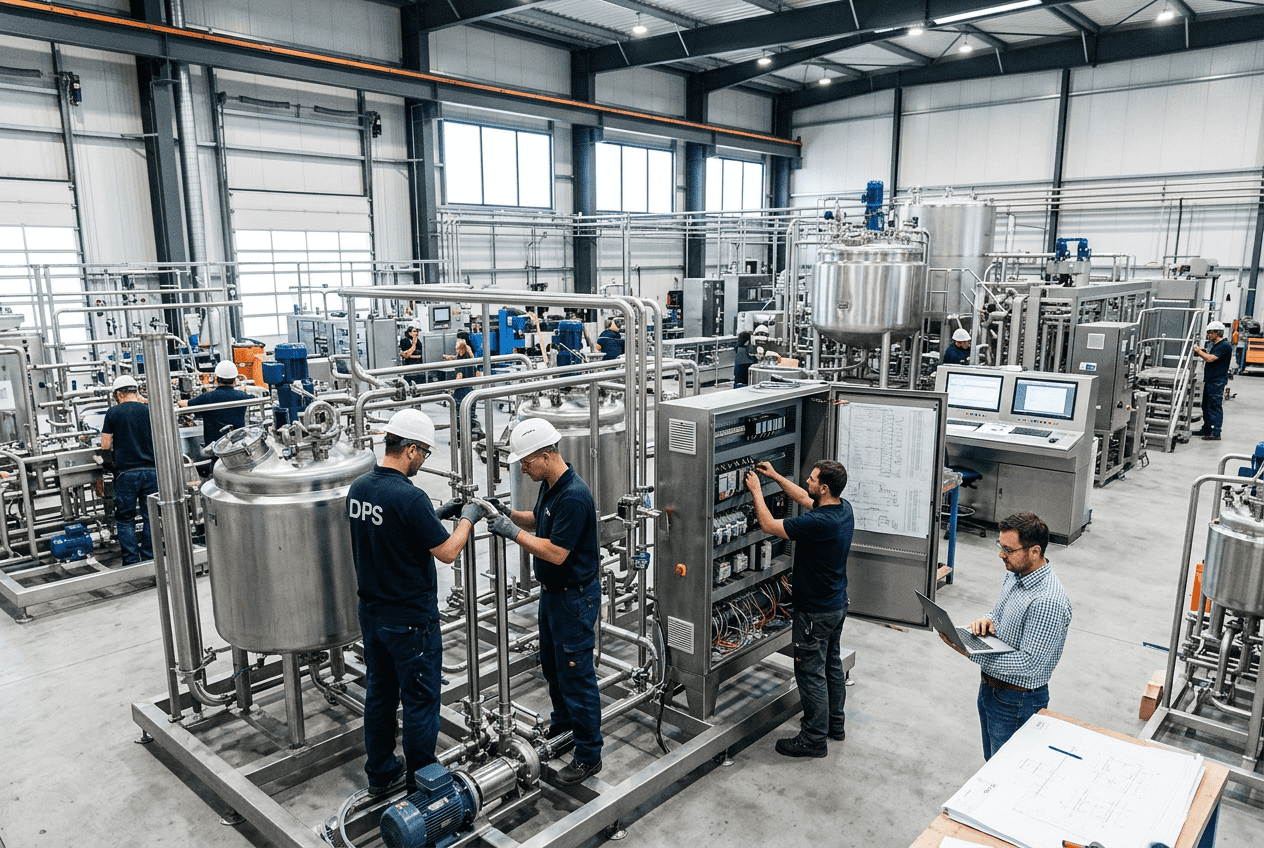
Beverage Plant PLC Programming
[trp_language language=”en_US”]
Beverage PLC programming is the control backbone that keeps a modern U.S. beverage plant running at high speed without sacrificing fill accuracy, product quality, sanitation, or packaging consistency. In practice, it connects conveyors, rinsers, rotary fillers, cappers, labelers, case packers, CIP systems, vision inspection, recipe management, and plant data systems into one coordinated operating platform. For manufacturers in markets such as Atlanta, Chicago, Dallas, Los Angeles, Charlotte, and New Jersey logistics corridors, good programming often delivers more throughput from existing assets before a major capital expansion is needed.
For beverage producers, co-packers, and brand owners, the value is straightforward: tighter synchronization, fewer micro-stops, faster changeovers, better reject handling, clearer downtime visibility, and safer cleaning cycles. Whether the line is filling carbonated soft drinks, juices, dairy beverages, RTD cocktails, kombucha, spirits-based canned products, or aseptic drinks, the PLC logic determines how reliably the line performs under pressure.
Quick Answer

If you are asking what beverage plant PLC programming includes, the short answer is this: it is the engineering of machine control logic, motion coordination, safety interlocks, recipe control, process sequencing, line tracking, and plant data communication for beverage production and packaging systems. On high-speed lines in the United States, this usually covers bottle handling, rotary filling, cap application, label verification, reject systems, CIP automation, utility integration, alarms, historian data, and OEE reporting.
The best programming work is not only about making equipment move. It is about making equipment move predictably at scale. A well-programmed line can help a facility in California, Texas, North Carolina, Wisconsin, or Pennsylvania raise output, protect quality, and lower cost per case. In many plants, the true bottleneck is not mechanical nameplate speed but the way the controls are tuned, sequenced, and integrated.
| Function | What It Controls | Plant Benefit |
|---|---|---|
| Conveyor coordination | Infeed, mass flow, accumulation, discharge timing | Fewer jams and smoother bottle flow |
| Filler synchronization | Rotary timing, valve actuation, head control | Stable fill accuracy at high speed |
| Capping and labeling logic | Cap placement, torque checks, label presence and position | Reduced packaging defects |
| CIP automation | Rinse, caustic, acid, sanitize, recovery sequences | Food safety and repeatability |
| Product tracking | Bottle, pack, lot, and reject position tracking | Better traceability and less rework |
| Performance analytics | Downtime, speed loss, reject rates, OEE | Data-driven continuous improvement |
The table above shows why PLC work matters beyond simple machine startup. In beverage operations, control architecture affects sanitation, labor efficiency, utility use, and customer service performance just as much as production speed.
Engineering High-Speed Beverage Production: Precision Meets Throughput

High-speed beverage production is a balancing act between precision and throughput. U.S. plants serving major retail networks through hubs like Savannah, Houston, Long Beach, and the Midwest distribution belt must hit aggressive production targets while still maintaining package quality and regulatory compliance. That requires programming that can manage fast transitions, changing line pressures, multiple SKUs, and operator intervention without destabilizing the process.
Precision in this environment means more than accurate filling. It also means coordinated starts and stops, stable acceleration curves, anti-slosh transfer logic, timing windows for inspection, and repeatable response to faults. Throughput means the line keeps moving, not just in short bursts, but over an entire shift with minimal starved or blocked conditions.
In beverage plants, line performance often depends on how control zones are divided. The depalletizer, empty bottle conveyor, rinser, filler, capper, labeler, packer, palletizer, and utilities must all communicate effectively. If one zone responds too aggressively or too slowly, the effect ripples downstream. Advanced PLC programming solves this with queue management, machine state models, fault recovery routines, and controlled accumulation strategies.
Market demand in the United States continues to support investment in these upgrades. Growth in canned cocktails, functional beverages, premium water, sports drinks, and contract packaging has increased the need for flexible automation that can switch products quickly while preserving uptime.
The line chart reflects a realistic direction for automation investment: steady growth driven by labor constraints, demand for traceability, sustainability targets, and higher packaging complexity. By 2026, many U.S. beverage sites will expect not only fast PLC control but also deeper integration with SCADA, energy monitoring, electronic batch records, and cybersecurity standards.
| Line Type | Typical Speed Range | Main Control Challenge |
|---|---|---|
| Still water PET | 200 to 900 bottles per minute | Mass flow stability and accumulation balance |
| CSD PET | 150 to 800 bottles per minute | Pressure, foam control, and cap timing |
| Hot-fill juice | 100 to 500 bottles per minute | Thermal conditions and container handling |
| Aluminum can RTD | 200 to 1,200 cans per minute | Seamer synchronization and reject precision |
| Dairy beverage | 80 to 400 bottles per minute | Sanitary control and changeover discipline |
| Aseptic beverages | 60 to 300 containers per minute | Sterility assurance and recipe validation |
This range shows why there is no one-size-fits-all controls template. Product characteristics, package format, utility quality, and sanitation regime all influence PLC design decisions.
Bottle Handling Systems: Air Conveyor Pressure and Gentle Product Transport

Bottle handling is often underestimated, yet it strongly influences total line performance. Air conveyors for empty PET bottles, neck handling systems, laning equipment, and accumulation tables must move containers quickly without scuffing, tipping, or generating unstable surges. The PLC typically coordinates blower demand, conveyor zoning, sensor validation, and machine permissives so bottles arrive at the filler consistently.
For lightweight containers, air pressure control is critical. Too little pressure causes starvation; too much creates bottle collisions and fallen containers. Gentle transport requires tuning fan speed, damper positions, conveyor transitions, and back-pressure logic. In U.S. plants running mixed bottle formats for private label and branded products, these settings often need recipe-based automation so operators can switch formats without manual trial and error.
Good programming also accounts for real-world plant conditions: humidity in Gulf Coast facilities, temperature swings in Midwest warehouses, or compressed air variability in older buildings. Sensors alone do not solve these problems. The control strategy must filter noise, detect unstable flow, and trigger corrections before jams spread to the filler.
| Variable | Purpose | If Set Too Low | If Set Too High |
|---|---|---|---|
| Air conveyor fan speed | Moves empty bottles efficiently | Starvation at the rinser or filler | Bottle instability and scuffing |
| Accumulation release timing | Maintains balanced product flow | Underfeeding downstream machines | Surges and pressure spikes |
| Sensor debounce time | Filters false bottle detections | Nuisance faults | Slow response to actual blockages |
| Zone stop/start delay | Coordinates conveyor sections | Frequent short cycling | Late fault recovery |
| Transfer speed ratio | Matches bottle handoff between machines | Gap formation | Tipping and collisions |
| Back-pressure threshold | Prevents excessive line force | Premature slowdowns | Container deformation or jams |
The explanation here is practical: bottle handling controls are where many “mystery” downtime losses originate. What looks like a filler issue is often a pressure balance or transition tuning issue upstream.
Rotary Filler Programming: Electronic Synchronization of 12-72 Filling Heads
Rotary fillers are the heartbeat of many beverage lines. Programming them requires tight synchronization between turret rotation, infeed timing, valve lift, flow control, snift operations, purge cycles, and container presence verification. Whether a filler has 12 heads on a craft line or 72 heads on a high-capacity commercial line, the control system must keep every station aligned with product and package conditions.
Electronic synchronization replaces much of the guesswork that older mechanical systems relied on. Servo coordination, encoder feedback, phase monitoring, and high-speed I/O allow the PLC and associated motion controllers to react in milliseconds. This matters greatly for carbonated products where pressure management influences foam, fill level, and cap-on-foam performance.
Programming logic also needs recipe intelligence. A juice line, a sports drink line, and an RTD cocktail line may use the same physical filler but require different parameters for fill volumes, purge times, valve timing, and sanitation sequences. A robust control platform stores these values securely, validates access, and logs changes for quality and compliance purposes.
For plants near major co-packing centers such as Dallas-Fort Worth, Indianapolis, or central Florida, filler flexibility can be the difference between winning and losing customer contracts. The more SKUs and container formats a line can run with stable performance, the more commercially valuable the operation becomes.
Capping and Labeling Automation: Vision Integration and Rejection Systems
Capping and labeling are where mechanical movement meets packaging compliance. A bottle can be filled perfectly and still become unsellable if the cap is cross-threaded, the tamper band is damaged, or the label is skewed. PLC programming in this area links torque monitoring, cap chute permissives, no-bottle-no-cap logic, vision systems, and reject devices into a fast and reliable control sequence.
Vision integration is increasingly standard in the United States. Retail requirements and brand expectations demand verification of cap presence, label presence, date code readability, lot code location, and in some cases barcode correctness. The PLC must receive inspection results, track the product position, and activate the proper reject device at exactly the right moment. If that timing slips, good bottles get rejected or bad bottles pass through.
Rejection system design varies by speed and package type. Air blast rejectors may work for lightweight empty containers, but full bottles often require pushers, sweep arms, drop gates, or diverters. The logic must include reject confirmation, bin full alarms, and escalation handling if rejected product fails to leave the conveyor.
The bar chart highlights where demand is strongest for advanced packaging inspection. RTD alcohol and functional beverages often lead because packaging variation, premium branding, and regulatory scrutiny tend to be higher.
| Inspection Point | Detection Method | Typical PLC Action |
|---|---|---|
| Cap presence | Vision or photoelectric | Reject bottle and log event |
| Cap torque fault | Torque feedback integration | Stop line or divert product |
| Label missing | Vision camera | Track and reject at station |
| Label skew or wrinkle | Vision measurement | Reject and alarm if rate rises |
| Date code unreadable | OCR/OCV camera | Reject and notify operator |
| Wrong barcode or SKU | Barcode scanner | Reject, hold lot, trigger investigation |
This packaging control layer directly supports brand protection, customer compliance, and waste reduction. It is one of the clearest examples of why controls engineering is a profit driver, not just an engineering cost.
Clean-in-Place (CIP) Sequence Control for Beverage Lines
CIP programming is one of the most important disciplines in beverage automation because it sits at the intersection of food safety, utility cost, uptime, and changeover planning. A CIP system must execute rinse, caustic wash, intermediate rinse, acid cycle when required, sanitize steps, conductivity verification, temperature confirmation, flow validation, and solution recovery with minimal operator error.
In real plants, CIP logic often touches more assets than expected: syrup rooms, blend tanks, fillers, product piping, bright tanks, pasteurizers, valves, and return circuits. Poor sequence control can waste water, overuse chemicals, extend downtime, or create sanitation risk. Strong PLC design uses interlocks, valve proofing, recipe-based paths, alarm priorities, and data logging so each cycle is repeatable and auditable.
This is also where sustainability and 2026 trends become highly relevant. Beverage manufacturers across the United States are being pushed to reduce water intensity, chemical loss, and energy use. Future-ready CIP programs increasingly support conductivity-based recovery, automated setpoint optimization, heat recovery coordination, and detailed reporting for ESG and plant management teams.
| CIP Stage | Main Control Variable | Objective |
|---|---|---|
| Pre-rinse | Flow and time | Remove gross residue before chemicals |
| Caustic wash | Temperature, concentration, return conductivity | Dissolve soils and biofilm risk |
| Intermediate rinse | Conductivity endpoint | Flush chemical carryover |
| Acid wash | Concentration and contact time | Remove mineral scale where needed |
| Final rinse | Water quality and conductivity | Confirm line is chemical free |
| Sanitize | Contact time and concentration | Prepare equipment for production |
The explanation is simple: each stage has a different validation need, and the PLC is what enforces those rules consistently. In regulated and audit-heavy environments, documented CIP execution is as important as the cycle itself.
High-Speed Product Tracking: From Infeed Through Case Packing
High-speed product tracking allows a beverage line to know where each bottle, can, or package is at all times. This starts at infeed and continues through filling, inspection, labeling, coding, packing, and palletization. The faster the line, the more important deterministic tracking becomes. Without it, rejection accuracy falls, traceability becomes weak, and operators spend too much time sorting suspect product.
Tracking can be encoder-based, sensor-based, or hybrid depending on the application. The PLC often manages shift registers, product maps, queue models, and batch identifiers while passing lot and production data to SCADA or MES layers. This is especially valuable in co-packing facilities handling frequent SKU changes and retailer-specific date coding requirements.
Plants serving national distribution through Memphis, Kansas City, Columbus, or the Port of New York and New Jersey often need robust line tracking because shipping errors become expensive quickly. If a wrong-code event occurs, accurate package tracking reduces the hold scope and limits waste.
The area chart shows the ongoing shift toward automated digital tracking. By 2026, more beverage producers are expected to integrate line-level tracking with case coding, warehouse systems, and quality data, creating stronger recall readiness and less manual paperwork.
OEE Optimization Strategies for Beverage Production Lines
OEE improvement is one of the strongest business reasons to invest in beverage PLC programming. Availability suffers when faults are unclear or recovery routines are weak. Performance suffers when machine handoffs are poorly tuned. Quality suffers when reject timing, fill control, or package inspection is unreliable. Controls engineers improve all three.
Effective OEE strategies start with data structure. Downtime states must be meaningful, not generic. Micro-stops should be captured separately from major faults. Speed losses should be tied to machine states and operator actions. The PLC should tag events cleanly so dashboards and reports tell the truth instead of just generating noise.
Second, OEE gains come from root-cause-oriented logic changes. Common examples include smarter permissives, reduced false trips, better starved/blocked balancing, controlled restart sequences, predictive maintenance alerts, and alarm rationalization. Sometimes the best gain comes from small programming changes rather than a new machine purchase.
This is where engineering judgment matters. In many facilities, operators have adapted to old logic quirks and manual workarounds. A capable controls team can eliminate these hidden losses systematically and measurably.
| Loss Category | Typical Symptom | PLC Improvement Action |
|---|---|---|
| Availability loss | Frequent nuisance trips | Alarm filtering and better fault hierarchy |
| Availability loss | Long restart times after stops | Automated recovery sequences |
| Performance loss | Micro-stops in conveyor zones | Zone timing and accumulation tuning |
| Performance loss | Filler not reaching target speed | Synchronization and infeed balancing |
| Quality loss | High reject rate at labeler | Tracking accuracy and inspection integration |
| Quality loss | Inconsistent fill volume | Valve timing and recipe optimization |
The explanation behind this table is that OEE is not improved by one dashboard alone. It improves when the PLC logic, machine settings, operator workflows, and maintenance priorities are aligned.
Career Opportunities and Industry Demand in Beverage PLC Programming
Demand for beverage PLC programmers in the United States remains strong because plants need people who understand both controls and process reality. This is not generic factory automation. Beverage systems combine sanitation, utility management, package handling, food safety, motion control, and production economics in a way that requires specialized experience.
Career opportunities exist with OEMs, integrators, engineering firms, plant operators, and large consumer packaged goods companies. Roles often include controls engineer, automation engineer, commissioning specialist, SCADA developer, systems integrator, plant controls manager, and technical project lead. Regions with consistent demand include the Southeast, Midwest, Texas, California, and major beverage distribution corridors.
For companies hiring, the challenge is not just finding programmers who know ladder logic or structured text. The best talent understands fillers, pasteurization, batching, CIP, packaging inspection, and line balancing. They can start up equipment, troubleshoot under pressure, speak with operators, and tie plant-floor work back to commercial outcomes.
The comparison chart illustrates a common buying reality: a general automation vendor may be technically capable, but a beverage-focused team usually performs better where sanitation, filler dynamics, packaging logic, and commissioning speed matter most.
Buying Advice for U.S. Beverage Manufacturers
When selecting a PLC programming partner, look beyond hourly rates. Ask how they handle line integration, sanitation validation, FAT/SAT support, on-site startup, recipe governance, change control, cybersecurity, and post-launch optimization. Ask for experience with beverage-specific assets such as syrup rooms, blending systems, carbonation loops, tunnel pasteurizers, bright tanks, canning systems, and sanitary CIP skids.
Also evaluate whether the provider can support your geography. Plants with multiple sites across the United States benefit from a partner that can respond in North Carolina, California, Texas, Illinois, or Ontario without rebuilding the support model each time.
| Selection Factor | Why It Matters | What to Ask |
|---|---|---|
| Beverage process knowledge | Reduces learning curve and startup risk | Have you programmed fillers, CIP, batching, or pasteurization? |
| Packaging integration experience | Improves line synchronization | Can you integrate vision, reject systems, and case packing? |
| Nationwide execution ability | Supports multi-site projects | Can you deploy across the U.S. and Canada? |
| Data and OEE capability | Turns controls into measurable value | How do you structure downtime and performance data? |
| Sanitary design awareness | Protects food safety and compliance | How do you validate CIP sequences and valve proofing? |
| Commissioning support | Determines launch success | Who stays on site through startup and ramp-up? |
This checklist helps buyers compare vendors based on outcomes instead of just proposal language.
Industries and Applications Served
Beverage PLC programming supports a wide range of industries and applications, including carbonated soft drinks, bottled water, dairy beverages, kombucha, energy drinks, juices, functional beverages, craft beer packaging, wine bottling, spirits, RTD canned cocktails, aseptic filling, and co-packing operations. The application range extends from syrup preparation and blending to final palletizing and warehouse interface.
Plants often need controls that bridge utilities and process. A filler cannot run reliably if compressed air, glycol, RO water, or steam systems are unstable. That is why experienced integrators treat utilities, process, and packaging as one operating system rather than isolated projects.
Case Study Perspective
In real projects, programming improvements can unlock more value than expected. Some beverage clients prepare for multimillion-dollar capacity expansions only to discover that the line’s biggest limit is sequencing, not steel. In those cases, retuning and reprogramming can produce significant throughput gains at a fraction of the cost of new equipment. For examples of capital project execution and practical results, manufacturers often review an integrator’s project case studies before starting a controls upgrade.
Local Supplier and Integrator Landscape
In the United States, local controls support can come from OEM technicians, regional integrators, electrical contractors, and specialized food-and-beverage engineering firms. The strongest option for larger projects is often a partner that combines local field execution with national process expertise. That matters in beverage hubs such as North Carolina, Southern California, Texas, Georgia, and the Chicago area, where projects may involve both immediate troubleshooting and long-term expansion planning.
Our Company
Disruptive Process Solutions supports food and beverage manufacturers across the United States and Canada with a business-first engineering approach. Rather than treating automation as a standalone trade, the company ties controls decisions directly to throughput, profitability, sanitation, and capital efficiency. Manufacturers can learn more about the firm’s background on the about page.
From a technological capability standpoint, DPS works across process, controls, utilities, and data systems. That includes PLC programming, automation integration, SCADA, batching logic, sanitary process control, recipe management, and coordination of systems such as carbonation, blending, filtration, aseptic operations, and water treatment. This cross-functional depth is especially useful when line performance depends on interactions between packaging equipment and upstream process assets.
From a manufacturing capability standpoint, DPS supports complete beverage and food system execution, including processing tanks, CIP systems, utility integration, and custom equipment solutions. The company also provides proprietary equipment in areas such as tanks and CIP packages, which can be explored through its equipment capabilities. For beverage manufacturers, that means controls work can align closely with the actual hardware being installed and commissioned.
From a service capability standpoint, DPS operates with an end-to-end model that covers engineering, installation oversight, integration, project management, startup, and owner-focused execution. Its support spans process design, capital planning, turnkey installation, and controls optimization across project sizes. Companies evaluating a broader automation and facility strategy can review these offerings on the services page. This integrated model is particularly helpful for co-packers and multi-line manufacturers that need one partner to connect business goals with field execution.
For U.S. beverage producers, this combination of technological, manufacturing, and service capability matters because line performance is rarely just a coding issue. It is usually the result of how engineering, equipment, utilities, and project execution fit together.
FAQ
What does a beverage PLC programmer actually do?
A beverage PLC programmer develops and maintains the control logic for processing and packaging systems such as fillers, conveyors, CIP skids, cappers, labelers, batch systems, and utility interfaces. The role also includes troubleshooting, startup support, optimization, and data integration.
Can PLC programming increase line speed without new equipment?
Yes. In many cases, better synchronization, improved line balancing, reduced nuisance faults, and cleaner changeover logic can unlock meaningful throughput gains from existing equipment.
Which beverage segments need the most advanced automation?
High-speed carbonated lines, RTD alcohol, functional beverages, aseptic products, and co-packing operations often need the most advanced controls because they combine high SKU count, strict packaging requirements, and demanding sanitation expectations.
How important is CIP programming?
It is critical. CIP programming affects food safety, downtime, water use, chemical consumption, and audit readiness. Weak CIP control can create both sanitation risk and unnecessary operating cost.
What should U.S. plants ask before hiring an integrator?
Ask about beverage-specific experience, nationwide field support, startup capability, OEE reporting structure, sanitary process knowledge, vision system integration, and long-term service responsiveness.
How does PLC programming support traceability?
It tracks products, rejects, lot codes, and machine states from infeed through case packing. When integrated with SCADA or MES, it supports faster investigations and better recall readiness.
What are the biggest 2026 trends in beverage automation?
The major trends are stronger digital traceability, water- and energy-efficient CIP control, more vision inspection, increased recipe and SKU flexibility, cyber-secure remote support, and greater use of production data for continuous improvement.
Is this relevant only for large beverage plants?
No. Small and mid-sized plants also benefit, especially when labor is tight, SKU complexity is increasing, or growth plans require better uptime before adding new equipment.
In the United States beverage market, PLC programming has moved from a support function to a strategic capability. It improves reliability, raises throughput, strengthens sanitation, and helps manufacturers scale intelligently. For producers planning a new line, upgrading a legacy system, or trying to solve a stubborn bottleneck, the right controls strategy can create measurable value faster than many capital-intensive alternatives.
[/trp_language]
Complete Company Portfolio

About the Author: Disruptive Process Solutions (DPS)
The DPS team combines process engineering expertise with real-world food and beverage manufacturing experience. Our content focuses on process optimization, production efficiency, facility improvements, and practical solutions that help manufacturers operate more effectively in a rapidly evolving industry.
Share

